Your Next Brand Style Guide Template
Stop guessing and start building a consistent brand. Use our proven brand style guide template to define your visuals, voice, and strategy with confidence.
A brand style guide template is essentially a pre-built, editable framework that helps you define and lock down your company's entire look and feel. Think of it as the ultimate rulebook for your brand, making sure everything from your logo placement to your social media voice is consistent, no matter where it shows up.
Why a Style Guide Is Your Brand’s Secret Weapon
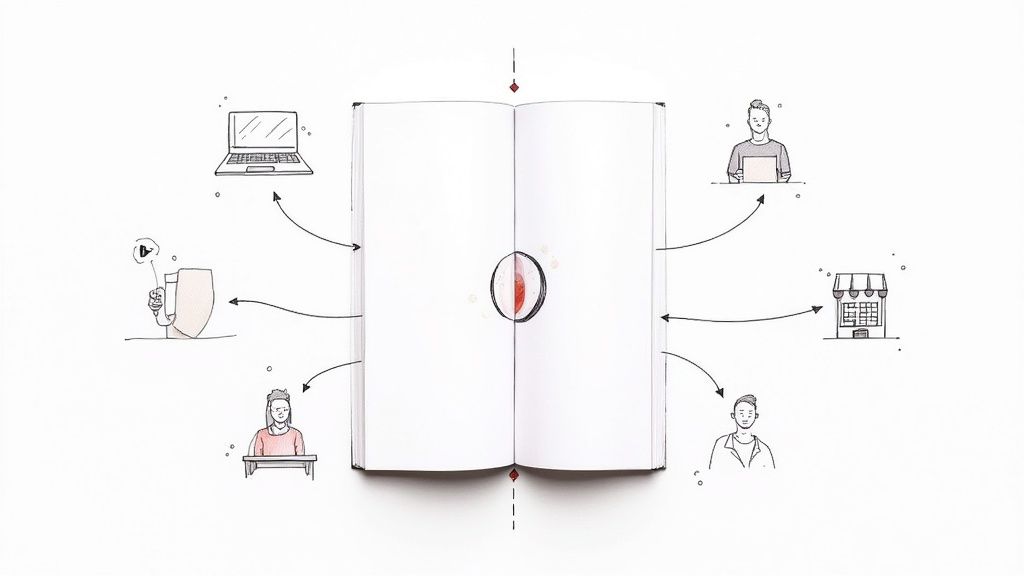
Let’s be honest: brand consistency isn't just a "nice-to-have" for designers; it's a critical business function. With so many different places for your brand to appear online and offline, a style guide acts as the single source of truth that keeps everyone on the same page and your message sharp. It’s what turns abstract brand concepts into concrete, actionable rules.
This document is so much more than a collection of logos and color codes. It becomes a strategic asset that helps get projects out the door faster, prevents expensive redesigns, and ensures every single piece of content feels deliberate and professional. It’s the key difference between a brand that looks put-together and one that just feels… messy.
What’s Inside Your Brand Style Guide Template
Here’s a quick look at the core components our guide will help you build, and why each one is critical for your brand's success.
| Section | Its Core Purpose |
|---|---|
| Brand Story & Mission | Defines who you are and why you exist, grounding all your visual and verbal choices in purpose. |
| Logo Usage | Establishes strict rules for your most recognizable asset, preventing distortion, misuse, or inconsistency. |
| Color Palette | Outlines your primary, secondary, and accent colors to create a consistent and emotionally resonant visual identity. |
| Typography | Sets your brand's typographic hierarchy (headings, body text, etc.) to ensure readability and a cohesive voice. |
| Tone of Voice | Guides how you communicate, defining the personality and language your team should use across all channels. |
| Imagery & Iconography | Provides direction on the style of photos, illustrations, and icons that align with your brand's aesthetic. |
Each of these pieces works together to form a complete, easy-to-follow playbook for anyone creating content on your brand's behalf.
The Real-World Impact of Brand Consistency
A unified brand presence has a direct, measurable effect on your reputation and your revenue. When your audience sees the same colors, fonts, and tone of voice everywhere they interact with you, they start to build a real connection. That familiarity is what builds trust and makes you instantly recognizable.
It’s no surprise that organizations with clear, well-defined brand guidelines are often seen as more trustworthy and professional. Consistency isn’t just about looking good—it's about building an unshakeable foundation of credibility with your customers.
A brand style guide empowers your team—whether they're in-house, remote, or freelance—to execute flawlessly without constant supervision. It’s the ultimate tool for scaling quality and maintaining integrity.
Driving Business Growth and Team Efficiency
The benefits ripple through your internal operations, too. A solid guide removes the guesswork, which means fewer back-and-forth revisions and faster content creation. Instead of your team asking, "Which blue is our blue?" for the tenth time, they can focus on what really matters: getting great work done. This efficiency directly impacts your bottom line.
In fact, the connection between structured branding and financial health is well-established. Studies show that companies with comprehensive brand style guides can see a significant uptick in revenue compared to those flying by the seat of their pants. For a deeper dive into the numbers, check out the full research on brand identity guidelines.
Ultimately, a brand style guide template is your launchpad for creating this powerful asset. It gives you the structure, and you bring the personality, turning a simple document into the backbone of your brand's success.
Building Your Brand's Strategic Foundation
Before you even touch a color palette or scroll through a font library, you have to give your brand a soul. This strategic groundwork is the most critical piece of your entire brand style guide template. It’s what separates a memorable brand from a forgettable one.
This isn't about slapping together some corporate-speak that sounds impressive. It's about nailing down the "why" that fuels every decision you'll make. Get this part right, and your design choices stop being just pretty decorations—they become powerful, meaningful expressions of who you are.
Defining Your Mission Statement
Your mission statement is your reason for existing, plain and simple. It answers the one question that matters most: Why does this company exist? A truly great mission is short, sharp, and focused on the real value you bring to people, not just on the thing you sell.
Think of it as your North Star. A mission isn't "to sell eco-friendly water bottles." That's what you do. The real mission is something like, "to make sustainable hydration accessible to everyone, reducing single-use plastic waste." See the difference? One is a product, the other is a purpose.
To get to your own, start asking the hard questions:
- What problem are we genuinely solving for our customers?
- Who are we here to help, and what lasting impact do we want to have?
- Beyond making money, what is our fundamental purpose?
This statement will be the anchor for your brand’s voice, ensuring everything you say and do connects back to your core reason for being.
Your mission isn't what you do—it's why you do it. This single sentence is the foundation upon which your entire brand identity is built, giving meaning to every color, font, and word you choose.
Articulating a Clear Vision
If the mission is your "why," then the vision is your "where." Your vision statement paints a picture of the future you're working tirelessly to create. It needs to be ambitious, maybe even a little audacious, giving your team and your customers a clear destination to rally behind.
A good vision statement should feel just a little out of reach, but not so far-fetched that it's unbelievable. It's the ultimate summit you're climbing. For a small software startup, that vision might be "a world where any small business can compete with a global enterprise." It’s big, bold, and inspiring.
This isn’t a five-year business plan loaded with spreadsheets and KPIs. It’s a declaration of your ideal future, a guiding light that keeps the whole company pointed in the same direction as you grow.
Establishing Authentic Core Values
Finally, your core values are the DNA of your brand's behavior. These are the non-negotiable principles that shape your culture and define every single customer interaction. But please, steer clear of generic words like "integrity" or "innovation" unless you're ready to back them up with specific, real-world actions.
For example, instead of just "Excellence," you could try "Relentless Improvement." That’s a value you can act on—it means constantly seeking feedback and making things better. Instead of "Customer-Focused," go for "Customer Obsessed," which means you’re always trying to anticipate what your customers need before they even ask.
Make sure your core values are:
- Memorable: Can your team recite them?
- Actionable: Do they translate into day-to-day behaviors?
- Unique: Do they feel like you, or could they be for any company?
These values are what give your brand its personality. They're the reason your brand voice might be witty and clever instead of formal and serious. By cementing these foundational elements in your style guide, you’re making sure every choice that follows is not just consistent, but also genuinely meaningful.
Defining Your Visual Identity
Okay, this is where your brand stops being an abstract idea and starts showing up in the real world. You’ve already done the hard work of nailing down your mission, vision, and values. Now, it's time to give that purpose a face—a consistent visual language that people can instantly recognize.
Think of your visual identity as a shorthand for who you are. It's not just about making things look pretty. Every single element, from the logo to the color choices, needs to feel like a genuine extension of your brand’s personality. These are the building blocks that make sure every ad, social post, and business card all work together to build that all-important recognition and trust.
Mastering Your Logo Usage
Your logo is the most concentrated shot of your brand. It’s the face everyone will come to know, so how you use it has to be absolutely consistent. This section of your brand style guide template isn’t about stifling creativity; it’s about protecting your most valuable visual asset from the little mistakes that can seriously weaken its power.
First, lock in your primary logo. This is your default, the one you'll use 90% of the time. From there, think about practical variations. You’ll probably need a stacked version for square spaces (like social media profiles), a horizontal one for website headers, and simple monochrome versions for situations where color just isn't an option.
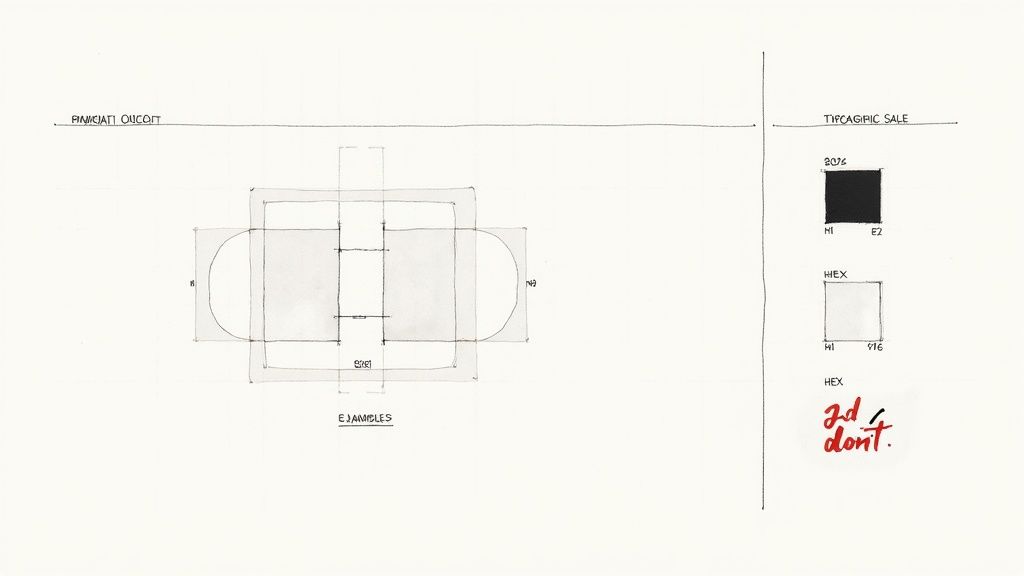
Next up is clear space—and it’s a non-negotiable rule. This is the "exclusion zone," or the minimum amount of breathing room you must always leave around the logo. It keeps it from getting lost in a sea of other text or graphics. A great way to define this is to use a part of the logo itself, like the height of the main letter, as your unit of measurement for the buffer.
Most importantly, you have to show people what not to do. Visuals are your best friend here. Create a simple "Don'ts" section that clearly illustrates the cardinal sins of logo usage:
- Stretching or squishing the logo.
- Changing the colors to anything not in the official palette.
- Slapping it on a busy background where it becomes unreadable.
- Adding cheesy effects like drop shadows.
- Rearranging or taking apart the logo elements.
These rules are your defense against the small, seemingly harmless tweaks that, over time, completely erode brand recognition.
Establishing a Clear Typographic Hierarchy
If your brand had a voice, typography would be it. The fonts you choose—and how you use them—can instantly make your brand feel modern and sleek, classic and trustworthy, or fun and energetic. Getting this right is crucial for readability and creating a unified feel everywhere your brand shows up.
A solid typography system is all about hierarchy. You need to assign clear jobs to your different typefaces, weights, and sizes. Your brand style guide template should lay this out so clearly that anyone, from a designer to an intern, can get it right every time.
A good starting point is to pick a primary and a secondary typeface. The primary is usually for your big, attention-grabbing headlines, while the secondary handles the body text and needs to be super readable.
Here’s a practical way to structure it in your guide:
- H1 (Primary Headline): Your biggest, boldest text for main page titles.
- H2 (Secondary Headline): Perfect for section titles on a webpage or in a report.
- H3 (Tertiary Headline): Used for breaking up smaller chunks of content.
- Body Copy: The workhorse. This is your standard paragraph text, so optimize it for readability.
- Captions & Labels: Smaller text for things like image descriptions or form fields.
For each of these, spell out the font family (e.g., Montserrat), weight (e.g., Bold, Regular), size (e.g., 48px, 16px), and line spacing. This level of detail removes all the guesswork and ensures a blog post has the same visual flow as a printed flyer.
A well-defined typography system doesn't just make content look good; it makes it easier to understand. By creating a clear visual order, you guide the reader's eye, helping them process information quickly and efficiently.
Building Your Core Color Palette
Color hits us on an emotional level. It's often the first thing someone notices about your brand and can instantly communicate a feeling—think calming blues or energetic oranges. A well-defined color palette ensures you’re using this powerful tool consistently to build a memorable identity.
The goal is a palette that's both unique and practical. It should be anchored by a few core colors and supported by shades that give you flexibility. In your guide, it helps to break the palette down into distinct roles.
1. Primary Colors These are your brand's signature colors, the ones you'll use most often. Usually, this is just one to three colors that are pulled directly from your logo and are central to your overall look.
2. Secondary Colors These are the supporting actors. They complement your primary colors and are used for less critical elements like subheadings, quote boxes, or subtle background textures. They add visual depth without stealing the show.
3. Accent Colors Think of these as your highlighters. You’ll use them sparingly to make important things pop—like a "Buy Now" button, a special offer, or a hyperlink. An accent color should be bright and have high contrast to grab attention.
For every single color, you have to provide the specific codes for print and digital. This is how you achieve true consistency.
| Color Use | HEX | RGB | CMYK |
|---|---|---|---|
| Primary Blue | #005A9C | 0, 90, 156 | 100, 42, 0, 39 |
| Secondary Gray | #F0F2F5 | 240, 242, 245 | 2, 1, 0, 4 |
| Accent Orange | #FF7A00 | 255, 122, 0 | 0, 52, 100, 0 |
Providing these values ensures your brand's signature blue looks identical on a website (HEX, RGB) and on a printed business card (CMYK). This kind of detail is what separates the pros from the amateurs. If you want to dig deeper into the strategy behind these choices, check out these resources on understanding brand identity. The payoff for this structured approach is real, too. One study found that brands using templates to enforce consistency saw a 35% higher engagement rate on social media. It’s proof that a coherent identity truly connects with people.
Your Brand Voice: More Than Just Words
Logos and color palettes are crucial, but how your brand sounds is what truly builds a connection. Your brand voice is the personality that comes through in every email, social post, and landing page. It’s what turns a passive audience into an active community. Nailing this down in your brand style guide template is one of the most important things you can do for consistency.
A lot of people get voice and tone mixed up, but the difference is simple.
Think of it this way: voice is your brand's unchanging personality. It’s the core of who you are. Are you the witty expert, the encouraging mentor, or the rebellious innovator? That doesn't change based on who you're talking to.
Tone, however, is the emotional flavor you add to that voice for different situations. You wouldn't talk to a frustrated customer the same way you’d announce a new product. The voice stays the same, but the tone shifts—from a supportive social media reply to a formal press release.
Putting a Finger on Your Voice
The biggest mistake I see is teams settling for vague descriptions like "friendly" or "professional." These words are too broad; "friendly" means something different to everyone. You have to dig deeper and get specific.
The trick is to establish clear principles that guide your writers and give them boundaries.
Start by picking 3 to 5 core characteristics that define your voice. Then, for each one, use a simple “We are X, but not Y” framework to give it real meaning. It's a game-changer.
- Insightful, but not preachy. We share what we know to empower people, not to lecture them.
- Witty, but not silly. We love a clever line, but we never let a joke get in the way of clarity.
- Confident, but not arrogant. We speak from a place of expertise, but we're always approachable and open to conversation.
This simple exercise gives your team a practical filter. Before they hit publish, they can ask themselves, "Does this sound more preachy than insightful?" Suddenly, a fuzzy idea becomes a concrete, daily check.
Your brand voice isn't just about the words you choose; it's about how you make people feel. It's the consistent personality that turns a one-time buyer into a loyal advocate who truly believes in what you're saying.
Give Your Team Tools, Not Just Rules
Once you've defined your voice, you need to make it easy for everyone—from the marketing team to customer support—to put it into practice. The voice section of your style guide should be a practical playbook, not a boring academic paper.
One of the most effective tools is a simple "Words to Use / Words to Avoid" list. This isn't about banning words. It's about gently guiding word choices to reinforce the personality you're trying to build.
| Use These Words | Avoid These Words | Why It Matters |
|---|---|---|
| Collaborate, Partner | Utilize, Leverage | "Collaborate" feels human and equal. "Utilize" is cold corporate jargon. |
| Simple, Straightforward | Easy-peasy, Seamless | "Simple" is professional and clear. "Easy-peasy" can come across as childish. |
| Team, Crew | Staff, Employees | "Team" fosters a sense of shared purpose and community. |
Don't Forget the Nuts and Bolts
Consistency goes all the way down to the small stuff, like grammar and punctuation. Making deliberate choices here prevents your communications from feeling messy or inconsistent.
Here are a few key areas to nail down in your style guide:
- The Oxford Comma: Are you in or are you out? Decide whether you’ll write "red, white, and blue" or "red, white and blue." Just pick one and stick to it.
- Headline Capitalization: Do you prefer Title Case (Capitalizing Most Words in a Headline) or Sentence case (Only capitalizing the first word)?
- Acronyms: Set a rule for whether you need to spell out an acronym on its first use, like "Search Engine Optimization (SEO)."
- Contractions: Decide if you’ll use contractions like "we’re" and "it's." Using them makes you sound more conversational and human. Avoiding them feels much more formal.
By getting these guidelines into your brand style guide template, you're not just creating rules. You’re empowering every single person on your team to become a true guardian of your brand's voice.
Getting Your Brand Style Guide Off the Shelf and Into the Wild
Let's be honest, a beautifully designed brand style guide is completely useless if it just gathers dust in a forgotten folder. The real work begins when you turn that document into a living, breathing part of your company’s DNA. This is where you make brand consistency an effortless habit for everyone, not just another rule to follow.
The whole point is to weave these guidelines into your daily workflow so deeply that they become second nature. You're giving your entire team—from marketing and sales to product and HR—the confidence to make on-brand decisions quickly and without a second thought.
Launching Your Guide Internally
How you roll out your guide internally is everything. Don’t just fire off a mass email with a link and cross your fingers. You’ve got to treat this like a real product launch, because that's what it is. Your mission is to build genuine excitement and get buy-in from every department.
A great way to kick things off is with a company-wide meeting or a few team-specific workshops. As you walk everyone through the guide, focus on the "why" behind the rules, not just the "what."
- For the sales team: Show them how using the right proposal template and consistent messaging actually builds trust and helps close deals faster.
- For the marketing team: Demonstrate how the new voice and visual guidelines will make their campaigns feel more connected and hit harder.
- For developers: Explain how the defined UI components and color codes will speed up their work and create a much more polished user experience.
When people see how the guide makes their jobs easier and their work better, they'll actually want to use it. It stops being a restrictive rulebook and becomes a tool that helps them win.
A brand style guide isn’t a set of rules meant to stifle creativity. It's a framework designed to channel it. By handling the foundational decisions, it frees up your team's mental energy to focus on innovation and execution.
This process is all about taking your core brand voice, adapting it with the right tone for the situation, and then applying the clear rules you've set out.
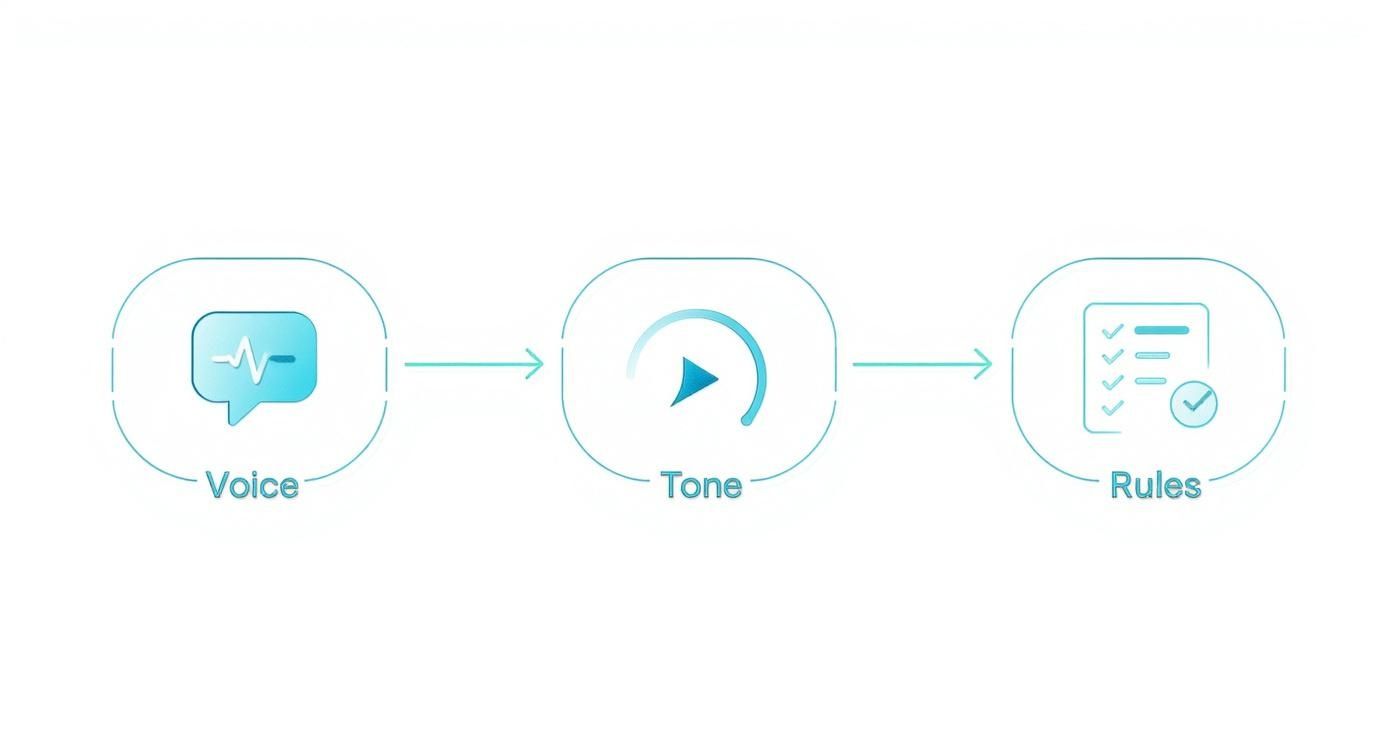
As the diagram shows, your brand's core voice never changes, but it's expressed through a situational tone that's governed by the practical rules in your guide.
Onboarding New Hires and Partners
Your style guide should be a day-one resource for every new employee and external partner, whether they're a freelancer or a new agency. It's the absolute fastest way to get them up to speed on who you are and how you talk to the world.
Make reviewing the guide a non-negotiable part of their first-week checklist. Even better, run a quick, engaging training session on it. This ensures everyone is creating on-brand work from the get-go, which drastically cuts down on endless and frustrating revisions later.
The time savings here are no joke. Research has shown that 60% of global organizations reported that using a brand style guide template cut the time spent on brand training by up to 50%. You can check out Rewritify's breakdown of the findings to dig deeper into these efficiency gains.
Creating Quick-Reference Checklists
A comprehensive 50-page guide is essential for detail, but nobody's going to pull it up to check a social media post. The key to daily use is to break your guide down into simple, actionable checklists for specific tasks.
Think of them as one-pagers or digital templates that turn dense rules into scannable to-do lists.
Here are a few ideas to get you started:
- Social Media Post Checklist: Does the image fit our visual style? Is the caption's tone on point? Is the logo used correctly in the video?
- Blog Post Checklist: Is the headline in Title Case? Are the H2s and H3s formatted properly? Does our brand voice really come through?
- Sales Deck Checklist: Are the brand colors and fonts right? Is this the most current company boilerplate? Does the logo have enough breathing room?
These little checklists are the bridge between your in-depth guide and the fast pace of daily work. They empower your team to check their own work, ensuring a high level of consistency without creating bottlenecks or slowing everyone down. This makes brand governance a shared responsibility, not just one person's headache.
Your Brand Style Guide Questions Answered
When you're putting together a brand style guide, a lot of questions pop up. That's totally normal. Getting those answers sorted out early on is the key to creating a guide that people actually use, not one that just gathers dust on a server. Let's tackle some of the most common ones I hear from teams.
One of the first things people ask is how often they should be updating their guide. My advice? Don't think of your brand style guide template as a one-and-done project. It’s a living document. You should plan for a big, formal review at least once a year. It's also a good idea to revisit it anytime there's a major shift in the business, like a new product launch or a pivot in your target audience.
Smaller updates, like adding fresh photography examples or tweaking a rule about tone, should happen whenever they're needed. The whole point is to keep the guide relevant and genuinely useful for what your brand looks like today.
Clarifying Key Concepts
I've noticed people tend to use "brand book" and "style guide" as if they're the same thing, but there's a subtle and important difference.
A brand style guide is your practical, day-to-day playbook. It's the "how-to" manual, giving you the specific rules for your logo, color palette, fonts, and voice. Think of it as the tactical tool your team uses to create things.
A brand book is the "why." It's more of a big-picture, strategic document. It tells your company's story—its mission, vision, values, and the people you're trying to reach. While it often contains the style guide, its main job is to define the soul of the brand.
If you're just starting out, a solid style guide is what you need to focus on first. If you need some inspiration, checking out these 12 best brand style guide template resources can give you a great starting point.
Will a Style Guide Restrict Creativity?
This is a big one. There’s a persistent fear that putting rules in place will box everyone in and kill creativity. I've found the opposite is true. A good style guide doesn't stifle creativity; it focuses it.
By setting clear boundaries for the foundational elements—like which logo variation or color hex code to use—it frees your team from repeatedly making the same small, tedious decisions. This allows them to focus their valuable creative energy on what truly matters: crafting a compelling message and executing it beautifully.
Instead of wasting time and energy debating the basics over and over, your team gets to innovate within a polished, professional framework. This structure actually empowers them to do more creative and impactful work. For more on building a strong content foundation, you can find some great advice on the Rewritify blog. Ultimately, the guide becomes a tool that helps everyone be more consistent and more creative.
Ready to create perfectly on-brand content every time? Rewritify helps you rewrite and refine your text to match your brand’s unique voice, ensuring every blog post, email, and report is clear, consistent, and compelling. Get started today at https://www.rewritify.com.
Relevant articles
Discover how mastering the tone of voice in writing can build trust and connect with your audience. Learn to define and adapt your brand voice with our guide.