Mastering Tone of Voice in Writing for a Stronger Brand
Discover how mastering the tone of voice in writing can build trust and connect with your audience. Learn to define and adapt your brand voice with our guide.
Your tone of voice is the personality that shines through your writing. It’s not about what you say, but how you say it—the feeling, attitude, and emotion your words create. Nail this, and you’ve got content that truly connects. Flub it, and you're just another voice in the noise.
Why Your Tone of Voice in Writing Shapes Everything
Ever tried to read someone's mood over a text message? It's tough. You're missing the cues—the smile, the eye-roll, the confident posture. In writing, your tone of voice is the digital equivalent of that body language. It fills in the gaps, giving your words the context and personality they need to land properly.
Without a distinct tone, your words are just data—cold and impersonal. But when you consciously shape your tone, those words become a conversation. A consistent, authentic voice turns a faceless brand into a personality people can relate to. That relatability is the bedrock of trust. When your content feels like it was written by a real, dependable human, your audience is far more likely to listen, engage, and stick around.
The Power of a Human Connection
This isn't just about sounding nice; it's smart business. Research from the Nielsen Norman Group shows a direct link between the tone you use and how people perceive your brand.
For example, their study found that a conversational style boosted trustworthiness ratings by a whopping 25% compared to stiff, corporate-speak. Casual tones were also seen as far friendlier, and writing with moderate enthusiasm made a brand 18% more desirable. The data is clear: a more human approach pays off.
Here’s a quick breakdown of how different tones can shape what your users think and feel.
How Different Tones Impact User Perception
This table summarizes key findings from Nielsen Norman Group on how specific writing tones directly affect brand metrics.
| Tone of Voice | Friendliness Score (out of 5) | Impact on Trustworthiness | Impact on Desirability |
|---|---|---|---|
| Corporate/Formal | 2.1 | Baseline | Baseline |
| Casual | 3.8 | Slight increase | Neutral |
| Enthusiastic | 4.2 | Significant increase | +18% increase |
| Conversational | 3.5 | +25% increase | Slight increase |
These numbers tell a powerful story. Simply shifting from a formal to a conversational tone can fundamentally change how trustworthy your audience finds you.
This kind of connection is how you build a memorable brand. Your tone becomes your signature, the thing that makes you instantly recognizable in a crowded market. It ensures that no matter where someone finds you—a blog post, an email, a social media update—they feel like they're talking to the same brand they know and trust.
A well-defined tone of voice does more than just communicate information; it builds a bridge of trust between you and your audience, making every piece of content feel like a genuine interaction.
Ultimately, getting your tone right is a fundamental part of effective communication and one of the most important SEO copywriting best practices for creating content that people actually want to read. It's not a gimmick. It’s how you make your message matter. By choosing how you sound, you get to guide how your audience feels, turning passive readers into a loyal community.
Understanding the Four Dimensions of Tone
Trying to define your brand's tone of voice can feel a bit like trying to catch smoke. It's an abstract feeling, right? To make it concrete and actionable, we can break it down into four key dimensions.
Think of these as mixing sliders on a soundboard. You can adjust each one to find the perfect blend for any piece of writing, giving you a clear, practical language to shape how your words land with your reader. This framework helps you move from a vague goal like "sound friendly" to a specific, repeatable system for all your brand communications.
These dimensions are the building blocks that influence how people perceive your brand—whether they see you as trustworthy, relatable, or desirable.
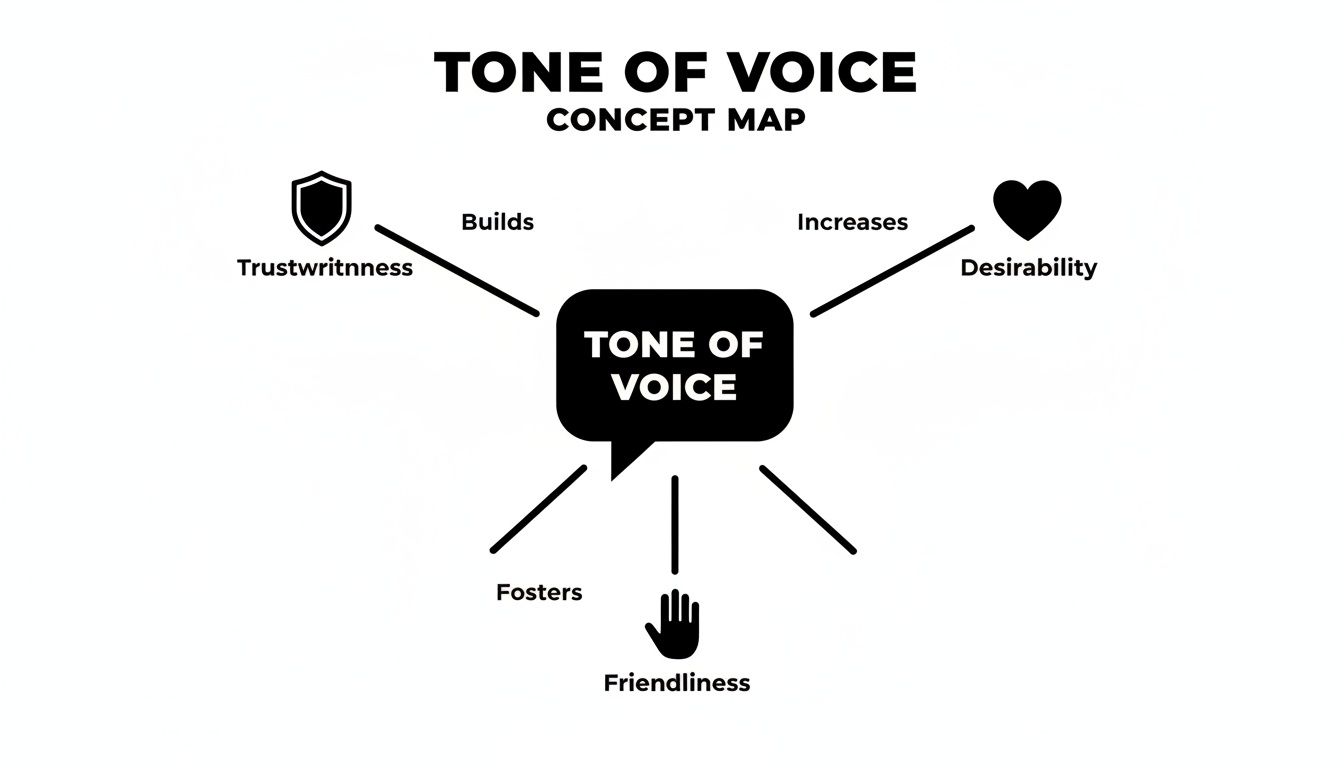
As you can see, tone isn't just window dressing. It's a strategic tool that builds the entire emotional foundation of your brand.
The Formality Spectrum
First up is formality. This is the most fundamental choice, and it runs on a spectrum from casual and chatty to formal and buttoned-up. A formal tone keeps a professional distance. It uses full sentences, steers clear of slang, and sounds more like an academic paper or a legal contract.
A casual tone, on the other hand, feels like you're talking to a friend. It uses simpler language, contractions (like "you're" and "it's"), and maybe even a few well-placed colloquialisms. A bank’s terms and conditions will be intensely formal, but its Twitter feed will almost certainly be casual to connect with customers.
The Humor Spectrum
Next, we have humor. This slider moves from witty and playful all the way to serious and straightforward. Humor is a powerful tool, but it demands you know your audience inside and out. Get it right, and your brand becomes instantly memorable and human. Just look at how brands like Oatly or the Wendy's social media team have built loyal followings with their sharp, irreverent wit.
But humor isn’t always the answer. A serious tone is crucial when the stakes are high. You wouldn’t want your doctor cracking jokes while explaining your test results. In fields like healthcare, finance, or law, a serious tone conveys authority and respect, assuring your audience that you’re taking their needs seriously.
The Enthusiasm Spectrum
The third dimension is enthusiasm, which ranges from passionate and high-energy to matter-of-fact and reserved. An enthusiastic tone is full of life. It uses exclamation points, vibrant language, and an upbeat tempo to get readers excited. It’s perfect for product launches or any content designed to inspire action.
A matter-of-fact tone, however, is calm and measured. It strips away the emotional flair to present information as clearly and objectively as possible. This is the go-to tone for technical guides, scientific reports, or any situation where straightforward clarity trumps excitement.
Choosing your level of enthusiasm is like setting the volume for your writing. Sometimes you need to shout from the rooftops, and other times a quiet, confident statement makes a much bigger impact.
The Respectfulness Spectrum
Finally, there’s respectfulness. This isn't about being polite versus rude; it's about being reverent versus irreverent. A reverent tone shows deep respect for the rules, traditions, and the "way things are done." You’ll see this with luxury brands, universities, and other legacy institutions that want to project an image of prestige and timelessness.
An irreverent tone, however, loves to challenge the status quo. It’s the voice of a disruptor—a brand that isn’t afraid to be bold, cheeky, and poke fun at industry norms. This approach can build a fiercely loyal community, especially with audiences who feel ignored by the more traditional players.
How to Define Your Brand's Unique Tone
Alright, let's get down to business. Moving from the idea of a tone of voice to actually defining it is where the magic happens. This isn't some abstract marketing exercise; it's a practical process of looking at who you are as a brand and who you want to talk to. This is how you build a voice that people instantly recognize as yours.
Think of your brand as a person. Before you can figure out how they talk, you need to know who they are. What do they stand for? How do they treat others? Nailing down these core ideas is the first step to creating a voice that truly connects.
Start with Your Core Values
Every great brand has a backbone—a set of core values that guide every decision. These are your non-negotiables. Your tone of voice is simply these values brought to life through words.
If one of your values is "empowerment," your tone needs to sound encouraging and supportive. If it's "innovation," you'll probably want to sound bold and forward-thinking. Get started by jotting down three to five core values that are genuinely at the heart of your brand.
Here's how that might look:
- Value: Simplicity
- Tone Implication: We use clear, direct, and jargon-free language.
- Value: Integrity
- Tone Implication: Our writing is honest, transparent, and authoritative.
These values become the anchor for everything you write, making sure your communication is always in tune with your brand's soul.
Understand Your Audience Deeply
Who, really, are you talking to? You can’t strike the right tone if you don't have a clue about the people on the other end. The way you’d talk to Gen Z on TikTok is worlds away from how you’d address a group of C-suite executives on LinkedIn.
You have to go deeper than just demographics. Ask yourself:
- What kind of slang or phrasing do they use with their own friends and colleagues?
- What are their real-world problems and biggest goals?
- Whose content do they already follow and trust?
Building out a detailed audience persona makes this whole process much easier. Give this person a name, a job, and a personality. Then, imagine you're writing directly to them—just one person. This simple shift can take your writing from sounding like a corporate broadcast to a genuine conversation.
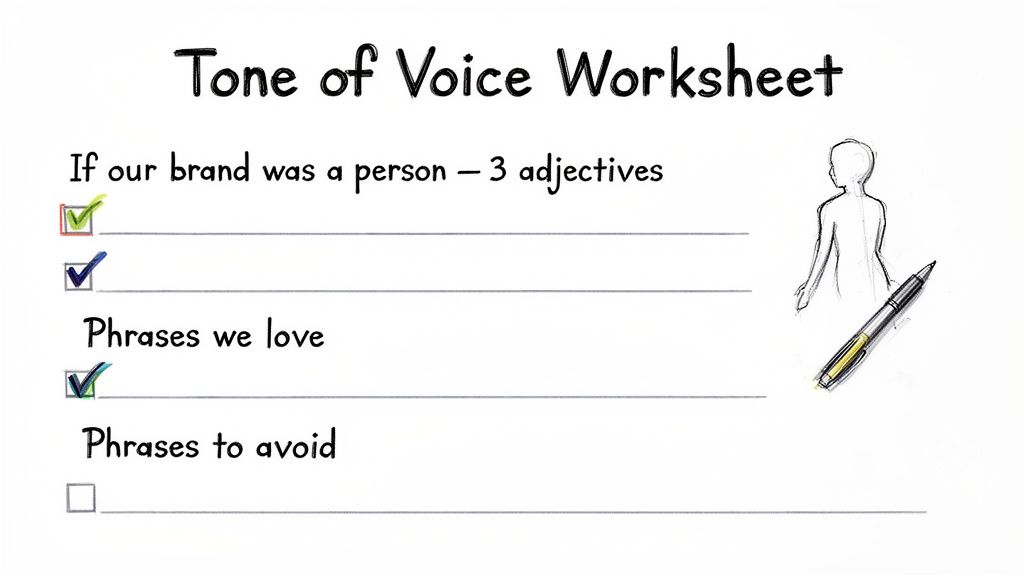
Create Your Tone of Voice Worksheet
Now it's time to get all these ideas down on paper. A tone of voice worksheet is a fantastic tool for turning abstract concepts into concrete guidelines. It’s a simple document that spells out the do's and don'ts for anyone writing on behalf of your brand.
Your tone worksheet isn't just a rulebook. Think of it as a compass for every writer, making sure that no matter who’s at the keyboard, the voice stays consistent and true.
Here are a few key sections to include in your worksheet:
1. Our Brand as a Person: If our brand walked into a room, what three adjectives would describe them? (e.g., Knowledgeable, Witty, Approachable)
2. Our Voice Is... / Our Voice Is Not...: This is a surprisingly powerful exercise.
* We are: Confident, but not arrogant.
* We are: Expert, but not condescending.
* We are: Fun, but not silly.
3. Phrases We Love / Phrases We Avoid:
* Love: "Let's break it down," "Here's the deal," "You've got this."
* Avoid: "Utilize," "In order to," "Synergize."
4. Grammar and Punctuation Rules:
* Do we use the Oxford comma? (A classic debate!)
* Are contractions like "it's" and "you're" okay?
* How do we feel about exclamation points?
This worksheet will become the bedrock of your communication strategy. It’s a living document, so don't be afraid to tweak it as your brand grows. For more ideas, check out our deep dive into creating a full https://www.rewritify.com/blog/brand-style-guide-template that covers tone and much more.
The same way brands define their voice to connect with customers, this process is just as vital when it comes to building a strong personal brand. The core principles of authenticity, knowing your audience, and staying consistent are universal. Deciding how you want to sound is the first step toward actually being heard. Put these steps into action, and you'll craft a tone of voice that doesn't just grab attention—it builds real, lasting relationships.
Adapting Your Tone Without Losing Your Voice
Think of your brand's voice as its core personality—it's who you are, and it doesn't really change. The tone of voice in writing, however, is more like your mood. It shifts depending on the situation.
You wouldn't use the same tone with your best friend that you'd use with a CEO in a boardroom, right? You're still you, but you adapt. The exact same principle applies to how your brand communicates. Your voice provides consistency, but your tone provides context.
This flexibility is what allows you to connect with different people on different platforms. Get it wrong, and your message can feel jarring—way too formal for a fun social media post or far too casual for a serious technical guide.
The Volume Dial Analogy
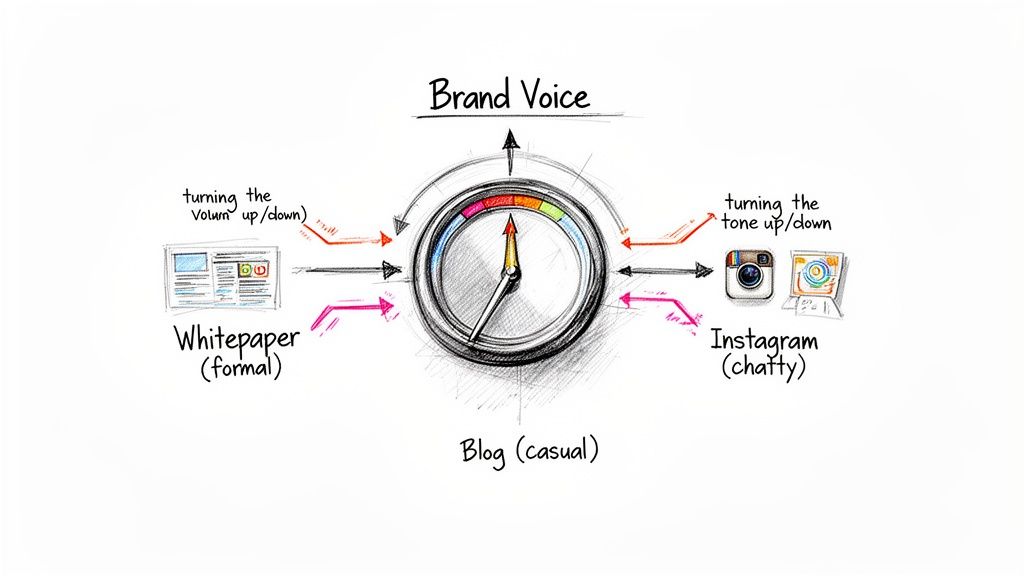
Here’s a helpful way to think about it: imagine your brand voice has a sound mixer with a bunch of different dials. The main "voice" dial is set and rarely moves. But the "tone" dials for things like formality, humor, or enthusiasm can be turned up or down.
- Writing a whitepaper? You’ll want to turn the formality dial way up, keep the humor dial near zero, and set the enthusiasm to a professional, confident hum.
- Posting an Instagram story? Dial the formality way down. Crank up the enthusiasm and maybe add a bit of humor. Keep the language snappy and quick.
This approach isn't about being a different brand in every situation. It’s about being the most effective version of your brand for that specific audience and moment, ensuring you always sound authentic and appropriate.
Putting Tone Adaptation Into Practice
Mastering this isn't just a "nice-to-have" skill; it has a real, measurable impact. Brands that nail this see tangible results. For instance, a consistent tone can boost brand recall by 23%. Getting it right can also lead to a 28% increase in time on page and a 19% drop in bounce rates.
In a world where 70% of consumers simply tune out brands with inconsistent messaging, being able to adapt your tone is a huge advantage. You can explore more about brand voice trends and strategies on jusagency.com.
Adapting your tone isn’t about being inconsistent. It’s about being versatile. Your voice is the constant melody, while your tone is the harmony that changes to fit the song.
So, how does this look in the real world? Let’s take one core message—"Our new software update improves team productivity"—and see how we can shape its tone for different channels.
This table shows how the same essential idea can be rewritten for different formats while keeping the underlying brand voice (let's say it's helpful and innovative) totally intact.
Adapting Tone Across Different Formats
| Format | Audience | Primary Goal | Example Tone Adaptation |
|---|---|---|---|
| Formal Press Release | Journalists & Industry Analysts | Announce official news and establish authority | "Our latest software iteration, Version 3.0, introduces a suite of advanced features engineered to optimize team workflow and elevate operational productivity." |
| Casual Blog Post | Existing & Potential Customers | Explain benefits in a relatable way and build community | "Ready for a productivity boost? Our new update is here to help your team get more done with less hassle. Let’s dive into what’s new!" |
| Concise Tweet | General Followers & Tech Enthusiasts | Generate excitement and drive clicks with a quick update | "🚀 Teamwork just got a major upgrade! Our new update is live and packed with features to supercharge your productivity. Check it out! #Productivity #SoftwareUpdate" |
| Support Email | A User Reporting a Problem | Provide a solution with an empathetic and reassuring tone | "We understand you've been experiencing some slowdowns, and we're confident our latest update will resolve this. It’s designed specifically to enhance performance and team efficiency." |
See what happened there? Each example communicates the same basic idea, but the vocabulary, sentence length, and overall energy are adjusted to fit what the audience expects from that platform.
The press release is objective and buttoned-up. The blog post is friendly and direct. The tweet is all about high energy and brevity, while the support email is reassuring and clear.
This is the heart of mastering your tone of voice in writing. Learning to adjust those "dials" ensures your message doesn't just reach people—it actually resonates with them, no matter where you're having the conversation.
Keeping Your Voice Authentic with AI Tools
Artificial intelligence can feel like a secret weapon for writers. These tools are amazing for shaking up ideas, creating outlines, and spitting out a first draft in the time it takes to brew a coffee. But here’s the catch: they often lack personality. AI-generated text can come out sounding a bit generic, almost sanitized, and that can completely wash away the unique tone of voice in writing you’ve worked so hard to create.
The trick is to think of AI as a very capable, very fast assistant, not the final author. It gets the basic structure on the page, but it’s your job—the human’s job—to weave in the character, nuance, and genuine feel. When you use it this way, AI doesn't erase your voice; it actually frees you up to focus on making it even stronger.
This is more important than ever, especially when you consider that nearly 85% of marketers are already using AI to help create content. If you want to stand out, your words need to sound like they came from you, not a machine's default setting.
Prompting AI to Adopt Your Tone
The first step to keeping your voice is to give the AI good directions right from the start. A simple prompt like "write a blog post about productivity" will get you a generic, soulless article. A detailed prompt, on the other hand, can work wonders. You're essentially giving the AI a character to play.
Think of it like coaching an actor. You wouldn't just hand them a script; you'd give them notes on their character's personality.
- Serve Up Some Adjectives: Start your prompt by defining the vibe. "Write in a witty, encouraging, and slightly irreverent tone."
- Give It a Persona: Tell the AI who it should be. "Act as a seasoned startup founder mentoring a new entrepreneur."
- Create Guardrails: Give it your brand's vocabulary. "Use phrases like 'let's dig in' and 'the real scoop.' Avoid corporate jargon like 'synergize' and 'leverage'."
By loading your instructions with these tonal guides up front, you’re giving the AI a much better starting point. The draft it produces will still need your touch, but it’ll be miles closer to what you’re aiming for.
From AI Draft to Polished Final Product
Once the AI hands over its draft, the real work begins. This is where you switch from director to editor. Your job is to go through it line by line and ask, "Does this actually sound like us?"
This human-in-the-loop process is non-negotiable for quality control. It's the same principle behind automating customer service without losing the human touch, a challenge many companies face as they bring in new technology.
An AI can mimic a style, but it can't replicate lived experience or genuine brand passion. The final layer of authenticity must always come from a human.
Here are a few practical things you can do to take a generic AI paragraph and make it yours:
- Rewrite Key Sentences: Pinpoint the most important sentences—the hooks, the takeaways—and rewrite them completely in your own words. This instantly injects your natural rhythm and phrasing.
- Add Personal Stories: Drop in a short, relevant anecdote or example from your own experience. That's something an AI can never fake.
- Fix the Rhythm: Look for long, clunky sentences and break them up. Vary your paragraph lengths to make the whole piece flow better for the reader.
- Inject Your Lingo: Sprinkle in those unique phrases, inside jokes, or bits of terminology that your audience knows and loves.
After you have a draft, using an AI text enhancer can be a smart next move. Tools like Rewritify are designed to refine AI-generated content, making it sound more natural and human while keeping your core message intact.
For instance, a tool like Rewritify can take a standard piece of text and offer several polished versions, helping you find just the right phrasing.
By showing you different stylistic options, these tools help you choose the version that clicks perfectly with your established tone of voice.
Let’s look at a quick example.
AI-Generated Draft:
"The utilization of our new software platform can substantially enhance operational efficiency. It provides users with a suite of tools designed to optimize workflow and reduce project completion times, thereby increasing overall productivity."
Sure, it's correct. It’s also completely lifeless. There's no personality here.
Edited Version with a Witty, Encouraging Tone:
"Tired of projects dragging on forever? We get it. That's why we built our new platform to help you crush your to-do list. It’s packed with tools that cut out the busywork, so your team can get back to doing what they do best—without the endless meetings."
See the difference? The edited version is far more engaging. It speaks like a real person ("we get it," "crush your to-do list"), asks a question we can all relate to, and focuses on the human benefit, not just the technical features. This is how you go from writing that just informs to writing that truly connects.
Got Questions About Tone of Voice? Let's Clear Things Up.
As you start working with tone of voice, a few questions always seem to come up. It's totally normal. Nailing down these key points can be the difference between a tone that’s just a vague idea and one you can actually use to connect with people.
Think of this section as a quick FAQ with an expert. We'll sort out the common mix-ups, look at how to tell if your tone is actually hitting the mark, and give you the confidence to make it one of your brand’s strongest assets.
What’s the Difference Between Tone and Voice?
This is easily the question I get asked the most, and the distinction is simpler—and more useful—than you might think.
Your brand voice is your personality. It’s who you are, it doesn't change, and it’s grounded in your company's core values. Your voice might be witty, an expert, or genuinely supportive. That’s the constant.
Your tone, on the other hand, is the mood you express in a specific piece of writing. It’s how you adapt your voice for a particular audience or situation. You only have one voice, but you use a whole range of tones to apply it effectively.
Here’s an easy way to think about it: Your voice is your personality—it’s always you. Your tone is how you talk to your best friend versus how you talk to your boss. You’re still the same person, but you adjust your delivery based on the context.
For example, your brand voice might be "helpful and reassuring." You’d use a serious, formal tone from that voice when writing a crisis communication email. But when celebrating a company win on social media, you’d use an enthusiastic, casual tone. Same voice, different emotional delivery.
How Can I Tell If My Tone Is Working?
You can't just set a tone and hope for the best. You have to check if it's actually connecting with your audience. Figuring this out is a mix of looking at the data and, well, just asking people.
On the data side, keep an eye on your engagement metrics. Let's say you started using a more conversational tone in your blog posts. Did your average time on page go up? Are more people leaving comments or sharing the articles? A/B testing is brilliant for this, too. Try two different email subject lines—one straight and one with a more playful tone—and see which gets more opens.
But numbers only tell half the story. You need direct, human feedback to get the full picture.
- Audience Surveys: Run simple polls asking how your content makes people feel. Do they find it helpful? Trustworthy? Inspiring? Or just plain confusing?
- Comment Sections: Your blog and social media comments are a goldmine. Pay close attention to the kind of language people use when they reply to you—it often mirrors the tone they feel you're projecting.
- Direct Conversations: Just talk to your customers. Whether it’s through support chats or sales calls, listen to how they talk about your brand and its communication.
Can I Use a Casual Tone in Professional Writing?
Absolutely. In fact, in many fields, it's quickly becoming the new normal. A "professionally casual" tone often works better because it feels approachable, strips away the corporate jargon, and helps you build a connection much faster than stiff, overly formal language ever could. It just sounds more human.
The key word, though, is always context. Your goal is to meet your audience's expectations for that specific situation.
For things like legal contracts, scientific papers, or official financial reports, a strict, formal tone is non-negotiable. It conveys the seriousness and precision those documents demand. But for most of your day-to-day business writing—emails, blog posts, social media updates—a casual-yet-professional tone usually builds more trust. Always ask yourself, "What tone will best serve this reader, right here, right now?"
How Do I Keep Our Tone Consistent Across a Team?
Keeping a tone consistent when you have multiple people writing for one brand is the biggest challenge, but it's totally solvable with a good system. The single most important tool you can have is a detailed tone of voice style guide.
This document needs to be the one source of truth for everyone who writes for you, from full-time employees to freelancers and agency partners.
A really effective style guide should include:
- Core Brand Personality: The three to five adjectives that truly capture your brand's voice.
- The Four Dimensions: Clear guidance on where you land on the scales of formality, humor, enthusiasm, and respectfulness.
- Vocabulary Lists: Practical lists of "words we love" and "words we avoid" make the tone feel tangible.
- Before-and-After Examples: This is huge. Show, don't just tell. Provide real-world examples of copy rewritten to fit the brand tone.
Beyond the guide itself, hold regular training sessions. Get the team together to review and critique new content. This kind of collaboration helps everyone internalize the brand voice, so it stops being a document they have to check and becomes an intuitive part of how they write.
Ready to take your rough drafts and polish them into perfectly toned, human-quality content? Rewritify is designed to help you refine AI-generated text or your own notes, ensuring every sentence aligns with your unique brand voice. Preserve your personality while enhancing clarity and readability. Try Rewritify for free and see how easy it is to make your writing shine.
Relevant articles
Discover content creation best practices to accelerate growth with practical tips, templates, and workflows that boost engagement in 2025.

Discover the top 10 actionable content marketing best practices for 2025. Drive growth with proven strategies for planning, creation, SEO, and measurement.

Stop guessing and start building a consistent brand. Use our proven brand style guide template to define your visuals, voice, and strategy with confidence.