Fibre vs. Fiber: Choosing the Right Spelling for a Global Audience
Struggling with fibre vs. fiber? This guide clarifies the British and American spellings and shows how to choose the right one for your audience and SEO.
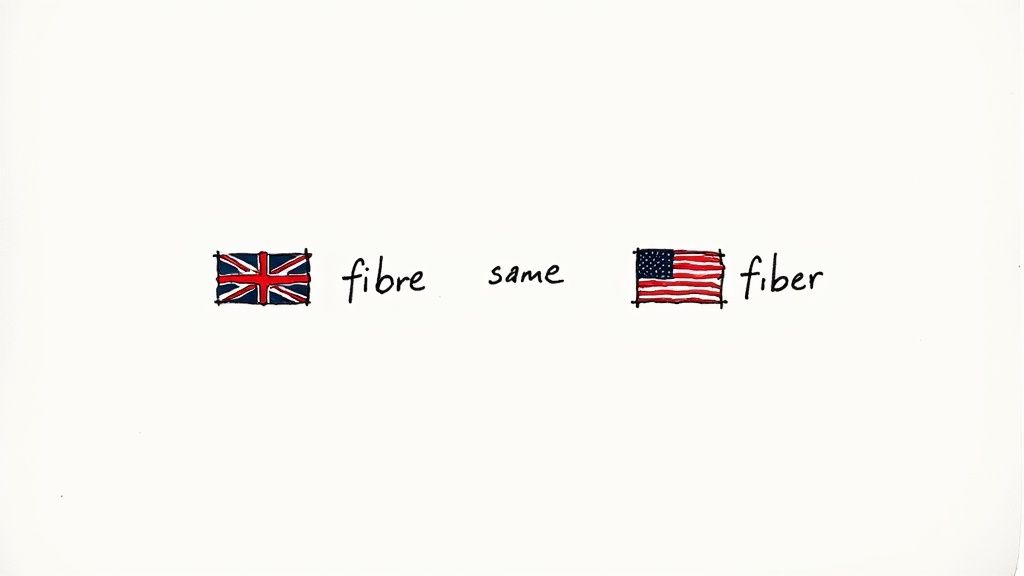
The whole fibre vs. fiber debate boils down to one simple fact: it's a regional spelling difference. Fibre is the go-to spelling in British English, while fiber is standard in American English.
Both words mean the exact same thing. Whether you're talking about a high-fiber diet, cotton fibers, or fiber-optic internet, the concept is identical. The only thing that changes is the spelling.
Why This Little Difference Matters
This isn't just a trivial spelling quirk; it's a classic example of how English has evolved differently on opposite sides of the Atlantic. Choosing the right spelling shows your audience you understand their world. It’s a small detail that makes your content feel more familiar and trustworthy.
Think about it: a nutritionist in Manchester will talk about the importance of "dietary fibre," while a doctor in Miami will advise patients to eat more "dietary fiber." A UK internet company will boast about its "full-fibre" network, but an American provider will market its "100% fiber-optic" service.
The bottom line: The word's meaning doesn't change, just the spelling. The "-re" ending is the British convention, and the "-er" is the American one. It’s that simple.
So, how does this play out in the real world? Let’s look at the most common places you'll see each version.
Fibre vs. Fiber at a Glance
For a quick reference, this table breaks down the typical usage in key areas. It's all about matching your spelling to your audience's expectations.
| Context | Fibre (British English) | Fiber (American English) |
|---|---|---|
| Nutrition | "High-fibre diet" on UK food labels and NHS guidelines. | "High-fiber diet" on US food labels and FDA recommendations. |
| Textiles | "Natural fibres" like cotton and wool in British fashion. | "Natural fibers" used in clothing descriptions in the US. |
| Technology | "Optical fibre" or "fibre optic cable" in UK/EU technical specs. | "Optical fiber" or "fiber optic cable" in North American tech documents. |
Ultimately, getting this right is a fundamental step in creating content that connects. It affects everything from how easily your audience reads your work to how well your pages perform in search engines.
The Global Impact of Optical Fibre Technology
It’s easy to get caught up in the spelling debate—fibre vs. fiber—but the technology itself is what truly matters. Optical fibre is the invisible skeleton holding up our modern, interconnected world. Whether you spell it optical fibre in London or optical fiber in Los Angeles, this incredible innovation is the bedrock of digital life, powering everything from Netflix binges and global stock trades to the rollout of 5G.

At its core, the technology is simple yet brilliant. Tiny glass strands carry data as pulses of light, delivering a massive leap in speed and bandwidth over old-school copper cables. This isn't just a small step up; it's the engine that makes global connectivity possible and paves the way for what comes next. As our demand for faster, more dependable internet grows, this technology is being pushed into every corner of the planet.
Powering Global Connectivity and Growth
Getting high-speed internet to everyone is a global mission, and optical fibre is how we get there. Governments and massive corporations are pouring billions into laying vast networks of cables under oceans and across continents, building a true information superhighway. This isn't just about faster downloads; it's about closing the digital divide and driving real economic growth.
The market numbers tell the story. The global fiber optics market was valued at USD 8,220 million and is expected to hit USD 18,008.4 million by 2032, growing at a CAGR of roughly 10%. A huge driver for this is 5G, with over 85% of new base stations being connected by fiber. The Asia-Pacific region is currently leading the charge. You can dig deeper into the explosive growth of the fiber optics market through recent industry analyses.
This technology transcends language. Regardless of the spelling, the function remains the same: to transmit vast amounts of data at the speed of light, connecting people, businesses, and entire economies.
Lit Fibre vs. Dark Fibre: A Technical Distinction
Once you dive into the world of optical networks, you'll hear two key terms: lit fibre and dark fibre. This has zero to do with regional spelling and everything to do with how the network cable is being used.
- Lit Fibre: Think of this as the standard service. It's when a provider, like your home ISP, "lights up" the cable with lasers and manages all the data traffic running through it. When you sign up for an internet plan, you're using lit fibre.
- Dark Fibre: This term refers to fibre optic cables that have been laid in the ground but aren't currently active or "lit." A company can lease this dark fibre and set up its own private, highly secure network, giving them total control.
Making the call between lit and dark fibre is a major strategic decision for big players with huge data demands—think data centers, banks, and government bodies. Going with dark fibre gives them complete command over their network, offering practically unlimited bandwidth and top-tier security. It just goes to show how this single technology provides flexible answers for everyone, from a single family home to a dedicated global network.
Dietary Fibre vs. Fiber: A Health and Nutrition Deep Dive
While the difference between fibre and fiber might seem like a simple regional spelling quirk in textiles or tech, it takes on a whole new level of importance in health and nutrition. Here, the choice isn't just about preference—it's about adhering to national standards that directly influence how people understand food labels, health advice, and medical guidance.
In the UK, the National Health Service (NHS) is firm in its use of 'fibre'. Every piece of public health information, from doctor's recommendations to official dietary guidelines, uses this spelling. If you're in London, your GP will tell you to eat more dietary fibre, and your wholemeal bread will list its 'fibre' content in grams.
Cross the pond, and the U.S. Food and Drug Administration (FDA) has standardized 'fiber'. It's the only spelling you'll find on Nutrition Facts labels across the United States. A dietitian in New York will advise a high-fiber diet to help manage cholesterol, ensuring complete consistency for American consumers.
How Global Brands Adapt Their Message
This clear regional divide creates an interesting puzzle for international food companies. To connect with local shoppers, they have to tailor their packaging and marketing. Take a global giant like Kellogg's—the cereal box you buy in the UK will proudly display its 'fibre' content, but the identical product on a shelf in the US will show the amount of 'fiber'.
This isn't just about good grammar. It's about building trust. Seeing the familiar spelling makes the information feel credible and instantly understandable.
Using the wrong spelling on a food label can make a product seem out of place, or even untrustworthy. When it comes to health, consumers rely on clear, familiar language to make decisions with confidence.
Why This Matters for You
Knowing this distinction has real-world applications. Maybe you're a nutritionist crafting advice for a specific audience, a content creator in the wellness space, or just a traveler trying to make sense of a food label in another country. Using the right term is crucial.
Here’s a simple guide to where you’ll find each spelling in the world of nutrition:
- Fibre (British English): This is the go-to spelling in the United Kingdom, Ireland, Australia, New Zealand, and other Commonwealth nations. Expect to see it on government health websites, supermarket packaging, and in local health magazines.
- Fiber (American English): This is standard in the United States and Canada. It's also common in countries with significant American influence. The FDA and major US health bodies use it exclusively.
At the end of the day, when you're talking about nutrition, your audience's location dictates the spelling. Getting it right ensures your health content comes across as accurate, authoritative, and truly helpful to the people you’re trying to reach.
Making the Right Spelling Choice for SEO
Deciding between fibre vs. fiber is more than just a style guide preference—it's a sharp strategic move that can make or break your visibility online. While search engines like Google are smart enough to know they're synonyms, they will almost always favour content that directly matches the searcher's local language and query.
What does that mean for you? It means aligning your spelling with your target audience is non-negotiable for effective SEO.
If you’re trying to connect with readers in the United Kingdom, Australia, or New Zealand, using “fibre” is the only way to go. On the flip side, if your audience is based in the United States, “fiber” is the spelling you need to use. This seemingly minor tweak makes your content feel instantly familiar and relevant, which can boost both click-through rates and search rankings.
Analysing Search Intent and Volume
Before you write a single word, you need to look at the data. The first step is figuring out which spelling your ideal customer is actually typing into their search bar. Tools like Google Trends are perfect for this, giving you a clear picture of search interest across different regions over time.
Think of it this way: a London-based internet provider rolling out a new "full-fibre broadband" package must optimize for "fibre." In contrast, a US health blogger writing about nutrition needs to target keywords like "high-fiber foods" to reach their audience. If you get this wrong, you're essentially trying to rank for a term your target market isn't even using.
Diving into regional spelling differences shows why a deep understanding of how to choose keywords for SEO is so important. It's about getting beyond the basics to find the exact phrasing and questions your audience uses every day.
Key Takeaway: Success in SEO comes down to speaking your audience's language. Choosing the right spelling isn't about being pedantic; it's about matching user intent and giving your content the best possible chance to be seen in a specific geographic market.
Practical SEO Implementation
Once you’ve locked in the right spelling for your audience, consistency is everything. You need to weave your chosen term throughout your content in all the right places.
Here's a quick checklist:
- Page Titles and Meta Descriptions: These are your digital storefront. They have to match what local searchers expect to see.
- Headings (H1, H2, H3): Using your target term in headings tells search engines what the page is about and signals its importance.
- Body Content: The term should appear naturally in your paragraphs. For a masterclass on how to do this effectively, check out our guide on SEO copywriting best practices.
- Image Alt Text: Describe your images using the regionally appropriate spelling.
- URLs: A URL like
/blog/best-fibre-deals-uksends a powerful, targeted signal to both users and search engines.
This simple decision tree helps visualize the choice, especially when discussing dietary intake—a very common context for the fibre vs. fiber debate.
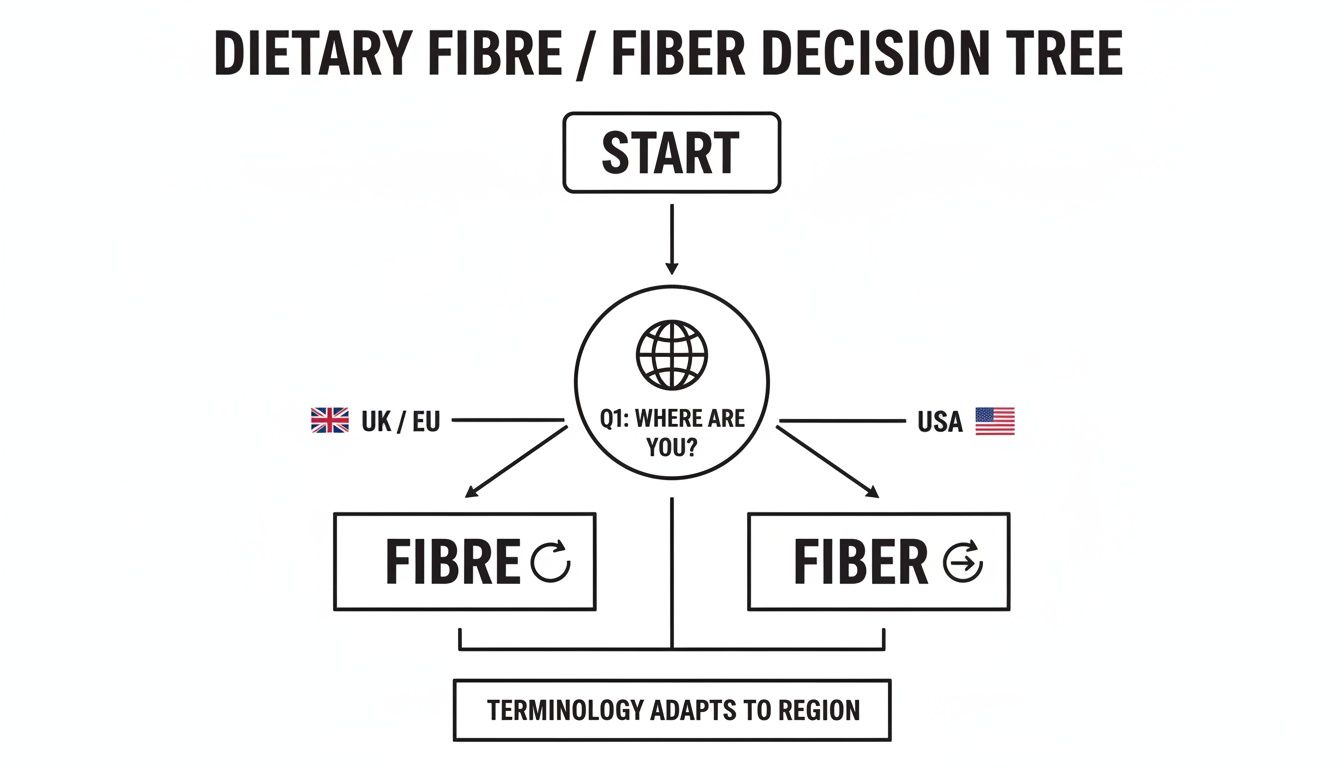
As you can see, the correct spelling is entirely dependent on your geographical target. This isn't just an afterthought; it's a core part of any good content localization strategy. By picking one spelling based on audience data and sticking to it, you build a much stronger, more authoritative presence that search engines will reward.
Seeing Spelling Differences in the Real World
The whole fibre vs. fiber debate moves from the dictionary to the real world when you see how global brands handle it. This isn't just about being a stickler for grammar; it's a smart, strategic move that shapes how a company connects with its audience, builds trust, and keeps its message crystal clear.
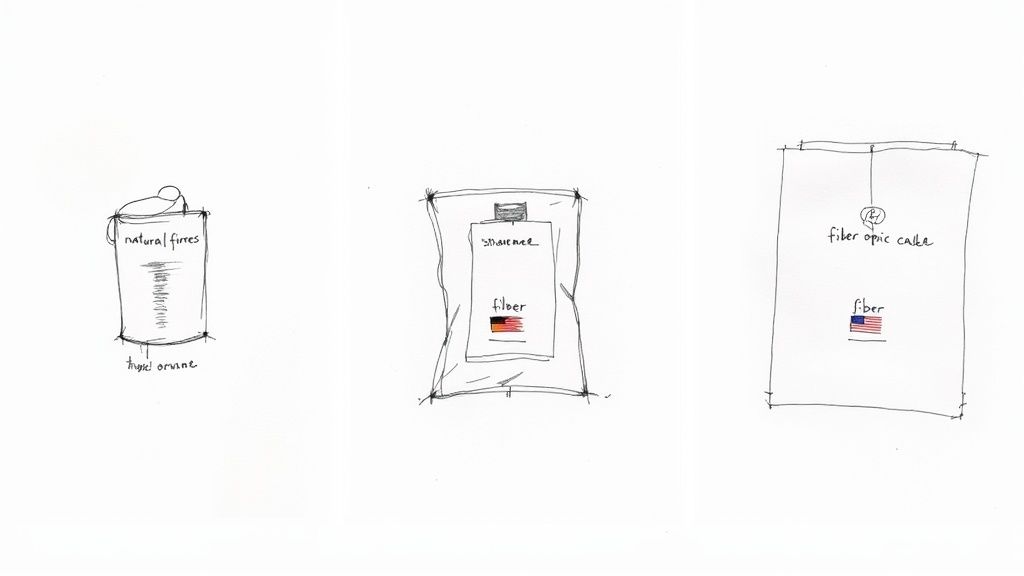
From dense technical manuals to flashy product ads, companies with a global footprint have to nail this nuance to feel local and authentic. Get it wrong, and a product can instantly feel foreign, like it wasn't meant for that market at all.
Technology and Telecommunications
In the high-stakes world of tech, precision is everything. A European telecom company selling networking gear in Germany will publish specs referring to ‘optical fibre cable’. Their entire documentation is written for an audience that expects British English, so using ‘fibre’ is non-negotiable for professional credibility.
Meanwhile, a competitor based in the United States will consistently use ‘fiber optic cable’ across all its materials. Their manuals, marketing, and website copy are all designed for an American market where ‘fiber’ is the standard. This consistency is key—it prevents confusion and meets customer expectations head-on.
You can see this split even as global connectivity booms. The Fiber-to-the-Home (FTTH) market, valued at $47 billion worldwide, shows how different regions adopt the same technology under different linguistic umbrellas. In the U.S., record deployments pushed total FTTH passings to 98.3 million homes, a huge expansion driven by IP traffic that's projected to triple.
Fashion and Consumer Goods
The difference is just as stark in the retail space. Picture an international clothing brand launching a new sustainable line—they'll meticulously adjust their language for each region.
On their UK website, you’ll find product descriptions celebrating the softness of ‘natural fibres’ like organic cotton and linen. That choice of spelling instantly clicks with British shoppers.
But hop over to the brand's US site, and you’ll see those exact same clothes described as being made from ‘natural fibers’. It’s a simple switch, but it makes the marketing feel native to American consumers, who would likely find the ‘-re’ spelling a bit odd.
By adapting their spelling, these brands show they actually get their target markets. It’s a subtle but powerful signal that says, "We speak your language," which fosters a much stronger connection and boosts engagement.
This principle goes way beyond just fibre vs. fiber. Tons of words, like 'analyze' and 'analyse', follow similar regional patterns. You can dive deeper into these differences in our detailed guide comparing analyze vs. analyse. At the end of the day, these examples prove that successful global communication comes down to sweating the small stuff—because those are the details that matter most to your audience.
Answering Your Questions About Fibre and Fiber
It's easy to get tangled up in the "fibre vs. fiber" debate. Let's clear up some of the most common questions so you can feel confident choosing the right word for the right audience.
Think of this as your go-to guide for navigating this transatlantic spelling quirk.
Is There a Difference in Meaning Between Fibre and Fiber?
Nope. There is absolutely no difference in meaning. Fibre is the standard spelling in British English, while fiber is its American English counterpart. They refer to the exact same thing.
This holds true no matter what you're talking about:
- Nutrition: A high-fibre diet is the same as a high-fiber diet.
- Textiles: Cotton fibres are identical to cotton fibers.
- Technology: Fibre optic and fiber optic cables describe the very same technology.
The only thing that changes is where you are in the world.
Which Spelling Should I Use for an International Audience?
This is a great question. When you’re writing for a truly global audience without a specific regional focus, fiber is generally the safer bet. American English has a slightly larger presence online, so the "-er" spelling tends to be more universally recognized.
But the best approach is always to know your audience. If you're targeting readers primarily in the UK, Australia, Canada, or another Commonwealth nation, stick with fibre. It feels more natural to them and shows you've done your homework.
Expert Tip: If your content platform supports it, think about creating regional versions of your most important pages. This allows you to fine-tune spelling and other local details for different markets, giving your SEO a serious boost.
Can I Use Both Spellings in the Same Document?
You really shouldn't. Consistency is a cornerstone of professional writing, so you should never mix fibre and fiber in the same piece of content. Pick one based on your audience and use it exclusively.
Switching back and forth looks sloppy and can confuse your readers. This is a classic trap with frequently misused words where regional habits can catch even seasoned writers off guard.
Do Search Engines Penalize the Wrong Spelling?
Good news: search engines like Google are sophisticated enough to know that fibre and fiber are the same thing. You won't get hit with a direct penalty for using one over the other.
That said, search engines are all about user experience. They want to serve up content that perfectly matches a user's search and location. Someone in London searching for "full fibre broadband" is far more likely to see results optimized for the term "fibre." Using the local spelling is a smart SEO move that tells search engines your content is relevant for that specific region.
If you're looking for more answers on common content questions, you might find these general frequently asked questions helpful.
Ready to make every word count? Rewritify helps you adapt your content for any audience, turning drafts into clear, polished text that connects. Whether you need to switch between regional English variants or refine your tone, our AI-powered tool ensures your writing is always on point. Try Rewritify for free and see the difference.
Recent articles

Is ZeroGPT accurate? We tested its AI detection using 2026 data. See how it performs on false positives and reliability for students, writers, and marketers.

Master the difference between complement and compliment with our guide. Learn the definitions, grammar, and usage with clear examples to perfect your writing.

Discover our top 8 company bio example formats for websites, social media, and sales. Get templates and tips to write a bio that converts.

Discover 10 powerful not understandable synonyms to enhance your writing. Explore examples, tips, and contexts to improve clarity and precision.

Learn how to humanize AI generated text with proven strategies. Move beyond robotic writing to create authentic, engaging content that connects with readers.

Learn how to correct the sentence with practical grammar tips, proofreading tricks, and clear examples that boost clarity and confidence.