Master Your Writing: 10 Frequently Misused Words and How to Fix Them in 2025
Stop making common errors! Our guide to 10 frequently misused words includes clear examples, memory aids, and tips to improve your writing clarity today.
In a world of fast-paced communication, clarity is king. Whether you're a student crafting a research paper, a marketer optimizing a landing page, or a business professional drafting a critical proposal, your credibility hinges on the words you choose. Even the most compelling ideas can be undermined by small, persistent writing errors. The wrong word can confuse your reader, weaken your argument, and dilute the impact of your message. This guide is designed to eliminate that risk by tackling some of the most frequently misused words in the English language.
We'll go beyond simple dictionary definitions. For each common pitfall, you'll get actionable memory aids, clear 'before and after' examples, and practical strategies to permanently fix these mistakes in your own writing. This isn't just about avoiding grammatical red flags; it's about making your communication more precise, professional, and powerful. By mastering these distinctions, you ensure your message is always understood exactly as you intend, enhancing both your authority and your ability to connect with your audience.
This comprehensive list will help you distinguish between tricky pairs like affect and effect, principle and principal, and many others that trip up even seasoned writers. Think of this as a toolkit for refining your content, ensuring every sentence is polished and effective. Ultimately, mastering frequently misused words is a crucial step in learning how to write engaging content that truly captivates your audience. Let's dive in and sharpen your skills.
1. Affect vs. Effect
Kicking off our list of frequently misused words is a classic pair that trips up even seasoned writers: affect and effect. Their similar sounds and spellings make them easy to confuse, but understanding their distinct roles as a verb and a noun is crucial for clear communication. Getting this right demonstrates precision, a key element in strong writing.
The Core Difference
At its heart, the distinction is simple:
- Affect is a verb meaning to influence, change, or impact something. Think of it as the action.
- Effect is a noun that means the result, outcome, or consequence of an action. Think of it as the end result.
This distinction is especially vital in formal contexts. For those looking to sharpen their formal prose, mastering such nuances is a great first step. You can discover more essential tips for improving academic writing to elevate your work.
Examples in Action
Let's see how these words function in sentences:
INCORRECT: The new policy will effect employee morale.
CORRECT: The new policy will affect (influence) employee morale.
INCORRECT: We analyzed the positive affect of the marketing campaign.
CORRECT: We analyzed the positive effect (result) of the marketing campaign.
Memory Aids and Editing Tips
Remembering the difference can be simple with a quick mental check. This is one of those frequently misused words that a simple trick can solve.
Pro Tip: Use the RAVEN acronym: Remember Affect is a Verb, Effect is a Noun.
Another easy way to remember is by association:
- Affect = Action or Alter.
- Effect = End result.
When editing, try substituting "influence" for affect and "result" for effect. If the sentence still makes sense, you've likely chosen the correct word. Tools like Rewritify can automatically detect and correct this common error, ensuring your final text is polished and accurate.
2. Their vs. There vs. They're
Next on our list of frequently misused words are three homophones that sound identical but serve entirely different functions: their, there, and they're. The confusion is common, especially in fast-paced writing, but mastering them is a hallmark of a careful writer. Correctly using these words enhances clarity and prevents readers from stumbling over your sentences.
The Core Difference
Each word has a distinct job in a sentence:
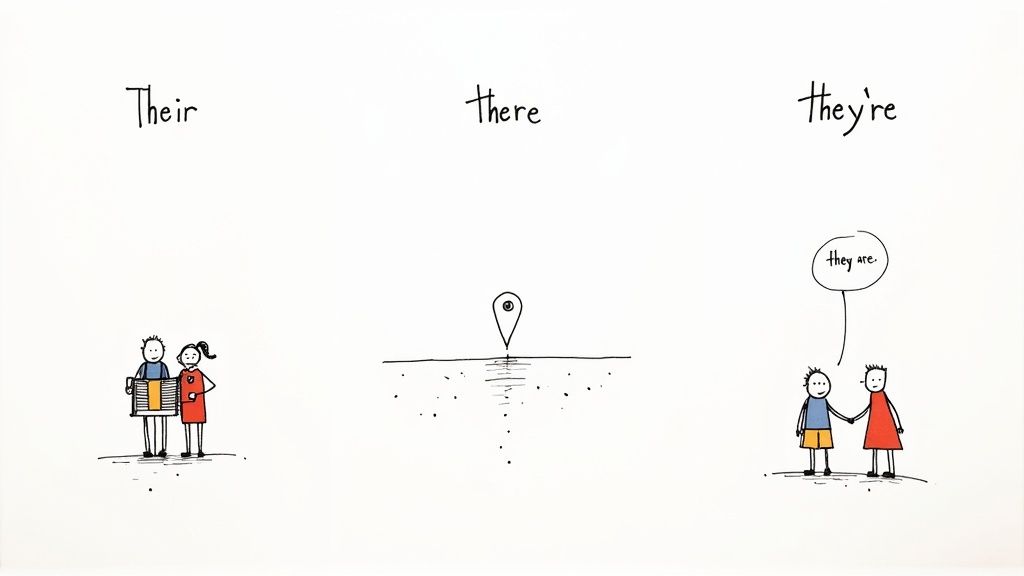
- Their is a possessive pronoun. It shows that something belongs to "them."
- There is an adverb indicating a place or location, or it's used to introduce a sentence.
- They're is a contraction of "they are."
This is a fundamental grammatical rule, and getting it right is essential for credibility. Correct usage ensures your meaning is immediately understood without forcing the reader to pause and reinterpret your intent.
Examples in Action
Let's look at how a single sentence can go wrong with these words:
INCORRECT: Their going to put there coats over they're.
CORRECT: They're (they are) going to put their (belonging to them) coats over there (in that place).
INCORRECT: There excited about they're new project.
CORRECT: They're (they are) excited about their (belonging to them) new project.
Memory Aids and Editing Tips
Remembering which word to use is easy with a few simple tricks. For these frequently misused words, association is key.
Pro Tip: Break down the words to find clues to their meanings.
- Their has the word "heir" in it, and an heir inherits things (possessions).
- There has the word "here" in it, which points to a location.
- They're has an apostrophe, which signifies a contraction (missing letters).
When you're editing, say "they are" out loud where you've written they're. If it makes sense, you've used the correct word. For their and there, check for possession or location. Using a tool like Rewritify can also help by flagging these homophone errors automatically, leaving your writing clear and professional.
3. Your vs. You're
In the fast-paced world of digital communication, few errors are as common or as glaring as the mix-up between your and you're. This pair of homophones sounds identical but carries entirely different meanings, making their misuse a frequent stumbling block in everything from text messages to professional emails. Mastering this distinction is a simple yet powerful way to enhance your credibility and clarity.
The Core Difference
The confusion between these two frequently misused words stems from their sound, but their functions are completely separate:
- Your is a possessive adjective used to indicate ownership or that something belongs to "you."
- You're is a contraction of the words "you are." It combines two words into one for brevity.
This difference is fundamental to sentence structure. Using the wrong one can change the meaning of a sentence or simply make it grammatically incorrect. Consistent, correct usage is a core part of maintaining a professional voice, which can be defined in a comprehensive brand style guide.
Examples in Action
Let's look at how this common mistake appears and how to correct it:
INCORRECT: Can you check you're email before the meeting?
CORRECT: Can you check your (possessive) email before the meeting?
INCORRECT: I think your going to do great in the presentation.
CORRECT: I think you're (you are) going to do great in the presentation.
Memory Aids and Editing Tips
Fortunately, this is one of the easiest errors to catch and fix with a quick mental test. A simple substitution is all it takes to ensure you've picked the right word.
Pro Tip: Read the sentence aloud and replace the word with "you are." If the sentence still makes grammatical sense, you're is the correct choice. If it sounds wrong, you need the possessive your.
Let's apply this test:
- "Can you check you are email?" (Incorrect, so use your)
- "I think you are going to do great." (Correct, so use you're)
When editing, actively look for every instance of "your" and "you're" and perform this quick substitution. This small step can dramatically improve the professionalism of your writing and ensure your message is always clear.
4. Its vs. It's
Among the most common errors in modern writing, this pair of frequently misused words often appears due to a simple misplaced apostrophe. Its and it's are auditory twins but have entirely different grammatical functions. Confusing them can undermine the credibility of your writing, making this a critical distinction to master for clear and professional communication.
The Core Difference
The rule here is straightforward, yet it consistently trips people up. Let's break it down:
- It's is a contraction of "it is" or "it has." The apostrophe signals that a letter has been removed.
- Its is a possessive pronoun indicating ownership, similar to his or her. It shows that something belongs to "it."
Getting this right is a hallmark of a careful writer. While a single typo might seem minor, repeated errors of this nature can distract your reader and weaken the impact of your message, a crucial consideration for anyone aiming to produce high-quality content.
Examples in Action
Seeing the words in context makes the distinction crystal clear:
INCORRECT: It's hard to know if the dog likes it's new toy.
CORRECT: It's (It is) hard to know if the dog likes its (possessive) new toy.
INCORRECT: The company lost its way; its struggling now.
CORRECT: The company lost its (possessive) way; it's (it is) struggling now.
Memory Aids and Editing Tips
A quick mental substitution is the most effective way to check your usage. This is one of those frequently misused words that a simple trick can solve permanently.
Pro Tip: If you can replace the word with "it is" or "it has" and the sentence still makes sense, the correct choice is it's. If not, use its.
Another helpful association is to remember that possessive pronouns don't use apostrophes:
- His, hers, yours, theirs, its.
When you're editing, say the sentence out loud using "it is" in place of "it's/its." The correct choice will become immediately obvious. For those who want to ensure their writing is always error-free, tools like Rewritify can help spot and fix these common mix-ups automatically, ensuring your text is polished and professional.
5. Then vs. Than
Next on our list of frequently misused words is a pair that often gets swapped due to their similar pronunciation: then and than. While they sound alike, their functions are entirely different. One refers to time and sequence, while the other is essential for making comparisons. Using them correctly is a small but significant detail that elevates your writing from casual to precise.
The Core Difference
The distinction lies in their grammatical roles. Understanding what each word does is the key to using it correctly:
- Then is an adverb that deals with time or sequence. Think of it as answering the question "when?" or "what's next?".
- Than is a conjunction used to make comparisons. Think of it as showing the relationship between two things.
This rule is a cornerstone of clear writing. For writers looking to produce polished and error-free content, mastering these common stumbling blocks is a non-negotiable step.
Examples in Action
Let's look at how this distinction plays out in real sentences:
INCORRECT: First, we'll finish the report, than we can go to lunch.
CORRECT: First, we'll finish the report, then (next in sequence) we can go to lunch.
INCORRECT: My presentation is scheduled for later then yours.
CORRECT: My presentation is scheduled for later than (a comparison of time) yours.
INCORRECT: If you study hard, than you will pass the exam.
CORRECT: If you study hard, then (as a consequence) you will pass the exam.
Memory Aids and Editing Tips
This is one of those frequently misused words where a simple mnemonic can make all the difference.
Pro Tip: Associate the letters in the words with their meanings: Then deals with time, and than is used for comparisons.
Here are two more tricks to help you remember:
- Then rhymes with when. If your sentence is about time, then is your word.
- Than has an 'a', just like comparison.
When you're editing, read the sentence aloud. Ask yourself if you are describing a sequence of events or comparing two things. This quick check can help you catch the error before anyone else does. Automated tools can also be a great safety net, flagging these common mix-ups and ensuring your writing is consistently accurate.
6. Lose vs. Loose
A single letter separates these two words, but that one "o" makes a world of difference in meaning. Lose and loose are another classic pair of frequently misused words where a simple spelling error can completely alter the logic of a sentence. Understanding their roles as a verb and an adjective is fundamental for precise and professional writing.

The Core Difference
At its heart, the distinction comes down to their function in a sentence:
- Lose is a verb that means to misplace something, fail to win, or be deprived of something. It is an action.
- Loose is an adjective that describes something as not tight, not fastened, or free from restraint. It describes a state.
This is a crucial distinction in any form of communication. For professionals refining reports or marketers optimizing content, mixing these up can undermine credibility and distract the reader from the core message.
Examples in Action
Let’s look at how these words are correctly and incorrectly used:
INCORRECT: Don't loose your keys while you're out.
CORRECT: Don't lose (misplace) your keys while you're out.
INCORRECT: My shoelaces are too lose; I might trip.
CORRECT: My shoelaces are too loose (not tight); I might trip.
INCORRECT: If you keep a lose grip, you might loose the rope.
CORRECT: If you keep a loose grip, you might lose the rope.
Memory Aids and Editing Tips
Remembering the difference can be straightforward with a few simple tricks. This is one of those frequently misused words that a mnemonic device can easily solve.
Pro Tip: If you lose something, it has lost an "o." The word loose is looser because it has an extra "o."
Another easy way to remember is by sound and function:
- Lose (pronounced "looz") is a verb, an action.
- Loose (pronounced "loos") is an adjective, a description.
When editing your work, say the sentence aloud. The distinct pronunciations often make the error obvious. As you proofread, ask yourself if you are describing an action (lose) or a state of being (loose). For a final check, a tool like Rewritify can scan for this common mix-up, helping ensure your text is error-free.
7. Accept vs. Except
Next on our list is a pair of words that sound alike but have opposite meanings: accept and except. The similar pronunciation makes them easy to mix up in speech, a confusion that often carries over into writing. Understanding their very different roles is key to conveying your intended meaning without creating ambiguity.
The Core Difference
At its heart, the distinction lies in their function of inclusion versus exclusion:
- Accept is a verb that means to receive, agree to, or take on something willingly. Think of it as an action of inclusion.
- Except is most often a preposition meaning "other than" or "not including." It can also be a verb meaning to exclude. Think of it as an action of exclusion.
This difference is fundamental. Using one in place of the other can completely reverse the meaning of a sentence, a critical error in any form of communication.
Examples in Action
Let’s look at how this common confusion plays out in practice:
INCORRECT: Please except my sincerest apologies for the delay.
CORRECT: Please accept (receive) my sincerest apologies for the delay.
INCORRECT: All the students passed the exam, accept for Tom.
CORRECT: All the students passed the exam, except (other than) for Tom.
INCORRECT: The machine will not except coins that are bent.
CORRECT: The machine will not accept (take) coins that are bent.
Memory Aids and Editing Tips
Keeping these two straight is easy with a few simple tricks. For a list of frequently misused words, this pair has some of the best memory aids available.
Pro Tip: Remember that except means to exclude. The "ex" at the start of both words is your connection.
Here are a few other associations to help you remember:
- Accept = Agree or Acquire.
- Think of the "X" in except as "X-ing" something out or crossing it off a list.
When you're editing, try to substitute "receive" for accept and "other than" for except. If the sentence reads correctly, you've used the right word. This simple check can prevent a significant error and ensure your writing is clear and precise.
8. Principle vs. Principal
Next up is a pair of homonyms that sound identical but mean entirely different things: principle and principal. Confusing these two is a common slip-up, but mastering their distinction is a hallmark of a careful writer. Since one relates to fundamental truths and the other to primary importance or a person, mixing them up can significantly alter your sentence's meaning.
The Core Difference
At its heart, the distinction lies in their roles as a noun and an adjective/noun:
- Principle is always a noun that refers to a fundamental truth, rule, belief, or moral code.
- Principal can be a noun (the head of a school, a sum of money) or an adjective meaning main, primary, or most important.
Getting this pair right is crucial in professional and academic settings, where precision is paramount. For instance, discussing the principal reasons for a study's outcome is very different from discussing the ethical principles that guided it.
Examples in Action
Let's see how these words function in practice:
INCORRECT: The principle reason for our success was teamwork.
CORRECT: The principal (main) reason for our success was teamwork.
INCORRECT: Our school's principle is dedicated to student achievement.
CORRECT: Our school's principal (head of school) is dedicated to student achievement.
INCORRECT: She is a person of high moral principals.
CORRECT: She is a person of high moral principles (beliefs).
Memory Aids and Editing Tips
Remembering the difference for these frequently misused words can be made easier with a few simple tricks.
Pro Tip: Your principal is your pal. The person who is the head of the school can be your "pal." In contrast, a principle is like a rule.
Here’s another way to frame it:
- Principal = Main or leader.
- Principle = Rule or belief.
When you're editing, ask yourself if you're referring to a person or the "main" part of something. If so, you need principal. If you're talking about a guideline, belief, or standard, the correct choice is principle. Using a tool like Rewritify can help catch these errors automatically, ensuring your writing is both clear and correct.
9. Complement vs. Compliment
Next on our list of frequently misused words are two homophones that sound identical but carry vastly different meanings: complement and compliment. Confusing these terms can change the entire meaning of a sentence, shifting from praise to a statement about completion. Mastering this pair is a mark of a careful and precise writer.
The Core Difference
At its heart, the distinction lies in what each word does:
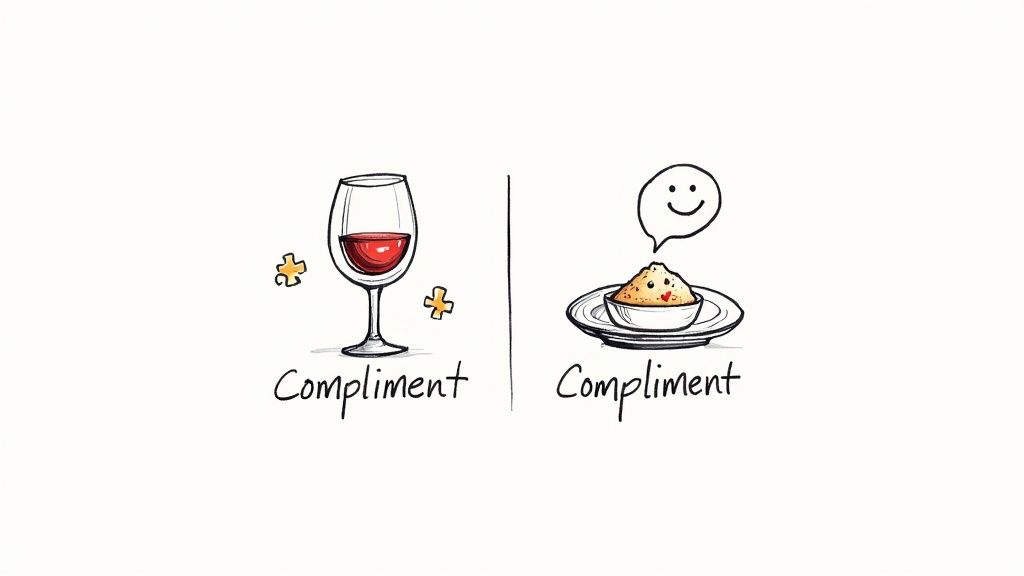
- Complement is a verb or noun that refers to something that completes, enhances, or goes well with something else. It makes a set whole.
- Compliment is a verb or noun that means to praise, admire, or express approval. It is an expression of admiration.
This difference is key in contexts from culinary reviews to design critiques. Using the correct word ensures your message is received as intended, whether you are praising a chef or describing a perfect color palette.
Examples in Action
Let's look at these words in context to see how a single letter changes the meaning:
INCORRECT: The new curtains really compliment the color of the walls.
CORRECT: The new curtains really complement (complete the look of) the color of the walls.
INCORRECT: She gave me a nice complement on my presentation skills.
CORRECT: She gave me a nice compliment (praise) on my presentation skills.
Memory Aids and Editing Tips
Remembering which word to use is easier when you focus on the middle vowel. This is one of those frequently misused words that can be clarified with a simple mnemonic.
Pro Tip: Associate the vowel with the word's meaning:
- Complement helps to complete something.
- Compliment is something I say to be nice.
When editing your work, ask yourself if you mean "to complete" or "to praise." If you mean "to complete," use the word with an "e." If you mean to offer kind words, use the word with an "i." Automated tools can also help flag these homophones, but understanding the core difference is the best way to ensure accuracy.
10. Advice vs. Advise
Next on our list of frequently misused words is a pair separated by just one letter but worlds apart in function: advice and advise. Their nearly identical pronunciation and close relationship make them a common stumbling block. Mastering the difference between this noun and verb is a simple yet powerful way to make your writing more precise and professional.
The Core Difference
At its heart, the distinction comes down to parts of speech:
- Advice is a noun that refers to a recommendation, an opinion, or guidance offered to someone. Think of it as the thing being given.
- Advise is a verb that means to offer a suggestion, give counsel, or recommend a course of action. Think of it as the action of giving guidance.
This distinction is crucial for clear communication. When you're paraphrasing someone's guidance, for instance, you need to be clear about whether you are describing the advice itself or the act of advising. Getting this right is a key part of effective communication, similar to understanding how to properly paraphrase sources without plagiarizing to maintain academic integrity.
Examples in Action
Let's see how these words function correctly in sentences:
INCORRECT: My lawyer's advise is to accept the settlement.
CORRECT: My lawyer's advice (recommendation) is to accept the settlement.
INCORRECT: I will advice you to seek a professional opinion.
CORRECT: I will advise (counsel) you to seek a professional opinion.
Memory Aids and Editing Tips
Remembering the difference can be easy with a couple of handy tricks. This is one of those frequently misused words that a simple mnemonic can solve.
Pro Tip: Think about pronunciation. AdviCe (noun) is pronounced with a soft "s" sound, like "ice." AdviSe (verb) is pronounced with a "z" sound, like "is."
Another simple way to remember is by word association:
- adviCe = Counsel (a noun).
- adviSe = Suggest (a verb).
When you're editing your work, ask yourself if you need an action (verb) or a thing (noun). If you need an action, use advise. If you need a thing, use advice. Tools like Rewritify can help catch these errors automatically, ensuring your writing is always clear and correct.
10 Commonly Confused Words — Quick Comparison
| Term | Part(s) of speech | Common confusion / difficulty | Quick distinguishing tip | Typical use cases | Expected outcome / benefit |
|---|---|---|---|---|---|
| Affect vs. Effect | Affect = verb (sometimes noun in psych); Effect = noun (rarely verb) | Similar pronunciation/spelling; psychology exceptions | AFFECT = Action (influence); EFFECT = End result; test by replacing with "bring about" or "result" | Academic, scientific, business writing | Clear cause/result distinction; improved credibility |
| Their vs. There vs. They're | Their = possessive adj; There = adverb/existential; They're = contraction (they are) | Homophones; visual distinction necessary | They're → replace with "they are"; There = location; Their = possession | General writing, emails, social media, signage | Correct ownership/location expression; fewer misunderstandings |
| Your vs. You're | Your = possessive adj; You're = contraction (you are) | Homophones; common in informal writing and texting | Substitute "you are" — if it fits use you're; otherwise use your | Social media, messages, professional correspondence | Basic grammatical accuracy; perceived competence |
| Its vs. It's | Its = possessive pronoun; It's = contraction (it is / it has) | Apostrophe misuse; extremely common error | Replace with "it is" — if it fits use it's; possessive has no apostrophe | Digital communication, publishing, formal writing | Eliminates a frequent error; improves professionalism |
| Then vs. Than | Then = adverb (time/sequence); Than = conjunction/preposition (comparison) | Similar sound/appearance; context-sensitive | Then = time/next; Than = comparison (think "a" in compArison) | Narratives, comparisons, instructions | Correct sequencing vs. comparison; clearer meaning |
| Lose vs. Loose | Lose = verb; Loose = adjective (rarely verb) | One-letter difference; spellcheck often misses | Lose (one 'o') = to misplace/defeat; Loose (two 'o') = not tight | Everyday writing, instructions, product descriptions | Prevents reversed meanings; clearer instructions |
| Accept vs. Except | Accept = verb; Except = preposition/conjunction (to exclude) | Similar pronunciation; misuse affects inclusion/exclusion | Accept = receive/agree; Except = exclude (think "x" = exclude) | Responses to offers, policy language, formal replies | Avoids miscommunication about inclusion or exclusion |
| Principle vs. Principal | Principle = noun (rule); Principal = noun/adj (head, main) | Homophones; context determines form | Principal = "pal" (school head) or main; Principle = rule | Education, ethics, formal documents | Correct formal usage; avoids embarrassing errors |
| Complement vs. Compliment | Complement = n/v (completes); Compliment = n/v (praise) | Identical pronunciation; e/i distinction overlooked | Complement (e) completes; Compliment (i) praises ("i" = nice) | Design/food pairing vs. interpersonal praise, reviews | Accurate meaning in context; clearer communication |
| Advice vs. Advise | Advice = noun; Advise = verb | Nearly identical pronunciation; c vs s confusion | Advice (c) = guidance (noun); Advise (s pronounced 'z') = to counsel (verb) | Professional, legal, medical, consulting contexts | Grammatically correct recommendations; clearer instructions |
Automate Your Accuracy: The Smart Way to Eliminate Errors
Navigating the nuances of the English language can be a challenging yet rewarding journey. Throughout this guide, we've dissected ten of the most frequently misused words, from the subtle dance between 'affect' and 'effect' to the critical distinction between 'principle' and 'principal'. We’ve equipped you with definitions, examples, and memory aids designed to cement these rules into your writing habits.
Understanding the difference between homophones like 'your' and 'you're' or near-homophones such as 'lose' and 'loose' is more than just a grammatical exercise. It is the foundation of clear, credible, and persuasive communication. Each correct word choice builds trust with your audience, whether they are professors, clients, or blog readers. In contrast, even a single slip can distract from your core message and undermine your authority.
From Knowledge to Mastery: Building a System for Success
Memorizing the rules is the essential first step, but true mastery comes from consistent application. The goal is to move beyond conscious effort, where you actively pause to recall whether 'its' or 'it's' is appropriate, to a state of instinctual accuracy. This transition doesn't happen overnight; it requires a reliable system for practice and reinforcement.
This is where self-editing and strategic proofreading become invaluable. The actionable tips and exercises provided for each word pair are not just for one-time use. They are tools you can integrate into your regular writing workflow to build and maintain your skills.
Here are the key takeaways to transform your writing process:
- Active Recall is Key: Don't just passively read the rules. Actively test yourself. When you write, pause and consciously ask: "Am I using 'then' for time or 'than' for comparison?" This simple habit reinforces the neural pathways for correct usage.
- Contextual Clues are Your Guide: Remember the mnemonic devices. If you can substitute "it is," you need "it's." If you are talking about a "pal" at your school, you mean the "principal." These mental shortcuts are powerful allies in the heat of drafting.
- Proofread in Passes: Don't try to catch every type of error at once. Dedicate one specific proofreading pass to hunting for only these frequently misused words. This focused approach dramatically increases your chances of catching mistakes your brain might otherwise overlook.
Embracing Technology for Flawless Execution
While manual proofreading is a crucial skill, even the most diligent writers can miss errors, especially when working against tight deadlines. Human brains are wired to see what they expect to see, often skipping over a misplaced 'their' or an incorrect 'affect'. This is where technology provides a critical safety net.
Intelligent writing assistants have evolved far beyond simple spell-checkers. Modern tools are designed to understand context, grammar, and syntax, making them indispensable for anyone serious about producing professional-quality content. Integrating a powerful assistant into your workflow helps catch mistakes in real time, reinforcing good habits by showing you the corrections as you go. To truly automate your accuracy and eliminate common errors like misused words, exploring the best proofreading software can significantly enhance your writing process.
By combining your growing knowledge with the power of smart technology, you create a comprehensive system that ensures consistency and precision. This frees up your mental energy to concentrate on the more creative aspects of writing: developing your ideas, crafting a compelling narrative, and connecting with your audience. You can write with confidence, knowing that a reliable system is in place to polish the final product, ensuring your message is always clear, professional, and impactful.
Ready to eliminate these common errors from your writing for good? Let Rewritify be your intelligent proofreading partner, automatically detecting and correcting frequently misused words so your message always shines. Try Rewritify today and elevate your writing to a new standard of clarity and professionalism.
Relevant articles

Master the difference between complement and compliment with our guide. Learn the definitions, grammar, and usage with clear examples to perfect your writing.

Learn how to correct the sentence with practical grammar tips, proofreading tricks, and clear examples that boost clarity and confidence.

Learn how to structure an argumentative essay with our expert guide. We break down the thesis, body paragraphs, and counterarguments for a powerful paper.
Discover 8 expert-approved concluding sentence starters with examples. Learn how to write powerful, memorable conclusions for essays, reports, and more.
Explore formal writing style examples across academic and professional contexts. Learn tone, structure, and vocabulary to write with clarity.

Learn how to write executive summaries that capture attention and drive action. Our guide covers structure, examples, and expert tips for busy professionals.