How to Write Executive Summaries That Win Over Stakeholders
Learn how to write executive summaries that capture attention and drive action. Our guide covers structure, examples, and expert tips for busy professionals.

Learning to write a great executive summary is pretty simple in theory: you just need to boil down a long document into a short, powerful overview. It needs to hit the core problem, your key findings, and what you think should happen next. Think of it as a standalone snapshot for busy decision-makers, giving them everything they need without having to wade through the full report.
Why Executive Summaries Matter More Than Ever
Let's be honest, we're all drowning in information. That's why an executive summary isn't just a nice-to-have anymore; it's an essential tool. It’s often the only thing a leader will read. Their time is their most valuable asset, and a sharp summary shows you respect that by getting straight to the point.
It’s also the ultimate test of your own understanding. If you can’t convincingly explain your 50-page analysis in 500 words, you probably don’t have as tight a grip on the material as you think. The real job of a summary is to equip stakeholders to grasp your argument and make a confident decision.
Your Make-or-Break First Impression
A well-written summary can mean the difference between getting your project green-lit and having your proposal completely ignored.
Picture this scenario: two teams are pitching a new software investment.
Team A sends over a proposal with a summary that’s a wall of text, clogged with technical jargon. The CFO gives it a quick scan, can’t immediately spot the ROI, and moves on to the next email. The project is dead in the water before it even had a chance.
Team B, on the other hand, leads its summary with a crystal-clear problem: "Our current system is causing 40 wasted hours per week, costing us over $100,000 a year." It immediately follows up with the solution's main benefit—a projected 30% efficiency gain inside of six months. The CFO instantly gets it and pencils in a meeting to discuss.
The goal of an executive summary isn't just to inform; it's to persuade. It has to turn all your data and analysis into a compelling story that makes people want to act.
This Isn’t Just the Short Version
It’s so important to remember that a summary is not an introduction or an abstract. An intro just sets the stage. An executive summary tells the entire story, just in miniature. It has to stand on its own.
Anyone reading it should walk away with a complete picture, understanding:
- The Core Problem: What’s the specific issue or opportunity at hand?
- The Main Findings: What did your research actually uncover?
- The Key Recommendations: So, what should we do about it?
- The Expected Impact: What good things will happen if we follow your advice?
Nailing this skill is a genuine career accelerator. It proves you can think strategically, communicate with clarity, and respect other people's time—all hallmarks of a true leader. In the next sections, we'll get into the nuts and bolts of how to make sure your summaries always hit their mark.
The Groundwork: How to Prepare Before You Write a Single Word
A powerful executive summary isn’t born from a frantic last-minute scramble. It’s built on a solid foundation of strategic thinking. The real work—understanding your purpose, your reader, and your core message—happens long before your fingers hit the keyboard. Skipping this groundwork is like trying to build a house without a blueprint. You might end up with something standing, but it won't be strong, and it certainly won't be what you intended.
The most common mistake I see is people writing for a generic, faceless reader. That’s a missed opportunity. An executive summary is a precision tool, and its impact depends entirely on how well it connects with the specific person reading it. You have to tweak your language, your data, and your recommendations to hit exactly what they care about most.
Know Your Audience and Their Priorities
Who is this really for? The CEO, a technical manager, and a potential investor might all be looking at the same project, but they’re seeing it through completely different lenses.
For the CEO: They live and breathe the bottom line. You need to talk about Return on Investment (ROI), strategic fit, market positioning, and anything that gives the company a competitive edge. They’re asking, "How does this make us more money or put us ahead of the competition?"
For the Technical Manager: This person is all about feasibility and execution. Your summary has to touch on resource needs, technical requirements, potential roadblocks, and how this plan will actually work on the ground. Their focus is on the "how."
For the Investor: They’re weighing risk versus reward. Highlight market size, scalability, financial projections, and the strength of the team behind the idea. Their core question is simple: "Is this a smart place to put my money?"
Trying to be everything to everyone just doesn't work. A summary bogged down in technical jargon will make a CEO’s eyes glaze over, while one that only talks about high-level ROI will leave a project manager wondering if it's even possible to pull off.
This is the mental model I use—it’s a three-step process of refining a mountain of information into a focused, decisive summary.
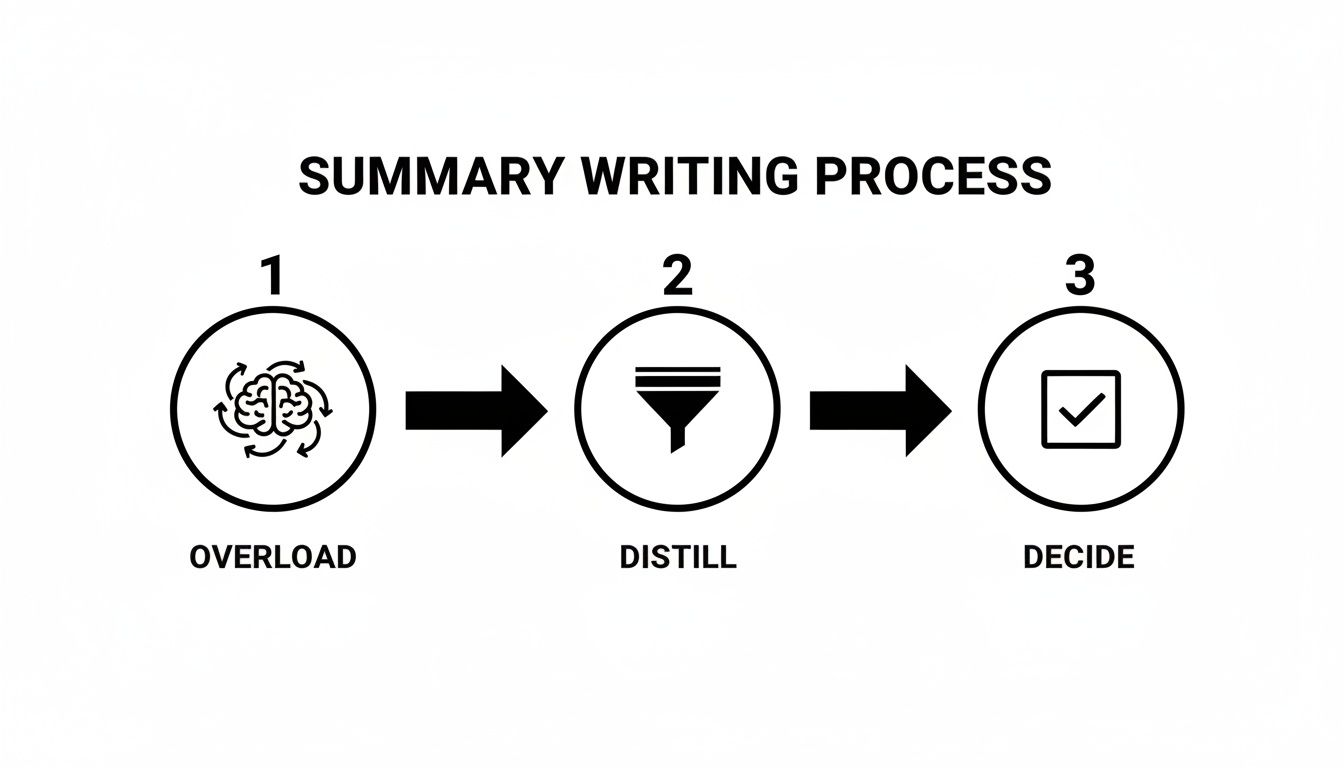
The real magic happens in that distillation step, where you move from overwhelming detail to strategic clarity.
Define the Document’s Core Purpose
Once you've got your reader figured out, you need to get brutally honest about your objective. What, specifically, do you want them to do after reading this? Every word in your summary should be pushing toward one clear goal.
Are you trying to:
- Persuade? You're making a case for a decision—approving a budget, funding a new project, or shifting a strategy. Your tone needs to be confident and your recommendations have to be direct.
- Inform? You're delivering the results of research or a project update. The goal here is clarity and alignment, making sure every stakeholder has the same objective overview.
- Propose? You're pitching a new initiative or business plan. Your summary has to build a compelling case for why your idea is worth their time and consideration.
This focus is everything. In fact, a striking 85% of organizations rely on executive summaries for their reporting, which makes having a clear purpose more critical than ever. You can dig deeper into how clear reporting drives decisions and learn more about content repurposing strategies to keep your core message consistent.
Extract the Absolute Essentials
Now that you know who you’re talking to and what you want from them, it’s time to raid the main document for the "must-know" facts. Don't just summarize chapter by chapter. That’s a rookie mistake. Instead, hunt for the golden threads that, when woven together, tell the whole story on their own.
Think like a journalist writing the first paragraph of a breaking news story. You need to grab the reader with the most critical information right away, answering their biggest questions before they even have to ask.
Focus on pulling out these three pillars:
- The Problem: What’s the core challenge or opportunity? State it simply.
- The Key Findings: What are the 2-3 most important data points or insights you discovered?
- The Recommendations: What is the single most important action that needs to be taken as a result?
This prep work is foundational, not just for summaries but for many business documents. If you're building a case for funding, for example, it's worth checking out a full guide on how to write funding proposals that actually get read and approved.
And one final, crucial piece of advice: always write the executive summary last. It might feel counterintuitive, but you can only accurately summarize a document once it's completely finished. Writing it first is a surefire way to create inconsistencies between the summary and the detailed report that follows.
The Anatomy of a High-Impact Executive Summary
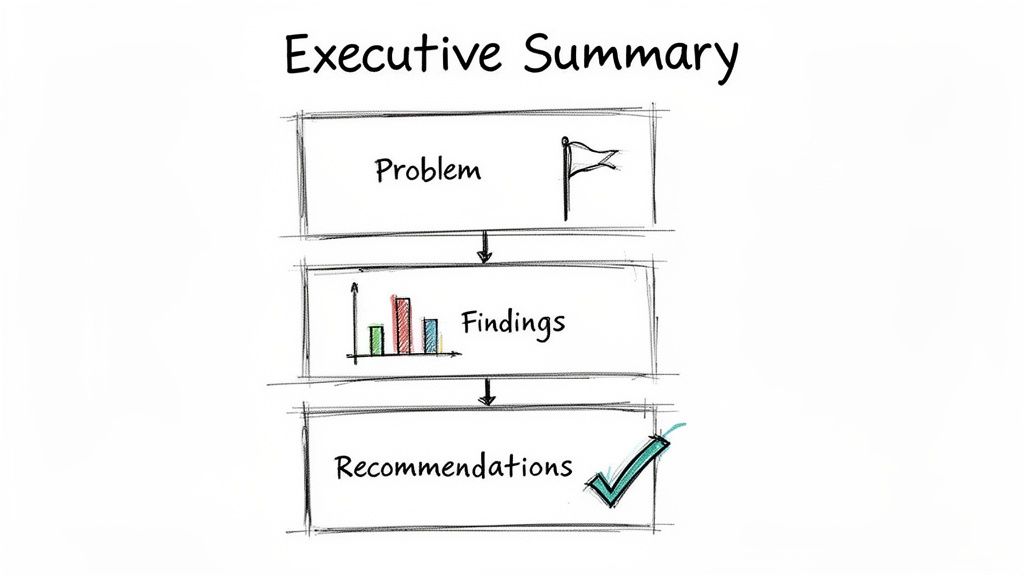
Think of your executive summary not as an introduction, but as a miniature version of the entire document. It’s a complete story—beginning, middle, and end—that has to stand on its own. If a stakeholder reads nothing else, they should still walk away with a crystal-clear understanding of the situation and the proposed path forward.
A powerful summary always follows a logical flow. It hooks the reader by defining a clear problem, builds credibility with hard data, and finishes with a decisive call to action. Mastering this structure is what turns a simple overview into a genuinely persuasive tool.
Start with a Powerful Opening Statement
Your first one or two sentences are everything. They have one job: to answer the reader's unspoken question, "Why should I care?" Don't waste this prime real estate on generic background info. Get straight to the core problem or opportunity with absolute clarity.
For example, a weak opening sounds like this: "This report analyzes our Q3 customer service metrics." It’s passive and uninspired.
Now, contrast that with a strong opening: "Our Q3 customer service response times have surged by 40%, driving a 15% drop in customer satisfaction and putting our premium client accounts at immediate risk."
See the difference? The second version instantly frames the issue, creates urgency, and tells the executive exactly why this document demands their attention. It respects their time and focuses their mind right where you need it.
A great opening doesn’t just introduce the topic; it defines the stakes. It turns a routine report into an urgent business matter that requires immediate attention.
Present Your Key Findings with Credibility
Once you've grabbed their attention with the problem, you need to back it up. This is where you build your case with cold, hard evidence. Vague statements just won't cut it here. You have to lean on specific, quantifiable data pulled directly from your main report.
Instead of saying, "Many customers were unhappy," get specific: "Our analysis of 500 customer surveys revealed that slow issue resolution was the primary complaint, cited by 68% of respondents."
Stick to the 2-3 most critical insights you discovered. Any more, and you risk muddying the waters. The goal is to provide just enough evidence to make your conclusions feel inevitable without drowning the reader in details. For anyone trying to get funding, this data-driven approach is non-negotiable. You can find more tailored advice on how to write an executive summary VCs will read to really sharpen your pitch.
Presenting your findings this way shows you've done the work and turns your summary from a set of opinions into a fact-based argument that’s tough to ignore. This kind of clarity is crucial in all business communications. It’s the same principle we discuss in our guide for creating a brand style guide template, where consistent, clear messaging builds trust across the board.
Before moving on, let's break down the essential pieces of a well-structured summary.
| Component | Purpose | Example Snippet |
|---|---|---|
| Opening Hook | Immediately state the problem or opportunity and its impact. | "Our Q3 customer service response times have increased by 40%, putting key accounts at risk." |
| Key Findings | Provide 2-3 data-backed points that support the opening statement. | "Surveys show 68% of dissatisfied customers cite slow resolution times as their primary issue." |
| Recommendations | Propose specific, actionable solutions to the problem. | "We recommend hiring two support specialists and implementing the Zendesk Pro ticketing system." |
| Expected Outcome | Briefly state the anticipated positive results of your recommendations. | "This action is projected to reduce response times by 50% and improve satisfaction by 20% within six months." |
| The "Ask" | Clearly state what you need from the reader (e.g., funding, approval). | "We are seeking approval for a budget of $95,000 to implement these changes in Q4." |
Having these components in place ensures your summary tells a complete and compelling story from start to finish.
Formulate Clear and Actionable Recommendations
This is the payoff. You’ve defined the problem and laid out the evidence—now you have to tell the reader what to do next. Your recommendations must be direct, logical, and tied directly to the issues you've raised.
Here’s a quick framework to keep your recommendations sharp:
- Be Specific: Don't suggest "improving customer service." Instead, recommend "implementing a new ticketing system and hiring two additional support specialists."
- Be Action-Oriented: Kick things off with strong verbs like launch, invest, approve, or restructure.
- Be Forward-Looking: Touch on the expected outcome. For instance, "This investment is projected to reduce response times by 50% within six months."
It's not just good practice; it gets results. One 2022 analysis found that effective executive summaries can boost project approval rates by as much as 62%, simply because a data-driven overview was the deciding factor for the board.
Business Plans and Market Opportunity
If your executive summary is for a business plan, you have a few extra ingredients to mix in. The structure should still follow that core problem-solution format, but with a laser focus on the business case itself.
You'll need to concisely cover:
- Market Opportunity: Briefly outline the size and potential of your target market.
- Your Solution: Explain what your product or service does and what makes it different.
- Financial Projections: Give a high-level snapshot of key forecasts, like projected revenue and profitability.
- The "Ask": Clearly state what you're after, whether it's a specific amount of funding or a strategic partnership.
Each of these points needs to be handled with brevity, giving investors and stakeholders the full picture in just a few paragraphs. This is often your one shot to make a great first impression, so make every word count.
Mastering a Clear and Persuasive Tone
If the structure is the skeleton of your executive summary, the tone is what gives it a pulse. You can have all the right information in all the right places, but your summary will fall completely flat if the voice is passive, muddy, or clogged with jargon. The real art is in striking a balance—projecting confidence and authority without tipping into arrogance, and being objective with the data while still being persuasive with your recommendations.
This isn't just a stylistic preference; it's a strategic necessity. Time-tracking studies show that executives spend a mere 15% of their time reading full reports. That means your summary has to be incredibly clear and convincing. They're looking for quick hits on potential ROI and strategic impact. For more on how executives read and what they value, check out this great breakdown of a summary that respects their time on swydo.com.
Adopt an Authoritative and Confident Voice
Writing with confidence isn't about using flashy, boastful language. It’s about being direct and showing conviction. When you use strong verbs and cut out hesitant, wishy-washy phrasing, you're telling the reader they're in capable hands.
Think about the difference here:
- Weak Tone: "It seems like there might be an opportunity to potentially improve our workflow."
- Confident Tone: "A significant opportunity exists to streamline our workflow and increase productivity."
See how the second one feels like a fact, not a guess? That’s what builds trust and gets your reader to take your findings seriously.
Use Active Voice to Drive Action
Want a quick way to make your writing instantly more powerful? Ditch the passive voice. The active voice is direct, energetic, and clearly states who is doing what. Passive voice, on the other hand, often sounds weak, evasive, or just plain clumsy.
It’s a simple switch with a big impact:
- Passive: "A decision was made to increase the marketing budget." (Made by whom? A ghost?)
- Active: "The leadership team decided to increase the marketing budget." (Ah, much clearer.)
Writing in the active voice forces you to be specific and gives your recommendations a real sense of forward momentum.
Eliminate Jargon and Vague Language
Remember, your executive summary is for everyone—from the CEO to a manager in a totally different department. Corporate buzzwords and overly technical jargon are just roadblocks to understanding. They make your writing feel generic and, frankly, a little lazy.
Go through your draft with a fine-toothed comb and hunt down words that sound important but don't actually say much.
- Vague: "We will leverage synergies to optimize our core competencies."
- Clear: "We will combine our marketing and sales teams’ efforts to improve our lead generation process."
Clarity is always the goal. If a term isn't universally understood, find a simpler way to say it. For those looking to tighten up their writing, using a tool like an AI text enhancer can be a great way to spot and swap out jargon for clearer alternatives.
A Practical Checklist for Self-Editing
Before you call it done, give your summary one last pass. This final polish is what separates a good summary from a great one. Ask yourself these questions:
- Is my opening sentence compelling? Does it hook the reader with the core problem or opportunity right away?
- Is every sentence in the active voice? I always search for phrases like "it was decided" or "was found" and rephrase them.
- Have I eliminated all unnecessary jargon? Could my cousin in a different industry understand this?
- Are my claims backed by specific data? Swap out vague phrases like "significant growth" with hard numbers like a "25% revenue increase."
- Are my recommendations direct and actionable? Do they kick off with strong verbs like implement, invest, or approve?
Think of your executive summary as the ultimate elevator pitch. You have a very short window to capture attention, build a case, and persuade your audience to act. A clear, confident, and direct tone is your most powerful tool to make every second count.
Putting Theory into Practice: Real-World Executive Summary Examples
Reading about how to write an executive summary is one thing, but seeing how they work in the real world is where the lessons really stick. The best way to get a feel for the right tone, structure, and flow is to look at a few solid examples.
Let’s walk through three common scenarios you’ll almost certainly encounter: a formal business proposal, a high-stakes project update, and a comprehensive marketing plan. Each one targets a different audience and has a unique goal, which completely changes the approach.
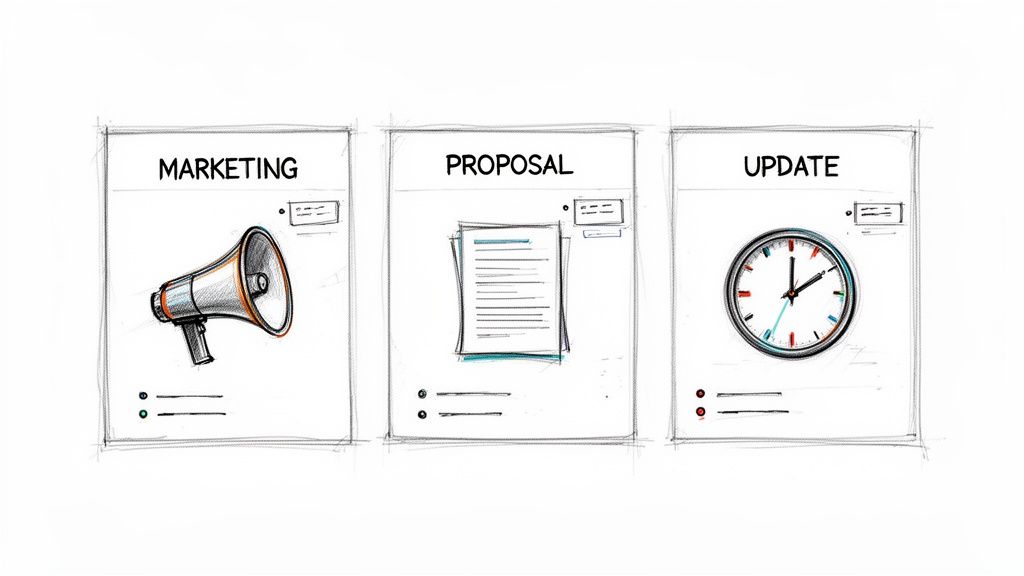
We'll look at not just what was written, but why it works—from the specific data chosen to the way the final "ask" is framed.
Example One: The Formal Business Proposal
Picture this: you need to convince the C-suite to invest in a major software overhaul. These are busy people who live and breathe efficiency, cost, and return on investment. Your summary has to speak their language from the very first sentence.
Executive Summary: Project Apex Software Upgrade
Our current project management system is causing an average of 8 hours of duplicate data entry per employee each week, costing the company an estimated $350,000 annually in lost productivity. This proposal outlines the implementation of Project Apex, a new integrated software solution designed to eliminate these inefficiencies.
Following a three-month pilot program with the operations team, we confirmed that Project Apex reduces administrative time by 90% and dramatically improves cross-departmental visibility. The core recommendation is to approve a budget of $150,000 for a company-wide rollout in Q3. We project this investment will deliver a full return within seven months and generate $1.2 million in productivity savings over the next three years.
Why This Works
- It leads with the pain. The summary opens with a huge, quantifiable problem ($350,000 lost annually) that immediately gets attention.
- Proof is in the data. It doesn’t just promise results; it cites a pilot program with a hard metric (90% reduction) to build instant credibility.
- The "ask" is crystal clear. There’s no ambiguity. The request is for a $150,000 budget.
- It’s all about ROI. The summary closes by reframing the cost as an investment with a significant and specific financial upside.
Example Two: The Critical Project Update
Now for a tougher scenario. A key project is in trouble, and you need to inform stakeholders and get them to approve a fix—fast. The audience here includes your project sponsor and department heads who need to know what’s wrong, what the solution is, and what you need from them.
Executive Summary: "Odyssey" Platform Launch Status
The "Odyssey" platform launch, currently scheduled for October 1st, is at risk of a four-week delay due to unforeseen integration issues with our legacy CRM. The primary roadblock is an API incompatibility causing critical data sync failures in 85% of our tests.
Our engineering team has identified a solution: bringing in a specialized third-party consultant to build a custom API bridge. The estimated cost is $25,000, with a two-week timeline. We are requesting immediate approval for this expenditure to get the launch back on track for October 15th, which will minimize disruption to our Q4 sales pipeline.
Why This Works
- It’s direct and honest. The bad news (four-week delay) is right at the top. No sugarcoating.
- The problem is specific. It pinpoints the exact technical issue (API incompatibility with an 85% failure rate), showing you’ve done your homework.
- The recommendation is actionable. It presents a single, clear solution with a defined cost and timeline.
- It connects to business impact. The summary smartly links the project delay to something leadership really cares about: the Q4 sales pipeline.
Example Three: The Annual Marketing Plan
Here, the goal is to get the executive team to sign off on your budget for the upcoming year. You need to focus on the big picture—market opportunities, strategic goals, and measurable business results—not get bogged down in the weeds of marketing tactics.
Executive Summary: 2024 Growth Marketing Strategy
Our 2024 marketing strategy is designed to grow our market share in the enterprise SaaS sector from 12% to 15%. Our research shows a clear opportunity to win new clients by targeting mid-market financial institutions with an integrated content and paid media campaign.
To do this, we will launch a certified partner program and increase our digital advertising spend by 30%. We project these key initiatives will generate 600 new marketing-qualified leads (MQLs) per quarter, translating to a $2.4 million increase in annual recurring revenue (ARR). We are requesting a total marketing budget of $850,000 to execute this plan and hit our revenue targets.
Why This Works
- The focus is strategic. It kicks off with a high-level business objective (growing market share from 12% to 15%).
- It connects activity to outcome. It draws a straight line from marketing tactics (partner program, ad spend) to key business metrics (600 MQLs, $2.4 million in ARR).
- The projections are quantified. Every goal is tied to a specific number, making the entire plan feel concrete, credible, and measurable.
- The budget is justified. The $850,000 ask isn’t just a number; it’s positioned as the investment required to achieve the impressive revenue growth.
A quick reference guide can be helpful to keep these core principles top of mind as you write.
Executive Summary Do's and Don'ts
| Do | Don't |
|---|---|
| Start with the most important takeaway. | Bury the conclusion at the end. |
| Use strong, quantifiable data (%, $, #). | Use vague terms like "significant" or "many." |
| Keep it concise—ideally one page or less. | Include unnecessary background or technical details. |
| Write for a non-expert audience. | Use industry jargon or acronyms without explanation. |
| Focus on recommendations and outcomes. | Simply describe the problem without a solution. |
| Write it last, after the full document is done. | Try to write it first as an outline. |
These examples and guidelines show that a great executive summary is flexible. By always focusing on your audience’s priorities and leading with clear, data-supported insights, you can craft a powerful document that gets results every time.
Common Questions About Writing Executive Summaries
Even with the best templates and guides, a few nagging questions always seem to surface right when you're trying to wrap up a report. Getting these details right can be the difference between a summary that gets your project approved and one that gets skimmed and forgotten.
Let's clear up some of the most common sticking points I've seen trip people up over the years.
What Is the Ideal Length for an Executive Summary?
There's a simple rule of thumb that's served me well: keep your executive summary to about 5-10% of the total length of the main document.
For a 20-page report, you're aiming for one, maybe two pages max. Any more than that, and you're not writing a summary anymore; you're writing a mini-report. Busy executives don't have time for that.
The real art is packing a punch into that small space. It needs to hit all the high notes—the core problem, your most important findings, and your final recommendations—so your reader gets the complete picture without having to dig through the details. Always lean towards brevity.
Should I Write the Executive Summary First or Last?
This one's not up for debate. Always, always write the executive summary last.
It’s tempting to knock it out first, thinking it will act as a roadmap for the rest of the document. In my experience, that’s a classic mistake. The story you tell in your report often evolves as you dig into the data. Key findings might shift, and your final conclusions could look different from what you initially expected.
By waiting until the main document is 100% done, you ensure the summary is a perfect, accurate reflection of the final product. It’s a snapshot of a finished masterpiece, not the rough sketch you start with.
Writing the summary last guarantees alignment. You avoid the frustrating (and credibility-damaging) scenario where your summary promises one thing, but the full report delivers something else entirely.
How Can I Make My Executive Summary More Persuasive?
True persuasion isn't about fancy words or hyped-up claims. It's about building a clear, logical business case that speaks directly to your reader's priorities. You need to show them you understand their problem and have a credible solution.
Here’s how to dial up the persuasive power:
- Hook them immediately. Open with a critical problem or a can't-miss opportunity that matters to them. Get straight to the "why."
- Back it up with hard numbers. Don't just say sales went up. Say, "We drove a 15% revenue increase in Q4." Specific data builds trust and makes your claims undeniable.
- Focus on the outcome. Instead of just listing what you want to do, connect each recommendation to the return on investment (ROI). Explain exactly how your plan solves that problem you mentioned in the hook.
- Make a clear "ask." End by telling them precisely what you need. Do you want them to approve a budget? Green-light the next phase of the project? Don't be vague.
What Is the Difference Between an Introduction and an Executive Summary?
This is a common point of confusion, but the distinction is critical. Think of it this way: an introduction is a signpost. It sets the stage and tells the reader what they are about to read, giving them context and a map of the document.
An executive summary, on the other hand, is the whole story in miniature. It’s a self-contained document. Someone can read it and walk away with a complete understanding of the problem, the analysis, and the solution, even if they never touch the full report.
In short, an introduction says, "Here's what I'm going to tell you." An executive summary says, "Here's everything you need to know."
Ready to turn your drafts into polished, professional content? Rewritify is an AI-powered tool that refines your writing to be clear, original, and ready for any audience. Stop struggling with awkward phrasing and start creating high-impact documents in a single click. Discover how it works.
Relevant articles

Master the difference between complement and compliment with our guide. Learn the definitions, grammar, and usage with clear examples to perfect your writing.

Learn how to structure an argumentative essay with our expert guide. We break down the thesis, body paragraphs, and counterarguments for a powerful paper.

Discover differences between formal and informal writing, with practical tips, examples, and syntax cues to choose the right tone every time.
Discover 8 expert-approved concluding sentence starters with examples. Learn how to write powerful, memorable conclusions for essays, reports, and more.
Tired of memos getting ignored? Learn how to write a memo that commands attention, drives action, and gets results with our expert guide and practical examples.
Explore formal writing style examples across academic and professional contexts. Learn tone, structure, and vocabulary to write with clarity.