How to Rewrite a Paragraph to Sound Smarter and More Professional
Learn how to rewrite a paragraph for clarity, originality, and impact. Our guide offers professional techniques and real-world examples to elevate your writing.
To rewrite a paragraph, you first need to figure out what’s wrong with it. Is it clunky? Unclear? Does it sound like someone else wrote it? Once you've diagnosed the problem, you can use different techniques like paraphrasing or shuffling sentences around to fix it. The trick is to keep the original meaning intact while making the text entirely your own.
Why Effective Rewriting Is a Career-Defining Skill
We're all drowning in content. In this environment, the ability to take a so-so paragraph and make it great is a massive advantage. It’s what separates a message that gets scrolled past from one that actually makes someone stop and think.
Think of it this way: rewriting is how you make every word pull its weight. This skill isn't just for professional writers. If you're a student trying to avoid plagiarism, a marketer fighting for clicks, or a manager who needs your team to understand a memo perfectly, rewriting is what turns a good idea into a great piece of communication.
The Growing Demand for Polished Content
The demand for genuinely good writing has exploded. The global content marketing industry ballooned from $36.8 billion in 2018 to a massive $413.3 billion by 2022. It's no surprise that 90% of marketers see content creation as the single most important skill for success. You can see more details on these trends in Meltwater's 2023 report.
This trend points to a clear reality: just having the information isn't enough anymore. People expect content that’s polished, clear, and easy to digest. Knowing how to effectively rewrite a paragraph is how you meet that expectation every time.
Key Takeaway: Rewriting isn't just about correcting typos. It's about strategically reshaping your message to hit a specific target—whether that's persuading a customer, acing an assignment, or leading a team with crystal-clear directives.
What You Can Achieve with Better Rewriting
Once you get the hang of it, this skill delivers real, tangible benefits that take your work from "good enough" to "genuinely impressive." Before we jump into the "how," let's quickly cover the "why." Different rewriting goals solve different problems in your original text.
To help you pinpoint your own needs, here's a breakdown of the main objectives when you rewrite a paragraph.
Key Goals of Rewriting a Paragraph
| Goal | Why It Matters | Who It Helps Most |
|---|---|---|
| Improve Clarity | Ensures your message is understood instantly, preventing any confusion or misinterpretation. | Professionals, students, technical writers |
| Enhance Tone | Aligns your writing with your specific audience, making it more persuasive, formal, or engaging. | Marketers, customer support, managers |
| Ensure Originality | Prevents plagiarism by rephrasing ideas in your unique voice while properly citing your sources. | Students, researchers, journalists |
| Increase Engagement | Makes your writing more dynamic and interesting, hooking the reader from the very first sentence. | Bloggers, social media managers, copywriters |
As you can see, rewriting is a versatile tool. It’s not a one-size-fits-all process but a targeted solution for making your writing more effective, no matter who you're writing for.
Diagnosing Paragraph Problems Before You Rewrite
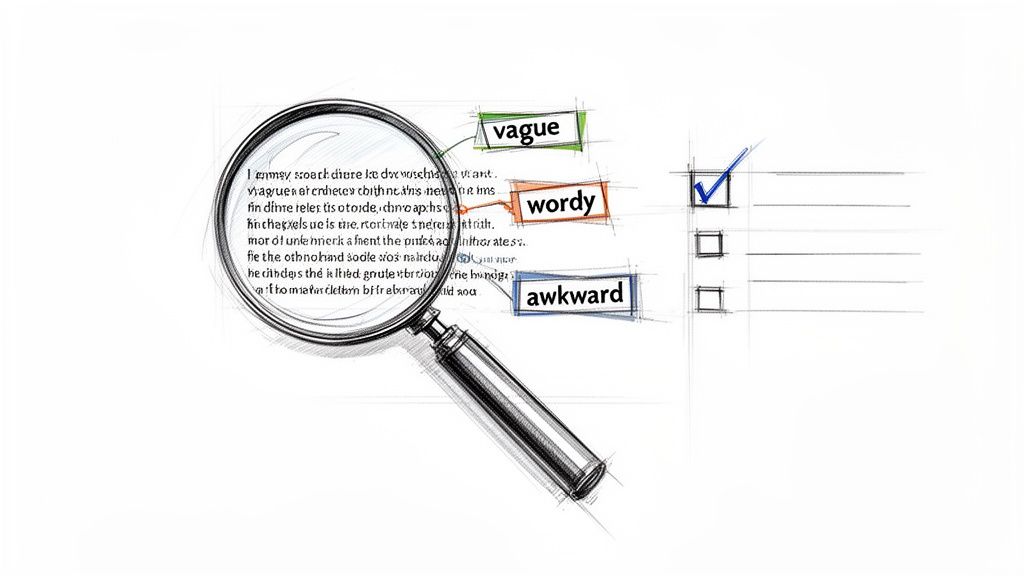
Before you can fix a paragraph, you have to know what's broken. It's tempting to just jump in and start swapping out words, but that's like putting a new coat of paint on a crumbling wall. You won't solve the real problem.
Here’s a trick I use all the time: I try to explain the paragraph's main idea out loud. You can do this with a colleague or even just talking to yourself. What you’ll find is that your spoken explanation is almost always clearer and more direct than what you originally wrote. That first thing you say? That’s probably the key point you buried halfway through the paragraph.
This simple exercise cuts through the fluff and reveals the core message. Once you’ve nailed that down, you can move on to a more formal check-up.
A Quick Diagnostic Checklist
Run your paragraph through this gauntlet of questions. Be honest with your answers—they'll tell you exactly what needs to be fixed and give you a clear roadmap for the rewrite.
- Is the main idea crystal clear? A good paragraph should rally around a single point. If you can’t summarize it in one clean sentence, your paragraph is trying to do too much.
- Is it full of filler? We all do it—we "warm up" with throat-clearing phrases and empty statements. It's time to be ruthless. Cut every word that doesn't actively support the main idea.
- Is the language specific or vague? Abstract words are a reader's worst enemy. Don’t say a tool "improves efficiency." Say it "cuts report generation time by 50%." Specific details build credibility and make your point stick.
- Does the tone fit the reader? Writing for a technical whitepaper is worlds away from writing a casual blog post. Make sure your voice, word choice, and level of formality are a perfect match for your audience.
If you answered "no" to any of these, you’ve got a clear signal that it’s time to roll up your sleeves and rewrite.
Expert Tip: Don't get emotionally attached to your first draft. The goal here is effective communication, not preserving every word you initially wrote down. Be ready to scrap whole sentences—or even the entire paragraph—if it's not pulling its weight.
Spotting Problems in a Real Example
Let's look at a pretty common offender, the kind of weak introduction you see all over the web.
Before:
For many years, the field of digital marketing has been an area of significant interest for businesses looking to expand their reach. The utilization of various strategies is important for success in this domain. This article will explore some of those strategies.
This paragraph is a textbook case of what not to do. It’s wordy (who says "utilization of"?), vague ("various strategies," "significant interest"), and has a passive, sleepy tone. It took three sentences to say absolutely nothing of substance.
The diagnosis? It lacks focus, energy, and any concrete detail. Now that we know exactly what’s wrong, we can rewrite it with a clear purpose.
Core Techniques for a Powerful Paragraph Rewrite
Alright, you've pinpointed what's wrong with a paragraph. Now for the fun part: rebuilding it. This is more than just swapping out a few words. Think of it less like a fresh coat of paint and more like taking an engine apart and putting it back together so it runs smoother and faster.
Each of these techniques is a tool for a specific job, whether you're trying to fix a clunky sentence, inject some personality, or make sure your ideas are truly your own.
Strategic Paraphrasing: More Than Just a Thesaurus
The first and most crucial technique is strategic paraphrasing. I’m not talking about right-clicking a word and finding a synonym. That’s a rookie mistake that often makes things worse. Real paraphrasing means you internalize the core idea and then explain it from a completely different angle, using your own words and sentence structure.
Let's look at a common example of corporate-speak:
Before:
The company’s implementation of a new software system resulted in a significant enhancement of operational efficiency.
A lazy paraphrase would just swap words, leaving you with something just as clunky. A strategic paraphrase, however, gets straight to the point:
After:
By adopting the new software, the company made its operations far more efficient.
See the difference? It’s shorter, clearer, and says the exact same thing without borrowing the original’s clunky framework.
Varying Sentence Structure for Rhythm and Flow
Nothing kills a reader's interest faster than a monotonous rhythm. If every sentence is the same length and structure (subject-verb-object, subject-verb-object), you're creating a lullaby. You need to mix it up to keep your reader awake and engaged.
Here are a few simple ways to do that:
- Lead with a clause: Instead of "We launched the campaign after we analyzed the data," try, "After analyzing the data, we launched the campaign." It just flows better.
- Use a short, punchy sentence: After a long, detailed thought, drop in a short, sharp sentence. Bam. It creates a powerful contrast.
- Flip the sentence on its head: Every now and then, inverting the normal word order can add emphasis right where you want it.
Playing with sentence length and structure is one of the quickest ways to inject energy into your writing. And while we're focused on the paragraph level here, remember that each one is a building block. For a deeper dive into the bigger picture, check out this guide on mastering overall structure in writing.
Strengthening Word Choice and Tone
Weak words make for weak writing. The goal here is to hunt down vague, passive language and replace it with strong verbs and precise nouns. This isn't about showing off a big vocabulary; it's about being clear and confident.
My Pro Tip: Do a quick scan for "to be" verbs (is, am, are, was, were) and adverbs ending in "-ly" (like really, very, or significantly). These are red flags for passive or weak phrasing. Challenge yourself to find a single, stronger verb to do the job instead.
Let’s see it in action. Here's a passive, wordy sentence:
Before:
There was a rapid increase in user engagement after the update was released by the development team.
It’s just… limp. Let’s give it some muscle:
After:
The development team's update triggered a surge in user engagement.
Boom. Shorter, more energetic, and it’s crystal clear who did what. It moves the tone from a boring observation to an impactful statement.
This stuff matters. With 5.30 billion internet users out there, and some publishers seeing social media referrals drop by over 50%, your content has to fight for attention. The demand for fresh, engaging content is what’s pushing the content services market toward a projected $35.63 billion by 2032, a trend highlighted in the October 2023 Global Statshot Report.
By combining these core techniques, you can take any paragraph apart and rebuild it to be stronger, clearer, and far more effective.
How to Use AI Rewriting Tools the Right Way
AI paragraph rewriters can be a massive help, but using them blindly is a surefire way to produce flat, uninspired content. The key is to see these tools as a starting point—a creative partner—not a machine that spits out a finished product. Your role is to guide the AI, not just take whatever it gives you on the first try.
Think of an AI tool like Rewritify as an assistant that does the initial heavy lifting. It can instantly spin up new sentence structures and find different words, which is perfect for breaking through writer's block. The real value, though, comes when you step in as the human editor to polish and refine its output.
Guiding Your AI for Better Results
The quality of your final paragraph comes down to how you interact with the tool. Don't just paste your text and hit "rewrite." You need a more thoughtful process. Start by giving the AI clear directions. For instance, if a paragraph sounds like it was pulled from a textbook, you could prompt the tool to "rewrite this for a beginner audience" or "make this sound more conversational."
This simple workflow applies whether you're rewriting manually or with an AI assist.
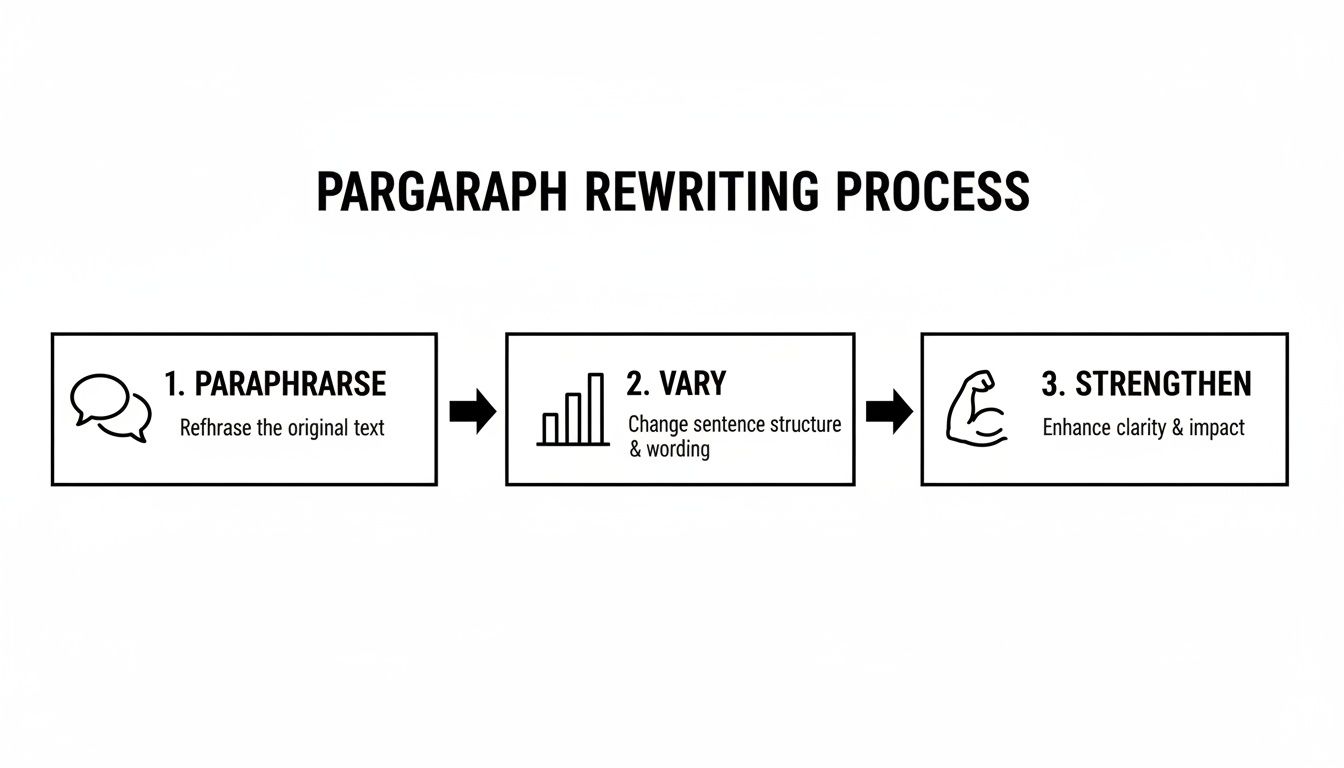
As you can see, a good rewrite isn't just about swapping out a few words. It's about fundamentally changing the structure and making the core message hit harder.
This "human-in-the-loop" strategy is more important than ever. AI detection rates on major platforms are now climbing past 70%. That reality has pushed 50% of users toward writing and rewriting tools, and 52% of them are focused specifically on paraphrasing to make their content feel more authentic. If you're exploring your options, this list of leading AI content creation tools is a great place to start.
Editing AI Output to Keep Your Voice
Once the AI gives you a new version, your real work begins. This is where you add the nuance, context, and personality—all the human elements that AI struggles with.
My Personal Workflow: I always read the AI-generated paragraph aloud. If it sounds clunky or nothing like I'd actually say, I start making changes. I might combine two short, choppy sentences to create a smoother flow, or I'll break up a long, rambling one to make a point more forcefully.
This final touch is everything. It's your chance to fact-check, add your own insights, and make sure the tone is a perfect match for your brand. To get better at this, check out our guide on how to rewrite AI-generated text and keep it sounding human.
At the end of the day, the tool is there to give you the clay; it's your job as the writer to shape it into something great.
The Final Polish: Your Rewritten Paragraph Checklist
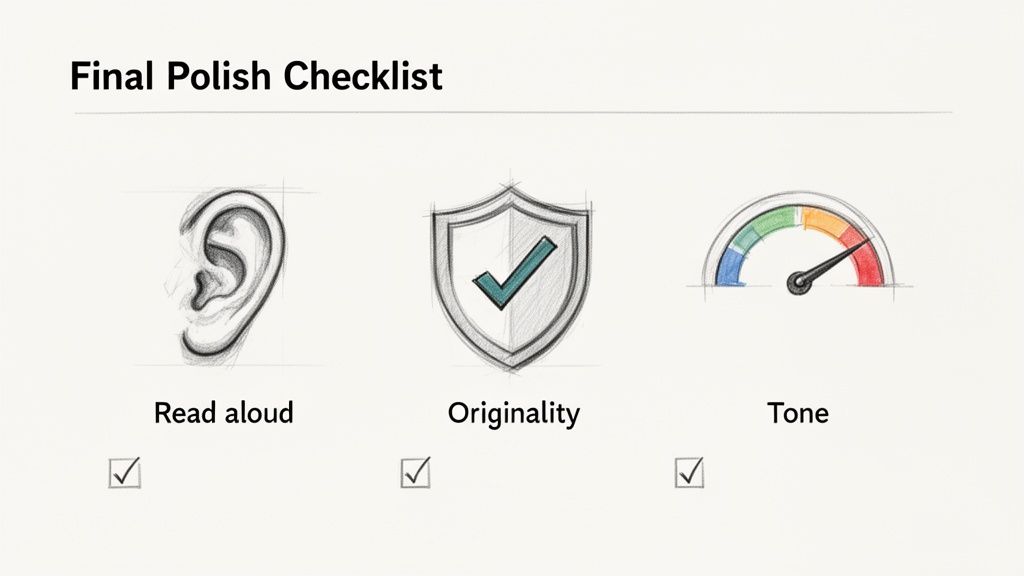
It’s tempting to hit "publish" the second you finish a rewrite, but that's a rookie mistake. A few extra minutes of review can elevate your work from "done" to "dazzling." Think of this as your final quality control sweep.
The very first thing I always do is read the paragraph out loud. It's a simple trick, but incredibly effective. Your ears will instantly pick up on clunky phrasing and awkward rhythms that your eyes might just skim over.
If you find yourself stumbling over a sentence, you can bet your reader will, too. This is the quickest way to find those last few spots that need a final tweak for a smoother, more natural flow.
Verifying Accuracy and Originality
Once the paragraph sounds good, you need to make sure it is good. The top priority here is confirming that the core meaning is still intact. Did your rewrite accidentally twist the original message? It’s an easy mistake to make, so double-check that the new wording is faithful to the initial idea.
Next up, run the text through a plagiarism checker. This isn’t just for academic essays; it’s a non-negotiable step for any professional writer. It helps you catch "patchwriting," where you've unintentionally copied the source's structure too closely, even with different words.
Key Takeaway: A great rewrite walks a fine line. It must be 100% original in its expression while remaining 100% faithful to the original meaning. This final check ensures you've nailed that balance perfectly.
Final Checks for Tone and Grammar
Now, step back and look at the bigger picture. Does the tone of your rewritten paragraph fit with the rest of the document? If you made a formal section more conversational, make sure it doesn’t stick out like a sore thumb. Consistency is what makes a piece of writing feel cohesive and professional.
Finally, do one last sweep for grammar and spelling. This is also the perfect time to look for those sneaky, commonly confused words that can trip up even experienced writers. If you want a quick refresher, check out our guide on frequently misused words.
This quick, multi-point inspection is what separates good writing from great writing. Making this checklist a habit guarantees your final product is clear, accurate, and truly ready for your audience.
Common Questions About Rewriting Paragraphs
Working out the kinks of a paragraph often brings up some tricky questions. It's totally normal to second-guess yourself. Are you accidentally plagiarizing? Is your own voice getting lost in the shuffle? Should you just scrap the whole thing and start over?
Let's walk through some of the most common hurdles writers run into. Getting these straight will make your whole rewriting process feel less like a chore and more like a craft.
What Is the Difference Between Paraphrasing and Rewriting?
People often use these terms interchangeably, but it helps to think of them as two different tools in your kit. One is a scalpel, the other is a complete renovation kit.
Paraphrasing is the scalpel. It’s a very specific action where you rephrase someone else's idea in your own words. The goal here is usually to avoid plagiarism while keeping the original meaning and structure mostly intact. You’re essentially translating it.
Rewriting is the big-picture renovation. It’s a much broader strategy where you might completely overhaul a paragraph's structure, tone, and focus to better serve your audience or your goal. Maybe you're rewriting a clunky academic paragraph to make it punchy and clear for a blog post.
All paraphrasing is technically a form of rewriting, but not all rewriting is just simple paraphrasing.
For a more detailed breakdown, our guide on how to paraphrase without plagiarizing is a great resource for mastering this skill.
How Can I Rewrite Without Losing My Personal Writing Voice?
This is a huge one. Your voice is what makes your writing yours, and it's essential to protect it. The key is to see rewriting as a process of refinement, not replacement.
After you've moved sentences around or swapped out a few words for clarity, take a step back and read the paragraph out loud. Seriously. Does it sound like you? If the rhythm feels stiff or the words sound like they came from a thesaurus, it’s not right. Tweak it until it feels natural coming out of your mouth.
Expert Tip: If you're using an AI tool for help, think of its output as raw material, not the final product. Your job is to be the human editor. The final pass is where you weave in your own perspective, add a personal touch, and adjust the phrasing until it sounds undeniably like you.
When Should I Rewrite a Paragraph Instead of Starting Over?
Ah, the classic "fix it or forget it" dilemma. I've found a simple rule of thumb works wonders here.
You should rewrite a paragraph when its core idea is solid, but the execution is weak.
If the paragraph holds a key piece of your argument or a vital transition but is just confusing, clunky, or has the wrong tone, it's worth the effort to rewrite it. On the other hand, if you realize the main point of the paragraph is flimsy, off-topic, or just repeats something you've already said, it's almost always faster to just hit delete and start again with a clearer goal.
If the "what" is good but the "how" is bad, rewrite.
Can I Get in Trouble for Rewriting Someone Else's Paragraph?
Yes, absolutely. Without proper care and citation, rewriting someone else's work is a fast track to plagiarism. Just changing a few words here and there—a practice often called "patchwriting"—is a major red flag and isn't enough to claim the work as your own.
To do this ethically, you have to truly digest the original idea first. Then, build it back up from scratch using your own vocabulary and sentence structure. Most importantly, you must always cite the original source. Giving credit where it's due is non-negotiable in any academic or professional setting.
Ready to turn those rough drafts into polished, professional paragraphs? Rewritify gives you the power to rephrase, restructure, and refine your writing in seconds. Whether you need to simplify complex ideas or ensure your text is undetectable by AI, our tool helps you produce clear, original content while preserving your unique voice. Try Rewritify for free and see the difference it makes.
Relevant articles

Master the difference between complement and compliment with our guide. Learn the definitions, grammar, and usage with clear examples to perfect your writing.

Learn how to structure an argumentative essay with our expert guide. We break down the thesis, body paragraphs, and counterarguments for a powerful paper.
Discover 8 expert-approved concluding sentence starters with examples. Learn how to write powerful, memorable conclusions for essays, reports, and more.
Explore formal writing style examples across academic and professional contexts. Learn tone, structure, and vocabulary to write with clarity.
Learn how to rewrite this sentence for clarity and engagement, with practical tips and real-world examples.
Discover how to reword a paragraph to improve clarity, voice, and SEO. Learn practical manual techniques and how to leverage AI tools for great results.