Formal Writing Style Examples: Master Tone, Clarity, and Structure
Explore formal writing style examples across academic and professional contexts. Learn tone, structure, and vocabulary to write with clarity.
In a world of informal texts and fleeting social media updates, mastering a formal writing style is a professional superpower. It is the key to earning academic respect, securing business deals, and building lasting credibility. But 'formal' does not mean overly complex or robotic; it means clear, precise, and appropriate for the context. Shifting from a casual to a formal tone requires more than just using bigger words, it demands a strategic approach to structure, objectivity, and audience awareness.
This guide moves beyond theory to provide a comprehensive collection of practical formal writing style examples. We break down 7 distinct categories of professional communication, from academic essays to business proposals and corporate press releases. Each section offers actionable before-and-after comparisons, strategic insights, and replicable methods you can apply immediately.
You will learn exactly how to:
- Adapt your tone for different professional audiences.
- Refine word choice to convey authority and precision.
- Structure sentences and paragraphs for maximum clarity and impact.
We will analyze everything from scholarly articles to professional emails, showing you exactly how to adjust your approach to achieve specific goals. Whether you are a student aiming for a better grade, a marketer optimizing content, or a business professional looking to make a stronger impact, these examples will equip you with the skills to write with confidence and authority. Let's explore how to transform your writing from casual to credible.
1. Academic Writing Style
Academic writing is a formal, objective, and evidence-based style used in scholarly contexts like research papers, dissertations, and peer-reviewed articles. Its primary purpose is to present complex ideas and research findings with clarity, precision, and credibility. This style avoids emotional language, slang, and personal opinions, instead relying on rigorous analysis, logical arguments, and verifiable evidence.
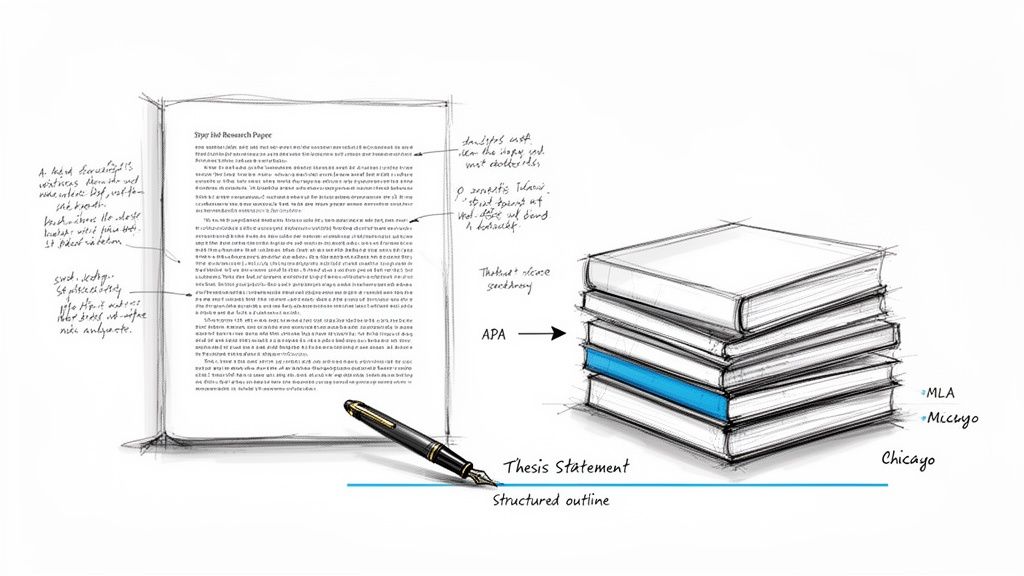
This formal writing style is characterized by its structured format, which often includes an abstract, introduction, literature review, methodology, results, and conclusion. Adherence to specific citation standards such as APA, MLA, or Chicago is non-negotiable, as it ensures intellectual honesty and allows other researchers to trace sources.
Example Breakdown: From Informal to Academic
Let's examine how a simple, informal observation can be transformed into a formal academic statement. This comparison highlights key differences in tone, vocabulary, and structure.
Informal Version:
"I think that when kids play video games a lot, they get better at solving problems. It’s like the games teach them to think faster."
This sentence uses a first-person perspective ("I think"), casual language ("a lot," "kids"), and makes a general claim without evidence.
Formal Academic Rewrite:
"Emerging research indicates a positive correlation between sustained engagement in strategic video games and the development of enhanced problem-solving skills in adolescents. These cognitive benefits are attributed to the complex, multi-step challenges that require rapid, analytical decision-making."
Analysis of the Rewrite:
- Objectivity: The rewrite removes the personal "I think" and instead uses the third-person phrase "Emerging research indicates," which grounds the claim in external evidence.
- Precision: Vague terms like "kids" and "a lot" are replaced with specific, formal language like "adolescents" and "sustained engagement."
- Specialized Vocabulary: Words like "correlation," "cognitive benefits," and "analytical decision-making" are used to convey meaning with academic accuracy.
- Structure: The sentence is more complex, linking a cause (gaming) to an effect (enhanced skills) while also providing a brief explanation for the connection.
Actionable Tips for Academic Writing
- Adopt a Third-Person Perspective: Unless your discipline or instructor specifies otherwise, write from an objective third-person point of view (e.g., "The study found..." instead of "I found...").
- Use Precise Language: Avoid generalizations. Replace "good" with "effective" or "advantageous," and "bad" with "detrimental" or "inefficient."
- Cite Everything: Every claim, statistic, or idea that is not your own must be attributed to its source using a consistent citation style. This is a fundamental rule of academic integrity.
- Structure for Clarity: Use clear topic sentences for each paragraph and logical transitions to guide the reader through your argument.
- Revise Thoroughly: The first draft is never the final one. Plan for multiple rounds of revision to refine your arguments, check for clarity, and eliminate any remaining informal language. For a deeper dive into these techniques, explore these resources on how to improve academic writing.
2. Business Proposal and Report Writing
Business proposals and reports employ a formal, persuasive style designed to present ideas, findings, or recommendations to key stakeholders like investors, clients, or management. This style balances professionalism with clarity, using structured formats and data-driven arguments to convince readers and guide decision-making. It avoids overly academic jargon and casual language, aiming instead for direct, authoritative, and actionable communication.
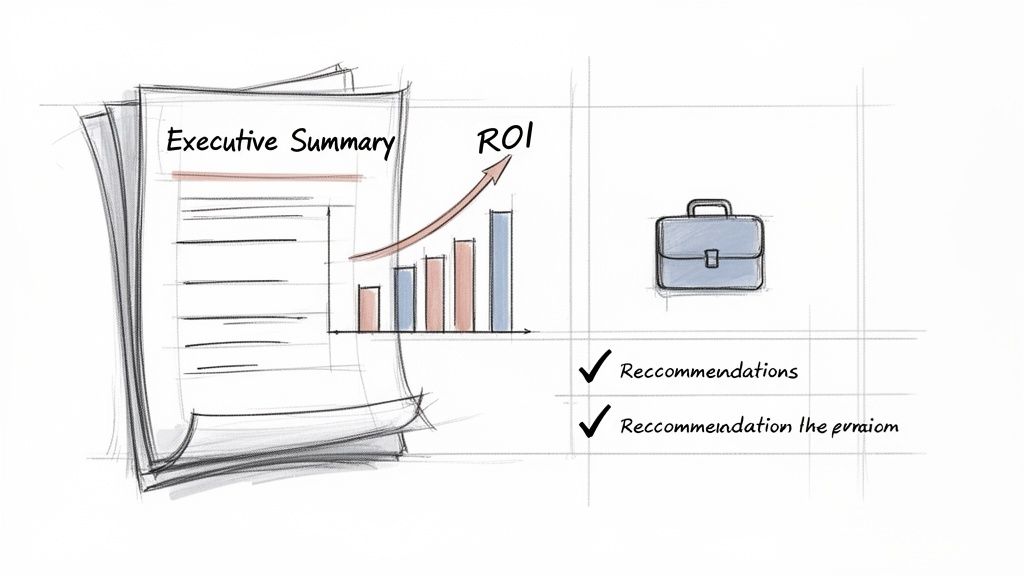
This type of formal writing is essential for documents like project proposals, quarterly earnings reports, and strategic plans. The core objective is not just to inform but to persuade. Therefore, the tone is confident, the language is precise, and the arguments are supported by quantifiable metrics, such as financial projections, market analysis, and key performance indicators (KPIs).
Example Breakdown: From Informal to Business Professional
Let's transform a casual project update into a formal business report statement. This comparison showcases the shift from conversational language to a data-centric, professional tone.
Informal Version:
"We've been working hard on the new marketing plan and it's going pretty well. We think it'll get a lot more people to visit our website soon."
This statement is vague, subjective ("pretty well"), and lacks the specific data needed for business decisions.
Formal Business Rewrite:
"The Q3 marketing initiative is on schedule, with Phase 1 completed 10% under budget. We project a 25% increase in website traffic and a 15% uplift in lead generation within the first month of implementation, based on preliminary A/B testing results."
Analysis of the Rewrite:
- Professional Tone: The rewrite eliminates casual phrases like "working hard" and "pretty well," replacing them with professional, objective language like "on schedule" and "completed."
- Data-Driven Arguments: Vague hopes ("get a lot more people") are replaced with specific, measurable projections ("a 25% increase in website traffic," "15% uplift in lead generation").
- Specificity: The statement specifies the project ("Q3 marketing initiative"), its status ("Phase 1 completed"), and the basis for its projections ("preliminary A/B testing results").
- Action-Oriented Language: The rewrite focuses on concrete outcomes and financial implications ("10% under budget"), which is critical for stakeholder evaluation.
Actionable Tips for Business Writing
- Lead with the Conclusion: Business readers are often time-poor. Start with an executive summary or "bottom line up front" (BLUF) to state your key findings or recommendations immediately.
- Quantify Your Claims: Whenever possible, use numbers, percentages, and financial data to support your arguments. Instead of "significant growth," state "a 40% year-over-year increase."
- Use Clear Headings and Bullet Points: Structure your documents with descriptive headings, subheadings, and bullet points to make information scannable and easy to digest.
- Maintain a Consistent Brand Voice: Ensure your terminology, tone, and formatting align with your organization's established brand identity for a professional and cohesive presentation.
- Tailor to Your Audience: Adjust the level of technical detail based on whether you are writing for executives, engineers, or external clients. Avoid jargon they may not understand.
3. Legal and Compliance Writing
Legal and compliance writing is a highly formal and precise style used in contracts, regulatory filings, and official notices. Its primary objective is to create unambiguous, enforceable documents that minimize legal risk. This style prioritizes accuracy over readability, often employing specific terminology and complex sentence structures to cover all potential scenarios and eliminate loopholes.
This formal writing style is essential for creating documents that are legally binding and defensible in court. It avoids emotional language, subjective interpretations, and any phrasing that could be construed in multiple ways, focusing instead on explicit definitions and logically structured obligations.
Example Breakdown: From Informal to Legal
Let's transform a simple verbal agreement into a formal legal clause. This comparison illustrates the dramatic shift in precision, tone, and structure required in legal writing.
Informal Version:
"Okay, I'll pay you back the $500 I owe you by the end of next month. I promise."
This statement is casual, lacks specific details (like the exact date or consequences of non-payment), and relies on a verbal promise, which is difficult to enforce.
Formal Legal Rewrite:
"The Debtor agrees to remit the full principal sum of five hundred dollars ($500.00) to the Creditor on or before the last business day of the subsequent calendar month. Failure to render payment by said date shall constitute a default, whereupon the Creditor may pursue all available legal remedies."
Analysis of the Rewrite:
- Precision and Specificity: The informal "pay you back" becomes the formal "remit the full principal sum." Vague terms like "next month" are replaced with the explicit "on or before the last business day of the subsequent calendar month."
- Defined Roles: Parties are formally identified as "Debtor" and "Creditor" to remove any ambiguity about who is who.
- Consequence-Oriented Language: The rewrite clearly states the consequences of non-compliance ("shall constitute a default") and the resulting actions ("pursue all available legal remedies").
- Formal Vocabulary: It uses specialized legal terms like "remit," "principal sum," "constitute a default," and "remedies" to ensure the clause is legally sound and understood within a legal framework.
Actionable Tips for Legal and Compliance Writing
- Define Key Terms Explicitly: Start your document with a "Definitions" section to clarify any term that could be ambiguous (e.g., "Confidential Information," "Effective Date").
- Maintain Absolute Consistency: Use the exact same term for the same concept throughout the entire document. For example, do not switch between "agreement," "contract," and "covenant."
- Use Numbered Sections and Subsections: Structure documents with a clear hierarchy (e.g., 1.0, 1.1, 1.1.1) to make them easy to navigate and reference specific clauses.
- Be Aware of Specific Jargon: Understanding the specific vocabulary and structure is key when preparing legal documents. For instance, processes involving official notarized texts require familiarity with what is known as notary language to ensure compliance.
- Seek Professional Review: Always have contracts, policies, and other critical documents reviewed by a qualified legal professional before finalization.
4. Technical and Scientific Documentation
Technical and scientific writing is a highly formal and precise style designed to convey complex information clearly, accurately, and unambiguously. It is the language of instruction manuals, engineering specifications, and scientific reports, where the primary goal is to inform and guide the reader without any room for misinterpretation. This style prioritizes objectivity, logic, and factual accuracy over creative expression.
Unlike more persuasive forms of formal writing, technical documentation avoids emotional appeals and subjective language entirely. Its structure is often rigid and standardized, as seen in product manuals or scientific papers, ensuring that users and researchers can find the information they need efficiently. Precision is paramount, as a single vague term could lead to incorrect procedures or flawed experimental replication.
Example Breakdown: From Informal to Technical
Let's transform a casual instruction into a formal technical directive. This comparison highlights the essential shift in clarity, precision, and tone required for effective technical writing.
Informal Version:
"Just plug the new part into the main board where the old one was. Make sure it clicks, and then you can turn the machine back on to see if it works."
This instruction is conversational and lacks the necessary specificity for a technical procedure. It uses ambiguous terms like "new part" and "main board."
Formal Technical Rewrite:
"1. Power down the device and disconnect it from the main power supply. 2. Unlatch and remove the existing RAM module (PN: 25-A8) from the primary memory slot (JRAM1) on the motherboard. 3. Align the notch on the new RAM module (PN: 25-B2) with the key in the JRAM1 slot and insert it firmly until the side clips lock into place with an audible click. 4. Reconnect the device to the main power supply and initiate the startup sequence to verify installation."
Analysis of the Rewrite:
- Precision and Specificity: The rewrite replaces vague terms with specific identifiers like "RAM module (PN: 25-A8)" and "JRAM1 slot." This eliminates guesswork.
- Procedural Clarity: The instructions are broken down into a numbered, sequential list, which is a hallmark of technical documentation. This logical flow is easy to follow.
- Objective Tone: The language is impersonal and command-based ("Power down," "Align," "Insert"). It focuses entirely on the action and the object, removing any subjectivity.
- Completeness: It includes critical prerequisite steps, such as powering down the device, which the informal version omitted for brevity.
Actionable Tips for Technical Writing
- Define All Jargon: Define any technical terms, acronyms, or abbreviations on their first use or in a dedicated glossary. Do not assume your audience knows everything.
- Use Numbered Steps for Procedures: For any set of instructions, use a numbered list to guide the user through the process sequentially. This is a fundamental aspect of clear technical communication.
- Be Direct and Concise: Use active voice and imperative verbs (e.g., "Connect the cable," "Install the software") for instructions. Avoid wordy phrases to ensure clarity.
- Incorporate Visuals: Use diagrams, schematics, flowcharts, and screenshots to supplement text. Visual aids can often explain complex spatial or procedural information more effectively than words alone.
- Verify All Data: Double-check every specification, number, and procedural step for accuracy. In technical writing, a small error can have significant consequences.
5. Corporate Communications and Press Releases
Corporate communications represent a formal yet accessible writing style used to convey official messages from a company to its stakeholders, including employees, investors, the media, and the public. The primary goal is to manage brand reputation, disseminate critical information, and maintain a consistent, professional voice. This style carefully balances clarity and engagement with strategic messaging, ensuring that all communications are accurate, authoritative, and aligned with company values.
This formal writing style is prevalent in press releases, investor relations updates, internal memos, and crisis management statements. It avoids overly technical jargon unless addressing a specialist audience and refrains from casual or speculative language. Every word is chosen to uphold the company's image, build trust, and deliver information with precision and impact.
Example Breakdown: From Informal to Corporate
Let's observe how an internal, informal update about a product delay can be transformed into a formal press release. This comparison showcases the shift in tone, vocabulary, and strategic focus required for public-facing communications.
Informal Version:
"Hey team, bad news. The new software launch is delayed. We ran into some major bugs and have to push the release date back a few weeks. We'll let everyone know the new date when we figure it out."
This message is casual, lacks specific details, and could create uncertainty or panic if released publicly.
Formal Corporate Rewrite:
"FOR IMMEDIATE RELEASE – [City, State] – [Company Name] today announced an updated release schedule for its upcoming software, [Software Name], to ensure the product meets the highest standards of quality and performance. The new launch date is projected for [New Date]. This extension allows our development team to implement additional enhancements and conduct further rigorous testing, reinforcing our commitment to delivering a best-in-class user experience."
Analysis of the Rewrite:
- Strategic Framing: The rewrite reframes a negative event ("delay") into a positive action ("updated release schedule," "commitment to delivering a best-in-class user experience").
- Professional Tone: Casual phrases like "bad news" and "figure it out" are replaced with authoritative, confident language such as "announced an updated release schedule" and "projected for."
- Audience Focus: The message is no longer about internal problems ("major bugs") but about the benefit to the customer ("highest standards of quality and performance").
- Clarity and Authority: It provides a clear, projected timeline and uses a standard press release format to convey official information, which is a key element in these formal writing style examples.
Actionable Tips for Corporate Communications
- Lead with the Key Message: Employ the "inverted pyramid" structure, placing the most critical information at the beginning of the communication.
- Maintain a Consistent Brand Voice: Use a style guide to ensure terminology, tone, and messaging are consistent across all platforms, from internal memos to public announcements.
- Be Factual and Specific: Support statements with verifiable data and clear facts. Avoid making ambiguous claims or promises that cannot be kept.
- Tailor the Message to the Audience: While the tone is always formal, adjust the language and level of detail for different stakeholders (e.g., investors require financial data, while customers need user benefits).
- Review and Approve Meticulously: All external communications should undergo a multi-level review process to check for accuracy, clarity, tone, and potential legal implications before publication.
6. Professional Email and Business Correspondence
Professional business correspondence is a formal yet concise style used to communicate effectively within and across organizations. It prioritizes clarity, purpose, and politeness to convey information, request action, and maintain professional relationships. This style avoids overly casual language, emojis, and ambiguity, ensuring that every message is efficient, respectful, and clear.
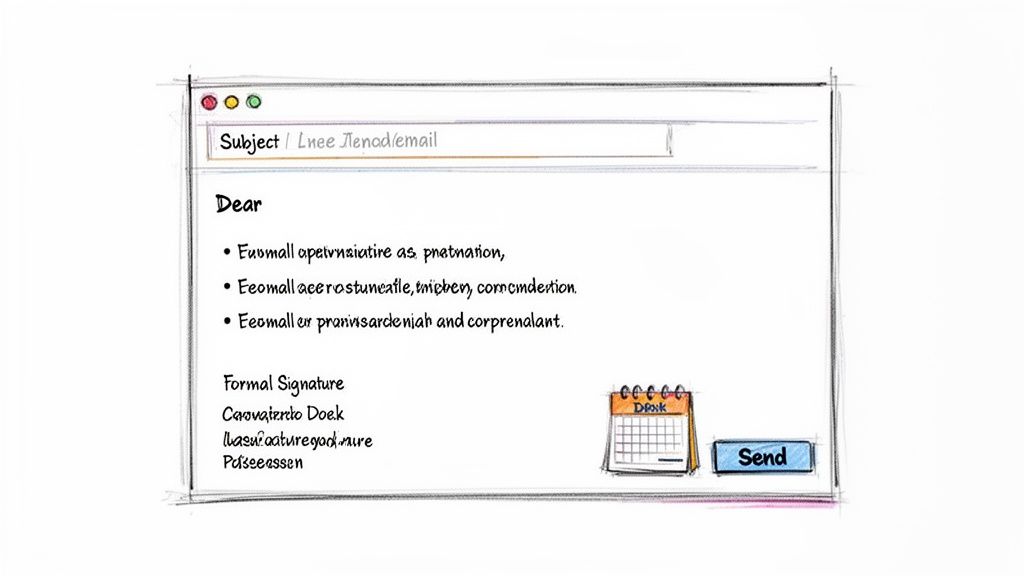
Unlike creative or academic writing, business correspondence is action-oriented. Its success is measured by the reader's ability to quickly understand the main point and know what is required of them. From project updates to executive announcements, this formal writing style is the foundation of effective workplace communication.
Example Breakdown: From Informal to Professional
Let’s transform a casual project update into a formal business email. This comparison highlights crucial differences in tone, clarity, and professionalism that define this particular formal writing style example.
Informal Version:
"Hey team, just wanted to let you know I’m kinda behind on the marketing deck. I’ll try to get it done by Friday, but things are super busy. Let me know if you need anything."
This message is vague, lacks commitment, and uses overly casual language ("kinda," "super busy") that can seem unprofessional.
Formal Professional Rewrite:
Subject: Update on Q3 Marketing Presentation
Dear Team,
This email is to provide a status update on the Q3 marketing presentation. I am currently projecting a slight delay and now anticipate completing the deck by EOD Friday, October 26th.
This revised timeline will ensure all data is accurately reflected. I will notify you immediately if any further changes are expected. Thank you for your understanding.
Best regards,
[Your Name]
Analysis of the Rewrite:
- Clarity and Directness: The rewrite opens with a clear purpose and provides a specific, committed deadline ("EOD Friday, October 26th").
- Professional Tone: Casual phrases are replaced with formal business language, such as "provide a status update" and "anticipate completing."
- Accountability: The rewrite takes ownership of the delay and provides a brief, professional justification ("ensure all data is accurately reflected") without making excuses.
- Structure: It uses a clear subject line, a professional salutation, and a closing, making the information easy to digest and file.
Actionable Tips for Professional Correspondence
- Use a Specific Subject Line: Your subject line should summarize the email's content, such as "Project Alpha: Feedback Required by 11/15" or "Invoice #5821 Due."
- State Your Purpose Immediately: Begin your email by stating its purpose directly in the first sentence to respect the reader’s time.
- Keep It Concise: Use short paragraphs and bullet points to present information clearly. Avoid unnecessary words and get straight to the point. When crafting outreach, exploring examples like these powerful cold email templates can provide valuable insights.
- Include a Clear Call-to-Action: Tell the recipient exactly what you need them to do and by when. For example, "Please review the attached document and provide your feedback by 3:00 PM tomorrow."
- Proofread Meticulously: Errors in grammar or spelling can undermine your credibility. Always read your email one last time before hitting send. For more guidance, review these professional email writing tips.
7. SEO-Optimized Formal Content for Digital Marketing
SEO-optimized formal content is a hybrid writing style that merges professional, authoritative language with strategic keyword placement to rank high on search engines like Google. The primary goal is to create content that is not only credible and informative for a professional audience but also discoverable through organic search. This style is crucial for digital marketing, where authority and online visibility are paramount for attracting and converting a target audience.
This formal writing style avoids overly casual language to maintain a professional tone, yet it must be clear, accessible, and structured for online readability. It effectively balances the demands of search engine algorithms with the expectations of human readers seeking expert information, making it a cornerstone of modern content marketing strategies.
Example Breakdown: From Informal to SEO-Optimized Formal Content
Let's transform a simple, informal marketing statement into a piece of formal content optimized for search engines. This comparison will highlight the shift in tone, keyword integration, and structure.
Informal Version:
"Our new software is awesome for making your team work better. It’s got cool tools to help everyone stay on the same page and finish stuff faster."
This version is casual, uses vague terms ("awesome," "cool," "stuff"), and lacks the keywords needed to attract qualified search traffic.
Formal SEO-Optimized Rewrite:
"Elevate team productivity with our advanced project management software, an integrated solution designed for seamless collaboration. This platform provides a suite of powerful tools that streamline workflow automation and enhance real-time communication, ensuring your projects are completed on schedule and within budget."
Analysis of the Rewrite:
- Professional Tone: The rewrite replaces informal words with professional terminology like "elevate," "advanced," "integrated solution," and "streamline workflow automation."
- Strategic Keywords: It naturally incorporates high-intent keywords such as "project management software," "team productivity," and "workflow automation," which a target user would search for.
- Benefit-Oriented Language: The content focuses on clear benefits ("seamless collaboration," "completed on schedule") rather than vague descriptions ("cool tools").
- Readability: The sentences are structured to be clear and direct, addressing a user’s search query while maintaining a formal and credible voice.
Actionable Tips for SEO-Optimized Formal Writing
- Conduct Keyword Research First: Identify the primary and secondary keywords your target audience is searching for before you begin writing. This research should guide your content's structure and headings.
- Integrate Keywords Naturally: Weave keywords into your headings, subheadings, and body paragraphs. Avoid "keyword stuffing," which can make the text unreadable and harm your SEO ranking.
- Structure for Skimmability: Use H2 and H3 headings, bullet points, and short paragraphs. This format is preferred by both search engines and online readers.
- Optimize for Featured Snippets: Answer common questions directly and concisely within your content. A question-and-answer format can help capture valuable "position zero" spots in search results.
- Build Internal Links: Link to other relevant pages on your website to distribute page authority and guide users through a logical journey. To master this, review some SEO copywriting best practices.
7-Point Formal Writing Style Comparison
| Style / Item | Implementation complexity | Resource requirements | Expected outcomes | Ideal use cases | Key advantages |
|---|---|---|---|---|---|
| Academic Writing Style | High — rigorous methodology and strict formatting | Extensive research, citation tools, subject expertise, time | Peer-reviewed, publication-ready manuscripts and credible scholarship | Research papers, theses, academic conferences | High credibility, scholarly rigor, recognized standards |
| Business Proposal and Report Writing | Medium–High — data analysis and persuasive structure | Business data, financial models, visualizations, stakeholder input | Decisions, funding approvals, actionable recommendations | Investor proposals, quarterly reports, strategic plans | Persuasive clarity, KPI-driven recommendations, decision support |
| Legal and Compliance Writing | Very High — precise language with legal risk management | Legal expertise, up-to-date regulations, lawyer review | Enforceable contracts, reduced legal exposure, regulatory compliance | Contracts, terms of service, regulatory filings, policies | Legal enforceability, ambiguity reduction, liability protection |
| Technical and Scientific Documentation | High — requires domain accuracy and reproducibility | Subject-matter experts, diagrams, test data, version control | Reproducible procedures, clear specifications, usable manuals | API docs, product manuals, scientific methods, engineering specs | Accuracy, reproducibility, effective knowledge transfer |
| Corporate Communications and Press Releases | Medium — strategic messaging and brand alignment | PR/communications team, messaging framework, media contacts | Brand awareness, stakeholder alignment, media coverage | Product launches, crisis statements, investor relations | Broad reach, reputation management, consistent brand voice |
| Professional Email and Business Correspondence | Low–Medium — concise and culturally aware | Templates, etiquette guidelines, time for review | Clear action items, documented trail, maintained relationships | Client outreach, status updates, HR and vendor communications | Efficiency, clarity, professional accountability |
| SEO-Optimized Formal Content for Digital Marketing | Medium–High — balances SEO tactics with formal tone | Keyword tools, SEO specialists, analytics, skilled writers | Increased organic traffic, domain authority, lead generation over time | Blog posts, landing pages, long-form guides, service pages | Search visibility, sustained traffic, authority and conversions |
Putting It All Together: Your Path to Polished, Professional Writing
Throughout this guide, we have explored a diverse collection of formal writing style examples, each tailored to a specific professional context. From the rigorous objectivity of academic papers to the persuasive precision of a business proposal, the core lesson is clear: formality is not a one-size-fits-all concept. It is a dynamic tool that, when wielded correctly, adds authority, credibility, and clarity to your message.
Mastering these styles is less about memorizing rigid rules and more about developing an intuitive understanding of audience, purpose, and context. The transition from an informal draft to a polished final product involves a series of deliberate choices in vocabulary, sentence structure, and tone. It's about knowing when to use passive voice for objectivity, when to employ active voice for directness, and when to select specialized terminology to demonstrate expertise.
Key Strategic Takeaways: From Theory to Practice
As you move forward, keep these foundational principles at the forefront of your writing process. These are the strategic pillars that support effective formal communication across all disciplines.
- Context is King: The single most important factor is your context. The persuasive, benefit-driven language of a business proposal would be entirely inappropriate in a legal document, which demands unambiguous and precise terminology. Always begin by defining your audience and the goal of your communication.
- Objectivity over Opinion: In most formal settings, especially academic and technical writing, your goal is to present information, not personal feelings. This is achieved by removing subjective adjectives (e.g., "amazing," "terrible"), avoiding first-person pronouns ("I believe"), and focusing on verifiable evidence and data.
- Precision in Word Choice: Formal writing leaves no room for ambiguity. Swapping a general term like "thing" for a specific noun like "apparatus," "component," or "finding" immediately elevates your work. Build a vocabulary specific to your field to communicate with greater accuracy.
- Structure Creates Clarity: A logical, well-organized structure is the backbone of any formal document. Whether it's the IMRaD format in a scientific paper or the Executive Summary in a business report, a predictable structure helps your reader navigate complex information efficiently.
Actionable Next Steps for Immediate Improvement
Understanding the theory is the first step; consistent application is what builds mastery. Here are some actionable steps you can take to integrate these concepts into your daily workflow and refine your command of formal writing style examples.
- Create a "Style Swipe File": When you encounter a particularly well-written report, email, or article, save it. Analyze what makes it effective. Is it the word choice? The sentence structure? The overall tone? Deconstruct these examples to build a library of proven techniques.
- Practice Deliberate Rewriting: Take a piece of your own informal writing, like a quick email or a draft of a blog post, and rewrite it for a more formal context. Challenge yourself to eliminate contractions, replace colloquialisms, and restructure sentences for greater clarity and impact.
- Seek Targeted Feedback: Ask a trusted colleague or mentor to review a piece of your formal writing. Instead of asking for general feedback, ask specific questions like, "Is the tone of this section appropriately objective?" or "Is there any language in this proposal that seems ambiguous?"
- Leverage Technology Wisely: Modern tools are designed to bridge the gap between your ideas and a polished final draft. Use them not as a crutch, but as a co-pilot to help you spot inconsistencies, suggest more precise vocabulary, and ensure your writing aligns with the required level of formality.
Ultimately, strengthening your formal writing skills is an investment in your professional credibility. It ensures your ideas are not just heard, but respected and understood with the clarity they deserve. By mastering the nuances we've discussed, you position yourself as a thoughtful, authoritative, and effective communicator in any professional arena.
Ready to instantly transform your drafts into perfectly polished formal documents? Rewritify uses advanced AI trained on countless formal writing style examples to elevate your text for any professional context, from academic essays to business reports. Stop guessing and start communicating with confidence by trying Rewritify today.
Relevant articles

Master the difference between complement and compliment with our guide. Learn the definitions, grammar, and usage with clear examples to perfect your writing.

Discover how to write a business report that gets read and acted on. This practical guide covers planning, drafting, and presenting data to drive decisions.

Learn how to structure an argumentative essay with our expert guide. We break down the thesis, body paragraphs, and counterarguments for a powerful paper.

Learn how to write an annotated bibliography with this comprehensive guide. Get actionable tips, real examples, and formatting advice for APA and MLA.

Learn how to write an effective essay rough draft. This guide provides actionable steps for turning messy ideas into a coherent and compelling paper.

Discover differences between formal and informal writing, with practical tips, examples, and syntax cues to choose the right tone every time.