How to Improve Academic Writing: Clear Strategies for Stronger Papers
Discover how to improve academic writing with actionable tips to sharpen arguments, clarity, and style for stronger, more persuasive papers.

The secret to better academic writing doesn't start with the first sentence you type. It actually begins much earlier, with the foundational work you do before you even think about drafting. Getting this part right—understanding the assignment, nailing down a strong thesis, and outlining your argument—is what separates a chaotic, frustrating writing process from a clear, manageable one.
Build a Rock-Solid Foundation Before You Write
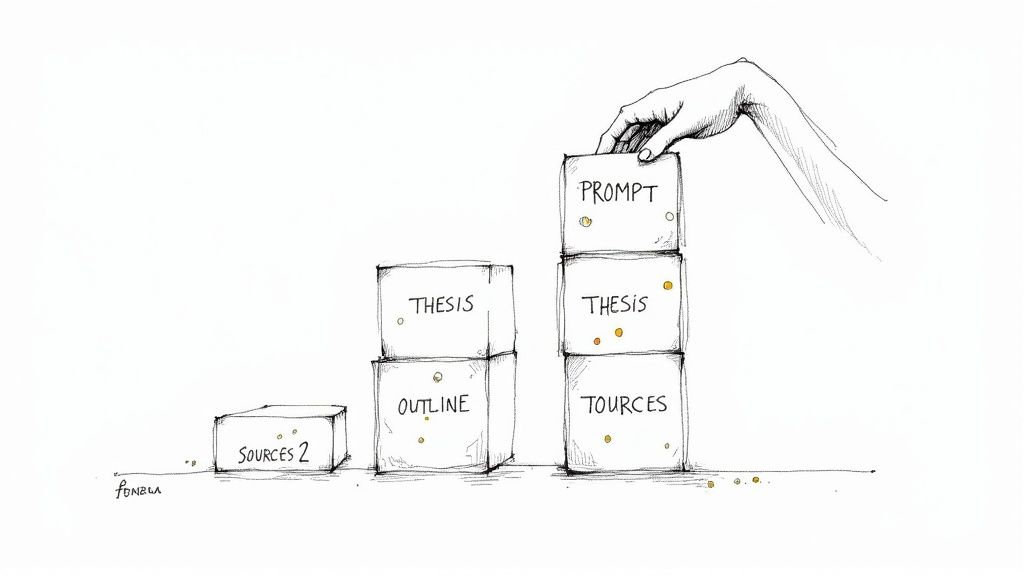
So many students make the mistake of just diving in and writing, hoping inspiration will find them along the way. I've seen it time and time again—this approach almost always leads to a jumbled argument, wasted hours, and endless, painful rewrites.
The strongest academic papers I’ve read were all clearly planned from the start. Think of it like building a house. You'd never just start nailing boards together without a blueprint. That pre-writing work is your blueprint, making sure every paragraph and piece of evidence has a clear purpose.
Decode the Assignment Prompt
First things first: you need to become a bit of a detective and really pick apart the assignment prompt. Your professor has hidden all the clues you need right there. Rushing this is a classic mistake that results in a paper that completely misses the point, no matter how well you write it.
Break down the prompt by looking for:
- Action Verbs: Hunt for words like "analyze," "compare," "evaluate," or "synthesize." Each one is asking for a different kind of thinking. "Compare" wants similarities and differences, but "evaluate" requires you to make a judgment call backed by evidence.
- Key Concepts and Limiting Phrases: Pinpoint the main topics you have to cover and any constraints, like a specific time period or theoretical lens. These are the boundaries of your playground.
- Implicit Questions: Often, a prompt has a deeper question hiding inside. "Discuss the impact of social media on politics" is really asking, "So, what is the real influence of social media on politics—is it a good thing, a bad thing, or something more complicated?"
By dissecting the prompt, you get past a surface-level reading and truly understand the analytical heavy lifting required. This is probably the single most important thing you can do to get on the same page as your instructor right from the get-go.
Craft a Powerful Thesis Statement
Once you know what you’re being asked to do, it’s time to formulate your thesis statement. This isn't just a topic sentence; it's the core, debatable argument that your entire paper will defend. A solid thesis is the spine of your essay—it gives you focus and tells your reader exactly where you're going.
A great thesis has to be:
- Arguable: It needs to be a claim someone could actually disagree with. "The Civil War was a major conflict" is a fact, not a thesis. A much better, arguable thesis would be: "While moral objections to slavery were a factor, the Civil War was primarily driven by economic disputes."
- Specific: It has to be focused enough to tackle within the page limit. Stay away from huge, sweeping statements you can't possibly back up.
- A Roadmap: It should give the reader a sneak peek of your main points, showing them how you plan to prove your argument.
Organize Your Research and Outline Your Argument
With your thesis locked in, you can start gathering and arranging your research. This is about more than just finding sources; it's about building a logical structure for your evidence that directly supports your main claim. If you want to go deeper, our guide on https://www.rewritify.com/blog/research-paper-writing-tips has some great strategies for this.
To keep from getting buried in information, you need a system. Mastering effective study note-taking strategies is a huge advantage here. From there, an outline—whether it's a formal multi-level list or just a quick mind map—is your best friend. It lets you see the flow of your argument, spot any weak points, and make sure every single paragraph is working to prove your thesis. Honestly, this foundational work is non-negotiable if you’re serious about improving your academic writing.
Write with Precision and Authority
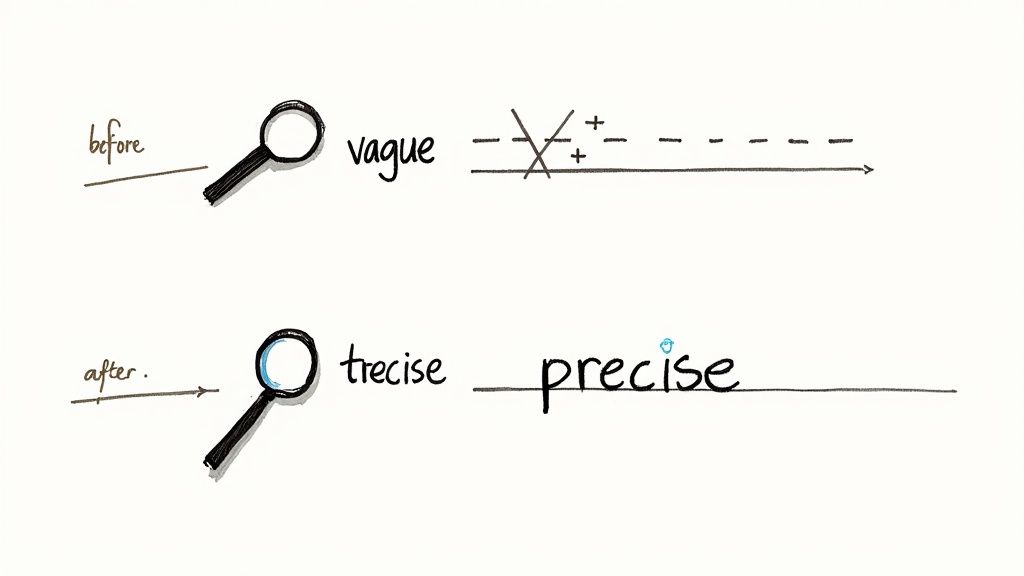
Powerful academic writing isn’t about using the biggest words you can find—it's about making every word count. Once you’ve built a solid structure for your paper, the real work of persuasion begins at the sentence level. This is where you swap out vague language for sharp, precise phrasing that gives your arguments genuine authority.
Think of each sentence as a tool. Is it doing its job, or is it just taking up space? Many early drafts are full of clutter that suffocates the core message. A huge part of improving your academic writing is learning to be a ruthless editor of your own work, cutting anything that doesn't add real value.
Prune Vague Language and Eliminate Clutter
The fastest way to sound more precise is to hunt down and remove "hedging" words and filler phrases. These are the words that soften your claims and make you sound unsure of your own research. While some nuance is obviously necessary in academia, too much hedging just guts your credibility.
Keep an eye out for phrases like "it seems that," "it could be argued," or "somewhat." You'd be surprised how often they can be deleted entirely, leaving you with a much stronger and more direct statement.
- Before: It seems that the results of the study might possibly suggest a connection between the two variables. (20 words)
- After: The study's results suggest a connection between the two variables. (11 words)
See the difference? The revised sentence is far more assertive without overstating the claim. The goal is to be confident in your analysis and just say what you mean.
A key part of developing an authoritative academic voice is learning to state your claims clearly and backing them with evidence, not burying them under layers of hesitant language. Confidence comes from clarity.
Shift to the Active Voice for Impact
Here’s one of the most effective edits you can make: favor the active voice over the passive voice. In the active voice, the subject of the sentence does the action. In the passive voice, the subject is just sitting there while something is done to it.
The passive voice has its place, of course—especially when the actor is unknown or irrelevant. But when you overuse it, your writing can feel detached, clunky, and frankly, a bit boring.
Passive Voice Example: The experiment was conducted by the research team.
The subject here is "the experiment," but it isn't doing anything. It's passive.
Active Voice Example: The research team conducted the experiment.
Now that's better. It's direct and has energy. The research team (the subject) is actively doing something. Making this one small shift consistently across your paper makes your arguments feel more immediate and compelling.
Maintain an Objective and Formal Tone
Academic authority is built on a foundation of objectivity. Your job is to present a well-reasoned argument supported by solid evidence, not to share your personal feelings. This requires a formal, impartial tone from start to finish.
Here are a few ways to keep your tone on track:
- Ditch the Personal Pronouns: Steer clear of phrases like "I think," "I believe," or "in my opinion." Your argument needs to stand on its own, based on the evidence you present. Instead of saying, "I think the data is wrong," you could write, "The data appears inconsistent with previous findings."
- Use Specific Terminology: Deploy the precise language of your discipline. This isn't about using jargon to sound smart; it’s about showing you're part of the scholarly conversation and using the correct technical terms when they are the most accurate choice.
- Keep Emotion Out of It: Avoid words with strong emotional baggage, like "tragic," "amazing," or "terrible." Let the facts speak for themselves. Your analysis should always be grounded in logic, not emotion.
By zeroing in on these sentence-level details, you can truly transform your writing. Your ideas will land with greater clarity and the kind of confidence that makes readers trust your analysis.
Construct Arguments That Persuade and Inform
A great academic paper isn't just a pile of facts—it's an argument. Your job is to guide your reader from one point to the next, building a case so logically that the conclusion feels inevitable. If you just dump information on the page without a clear structure, even groundbreaking research will fail to make an impact.
The reader will be left swimming in a sea of disconnected ideas, unable to follow your train of thought. This is why learning how to build a solid argument is one of the most critical skills you can develop. It’s what turns a simple report into a powerful piece of persuasion.
The Anatomy of a Powerful Paragraph
The best way to think about a paragraph is as a mini-argument. Each one should have a single, focused job: to prove one small piece of your main thesis. The most effective paragraphs follow a simple, time-tested pattern that moves from a clear claim to the proof that backs it up.
This structure really only has three key parts:
- The Topic Sentence: This is your opening shot. It’s the first sentence, and it needs to make a specific, arguable claim that directly supports your overall thesis. It’s basically a signpost telling the reader, "Here's what I'm going to prove in this next section."
- Evidence and Examples: You’ve made a claim, now you have to prove it. This is where you bring in your data, quotes from your sources, statistics, or concrete examples from your research. This is the "show me" part of the paragraph.
- Analysis and Interpretation: This is where so many writers stumble, but it’s arguably the most important step. Don't just drop a quote or a number and walk away. You absolutely must explain why that piece of evidence is important and how it proves the claim you made in your topic sentence. This is your voice, your thinking, connecting the dots for the reader.
So many students are fantastic at digging up evidence but fall short on the analysis. The most common mistake is assuming the evidence speaks for itself. It never does. Your job is to be the interpreter and explicitly show the reader how your data supports your point.
Weaving Paragraphs into a Cohesive Argument
Once you can write a solid, self-contained paragraph, the next step is getting them to work together. A good paper should feel like a single, flowing piece of writing, not a list of disconnected points. Each paragraph has to build on the one that came before it.
You achieve this with good transitions. And I don't just mean tacking on a "however" or "therefore." Real transitions are often entire phrases or sentences that form a logical bridge between the idea you just finished and the new one you’re about to start.
For example, you might end a paragraph summarizing an economic factor and then start the next one with something like, "While this economic factor was significant, its impact was amplified by the political climate of the era." See how that works? It creates a smooth connection and shows the reader exactly how your argument is progressing.
Choosing the Right Organizational Structure
The overall structure of your paper is like a blueprint for your argument. There isn't a single "best" way to organize every paper; the right structure depends entirely on your topic, your thesis, and the story you're trying to tell. Picking the right framework from the start is a strategic move that makes the entire writing process easier.
Here are a few classic organizational patterns you might consider:
| Structural Approach | Best Used For... | Example |
|---|---|---|
| Chronological | Tracing how an event, idea, or trend developed over time. | An essay on the evolution of a specific public policy, moving from its origins to its modern-day implementation. |
| Thematic | Exploring several key themes or categories related to your main topic. | A paper analyzing a novel by discussing its major themes—like identity, conflict, and redemption—in separate sections. |
| Comparative | Examining the similarities and differences between two or more subjects. | An article comparing the economic strategies of two different countries or the leadership styles of two historical figures. |
| Problem-Solution | Identifying a clear problem and then proposing or evaluating one or more solutions. | A research paper that outlines a challenge in public health and then analyzes the effectiveness of various interventions. |
When you choose a logical structure before you start writing, you give yourself a roadmap. It ensures your argument unfolds in a way that feels natural and intuitive, making your final conclusion feel both earned and completely convincing.
Use AI Writing Tools Ethically and Effectively
Let's be honest: AI has moved from a futuristic concept to a tool sitting in most students' browsers. When you know how to use it right, it can be a fantastic writing partner. It can help you untangle complex ideas, smooth out clunky sentences, or act as a super-powered grammar checker.
But here’s the crucial part: AI is your assistant, not your ghostwriter. You're the one in the driver's seat—the researcher, the thinker, the author. The arguments, the critical insights, and the final words have to be yours.
Setting the Right Boundaries with AI
The biggest trap with AI in academic writing is accidentally stepping over the line into plagiarism or academic misconduct. Before you do anything else, find your university's policy on AI use. Read it carefully and stick to it. Most schools draw a very clear line: AI as a support tool is often okay, but using it to generate your core ideas or text is not.
A smart way to stay on the right side of this is by adopting a hybrid workflow. You handle all the heavy lifting—the research, the analysis, the argument itself. The AI helps with the more mechanical parts of writing. This approach is quickly becoming the new norm.
In fact, recent data shows a major shift. The combined use of AI tools with human writing jumped from 24% to 44% between 2023 and 2025. During that same period, submitting purely AI-generated essays plummeted from 46% to 28%. It's clear that students are learning to collaborate with AI, not just copy from it.
Smart and Ethical AI Workflows
So, what does a responsible AI-assisted workflow actually look like? It’s all about playing to the tool's strengths without handing over your own intellectual work. Think of it as a collaboration where you are always the project lead.
Here are a few productive and ethical ways to bring AI into your process:
- Brainstorming and Idea Generation: Feeling stuck? Use an AI to spitball some research questions or explore different angles. For instance, you could prompt it with: "Generate five debatable research questions about the economic impact of renewable energy policies in Germany."
- Outlining and Structuring: If you have your main points but aren't sure how to sequence them, an AI can suggest a logical flow. Feed it your thesis and key evidence and ask for a potential outline for a five-page paper.
- Paraphrasing for Clarity: When you've written a sentence that just feels awkward, an AI can offer a few different ways to phrase it. This is great for improving readability, but always make sure the new version still sounds like you and reflects your original meaning.
- Grammar and Style Checks: AI tools are miles ahead of basic spell-check. They can spot inconsistent tone, awkward phrasing, and passive voice, giving your work a final polish before submission.
This diagram breaks down the core process of building an argument—a process AI can help you outline, but should never, ever do for you.
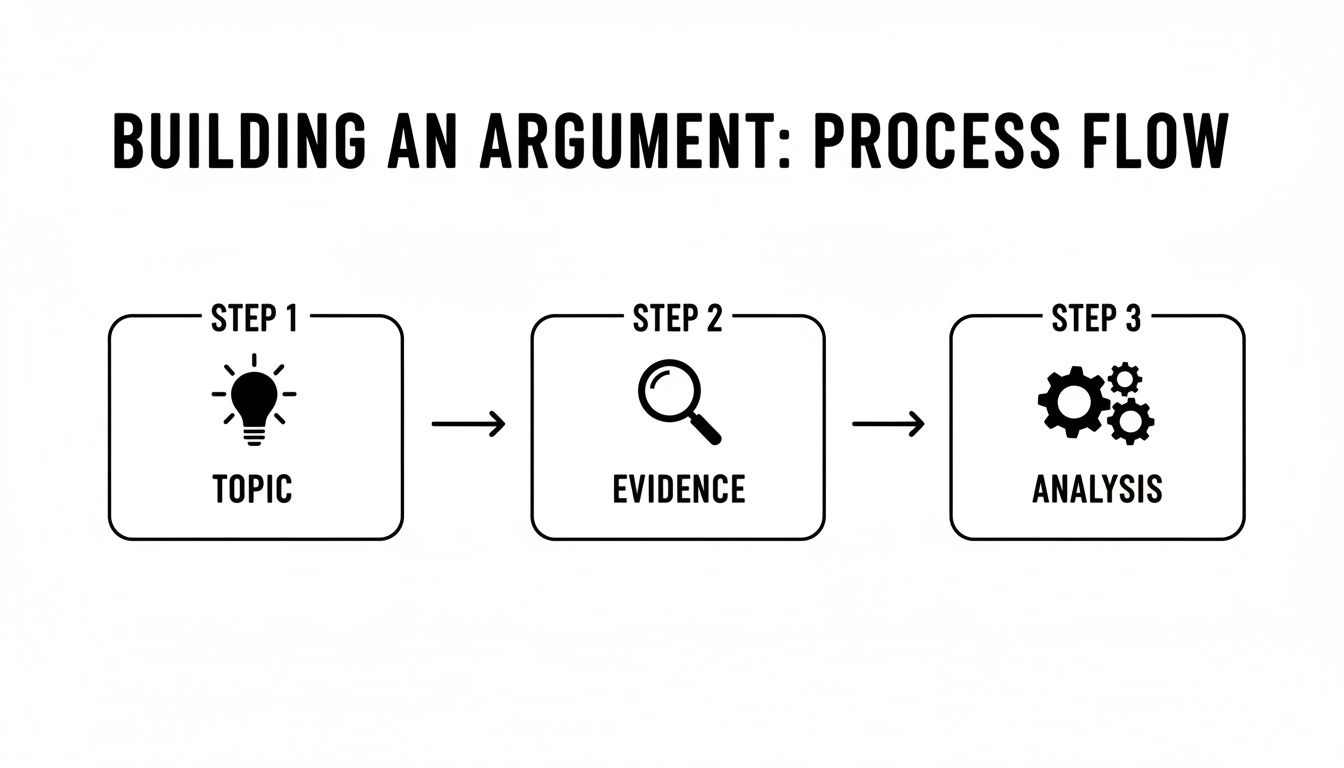
As the visual shows, solid academic work flows from a topic, to evidence, to analysis. That final step—the analysis—requires your brainpower.
To make the distinction clearer, here’s a breakdown of how to think about using these tools responsibly.
Ethical vs Unethical Use of AI in Academic Writing
| Ethical Use (Recommended) | Unethical Use (To Avoid) |
|---|---|
| Brainstorming: Generating initial ideas or research questions to get started. | Generating the Thesis: Asking the AI to create your core argument or thesis statement. |
| Outlining: Suggesting a logical structure for your own arguments and evidence. | Writing Paragraphs: Generating entire sections or paragraphs and submitting them as your own. |
| Clarity & Style: Rewording your own clunky sentences to improve flow and readability. | Plagiarizing: Paraphrasing sources with AI and failing to cite the original author properly. |
| Grammar Check: Polishing your final draft for typos, grammatical errors, and style issues. | Factual Research: Using AI to find data or citations without verifying them in academic sources. |
This table isn't exhaustive, but it highlights the core principle: use AI to enhance your writing process, not to replace your critical thinking.
What to Absolutely Avoid
Knowing what not to do is just as important as knowing what you can do. Misusing AI can lead to failing a course or even expulsion. It’s just not worth the risk.
The core principle is this: Never present AI-generated text as your own original thought. Every word that makes up your argument and analysis must come from you.
Here are the hard lines you should never cross:
- Generating Entire Essays or Paragraphs: Copying and pasting from an AI into your paper is plagiarism. Full stop.
- Factual Research: AI models are notorious for "hallucinating"—making up facts, sources, and quotes. Always find and verify your information using legitimate academic databases and primary texts.
- Creating Your Thesis Statement: Your central argument is the soul of your paper. It has to come from your own engagement with the course material.
Ultimately, you are responsible for every single word in your paper. If you've used an AI to help refine a paragraph, a smart final step is to rewrite AI-generated text to ensure it perfectly matches your voice and understanding.
It’s also fascinating to see where this technology is heading. Beyond text, some AI content creation tools can now transform written scripts into entire video presentations. By using these powerful tools ethically, you can elevate your work while maintaining complete academic integrity.
Turn Good Drafts into Great Papers Through Revision
Here's the single biggest mindset shift that will improve your academic writing: the first draft isn't the finish line. It’s barely the starting block.
Too many of us drain our energy just getting words on the page, then do a quick spell-check and call it a day. But the real magic, the part that separates an average paper from a great one, happens during revision.
Writing is rewriting. A good draft is full of potential, but a truly great paper is forged through deliberate, strategic editing. This isn't just about hunting for typos; it's about re-seeing your work, reinforcing your arguments, and making sure your ideas flow with an unstoppable logic.
Look Beyond Surface-Level Edits
Before you even think about grammar or spelling, zoom out. Your first pass at revision should focus entirely on the big-picture issues—the architectural beams holding your entire argument together. It’s time to ask the hard questions.
This "macro-editing" phase is where you confirm your paper's core is sound. It’s far more efficient to fix a shaky argument now than to spend an hour polishing sentences in a paragraph you might have to delete later.
Here’s what to zero in on first:
- Thesis and Argument: Is your thesis statement still a perfect reflection of the argument you actually wrote? Does every single paragraph directly serve that main claim, or have some gone rogue?
- Logical Flow: Try this: read only the topic sentences of each paragraph, one after another. Do they form a coherent, logical story? Do they guide your reader smoothly from one point to the next?
- Evidence and Analysis: Take a hard look at your evidence. Is it strong enough? Even more important, have you explained why it proves your point, or did you just drop it in and assume the reader would connect the dots for you?
Embracing revision means accepting that your initial ideas will evolve. The goal isn't to defend your first draft; it's to build the strongest possible version of your argument, even if that means cutting sections you worked hard on.
Practical Self-Editing Strategies
Once the foundation is solid, it's time to zoom in to the sentence and paragraph level. This is where you polish your prose until it’s sharp and clear. One of the most effective tricks in the book is surprisingly simple: read your paper out loud.
Your ears will catch what your eyes miss. Every time. Awkward phrasing, clunky transitions, and repetitive sentence structures become painfully obvious when you hear them. If you stumble while reading a sentence, your reader will, too. That's your cue to rewrite it.
Another powerful technique is to give yourself a break. Step away from the draft for at least a day, or even just a few hours if you're on a tight deadline. When you come back with fresh eyes, you'll be amazed at the mistakes and opportunities for improvement that suddenly jump off the page.
Seek and Embrace Constructive Feedback
You can only take your writing so far on your own. At a certain point, you absolutely need an outside perspective. Getting feedback from peers, your university’s writing center, or your professor is non-negotiable for real improvement. It exposes the gaps in your logic that are invisible to you because you're simply too close to the material.
The key is learning to take criticism without getting defensive. Remember, feedback isn’t personal—it's a gift that shows you exactly how to make your work stronger. Be specific when you ask for help. Instead of a vague "What do you think?", ask targeted questions like, "Is my argument in the third paragraph convincing?" or "Does the transition between these two sections feel abrupt to you?"
This focus on feedback loops is becoming a central theme in academic development. In fact, an analysis of over a thousand publications on academic writing between 2020 and 2025 revealed a growing emphasis on feedback systems and digital literacy. This just reinforces that real growth comes from creating these feedback cycles and learning to apply criticism effectively. You can read more about the findings on academic writing development from GA Excellence.
Common Questions About Academic Writing
Diving into academic writing can feel like learning a secret language with a bunch of unwritten rules. If you're wrestling with your work, you're not alone. Many students run into the same roadblocks on the journey from a decent paper to a truly excellent one. Let's tackle some of those common hurdles with practical, no-nonsense answers.
And it’s a skill in high demand. The market for academic writing support is expected to grow at a compound annual rate of 12% through 2033, a trend fueled by rising university enrollments and tougher assignments. This just goes to show how many students are looking for help to get this right. You can dig into the numbers yourself in this market research on academic writing services.
How Can I Sound More Academic Without Just Using Big Words?
This is a classic trap. Sounding "academic" isn't about finding the most obscure word in the thesaurus; it's about being precise, objective, and clear. Your goal is to make your argument stronger, not to confuse your reader.
Instead of swapping out simple words for complex ones, focus on using the specific terminology of your field correctly. For instance, a vague term like "thing" could be replaced with "phenomenon," "concept," or "factor"—whichever is most accurate in context. That's precision.
It's also about maintaining an objective voice. Cut phrases like "I think" or "I believe" and let the evidence do the talking. When you base your claims on data and research rather than personal feelings, your writing naturally develops an authoritative, scholarly tone that's both formal and easy to understand.
The best academic writing isn't the most complicated; it's the most clear. True authority comes from the strength of your ideas and the precision of your language, not from using unnecessarily complex vocabulary.
What Is the Most Common Student Mistake?
By far, one of the biggest missteps is dropping a piece of evidence—like a quote or a statistic—into a paragraph and just leaving it there. Students often assume the connection to their argument is self-evident, but that's a gamble you should never take.
Every single piece of evidence you use needs to be unpacked. After you present a fact or a quote, you absolutely must follow it with your own analysis. Explain why it's significant and how it supports your specific point. This is where you demonstrate real critical thinking and prove to your instructor that you're engaging with the material on a deeper level. For more on this, our guide on how to avoid plagiarism by properly integrating sources is a great resource.
How Much Time Should I Actually Spend Editing?
There isn't a single magic number, but a solid guideline is to set aside at least 25-30% of your total writing time for revising and proofreading. This is not a last-minute step to be squeezed in an hour before the deadline.
For the best results, try breaking the process down into a few distinct stages:
- The Big Picture Edit: Your first pass should be all about the fundamentals. Is your thesis clear? Does your argument flow logically from one section to the next? Are your paragraphs in the right order?
- The Sentence-Level Edit: Once the structure is solid, zoom in. This is where you polish sentence construction, refine your word choices, and smooth out transitions.
- The Final Polish: Your very last read-through is for catching pesky typos, grammar mistakes, and formatting errors. A great pro tip here is to read your paper out loud—your ears will catch awkward phrasing your eyes might have skipped over.
When your ideas are solid but the words just aren't clicking, Rewritify can be a huge help. Our AI rewriter is designed to help you polish your prose, improve clarity, and make sure your tone hits the right academic notes, all without losing your original voice. Give your drafts that final polish with confidence at https://www.rewritify.com.
Relevant articles

Learn how to write a comparative essay that stands out. Our guide unpacks thesis statements, structure, and analysis to help you craft a powerful argument.