10 Actionable Research Paper Writing Tips for Academic Success in 2025
Master your next assignment with our top 10 research paper writing tips. Learn to structure, argue, cite, and edit like a pro for better grades.

The thought of writing a research paper can be intimidating. It demands critical thinking, meticulous research, and a clear, persuasive voice. Many students and researchers struggle to translate complex ideas into a structured, coherent argument that meets rigorous academic standards. The challenge isn't just about what you know, but how effectively you can communicate it on the page.
Common hurdles include selecting a focused topic, navigating a sea of literature, building a logical argument, and avoiding the dreaded pitfalls of plagiarism. These obstacles can turn the writing process into a source of stress and uncertainty, making it difficult to produce work that truly reflects your knowledge and effort.
This guide is designed to transform that process from overwhelming to manageable. We have compiled a comprehensive list of essential research paper writing tips that go beyond generic advice. Instead of abstract concepts, you will find actionable strategies to streamline your workflow, strengthen your arguments, and produce a polished, high-quality paper.
Whether you are an undergraduate tackling your first major assignment, a graduate student refining your dissertation, or a professional crafting a detailed report, these techniques provide a clear roadmap. We will cover everything from crafting a powerful thesis and conducting a systematic literature review to mastering academic tone and executing a flawless editing process. This list equips you with the practical tools and concrete steps needed to achieve academic excellence and write with confidence. You will learn not just what to do, but how to do it effectively, ensuring your final paper is clear, compelling, and credible.
1. Start with a Strong Thesis Statement
The thesis statement is the single most critical sentence in your entire research paper. It acts as the central pillar of your argument, a clear and concise declaration of the claim you will prove. Think of it as a roadmap for your reader; it tells them exactly what to expect from your analysis and sets the boundaries for your entire discussion. This foundational element is one of the most important research paper writing tips because a weak or vague thesis leads to a disorganized and unconvincing paper.
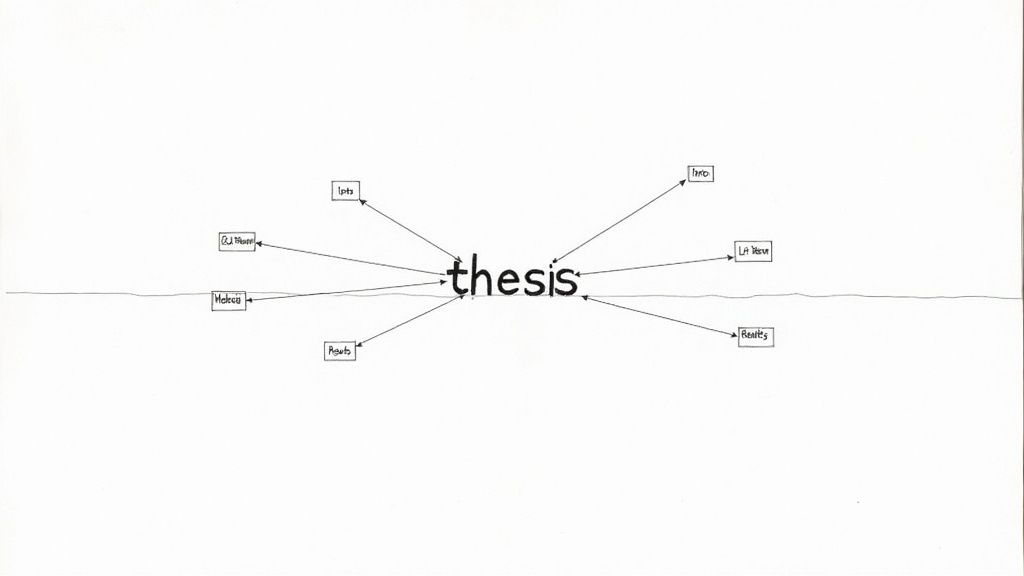
A powerful thesis is not just a statement of fact but a debatable assertion that requires evidence and analysis to support it. It moves beyond a simple topic announcement and presents a specific, arguable point of view.
Crafting a Compelling Thesis
To develop a strong thesis, avoid making broad generalizations. Instead, narrow your focus to a precise argument that you can realistically defend within the scope of your paper.
- Weak Thesis: "Social media has an effect on teenagers." (This is too broad and states an obvious fact.)
- Strong Thesis: "Instagram's algorithmic content curation disproportionately exposes vulnerable adolescents to unrealistic beauty standards, thereby increasing rates of body dysmorphia and anxiety disorders." (This is specific, arguable, and outlines a clear cause-and-effect relationship to be proven.)
Key Insight: A great thesis answers the "so what?" question. It must convey the significance of your argument, telling the reader why your claim matters and what its implications are.
Actionable Tips for Thesis Development
Use these strategies to refine your central argument:
- Develop it After Initial Research: Avoid formulating a rigid thesis before you've explored the literature. Let your initial findings guide you to a nuanced and supportable claim.
- Test its Specificity: Can your thesis be adequately defended in the required page count? If it's too broad, you won't be able to cover it in sufficient depth.
- Ensure it's Arguable: A reasonable person should be able to disagree with your thesis. If it's a statement of undisputed fact, it isn't an argument.
- Avoid Announcement Phrases: Steer clear of openings like, "In this paper, I will discuss..." Instead, state your argument directly and confidently.
2. Conduct a Thorough and Systematic Literature Review
A literature review is far more than a simple summary of existing studies; it is a systematic synthesis and evaluation of the scholarly conversation surrounding your topic. This foundational step is crucial because it demonstrates your understanding of the field, identifies gaps in current research that your paper will address, and justifies the relevance of your work. Neglecting this process is one of the most common pitfalls, leading to research that is redundant, uninformed, or disconnected from the broader academic dialogue.

The goal is not just to collect sources but to build an argument about the state of the research. You are telling a story about what has been studied, what has been learned, and what questions remain unanswered, thereby positioning your own research as the logical next step in that story.
Building a Comprehensive Review
To move from a simple book report to a critical synthesis, your approach must be methodical. This involves a planned search, careful evaluation, and organized analysis of the sources you find.
- Weak Review: Randomly grabbing the first five articles from a Google search and summarizing them one by one.
- Strong Review: Systematically searching multiple academic databases like JSTOR and PubMed with defined keywords, synthesizing findings from over 50 peer-reviewed articles on machine learning applications in healthcare, and organizing them thematically to highlight conflicting findings and underexplored areas.
Key Insight: A great literature review doesn't just report what others have said. It critically analyzes, compares, and contrasts different perspectives to construct a coherent narrative that leads directly to your research question.
Actionable Tips for Your Literature Search
Use these strategies to ensure your review is both thorough and efficient:
- Use Multiple Databases: Don't rely solely on Google Scholar. Branch out to subject-specific databases like PubMed (for medical research) or Scopus to find specialized literature.
- Create a Search Strategy: Define a set of primary and secondary keywords and use Boolean operators (AND, OR, NOT) to refine your searches and get more relevant results.
- Manage Sources Early: Use reference management tools like Zotero or Mendeley from day one. This saves countless hours by organizing your sources and formatting citations automatically.
- Read Strategically: Start by reading abstracts to quickly determine a source's relevance before committing to the full text. This helps you filter through large volumes of literature efficiently.
3. Follow a Clear Outline Structure
An outline is the architectural blueprint for your research paper. It provides a hierarchical structure that organizes your arguments, evidence, and ideas into a logical and coherent sequence. Attempting to write a complex academic paper without an outline is like building a house without a plan; you risk creating a disorganized, rambling, and structurally unsound final product. This preparatory step is one of the most effective research paper writing tips because it forces you to think through your argument's flow before you invest hours in writing prose.
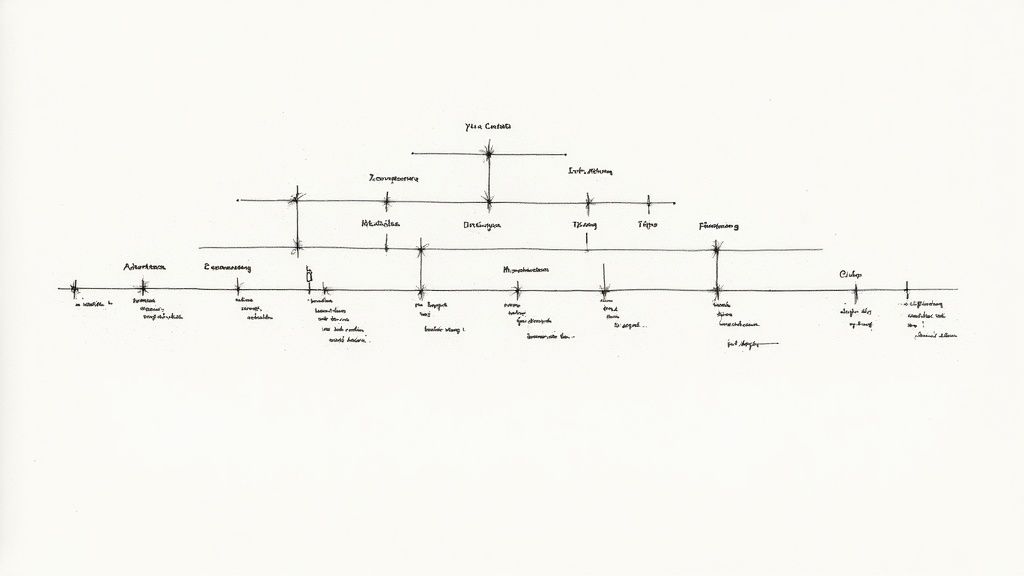
A well-constructed outline ensures that every section serves a purpose, every paragraph connects to the next, and every point directly supports your central thesis statement. It transforms the daunting task of writing into a manageable series of smaller, interconnected steps.
Building a Robust Outline
The key to an effective outline is detail and logical progression. The standard alphanumeric format is ideal for mapping out the main sections and their supporting points, creating a clear visual hierarchy for your argument.
- Standard Structure Example:
- I. Introduction
- A. Hook: Startling statistic or compelling anecdote
- B. Background: Brief overview of the research topic
- C. Thesis Statement
- II. Literature Review
- A. Foundational Theories and Historical Context
- B. Key Debates and Gaps in Current Research
- III. Methodology
- IV. Analysis of Results
- V. Discussion and Implications
- VI. Conclusion
- I. Introduction
Key Insight: Your outline is a dynamic tool, not a rigid contract. As you write and research, you may discover new evidence or identify weaker arguments. Revisit and refine your outline to reflect these new insights, ensuring your paper remains focused and strong.
Actionable Tips for Outlining
Use these strategies to create a powerful framework for your paper:
- Write Topic Sentences: For each main point (A, B, C), draft a full topic sentence. This clarifies the purpose of each paragraph and makes the actual writing process much faster.
- Check for Logical Flow: Read through your outline from beginning to end. Does one section logically lead to the next? Are there any abrupt jumps or missing connections?
- Ensure Thesis Support: Scrutinize every point in your outline. Ask yourself: "Does this directly help prove my thesis?" If not, it may be irrelevant and should be removed.
- Use Parallel Structure: For lists or series of points at the same level (e.g., A, B, C under section II), try to use parallel grammatical structure. This improves clarity and readability.
4. Use Credible and Peer-Reviewed Sources
The strength of your research paper is directly tied to the quality of the sources you use to support your arguments. Relying on authoritative, peer-reviewed sources is non-negotiable for building credibility and ensuring the accuracy of your information. This practice elevates your work from a simple opinion piece to a scholarly analysis grounded in established, verifiable evidence. This foundational research paper writing tip ensures your arguments are defensible and contribute meaningfully to the academic conversation.
A credible source has undergone a rigorous review process by experts in the field before publication. This peer-review process acts as a filter, separating methodologically sound research from unsubstantiated claims. When selecting your supporting materials, it's vital to ensure academic rigor by understanding what is a credible source and how to find one.
Locating Scholarly Sources
The best place to find high-quality academic material is your university's library database. These portals provide access to countless peer-reviewed journals that are not available through a standard web search.
- Top-Tier Journals: Publications like Nature, Science, and the Journal of the American Medical Association (JAMA) are premier examples in the sciences. In social sciences, look for sources like the American Political Science Review or the Journal of Applied Psychology.
- Unreliable Sources: Avoid using Wikipedia, personal blogs, or websites with clear commercial or political biases as primary evidence. These can be useful for initial brainstorming but should never be cited as authoritative support for your claims.
Key Insight: The credibility of your sources becomes the credibility of your paper. Every claim you make must be built upon a foundation of trustworthy, expert-vetted evidence.
Actionable Tips for Source Vetting
Use these strategies to evaluate the quality of your research materials:
- Prioritize Journal Articles: While academic books are valuable, peer-reviewed journal articles often present the most current and specific research in a field.
- Check Publication Dates: Ensure your sources are recent enough to be relevant to the current academic conversation, especially in fast-evolving fields like technology and medicine.
- Verify Author Credentials: Look up the author's affiliations and publication history. Are they a recognized expert at a reputable institution?
- Cross-Reference Citations: See which other scholars have cited the work. A highly cited paper often indicates significant impact and acceptance within the field.
5. Write Clear Topic Sentences and Transitions
If your thesis statement is the roadmap for your entire paper, topic sentences are the street signs that guide your reader through each neighborhood of your argument. They introduce the main idea of a single paragraph, while transitions act as the bridges connecting one idea to the next. Mastering this is one of the most effective research paper writing tips because it ensures your paper flows logically and is easy for your audience to follow.
A clear topic sentence sets the stage for everything that follows within its paragraph. Transitions, on the other hand, ensure that your shift from one paragraph to another is smooth rather than abrupt, creating a coherent and persuasive narrative.
Building Coherent Paragraphs
To construct a logical and readable argument, each paragraph must have a clear purpose that connects back to your central thesis. Topic sentences and transitions are the tools you use to make these connections explicit for your reader.
- Weak Paragraph Structure: A paragraph that jumps between multiple ideas without a clear topic sentence or transitions will confuse the reader and weaken your argument.
- Strong Paragraph Structure: A paragraph beginning with a focused topic sentence, such as, "The impact of digital technology on education extends beyond classroom instruction to fundamentally reshape student assessment methods," immediately tells the reader the paragraph's specific focus. A transition like, "While previous studies focused on individual factors, emerging research demonstrates that socioeconomic contexts play an equally important role," smoothly connects a preceding point to a new one.
Key Insight: Think of each paragraph as a mini-essay. The topic sentence is its thesis, the body sentences provide the evidence, and the concluding sentence (often with a transition) links it to the next part of your argument.
Actionable Tips for Logical Flow
Use these strategies to improve the coherence of your writing:
- Position Topic Sentences First: Place your topic sentence at the very beginning of each paragraph to immediately establish its main point.
- Use Transition Words and Phrases: Employ words like consequently, furthermore, however, and in contrast to signal the relationship between ideas.
- Link Back to the Thesis: Ensure every topic sentence directly supports or develops a part of your overall thesis statement.
- Create Bridges Between Paragraphs: End one paragraph with a sentence that hints at the next, or start a new paragraph by referencing the previous one.
- Read Your Paper Aloud: This is the best way to test the flow of your writing. Awkward phrasing and abrupt jumps between ideas become immediately obvious when spoken.
6. Support Arguments with Evidence and Data
A research paper's credibility hinges entirely on the quality of its evidence. Every major claim you make must be substantiated with empirical data, direct quotations from credible sources, or findings from peer-reviewed studies. This practice of evidence-based writing is what transforms a subjective opinion into a scholarly argument, demonstrating that your conclusions are built upon a foundation of rigorous, verifiable research.
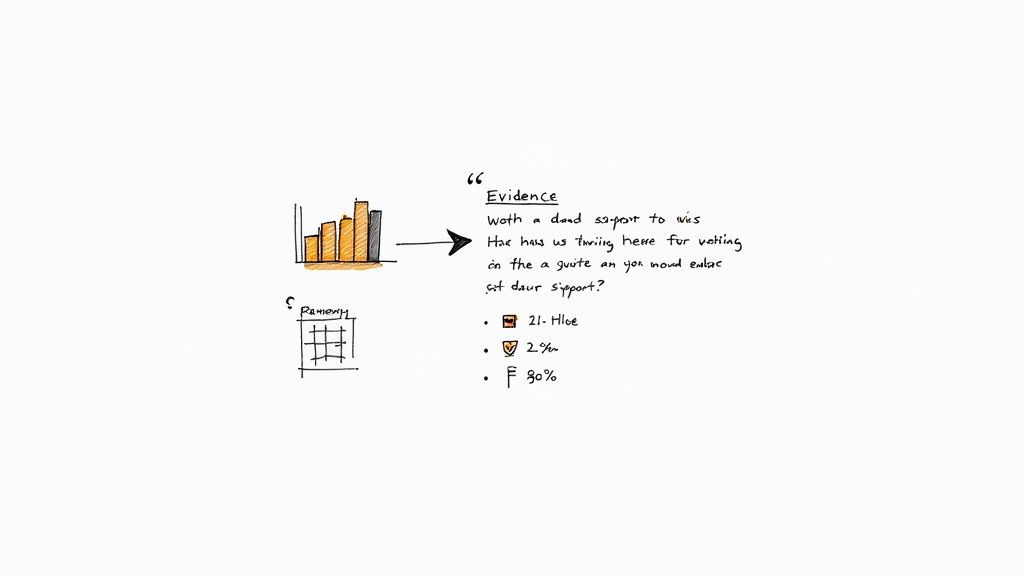
Strong evidence acts as the proof for your thesis. It shows your reader that you have engaged deeply with the existing scholarship and are contributing a well-supported perspective to the academic conversation. Without it, your paper is merely a collection of unsubstantiated assertions.
Weaving Evidence into Your Argument
To effectively support your claims, you must integrate evidence seamlessly rather than just dropping it into your text. Each piece of data or quotation needs context and analysis to connect it back to your main point.
- Weak Support: "Remote work is better for productivity." (This is an unsupported claim.)
- Strong Support: "The assertion that remote work enhances productivity is supported by a Stanford study which found that remote employees completed 13.5% more tasks than their office-based counterparts, citing fewer distractions and a quieter work environment as key factors." (This uses specific data and provides context.)
Key Insight: Evidence does not speak for itself. Your job as a writer is to be the interpreter, explaining precisely how the data or quotation proves the specific claim you are making in that paragraph.
Actionable Tips for Using Evidence
Use these strategies to fortify your arguments with powerful evidence:
- Use the Claim-Evidence-Commentary Framework: State your claim, provide the supporting evidence (a statistic, quote, or finding), and then add commentary explaining the evidence's significance.
- Vary Your Evidence Types: Strengthen your argument by using a mix of quantitative data (statistics, survey results) and qualitative evidence (expert opinions, case studies, direct quotes).
- Integrate Quotes Smoothly: Introduce quotations with signal phrases that attribute the source (e.g., "As Dr. Smith argues..."). Avoid leaving quotes as standalone sentences.
- Avoid Cherry-Picking: Present evidence honestly and avoid ignoring data that contradicts your argument. Acknowledging and addressing counter-evidence can actually make your position stronger.
7. Maintain Academic Tone and Formal Language
Academic writing is a distinct style characterized by its precision, objectivity, and formality. Adhering to this tone is crucial for establishing your credibility as a researcher and ensuring your work is taken seriously within the scholarly community. This convention is one of the most foundational research paper writing tips because it signals that your analysis is grounded in evidence and logic rather than personal opinion or emotion, which is essential for professional discourse.
The core principle of academic tone is to convey information in a clear, unbiased, and impersonal manner. It avoids colloquialisms, slang, and subjective language to present your findings as a contribution to a broader scholarly conversation, not just a personal reflection.
Cultivating a Scholarly Voice
To develop an appropriate academic tone, focus on being direct and professional. Your language should be sophisticated but not overly complex; the goal is clarity, not obfuscation.
- Informal: "The study totally proved that the new drug is way better."
- Formal: "The findings indicate that the new drug demonstrates a statistically significant improvement in efficacy compared to the existing standard treatment."
Key Insight: A consistent academic tone builds trust with your reader. It assures them that your arguments are based on rigorous research and logical deduction, free from personal bias or unsubstantiated claims.
Actionable Tips for Formal Writing
Use these strategies to ensure your paper meets scholarly standards:
- Avoid the First-Person Perspective: Refrain from using "I think," "I believe," or "In my opinion." Present your claims based on the evidence, not your personal feelings.
- Eliminate Contractions: Always write out the full form of words. Use "do not" instead of "don't" and "it is" instead of "it's."
- Use Discipline-Specific Terminology: Correctly employ the technical vocabulary relevant to your field to demonstrate your expertise and precision.
- Maintain Objectivity: Avoid emotional or sensational language. Words like "amazing," "terrible," or "shocking" have no place in a research paper. Similar to how a brand establishes its voice, your academic writing should follow a consistent set of stylistic rules; maintaining this formal consistency is a key part of the process.
8. Properly Cite and Attribute Sources
Accurate citation is the cornerstone of academic integrity and scholarly conversation. Proper attribution acknowledges the work of other researchers, provides credibility to your arguments, and allows readers to trace your intellectual journey. This practice is more than just a formatting requirement; it is a fundamental ethical obligation that separates credible academic work from plagiarism, making it one of the most critical research paper writing tips to master.
Properly citing sources demonstrates your engagement with the existing body of knowledge and situates your work within a broader academic context. Each citation acts as a signpost, guiding your reader to the evidence that supports your claims and enriching the overall discourse on your topic.
Mastering Citation Styles
Different academic disciplines use specific citation formats to maintain consistency and clarity. Understanding the rules for your required style, whether APA, MLA, Chicago, or another system, is non-negotiable for producing a professional research paper.
- APA Example: (Smith, 2023, p. 45) for an in-text citation.
- MLA Example: (Smith 45) for an in-text citation.
- Chicago Example (Notes-Bibliography): A footnote or endnote corresponding to a full citation in the bibliography, such as: John Smith, Title of Work (Publisher, 2023), 45.
Key Insight: Consistent and accurate citation is your primary defense against unintentional plagiarism. It is an act of scholarly transparency that builds trust with your reader and validates your research process.
Actionable Tips for Flawless Citations
Use these strategies to manage your sources effectively and maintain accuracy:
- Cite As You Write: Do not wait until the end to add citations. Document your sources immediately as you incorporate them into your draft to avoid losing track of where information came from.
- Use Citation Management Software: Tools like Zotero, Mendeley, or EndNote can save, organize, and format your citations automatically, significantly reducing the risk of manual errors.
- Cite Everything You Borrow: This includes direct quotes, paraphrased ideas, summaries of others' work, data, and unique concepts. When in doubt, cite it.
- Double-Check Your References List: Ensure every in-text citation has a corresponding entry in your bibliography or works cited page, and vice versa. Every detail, from punctuation to capitalization, matters. For a deeper dive, explore these strategies on how to avoid plagiarism and maintain academic honesty.
9. Revise, Edit, and Proofread Thoroughly
Submitting your first draft is one of the most common mistakes in academic writing. The writing process is recursive, meaning the real work often begins after the initial draft is complete. A systematic approach involving revision, editing, and proofreading transforms a good paper into an exceptional one, ensuring your arguments are not just valid but also presented with clarity, professionalism, and precision. This multi-stage process is one of the most critical research paper writing tips because it separates polished, persuasive work from rough, unconvincing drafts.
Treating revision, editing, and proofreading as three distinct stages is the key to success. Revision focuses on the big picture, evaluating the logic of your argument, the strength of your evidence, and the overall structure. Editing hones your prose at the sentence level for clarity, style, and flow. Finally, proofreading is the last check for surface-level errors like spelling, grammar, and typos.
Implementing a Multi-Pass Revision Strategy
A structured, multi-pass approach prevents you from trying to fix everything at once, which can be overwhelming and ineffective. Break down the process into focused stages for a more thorough review.
- Pass 1 (Revision): Read for content and argument. Does your thesis hold up? Is your evidence convincing? Is the structure logical, and does each paragraph support your central claim?
- Pass 2 (Editing): Focus on sentence-level clarity. Tighten awkward phrasing, improve transitions between paragraphs, and ensure a consistent academic tone.
- Pass 3 (Proofreading): Hunt for objective errors. Meticulously check for spelling mistakes, grammatical errors, punctuation issues, and correct citation formatting.
Key Insight: The best editing happens with fresh eyes. Step away from your paper for at least 24 hours between the writing and revision stages to gain a new perspective and spot errors you previously overlooked.
Actionable Tips for Polishing Your Paper
Use these strategies to ensure a comprehensive final review:
- Read Your Paper Aloud: This technique helps you identify awkward sentences and unnatural phrasing that your eyes might miss.
- Create a Checklist: Make a personalized checklist of common errors you make, such as comma splices or subject-verb agreement, to guide your proofreading.
- Use Tools Strategically: Grammar checkers are helpful, but don't rely on them blindly. To ensure your paper maintains a high academic standard and is free of errors, consider utilizing a language proficiency checker as part of your final revision process.
- Seek Peer Review: Ask a classmate or colleague to read your paper. A second reader can provide invaluable feedback on clarity and identify gaps in your argument that you may have missed. You can also explore tools like Rewritify to refine your text's clarity and style before submission.
10. Organize Sections with Standard Research Paper Format
Adhering to a standard research paper format is not about restricting creativity; it's about providing a universally recognized structure that makes your work accessible and professional. This framework acts as a logical guide, helping readers navigate your complex arguments and findings with ease. Following established sectional conventions, like the IMRaD (Introduction, Methods, Results, and Discussion) model, is a crucial research paper writing tip that ensures your paper meets the expectations of your discipline and audience.
This predictable structure allows your argument to unfold logically, with each section building upon the last. It demonstrates your familiarity with academic conventions and streamlines the process of communicating your research from the initial problem statement to your final conclusions.
Common Research Paper Structures
While the core components are often similar, the specific format can vary by academic field. Familiarize yourself with the conventions of your discipline to ensure your paper is structured correctly.
- STEM (Science, Technology, Engineering, Math): Typically follows the IMRaD structure: Abstract, Introduction, Methods, Results, Discussion, and Conclusion.
- Social Sciences: Often uses: Introduction, Literature Review, Methodology, Findings, Discussion, and Conclusion.
- Humanities: May have a more narrative flow: Introduction, Literature Review (or Theoretical Framework), Body Paragraphs with Analysis, and Conclusion.
Key Insight: The standard format is a powerful organizational tool. It forces you to separate your methodology from your results and your results from their interpretation, which promotes clarity and analytical rigor.
Actionable Tips for Section Organization
Use these strategies to structure your paper effectively:
- Create an Outline First: Before you start writing, create a detailed outline that maps out the content for each required section.
- Write the Abstract Last: Since the abstract summarizes the entire paper, it is most effectively written after you have completed all other sections.
- Use Headings and Subheadings: Break down longer sections like the Literature Review or Discussion with clear subheadings to improve readability and guide your reader.
- Ensure Smooth Transitions: Use transition sentences at the end of one section and the beginning of the next to create a cohesive flow and link your ideas.
10-Point Comparison of Research Paper Writing Tips
| Item | Implementation complexity | Resource requirements | Expected outcomes | Ideal use cases | Key advantages |
|---|---|---|---|---|---|
| Start with a Strong Thesis Statement | Low–Medium — crafting a clear claim can be hard | Low — time and initial research | Clear focus and roadmap for paper | All research papers; early drafting | Direction, coherence, easier organization |
| Conduct Thorough and Systematic Literature Review | High — systematic searching and synthesis | High — access to databases, time, reference tools | Contextualization; gap identification | New research projects; dissertations | Credibility, comprehensive background |
| Follow a Clear Outline Structure | Low–Medium — requires upfront planning | Low — time to plan and draft outline | Logical flow; efficient writing process | Complex arguments; drafting stage | Saves time, prevents disorganization |
| Use Credible and Peer-Reviewed Sources | Medium — locating and evaluating sources | Medium–High — subscriptions, library access | Reliable, defensible evidence | Empirical or literature-based research | Accuracy, stronger argumentative credibility |
| Write Clear Topic Sentences and Transitions | Low–Medium — careful wording needed | Low — editing and revision time | Improved paragraph coherence and flow | Paragraph-level writing; revisions | Reader guidance, clearer argument progression |
| Support Arguments with Evidence and Data | High — gathering and integrating data | High — data sources, analysis tools, time | Persuasive, verifiable claims | Empirical studies; claims requiring proof | Rigor, defensibility, increased persuasiveness |
| Maintain Academic Tone and Formal Language | Medium — consistent style and vocabulary | Low — style guides and editing | Professional credibility and clarity | Journal submissions; academic audiences | Authority, meets publication standards |
| Properly Cite and Attribute Sources | Medium — format knowledge and consistency | Low–Medium — citation tools, time | Academic integrity; traceable references | Any scholarly writing | Prevents plagiarism; standardized references |
| Revise, Edit, and Proofread Thoroughly | Medium–High — multiple passes and judgment | Medium — time, reviewers, editing tools | Polished, error-free final manuscript | Pre-submission and finalization stages | Error reduction, stronger clarity and logic |
| Organize Sections with Standard Research Paper Format | Medium — understand section purposes | Low–Medium — templates and guidelines | Familiar structure; easier navigation | Journal articles; coursework submissions | Consistency, easier peer review and reading |
Elevate Your Writing and Secure Your Success
Navigating the complex landscape of academic writing can often feel like a monumental task. However, as we've explored, the journey from a nascent idea to a polished, impactful research paper is not a matter of chance but a result of a structured, deliberate process. By internalizing and applying the research paper writing tips detailed in this guide, you are equipping yourself with a powerful framework for success. This isn't just about earning a good grade; it's about developing the critical thinking, organizational, and communication skills that are foundational to any intellectual or professional pursuit.
From Blueprint to Final Polish: A Recap of Core Principles
The ten strategies we've discussed form a cohesive and repeatable workflow. Think of your thesis statement as the architectural blueprint for your entire paper; without it, your structure will lack direction and purpose. The literature review acts as the foundation, grounding your work in the existing scholarly conversation and demonstrating your expertise. Your outline then becomes the scaffolding, ensuring each section logically connects to the next, building a coherent and compelling argument from the ground up.
The real substance of your paper lies in the evidence you present. Sourcing credible, peer-reviewed materials and weaving them into your narrative with clear topic sentences and smooth transitions transforms your claims from mere opinions into substantiated arguments. Maintaining a formal academic tone and adhering to a standard format are not just about following rules; they are about communicating your ideas with the seriousness and clarity that your research deserves.
The Transformative Power of Meticulous Refinement
Perhaps the most critical, yet often rushed, phase is the final one: revision, editing, and proofreading. This is where good papers become great. It’s a multi-layered process that demands fresh eyes and a systematic approach.
- Revision: Focus on the big picture. Is your argument consistent? Does the evidence truly support your thesis? Is the flow logical?
- Editing: Zoom in on sentence-level clarity. Are your sentences concise and impactful? Is the language precise? Is the academic tone consistent?
- Proofreading: The final sweep for surface errors. This is your last line of defense against typos, grammatical mistakes, and citation errors that can undermine your credibility.
Mastering these research paper writing tips is a significant step toward academic excellence. It’s about moving beyond simply completing an assignment and instead, crafting a piece of scholarship that contributes meaningfully to your field. Each paper you write is an opportunity to refine this process, making you a more effective researcher and a more persuasive writer.
Integrating Modern Tools for a Competitive Edge
In today's academic environment, leveraging technology is not a shortcut but a strategic advantage. While the core principles of research remain timeless, tools can significantly enhance your efficiency and the quality of your output. For instance, when you're deep in the editing phase and struggling to rephrase a complex idea or ensure your prose is both original and scholarly, an advanced rewriting tool can be invaluable. It acts as a sophisticated writing partner, offering alternative phrasings and helping you polish your work to a professional standard.
This integration of timeless techniques with modern tools creates a powerful synergy. You bring the critical thinking, the research, and the core arguments; technology helps you present them in the most polished, clear, and academically appropriate way possible. By embracing this combined approach, you are not just writing a research paper; you are mastering a process that will serve you throughout your academic and professional career, enabling you to communicate complex ideas with confidence and impact.
Ready to elevate your writing from draft to distinction? Rewritify is the perfect tool to help you implement these research paper writing tips, allowing you to refine clarity, perfect your academic tone, and ensure originality with ease. Transform your hard work into a polished, compelling final product by trying Rewritify today.
Relevant articles

Learn how to structure an argumentative essay with our expert guide. We break down the thesis, body paragraphs, and counterarguments for a powerful paper.

Learn how to write an annotated bibliography with this comprehensive guide. Get actionable tips, real examples, and formatting advice for APA and MLA.

Learn how to write an effective essay rough draft. This guide provides actionable steps for turning messy ideas into a coherent and compelling paper.

Discover differences between formal and informal writing, with practical tips, examples, and syntax cues to choose the right tone every time.

Learn how to write a critical analysis with our guide. We cover everything from developing a thesis to structuring your argument and refining your final draft.

Learn how to write a position paper with our expert guide. Discover proven strategies for research, structuring arguments, and persuasive writing.