How to Avoid Plagiarism Your Definitive Guide
Learn how to avoid plagiarism with proven strategies. Our guide covers proper citation, paraphrasing, and using tools to ensure your work is original.
To steer clear of plagiarism, you really need a two-pronged approach: get meticulous with tracking your sources and get good at ethical writing practices like paraphrasing and quoting. It's this blend of organized research and genuine writing that ensures your work is truly your own and protects your reputation, whether you're in a classroom or a boardroom.
Understanding Plagiarism Beyond Copy and Paste
Before you can confidently avoid plagiarism, you have to know what you’re up against. Most people think it's just grabbing a chunk of text from a website and dropping it into an essay. That’s definitely plagiarism, but it’s only the most obvious kind.
The truth is, plagiarism is a lot more subtle than that. Unintentional plagiarism is a huge trap that even well-meaning students and professionals fall into, and the consequences can be just as serious. Think of it like this: submitting someone else’s work is like stealing a car and claiming you built it. But what if you just used the original engine, swapped out the doors, and gave it a fresh coat of paint? It's still fundamentally someone else's machine. That's how many forms of plagiarism work—they blur the line between being inspired and just taking.
The Most Common Forms of Plagiarism
Getting to know the different flavors of plagiarism is your best defense. Some are blatant, but others are tricky and can happen purely by accident if you aren't paying close attention. Here are the main offenders to keep on your radar.
To help you spot these issues in the wild, here’s a quick breakdown of the most common types you’ll encounter.
Common Types of Plagiarism at a Glance
| Plagiarism Type | Description | Example Scenario |
|---|---|---|
| Direct Plagiarism | Copying someone else's work word-for-word without using quotation marks or providing a citation. | A student copies a full paragraph from a Wikipedia article and pastes it directly into their history essay without any changes or attribution. |
| Mosaic Plagiarism | Weaving borrowed phrases from a source into your own writing, changing only a few words. This is also called "patchwriting." | You find a sentence: "The Industrial Revolution dramatically altered societal structures." You write: "Society's structure was altered dramatically by the Industrial Revolution." The structure and key terms are too similar. |
| Self-Plagiarism | Reusing your own work that you previously submitted for another class or publication without getting permission first. | You submit an essay you wrote for a freshman English class to fulfill an assignment in a senior-level literature course. |
| Accidental Plagiarism | Forgetting to cite a source, misquoting someone, or paraphrasing improperly without meaning to. | While taking notes, you jot down an idea but forget to write down the source. Later, you include it in your paper, thinking it was your own original thought. |
Knowing these distinctions is crucial because it helps you self-audit your work before you ever hit "submit."
A Critical Takeaway: Intent doesn't get you off the hook. Whether you meant to plagiarize or not, the fallout can be the same. The responsibility to cite properly always falls on you, the writer.
Why the Consequences Are So Severe
The fallout from plagiarism goes way beyond just a bad grade. It can genuinely derail your academic and professional life.
In school, the consequences can range from a zero on an assignment to suspension or even expulsion. A single instance can tarnish your academic record, making it tough to get into grad school or win scholarships. Your reputation with professors and peers is on the line.
Once you're in the professional world, the stakes get even higher. A journalist caught plagiarizing can be fired and effectively blacklisted from the industry. A scientist could have their research retracted, completely destroying their credibility. For a company, using plagiarized content in marketing materials can lead to nasty lawsuits and do irreparable harm to the brand's image.
Imagine a marketing agency that lifts blog content for a client's website. They could be hit with a copyright infringement lawsuit, leading to expensive legal battles and a total loss of that client's trust. This is why learning to avoid plagiarism isn’t just about passing a class—it’s a fundamental professional skill. Your integrity is one of your most valuable assets.
Mastering the Art of Paraphrasing and Summarizing
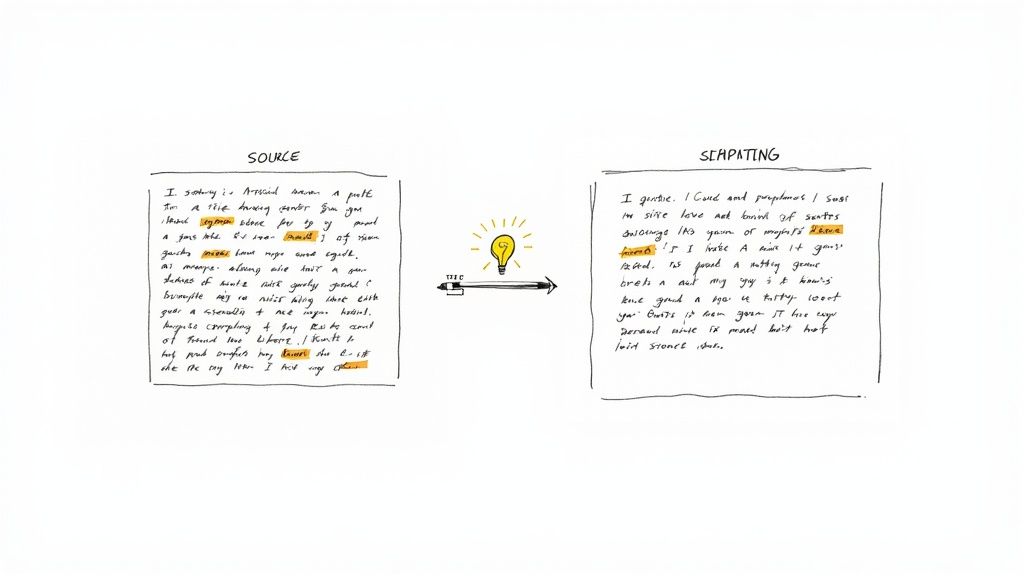
Let's get one thing straight: swapping a few words in a sentence isn't paraphrasing. That’s a shortcut to mosaic plagiarism, often called "patchwriting," and it's a huge red flag.
True paraphrasing is a skill. It’s about digesting an idea so completely that you can explain it in your own voice, with your own sentence structure and vocabulary. When you can restate a complex concept without clinging to the author's original phrasing, you're not just avoiding plagiarism—you're proving you actually understand the material.
Think of it like telling a friend about a great movie. You wouldn't just recite lines from the script. You'd hit the key plot points, describe the characters, and capture the overall theme, all in your own words. That’s the heart of effective paraphrasing.
A Practical Paraphrasing Framework
To get this right every time, you need a solid process. A structured approach takes the guesswork out and helps build the kind of writing habits that keep you out of trouble.
Here’s a simple but incredibly effective method I've relied on for years:
- Read and Absorb: Go over the passage a few times. Don't just skim. Your goal is to fully grasp the author's point, the evidence they use, and the logic connecting it all.
- Look Away and Write: Now, turn the source over or close the tab. From memory, write down the core idea as if you were explaining it to someone completely new to the topic.
- Compare and Refine: Pull the original source back up and put your version next to it. First, check for accuracy—did you nail the meaning? Then, look for overlap. Have you accidentally borrowed unique phrases or mirrored the sentence structure? Tweak as needed.
- Cite Your Source: This is the crucial final step. The words are yours, but the idea came from someone else. Always give credit where it's due with a proper citation.
This "look away" technique forces your brain to process the information, not just shuffle words around. It's a game-changer. For a deeper dive, especially when combining multiple sources, learning how to write an objective summary can help you capture the essence of a text without injecting your own bias.
Key Insight: Paraphrasing isn’t about hiding where an idea came from. It's about skillfully weaving that idea into your own work using your own voice. Citation isn't optional; it's essential.
Paraphrasing in Action: A Before and After Example
Theory is one thing, but seeing this in practice makes it click.
Original Text: "The proliferation of digital technologies has fundamentally transformed the media landscape, leading to a decentralized content creation model where consumers are also producers, thereby challenging the traditional authority of established media institutions."
Poor Paraphrase (Patchwriting): "The growth of digital tech has basically changed the media world, resulting in a decentralized model where consumers become producers and thus challenge the authority of traditional media."
See the problem? This version just substitutes a few words ("proliferation" becomes "growth," "transformed" becomes "changed") but the sentence's DNA is identical to the original. This is plagiarism, plain and simple.
Now, let's do it right.
Effective Paraphrase: "Thanks to the wide availability of digital tools, established media outlets no longer have a monopoly on information, as anyone can now create and share their own content."
This works because it captures the original meaning but uses a completely different structure and vocabulary. It demonstrates genuine comprehension.
Summarizing vs. Paraphrasing
People often use these terms interchangeably, but they serve different functions. Paraphrasing focuses on restating a specific point from a sentence or short paragraph, usually ending up around the same length.
Summarizing, on the other hand, condenses the main idea of a much larger work—an entire article, a book chapter, or a report—into a short, high-level overview. It strips away the supporting details to present only the core argument.
Both are vital skills for academic and professional writing, and both always require a citation.
For writers looking to sharpen their skills, a good rewriting tool can be a fantastic learning aid. Platforms like Rewritify use AI to generate different versions of a sentence, showing you multiple ways to express the same idea. This can be an eye-opening way to expand your vocabulary and get more comfortable restructuring sentences on your own.
The Power of Proper Citation and Referencing
Think of proper citation as your secret weapon against plagiarism. It’s far more than just a tedious academic hoop to jump through; it's the ethical foundation of any good piece of writing. When you cite your sources, you're building a transparent trail for your reader, showing them exactly where your ideas originated.
This simple act gives credit to the original thinkers and, in doing so, makes your own work far more credible. Failing to cite is like presenting evidence in court without saying where you found it—it immediately casts doubt on your entire argument.
When and Why You Absolutely Need to Cite
The rules can feel a little fuzzy at first, but they all come down to one core principle: if the idea isn't originally yours, give credit. This goes well beyond just direct quotes.
You should always drop in a citation when you:
- Use a direct quotation: Anytime you borrow someone's exact words, they need to be wrapped in quotation marks and followed by a citation. No exceptions.
- Paraphrase an idea: Putting a concept into your own words is great, but the idea itself still belongs to the original author. You have to cite where it came from.
- Include statistics or data: Numbers don't just appear out of thin air. Any facts, figures, or data from a study must be attributed to the source that published them.
- Reference a unique theory or concept: If you're discussing a specific framework, a groundbreaking model, or a well-known theory, you have to cite its creator.
Getting this right is a non-negotiable part of academic and professional integrity. In fact, robust citation has become so critical that the market for plagiarism detection software is booming, especially in regions like Asia Pacific, where it's projected to grow at a CAGR of 14.5%. This surge is driven by better internet access and a growing focus on protecting intellectual property, pushing tools from companies like Grammarly and Unicheck to offer sophisticated citation features. You can find more details on this market growth at Dataintelo.
Navigating the Major Citation Styles
Different fields have their own ways of organizing citations. While there are dozens of styles out there, you’ll almost certainly run into one of these three.
H3: APA (American Psychological Association)
- Who uses it? The social sciences, education, psychology, and business fields.
- What's its focus? It highlights the publication date in in-text citations, like (Smith, 2023), because timeliness is a big deal in these disciplines.
H3: MLA (Modern Language Association)
- Who uses it? The humanities—think literature, arts, and philosophy.
- What's its focus? It cares more about the author and the specific page number, like (Smith 42), since pinpointing a passage is often key to literary analysis.
H3: Chicago (The Chicago Manual of Style)
- Who uses it? History, fine arts, and some other social sciences.
- What's its focus? It's flexible, offering two systems: one with footnotes/endnotes and another with author-date citations. The footnote system is incredibly popular in the humanities because it lets you add detailed citations without cluttering the main text.
My Pro Tip: Don't even try to memorize every single rule. It's a waste of brain space. Instead, find a reliable guide like the Purdue Online Writing Lab (OWL) or use a citation manager like Zotero to do the heavy lifting. Your job is to know which style your project requires and then apply it consistently.
A Practical Look at Building Your Citations
Citations really have two parts that work as a team: the quick in-text citation and the full reference in your bibliography.
The in-text citation is a short marker you place right after you use the source. The bibliography entry is the full-blown, detailed information that lives at the end of your document.
Let's imagine we're using a book titled Digital Ethics by Jane Smith, published in 2023 by University Press.
- In-Text Citation (APA): According to Smith (2023), "ethical frameworks must adapt."
- Bibliography Entry (APA): Smith, J. (2023). Digital ethics. University Press.
See how the little in-text tag, (Smith, 2023), acts as a signpost, pointing your reader directly to the complete source in the bibliography?
This same principle applies no matter what you're writing. For a great breakdown of how to properly cite sources in a blog post, check out guides that specialize in that format. Building a solid citation habit is one of the most powerful things you can do to write with integrity.
Using Plagiarism Checkers as a Final Safeguard
Even the most diligent writer can make a mistake. You've paraphrased carefully and tracked your sources, but a forgotten citation or a phrase that’s a little too close to the original can easily slip through the cracks. This is where a good plagiarism checker comes in, serving as your final line of defense before you hit "submit."
Think of these tools less as an accusation and more as a helpful proofreader. They scan your work against a staggering number of web pages, academic journals, and publications, flagging any text that mirrors existing content. Running this final check is just smart practice to protect your work's integrity.
Choosing the Right Plagiarism Checker
You'll find a ton of options out there, from free online tools to comprehensive paid services. The best one for you really boils down to the stakes of your project.
Free Checkers: These are perfect for a quick, informal check on something like a blog post or a low-stakes assignment. While fast and accessible, they usually have limitations. You might run into smaller databases, word count caps, and less detailed reports. They’ll catch blatant copy-paste jobs but can miss more subtle similarities.
Paid Checkers: When you’re working on a major academic paper, a client report, or anything where originality is non-negotiable, a paid tool is a solid investment. These services usually offer access to massive databases, including paywalled academic journals that free tools miss. The detailed similarity reports they generate are also a huge plus, pointing you directly to the source of any flagged text.
The growing demand for these tools shows just how crucial they are. The global market for plagiarism detection software was valued at around USD 1.2 billion and is on track to more than double by 2033, all driven by the need to uphold academic and professional integrity. You can learn more about the market growth for plagiarism detection software.
To help you decide, here’s a quick breakdown of what you can typically expect from free versus paid plagiarism checkers.
Feature Comparison Free vs Paid Plagiarism Checkers
This table offers a side-by-side comparison to help you decide which type of tool best fits your needs.
| Feature | Free Tools | Paid Tools |
|---|---|---|
| Database Size | Limited (mostly public web pages) | Extensive (includes academic journals, books, and proprietary databases) |
| Word Count Limit | Often capped (e.g., 1,000 words per scan) | High or unlimited, suitable for long documents |
| Report Detail | Basic similarity score, may not link to all sources | In-depth, color-coded reports with direct links to matching sources |
| Grammar/Style Check | Basic or none | Advanced grammar, style, and tone suggestions often included |
| Customer Support | Limited or non-existent | Dedicated customer support via email, chat, or phone |
| Privacy & Security | Variable; some may store or resell your data | Generally high, with commitments to data privacy and security |
Ultimately, free tools can be a great starting point, but for any serious project, a paid checker provides a far more thorough and reliable safety net.
How to Interpret a Similarity Report
Getting a report back can be a little jarring, especially if the percentage is higher than you expected. Don't panic. A similarity score isn't a "plagiarism score." It’s just a measure of overlapping text. The real work is in analyzing the results.
A good report will highlight the specific sentences that match other sources. Your job is to review each one and figure out what’s going on.
Crucial Insight: A similarity score is just a starting point. The tool identifies matching text; it's up to you to add the human context and decide if a change is needed.
Look for patterns. Are the flagged sections direct quotes you’ve already put in quotation marks and cited? If so, you’re in the clear. The checker is just confirming you quoted correctly. Sometimes, it will also flag common phrases or standard terminology in your field, which you can usually ignore.
The real red flags are chunks of text that are identical or very similar to a source but are missing quotation marks or a proper citation. These are the spots that need your immediate attention. Go back and either rephrase the idea in your own words or add the correct citation to give credit where it's due.
Proper citation is everything, and different fields have their own specific rules. This visual gives a quick overview of three common styles you'll encounter.
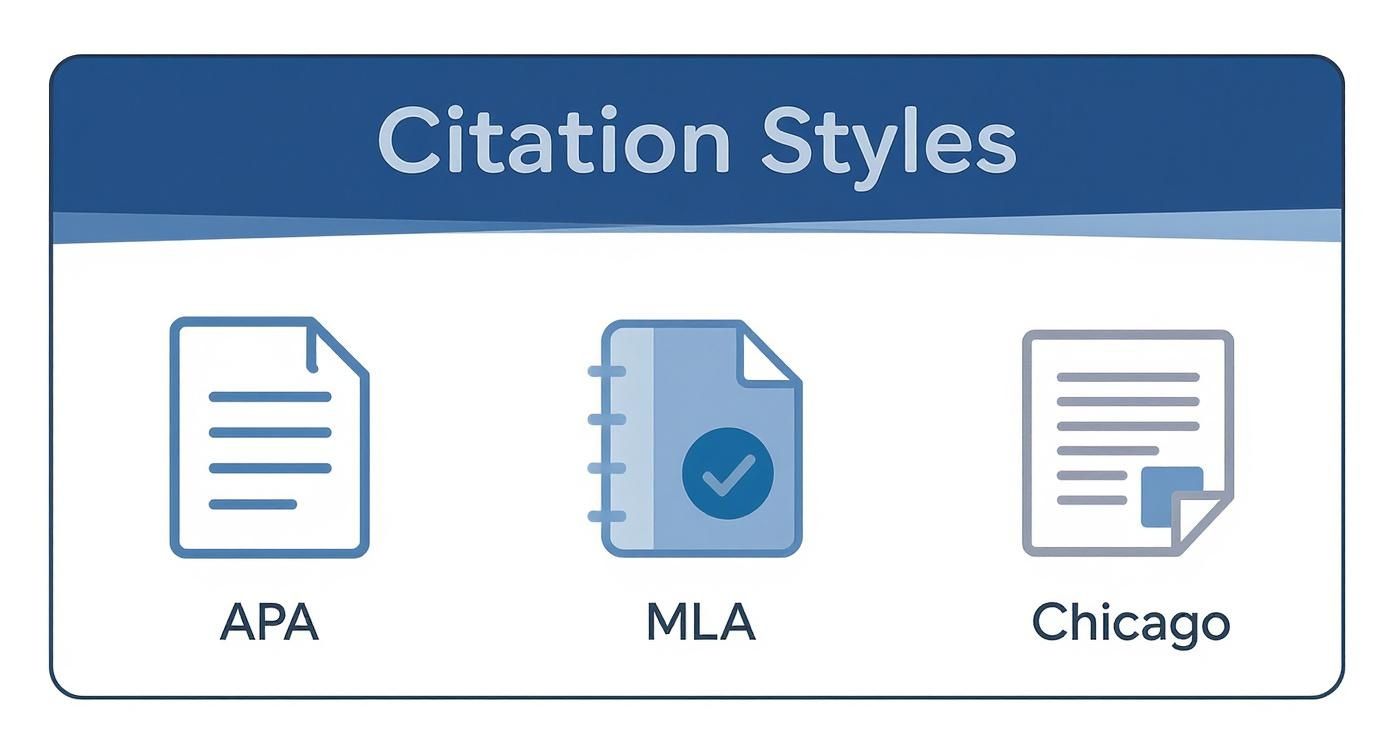
Knowing whether to use APA (common in sciences), MLA (humanities), or Chicago (history and arts) is key to giving proper credit.
Think of a plagiarism checker as a diagnostic tool, not a final verdict. It helps you find and fix potential issues before anyone else sees them. By using it wisely and interpreting the results with a critical eye, you can submit your work confident that it’s 100% yours.
Developing Strong Research and Note-Taking Habits
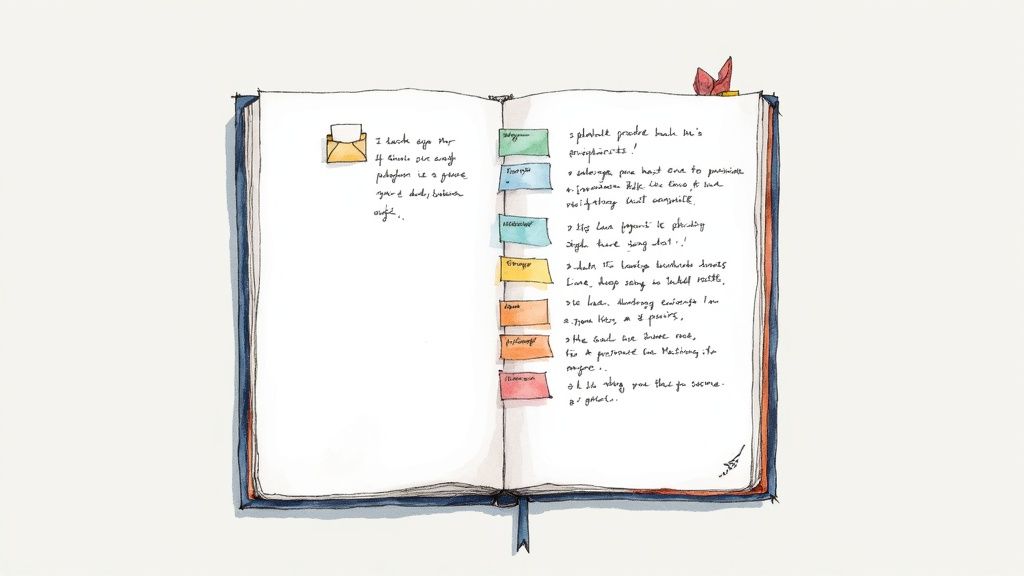
Honestly, the best way to stop plagiarism is to build a strong defense from the very beginning. This starts the second you open your first book or click on that first research article. I've seen it time and time again—accidental plagiarism isn't usually about a lack of integrity. It’s born from chaos.
When your notes are a jumbled mess of copy-pasted text, half-baked ideas, and stray links, it’s incredibly easy to lose track of where a source’s voice ends and your own begins.
The fix? Get systematic about how you research and take notes. A solid process creates a clear, unbreakable trail back to your sources, making citation feel like a natural part of your workflow instead of a frantic, last-minute chore. This isn’t about making more work for yourself; it's about working smarter to keep your writing genuinely yours.
Build an Annotated Bibliography from Day One
Whatever you do, don't wait until you're done writing to scramble for your sources. Start building an annotated bibliography the moment you find a source you think you'll use. This document is so much more than a simple list of links. Think of it as your research journal.
For every article, book, or study you consult, create an entry. Drop in the full citation right away, then write a short paragraph summing up the main arguments. Here's the most important part: add another paragraph explaining exactly how you plan to use this source in your own work. This little step forces you to think critically about the material right from the get-go.
An annotated bibliography is a game-changer because it:
- Keeps everything in one place. No more losing that one perfect article you found last week.
- Sharpens your thinking. It makes you spell out why a source is actually relevant to your project.
- Makes final citations a breeze. You’ve already done most of the heavy lifting.
This single habit is one of the most powerful ways to ensure you give credit where it's due.
Use a System to Differentiate Your Ideas
As you dive deeper into your research, your notes will become a blend of direct quotes, paraphrased ideas, and your own brilliant insights. Without a clear system to tell them apart, you're walking into a trap.
A simple but powerful method is color-coding. Use a different highlight color for each type of note. For example, yellow for direct quotes, green for paraphrased ideas from a source, and blue for your own analysis and questions.
This visual separation makes it practically impossible to mistake someone else’s words for your own when you finally sit down to write.
If you’re a fan of pen and paper, you can do the same thing with different colored pens or by using symbols. Maybe you put big, can't-miss-it quotation marks around any text you copy word-for-word. The specific system isn't what matters—consistency is. This small organizational trick is an essential safety net.
Let Technology Help You Stay Organized
Trying to juggle dozens of sources by hand is a recipe for headaches and mistakes. This is where reference management software becomes a researcher's best friend.
Tools like Zotero and Mendeley are built specifically to help you gather, organize, and cite your sources without losing your mind. Their browser extensions let you grab an article and all its bibliographic info with a single click. These platforms build your bibliography for you and can insert perfectly formatted citations directly into your document in hundreds of styles—APA, MLA, Chicago, you name it.
Using a reference manager automates the most tedious parts of citation, which frees up your mental energy to focus on what really matters: writing and developing your ideas.
Got Questions About Plagiarism? Let's Clear Things Up.
As you get deeper into writing, whether for school or work, you're bound to run into some gray areas. It happens. Here are some straight answers to the questions I hear most often about avoiding plagiarism.
Is Paraphrasing the Same as Summarizing?
This is a big one, and it's easy to get them mixed up. The real difference comes down to scope and detail.
Think of paraphrasing as zooming in on a specific idea. You're taking a single point—maybe a sentence or a short paragraph from a source—and rephrasing it completely in your own voice and sentence structure. The length usually ends up being about the same as the original snippet.
Summarizing, on the other hand, is like pulling the camera way back. You’re hitting the highlights of a much larger piece, like a whole journal article or a chapter of a book. The goal is to boil it down to its core arguments in a much shorter format.
Both are crucial writing skills, but don't forget the golden rule: they always require a citation. No exceptions.
Can I Really Plagiarize Myself?
You absolutely can, and it's a bigger deal than most people think. This is called self-plagiarism, and it's a genuine academic foul.
It happens when you recycle a chunk of a paper you wrote for one class and drop it into an assignment for another, without getting the green light from your professor first. The whole point of an assignment is to produce new, original work for that specific context. Handing in old work usually breaks the rules.
My Advice: Treat your own past work just like you'd treat a journal article or a book. If you want to build on an idea you've already written about, you have to cite yourself and, most importantly, get permission from your instructor beforehand. It's just not worth the risk.
What About Citing Common Knowledge?
Okay, so you don't have to cite everything. There's an exception for what's known as common knowledge. These are the undisputed facts you can find in countless places.
For instance, you don't need a citation for things like:
- The Earth revolves around the Sun.
- William Shakespeare wrote Hamlet.
- Water is made up of hydrogen and oxygen.
But where do you draw the line? It can feel a bit fuzzy sometimes. Here’s a simple test I've always used: if you had to look it up, you should probably cite it. When in doubt, just add the citation. It’s the safest bet and actually makes your work stronger by showing you've done your homework. For more practical writing tips, we cover a lot of ground on the Rewritify blog.
Ready to make sure your writing is original and polished? Rewritify is designed to help you refine your drafts into clear, high-quality work that's ready for submission. Give your essays and reports the final touch they need with confidence. You can try it for free at https://www.rewritify.com.
Relevant articles

Master the difference between complement and compliment with our guide. Learn the definitions, grammar, and usage with clear examples to perfect your writing.

Learn how to structure an argumentative essay with our expert guide. We break down the thesis, body paragraphs, and counterarguments for a powerful paper.

Learn how to write an annotated bibliography with this comprehensive guide. Get actionable tips, real examples, and formatting advice for APA and MLA.
Discover 8 expert-approved concluding sentence starters with examples. Learn how to write powerful, memorable conclusions for essays, reports, and more.
Master apa footnote example with a clear, step-by-step guide to APA 7th edition footnotes and citations.
Are AI detectors accurate? This guide unpacks the data, revealing why 99% claims are misleading and how to navigate the risks of false positives in your work.