Apa Guide: apa footnote example and citations
Master apa footnote example with a clear, step-by-step guide to APA 7th edition footnotes and citations.
In the world of APA 7th Edition, footnotes aren't for your everyday citations. Instead, they serve two very specific and limited roles: content footnotes to add extra, non-essential details, and copyright footnotes to give credit for long quotes or images.
When and Why to Use APA Footnotes
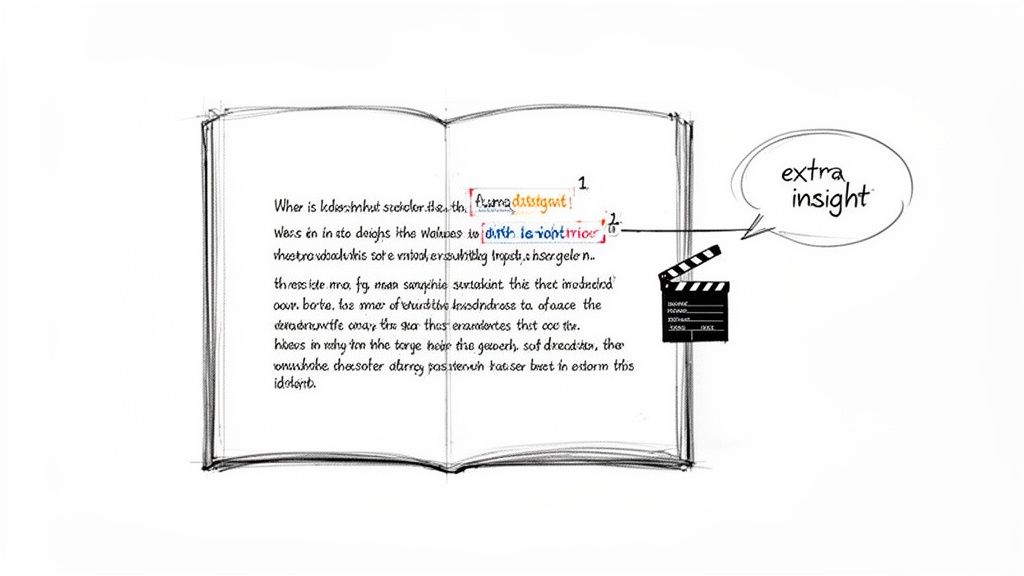
Think of APA footnotes as the "director's commentary" track for your academic paper. Their job isn't to list every source—that’s what your in-text citations and References page are for. Instead, footnotes are for supplemental tidbits that are interesting but would clutter up your main argument if you squeezed them into the main text.
This approach is central to the APA 7th Edition's philosophy, which champions clear, concise writing. The whole point is to keep your reader locked into your core ideas without unnecessary side trips.
The Philosophy of "Less Is More"
The official APA style guide is pretty clear: use footnotes sparingly. Before you add one, stop and ask yourself, "Is this information absolutely critical for my reader to get my point?"
If the answer is yes, that information probably belongs right in the main text. But if it's just a helpful aside, a quick definition of a niche term, or a required copyright notice, a footnote is the perfect spot for it.
The American Psychological Association (APA) heavily favors parenthetical in-text citations—like (Smith, 2023)—to keep the text clean. Footnotes, marked with superscript numbers¹, are saved for those rare instances of extra content or copyright permissions. This focus on decluttering the page is so effective that some journals saw a 70% reduction in footnote usage after adopting the 7th edition, as noted in recent academic writing style research.
Two Primary Use Cases
So, when do you actually use one? It really boils down to two main scenarios.
- Content Footnotes: You'll use these to offer a brief, supplemental explanation or to define a technical term that some of your readers might not know.
- Copyright Permission Footnotes: These are non-negotiable. You must use them when you reproduce a long quotation (more than 500 words), or a table or figure from a copyrighted source. This is all about giving proper credit and is a crucial step to check out our guide on how to avoid plagiarism.
The Two Types of APA Footnotes Explained
When it comes to APA style, footnotes aren't just for miscellaneous notes. They're specific tools with very different jobs. Getting a handle on the two main types is your first step toward using them correctly and showing you know your way around academic writing.
Think of them as two distinct tools in a writer's toolbox, each one pulled out for a very specific task.
Content Footnotes
First up, we have the content footnote. This is the one you'll probably use most often. Its purpose is simple: to add a quick, supplementary comment that adds value without derailing the main argument in your paragraph.
It’s the perfect spot to briefly define a technical term your reader might not know or to offer an interesting little aside that doesn't quite fit the narrative flow. For instance, you could use a content footnote to clarify a small detail about your research method or point someone to an appendix for the raw data. The key word here is supplementary. If the information is essential for understanding your point, it belongs in the main text, not tucked away at the bottom of the page.
Copyright Permission Footnotes
The second type is the copyright permission footnote, and this one is a different beast entirely. It serves a crucial legal and ethical function. You use this footnote when you reproduce a significant chunk of someone else's copyrighted work in your paper. We're talking about long quotations (often over 500 words), full tables or figures, charts, or even certain tests and scales you've borrowed.
This footnote is non-negotiable. It's how you formally state that you've received permission from the copyright holder to use their material. Skipping this step isn't just bad form; it can land you in serious academic and legal trouble. It's a fundamental part of responsible scholarship.
A copyright footnote is more than just a citation—it’s your formal proof that you have the right to use protected intellectual property. It safeguards you and respects the original creator.
Content Footnotes vs. Copyright Footnotes in APA
So, how do you decide which one to use? The distinction is actually quite clear once you see them side-by-side. Choosing the right one keeps your paper clean, readable, and in line with academic standards.
This quick comparison should help you choose the right footnote for any situation.
| Feature | Content Footnote | Copyright Permission Footnote |
|---|---|---|
| Purpose | To provide extra, non-essential information or clarification. | To formally state that you have permission to use copyrighted material. |
| When to Use | For brief asides, definitions, or directing readers to other sections. | When reprinting long quotes, tables, figures, or scales from another source. |
| Is it Optional? | Yes, its use depends on the writer's judgment. | No, it is mandatory when using copyrighted works. |
| Example Focus | Elaborating on a point without cluttering the main text. | Providing the formal attribution language required by the publisher. |
Ultimately, content footnotes are a stylistic choice to add depth, while copyright footnotes are an ethical and legal requirement. Knowing the difference is a small detail that makes a big impact on the quality of your work.
Getting the Formatting Right: A Step-by-Step Guide
Nailing the format for your footnotes is one of those little details that shows you know your stuff. It all begins in the main body of your paper. You’ll place a superscript number directly after the word or punctuation mark that needs a little extra explanation. This tiny number is a cue for your reader, letting them know there’s a note waiting for them at the bottom of the page.
Think of it as a quiet tap on the shoulder.¹ It’s there to guide them, not to interrupt their reading flow.
This process applies whether you're adding a content note for more detail or a copyright note for permissions, as you can see below.
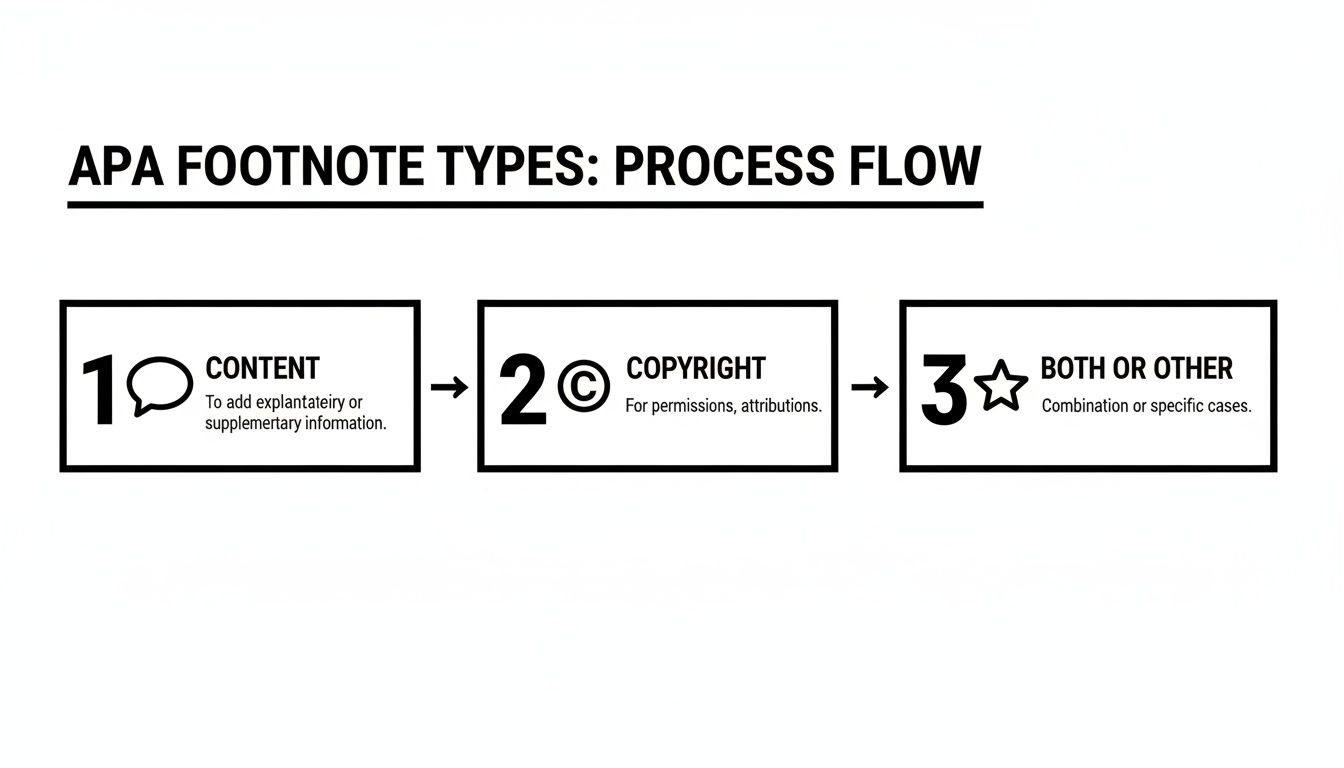
As the chart shows, both footnote types start with that same superscript number in your text, creating a clean, consistent look.
How to Structure the Footnote Itself
Once you’ve placed the superscript number in your text, it's time to write the actual note at the bottom of that page. The APA has specific rules here, all designed to keep your paper looking clean and professional.
Here's the basic anatomy of a well-formatted footnote:
- Numbering: The note begins with the corresponding number, but this time, it's full-sized and followed by a period (like this: 1.).
- Indentation: You'll indent the first line of the footnote 0.5 inches from the left margin—the same standard indentation you use for a new paragraph.
- Font and Spacing: Stick with the same font and size as your main text (e.g., 12-point Times New Roman). The footnote itself should be single-spaced, but be sure to leave a blank line between different footnotes if you have more than one on the same page.
Following these simple rules ensures your footnotes are easy to read and blend seamlessly with the rest of your work. It's a key part of academic writing, just like knowing how to cite a website in APA or any other source correctly.
Let Your Word Processor Do the Heavy Lifting
Trying to manage footnotes manually is a recipe for frustration. You’d have to renumber everything by hand if you added or removed one. Luckily, modern word processors like Microsoft Word and Google Docs automate this entire process beautifully.
In Microsoft Word:
- Click your cursor exactly where you want the superscript number to go.
- Navigate to the References tab in the main ribbon.
- Select Insert Footnote. Word instantly adds the number in your text and creates a space at the bottom of the page for you to start typing your note.
In Google Docs:
- Place your cursor in the right spot within your document.
- Go to the Insert menu at the top.
- Choose Footnote (or just use the handy shortcut Ctrl+Alt+F). Google Docs will do the same thing: insert the superscript and jump your cursor down to the footer so you can write the note.
Practical APA Footnote Examples You Can Use
Knowing the rules for APA footnotes is one thing, but seeing them in action is what really makes it all click. Let's move from theory to practice with some clear, copy-ready examples for the most common situations you'll run into. Whether you need to quickly define a term, add a related thought, or give credit for copyrighted material, you'll find a model here.
Each example will show you the superscript number as it appears in your text and the full footnote that goes at the bottom of the page. This way, you can find the format you need and adapt it for your own work in seconds.
Content Footnote Examples
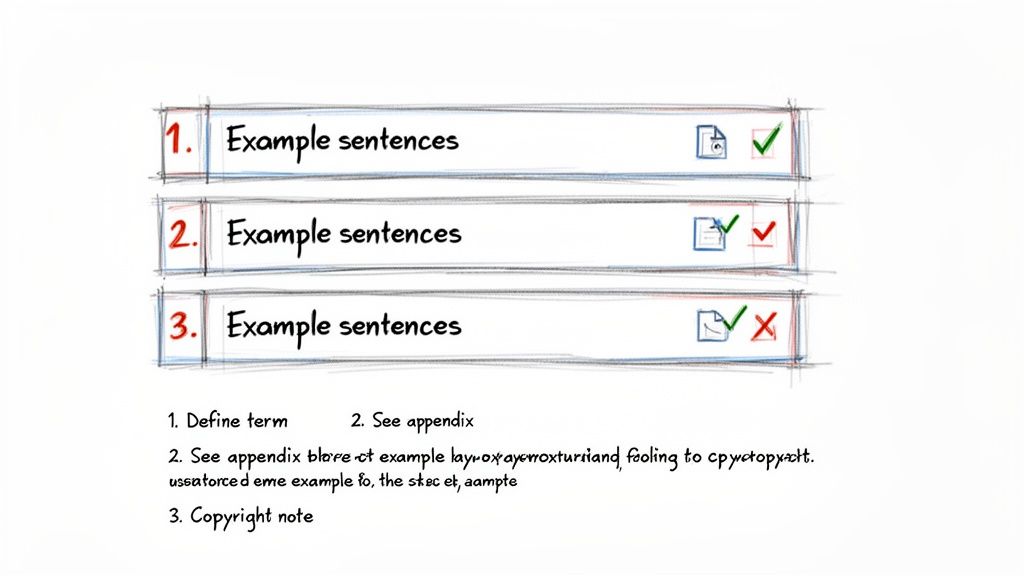
Think of content footnotes as your secret weapon for adding quick, supplemental notes without breaking the flow of your writing. They’re perfect for offering a quick definition, sharing a tangential insight, or pointing a reader toward an appendix for more detail.
Example 1: Defining a Technical Term
Here, the footnote clarifies a specialized term, making sure every reader is on the same page without having to stop and define it in the middle of a sentence.
- In-Text Sentence: The study employed a double-blind methodology¹ to ensure impartial results.
- Footnote: ¹ In a double-blind study, neither the participants nor the researchers administering the experiment know who is receiving a particular treatment.
Example 2: Expanding on a Concept
Sometimes you have an interesting tidbit that doesn't quite fit in the main paragraph but is still worth sharing. A footnote is the perfect spot for this kind of "bonus content."
- In-Text Sentence: This particular finding was consistent across all demographic groups, a result that was not initially anticipated.²
- Footnote: ² For a complete breakdown of the demographic data, including age, gender, and geographic location, see Appendix B.
Copyright Permission Footnote Example
When you use a substantial piece of someone else's work—like a long quote (usually over 500 words), a table, a figure, or an image—a copyright permission footnote isn't just good practice; it's a requirement.
The format for these is very specific and is often dictated by the publisher who gave you permission to use the material.
"A proper copyright footnote serves as a formal acknowledgment, demonstrating that you have legally and ethically secured the rights to reproduce another creator's intellectual property. It is a critical component of academic integrity."
Here’s what a standard footnote looks like for a long quote from a book.
- In-Text Placement: A long block quote from a copyrighted source would be placed here.³
- Footnote: ³ From The Art of Academic Writing (p. 45), by J. Doe, 2021, Academic Press. Copyright 2021 by Academic Press. Reprinted with permission.
That precise wording is your proof that you’ve done your due diligence.
Why APA Prefers In-Text Citations
It's helpful to remember the bigger picture: APA style uses footnotes sparingly for a reason. The guide's evolution from its first edition in 1952 to the seventh in 2020 has always leaned toward clarity and standardization, which is why it prioritizes in-text citations.
Unlike a style like Chicago, which uses footnotes for primary citations, APA keeps things in the main text with parenthetical citations like (Grady, 2019). Footnotes are reserved only for that extra, supplemental information we've been discussing. It’s a core difference. If you're curious about the history, detailed guides from academic writing centers offer great insights into these stylistic shifts.
By getting comfortable with these hands-on examples, you can use APA footnotes with confidence, making your work clearer for readers and perfectly aligned with academic standards.
Common Footnote Mistakes and How to Avoid Them
Even seasoned writers can get tripped up by APA footnotes. It’s not surprising, really, since their purpose is so specific and different from other styles. The number one mistake I see is treating them like regular citations, a habit that comes from formats like Chicago. But in the APA world, footnotes are strictly for extra commentary, not your basic source attribution.
This single misunderstanding snowballs into other problems. You might see someone cram full bibliographic details into a footnote. Or, on the flip side, they'll use a footnote where a simple in-text citation—like (Smith, 2023)—is all that's needed. Both of these habits go against a core principle of APA style: keeping your main text as clean and readable as possible.
Using Too Many Footnotes
Another big pitfall is simply overdoing it. A paper littered with superscript numbers can make the reader’s head spin, forcing them to constantly glance down and breaking the flow of your argument. If you find yourself adding a footnote to every other paragraph, take that as a sign. The information is probably important enough to be woven directly into the main text.
The goal is always clarity, not clutter. Each footnote has to justify its existence by serving a specific, supplemental purpose.
Here are the most common slip-ups to watch out for:
- Footnotes for Citations: This is the big one. Using a footnote to cite a source instead of the required (Author, Year) format in the text.
- Full References in Footnotes: The complete, detailed source information belongs on your References page, and only there.
- Redundant Information: A footnote shouldn’t just repeat a fact or statistic you’ve already stated in the main body of your paper.
For example, the official APA style guides are very clear about not repeating statistical data. If you’ve already written that the mean was M = 4.2, you shouldn’t add a footnote saying the same thing. The idea is to keep the page looking clean and professional.
The Solution Is Simplicity
Getting this right really comes down to one guiding principle: keep it minimal. Before you hit that "insert footnote" button, pause and ask yourself a simple question: "Is this information truly just a helpful aside?"
If it's essential to your argument, find a way to work it into a sentence. If it's a standard citation, stick to the parenthetical format.
The best-written papers often have few, if any, content footnotes. This is a sign that the author has built a strong, coherent narrative where all the necessary information flows together seamlessly—the true mark of great academic writing.
When you stick to this "less is more" approach, your writing instantly becomes stronger and clearer, and it will be perfectly aligned with APA standards. This kind of attention to detail is just as important for academic credibility as knowing how to paraphrase without plagiarizing. A clean paper, free from distracting notes, shows your reader that your arguments are well-organized and confident.
Your Top APA Footnote Questions, Answered
Even with all the rules laid out, a few questions about APA footnotes tend to surface time and time again. Let’s tackle the most common ones head-on so you can clear up any confusion and use them like a pro.
Can I Put a Full Citation in an APA Footnote?
In a word, no. This is one of the most critical rules to get right. Your full, detailed citations belong in one place and one place only: the References list at the end of your paper.
An APA footnote is for extra commentary or clarification, not for citing sources directly.
Now, if you happen to need to cite a source within your footnote to back up a point you're making there, you’d just use a standard in-text citation, like (Smith, 2021). Of course, any source you mention in a footnote must also be listed in your main reference list. It’s all about keeping your paper tidy and consistent.
What’s the Difference Between Footnotes and Endnotes?
The only real difference here is placement. It's a simple distinction, but it changes how your reader interacts with the information.
- Footnotes live at the bottom of the very page where their little superscript number appears. This gives your reader immediate access to the extra info without breaking their reading flow.
- Endnotes, on the other hand, are all gathered together on a separate page at the very end of your document, right before the reference list.
The APA 7th edition gives you the green light to use either one. The key is to pick one style and stick with it throughout the entire paper. Most instructors (and readers!) prefer footnotes simply because they’re more convenient.
Are Footnotes the Same as In-Text Citations?
This is probably the most important distinction to nail down, and the answer is a firm no. They serve completely different purposes.
An in-text citation, like (Author, Year), is the non-negotiable, mandatory way you give credit to a source you’ve quoted or paraphrased. It's about academic integrity.
An APA footnote is an optional tool. Think of it as the "director's cut" commentary—it’s for adding interesting asides or supplemental details that would otherwise interrupt the flow of your main argument. If you're looking to brush up on the fundamentals, it's always helpful to review guides that help you improve your academic writing by focusing on core skills like proper citation.
In-text citations are the essential pillars holding up your argument's credibility. Footnotes are the optional annotations that add extra layers of detail.
How Many Footnotes Should I Have in My Paper?
There's no magic number, but when it comes to APA style, the guiding principle is always "less is more." Footnotes should be used sparingly. They are the exception, not the rule.
If you find yourself peppering every paragraph with a footnote, it’s a big red flag. That usually points to one of two issues: either the information is important enough to be woven directly into your main text, or you're mistaking footnotes for a place to put regular citations.
A well-crafted paper might only have a few footnotes—or none at all. Their absence is often the sign of a clear, strong, and self-contained argument. Every apa footnote example is designed to show how a note can add supplemental value. If your note doesn't do that, it's probably better to leave it out.
When you've polished your arguments and just need to refine the language, Rewritify can help. Our AI-powered tool rewrites your text to be clearer, more professional, and plagiarism-safe, ensuring your final draft meets the highest academic standards. Transform your writing today at https://www.rewritify.com.
Relevant articles

Learn how to structure an argumentative essay with our expert guide. We break down the thesis, body paragraphs, and counterarguments for a powerful paper.

Learn how to write an annotated bibliography with this comprehensive guide. Get actionable tips, real examples, and formatting advice for APA and MLA.

Learn how to write an effective essay rough draft. This guide provides actionable steps for turning messy ideas into a coherent and compelling paper.

Discover differences between formal and informal writing, with practical tips, examples, and syntax cues to choose the right tone every time.

Learn how to write a critical analysis with our guide. We cover everything from developing a thesis to structuring your argument and refining your final draft.

Learn how to write a position paper with our expert guide. Discover proven strategies for research, structuring arguments, and persuasive writing.