How to Write a Discussion Section That Elevates Your Research
Learn how to write a discussion section that gets your research noticed. Our guide covers interpretation, limitations, and real examples to impress reviewers.
So, you’ve wrestled with your data and presented your findings in the results section. Now comes the hard part—and arguably, the most important one: the discussion. This is where you breathe life into your data, explaining what it all means, why anyone should care, and where your field goes from here. It's your chance to step out from behind the numbers and show your reader the true impact of your work.
Why Your Discussion Is More Than Just a Summary
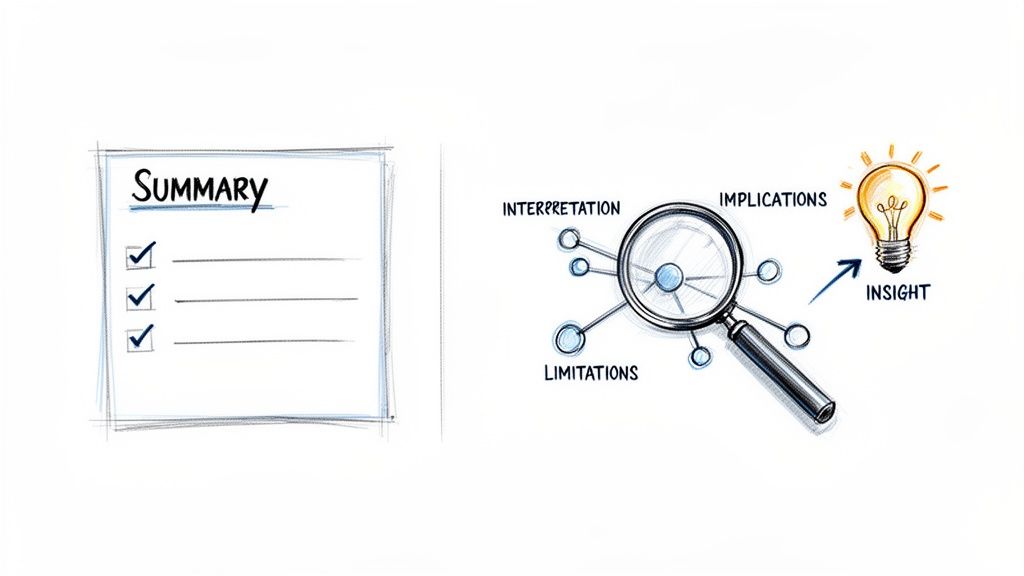
Let's be blunt: the discussion is where a research paper stands or falls. It’s the intellectual engine of your manuscript, the place you transform a dry list of findings into a compelling story about your contribution. This is where you move past simply reporting what you found and start arguing for its significance.
Many researchers—even seasoned ones—find this section tough to write. It demands a pivot from the objective, just-the-facts style of the results section to a more interpretive and persuasive voice. Your results laid out the evidence; your discussion builds the case. Getting this right is what separates a forgettable paper from a landmark one.
The importance of this section cannot be overstated. A 2022 analysis by Elsevier found that a staggering 45% of manuscript rejections in biomedical fields were due to weak or poorly structured discussions. Authors simply failed to connect their findings to the bigger picture. You can explore more detailed advice for dissertation discussions over at Scribbr.
This statistic reveals a harsh truth: a fantastic study with a weak discussion will likely get rejected or ignored. Journals and reviewers aren't just looking for new data; they're looking for new meaning.
To help you structure your thoughts, here’s a quick overview of the essential building blocks of a high-impact discussion section.
Core Components of a Powerful Discussion
| Component | Purpose |
|---|---|
| Interpret Findings | Go beyond the numbers to explain what your results actually mean in the context of your research question. |
| Situate in Context | Connect your work to the existing literature. Do your findings confirm, challenge, or refine what's already known? |
| Explain Significance | Answer the "so what?" question. What are the broader theoretical or practical implications of your study? |
| Acknowledge Limitations | Demonstrate intellectual honesty by discussing the constraints of your study. This builds credibility. |
| Suggest Future Work | Propose clear, logical next steps for research that build directly on your findings and limitations. |
Thinking about your discussion through this framework helps turn a daunting task into a clear opportunity to make your case.
The Core Purpose of Your Discussion
Ultimately, your goal is to answer the "so what?" question for your readers. A strong discussion doesn't just rehash the results; it synthesizes, analyzes, and persuades.
Think of it this way:
Interpret Your Findings: You need to explain what your results signify. Don't just say "X was higher than Y." Tell your reader what that difference means for the hypothesis you were testing.
Connect to Existing Knowledge: Place your study squarely within the ongoing conversation in your field. Are you reinforcing a popular theory, or are you throwing a wrench in the works? This is where you show you’ve done your homework.
Explore Implications: This is where you zoom out. How could your findings change the way people think or work in your field? Could they influence policy, clinical practice, or future research designs?
Acknowledge Limitations: No study is perfect, and acknowledging your work's boundaries is a sign of strength, not weakness. Being upfront about what your study couldn't do builds trust and gives other researchers a clear starting point.
This is your final opportunity to convince your audience that your research matters. Crafting it well not only helps you get published but ensures your work gets read, cited, and respected. If you're struggling to find the right words, tools like Rewritify can help you polish your arguments and make sure your insights are communicated with the clarity and authority they deserve.
Building Your Discussion from the Ground Up
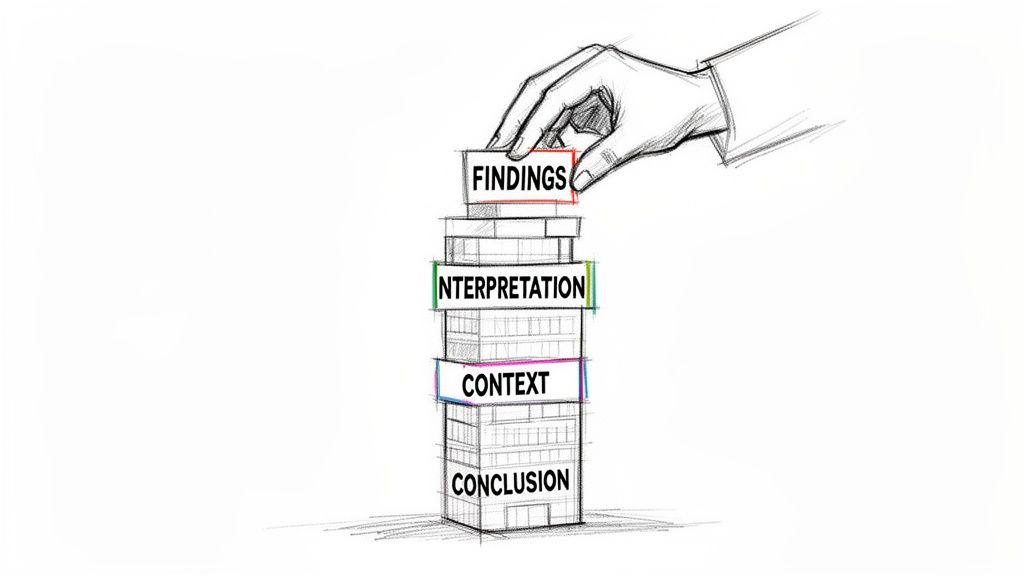
Staring at a blank page is often the hardest part of writing. But crafting a powerful discussion section isn't about waiting for a stroke of genius. It’s about having a repeatable framework that lets you build a story, turning your raw data into a meaningful narrative.
Your opening paragraph is your first, best chance to orient the reader. It needs to be a clear, concise summary of your most important findings—not just a copy-paste job from the results section. Think of it as a hook that reminds your reader what mattered most before you unpack why it mattered.
This initial summary is the bridge from the "what" of your results to the "so what?" of your discussion. It creates a natural entry point for your analysis.
Start with Interpretation, Not Repetition
The single most common mistake I see is researchers simply restating their results. The discussion isn't a recap; it's the interpretation. Your job here is to connect the dots for your reader and explain how your findings answer the research questions you laid out in the introduction.
To sidestep this trap, take your most significant finding and ask yourself two simple questions: "What does this actually mean?" and "Why is this important?" The answers are the real beginning of your discussion.
Here's a quick technique: try rephrasing a finding as an interpretive statement. Instead of, "The study found that 65% of participants improved," shift your language to something like, "The substantial 65% improvement rate suggests the intervention is highly effective, particularly when compared to the 40-50% rates typically seen in similar research." This one change immediately frames the result within a broader context.
This small tweak in how you present your data makes a huge difference. It shows you're actively thinking, guiding the reader through your intellectual process instead of just listing numbers.
Structure Your Arguments Logically
Once you have your key interpretive points, the next step is to arrange them in a way that tells a coherent story. A well-structured discussion flows, with each paragraph building on the one before it. The best structure really depends on your specific study.
- By Importance: Kick things off with your most significant finding and work down to the less critical ones. This is a great way to grab the reader's attention right away.
- By Objective: Structure the discussion to follow the same order as your research questions or hypotheses. This creates a predictable, easy-to-follow path for your reader.
- By Theme: If your findings naturally cluster around specific topics, organize your discussion around them. This works especially well for complex studies with multiple, related outcomes.
For example, if your research looked at how a new teaching method affected both student engagement and test scores, a thematic structure makes a lot of sense. You could have one subsection interpreting the engagement data, another for the test score results, and a final one synthesizing the two.
Weave in Your Hypothesis
A strong discussion always circles back to the original hypotheses that drove your research in the first place. This creates a tight, purposeful narrative. Don't just assume your reader remembers your hypotheses from the introduction—bring them back into the conversation.
You need to explicitly state whether your findings support, challenge, or perhaps modify your initial predictions. Making this connection is critical for showing the intellectual rigor behind your work.
Here’s how you might phrase these connections:
- "Consistent with our initial hypothesis, the results indicate that..."
- "Contrary to our expectations, the data did not support the predicted relationship between..."
- "While we hypothesized a direct effect, the findings suggest a more nuanced, indirect relationship..."
Continuously tying your results back to your hypotheses reinforces the scientific method at the heart of your paper. If you want to see how this connects to the overall research design, our guide on how to write a methodology offers some great insights. Sharpening your writing is also key; you can find excellent English writing resources to help you communicate your ideas more effectively.
By starting with an interpretive summary, structuring your arguments logically, and consistently linking back to your hypotheses, you build a solid foundation. This framework gives you the scaffolding needed for a discussion that is clear, persuasive, and truly impactful.
Connecting Your Research to the Bigger Picture
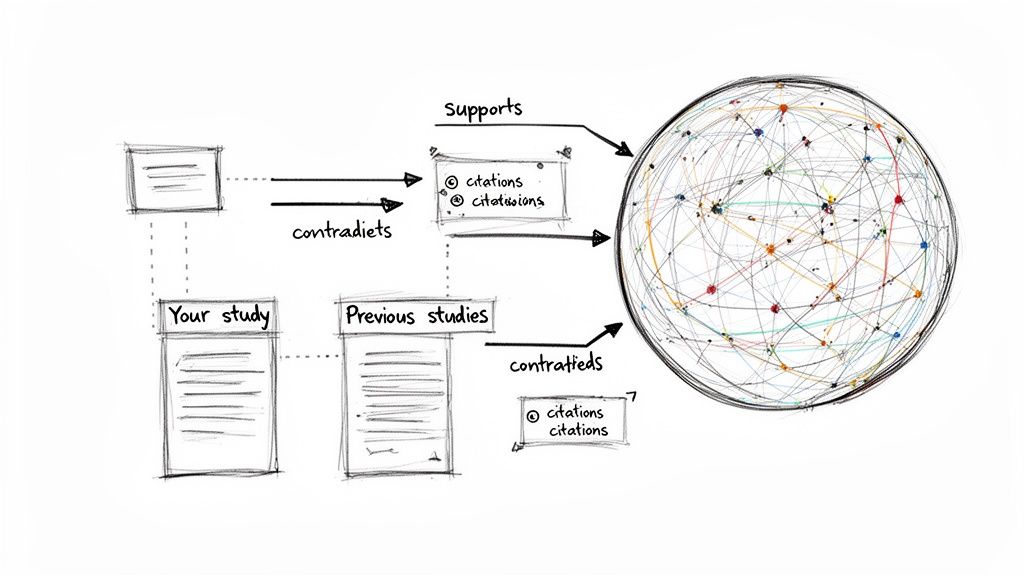
A truly great discussion section does more than just rehash your findings. It situates them within the ongoing scientific conversation. Your research doesn't exist in a vacuum; it's a new voice joining a chorus of previous studies. Your discussion is where you show the reader exactly how your voice adds to the harmony—or maybe even changes the tune.
This is the moment you transition from researcher to scholar. The whole point is to compare and contrast what you discovered with what others have already published. By doing this, you build a powerful case for your work's relevance and importance.
Situate Your Findings Within Existing Literature
First things first, go back to the key literature you introduced earlier. Think of your work as a direct response to that existing body of knowledge. Your job is to spell out precisely how your results connect to it.
Did your findings confirm a theory that’s been around for ages? Did they poke holes in a popular assumption? Or did they add a new layer of nuance to a complicated issue? Being explicit about this connection is what gives your research context and credibility. A discussion that doesn't engage with prior work just feels isolated and, frankly, less significant.
This connection isn't just a "nice-to-have." It directly impacts how other academics see and use your work. A 2021 PLOS ONE meta-analysis of 10,000 papers found that manuscripts with robust discussions citing prior literature had 52% higher citation rates five years post-publication. So, engaging with the literature isn't just good practice—it's critical for making an impact.
Articulate Agreement and Disagreement
When you start comparing your results to other studies, you’ll usually find they fall into one of three buckets. It’s incredibly helpful to structure your paragraphs around these relationships.
- Support: Your results line up with previous findings. This is great—it reinforces the existing evidence and strengthens everyone's understanding.
- Extend: Your results add something new to the puzzle. Maybe you studied a different population or used a novel method that builds on what was already known.
- Challenge: Your results contradict what other studies have found. This is often the most exciting scenario because it can blow open entirely new avenues for research.
If your findings do align with previous work, don't just state the obvious. Explain why that consistency matters. For instance, you could point out that your results in a new demographic group confirm a theory's broader applicability. If you need a refresher on weaving sources together, our guide on how to write a literature review is a great place to start.
Handling Unexpected or Contradictory Results
Discovering that your findings contradict established research can be a little jarring, but honestly, this is often where the most important contributions are made. Instead of seeing these results as a problem, frame them as an opportunity for new insight.
Don't sweep contradictions under the rug. Address them head-on and offer thoughtful, plausible explanations for the discrepancy.
A common mistake I see is when authors either ignore contradictory findings or just mention them briefly without any real explanation. A strong discussion embraces them. Your job is to become a detective and propose credible reasons for the differences.
Could the differences be due to your methodology? Was your sample population unique in some way? Or could there be an underlying factor that previous studies completely missed? Exploring these possibilities shows deep critical thinking and, just as importantly, intellectual honesty.
Use Specific Phrasing to Build Your Argument
The language you choose here is everything. Vague statements like "Our results are similar to..." will weaken your argument. You need precise, confident phrasing to guide the reader through your logic.
Here are a few templates to get you moving in the right direction:
- To Show Support: "Our findings are consistent with the work of [Author, Year], which also found..." or "This result reinforces the model proposed by [Author, Year], suggesting that..."
- To Show Extension: "While [Author, Year] identified a correlation, our results extend this by demonstrating a potential causal link." or "Building on the foundational research of [Author, Year], our study provides evidence for this effect in a previously unexamined context."
- To Address Contradiction: "In contrast to the findings of [Author, Year], our data did not show a significant effect. This discrepancy may be attributable to..." or "Our results challenge the prevailing view that..., suggesting an alternative explanation may be needed."
Using varied and specific language like this creates a sophisticated, persuasive narrative. It shows you aren't just dropping in citations, but are actively weaving your research into the fabric of your field's knowledge. This positions your work not as an endpoint, but as a vital part of an ongoing scientific journey.
Discussing Implications and Acknowledging Limitations
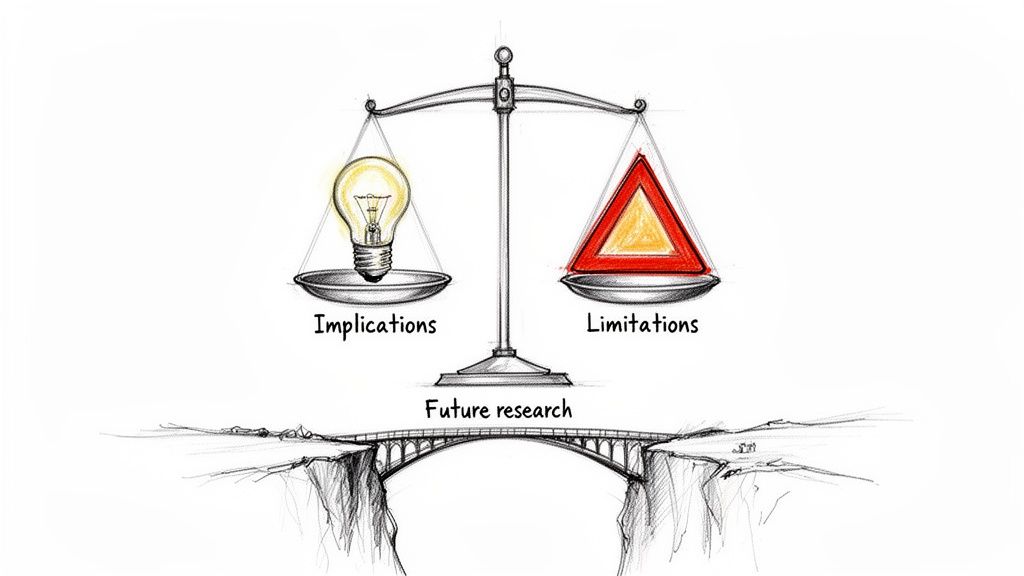
After you've walked the reader through your findings and connected them to the wider literature, it’s time for the part of the discussion that really shows your maturity as a researcher. This is where you zoom out to talk about the real-world implications of your work while also being refreshingly honest about its limitations.
These two things—implications and limitations—might sound like they're at odds, but they’re actually two sides of the same coin. Nailing this balance is what gives your discussion section its intellectual weight.
Think of implications as your answer to the big "so what?" question. Why does your study matter to anyone outside your lab or specific field? This is your chance to suggest how your work could spark changes in theory, professional practice, or even public policy.
Just be careful not to overplay your hand. Your credibility hinges on a measured, evidence-based tone. The goal is to propose what your work might mean, not to definitively prove it.
Articulating the Real-World Implications
A great discussion section doesn't just report numbers; it translates them into meaning. To get there, think about the different ways your research could make an impact. Not every study will hit all three of these, but it's always worth considering them.
- Theoretical Implications: How does your work speak to the existing theories in your field? Maybe it adds a new layer, challenges a long-held assumption, or suggests a completely new framework is needed. This is about pushing the academic conversation forward.
- Practical Implications: How can people use your findings? This is where you offer recommendations for professionals on the ground—clinicians, teachers, engineers, you name it. You’re suggesting real, actionable changes based on what you found.
- Policy Implications: Could your research help shape new guidelines or public policies? This is especially huge in fields like public health, environmental science, or economics, where data can directly influence how things are run.
For instance, if your study shows a new teaching method works, that’s a direct practical implication for educators. If you uncover a key driver of vaccine hesitancy, you've got practical implications for doctors and policy implications for public health officials. This is the core of learning how to write a discussion section that truly matters.
The Art of Acknowledging Limitations
Talking about your study's limitations isn't admitting failure. Far from it. It’s a sign of intellectual honesty and critical thinking. Every single study has constraints, no matter how perfectly it was designed.
Ignoring limitations doesn't make them go away. It just makes it look like you're either unaware of them or trying to hide something. Acknowledging them proactively builds trust and preempts potential criticism from reviewers.
Start by just brainstorming everything that could be a limitation. These often pop up from your methodology, your sample, or the general scope of your analysis. Common culprits include sample size, demographic diversity (or lack thereof), the study's duration, or the specific tools you used to measure things.
Once you have a list, pick the most important ones—the ones that could genuinely affect how your results are interpreted. Briefly explain what the limitation is and how it might have influenced your findings. The point isn't to tear down your own work, but to give readers a balanced, realistic view of what they can take away from it.
Turning Limitations into Future Research
Here's the most elegant move you can make: frame your limitations as a bridge to future research. This simple pivot transforms a potential weakness into a constructive, forward-looking roadmap for your field.
This approach shows you're not just closing the book on a project; you're contributing to a bigger, ongoing scientific story. Each limitation you identify can become a direct, specific suggestion for what another researcher (or your future self) should tackle next.
This table gives a few examples of how to reframe common limitations into compelling suggestions for what's next.
Turning Limitations into Future Research Opportunities
| Common Limitation | Constructive Framing Example | Future Research Suggestion |
|---|---|---|
| Small Sample Size | "While our findings show a clear trend, the small sample size limits the generalizability of these results." | "Future research should aim to replicate these findings in a larger, more diverse cohort to confirm the effect." |
| Short Study Duration | "The study's three-month duration prevents us from assessing the long-term effects of the intervention." | "A longitudinal study tracking participants over several years is needed to understand the sustainability of these outcomes." |
| Homogeneous Sample | "Our participants were primarily from a single urban area, which may not represent the experiences of rural populations." | "Subsequent studies should investigate whether these findings hold true across different geographic and cultural contexts." |
When you master this balance between big-picture implications and honest limitations, your discussion section will signal a deep level of scholarly insight. This kind of thoughtful analysis is what elevates a paper from a simple report to a genuinely meaningful contribution.
Polishing Your Discussion and Avoiding Common Pitfalls
Alright, you’ve done the heavy lifting. You've built your arguments, connected your findings to the wider field, and even acknowledged your study's limitations. Now it's time for the final, crucial step: polishing your work until it shines.
This isn't just about catching typos. This is where you transform a good draft into a persuasive, professional piece of scholarship. A well-polished discussion shows a level of precision and care that signals to reviewers and readers that your work is a serious contribution.
Sidestepping Common Mistakes
Even the most groundbreaking research can be let down by a few rookie mistakes in the discussion section. Knowing what these traps are is the first step in learning how to write a discussion section that stands out for all the right reasons.
Here are the most common missteps I see people make:
Suddenly Introducing New Data: The discussion is for interpreting the results you've already presented, not for introducing new ones. If you find yourself dropping in a new statistic or finding, stop. That almost always belongs back in the results section. Bringing it in here just confuses your reader and breaks the logical flow.
Overstating Your Claims: It’s so tempting to make big, bold claims, but your credibility is everything. Make sure every single interpretation is firmly rooted in your data. It's better to use cautious, precise language like, "This suggests..." or "These findings may indicate..." rather than making sweeping statements your evidence can't fully support.
A Weak or Repetitive Ending: Your discussion needs to build to a strong finish, not just trail off. A common mistake is to simply repeat the introduction or give a bland summary. Your goal here is to synthesize and provide a powerful final thought, not just restate what you've already said.
A classic pitfall is just repeating a result without adding any new insight. For example, instead of writing, "Our study found that 65% of participants improved," a much stronger discussion would frame it as, "The substantial 65% improvement rate we observed suggests the personalized treatment was highly effective, likely because of its tailored approach." See the difference? The second one adds that crucial layer of interpretation.
Dodging these errors ensures your hard work and thoughtful analysis aren't undermined by simple structural flaws.
Crafting a Strong Concluding Paragraph
Your final paragraph is your last chance to drive home the importance of your study. It should be concise, memorable, and leave no doubt about your contribution. Think of it as your closing argument.
A great concluding paragraph pulls everything together, offering a sense of closure while reinforcing the main takeaways.
Here’s a simple but effective structure:
- Reiterate Your Core Message: Kick it off with one clear sentence that summarizes the main answer to your research question. What’s the one thing you want the reader to walk away remembering?
- Reinforce the Significance: Briefly remind the reader why this research matters. What are the key implications in the bigger picture?
- Offer a Final Thought: End with a forward-looking statement. This could be a final thought on your work's potential impact or a compelling call to action for what should be studied next.
This structure smoothly transitions from your specific finding to its broader significance, creating a really satisfying and impactful ending. For a more detailed walkthrough, our article on how to write a conclusion paragraph can help you master the art of the powerful finish.
Using a Final Polish Checklist
Before you even think about hitting "submit," do one last pass with a checklist. This kind of systematic review can be the difference between a good discussion and a truly great one.
Here’s a practical checklist to run through:
- Clarity and Conciseness: Is every sentence crystal clear? Have I cut out all the jargon and convoluted phrasing?
- Logical Flow: Does one paragraph lead naturally into the next? Is my argument easy to follow from start to finish?
- Evidence-Based Claims: Is every single interpretation I've made backed up by the data in my results section?
- Tone and Voice: Do I sound professional and confident, but also appropriately cautious? Is my scholarly voice consistent?
- The "So What?" Question: Have I clearly and convincingly answered the "so what?" question? Is the significance of my study impossible to miss?
This is where specialized writing assistants can be a huge help. Using a tool like Rewritify can help you refine your sentences, boost clarity, and make sure your tone is spot-on for an academic audience. This final polish ensures that your critical insights are communicated with the authority and precision they deserve.
Common Questions Answered
Even with the best guide, a few questions always pop up when you're in the thick of writing. Let's tackle some of the most common ones I hear from researchers struggling with their discussion section.
Results vs. Discussion: What's the Real Difference?
This is probably the most crucial distinction to get right. Think of it this way: your Results section is where you lay out the cold, hard facts. It's the "what" of your study. You’re a neutral reporter presenting your data without any spin.
For example, you’d state: "The intervention group showed a mean score increase of 15%, while the control group's increase was 2%." That's it. Just the facts.
The Discussion is where you put on your expert hat and explain the "so what?" You interpret those facts, giving them meaning and context. Building on the example, you might write: "The significant 15% score increase in the intervention group strongly suggests the new teaching method is effective. This finding directly challenges previous research that indicated such methods offer only marginal gains..."
In short, Results = the evidence. Discussion = your argument based on that evidence.
How Long Does the Discussion Need to Be?
There’s no universal word count, as it really depends on your field, the journal's guidelines, and how much you have to unpack. A good benchmark, though, is to aim for the discussion to be about 25-35% of your paper's main text (the IMRaD sections).
It needs enough space to do the heavy lifting—interpreting results, connecting them to the literature, and discussing limitations—but it absolutely must be focused. If your target journal has a word limit, that’s your hard-and-fast rule.
The goal is comprehensive depth, not excessive length. A focused, well-argued discussion of 1,500 words is far more impactful than a rambling 3,000-word section that loses its way. Quality always trumps quantity.
Should I Use AI to Write My Discussion?
This is a tricky one. While AI writing assistants can be helpful, your discussion section is the absolute worst place to let one take the lead. This part of your paper demands deep critical thinking, a nuanced understanding of your field's ongoing conversation, and your unique perspective as the researcher. An AI simply can't replicate that.
Relying on AI to generate the core of your discussion often results in generic, soulless text that misses the real significance of your work.
Here’s a smarter way to use these tools:
- Write the first draft yourself. Get all your core arguments, interpretations, and insights down on the page.
- Then, use an academic writing tool. Use it to polish what you've already created. They're great for rephrasing clunky sentences, refining your academic tone, and catching inconsistencies.
This approach keeps your critical analysis front and center, using the AI as a helpful editor, not a ghostwriter.
Your discussion section is the final, powerful showcase of your research's value. Once you've laid out your arguments, Rewritify can help you sharpen your language and ensure your insights land with the impact they deserve. Polish your work and make your contribution count. Learn more at https://www.rewritify.com.
Relevant articles

Learn how to structure an argumentative essay with our expert guide. We break down the thesis, body paragraphs, and counterarguments for a powerful paper.

Learn how to write an annotated bibliography with this comprehensive guide. Get actionable tips, real examples, and formatting advice for APA and MLA.

Learn how to write an effective essay rough draft. This guide provides actionable steps for turning messy ideas into a coherent and compelling paper.

Discover differences between formal and informal writing, with practical tips, examples, and syntax cues to choose the right tone every time.

Learn how to write a critical analysis with our guide. We cover everything from developing a thesis to structuring your argument and refining your final draft.

Learn how to write a position paper with our expert guide. Discover proven strategies for research, structuring arguments, and persuasive writing.