How to Write a Literature Review That Makes an Impact
Learn how to write a literature review with this guide. Discover proven strategies for synthesis, structure, and writing that elevates your research.
A literature review is so much more than just a list of article summaries. Think of it as synthesizing existing research to map out what’s already known about a topic. Your goal is to find the gaps, establish the context for your own work, and ultimately prove you know what you're talking about. It’s an act of critical analysis, building a rock-solid argument that shows exactly why your research question needs to be asked.
What Is a Literature Review and Why Does It Matter?
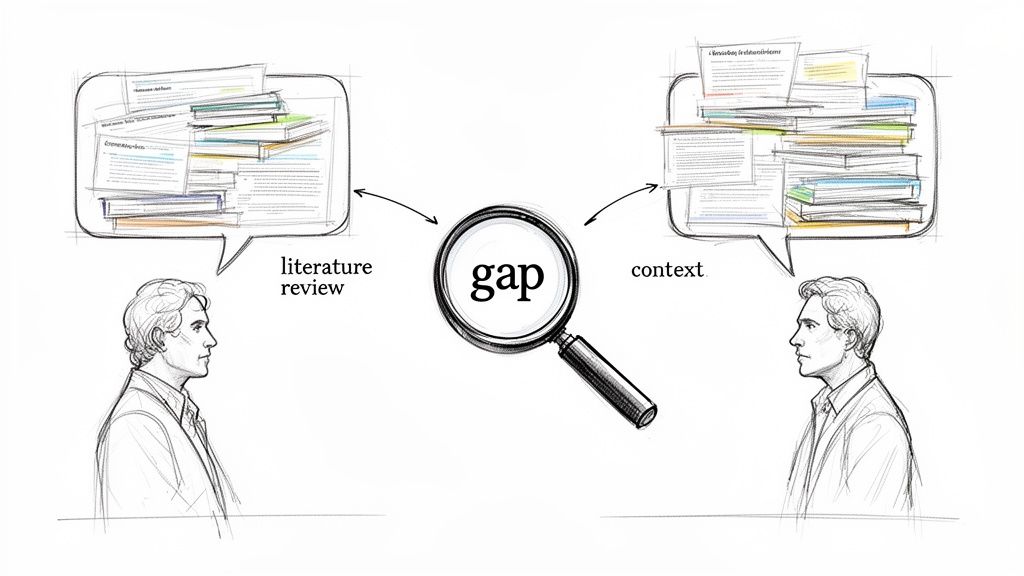
It’s easy to see the literature review as a chore—a box to check before you get to the "real" research. But that perspective completely misses its power. A great review is a dynamic, scholarly work in its own right. It’s you, entering into a conversation with all the researchers who have tackled this topic before you. You're essentially mapping the intellectual terrain.
I like to think of it like this: you'd never build a house without surveying the land first, right? A literature review does the exact same thing for your research. It helps you:
- Establish Credibility: When you can confidently discuss the current state of research, you show your reader you've done the work and are qualified to add something new.
- Identify Research Gaps: By carefully analyzing what’s already been done, you can spot the unanswered questions, the strange contradictions, or the areas that just haven't been explored enough. That’s where your research finds its home.
- Prevent Redundant Work: Most importantly, it ensures you aren't about to spend months—or years—repeating something that's already been settled. You get to build on what’s there instead of reinventing the wheel.
More Than Just a Summary
The single biggest thing that separates a literature review from other academic writing is synthesis. You’re not just lining up summaries of papers one after another. You’re weaving them together—connecting findings, contrasting arguments, and comparing methodologies from different sources to create a new, cohesive picture.
This synthesis process is what helps you build the theoretical foundation for your study. It’s directly tied to developing a strong conceptual framework for your research.
A great literature review doesn't just report information; it organizes the scholarly conversation. It clarifies what is known, what is debated, and what remains to be discovered, positioning your own work as the next logical step in that discussion.
And its value isn't just academic. Professionals in marketing, public policy, and healthcare rely on reviews to guide strategy, understand industry trends, and create evidence-based practices. They're fundamental tools for making smart decisions.
In fact, review articles are often among the most cited and downloaded publications, sometimes having a greater impact than original research papers. Their ability to pull together vast amounts of information makes them invaluable to other scholars, a trend supported by research on publication impact.
Literature Review vs Other Academic Assignments
To really nail this down, it helps to see how a literature review stacks up against other, similar-sounding assignments you might encounter. Each has a very different purpose.
| Feature | Literature Review | Annotated Bibliography | Research Summary |
|---|---|---|---|
| Primary Goal | To synthesize findings into a coherent narrative and identify research gaps. | To list and briefly describe relevant sources for a potential project. | To provide a condensed overview of a single research article's key points. |
| Structure | Organized thematically, methodologically, or chronologically around ideas. | An alphabetized list of sources, each followed by a descriptive paragraph. | Follows the structure of the original article (intro, methods, results). |
| Focus | The conversation between the sources; creating a holistic view. | Individual sources and their specific contributions or relevance. | A single source, explained in isolation from other works. |
As you can see, the literature review stands apart. Its focus is on creating a bigger picture from many smaller pieces, rather than just describing the pieces themselves.
Laying the Groundwork: Scope and Search Strategy
Every solid literature review starts well before you open a single database. Think of it less like a frantic information dump and more like a carefully planned expedition. Without a map, you're just wandering, and it's easy to get lost in a sea of irrelevant papers—a frustration I've seen derail countless projects.
The first, and most important, step is to get specific. You need a central question, a guiding theme that will serve as your compass. This isn’t about stifling your curiosity; it’s about giving it a powerful focus, ensuring every article you read is a deliberate step toward your final argument.
Nailing Down Your Core Question
Your research question is the lens through which you'll filter everything. A good one is sharp enough to be answerable but still gives you room to explore.
For example, a topic like "social media's effect on teenagers" is far too broad. You'll be buried in articles within minutes. A much stronger, more manageable question is: "How does the use of image-based social media platforms like Instagram correlate with body image dissatisfaction among female adolescents aged 13-18?" See the difference? That specificity immediately tells you what to look for—and, crucially, what to ignore.
A truly effective question usually has a few key ingredients:
- A specific population: (e.g., female adolescents aged 13-18)
- Key variables: (e.g., image-based social media use, body image dissatisfaction)
- A clear relationship to investigate: (e.g., correlation, impact, connection)
Building a Smart Search Strategy
With your question locked in, it's time to build a strategy to find the literature. This is more art than science and goes way beyond just typing your question into a search bar. You have to learn to think like a database, translating your ideas into a language of keywords and search terms.
One of the biggest hurdles today is the sheer volume of research out there. The academic world is constantly publishing, and the numbers are staggering. AI-powered tools now sift through nearly 250 million papers, a testament to this explosive growth. We saw hints of this trend over a decade ago, with fields like medical informatics seeing a 12% annual increase in articles. A methodical approach isn't just helpful; it's essential for survival. You can learn more about managing this academic volume here.
Your strategy should start with a mix of broad and specific keywords. For our example, I'd brainstorm a list like this:
- Broad terms: "social media," "body image," "adolescent mental health"
- Specific terms: "Instagram," "Snapchat," "body dissatisfaction," "teenage girls," "social comparison theory"
Next up is choosing the right battleground: your academic databases. General search engines are fine for an initial scout, but the real gems are in specialized databases where you'll find the high-quality, peer-reviewed research you need.
A great place to start is Google Scholar.
Its familiar interface makes it an excellent entry point for finding scholarly articles, theses, and books across almost any discipline you can think of.
Pro Tip: Never rely on a single database. Different platforms index different journals, and you'll miss crucial research if you stick to just one. For a truly comprehensive review, you have to search across multiple platforms relevant to your field. Think PubMed for biomedical sciences, JSTOR for humanities, or Scopus for a wide, interdisciplinary net.
Searching with Precision
To keep from getting overwhelmed, you need to master a few search tricks. Boolean operators are your absolute best friends for this. They're simple commands that give you incredible control over your results:
- AND: Narrows your search (e.g., "Instagram" AND "body image"). This finds articles containing both terms.
- OR: Broadens your search (e.g., "teenagers" OR "adolescents"). This is perfect for synonyms.
- NOT: Excludes terms (e.g., "social media" NOT "Facebook"). This helps filter out noise.
Finally, set some ground rules. Establish clear inclusion and exclusion criteria before you even start looking. These are the non-negotiable rules for which studies make the final cut, keeping your review focused and manageable. For our running example, the criteria might look something like this:
- Inclusion: Peer-reviewed articles published in the last 10 years, studies with female participants aged 13-18, quantitative or mixed-methods studies.
- Exclusion: Opinion pieces, book reviews, studies focused only on male participants, articles not available in English.
Alright, you've done the legwork and gathered a mountain of articles. Now what? This is the point where many researchers feel a bit overwhelmed. You're shifting from being a collector of information to a weaver of ideas, and that means turning a messy folder of PDFs into a clear, compelling story.
This is truly the heart of the literature review process. It's about spotting patterns, connecting dots, and building an argument from the work of others.
To pull this off without losing your mind, you need a system. Just winging it with scattered notes is a one-way ticket to chaos. The very first thing to do is get all your sources into one central hub using a reference manager.
Taming the Chaos with Reference Managers
If you’re still typing out your bibliography by hand or saving papers with names like article_final_v2.pdf, it’s time for a serious upgrade. Reference managers are lifesavers. They store, organize, and cite your sources for you, which lets you focus on the important part: thinking.
You've got some great, free options out there. The two I see most often are:
- Zotero: This one is a free, open-source workhorse. It's brilliant for grabbing sources from the web with a single click and sorting them into different project folders.
- Mendeley: Also free, Mendeley is well-known for its slick PDF reader and annotation features. It also has a social component, which can be neat for seeing what other researchers in your field are reading.
Think of these tools as a core part of a professional research workflow, not just a time-saver. They ensure your citations are accurate and consistent, which is non-negotiable for academic integrity.
The concept map below shows how all the initial planning—defining your scope, question, and keywords—really sets the stage for this organizational phase.
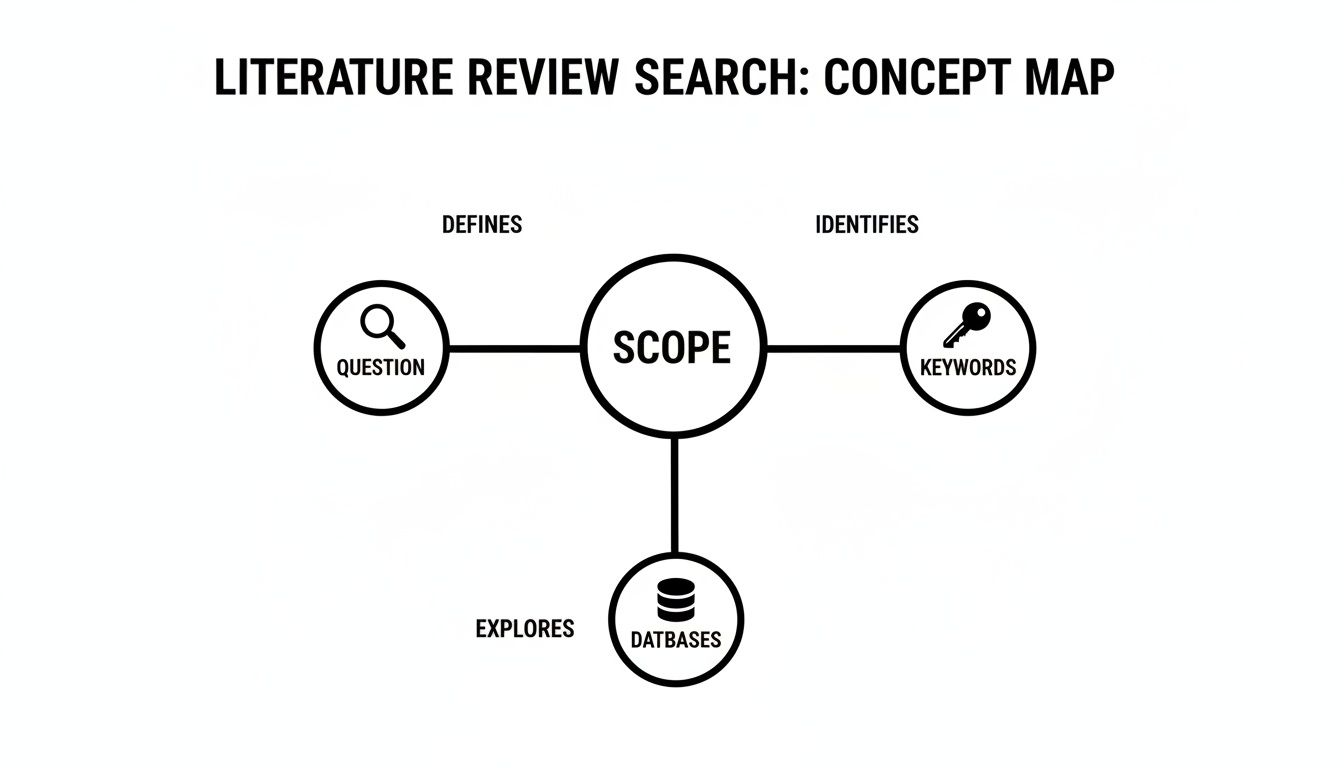
Getting that foundation right makes everything that comes next so much easier.
Once your sources are neatly corralled, the real synthesis begins. A simple list of summaries won't do. You need to see the "conversation" happening between the articles.
Unlocking Connections with a Synthesis Matrix
This is where a synthesis matrix becomes your secret weapon. It’s basically a fancy spreadsheet that helps you visually map out the research landscape. Instead of looking at each paper one by one, you lay them out side-by-side to compare their themes, methods, and conclusions.
Setting one up is easy. Just make a table. Each row is a different source (like "Smith, 2021"), and each column is a key theme or variable you're tracking.
Here’s a simple example you can adapt for your own topic:
| Source (Author, Year) | Theme 1: Social Comparison | Theme 2: Platform Specifics | Methodology | Key Finding / Takeaway |
|---|---|---|---|---|
| Jones et al. (2022) | Strong link between frequent Instagram use and upward social comparison. | Focuses only on visual platforms; results may not apply to text-based media. | Survey of 500 adolescents. | Higher usage correlates with lower self-esteem. |
| Chen (2020) | Argues that peer feedback (likes/comments) amplifies comparison effects. | N/A | Qualitative interviews with 25 participants. | The nature of engagement matters more than time spent. |
Once you start filling this in, the magic happens. You’ll immediately see where researchers agree (Jones and Chen both connect engagement to self-perception), where they disagree, and—most importantly—where the gaps are. Maybe no one has directly compared visual platforms to text-based ones. Boom, there’s a potential contribution for your own work.
This matrix isn't just for organizing; it’s for analyzing. It forces you to stop being a passive reader and start actively questioning the literature, helping you find those subtle connections and debates that make a review truly great.
Critically Evaluating What You Read
Putting ideas together isn't just about finding what's similar; it's also about judging the quality of the research. As you fill out your matrix, you have to constantly ask yourself: Is this study any good? Remember, not all published research is created equal.
Keep these questions in your back pocket for every article you read:
- Authority: Is the author a known expert? Is this a reputable, peer-reviewed journal?
- Objectivity: Does the author seem biased, or do they present a balanced view and acknowledge the study's limitations?
- Methodology: Was the research design solid? Is the sample size of 500 big enough and representative?
- Currency: Is this information still relevant? In a fast-moving field, a study from five years ago might as well be from the Stone Age.
This critical eye is what separates a book report from a genuine scholarly contribution. When you start drafting, you'll need to express these nuanced critiques in your own words. For anyone working on this, knowing how to paraphrase without plagiarizing is absolutely essential for weaving these ideas together while maintaining your academic integrity.
Structuring and Drafting Your Review

Now comes the fun part: building the actual review. With your research organized and your key themes mapped out, you’re ready to move from a pile of notes to a coherent, persuasive piece of writing.
The structure you choose isn't just a box to put your ideas in; it's a strategic decision that guides your reader through the scholarly conversation. Get it right, and your review will feel intuitive and impactful. Get it wrong, and your best insights can get lost in the noise. The best approach will always depend on your research question and the kind of literature you're working with.
Choosing Your Organizational Blueprint
Most literature reviews fall into one of three common structures. Think of them as different ways to tell the story of the research in your field.
Thematic: This is my go-to recommendation for most reviews. You organize the paper around the key concepts, debates, or themes you found. Each section tackles one theme, weaving together evidence from multiple sources. It’s the best way to show the connections and contradictions between studies, demonstrating a truly deep grasp of the topic.
Chronological: Here, you organize the literature by time, showing how ideas on a topic have evolved. This is perfect for historical reviews or any topic where the progression of thought is the main story. You might show how early theories were challenged and eventually replaced by newer models over the decades.
Methodological: This one is less common but can be incredibly powerful. You group studies based on their research methods—qualitative vs. quantitative, surveys vs. case studies, and so on. This is the ideal structure when the how of the research is a central point of debate in your field.
Your choice here is critical. In fast-moving fields like medicine, a chronological structure focused on the last two years might be essential because older data is obsolete. In the humanities, however, a review might trace intellectual shifts over centuries.
Drafting Your Introduction
Your introduction is your first and best chance to grab your reader. It needs to be clear, concise, and compelling, setting the stage for everything that follows. It doesn’t have to be long, but it absolutely must do its job.
A solid introduction will:
- Hook the reader by introducing the broad topic and its significance.
- Quickly narrow the focus to your specific research question.
- Clearly state the scope of your review (what you will and will not cover).
- Provide a quick roadmap of the paper’s structure.
Crafting a clear and concise introduction or executive summary is vital for engaging your audience. For expert tips on synthesizing key information into a powerful overview, refer to our guide on how to write an executive summary.
Constructing Coherent Body Paragraphs
The body of your review is where the magic happens. A common mistake I see is summarizing one article after another—don't do that. Instead, build each paragraph around an idea, not a source. This is a fundamental shift that makes all the difference.
Start every paragraph with a strong topic sentence that clearly states the point you're making. Then, bring in evidence from your sources to support, contrast, or expand on that idea. Use transitional phrases to create a smooth flow: "Similarly, Smith (2020) found that...", "In contrast, Jones (2019) argues...", or "Building on this idea, Chen (2021) demonstrated...".
Key Takeaway: You are orchestrating a conversation between scholars, with your voice as the guide. The goal of each paragraph is to advance your argument, not just describe a paper.
For instance, a weak paragraph simply lists findings: "Johnson (2022) studied social media and found it impacts sleep. Then, Lee (2021) did a survey and also found a connection to sleep."
A strong, synthesized paragraph tells a story: "The link between social media use and sleep disruption is a consistent theme across recent quantitative research. Johnson's (2022) experimental study, for instance, established a causal link, while Lee's (2021) large-scale survey confirmed this correlation in a broader population, suggesting the effect is widespread."
Writing a Powerful Conclusion
Finally, your conclusion ties it all together. It should do more than just repeat what you’ve already said. A strong conclusion synthesizes the main takeaways and offers a final, definitive statement on the state of the field.
A great conclusion will:
- Summarize the major themes and key findings.
- Highlight the most significant agreements or debates in the literature.
- Clearly point out the gaps or areas where more research is needed.
- Suggest specific directions for future studies, which often provides the perfect justification for your own research project.
This is your final word. It solidifies your review's contribution and leaves the reader with a clear understanding of what is known and, just as importantly, what still needs to be discovered.
7. Refining Your Draft and Citing with Confidence
Getting that first draft down is a massive win, but it’s really just the beginning. The real work—and the real magic—happens during revision. This is where you sharpen your arguments, polish your prose, and turn a decent collection of ideas into a powerful scholarly statement.
Think of it like being a sculptor. You've gathered the raw clay with your research and initial draft. Now, it's time to start chipping away at the excess, smoothing the rough spots, and really bringing your final form into focus. This requires a critical eye and a willingness to rethink, rephrase, and restructure.
From Good to Great Through Self-Editing
The whole point of editing is to make your writing as clear and compelling as possible. You want your voice to be the confident guide leading the reader through the complex conversation you've just mapped out. It's not just about catching typos; it's about hunting for opportunities to make your writing punch harder.
One of the best tricks in the book? Read your draft out loud. It feels a bit strange at first, but it's incredibly effective for catching awkward phrasing and sentences that drag on forever.
As you read, keep these questions in mind:
- Is my argument crystal clear? Can someone easily follow my main point from the introduction all the way to the conclusion?
- Could I be more concise? Am I using ten words when five would do the job? Strong academic writing is precise, not needlessly wordy.
- Does it flow logically? Does each paragraph build on the last, or are there jarring jumps that will confuse my reader?
A Quick Tip for Clarity: Zero in on your topic sentences—the very first sentence of each paragraph. If you can read only those sentences and still get the gist of your entire review, you’re in great shape. If not, that’s a clear sign your structure needs work.
Upholding Academic Integrity
As you polish your draft, academic integrity has to be front and center. This is about more than just not copying and pasting. It's about meticulously representing the work of other scholars and making a sharp distinction between their ideas and your own unique contribution.
Every single claim you make that isn’t common knowledge must have a citation. Accidental plagiarism, usually born from sloppy note-taking, is still a serious academic offense. This is where the synthesis matrix you built earlier becomes your best friend, helping you remember exactly where every idea came from. To see how you can safeguard your work, it's worth checking out modern plagiarism detection and correction tools like Grammarly.
This is also where you find your own voice. It’s so easy to stick too closely to the original phrasing from a source, but true synthesis requires you to rephrase and internalize the information. A tool like Rewritify can be a huge help here, assisting you in turning complex academic jargon from your notes into your own authentic voice while keeping the original meaning intact.
Mastering Citations and Formatting
Proper citation isn't just a tedious rule—it's the backbone of scholarly conversation. It's how you show respect for the researchers who came before you and how you give your readers a roadmap to your sources.
Different fields have their own styles, with the most common being:
- APA (American Psychological Association): The go-to for social sciences, education, and psychology.
- MLA (Modern Language Association): Standard in the humanities, especially literature.
- Chicago/Turabian: Frequently used in history and the arts, with both an author-date and a notes-bibliography option.
First thing's first: confirm the required style for your course or publication and stick to it religiously. Consistency is everything. Every comma, every period, every italicized word matters. For anyone dealing with unique sources, it's crucial to get the details right. If you're using APA, for instance, you can find great guides on niche cases like how to properly format footnotes.
Seriously, using a reference manager like Zotero or Mendeley will save you hours of headache and prevent a ton of common formatting mistakes. Before you even think about submitting, do one last check: Are all in-text citations present? Does every single one match an entry in the bibliography? Is the reference list formatted perfectly? That final polish is what makes your work look professional and credible.
Common Questions About Writing Literature Reviews
Even the most well-thought-out plan can't anticipate every question that will pop up while you're deep in the literature review process. That's totally normal. Think of these questions not as roadblocks, but as the final hurdles to clear before you feel confident enough to get this project over the finish line.
Let's walk through some of the most common questions I hear from students and fellow researchers. The goal here is to give you quick, practical answers to get you unstuck and back on track.
How Many Sources Is "Enough"?
This is the big one, isn't it? The honest-to-goodness answer is, "it depends." There's simply no magic number that works for every project. The real driver behind your source count is the scope of your research question, not some arbitrary target.
For example, a PhD dissertation might easily crest 100 sources to be truly comprehensive. On the other hand, an undergraduate term paper might only need 15-20 carefully selected articles to make its point effectively.
Instead of fixating on a number, try asking a better question: "Have I hit saturation?"
You'll know you've reached saturation when you start seeing the same names, the same core studies, and the same arguments cited over and over again. When new searches bring up little that feels fresh, you can be pretty confident you've covered the essential ground for your topic.
What If I Find Studies That Contradict Each Other?
Finding conflicting studies isn't a problem—it's a gift! Your job isn't to pretend these disagreements don't exist. It's to dig into them. These are the places where the most interesting and important research gaps are hiding.
When you stumble upon conflicting findings, here's what to do:
- Look at the methodology. Did the studies use different research designs, sample sizes, or populations? It's not surprising that a small-scale qualitative study might yield different insights than a massive quantitative survey.
- Discuss the disagreement. Carve out a specific part of your review to explore why these contradictions might exist. This is a golden opportunity to showcase your critical thinking.
- Position your own work. A contradiction can serve as the perfect launchpad for your own research. Perhaps your study is designed to resolve the conflict or explore a new angle that might explain it.
Contradictory findings are the very heartbeat of academic debate. Your literature review should illuminate that debate, not smooth it over. Put those disagreements in the spotlight to show you grasp the full complexity of your field.
How Should I Handle Older Sources?
The value of an older, or "seminal," source really depends on your field. If you're in a fast-moving area like computer science, a five-year-old paper might already feel dated. But in philosophy or history, a source from 100 years ago could still be a cornerstone of the entire discipline.
A good rule of thumb is to strike a balance:
- Prioritize recent literature. Generally, focusing on work from the last 5-10 years ensures your review is current and relevant.
- Include seminal works. You must include the foundational papers or books that introduced a key theory or methodology that everyone still references today.
You don't need to give a full summary of every classic study, but acknowledging them shows you've done your homework. It proves you understand the intellectual lineage of your topic.
Can My Literature Review Actually Have an Argument?
Yes! And it absolutely should. One of the biggest misconceptions about writing a literature review is thinking it's just a passive summary of what other people have said. A truly excellent review makes its own argument.
Now, this argument isn't based on new data you've collected. It's an argument about the state of the existing literature. For instance, your central claim could be:
- "The current research has a significant gap when it comes to..."
- "While most scholars have focused on X, this review argues that Y is an overlooked but crucial factor."
- "The dominant methodology in this field has serious limitations that need to be addressed."
Your entire review should be built to support this central thesis, guiding the reader to the logical conclusion that your proposed research isn't just a good idea—it's essential.
Feeling confident in your arguments but finding it hard to phrase them in your own voice? Rewritify is a writing tool designed to help you turn your notes and drafts into clear, original, and academically sound prose. It's perfect for polishing your literature review, ensuring your writing maintains its integrity while helping you avoid accidental plagiarism. You can get started for free and refine your work with confidence.
Relevant articles

Learn how to structure an argumentative essay with our expert guide. We break down the thesis, body paragraphs, and counterarguments for a powerful paper.

Learn how to write an annotated bibliography with this comprehensive guide. Get actionable tips, real examples, and formatting advice for APA and MLA.

Learn how to write an effective essay rough draft. This guide provides actionable steps for turning messy ideas into a coherent and compelling paper.

Discover differences between formal and informal writing, with practical tips, examples, and syntax cues to choose the right tone every time.

Learn how to write a critical analysis with our guide. We cover everything from developing a thesis to structuring your argument and refining your final draft.

Learn how to write a position paper with our expert guide. Discover proven strategies for research, structuring arguments, and persuasive writing.