Conceptual Framework Examples: 9 Diagrams, Applications, and Insights
Discover conceptual framework examples with clear diagrams and practical analysis to elevate qualitative or quantitative research.
A conceptual framework is more than a research buzzword; it's the architectural blueprint for your entire study. It visualizes the key variables, concepts, and their presumed relationships, providing a roadmap that guides your investigation from hypothesis to conclusion. Without a solid framework, research can drift, lacking the focus and logical structure necessary for credible findings.
This article demystifies the process by showcasing a curated collection of powerful conceptual framework examples across various disciplines, from qualitative social sciences to quantitative business analysis. We move beyond simple definitions to provide a deep, strategic breakdown of each model.
For every example, you will find:
- A clear diagram illustrating the framework's structure.
- A concise explanation of its core components and relationships.
- Actionable takeaways on how to adapt and apply it to your own work.
- Insight into common pitfalls to avoid during implementation.
By dissecting these frameworks, you will gain a practical understanding of how to build a robust foundation for your academic papers, business proposals, or complex projects. While these models often focus on research questions, the principles of structured thinking are universal. Similarly, understanding various organizational structure models can offer a broader perspective on how conceptual blueprints are applied to drive success in different contexts. Our goal is to equip you with the strategic tools needed to transform abstract ideas into a clear, compelling, and methodologically sound plan.
1. The Logic Model: Mapping Your Path from Resources to Impact
The Logic Model is a powerful visual tool used to articulate and understand the theoretical underpinnings of a program, intervention, or initiative. It serves as a roadmap, illustrating the logical sequence of events that connect planned work to intended results. This framework forces you to think systematically about your project, breaking it down into five core components: Inputs (resources), Activities (actions), Outputs (direct products of activities), Outcomes (short- and medium-term changes), and Impact (long-term, systemic change).
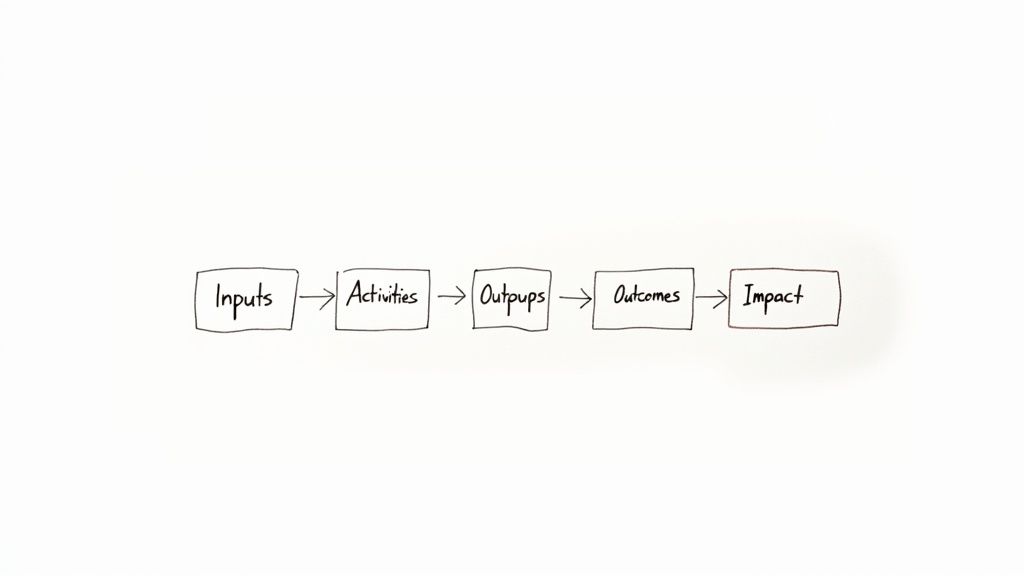
Popularized by organizations like the W.K. Kellogg Foundation and the CDC for program evaluation, its utility extends across many fields. For instance, a public health initiative aiming to reduce smoking would map inputs like funding and staff to activities like ad campaigns and workshops. The outputs would be the number of ads run or workshops held, leading to outcomes like increased awareness and, ultimately, the impact of lower smoking rates. It's one of the most practical conceptual framework examples for anyone involved in project planning and evaluation.
Strategic Breakdown
- When to Use It: The Logic Model is ideal for program planning, grant proposal writing, stakeholder communication, and evaluation. It excels in contexts where demonstrating a clear cause-and-effect chain is crucial for funding or approval.
- Core Benefit: Its primary strength is clarity. It translates complex program theories into an easily digestible, linear format, ensuring all stakeholders share a common understanding of the project's goals and mechanisms. This is particularly useful for aligning team efforts and managing expectations.
- Common Pitfall: A frequent mistake is creating the model in isolation. Without input from stakeholders and program implementers, the model can become an unrealistic "ivory tower" plan that doesn't reflect on-the-ground realities.
Actionable Takeaways
- Start with the End in Mind: Begin by defining your long-term impact and work backward. What outcomes are needed to achieve that impact? What outputs will produce those outcomes? This reverse-engineering approach ensures your activities are purposefully aligned with your ultimate goals.
- Make It a Living Document: A logic model isn't static. Revisit and update it regularly as your program evolves and you gather new data. This iterative process helps you adapt to changing circumstances and test your underlying assumptions. For additional guidance on structuring your project's theoretical basis, explore these research paper writing tips that can help refine your framework.
2. The Conceptual Pyramid Model (Stakeholder Analysis Framework)
The Conceptual Pyramid Model is a hierarchical framework that organizes stakeholders based on their level of power, interest, and influence over a project or organization. It acts as a strategic lens, helping researchers and project managers prioritize engagement efforts by visually separating key players from those with less impact. The model typically categorizes stakeholders into tiers: a small group of high-power individuals at the top, a broader base of moderately influential groups in the middle, and a large number of low-interest parties at the bottom.
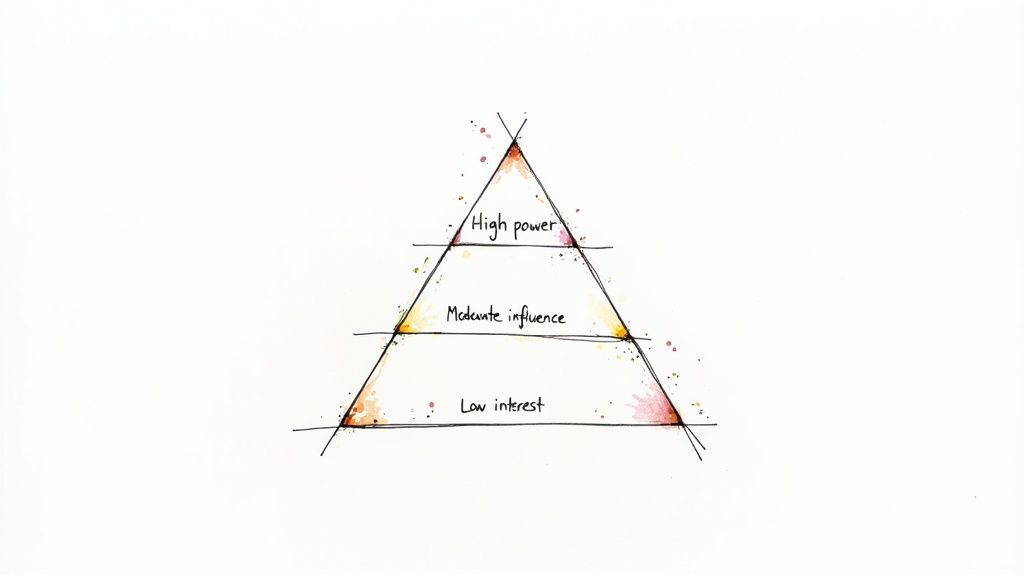
Drawing from principles found in Mendelow's Power-Interest Matrix and widely used by the Project Management Institute (PMI), this framework is indispensable for strategic communication. For example, a tech company launching a new product would place investors and regulators at the pyramid's apex, key department heads in the middle, and end-users at the base. This informs who needs detailed, frequent updates versus who requires general awareness campaigns. It is one of the most effective conceptual framework examples for managing complex human dynamics in any initiative.
Strategic Breakdown
- When to Use It: This model is ideal during the initial planning stages of any project involving diverse groups, such as corporate social responsibility initiatives, public policy development, or large-scale construction projects. It is essential when resources for stakeholder engagement are limited and must be allocated efficiently.
- Core Benefit: Its chief advantage is focus. By stratifying stakeholders, the model allows teams to tailor communication strategies and allocate resources strategically, ensuring that the most influential voices are managed closely while preventing less critical groups from consuming disproportionate attention.
- Common Pitfall: A frequent error is treating the pyramid as static. Stakeholder power and interest can shift dramatically due to market changes, political events, or project milestones. Failing to regularly reassess and update the pyramid can lead to misaligned communication and unforeseen project risks.
Actionable Takeaways
- Map Power and Interest First: Before constructing the pyramid, conduct a thorough stakeholder mapping exercise. Use a simple grid to plot each stakeholder's power (ability to influence the project) against their interest (level of concern). This preliminary analysis provides the objective data needed to accurately place them within the pyramid's tiers.
- Customize Communication by Tier: Develop distinct communication plans for each level of the pyramid. The top tier may require one-on-one meetings and detailed reports, the middle tier may engage through regular workshops and newsletters, and the bottom tier might be informed through mass communications like press releases or social media updates.
3. Kirkpatrick Model of Training Evaluation
The Kirkpatrick Model is a globally recognized framework for evaluating the effectiveness of training programs. Developed by Donald Kirkpatrick in the 1950s, it provides a four-level approach to measure learning and its impact on organizational goals. The model guides evaluators through a sequence of increasing complexity: Level 1: Reaction (how participants felt), Level 2: Learning (increase in knowledge/skills), Level 3: Behavior (application of learning on the job), and Level 4: Results (tangible outcomes on the business).
This hierarchical structure provides a comprehensive lens for assessing training ROI. For example, a leadership development initiative at a Fortune 500 company would first use surveys to gauge participant reaction (Level 1). It would then use pre- and post-training assessments to measure knowledge gain (Level 2). Months later, 360-degree feedback could track behavioral changes in leadership style (Level 3), ultimately linking the program to improved team performance metrics like productivity or employee retention (Level 4). Its systematic progression makes it one of the most enduring conceptual framework examples in corporate and educational settings.
Strategic Breakdown
- When to Use It: This model is indispensable for corporate training, instructional design, and human resources departments aiming to justify training budgets and demonstrate value. It is most effective for programs where behavioral change and business results are the ultimate goals.
- Core Benefit: Its primary advantage is its comprehensive, multi-layered approach. It moves beyond simple "smile sheets" (Level 1) to connect training directly to tangible business outcomes, providing a clear narrative about the program's strategic value and overall impact.
- Common Pitfall: A frequent mistake is stopping at Levels 1 and 2. Many organizations measure participant satisfaction and knowledge gain but fail to follow up on behavior change and business results, which are the most critical indicators of a training program's true success.
Actionable Takeaways
- Design Evaluation from the Start: Integrate evaluation tools for all four levels into your training design process, not as an afterthought. Determine your Level 4 business metrics first and work backward to ensure your training content and activities directly support those goals.
- Establish a Pre-Training Baseline: Before the program begins, measure the key metrics you intend to influence (e.g., current sales figures, team efficiency, or leadership scores). This baseline is essential for accurately demonstrating improvement and isolating the training's impact. For those employing the Kirkpatrick Model, exploring essential training evaluation methods can provide a deeper understanding of assessment strategies across all levels.
4. Conceptual Ecology Framework (Systems Thinking Model)
The Conceptual Ecology Framework, rooted in systems thinking, is an integrative approach for understanding complex phenomena by examining the relationships and interdependencies among multiple components. Instead of isolating variables, it views a problem or organization as an interconnected ecosystem where changes in one area ripple throughout the entire system. This framework helps visualize how various elements interact, influence each other, and produce emergent behaviors that are not predictable by studying the parts alone.
Popularized by thinkers like Peter Senge and Donella Meadows, this model is invaluable for tackling "wicked problems" like climate change or healthcare reform. For example, when redesigning a healthcare system, this framework moves beyond just doctors and patients to map the interactions between insurance policies, technology, public health trends, and hospital administration. It is one of the most dynamic conceptual framework examples for analyzing non-linear, multifaceted challenges where simple cause-and-effect logic falls short.
Strategic Breakdown
- When to Use It: This framework is ideal for addressing complex, systemic issues with many moving parts and feedback loops. Use it for organizational change management, public policy development, urban planning, and large-scale environmental analysis.
- Core Benefit: Its primary strength is revealing hidden leverage points. By mapping the entire system, you can identify the small, targeted interventions that can trigger significant, lasting change, avoiding wasted effort on symptoms rather than root causes.
- Common Pitfall: A frequent mistake is oversimplification or failing to define system boundaries. If the map is too narrow, critical influences are missed; if it's too broad, the analysis becomes unmanageable and loses focus.
Actionable Takeaways
- Identify Feedback Loops: Focus on mapping both reinforcing loops (which amplify change, like a viral marketing campaign) and balancing loops (which resist change and seek stability, like market competition). Understanding these dynamics is key to predicting system behavior and designing effective interventions.
- Engage Diverse Stakeholders: The accuracy of your system map depends on the perspectives included. Involve people from all levels and areas of the system, from senior leaders to frontline staff and external partners, to build a comprehensive and realistic model of how things truly work.
5. Conceptual Framework for Implementation Science: Bridging Research and Reality
A Conceptual Framework for Implementation Science is a theoretical model designed to close the critical gap between research evidence and real-world practice. It provides a systematic way to understand and address the numerous factors that influence the adoption, integration, and sustainability of evidence-based practices in settings like hospitals, schools, and organizations. The goal is to move beyond simply knowing "what works" to understanding "how to make it work" in complex, dynamic environments.
Popularized by models like the Consolidated Framework for Implementation Research (CFIR), these frameworks examine the interplay between the intervention itself, the inner setting (e.g., organizational culture), the outer setting (e.g., policy), and the implementation process. For example, when a hospital implements a new evidence-based clinical guideline, this framework helps analyze potential barriers like staff resistance or resource limitations, and facilitators like strong leadership support. It stands as one of the most vital conceptual framework examples for anyone in healthcare, public policy, or organizational change.
Strategic Breakdown
- When to Use It: This framework is essential when introducing a new evidence-based program, policy, or practice into a real-world setting. It is invaluable for planning implementation strategies, troubleshooting challenges during rollout, and evaluating the long-term success and sustainability of an initiative.
- Core Benefit: Its primary advantage is its comprehensive, multi-level approach. It prevents a narrow focus on just the intervention itself by forcing planners to consider the broader context, including organizational readiness, stakeholder engagement, and external influences, thereby increasing the likelihood of successful adoption and lasting impact.
- Common Pitfall: A frequent error is underestimating the "implementation dip," a temporary drop in performance as staff adapt to new workflows. Without preparing stakeholders for this predictable phase, leaders may prematurely abandon a promising practice, mistaking the initial struggle for long-term failure.
Actionable Takeaways
- Identify Champions and Engage Staff Early: Don't impose change from the top down. Identify respected local champions and opinion leaders within the organization to advocate for the new practice. Involving front-line staff in the planning process fosters ownership and helps tailor the implementation strategy to on-the-ground realities.
- Plan for Adaptation and Monitoring: While maintaining fidelity to the core components of the evidence-based practice is crucial, allow for adaptation to the local context. Build in robust mechanisms for ongoing monitoring and feedback to learn what's working and what isn’t, allowing for real-time adjustments. To articulate these complex interactions effectively in your research, consider these strategies on how to improve academic writing.
6. The Driver Diagram: A Roadmap for Change Management
A Driver Diagram is a visual tool that translates a high-level goal into actionable, testable change ideas. It provides a clear, logical structure that links a project's overall Aim to the system components that will influence the result, known as Primary Drivers. These drivers are then broken down further into Secondary Drivers and finally into specific Change Ideas. This framework helps teams visualize the cause-and-effect relationships within a system and focus their efforts on interventions that have the highest potential for impact.
Popularized by the Institute for Healthcare Improvement (IHI), its application is widespread in quality improvement projects. For example, a hospital aiming to reduce patient readmissions would identify primary drivers like improved discharge planning and medication management. A secondary driver under discharge planning could be "patient education," leading to a specific change idea like "implementing a teach-back method with all patients." This model is one of the most effective conceptual framework examples for turning abstract goals into concrete plans.
Strategic Breakdown
- When to Use It: The Driver Diagram is ideal for quality improvement, process optimization, and change management initiatives where you need to move from a general aim to specific actions. It is particularly useful for complex problems where multiple factors contribute to the desired outcome.
- Core Benefit: Its main advantage is its ability to build shared understanding and consensus within a team. By mapping out the theory of change visually, it ensures everyone is aligned on what needs to be done and why, fostering buy-in and focused execution.
- Common Pitfall: A frequent mistake is creating an overly complex diagram with too many drivers. This can lead to a loss of focus and an overwhelming number of change ideas, making it difficult to prioritize and test interventions effectively.
Actionable Takeaways
- Start with a SMART Aim: Your central aim should be Specific, Measurable, Achievable, Relevant, and Time-bound. A clear, quantifiable goal (e.g., "Reduce staff turnover by 15% in the next 6 months") provides the necessary focus to identify meaningful drivers and measure success.
- Use It to Prioritize Efforts: Once you have mapped your change ideas, use the diagram to facilitate a team discussion on which changes are likely to have the biggest impact with the least effort. This helps you select a few high-leverage ideas to test first using small-scale cycles of improvement.
7. The Ecosystem Framework: Visualizing Interconnected Value Creation
The Ecosystem Framework shifts the analytical lens from a single organization to a complex, interconnected system of actors, resources, and value exchanges. It models an industry or business environment as a living ecosystem where companies, partners, suppliers, customers, and competitors interact to co-create value. This framework is crucial for understanding modern business dynamics, especially in technology and platform-based industries, by mapping out the flows of information, capital, and goods between all participants.
Pioneered by thinkers like James F. Moore, this model visualizes how organizations like Apple don’t just sell products; they orchestrate a vast ecosystem. The iPhone, App Store, developers, and accessory makers all work together, creating a value proposition that is far greater than the sum of its parts. Similarly, Amazon's success is built on an ecosystem connecting retail, logistics, cloud services (AWS), and content. This is one of the most powerful conceptual framework examples for strategists analyzing market positioning and competitive advantage in a networked world.
Strategic Breakdown
- When to Use It: This framework is ideal for strategic planning in platform-based businesses, analyzing market entry into complex industries, understanding digital transformation, and mapping innovation opportunities. It's essential when your success depends heavily on partners, third-party developers, or a large user base.
- Core Benefit: Its primary strength is its holistic perspective. Instead of a linear value chain, it reveals the network effects and symbiotic relationships that drive modern value creation. This helps leaders identify non-traditional partners, anticipate competitive threats from adjacent sectors, and design more resilient business models.
- Common Pitfall: A frequent mistake is focusing only on complementary relationships while ignoring competitive tensions within the ecosystem. Many partners are also potential competitors (a "co-opetition" dynamic). Failing to map and manage these tensions can leave an organization vulnerable to disruption from within its own network.
Actionable Takeaways
- Map the Key Players and Value Flows: Start by identifying all the actors in your ecosystem: producers, consumers, suppliers, partners, and regulators. Diagram how value (money, data, services) is created and exchanged between them. This visual map will quickly highlight critical dependencies and ares of influence.
- Define Your Role: Keystone, Dominator, or Niche Player? Analyze your position. Are you a "keystone" that provides a stable platform for others (like Google with Android)? A "dominator" that controls the network (like early Microsoft)? Or a "niche player" that offers a specialized service within a larger ecosystem? Clarifying your role helps you define a coherent strategy for engaging with others and capturing value.
8. Social-Ecological Model (Socio-Ecological Framework)
The Social-Ecological Model is a comprehensive framework that posits that behavior is shaped by multiple levels of influence, often depicted as a series of nested circles. It moves beyond a focus on individual behavior to consider the complex interplay between individuals and their environment. The core components of this model are five interlocking layers: the Individual (knowledge, attitudes), Interpersonal (family, peers), Organizational (schools, workplaces), Community (cultural norms, built environment), and Policy (laws, regulations).
This framework, originally rooted in Urie Bronfenbrenner's work and widely adopted by the CDC, provides a holistic lens for understanding and addressing complex public health issues. For example, an initiative to combat obesity wouldn't just focus on individual diet choices. It would also address interpersonal factors like family eating habits, organizational factors like cafeteria food options, community factors like access to parks, and public policy like taxes on sugary drinks. It's one of the most effective conceptual framework examples for designing interventions that create sustainable, population-level change.
Strategic Breakdown
- When to Use It: This model is ideal for tackling complex, multifaceted problems like youth violence, substance abuse, or mental health promotion. It is particularly powerful in public health, social work, and community development where problems are deeply embedded in social and environmental contexts.
- Core Benefit: Its main advantage is its comprehensiveness. By forcing a multilevel analysis, it prevents overly simplistic, individual-focused solutions that often fail. It encourages the development of synergistic strategies that reinforce each other across different levels, leading to more robust and lasting outcomes.
- Common Pitfall: The model's complexity can be its downfall. A common mistake is attempting to address every level with equal intensity from the start, which can be resource-prohibitive and overwhelming. It is also easy to neglect the feedback loops between levels, treating them as separate silos rather than an interconnected system.
Actionable Takeaways
- Assess and Prioritize: Don't try to boil the ocean. Conduct a thorough needs assessment at each of the five levels to identify the most critical barriers and leverage points. Prioritize a few high-impact, complementary strategies across different levels to create a focused and manageable action plan.
- Foster Cross-Sector Collaboration: No single entity can effectively intervene at all ecological levels. Success requires building strong partnerships with diverse stakeholders, including community groups, schools, government agencies, and private businesses. When collaborating on research and writing, it's also vital to ensure all contributions are properly integrated and cited; you can learn more about ethical writing practices to maintain academic integrity.
9. The Social Ecological Model: Understanding Interconnected Systems
The Social Ecological Model offers a multi-layered framework for understanding how individual behavior is shaped by the interplay of various environmental and personal factors. It moves beyond a focus on individual responsibility, positing that behavior is influenced by a complex web of relationships and environments. This model is visualized as a set of nested circles, each representing a different level of influence: Individual (knowledge, skills), Interpersonal (family, peers), Organizational (schools, workplaces), Community (social networks, norms), and Public Policy (laws, regulations).
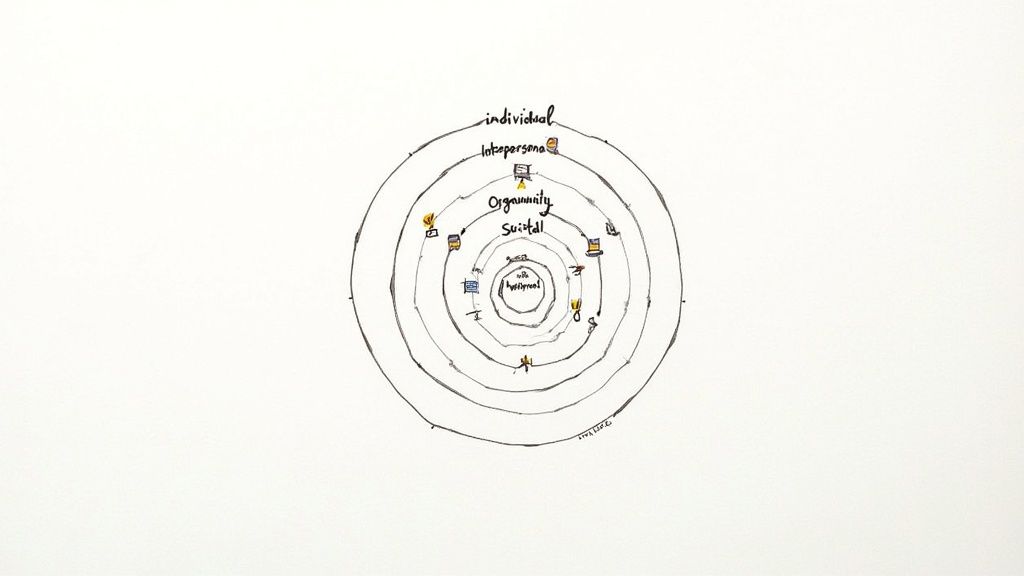
Developed by Urie Bronfenbrenner and widely adopted in public health and social sciences, it helps researchers and practitioners design more comprehensive interventions. For example, a campaign to promote physical activity would not only target individual motivation but also address supportive social networks, safe community spaces, and policies that encourage active transport. By considering these nested levels, it becomes one of the most holistic conceptual framework examples available for tackling complex societal issues.
Strategic Breakdown
- When to Use It: This model is exceptionally well-suited for research and interventions in public health, community psychology, and social work. Use it when the problem you're studying (e.g., obesity, violence, mental health) cannot be explained by individual factors alone and requires a systems-level approach.
- Core Benefit: Its greatest strength is its comprehensive, systems-thinking perspective. It forces you to consider the dynamic interactions between various levels of influence, leading to more robust and sustainable interventions that address root causes rather than just symptoms.
- Common Pitfall: A frequent challenge is the model's complexity. It can be difficult to measure the interactions between all levels simultaneously, potentially leading researchers to focus on only one or two layers while neglecting the others, thus undermining the model's core purpose.
Actionable Takeaways
- Conduct a Multi-Level Assessment: Before designing an intervention, use the model as a guide to map out the influential factors at each level. What individual beliefs, peer influences, organizational rules, community resources, and public policies are currently shaping the behavior you want to change? This initial analysis is critical for targeted action.
- Integrate Strategies Across Levels: Effective interventions rarely target just one level. Your plan should include coordinated strategies that reinforce each other. For instance, a school-based nutrition program (Organizational) can be strengthened with parent workshops (Interpersonal) and support for local farmers' markets (Community).
Comparison of 9 Conceptual Frameworks
| Model | Implementation complexity | Resource requirements | Expected outcomes | Ideal use cases | Key advantages |
|---|---|---|---|---|---|
| Logic Model Framework | Low–Medium — structured mapping, upfront thinking | Low–Moderate — stakeholder time, basic data | Clear program theory, defined outputs and outcomes | Program design, nonprofit projects, public health evaluations | Clarifies cause-effect, aids communication and evaluation planning |
| Conceptual Pyramid Model (Stakeholder Analysis) | Low–Medium — hierarchical mapping | Low — interviews, stakeholder data | Prioritized stakeholders, tailored engagement plans | Project management, CSR, conservation, organizational change | Improves engagement efficiency, clarifies priorities |
| Kirkpatrick Model of Training Evaluation | Medium–High — multi-level measurement | Moderate–High — evaluation tools, follow-up, time | Measured reaction, learning, behavior change, organizational results | Training programs, leadership development, medical education | Comprehensive evaluation, links training to business outcomes |
| Conceptual Ecology Framework (Systems Thinking) | High — maps interdependencies and feedback loops | High — multidisciplinary expertise, data, modeling | Holistic insights, leverage points, anticipation of unintended effects | Wicked problems, system redesign, climate and healthcare policy | Captures complexity, reveals feedback loops and emergent behavior |
| Conceptual Framework for Implementation Science | High — context-rich, multi-variable | High — organizational engagement, monitoring, long-term evaluation | Improved adoption and sustainability of evidence-based practices | Healthcare quality improvement, policy implementation, system rollouts | Bridges research and practice, predicts implementation barriers |
| Driver Diagram (Change Management) | Low–Medium — focused visual hierarchy | Low–Moderate — team workshops, rapid testing (PDSA) | Prioritized change ideas, testable interventions, focused effort | Quality improvement, patient safety, targeted performance goals | Simple, actionable, links aims to specific changes |
| Ecosystem Framework (Organizational/Business Model) | High — maps networks and value flows | High — cross-organization data, strategic analysis | Strategic partnership opportunities, identification of network effects | Platform strategy, digital transformation, innovation planning | Reveals interdependencies, identifies collaboration and disruption risks |
| Social-Ecological Model (Socio-Ecological Framework) | High — multi-level planning and coordination | High — multi-sector resources, long-term evaluation | Multi-level interventions addressing root causes, sustained population-level change | Public health campaigns, community resilience, prevention programs | Addresses root causes, supports comprehensive, multi-level interventions |
Putting Your Framework into Practice: Key Takeaways for Researchers
Navigating the landscape of research can feel like exploring a vast, uncharted territory. As we've journeyed through these diverse conceptual framework examples, from the programmatic clarity of the Logic Model to the systemic complexity of the Conceptual Ecology Framework, a central truth emerges: a strong conceptual framework is your map and compass. It is the essential tool that transforms a vague area of interest into a focused, navigable, and ultimately conquerable research question.
The power of these frameworks is not in their rigidity, but in their adaptability. They are not prescriptive formulas to be copied verbatim. Instead, they are intellectual blueprints, providing a foundational structure that you, the researcher, must customize. The Kirkpatrick Model offers a layered approach to evaluation, but its true value is realized when you define what "Reaction," "Learning," "Behavior," and "Results" mean within the specific context of your training program. Similarly, the Driver Diagram is a powerful tool for change, but its effectiveness hinges on your ability to accurately identify the primary and secondary drivers unique to your organizational challenge.
Synthesizing Your Learnings: Core Principles for Success
Across all the models we've explored, several core principles stand out as critical for effective implementation. Mastering these will significantly elevate the quality and impact of your research.
- Context is King: A framework is only as good as its application. The Social-Ecological Model, for instance, demands a deep understanding of the individual, relational, community, and societal factors at play. Applying it generically, without this nuanced contextualization, will lead to superficial findings.
- Visuals Drive Clarity: The most compelling frameworks are almost always visual. A well-designed diagram isn’t just an illustration; it's an argument. It communicates complex relationships, variables, and pathways more effectively than paragraphs of text ever could. This is a key takeaway from models like the Conceptual Pyramid and the Ecosystem Framework.
- Iterate and Refine: Your initial framework is a starting point, not a final destination. As you delve into your literature review and preliminary data collection, be prepared to revise your model. This iterative process is a sign of rigorous engagement, not a flaw in your initial thinking.
Actionable Next Steps for Your Research
Feeling empowered by these conceptual framework examples is one thing; putting that knowledge into practice is another. Here are your immediate next steps to move from inspiration to application:
- Clearly Define Your Research Question: Before you can select a framework, you must have absolute clarity on what you are trying to investigate. Is it an intervention's impact (Logic Model), a system's dynamics (Ecology Framework), or a behavioral change (Social-Ecological Model)?
- Conduct a "Framework-Focused" Literature Review: Go beyond just gathering facts. Actively look for how other researchers in your field have structured their inquiries. Identify the common theoretical and conceptual models they use and critique their applications.
- Start Sketching, Not Writing: Begin by visually mapping out your variables and their presumed relationships. Use boxes, arrows, and labels. This act of "thinking on paper" will help you clarify your logic before you commit to prose. Does your sketch look more like a linear process or a complex web of interactions? This will guide your framework choice.
Ultimately, constructing a robust conceptual framework is one of an academic's and professional's most critical skills. It demonstrates a sophisticated understanding of your topic, provides a clear rationale for your methodology, and creates a coherent narrative that guides your audience through your findings. It is the bedrock upon which credible, impactful, and defensible work is built. By investing the time and intellectual energy upfront, you ensure the entire research process that follows is more focused, efficient, and meaningful.
Ready to articulate your meticulously designed conceptual framework with precision and clarity? Rewritify helps you transform complex academic ideas into polished, original, and impactful prose, ensuring your research narrative is as strong as your methodology. Perfect your research paper, proposal, or presentation by visiting Rewritify today.
Recent articles

Is ZeroGPT accurate? We tested its AI detection using 2026 data. See how it performs on false positives and reliability for students, writers, and marketers.

Master the difference between complement and compliment with our guide. Learn the definitions, grammar, and usage with clear examples to perfect your writing.

Discover our top 8 company bio example formats for websites, social media, and sales. Get templates and tips to write a bio that converts.

Discover 10 powerful not understandable synonyms to enhance your writing. Explore examples, tips, and contexts to improve clarity and precision.

Learn how to humanize AI generated text with proven strategies. Move beyond robotic writing to create authentic, engaging content that connects with readers.

Learn how to correct the sentence with practical grammar tips, proofreading tricks, and clear examples that boost clarity and confidence.