How to Paraphrase Without Plagiarizing Your Writing
Learn how to paraphrase without plagiarizing using expert techniques. Master ethical rewriting and proper citation to create truly original content.
The trick to paraphrasing without plagiarizing is to completely rebuild the original idea using your own words and sentence structure. It’s not about just swapping out a few synonyms here and there.
The goal is to show you truly understand the concept, and then—this is the crucial part—give credit where it's due with a proper citation.
The Real Difference Between Paraphrasing and Plagiarism
Let's get one thing straight from the jump: real paraphrasing is a skill, while plagiarism is a serious ethical blunder. A lot of people fall into the trap of thinking that changing a handful of words is enough to make a passage their own. Honestly, that myth is one of the fastest routes to academic or professional trouble.
Proper, ethical paraphrasing means you first have to deeply understand the source material. Then, you step away from it and explain the core concept entirely in your own voice. It’s less about finding synonyms and more about internalizing an idea and then articulating it with your unique phrasing and sentence flow.
Think of yourself as a translator of ideas, not just a rearranger of words. You're aiming to represent someone else's idea accurately, but through your own intellectual lens.
Where’s the Line?
The boundary between these two can feel a bit fuzzy, especially now with so many AI tools in the mix. But the fundamental difference really boils down to two things: intent and originality.
- Paraphrasing is a legitimate part of research and writing. You're borrowing an idea to support your own point, and you give full credit through a citation. It proves you've actually engaged with the source material.
- Plagiarism is trying to pass off someone else's work—their ideas, their sentence structure, or their exact words—as your own, whether you meant to or not. Even if you manage to change every single word, just copying the original sentence structure can still be flagged as plagiarism.
With sophisticated AI becoming more common, detecting cleverly disguised paraphrasing has become a major focus. In fact, one study found that in a whopping 70% of plagiarism cases, nearly half or more of the content was paraphrased, not directly copied. This makes the job of detection that much harder.
Ultimately, knowing how to paraphrase ethically is essential for protecting your credibility. For a deeper dive, check out our guide on how to avoid plagiarism, which is packed with strategies for both students and professionals.
A Proven Framework for Effective Paraphrasing
Knowing how to paraphrase without plagiarizing isn't about following a rigid checklist. It’s more of a mindset, a repeatable process you get better at with practice. The key is to move beyond simply swapping out words and focus on genuinely understanding and re-explaining an idea in your own unique way.
The first step is always the most important: truly understand the source material. Don't just skim it. Read the passage a few times, then put it away and try to explain the main point out loud to yourself. If you can't do it without peeking, you're not ready to write. This little active recall trick is the best test for comprehension.
This simple process boils down to three core actions: understand, rewrite, and cite.
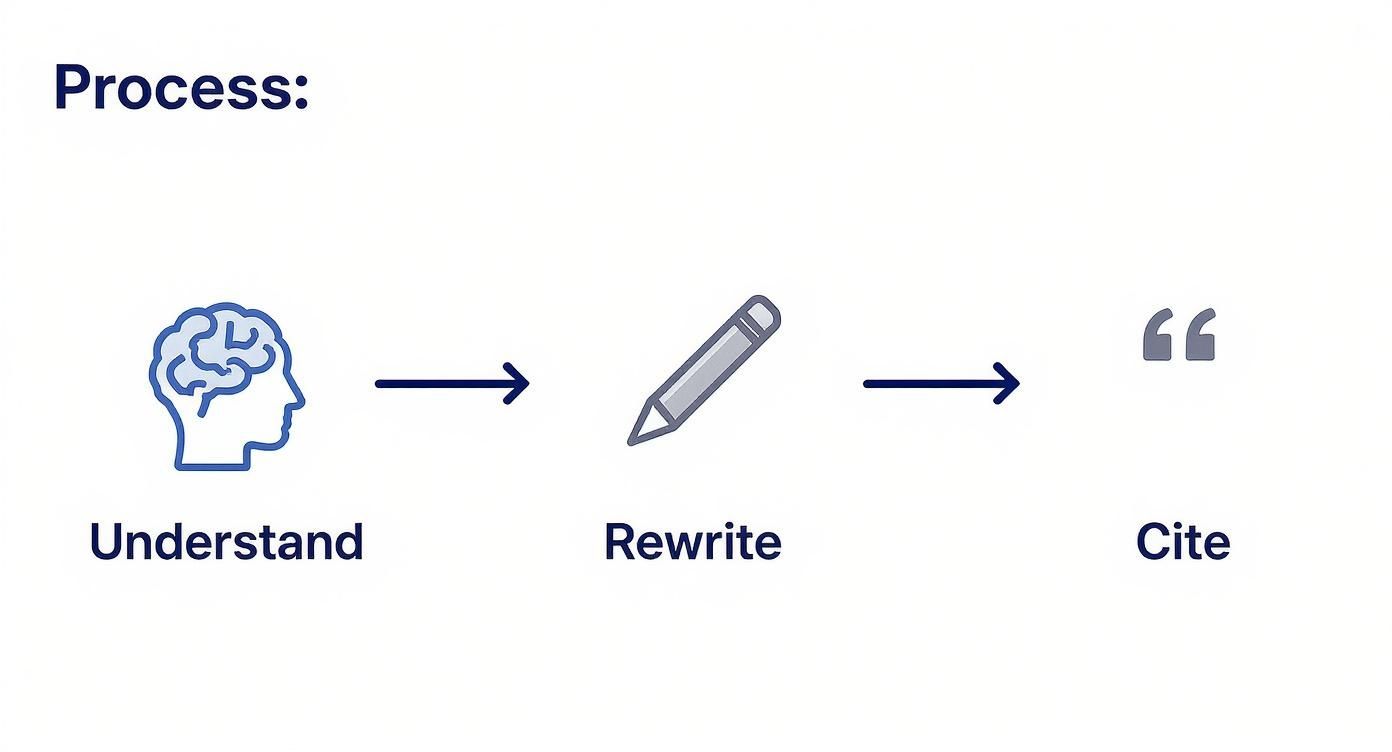
As you can see, each step naturally leads to the next. It’s a workflow that keeps your writing original while making sure you give credit where credit is due.
Deconstruct and Rebuild the Idea
Once you've got the core concept locked in, it's time to take apart the original author's work—intellectually, of course. Look at how they built their argument. Did they lead with a big claim and back it up with data? Or did they start with small details and build toward a conclusion? Your mission is to completely dismantle that structure.
Instead of just following their blueprint, you need to architect your own. Think about a totally new way to present the same information.
- Shift the focus: Maybe you can start with a detail the original author buried in the middle and make it your new opening hook.
- Reverse the flow: If the source explains cause then effect, try explaining the effect first and then work backward to explore what caused it.
- Add your own perspective: The best paraphrasing synthesizes ideas. Weave in your own insights or connect the concept to other research to give it a fresh context.
This isn't optional. This structural re-engineering is what separates a genuine paraphrase from a lazy copy that plagiarism checkers can easily spot. Even if every word is different, if you just mimic the original sentence structure and logical flow, you're still on shaky ground.
Rewrite and Compare Meticulously
Now, and only now, should you start writing. With your new structure in mind, explain the concept using your own voice and vocabulary. A great way to do this is to pretend you're explaining it to a friend or colleague who knows nothing about the topic. This forces you to use natural language that’s entirely your own.
Steer clear of the "thesaurus trap," where you just plug in synonyms for individual words. This is a common mistake called "patchwriting," and it almost always sounds clunky and unnatural. More importantly, it doesn’t change the core structure, leaving you vulnerable to plagiarism accusations.
After you've drafted your version, pull up the original and do a side-by-side comparison. Read both out loud. Does anything sound a little too close for comfort? Did you accidentally borrow a unique turn of phrase or a specific sentence rhythm? Be your own harshest critic here and tweak anything that feels derivative.
This final check is your last line of defense. Once you're confident your work is original, drop in your citation immediately. Don't tell yourself you'll do it later; it's way too easy to lose track of where an idea came from. Citing as you go is a powerful habit for ethical and stress-free writing.
A big part of paraphrasing effectively is knowing which techniques work and which ones are just plagiarism in disguise.
Effective vs Ineffective Paraphrasing Techniques
This table breaks down some common approaches to help you stay on the right track.
| Technique | Description | Plagiarism Risk | Recommended Action |
|---|---|---|---|
| Thesaurus Substitution | Swapping individual words with synonyms without changing the sentence structure. | High | Avoid. This is patchwriting. Focus on changing the entire structure and expressing the idea in your own words. |
| Sentence Reordering | Shuffling the order of sentences from the original source without rewriting them. | High | Avoid. This is still considered plagiarism as the original phrasing and ideas are copied directly. |
| Structural Mimicking | Keeping the original's logical flow and argument structure but changing words. | Moderate | Avoid. A true paraphrase requires you to create a new structure for presenting the information. |
| Conceptual Rewriting | Understanding the core idea and explaining it entirely in your own words/style. | Low | Recommended. This is the gold standard for ethical paraphrasing. Always cite the original source. |
| Summarizing | Condensing the main points of a longer text into a brief overview. | Low | Recommended. Useful for conveying the gist of a source. Still requires a citation. |
Ultimately, the safe and effective techniques all come back to one thing: genuine comprehension. If you understand the idea, you can explain it. If you're just manipulating words, you're walking a fine line.
Advanced Techniques for Truly Original Writing
Once you have the basics down, you can take your paraphrasing skills to the next level. This is where you stop just rewriting and start genuinely improving on the source material, adding your own perspective and demonstrating a much deeper understanding. It’s about making the information fit your voice and your narrative, not just changing the words.
These more advanced strategies take a bit more effort, but the result is work that’s undeniably original. The goal is to reshape the information so completely that it feels like it was yours from the start.
Restructure Sentences and Voice
One of the most effective ways to distance your writing from the original is to tear down and rebuild its fundamental structure. Forget just swapping words; look at the grammatical blueprint of every sentence.
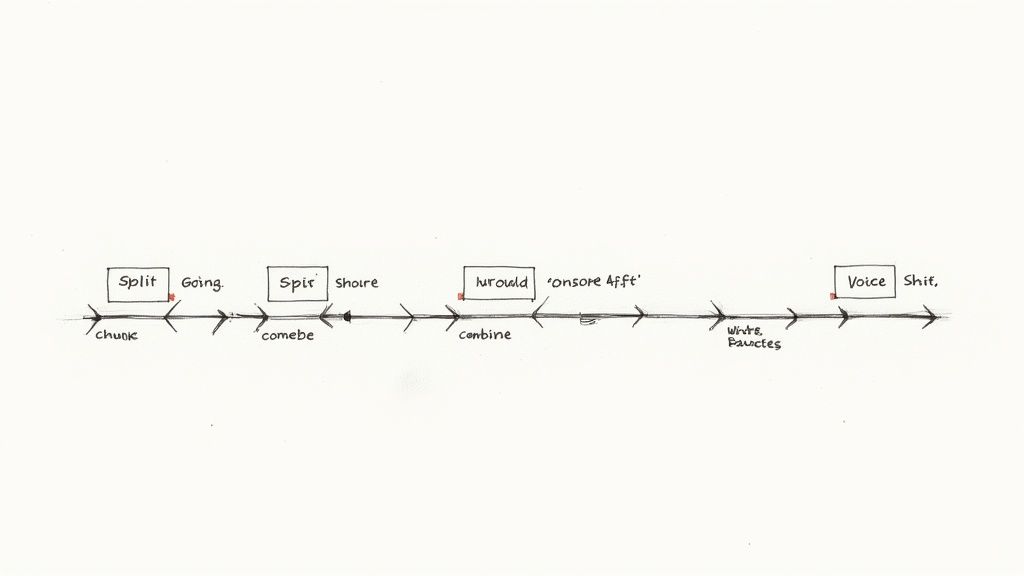
- Combine and Split: Play with the rhythm of the text. If the original uses a series of short, snappy sentences, see if you can merge them into a more complex sentence that better explains how the ideas connect. On the flip side, if you’re dealing with a long, winding sentence, break it apart into a few clearer, more focused statements.
- Shift the Authorial Voice: Flipping the voice from active to passive (or the other way around) is a game-changer. For example, "The team launched the product" (active) becomes "The product was launched by the team" (passive). It’s a simple change, but it forces you to completely rephrase the entire sentence.
This isn't just about making things look different. These techniques force you to rethink how the information is presented, which is a huge step toward truly ethical paraphrasing.
Use Conceptual Synonyms
It’s time to graduate from the basic thesaurus. Instead of finding a one-to-one word replacement, start thinking in terms of conceptual synonyms—different phrases that capture the same core idea, maybe with a slightly different emphasis.
For instance, rather than swapping "economic downturn" for "recession," you could use a more descriptive phrase like "a period of significant financial contraction" or "a slowdown in market activity." This shows you've actually absorbed the meaning, not just copied the vocabulary.
This approach proves you’re engaging with the concepts, not just the words. It makes your writing sound far more authoritative and adds a layer of depth that simple word-swapping can't achieve.
This is especially critical now, with AI-generated text becoming so common. Paraphrasing without credit is a huge issue in AI writing. One recent analysis found that in Computer Science content from GPT-3.5, a staggering 80.7% was paraphrased from other sources without attribution. You can dig into more of these startling AI plagiarism findings in the full report.
Apply the Chunking Method
Think of the chunking method as a way to completely deconstruct an idea before rebuilding it from the ground up. It’s my go-to technique for tackling really dense or complex information.
Here’s how it works:
- Isolate the Core Ideas: Read the original text and pull out the absolute key points. Jot them down as simple bullet points, using just a few keywords for each "chunk" of information.
- Forget the Original: This is the most important part. Put the source text away. Hide it, close the tab—just make sure you can't see it.
- Reassemble from Memory: Now, looking only at your list of "chunks," explain the concept out loud or write it out in your own words. Because you’re starting from fragmented ideas instead of fully formed sentences, you’re forced to build your own connections and narrative flow.
This method pretty much guarantees you’re not just mimicking the source's structure. You’re building something new from the raw materials, which is the ultimate test of both your understanding and your ability to write originally.
Why Citing Your Sources Is Non-Negotiable
Let's be clear: even a perfectly rewritten sentence is still plagiarism if you don't give credit to the original author. This isn't just some dusty academic rule; it's the bedrock of intellectual honesty. Proper citation is your entry ticket into the scholarly conversation, showing you respect the work that came before you.
Think of it as building your own credibility. When you link your ideas to established research, you're telling your readers that your work is grounded in fact, not just opinion. It’s one of the most important research paper writing tips we can offer. It also gives your audience a path to follow, letting them dig deeper into the sources and see how you built your argument.
A citation is your way of saying, "This idea is important, and here's who deserves the credit for it." It transforms your writing from a simple opinion piece into a documented, verifiable work.
Attribution is the bright line separating ethical paraphrasing from intellectual theft. Forgetting to cite, even by accident, can carry serious weight in school and your career.
Understanding Basic Citation Styles
You don't need to be a citation guru, but knowing the fundamentals of in-text citations is crucial for paraphrasing ethically. The exact format will change depending on the style guide you’re using—like APA, MLA, or Chicago—but the goal is always the same: point the reader to the original source.
Here’s a quick rundown of the big three:
- APA (American Psychological Association): The go-to for social sciences, education, and psychology. It uses an author-date format, like this: (Smith, 2023).
- MLA (Modern Language Association): You'll see this all over the humanities. For direct quotes, it uses an author-page number format like (Smith 45). For a general paraphrase, just the author's last name often works.
- Chicago Style: Common in history and the arts. This style typically uses footnotes or endnotes, marked by a little superscript number right in your text.¹
Whichever style you use, the in-text note is a signpost that connects to the full reference in your bibliography. If you're juggling a lot of sources, it's worth looking into ways to streamline your citation process with dedicated software.
When Is a Citation Not Needed?
There is one major exception to the "cite everything" rule: common knowledge. This is information so widely known and undisputed that it can be found in countless general sources.
For instance, you don't need a source to say that George Washington was the first U.S. President. But if you were to share a specific historian's unique theory about Washington's leadership style, that absolutely needs a citation.
When in doubt, just add the citation. It’s a simple act that protects your integrity and makes your work stronger.
How to Use Paraphrasing Tools the Right Way
AI paraphrasing tools can be a fantastic way to break through writer's block, but they're a double-edged sword. If you're not careful, they can become a crutch that weakens your writing. The trick is to treat them as a brainstorming partner, not a robot that finishes your work for you. Think of it as a tool for inspiration that helps you get to a final product that is genuinely yours.
Here’s a practical approach: run a passage through a tool to see a few different ways the idea can be phrased. Look at the new sentence structures and word choices. Then, close the tool and rewrite the entire concept from scratch, guided by that new perspective. This simple habit keeps you from just swapping a few words and calling it a day.
A paraphrasing tool should spark your creativity, not replace it. Use its output as a suggestion to be dissected and improved upon, never as the final text. The human touch is what adds nuance, analysis, and a unique voice.
The Essential Human Editing Workflow
Let's be blunt: relying solely on an AI-generated paraphrase is a huge risk. These tools often spit out generic, clunky text that sounds robotic—exactly the kind of writing that today's plagiarism checkers are designed to flag. Your job is to take that raw material and shape it into something that sounds human.
Try this simple but effective workflow:
- Generate and Step Away: Get a few different versions from your tool, then immediately put them aside. Don't get attached to them.
- Inject Your Voice: Now, write the passage yourself. This is where you add your personal style, your insights, and the specific vocabulary that makes your writing yours.
- Fact-Check Everything: AI tools are notorious for misunderstanding context or just making things up. Always, always verify every single detail against the original source.
This hands-on editing process isn't optional; it's essential for protecting your credibility and making sure the work is truly original. If you're curious about how AI can fit into a broader content creation process, check out this review of the best AI writer for SEO tools.
Navigating Advanced AI Detection
The technology for catching unoriginal content is evolving at a breakneck pace. By 2025, the game will have changed completely. We're already seeing advanced systems that use behavioral and contextual signals, going way beyond simple text matching. For instance, some of the most sophisticated multi-layered detectors can now achieve 93% accuracy by blending machine learning with analytics like typing cadence.
Your unique writing style is your best defense against these systems. A heavily edited, thoughtfully rewritten paraphrase will always stand up to scrutiny better than a quick AI spin. For a deeper dive into this, our guide on how to make AI content undetectable offers more advanced strategies.
Common Questions About Paraphrasing and Plagiarism
Figuring out the fine line between good paraphrasing and accidental plagiarism can feel tricky. Even with the best intentions, it's easy to second-guess yourself. Let's clear up some of the most common questions writers have.
Is It Plagiarism if I Change Most of the Words?
This is a big one, and the answer is a definite yes, it can still be plagiarism.
A lot of people fall into the trap of "patchwriting," which is just swapping out words for synonyms. If you keep the original author's sentence structure and the way they laid out their argument, you're still borrowing their intellectual heavy lifting without giving them credit.
Real paraphrasing is about digesting the idea first, then explaining it from scratch in your own voice and with your own sentence structures. It's less like repainting a house and more like building a new one from the same set of blueprints.
Remember, plagiarism checkers and your professors are wise to this. They can spot when the underlying structure is the same, even if the words are different. The goal is to show you understand the idea, not just that you know how to use a thesaurus.
How Much of a Sentence Needs to Be Different?
Writers always want a magic number here, like a "50% rule," but there isn't one. Getting hung up on a percentage completely misses the point. You could change 90% of the words, but if it's still a carbon copy of the original's sentence pattern, it's plagiarism.
Instead of counting words, ask yourself this: "Have I truly made this idea my own and explained it from my perspective?" If your version still feels like it's clinging to the original sentence for support, you need to step back and try again. Aim for a total reconstruction, not just a surface-level edit.
Can I Paraphrase Multiple Sources in One Paragraph?
Absolutely! In fact, this is a sign of great writing. It's a technique called synthesis, where you weave together ideas from different sources to support a new, bigger point of your own.
The key is to cite each piece of information as you use it. For instance, you might introduce a finding from one study (and cite it), then immediately follow up with a related but different point from another author (and cite that one, too). This demonstrates that you're not just regurgitating information but are actually in conversation with your sources.
What Counts as Common Knowledge?
Common knowledge refers to facts that are undisputed and available in countless general sources. Think of things like "The Earth revolves around the Sun" or "William Shakespeare wrote Hamlet." You don't need a citation for that.
But the line can get fuzzy. If you're talking about a specific researcher's interpretation of a fact, a unique statistic, or an idea that isn't widely known outside a particular field, you need a citation. When in doubt, always add the citation. It’s the safest and most professional route, and it makes your work more credible.
Ready to transform your drafts into clear, original, and plagiarism-safe content? Rewritify helps you rewrite text with confidence, ensuring your voice shines through while maintaining academic and professional integrity. Try Rewritify for free and see the difference.
Relevant articles
Are AI detectors accurate? This guide unpacks the data, revealing why 99% claims are misleading and how to navigate the risks of false positives in your work.
Explore turnitin similarity score meaning and how it reflects originality, citation practices, and steps to improve your paper before submission.
Learn how to check for plagiarism with confidence. Our guide covers the best tools, manual techniques, and a clear workflow to ensure your content is original.
Does Turnitin check for AI? Yes. We explain how its detection works, why false positives happen, and how to use AI ethically to protect your academic integrity.
Difference between paraphrasing and plagiarism explained with clear examples and actionable tips to protect academic integrity.
Learn how to avoid plagiarism with proven strategies. Our guide covers proper citation, paraphrasing, and using tools to ensure your work is original.