How to make ai content undetectable: Master authentic writing today
How to make ai content undetectable: A balanced look at authenticity, detection methods, and best practices for clear, human-like writing.
To make AI content undetectable, you have to go deeper than just swapping a few words. The real strategy is to completely rewrite and restructure the text to introduce the kind of variability that’s second nature to human writers. This means shaking up sentence lengths, injecting a genuine tone, and using phrasing that breaks free from the predictable patterns AI detection tools are built to catch.
Beyond Deception: The Real Goal of Undetectable AI Content
Let's get one thing straight: this isn't about tricking algorithms. It's about elevating AI-assisted text into high-quality, human-centric content that actually helps people. When you ask how to make AI content undetectable, the answer should push you toward excellence, not evasion. The true aim is to create something so authentic and well-crafted that its origin simply doesn't matter.
This whole process starts with understanding what AI detectors are even looking for. These tools are trained to spot the "digital fingerprints" that large language models often leave behind. These tell-tale signs include:
- Low Perplexity and Burstiness: AI models tend to play it safe, using common words and sticking to a monotonous sentence structure. Human writing is messier. We naturally mix short, punchy sentences with longer, more detailed ones.
- Robotic Sentence Structures: AI-generated text often follows a rigid, almost mathematical logic. It lacks the subtle detours, interruptions, and occasional imperfections that make human expression feel real.
- A Lack of Unique Voice: Without a heavy dose of human guidance, AI content can sound generic. It's often missing the personality, strong opinions, and firsthand experience that readers connect with.
The Inconsistency of AI Detection
Here’s the thing about AI detectors: they’re notoriously unreliable. They aren't foolproof, and their results can be all over the place. I've seen them flag completely human-written text as AI-generated, while a carefully refined AI draft can sail right through.
One study that looked at different AI detectors in an academic setting found that none of them achieved 100% accuracy. While they gave high AI-likelihood scores (85%-94%) to abstracts written by ChatGPT, they also flagged original human writing with an average AI score of 36.9%. This happens because detectors are just scanning for stylistic patterns, not actually comprehending the content.
This simple framework shows how to think about turning raw AI output into something polished and genuinely human.
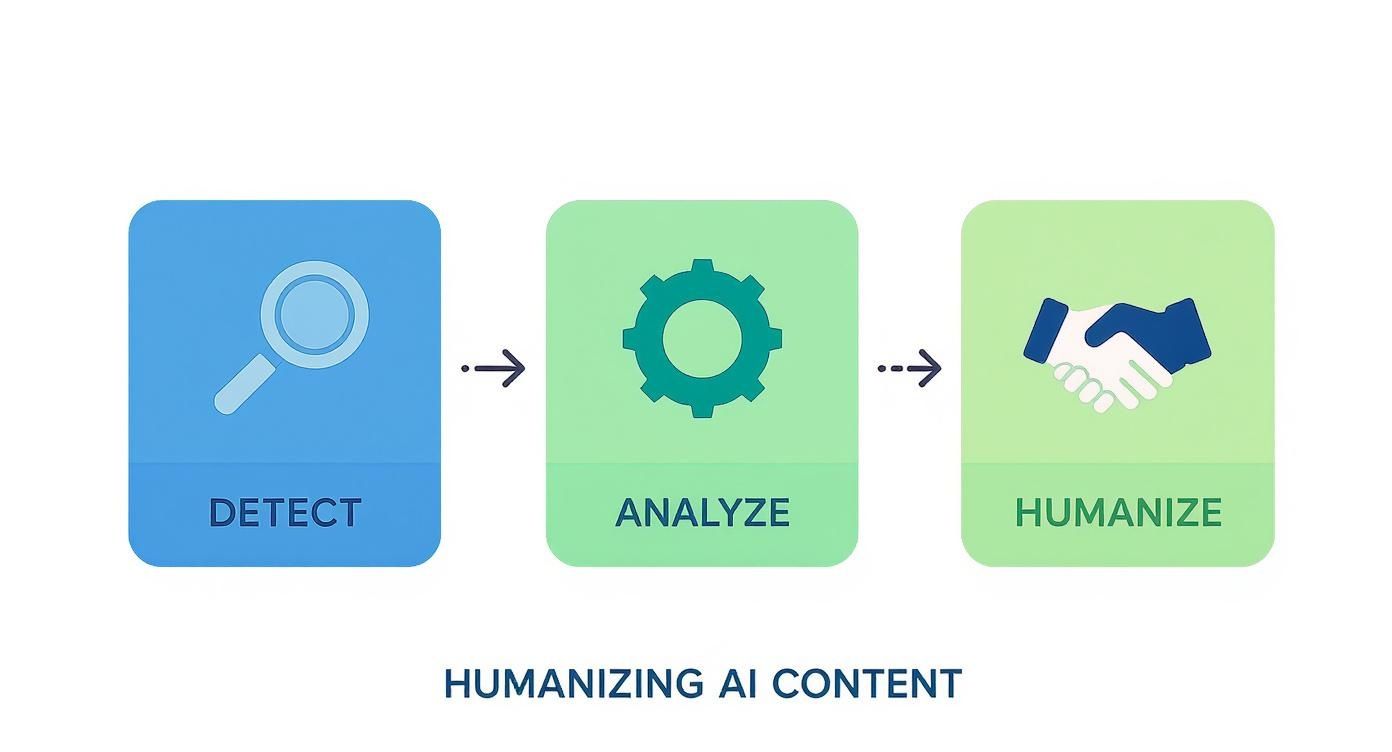
The big takeaway here is that humanizing AI text is an active job. It demands critical thinking and creative effort, not just hitting a "rewrite" button.
This table breaks down the core strategies we'll be covering, giving you a quick overview of what it takes to truly humanize AI-generated content.
Core Strategies for Humanizing AI Content
| Strategy | Objective | Key Action |
|---|---|---|
| Introduce Variability | Break predictable AI patterns in sentence structure and word choice. | Mix short, direct sentences with longer, more complex ones. |
| Inject Personality | Add a unique voice, tone, and perspective to the content. | Incorporate personal anecdotes, opinions, and brand-specific language. |
| Add Human Nuance | Include idioms, metaphors, and rhetorical questions that feel natural. | Edit for conversational flow and add elements of storytelling. |
| Fact-Check & Cite | Ensure all claims are accurate, sourced, and add E-E-A-T signals. | Independently verify all data and link to authoritative sources. |
Each of these strategies plays a critical role in transforming generic AI output into content that feels authentic and trustworthy.
Drawing an Ethical Line
Look, using AI as a powerful writing assistant is a smart and effective way to produce more content. There’s nothing wrong with that. The ethical line gets crossed when AI is used for academic cheating, churning out spam, or spreading misinformation.
Our focus is on a workflow for excellence, not a manual for evasion. The techniques discussed here are meant to help you produce better, more authentic content that serves your audience, whether you're a marketer, student, or business owner.
At the end of the day, creating high-quality, humanized content isn't just about flying under the radar of detectors. It's about building trust with your audience and establishing your authority. To gain real visibility, you need to understand how to create content that shines in new AI-powered search experiences. For instance, learning how to rank in Google SGE is a perfect example of where quality and authenticity directly drive performance. The best content—no matter how it started—is the content that is helpful, insightful, and genuinely connects with a human reader.
Erasing the Digital Fingerprints: How to Rewrite AI Text
This is where the real work begins. Moving beyond simple paraphrasing is the key to making AI content truly your own and, in the process, undetectable. Just swapping out a few words here and there won't cut it. You have to get under the hood, dismantle the predictable, almost mathematical sentence structures AI models love, and then rebuild the text with a natural, human rhythm.
Think of it this way: raw AI text is like a wall of perfectly uniform, machine-made bricks. It’s functional, but it has no character. Your job is to become a master mason—swapping in different-sized bricks, adding unique textures, and creating the subtle imperfections that make something feel authentic. This isn't about finding synonyms; it's about rewriting for style.
Dismantling Predictable AI Sentence Patterns
AI has a few tell-tale habits, and one of the biggest is its tendency to use the same sentence length and structure over and over again. It creates a monotonous, hypnotic rhythm that screams "robot." Your first mission is to smash that uniformity.
Read through your AI-generated draft and look for the patterns. Does every other sentence start with a predictable transition word like "Additionally" or "Therefore"? Are most of the sentences long and complex, stuffed with multiple clauses? Once you see the pattern, you can break it.
- Combine and Conquer: Find those short, choppy sentences and merge them to create a more sophisticated, flowing thought.
- Divide and Clarify: Take a long, convoluted sentence and split it into two or three shorter, punchier ones. This adds impact.
- Flip the Script: Don't be afraid to completely reorder the clauses in a sentence. If the AI puts the main point first, try leading with the conditional clause instead.
For example, an AI might spit out: "The system provides a comprehensive solution for data analysis, which is essential for business growth."
It's grammatically perfect but dull. A quick rewrite gives it life: "For businesses aiming to grow, a comprehensive data analysis solution isn't just helpful—it's essential." The meaning is the same, but the delivery feels far more human.
Using Rewriting Modes for Surgical Control
This is where you can get really precise. Modern tools like Rewritify aren't just simple paraphrasers; they offer different modes designed for specific outcomes. Using these strategically is how you shape the text's voice and scrub away those last AI fingerprints.
Let's take a classic AI-sounding sentence and run it through the gauntlet.
AI Original: "It is imperative for organizations to implement robust cybersecurity measures to mitigate potential threats."
Wordy, formal, and totally impersonal. Now, watch what happens when we apply different rewriting modes:
- Natural Mode: This mode focuses on making the text sound like a real person talking. The result might be: "Companies really need to put strong cybersecurity measures in place to handle potential threats."
- Simple Mode: Perfect for when you need to cut through the jargon. It might simplify the sentence to: "Businesses must have good security to stop online dangers."
- Undetectable Mode: This is the specialized tool. It’s built specifically to vary sentence structures and word choices to fly under the radar of AI detectors. It could produce something like: "To effectively counter online risks, having solid cybersecurity protocols is something organizations can't afford to ignore."
By switching between these modes, you can surgically remove the robotic elements and tailor the content to fit your brand's voice perfectly.
The real art of rewriting isn’t about finding a better word; it’s about finding a better way to express an idea. It’s the difference between a thesaurus and a conversation.
Before-and-After: A Real-World Example
Let's see how this works on a full paragraph.
AI-Generated Draft: "Content marketing is a strategic marketing approach focused on creating and distributing valuable, relevant, and consistent content to attract and retain a clearly defined audience. The ultimate goal of this process is to drive profitable customer action. This methodology helps businesses establish authority and build trust with their audience over time."
It’s correct, but it has all the personality of a Wikipedia entry.
Humanized Rewrite: "Forget just selling. Content marketing is all about building a relationship by consistently sharing genuinely helpful information. It’s how you attract the right people and keep them coming back. Ultimately, this approach turns curious readers into loyal customers, establishing your brand as the go-to expert in your field."
See the difference?
- Conversational Tone: We start with a hook ("Forget just selling") and use phrases like "genuinely helpful."
- Varied Sentence Length: The rewrite mixes short, punchy statements with longer, more explanatory ones.
- Active Voice: It’s full of energetic language ("building a relationship") instead of passive, academic descriptions.
This hybrid workflow—using AI for the first draft and then layering on significant human rewriting—is quickly becoming the new standard. With some estimates suggesting that 30–40% of text on the web is already produced by AI, this human touch is what separates high-value content from the digital noise. In fact, studies show that when AI text is heavily edited, AI detection accuracy drops off a cliff. For a deeper dive, you can explore more about these AI detection trends and see how this kind of deep rewrite is your most powerful tool.
Transforming AI text isn't a single action; it's a process. It requires you to be an editor, a stylist, and a strategist all at once. But by focusing on breaking robotic patterns and injecting your own voice, you can create content that doesn’t just pass a detector—it actually connects with a human being.
Injecting Authentic Human Experience and Insight
Running your text through a rewriter gets you most of the way there, but the real magic happens during the human editing pass. This is where you make the content truly undetectable.
We're moving beyond simple grammar checks or swapping out a few words. This is about strategically weaving in the one thing AI can't fake: your genuine personality, unique perspective, and hard-earned experience.
Think about it: AI models are trained on the internet. They're incredible at summarizing what everyone else is already saying. They can report on conventional wisdom, but they can't tell your reader what you actually think. That’s your biggest advantage.
Weave in Personal Anecdotes and Stories
Nothing connects with a reader like a good story. It’s the bedrock of human communication, and it's something AI is notoriously bad at generating with any real soul.
A well-placed personal anecdote can instantly transform a dry, informative piece into something memorable and relatable. Don't just state a fact; illustrate it with a brief story from your own life or career.
For example, if you're writing about common SEO mistakes, don't just list them out. Share a quick, painful memory of when you made one.
- Before (AI-style): "It is important to monitor keyword rankings to assess SEO performance."
- After (Humanized): "I'll never forget that sinking feeling of watching our traffic plummet. We'd been chasing a 'vanity' keyword for months, only to realize our actual customers were searching for something completely different. That's when I learned the hard way to focus on intent, not just volume."
See the difference? That simple shift adds a layer of authenticity and authority a machine just can't fake. It proves you've actually been in the trenches.
Share Strong, Defensible Opinions
AI is programmed for neutrality. It’s designed to be agreeable and avoid taking a strong stance. Your unique perspective is a powerful humanizing tool.
Don't be afraid to challenge conventional wisdom or offer a contrarian view, as long as you can back it up with solid logic and evidence. This is what creates a distinct voice that rises above the noise of generic AI content. A strong, well-argued opinion is a clear signal of a human mind at work.
For a deeper dive, exploring various strategies to humanize AI can give you more tools to inject a genuine personality into your writing.
Key Takeaway: An AI can summarize what's known. A human expert can tell you what it means. Your opinions and interpretations are where you provide unique value that no AI can replicate.
Add Unique Data and Lesser-Known Sources
Anyone can ask an AI to pull up common statistics. To truly make your content stand out, you have to dig deeper.
Incorporate original data from your own surveys, case studies, or internal analytics. This is information that literally doesn't exist anywhere else, making it impossible for an AI to have generated it.
Also, try to seek out credible but lesser-known sources. Instead of citing the same industry-leading blogs everyone else does, find an obscure academic paper or an insightful interview from a niche expert. This demonstrates a level of curation and deep expertise that goes far beyond a simple AI query.
To put it all together, think about the transformation you're trying to achieve. This table breaks down the key differences between a raw AI draft and a piece that's been thoroughly humanized.
Humanization Checklist: AI vs. Human-Edited Content
| Characteristic | Typical AI Output | Goal of Human Edit |
|---|---|---|
| Perspective | Neutral, summarizes consensus | Shares a strong, unique opinion |
| Examples | Generic and hypothetical | Includes personal anecdotes or real-world case studies |
| Data | Cites well-known, common statistics | Introduces original data or lesser-known sources |
| Tone | Formal and uniform | Conversational, with a distinct personality |
| Credibility | Based on aggregated information | Built on firsthand experience and expertise |
Ultimately, this phase is about layering you—your stories, your opinions, your research—onto the AI-generated foundation. It’s this deep, thoughtful editing that closes the final gap, making your content not just undetectable, but genuinely valuable to your readers.
Break Up That Hypnotic AI Rhythm
One of the biggest tells of AI-generated content is its almost hypnotic, predictable rhythm. The sentences often have a similar length, the paragraphs are perfectly balanced, and the logical flow is just a little too perfect.
Human writing? It’s messier. It's dynamic. It ebbs and flows with intentional inconsistency, and that's precisely what we need to bring to the table.
If you want your AI-assisted content to feel human, you have to consciously break these rhythmic patterns. It's not just about the words you choose; it's about how they look and feel on the page. By shaking up the structure and leaning into a unique style, you can breathe life into what started as robotic text.
Vary Your Cadence
First things first: dismantle that uniform wall of text. AI models are trained to produce clear, orderly prose, which often leads to paragraphs of nearly identical length. Your job is to introduce a more natural, almost musical cadence.
Think about how you talk. You don't speak in perfectly measured sentences. You mix short, direct statements with longer, more descriptive thoughts. Your writing should do the same.
- Short, punchy sentences: Use these for impact. They land hard.
- Medium sentences: These are your workhorses, where you do the bulk of your explaining and connect your ideas.
- Long, complex sentences: Use these more sparingly. They’re great for adding depth and a bit of sophisticated flair.
Get comfortable with paragraphs of different sizes, too. A single-sentence paragraph can deliver a powerful gut punch. Follow it with a slightly longer one that unpacks the idea, and you create a visual rhythm that pulls the reader right through the content. This deliberate chaos is a hallmark of authentic human writing.
Use Formatting to Guide the Eye
Smart formatting does more than make your content scannable—it creates a visual flow that shatters the monotony of raw text. Think of formatting as the punctuation of your page design. It tells the reader where to pause and what to focus on.
Look at how these simple elements can completely disrupt the standard block-of-text format:
- Lists: Bulleted and numbered lists are perfect for breaking down complex ideas into bite-sized takeaways. They create valuable white space and signal to the reader that structured, important info is coming.
- Bold Text: Use bolding to make critical terms, key stats, or powerful phrases jump off the page. It’s a visual magnet that helps people quickly find the most important information.
- Blockquotes: A blockquote is like hitting the pause button for dramatic effect. It elevates a key insight and gives it the space it deserves.
Formatting isn't just about organization; it's a stylistic tool. When you use it with intent, you're adding a layer of human decision-making that AI generators just can't replicate.
Develop a Voice They Can Recognize
Beyond structure, your unique voice is the ultimate humanizer. AI can mimic tones, but it really struggles to maintain a consistent, nuanced personality across an entire piece. This is your chance to infuse the writing with a style that is recognizably yours.
Are you witty and informal? Authoritative and academic? Your word choice, syntax, and overall tone need to reflect that consistently. This is about more than just telling a rewriter to be "friendly." It's about defining your brand's personality on the page.
For those looking to get serious about this, creating a set of internal guidelines is a game-changer. You can get started by exploring a brand style guide template to help you document your unique voice and keep everyone on the same page.
By combining a varied cadence, strategic formatting, and a distinct voice, you effectively erase the rhythmic fingerprints of AI. The result is content that not only sails past detection tools but, more importantly, genuinely connects with your audience.
Validating Your Work Against Detection Tools
So, you’ve rewritten, edited, and polished your text. But how can you be sure it worked? This is the moment of truth, where you confirm your content reads like it was written by a person, not a machine. It's all about creating a feedback loop: test, refine, repeat.
A common pitfall is trusting just one detection tool. Every detector has its own algorithm, its own quirks. What flies under the radar on one might set off alarm bells on another. For a much more reliable verdict, you should always check your work against at least two or three different detectors.
This approach gives you a clearer, more balanced picture. If two out of three tools give you a high "human" score, you can feel pretty confident you're on the right track.
Interpreting the Scores and Feedback
When you get the results, don't just glance at the final percentage. The real value is in the details. Most good tools highlight the specific sentences or phrases that they think are AI-generated. This feedback is pure gold.
Pay close attention to any patterns you see. Are the flagged sections overly simplistic or predictable? That’s a classic sign of low perplexity. Do they all have a similar, monotonous sentence length? That points to low burstiness. These are the digital fingerprints you’ve been working so hard to wipe away.
When you find a highlighted section, resist the urge to just swap a few synonyms. Instead, try this:
- Tear it Down, Build it Up: Take the core idea and rewrite the sentence completely from scratch, using your own voice.
- Add a Human Touch: Can you insert a rhetorical question? A quick personal observation? Anything to break up that sterile, robotic rhythm.
- Get Specific: Ditch the generic, safe words for language that is more vivid and precise.
This process trains your brain to spot AI-isms in the future, making your first-round edits much more effective. It's also worth remembering that these tools aren't foolproof. The AI models creating content are evolving at an incredible pace. While detectors do well in controlled tests, some research suggests their real-world accuracy can drop by as much as 50% when they encounter new types of AI writing. You can find more details on the challenges in detecting synthetic media on deepstrike.io.
The Iterative Loop of Refining and Re-Testing
The goal here is to build a simple, repeatable process. After your first test, focus your edits only on the sections that got flagged. Once you've revised them, run the text through the detectors again.
The ultimate measure of success isn't fooling a machine. It's creating high-quality, valuable content that connects with a human reader. The detectors are just a tool to help you get there—they aren't the final destination.
This cycle of testing, refining, and re-testing is the most reliable way to get your content where it needs to be. Over time, you'll start to develop a natural feel for what sounds robotic, and your initial drafts will need less and less work.
Remember, this entire workflow is designed to enhance the originality of your writing. For more on that, take a look at our guide on how to avoid plagiarism when working with AI. At the end of the day, you want content that is not only undetectable but also authentically yours.
Common Questions About Humanizing AI Content
Diving into AI-assisted writing naturally brings up some important questions. Let's walk through a few of the most common ones I hear from writers and clear up the confusion so you can move forward with confidence.
Is Using a Simple Paraphrasing Tool Enough?
Definitely not. I've seen this mistake a lot. Basic paraphrasing tools just swap out words or slightly reorder them, but they don't touch the core sentence structure or the predictable rhythm of AI writing. Those are two of the biggest giveaways for any detection tool.
It’s like trying to disguise yourself by just changing your shirt. The underlying robotic patterns are still there, making the text easy to flag. A real humanization process involves completely deconstructing and then rebuilding sentences to introduce natural variation in length and flow.
Will Google Penalize Me for Using AI Content?
This is the big one, and it's a valid concern. The good news is, Google’s focus isn't on how you create content, but on its quality and helpfulness. They’re fighting against spam, not against using smart tools.
If you're just pumping out generic, unedited AI articles to flood the SERPs, you're playing a dangerous game and will likely get flagged. But if you use AI as a smart assistant—a starting point for a piece you then meticulously edit, fact-check, and enrich with your own expertise—you're just creating great content. And that's exactly what Google wants.
How Much Editing Is Really Necessary?
There's no single percentage, but here's the benchmark I use: the final piece should sound like you, not a machine. If you read it and still hear that overly formal, bland AI tone, it's time for another pass.
When you're editing, zero in on these areas:
- Inject Your Voice: Add your own stories, opinions, and real-world examples that only you could provide.
- Fix the Rhythm: Break up those long, winding AI sentences. Combine short, choppy ones. Read it aloud to catch awkward phrasing.
- Check the Flow: Does one paragraph transition smoothly to the next? Or does it feel disjointed?
The goal is to weave in a layer of human experience that no algorithm can fake. For a deeper dive into improving your writing process, our team regularly shares practical tips on the Rewritify blog. The more you refine the text, the more it stands out as genuinely helpful and authentic.
Recent articles

Is ZeroGPT accurate? We tested its AI detection using 2026 data. See how it performs on false positives and reliability for students, writers, and marketers.

Master the difference between complement and compliment with our guide. Learn the definitions, grammar, and usage with clear examples to perfect your writing.

Discover our top 8 company bio example formats for websites, social media, and sales. Get templates and tips to write a bio that converts.

Discover 10 powerful not understandable synonyms to enhance your writing. Explore examples, tips, and contexts to improve clarity and precision.

Learn how to humanize AI generated text with proven strategies. Move beyond robotic writing to create authentic, engaging content that connects with readers.

Learn how to correct the sentence with practical grammar tips, proofreading tricks, and clear examples that boost clarity and confidence.