Turnitin: turnitin similarity score meaning and what it means for your paper
Explore turnitin similarity score meaning and how it reflects originality, citation practices, and steps to improve your paper before submission.
That initial moment when you see a percentage on your Turnitin report can be a bit jarring. But the first thing to understand is that this number isn't a "plagiarism score." It’s actually a text-matching score—a simple indicator of how much text in your paper matches sources from the massive Turnitin database.
Think of it as a helpful guide, not a final verdict.
Decoding Your Turnitin Similarity Report
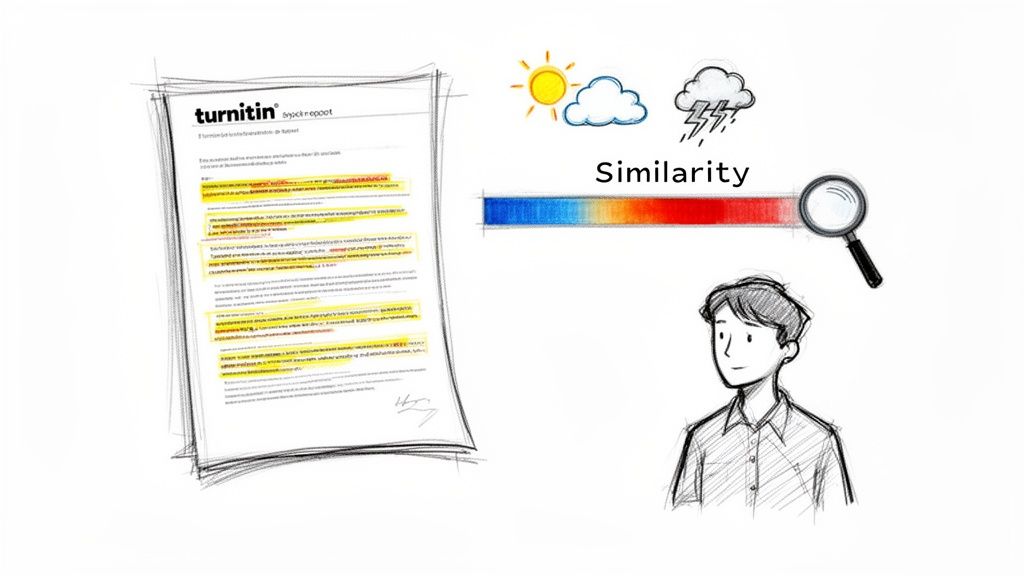
The key to using your report effectively is to stop seeing it as an accusation. Instead, treat the Similarity Report as a powerful tool to help you sharpen your academic writing. It points out passages that might need better paraphrasing, stronger citations, or more of your own original analysis.
The Weather Forecast Analogy
I like to think of a similarity score as a weather forecast. A high percentage—say, a 50% chance of rain—doesn’t guarantee a downpour, but it’s a clear signal to grab an umbrella and check the radar.
Likewise, a high Turnitin score doesn't automatically mean you've plagiarized. It's just a heads-up that you need to look closely at the highlighted sections and make sure every single one is properly attributed. A low score is like a sunny forecast; things probably look great, but it’s still wise to scan the report for any small, overlooked clouds.
This mindset shifts the whole experience from one of anxiety to one of proactive, confident revision.
Understanding the Color Codes
Turnitin’s color-coded system gives you an instant visual read on your paper's matched text. This score, a percentage from 0% to 100%, shows how much of your writing matches up against billions of academic papers, websites, and publications.
Each color corresponds to a specific percentage range, giving you an immediate gut check on your work's originality. You can find more details on these metrics straight from the source on the official Turnitin help page.
The table below is a quick reference for what each color in your Turnitin report means.
Turnitin Score Color Codes at a Glance
| Color Code | Similarity Percentage Range | What It Typically Means |
|---|---|---|
| Blue | 0% | No Matching Text Found. This is rare and usually only occurs on assignments that don't require external sources. |
| Green | 1%–24% | Low Level of Matched Text. This is the ideal range, often indicating properly cited quotes, references, and common phrases. |
| Yellow | 25%–49% | Moderate Level of Matched Text. This score suggests a need for review. It could mean you're relying too heavily on sources. |
| Orange | 50%–74% | High Level of Matched Text. A score in this range requires careful revision, as it may flag significant unoriginal sections. |
| Red | 75%–100% | Very High Level of Matched Text. This almost always indicates extensive copy-pasting and needs immediate attention. |
Remember, the goal isn't to get to 0%. Any well-researched paper with proper citations will naturally have some matching text.
The goal is never to achieve a 0% score. A well-researched paper with correct citations will naturally have some matching text. The key is ensuring that every highlighted section is intentional and properly credited.
Once you understand these basics, you can start using the report constructively. The next logical step is learning how to check for plagiarism with a critical eye, turning the report into a final quality check before you hit "submit."
How Turnitin Calculates Your Similarity Score
To really get what your similarity score means, you have to pull back the curtain on how Turnitin’s algorithm actually works. It isn't a person thoughtfully reading your paper for tone or intent. Instead, think of it as a super-fast, powerful pattern-matching engine—a digital librarian that can instantly check your paper against a colossal library.
Just how big is this library? We're talking over 993 million student papers, 82 million articles from academic journals and books, and a mind-boggling 177 billion web pages, both current and archived. The moment you submit your work, Turnitin’s software gets to work, breaking your text down into unique strings of words and phrases. It then methodically compares these strings against its database, flagging any sequence that matches something it has seen before.
The whole process is automated. The system doesn't understand why a phrase matches; it just reports that it does.
What the Algorithm Flags and Ignores
At its core, Turnitin is designed to find overlapping text. This means it flags a lot more than just passages that were copied and pasted without credit.
Here’s a quick rundown of what commonly gets highlighted:
- Direct Quotes: Even if you’ve formatted them perfectly, direct quotes will be flagged. They are, by definition, identical to the source text.
- Paraphrased Text: If your paraphrasing sticks too close to the original source’s sentence structure or uses too many of the same key words, the algorithm will likely spot the similarities.
- Common Phrases and Terminology: Standard definitions or common academic phrases (like "the scientific method involves") might show up as matches simply because they're used everywhere.
- Bibliography and References: The citations at the end of your paper will almost always match other sources. Formatting styles like APA or MLA, along with publication titles, are standardized, so overlap is inevitable.
What's really important to remember is that your instructor has a ton of control over what the algorithm includes in that final percentage. This is a huge reason why the same exact paper could get different scores in different classes.
A common myth is that the similarity score is some absolute, final verdict. The reality is that your instructor’s settings act as a filter, telling Turnitin what to count and what to ignore. Those settings can drastically change the final percentage.
The Impact of Instructor Settings
Your professor can tweak the Similarity Report to fit the specific goals of an assignment. This fine-tuning is what makes interpreting the Turnitin similarity score so dependent on context. They can apply filters that tell the system to ignore certain types of matches when calculating the final score.
Commonly excluded elements include:
- Bibliographic Material: Most instructors will set Turnitin to ignore your reference list or bibliography, since these sections are supposed to match other sources.
- Quoted Material: For an assignment that requires a lot of direct quotes, a professor might choose to exclude any text that appears inside quotation marks.
- Small Matches: Instructors can also tell the system to ignore matches below a certain word count (say, any phrase under eight words) or percentage. This is a great way to stop common phrasings from needlessly bumping up your score.
Understanding these settings is key. If your instructor has decided not to exclude quotes, a paper filled with perfectly cited quotations might still get a high score. That doesn't mean you've plagiarized; it just means you need to look at the report through the lens of the assignment's rules. The score is meant to be a starting point for a conversation, not the final word. On a related note, as academic writing evolves, it's also helpful to understand how these tools are adapting. For more on this, check out our guide that explores whether Turnitin can detect AI-generated content.
Putting Your Score into Context with Examples
A percentage on a report is just a number until you can see what it actually represents in a real paper. Abstract scores don't tell the full story. To really grasp what a Turnitin similarity score means, you need to see it in action. This is where we turn those color-coded figures into practical, diagnostic insights you can use to improve your own writing.
First, let's quickly recap how it works. When you submit your paper, the Turnitin engine scans it and compares it against a massive database of existing sources.
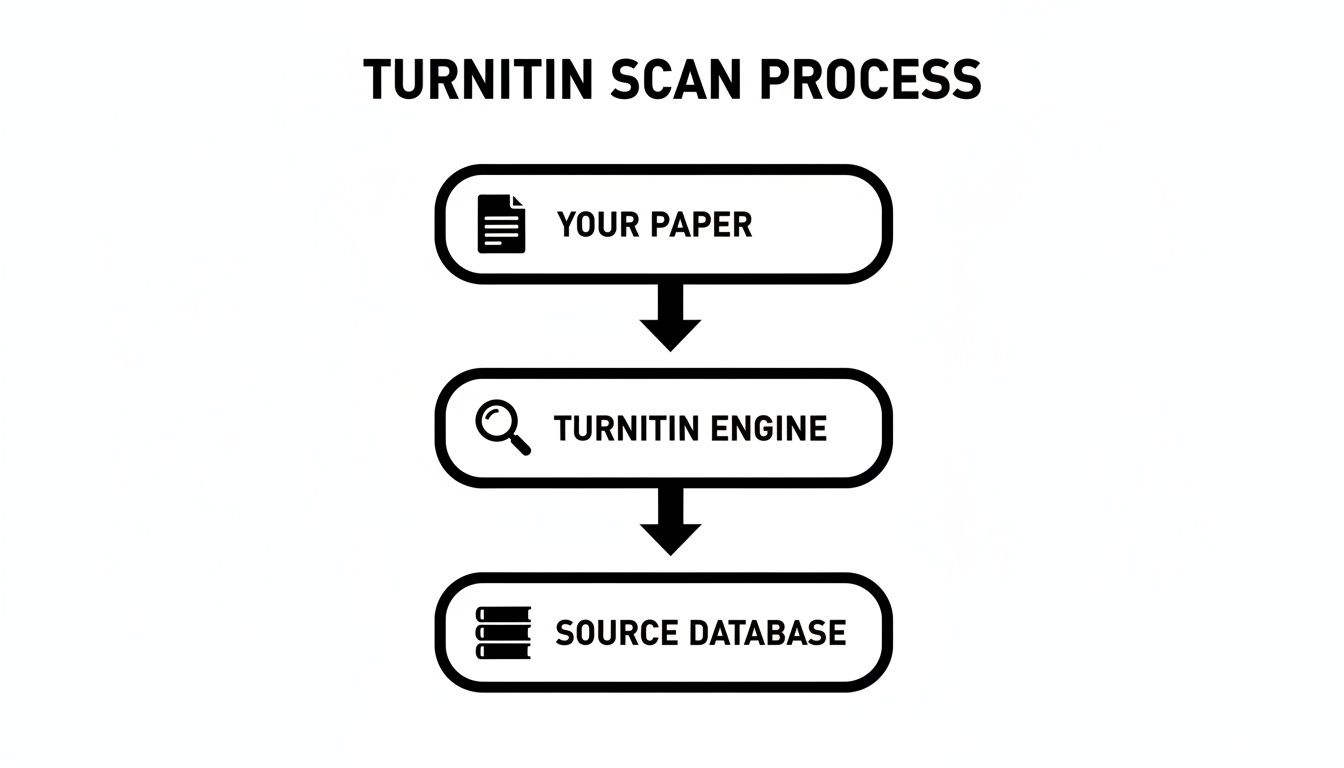
This process is designed to find any textual overlaps between your submission and its vast collection of academic papers, publications, and web pages.
The Green Zone (1-24%): A Well-Cited Paper
Imagine you’ve just finished a history essay on the American Revolution. You carefully included several direct quotes from primary source documents and referenced key arguments from three different historians, all properly cited.
You submit the paper and get a 17% similarity score—solidly in the green. When you open the report, the highlighted sections are exactly what you'd expect: the direct quotes (safely inside quotation marks) and the titles of books in your bibliography. This is a fantastic result. It shows your work is original while still being firmly grounded in solid research.
A green score doesn't mean your paper is perfect, but it's a strong sign that your balance between original thought and sourced material is healthy. It's confirmation that your citations are doing their job.
For an instructor, this score indicates you've engaged with academic sources appropriately without leaning too heavily on any single one. It’s a hallmark of good academic practice.
The Yellow Zone (25-49%): Clumsy Paraphrasing
Let’s switch gears to a different scenario. A student working on a literature review gets a 38% similarity score, landing them in the yellow range. It's easy to panic, but a closer look at the report reveals the problem isn't outright plagiarism.
Instead of truly paraphrasing, the student fell into the "thesaurus trap." They took sentences from a major source and just swapped a few words for synonyms, leaving the original sentence structure almost completely intact. Turnitin’s algorithm is smart enough to see right through this because the underlying pattern of the text hasn't changed. The report shows big chunks of text matching a single journal article.
A yellow score like this is actually a helpful wake-up call. It signals that the student needs to refine their paraphrasing skills, focusing on rewriting ideas in their own voice and structure, not just changing a few words.
The Red Zone (75-100%): Direct Copying
A red score, particularly one over 75%, is almost always a major red flag. Let’s say a student submits a five-page paper on climate change and gets a shocking 92% score. The Similarity Report is a sea of red. Nearly every paragraph is highlighted and linked back to a handful of popular science websites and a Wikipedia article.
This is a clear-cut case of copy-and-paste. There are no quotation marks, no citations, and no original analysis to bridge the different copied sections. The student simply compiled text from other sources and tried to pass it off as their own. A score this high indicates a serious misunderstanding of academic integrity and will almost certainly result in academic penalties.
A Special Case: Student Collusion
One of Turnitin’s most interesting capabilities is detecting collusion between students—when they share work, leading to identical or nearly identical submissions.
For example, picture Eric getting Jane's completed essay. He submits it first and gets a 25% score, matching only existing web and academic sources. A bit later, Jane submits her own original work. But this time, it gets flagged with a 100% score. Why? Because it’s now a perfect match for a paper already in the database: Eric’s submission. The system is built to catch these situations by comparing all submissions within a course. You can learn more about how Turnitin interprets similarity scores in these specific instances.
This proves that Turnitin isn't just checking against outside websites; it's also building an internal library of student papers to ensure a level playing field for everyone.
Common Myths About Turnitin Scores Debunked
The anxiety around Turnitin has created a lot of misinformation. It's easy to see why—that little percentage can feel like a final judgment on your work. But a lot of that stress comes from myths that just aren't true.
Let's clear the air and tackle these misconceptions. Once you separate the facts from the fiction, you’ll start to see your similarity report for what it really is: a helpful tool, not a verdict.
Myth 1: A High Score Automatically Means Plagiarism
This is probably the biggest and most damaging myth out there, and it’s flat-out wrong. A high similarity score does not automatically mean you've plagiarized. It simply points out that parts of your text match material in Turnitin's massive database.
Think of Turnitin as a text-matching tool, not a plagiarism detective. It can't read your mind or understand context. It doesn't know if you've used quotation marks correctly or if you’ve cited your sources perfectly. It just flags similarities.
Turnitin can’t determine your intent. It highlights overlapping text, but only an instructor, using their professional judgment, can decide if that overlap is actually plagiarism.
For instance, a paper packed with properly cited block quotes from historical documents could easily get a high score. An instructor would look at the report, see that the matches are legitimate quotes, and understand that no academic misconduct occurred.
Myth 2: Any Score Above Zero Is Bad
Chasing a 0% similarity score is a fool's errand. In fact, getting a zero could be a red flag that you haven't engaged with enough source material. A well-researched paper should have some matching text.
A score in the 1% to 24% range is often considered perfectly fine, even good. Why? Because it usually means you’ve done your job as a researcher. You've incorporated quotes to support your arguments, used standard terminology for your field, and included a bibliography—all things that Turnitin will naturally flag.
So, forget about hitting zero. The real goal is to make sure every highlighted phrase in that report is there for a good reason and is properly attributed to the original author.
Myth 3: Paraphrasing Tools Can Beat Turnitin
In a time crunch, it can be tempting to run someone else's text through an online paraphrasing or "spinning" tool to try and fool the system. This is a bad idea. It rarely works, and it often just makes things worse.
Here’s a breakdown of why this strategy usually backfires:
- It Produces Awful Writing: Most of these tools just swap words for synonyms, leading to clunky, unnatural sentences that scream "I used a machine!" to any experienced reader.
- The Algorithms Are Smarter Now: Turnitin is pretty sophisticated. It’s designed to spot text that keeps the original sentence structure, even if the words have been changed.
- It's Still Academic Misconduct: Trying to pass off re-spun text as your own is just as dishonest as copying and pasting. You're skipping the most important part of the research process: actually understanding and synthesizing the information yourself.
Instead of looking for a tech shortcut, invest that time in honing your own paraphrasing skills. It's the only reliable way to lower your score and, more importantly, to become a stronger, more confident writer. The whole point of the Turnitin similarity score meaning is to encourage original thought. Your instructor wants to see your analysis, not a robot's clumsy attempt to rephrase someone else's work.
Proven Strategies to Reduce Your Similarity Score
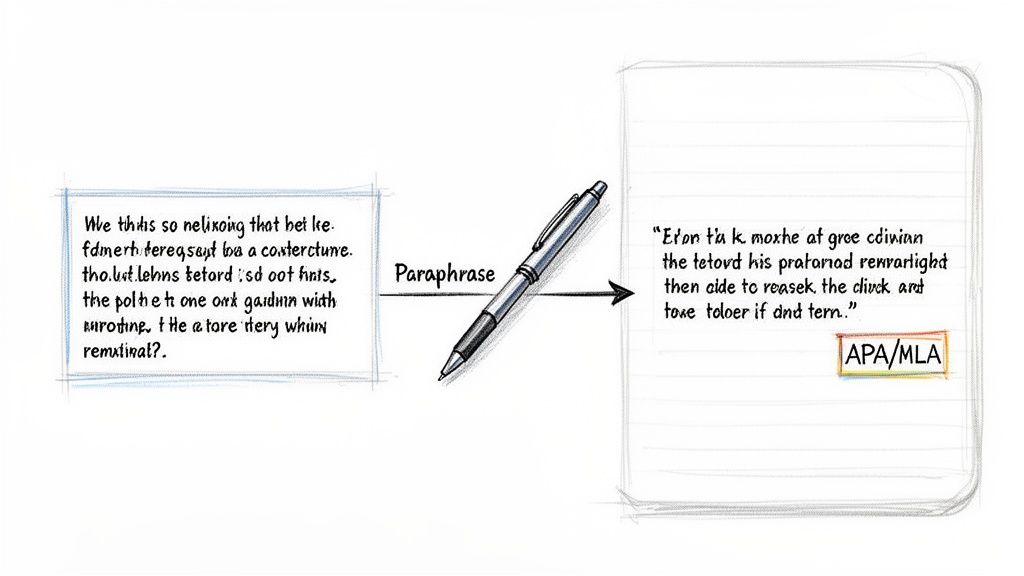
Seeing a high similarity score can be nerve-wracking, but it's really just an opportunity to sharpen your academic writing skills. The goal isn't to "beat the system" but to learn how to properly weave research into your work so your own voice comes through loud and clear.
Think of it as moving from an assembler of information to a creator of knowledge. Let’s get past the quick fixes and dig into the core strategies that will not only improve your score but make your paper much stronger overall.
Master the Art of Effective Paraphrasing
One of the most common pitfalls is "patchwriting"—just swapping out a few words for synonyms. Turnitin’s algorithm is smart enough to see right through that. Real paraphrasing goes much deeper. It's about completely digesting an idea and then explaining it in your own unique words and sentence structure.
Imagine you're explaining a complicated movie plot to a friend. You wouldn't just recite lines from the script. You'd summarize the key events and character arcs using your own language. That's exactly what good paraphrasing is.
Here’s a simple, four-step method to get it right every time:
- Read and Absorb: Read the original passage a few times until you genuinely understand its meaning. Don't move on until you can explain it without looking.
- Look Away, Then Write: Put the source material aside. Now, write out the concept from memory. This simple trick forces you to use your own voice.
- Compare and Refine: Place your version next to the original. Did you capture the meaning accurately? Did you accidentally copy the sentence structure or use too many of the same key phrases? Tweak it until it's truly yours.
- Cite It Immediately: The words might be yours, but the idea isn't. Always add a proper citation right after your paraphrased text.
This approach does more than just lower your score; it proves you're actually learning from your research. For a closer look at this and other ethical writing habits, our guide on https://www.rewritify.com/blog/how-to-avoid-plagiarism is a great resource.
Use Direct Quotes Sparingly and Purposefully
Direct quotes have their place. They're perfect for capturing a precise definition, highlighting a powerful statement, or analyzing an author's specific word choice. But relying on them too heavily will inflate your similarity score and make it seem like you have nothing original to say.
Your paper should be your argument, supported by evidence—not a patchwork of other people's words.
As a rule of thumb, direct quotes should make up no more than 10-15% of your paper. The rest should be your analysis and paraphrasing.
When you do use a quote, make sure you integrate it smoothly. Introduce the quote, present it with the correct formatting (like quotation marks), and then—this is the crucial part—follow it with your own commentary explaining why it matters. This "quote sandwich" technique shows you're engaging with the material, not just dropping it in.
Perfect Your Citation Practices
This one is non-negotiable. Any piece of information that isn't your own original thought needs a citation—paraphrased ideas, quotes, statistics, you name it. One of the most basic ways to keep your score in check is to master how to cite sources effectively.
Forgetting to cite something, even accidentally, is a huge red flag and can be interpreted as plagiarism.
Get comfortable with the citation style your course requires, whether it's APA, MLA, or Chicago. While online citation generators can be helpful, always double-check their output for accuracy. Consistent, correct citation tells your instructor you're an ethical researcher and gives your own arguments the solid foundation they need.
Got Questions About Turnitin? We've Got Answers
Even after you get the hang of reading the reports, a few nagging questions always seem to pop up. Let's tackle some of the most common worries students have about their Turnitin similarity score. Getting these cleared up can save you a ton of stress and help you submit your work with more confidence.
What Is a Good Turnitin Score?
Everyone wants to know the magic number, but here’s the truth: there isn’t one. A "good" Turnitin score is entirely contextual. It all comes down to the assignment type and your instructor's specific guidelines.
For instance, a literature review packed with quotes and citations is naturally going to have a higher score than a personal reflection paper. As a general rule of thumb, a similarity score under 15% is usually nothing to worry about. This percentage typically covers things like correctly cited quotes, common phrases, and your bibliography.
Your goal should never be to hit 0%—that's practically impossible. Instead, focus on making sure every single highlighted match is properly attributed. When in doubt, the best move is always to check your syllabus or just ask your professor what they expect.
Can I Check My Paper Before Submitting?
This is a big one, and the answer is: it depends. Your instructor decides whether you can see a similarity report before your final submission. Many will set up the assignment to allow you to submit drafts, which is a golden opportunity to review your work and fix any issues.
If your professor has enabled this feature, you can usually submit your paper a few times before the due date, with only the last version counting for your grade. If they've turned it off, you won't see your report until after you've submitted for good. If you're not sure, don't guess—ask your instructor about the assignment settings.
Being able to pre-check your paper is a setting controlled by your instructor, not a standard Turnitin feature. If you have the chance, use it to sharpen your writing and citation skills.
Will My Reference List Get Flagged?
Yes, and you should expect it to. Your bibliography or reference list is almost guaranteed to get flagged, and that's perfectly normal. Think about it: citation styles like APA or MLA are standardized, and book titles or journal articles will obviously match other sources.
Good news, though. Your instructor can easily set up the assignment to exclude the bibliography and quoted material from the similarity report. Even if they don't, they know how to interpret the report and will simply ignore matches in your reference list when grading. A highlighted bibliography is not a red flag.
Does Turnitin Save My Paper?
Typically, yes. When you submit a paper, it usually gets added to the Turnitin student paper database. This is actually a key part of how the system works—it prevents another student from submitting your work as their own down the line.
But this has a direct impact on you, too. If you submit the same paper for another class, it will likely come back with a 100% match for self-plagiarism. While some professors might use a "no repository" setting for certain assignments, it's not the default. It's always safest to assume your paper is being saved.
Ready to move beyond just checking scores and actively improve your writing? Rewritify helps you rephrase your text to ensure it's clear, original, and academically sound. Perfect your paraphrasing and submit your work with confidence. Learn more about how Rewritify can help.
Relevant articles
Are AI detectors accurate? This guide unpacks the data, revealing why 99% claims are misleading and how to navigate the risks of false positives in your work.
Discover the best AI writing detector to ensure content authenticity. We tested and ranked 12 top tools for accuracy, false positives, and specific use cases.
Learn how to check for plagiarism with confidence. Our guide covers the best tools, manual techniques, and a clear workflow to ensure your content is original.
Does Turnitin check for AI? Yes. We explain how its detection works, why false positives happen, and how to use AI ethically to protect your academic integrity.
Difference between paraphrasing and plagiarism explained with clear examples and actionable tips to protect academic integrity.
Learn how to paraphrase without plagiarizing using expert techniques. Master ethical rewriting and proper citation to create truly original content.