The 12 Best AI Writing Detector Tools of 2026 (Tested & Ranked)
Discover the best AI writing detector to ensure content authenticity. We tested and ranked 12 top tools for accuracy, false positives, and specific use cases.
In an era where AI-generated text is increasingly common, distinguishing human writing from machine output has become a critical task for students, publishers, and marketers. The challenge is clear: how can you maintain academic integrity, protect your website's SEO, and ensure authenticity when the lines are so blurred? To truly understand the landscape of AI-generated content, it's essential to be aware of the best AI writing software tools available today, as their sophistication directly impacts detection difficulty.
The truth, however, is that no AI detector is perfect. These are probabilistic tools, not definitive judges of authorship. Their results can be influenced by everything from the specific AI model used to create the text to simple human edits and paraphrasing. A high AI score doesn't automatically mean plagiarism or cheating, and a low score doesn't guarantee human origin. This reality creates a significant problem: relying on a flawed tool can lead to false accusations against students or unnecessary rewrites of perfectly good marketing copy.
This guide cuts through the noise and exaggerated claims. We will provide a comprehensive, data-driven review of the 12 best AI writing detector platforms currently available. We detail our rigorous testing methodology for evaluating both accuracy and, crucially, the rate of false positives. Our goal is to equip you with the knowledge to not only choose the right tool but also to interpret its findings wisely. You'll learn how to use these detectors as a guide, not a verdict, ensuring you can uphold content integrity without falling victim to inaccurate results. Each review includes direct links and screenshots to help you make an informed decision for your specific needs.
1. Originality.ai
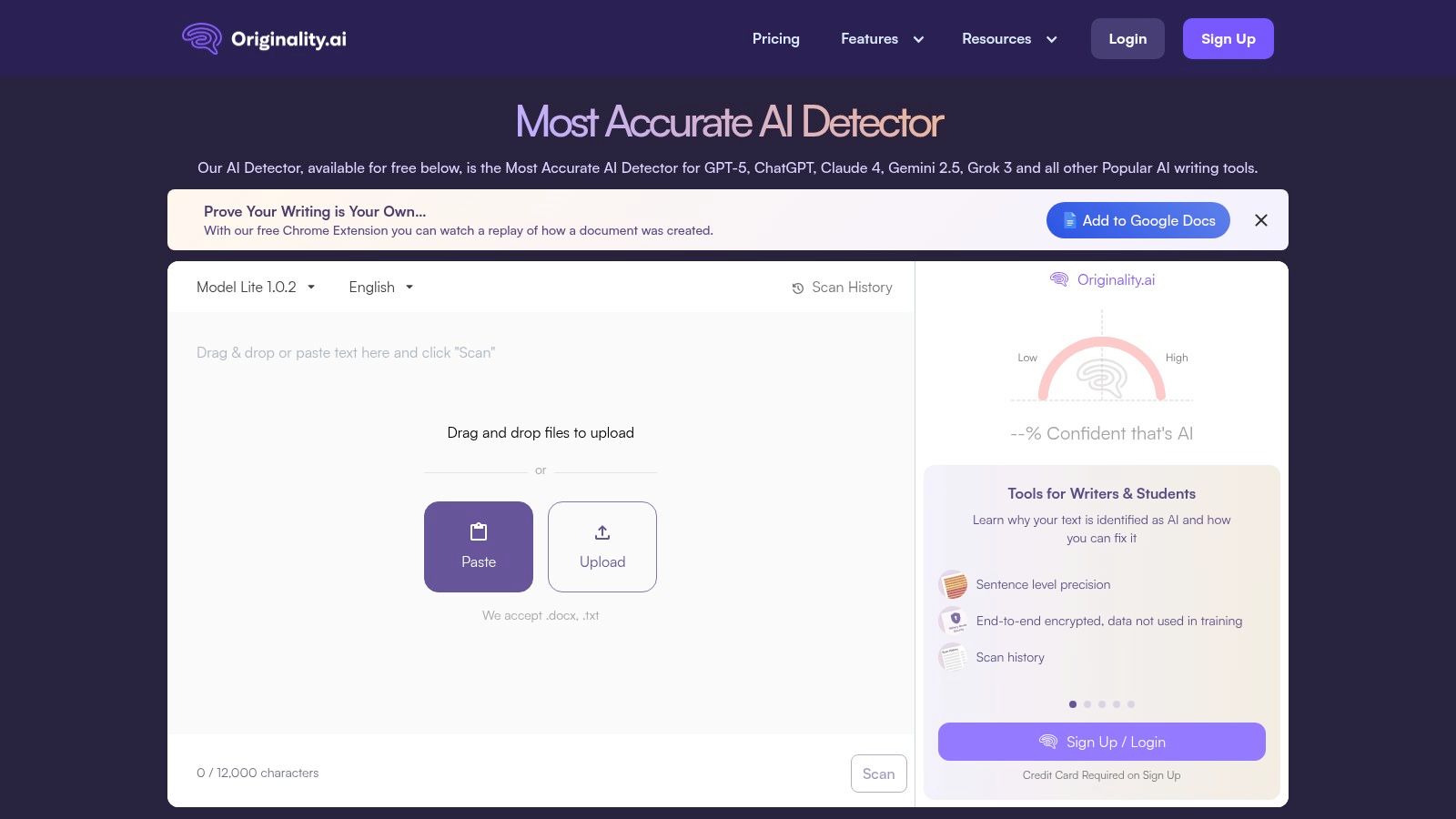
Originality.ai is a powerful, all-in-one suite designed specifically for serious publishers, SEO agencies, and content teams who need to verify content integrity at scale. Unlike many free tools, it bundles AI detection, a robust plagiarism checker, and readability analysis into a single, efficient workflow. This makes it a strong contender for the title of best AI writing detector for professionals managing high volumes of content.
The platform is purpose-built to integrate into professional publishing pipelines. Its detection capabilities are updated for the latest models, including GPT-4o and Claude 3.5, providing a more reliable check against sophisticated AI-generated text. The interface is clean, allowing users to quickly paste text, upload files, or scan entire websites.
Key Features and Pricing
Originality.ai operates on a credit-based system, which is transparent and scalable. You purchase credits (1 credit scans 100 words), which can be used for AI detection, plagiarism checks, or readability scores.
- Pricing: Pay-as-you-go credits start at $30 for 3,000 credits. Monthly subscriptions offer lower per-credit rates but credits expire each month, making the pay-as-you-go option better for sporadic use.
- Workflow Integration: Its standout features are team management, shareable reports, and a full API. This allows agencies to automate content checks and provide clear, verifiable reports to clients.
- Accuracy: It provides a granular score from 0-100% Original vs. AI, rather than a simple binary judgment. For best results, it requires a minimum of 50-100 words.
While it's a paid tool and might be overkill for a student checking a single essay, its comprehensive feature set and focus on professional workflows make it an indispensable resource for content quality control.
Website: https://originality.ai/
2. GPTZero
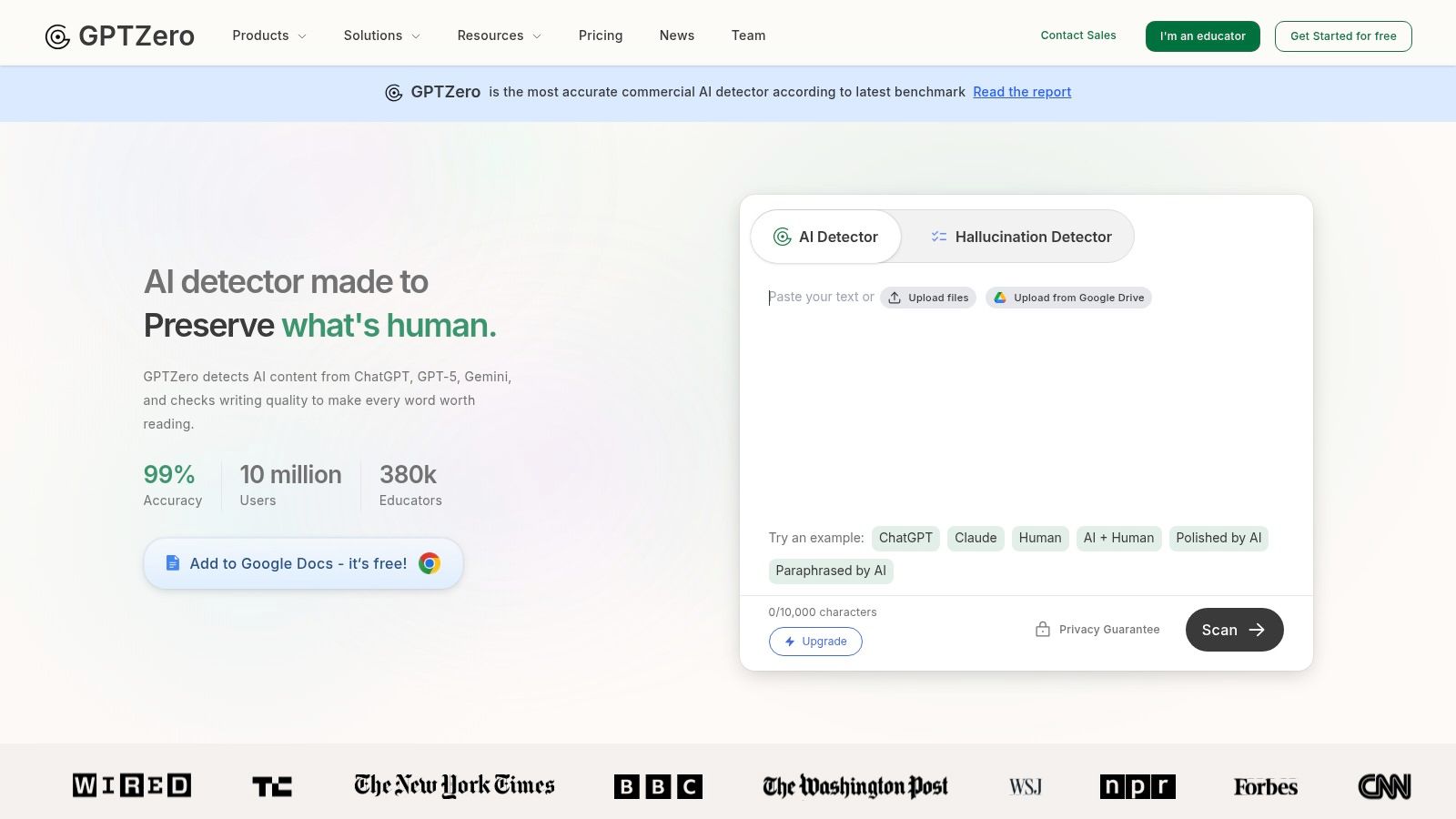
GPTZero has established itself as one of the most recognized and widely adopted AI text detectors, particularly within the education sector. Its model was built by a Princeton student and quickly gained traction among educators for its straightforward interface and focus on academic integrity. It excels at providing detailed, sentence-level analysis, highlighting passages that are most likely to be AI-generated, which makes it a practical tool for providing feedback.
The platform is designed for both individual users and institutional deployment. It offers a simple web app for quick checks, alongside more robust solutions for organizations needing to screen content systematically. While its core function is detection, GPTZero also provides a "Writing Report" that gives a holistic view of a document's composition.
Key Features and Pricing
GPTZero uses a freemium model, offering limited free scans and more advanced features through paid subscriptions. The paid tiers are geared toward professionals, educators, and organizations requiring higher volume and deeper integration.
- Pricing: A free plan allows for basic scanning up to 10,000 words per month. Paid plans start at $10/month (billed annually) for 150,000 words, deep scans, and batch file uploads. Team and enterprise plans offer API access and unified billing.
- Workflow Integration: Its key strengths are its Chrome extension for easy browser-based checks and its developer API, which supports integration into learning management systems (LMS) and other platforms.
- Accuracy: GPTZero provides a document-level probability score and color-codes individual sentences based on the likelihood of AI generation. Its accuracy can diminish with heavily edited or very short text snippets, a common limitation for many detectors.
For educators seeking a user-friendly tool to uphold academic standards or professionals needing a quick, reliable check, GPTZero remains a top-tier choice for the best AI writing detector.
Website: https://gptzero.me/
3. Copyleaks AI Content Detector
Copyleaks is an enterprise-grade platform widely trusted in academic and business environments for its robust plagiarism and AI detection capabilities. It has built a strong reputation within educational institutions, making it a go-to tool for ensuring academic integrity. Its combined approach allows users to check for both plagiarism and AI-generated text in a single, unified workflow, which is a significant advantage for organizations requiring comprehensive content verification.
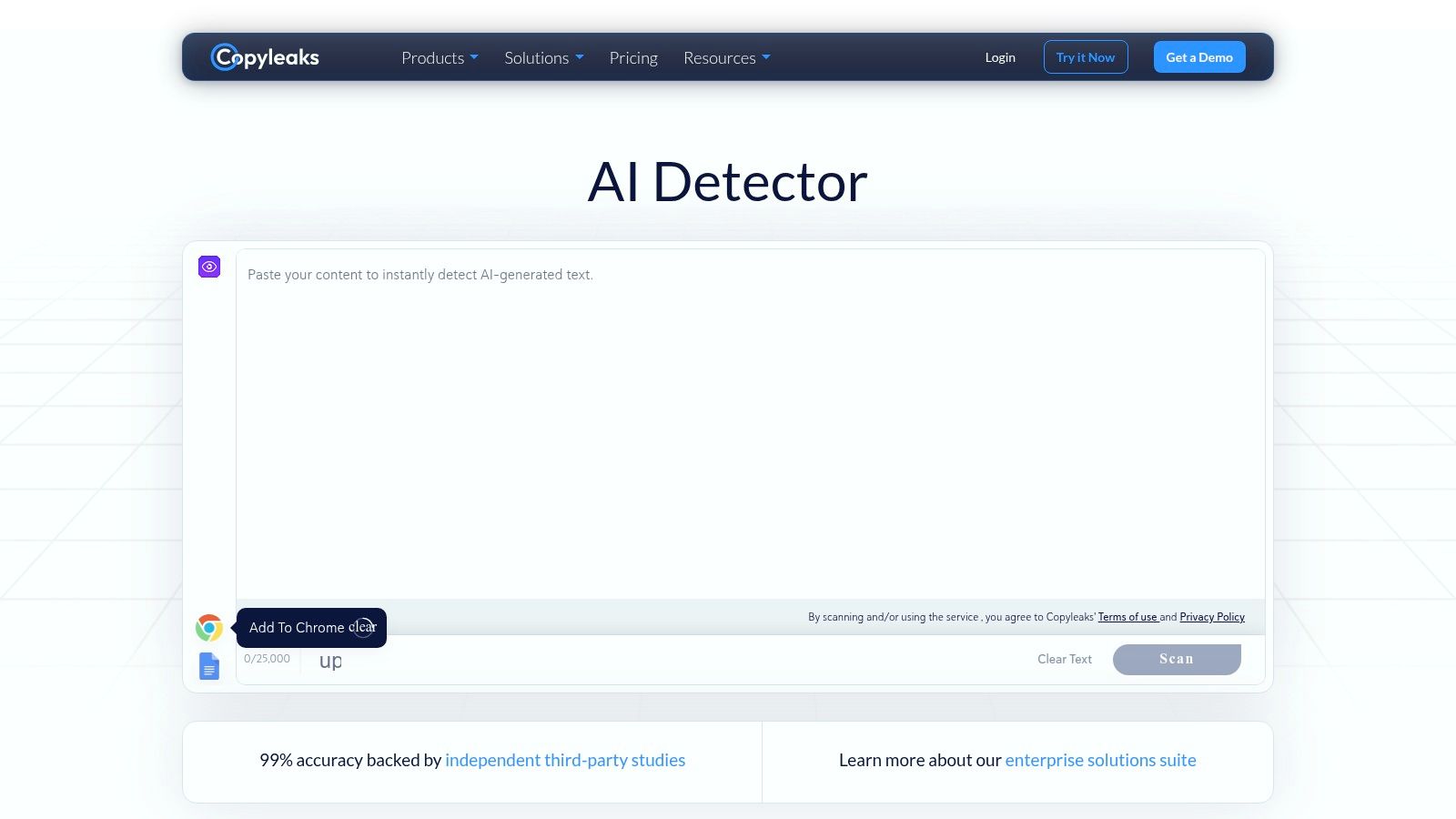
The tool is designed for deep analysis, providing detailed, sentence-level reports that highlight the probability of AI generation. Copyleaks supports detection for the latest models, including GPT, Claude, and Gemini, and offers extensive integration options, solidifying its place as a leading AI writing detector for institutional use.
Key Features and Pricing
Copyleaks uses a credit-based system where 1 credit scans 250 words for AI detection. While it offers a limited free trial, ongoing use requires a subscription, which is geared more toward professional and academic needs rather than casual individual use.
- Pricing: The AI Detector plan starts at $9.99 per month for 1,200 credits (300,000 words). Higher-tier plans are available for businesses and educational institutions with greater volume and integration needs.
- Workflow Integration: Its primary strength lies in its API and seamless LMS integrations with platforms like Canvas, Moodle, and Blackboard. This makes it ideal for schools and universities to embed directly into their existing systems.
- Accuracy: Copyleaks provides explainable AI reports, breaking down its analysis to help users understand the results. This transparency is particularly valuable in academic settings where evidence is required.
While the pricing model may be a barrier for individuals, its proven reliability, detailed reporting, and deep integration capabilities make Copyleaks an excellent choice for organizations that prioritize compliance and academic honesty.
Website: https://copyleaks.com/ai-content-detector
4. Turnitin
Turnitin is the institutional standard for academic integrity, primarily known for its comprehensive plagiarism checker. Its AI writing detection capability is an integrated feature within its existing products like Feedback Studio and iThenticate, making it a seamless addition for universities and schools already using the platform. It is not a standalone tool for individuals but rather a powerful, system-level solution for educational institutions.
The platform's AI indicator is designed to be a starting point for conversation, not a final verdict. It flags text segments with a high probability of AI generation directly within the standard similarity report, allowing instructors to investigate further. Because it’s built into the workflow educators already use, it requires no new software or processes, which is its main advantage for large-scale academic use.
Key Features and Availability
Turnitin's AI detection is a feature of its institutional licenses and is not sold separately to the public. Access is typically provided through a university or school's Learning Management System (LMS).
- Pricing: Not available for individual purchase. Pricing is based on institutional contracts and student enrollment numbers.
- Workflow Integration: Its key strength is deep integration with systems like Canvas, Blackboard, and Moodle. The AI writing score appears alongside the traditional Similarity Score. You can learn more about how Turnitin checks for AI in our detailed guide.
- Accuracy: The tool provides a percentage score indicating the amount of text likely generated by AI. However, like all detectors, it is not infallible and has raised concerns about false positives, reinforcing its role as an investigative aid rather than a definitive proof of misconduct.
While individuals cannot purchase it, its widespread adoption makes it one of the most encountered AI detectors in academia, establishing it as a critical tool in the educational integrity landscape.
Website: https://www.turnitin.com/
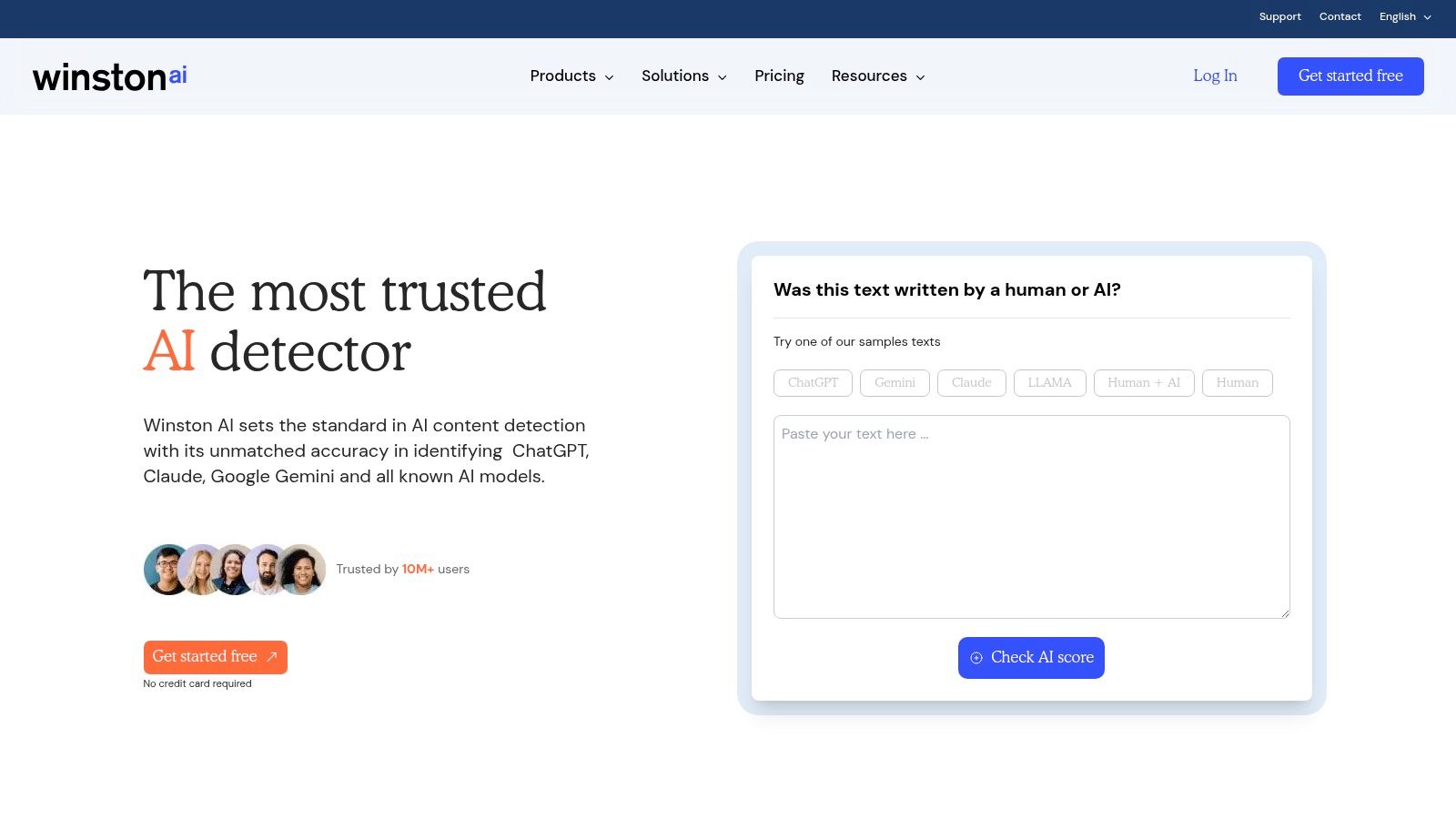
5. Winston AI (gowinston.ai)
Winston AI is a comprehensive AI content detection platform that stands out by offering multi-modal checks, including text, AI-generated images, and deepfakes. This makes it an excellent choice for educators, publishers, and teams who need to verify the authenticity of various content types beyond just written text. It provides clear, shareable PDF reports, making it easy to document findings for academic integrity or client work.
The platform supports multiple languages and even features Optical Character Recognition (OCR) to analyze scanned documents or handwritten notes, adding a layer of versatility not found in many other tools. Its flexible credit system allows users to allocate resources across different types of scans, from text analysis to image detection, making it a highly adaptable solution for diverse verification needs.
Key Features and Pricing
Winston AI uses a credit-based model where credits are spent on scanning words or images. This provides flexibility, especially for users with fluctuating or varied content verification requirements. The platform also offers a limited free trial to test its capabilities.
- Pricing: Plans start with a free trial of 2,000 words. Paid plans begin at $12 per month (billed annually) for 80,000 words, with larger plans available for teams and enterprises.
- Multi-Modal Detection: A key differentiator is its ability to detect AI-generated images and deepfakes alongside text, making it a more holistic content integrity tool.
- Team Collaboration: Features like team seats and shareable PDF reports are built-in, making it well-suited for academic departments or content agencies needing a collaborative workflow.
While its per-word/image credit system can take some getting used to, Winston AI's broad feature set and low-cost entry point make it a strong contender for the best AI writing detector for users who require more than just text analysis.
Website: https://gowinston.ai/
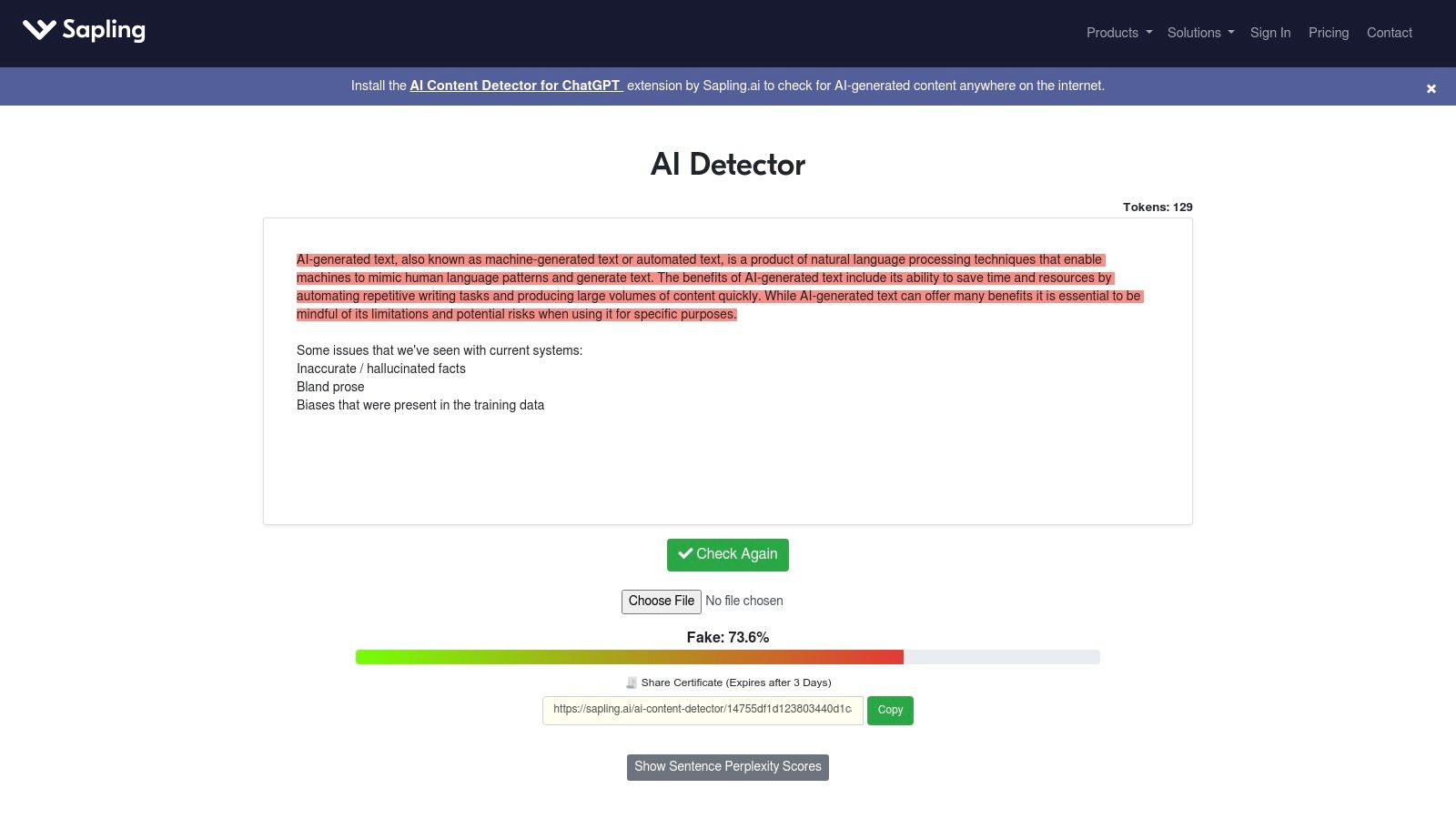
6. Sapling AI Content Detector
Sapling AI Content Detector is a versatile tool that caters to both casual users and development teams. It offers a free, straightforward web detector alongside more powerful Pro and Enterprise tiers that include an API, SDKs, and a handy Chrome extension. This tiered approach makes it a flexible option for individuals who need quick checks and for businesses that require integrated, in-context detection solutions.
The platform stands out by providing clear sentence-level highlighting, which helps users pinpoint specific areas that are flagged as AI-generated. Its free tool is accessible, but it truncates longer texts, encouraging users with higher volume needs to upgrade. The real power of Sapling lies in its developer-friendly features and its browser extension, which brings AI detection directly into platforms like Google Docs or Gmail.
Key Features and Pricing
Sapling’s model is designed for scalability, starting free and expanding into paid plans for advanced functionality and higher usage limits. The company is transparent about its model updates and limitations, which builds user trust.
- Pricing: The basic web detector is free for short texts. The Pro plan unlocks higher limits and the browser extension, while the Enterprise plan provides full API access and custom solutions.
- Developer-Focused Integrations: With a comprehensive API and SDKs, Sapling is an excellent choice for teams looking to build AI detection into their own applications or content workflows.
- In-Context Checking: The Chrome extension is a significant advantage, allowing users to check content without leaving their current window, streamlining editing and verification processes.
While the free version is limited, Sapling’s robust integration options and clear, sentence-level feedback make it a strong contender, particularly for teams needing the best AI writing detector built into their existing tools.
Website: https://sapling.ai/ai-content-detector
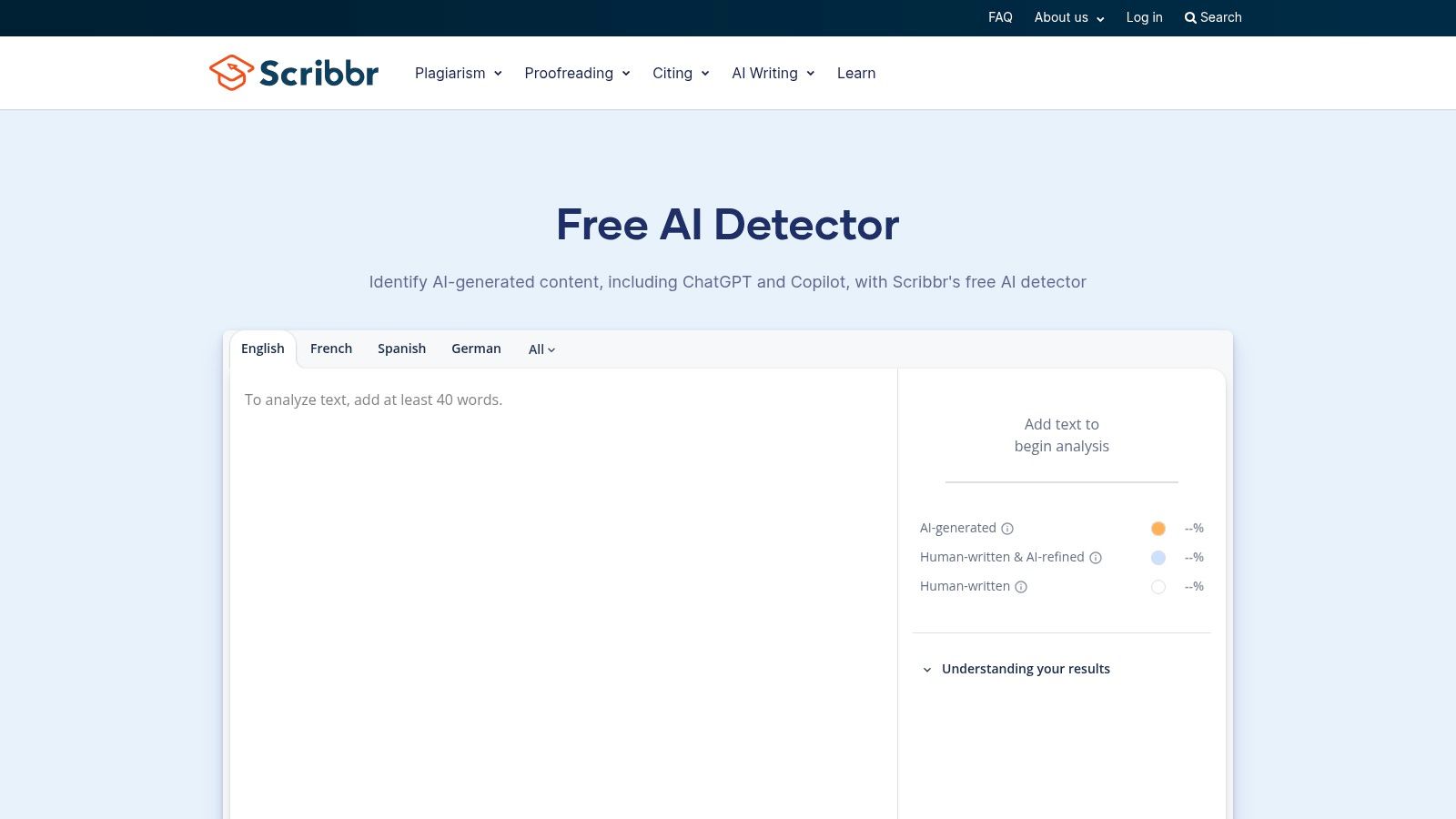
7. Scribbr AI Detector
Scribbr's AI Detector is a free, user-friendly tool primarily designed for students, academics, and editors. It offers a straightforward way to check text for AI-generated content without requiring an account for basic use. The platform stands out by providing paragraph-level feedback, highlighting specific sections it suspects are AI-generated, AI-refined, or human-written, which is particularly useful for academic integrity checks.
This tool is part of Scribbr's broader suite of academic services, which includes a well-regarded plagiarism checker and proofreading services. While the AI detector is free, it can be bundled with these premium services for a more comprehensive document review, making it a convenient one-stop-shop for students finalizing their papers. Its multilingual support is also a significant advantage for non-English academic work.
Key Features and Pricing
The core AI detector is free, but its capabilities are expanded when combined with Scribbr's paid services. The free version is ideal for quick, individual checks, while the paid bundle offers a more robust solution for ensuring academic originality.
- Pricing: The AI detector is free for submissions up to approximately 1,200 words. For more extensive checks, it is bundled with the Scribbr Plagiarism Checker, with pricing starting around $19.95 per document (depending on word count).
- User Experience: The interface is clean and simple. No sign-up is needed for the free tool, allowing users to paste their text and get instant, color-coded results that are easy to interpret.
- Multilingual Support: It effectively detects AI content in multiple languages, including English, Spanish, German, and French, catering to a global academic audience.
Scribbr’s focus on the academic user makes it one of the best AI writing detector options for students who need a reliable, easy-to-use tool to ensure their work is original before submission.
Website: https://www.scribbr.com/ai-detector/
8. QuillBot AI Detector
QuillBot, known widely for its paraphrasing and writing tools, offers a free AI Detector integrated directly into its ecosystem. This tool is designed for convenience, especially for students, writers, and educators already using QuillBot’s other services. It provides a quick and accessible way to perform spot-checks on text without needing to sign up for a dedicated, paid detection service.
The detector allows users to paste text directly, upload files, and view a history of previous scans, making it a functional choice for everyday use. While the core detection technology is available for free, a QuillBot Premium subscription unlocks convenience features like batch file uploads, which is useful for users needing to process multiple documents at once.
Key Features and Pricing
The QuillBot AI Detector is primarily a free tool, with its premium features tied to the overall QuillBot subscription, which also enhances its paraphrasing, grammar checking, and other writing tools.
- Pricing: The AI detector is free to use. A QuillBot Premium subscription (starting at $19.95/month or less with annual billing) adds batch processing capabilities but does not change the underlying detection algorithm.
- Integration: Its biggest advantage is its seamless integration with the QuillBot suite. Users can paraphrase, check for grammar, and then verify AI content all within the same platform, streamlining the writing and editing workflow.
- Accessibility: As a free tool, it’s a great starting point for those who need a quick, no-commitment check. The interface is clean and straightforward, requiring no complex setup.
While it may not offer the granular reporting or API access of specialized professional tools, QuillBot provides a reliable and convenient option that solidifies its place as a strong contender for the best AI writing detector for casual users and existing platform subscribers.
Website: https://quillbot.com/ai-content-detector
9. Crossplag AI Content Detector
Crossplag offers a free AI content detector as part of its broader suite of academic and editorial tools, which primarily focus on multilingual plagiarism checking. This positions it as a convenient option for students, educators, and publishers who already use or are considering Crossplag's similarity detection services. Its main draw is providing a quick, no-cost initial assessment of a text's likely origin.
The tool is designed for ease of use, providing a straightforward interface where users can paste text and receive an immediate "confidence score." This score indicates the probability that the content was generated by AI. While it serves as a useful first-pass checker, its primary strength lies in its integration with the more comprehensive Crossplag plagiarism and similarity environment for a more holistic content integrity check.
Key Features and Pricing
The AI detector itself is free, making it an accessible entry point. Users looking for more advanced features like plagiarism checking will need to explore Crossplag’s paid plans, which cater to individuals, businesses, and educational institutions.
- Pricing: The AI content detector is free to use. Paid plans for the full Crossplag suite (including plagiarism checks) vary for different user types.
- Confidence Scoring: Instead of a simple "AI" or "Human" label, it provides a confidence percentage, offering a slightly more nuanced result for initial analysis.
- Integration: The detector is part of a larger ecosystem. For users needing both AI and plagiarism checks, this can streamline workflows by keeping tools within one platform.
While Crossplag provides a solid free tool, it is primarily English-focused and some third-party tests have noted mixed accuracy. It's a strong candidate for the best AI writing detector for those already invested in the Crossplag ecosystem or needing a quick, free check.
Website: https://crossplag.com/ai-content-detector/
10. Content at Scale — AI Content Detector (ContentAtScale/BrandWell)
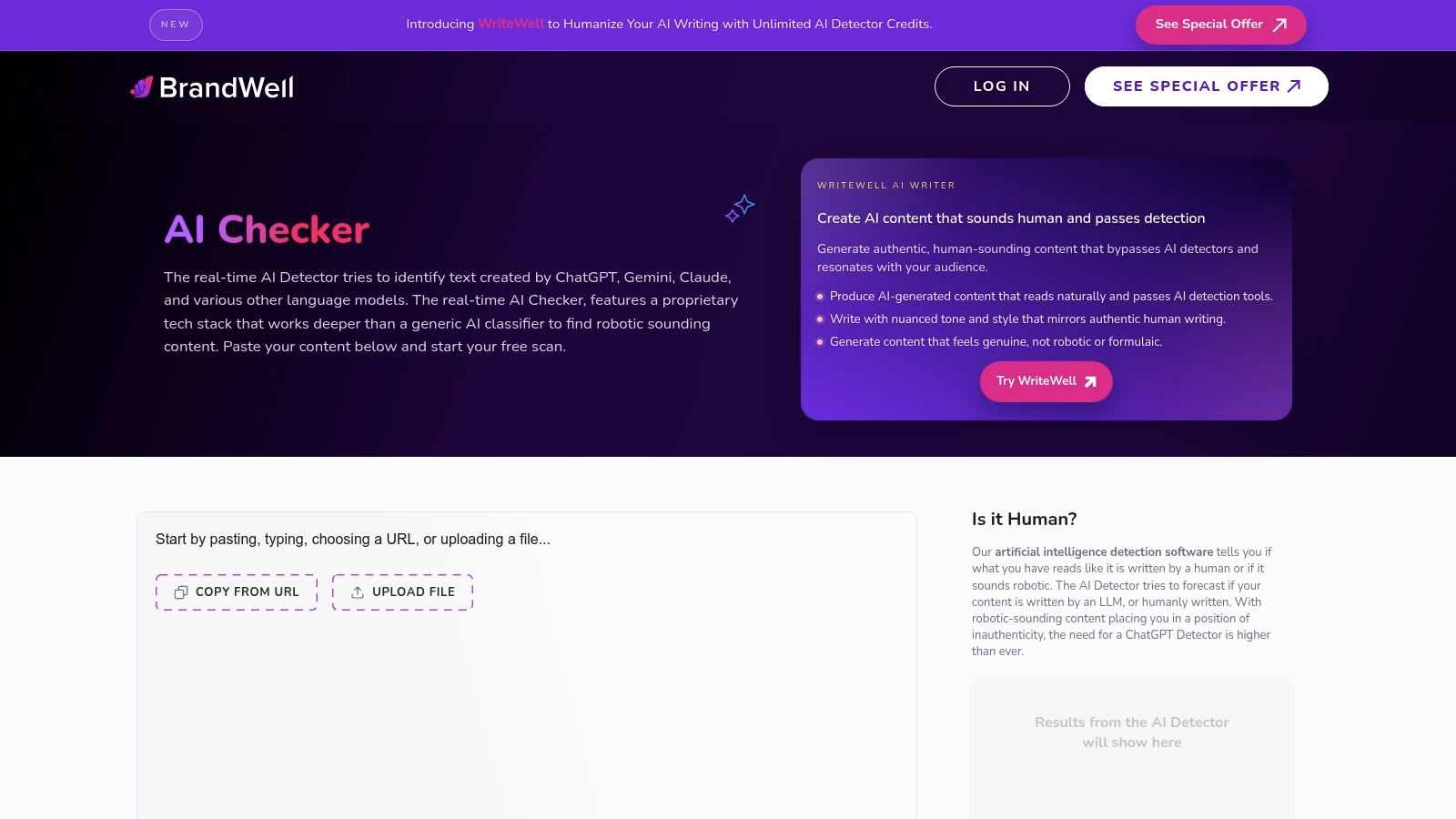
Content at Scale's AI detector, now part of the BrandWell.ai suite, is a popular, long-running tool designed for quick content verification. It's built primarily for marketers, bloggers, and SEO professionals who need a fast, free way to spot-check content before it goes live. The tool provides a simple probability score, classifying text as likely human, AI, or somewhere in between, making it a straightforward first-pass check.
Its main appeal is its low-friction, no-signup-required access for basic scans. The detector provides real-time feedback and highlights sentences it flags as potentially AI-generated, which is useful for quick edits. While it once stood alone, it's now integrated into a larger ecosystem of paid content creation and "humanizing" tools, serving as an entry point to their broader platform.
Key Features and Pricing
The core detection functionality is free, but it's positioned to upsell users to BrandWell's comprehensive content marketing and rewriting services. This makes it a great tool for one-off checks but less ideal for users needing deep analysis without a sales pitch.
- Pricing: The AI detector itself is free for basic use, with a limit of 2,500 characters per scan. Advanced features and higher limits are tied to paid subscriptions for the broader BrandWell platform.
- Workflow Integration: It’s less about deep integration and more about speed. The platform encourages users to use its paid "humanizer" tool to rewrite any text that gets flagged, creating a direct path from detection to revision within its ecosystem.
- Accuracy: It offers a high-level probability score and sentence highlighting. While effective for initial checks, its sensitivity can vary with highly edited or mixed-origin content, making it a good but not definitive best AI writing detector for complex documents.
This tool is perfect for content teams needing a quick sanity check, but users requiring detailed reporting or batch processing may find it limiting compared to dedicated, paid solutions.
Website: https://contentatscale.ai/ai-content-detector/
11. Pangram (Pangram Labs)
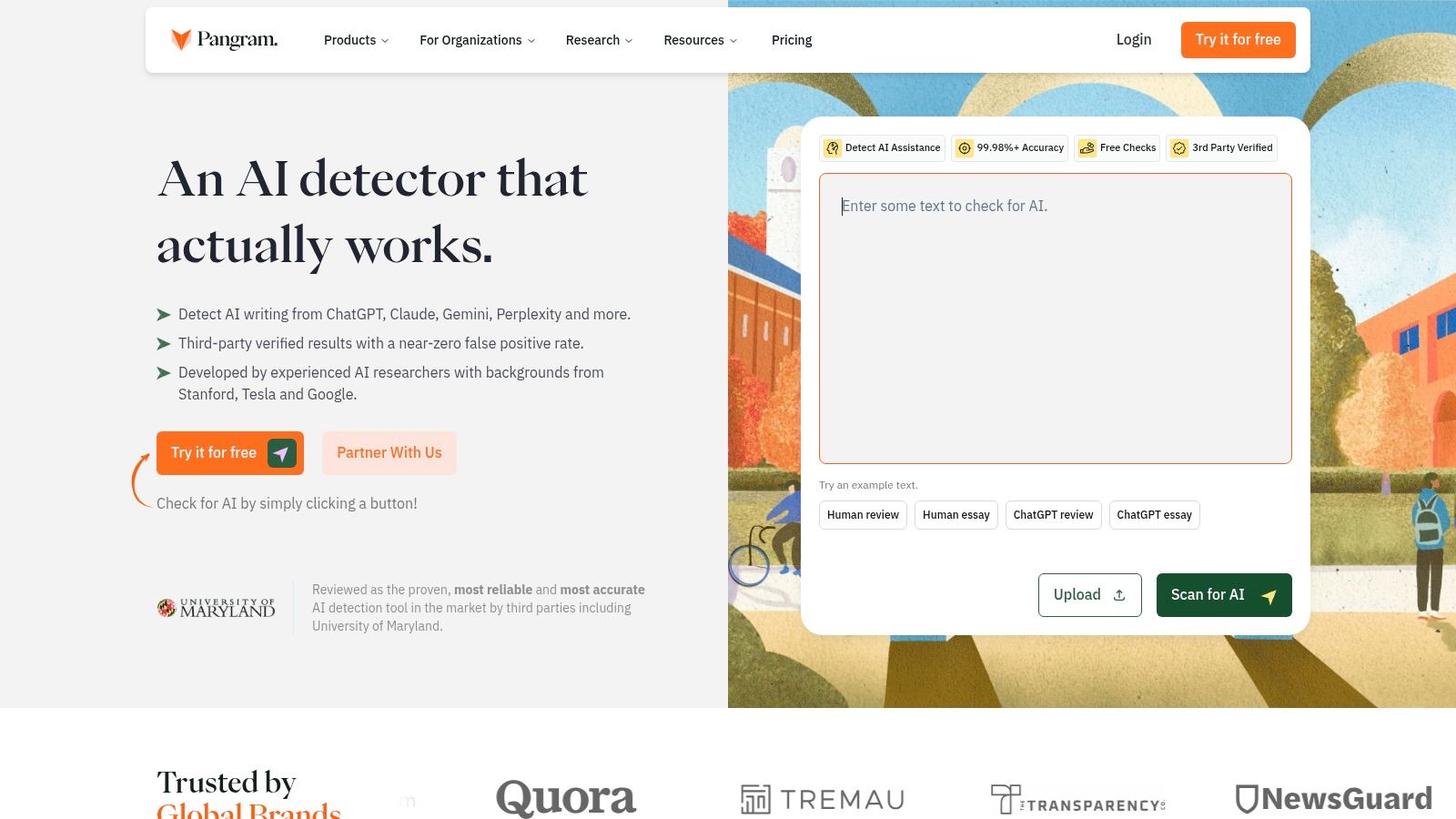
Pangram is an enterprise-grade AI detection platform built specifically for academic institutions, large publishers, and technology teams. It prioritizes institutional governance and workflow integration over individual use, positioning itself as a solution for organizations that need to deploy a reliable AI writing detector across entire systems. Its core focus is providing a tool with research-backed low false positives, a critical requirement for academic and professional settings where accuracy is paramount.
The platform is designed to seamlessly fit into existing educational and publishing ecosystems. It offers a clean detection dashboard, a convenient Chrome extension for on-the-fly checks, and robust API access for custom integrations.
Key Features and Pricing
Pangram’s value proposition lies in its enterprise-readiness, combining detection with governance tools and extensive integration support. This makes it a strong choice for organizations rather than individual users.
- Pricing: Pricing is not publicly listed and requires contacting their sales team for a custom quote. This model is typical for enterprise software focused on tailored solutions for schools and businesses.
- Integrations: A key differentiator is its native support for Learning Management Systems (LMS), including Canvas, Google Classroom, and Moodle, allowing educators to check submissions directly within their existing workflows.
- Accuracy and Trust: The company emphasizes its commitment to minimizing false positives and provides research documentation to back its claims. It also maintains a SOC 2 Type II security posture, which is essential for handling sensitive institutional data.
While its enterprise focus and lack of transparent pricing make it inaccessible for casual users, Pangram is a formidable option for organizations needing a scalable, integrable, and security-conscious AI detection solution.
Website: https://www.pangram.com/
12. Google DeepMind — SynthID Detector
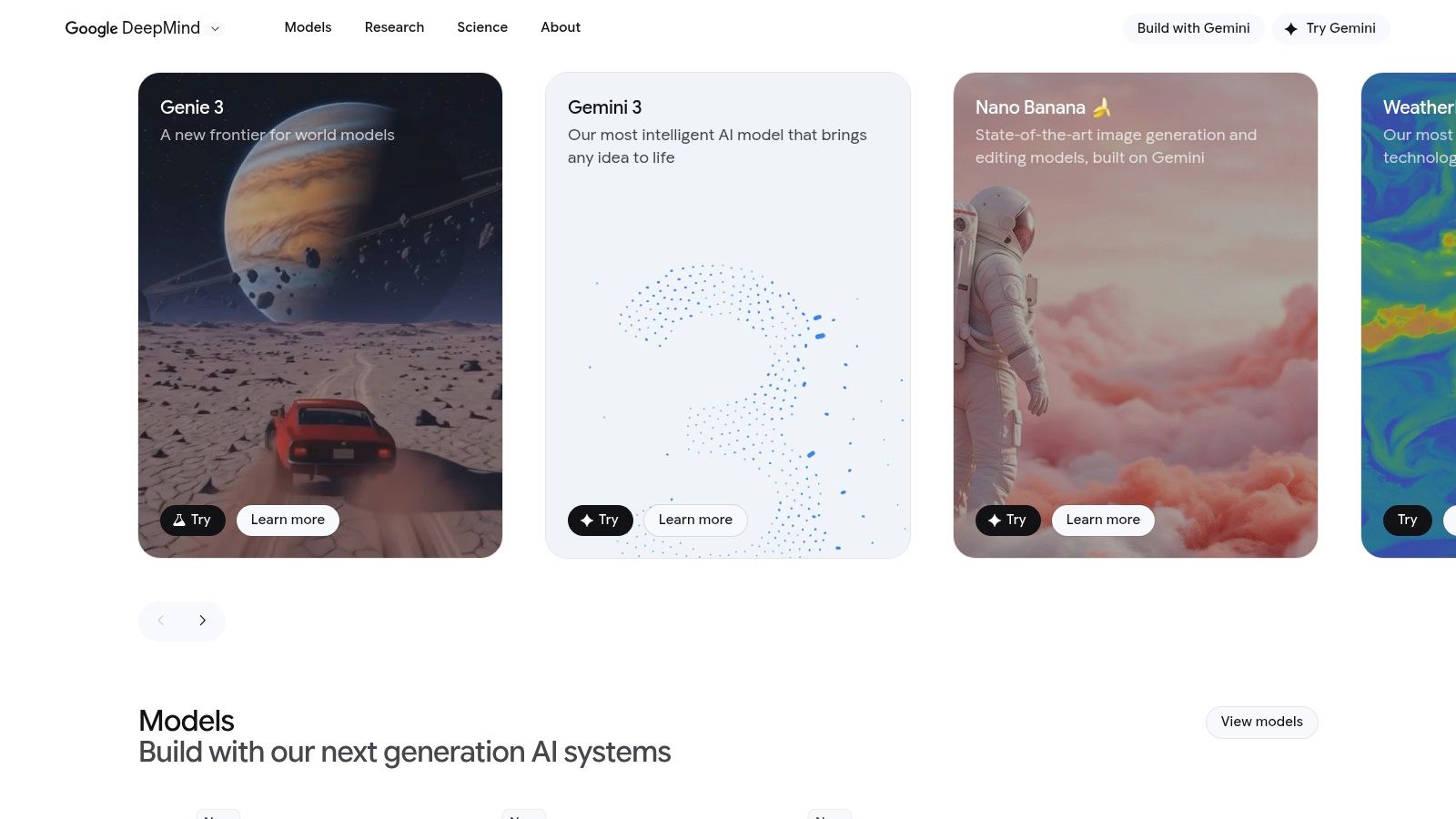
Google DeepMind's SynthID offers a different approach to content authenticity, focusing on watermarking rather than probabilistic detection. It’s not a traditional AI writing detector that analyzes patterns; instead, it's a verification tool designed to find invisible watermarks embedded directly into AI-generated content from Google's models like Gemini. This makes it a crucial tool for provenance, allowing creators and consumers to confirm if a piece of media originated from a specific AI.
SynthID is built to be a deterministic check for content created by Google's ecosystem, covering text, images (Imagen), video (Veo), and audio (Lyria). Instead of giving a probability score, it definitively confirms the presence of a SynthID watermark. This complements other AI detectors by providing a clear signal of origin for supported content, which is invaluable for fighting misinformation and ensuring media authenticity.
Key Features and Access
SynthID operates as a verification portal where users can upload media to scan for the digital watermark. Its primary strength lies in its precision for watermarked content.
- Access: The tool is being rolled out, with initial access provided through an early tester program or waitlist. A general availability release is planned, but it is not yet universally accessible.
- Multi-Modal Support: It is one of the few tools designed to work across text, images, audio, and video, making it future-proof as AI generation becomes more diverse.
- Limitations: Its biggest limitation is that it only works on content generated by Google's tools that have the SynthID watermark embedded. It cannot detect AI content from other models like those from OpenAI or Anthropic.
While not a universal AI writing detector, SynthID is a vital piece of the content authenticity puzzle, offering a reliable way to trace the origins of Google-generated media.
Website: https://deepmind.google/
Top 12 AI Writing Detectors — Head-to-Head Comparison
| Tool | Core features | Target audience | UX / Accuracy & limits | Unique selling point | Pricing / Access |
|---|---|---|---|---|---|
| Originality.ai | AI writing detection (modern LLMs), plagiarism & readability checks, API, team seats | Publishers, agencies, SEO teams | Robust for longer texts; dashboard reports; needs credits; best on substantial content | Combined AI-detection + plagiarism + readability in one workflow | Paid, credit-based subscriptions (monthly credit expiry) |
| GPTZero | Paragraph & document detection, team plans, developer API | Educators, institutions, classrooms | Simple web UI; widely used in education; free tier limited; accuracy varies on short/edited text | Popular in education with straightforward reporting | Free limited tier; paid team/enterprise plans |
| Copyleaks AI Content Detector | AI detection across models, explainable logic, LMS & API integrations | Schools, compliance teams, enterprises | Detailed, explainable reports; enterprise-focused; no ongoing free plan | Explainable “AI Logic” + LMS integrations for compliance | Trial credits then paid enterprise subscriptions |
| Turnitin | AI writing indicator inside Feedback Studio & iThenticate, LMS integration | Universities, school districts, institutions | Deeply integrated into academic workflows; admin-managed; flagged as review signal (false positives noted) | Institutional governance and constant model updates | Institutional licensing only (not sold to individuals) |
| Winston AI (gowinston.ai) | Text detection + image/deepfake detection, OCR, PDF reports, team seats | Teams needing multimodal checks (text + image) | Flexible credit system (words/images); low-cost entry; trial credits limited | Multimodal detection (text + image/deepfake + OCR) | Credit-based pricing per word/image; paid tiers |
| Sapling AI Content Detector | Web detector with sentence highlights, API/SDK, Chrome extension, multilingual | Dev teams, product integrations, in‑context browser checks | Good developer tooling; free detector truncates long text; better on paid tiers | Strong API/SDK and browser extension for in‑context checks | Free limited; Pro/Enterprise for higher limits and API access |
| Scribbr AI Detector | Free checks (~1,200 words), paragraph-level feedback, multilingual; premium with plagiarism | Students, editors | No sign-up for quick checks; student-focused reports; free per-check word limit | Student/editor-friendly feedback and bundled plagiarism option | Free per-check; premium plagiarism bundle per document |
| QuillBot AI Detector | Free pasted-text detection, file uploads, scan history; premium adds batch uploads | Writers and QuillBot users | Easy spot-checks; integrates with QuillBot tools; premium for bulk features | Built into QuillBot ecosystem for streamlined rewriting | Free basic; premium subscription adds batch/upload features |
| Crossplag AI Content Detector | Free AI detector, confidence scoring, integrates with Crossplag similarity tools | Education and editorial users of Crossplag | Quick checks; mixed third‑party accuracy reviews; English-focused | Integrated with Crossplag plagiarism/similarity suite | Free detector; paid Crossplag plans for similarity checking |
| Content at Scale (BrandWell) | Real-time human/AI probability scoring and highlights; optional rewrite upsells | Marketers, publishers needing fast spot-checks | Fast, low-friction checks; free spot-checks; advanced features tied to paid tools | Quick probability checks tailored to publishing workflows | Free spot-checks; paid content tools/upsells under BrandWell |
| Pangram (Pangram Labs) | Detection dashboard, Chrome extension, API, plagiarism, LMS integrations, research docs | Enterprises, schools, publishers seeking governance | Enterprise integrations, SOC 2 posture; sales-contact pricing; focused on minimizing false positives | Research-backed approach and enterprise compliance features | Enterprise pricing; contact sales |
| Google DeepMind — SynthID Detector | Scans for SynthID watermarks across text, image, audio, video; highlights watermarked segments | Media authenticity teams, provenance verification use cases | Deterministic when SynthID watermark present; limited to Google‑watermarked content; early access | Deterministic watermark detection for Google-generated content | Access via program/waitlist; limited scope to SynthID-bearing content |
Choosing Your AI Detector: A Final Verdict and Practical Advice
Navigating the landscape of AI-generated content requires a new kind of diligence, and as we've explored, a host of tools has emerged to meet this challenge. After testing and analyzing a dozen of the top contenders, from Originality.ai to Google's SynthID, one truth is abundantly clear: there is no single, universally "best AI writing detector." The right choice is not about finding a magic bullet, but about selecting a strategic partner that aligns with your specific goals, workflow, and tolerance for risk.
The journey to find the right tool begins with a clear understanding of your primary use case. The needs of a university academic integrity office are vastly different from those of a solo blogger trying to maintain an authentic voice.
Key Takeaways and Recommendations
Our comprehensive review revealed distinct tiers of performance and utility. For those who demand the highest level of scrutiny and integration, a few clear winners emerged.
- For SEO Agencies & Publishers: Originality.ai and Winston AI are the top-tier choices. Their combination of high accuracy, plagiarism checking, API access, and detailed reporting makes them indispensable for content teams operating at scale. They provide the robust, defensible data needed to enforce content standards and protect search rankings.
- For Educators & Academic Institutions: Turnitin remains the institutional standard, deeply integrated into Learning Management Systems. However, Copyleaks and GPTZero offer powerful, modern alternatives with strong educational features and more transparent scoring. The key here is using the results not as a final judgment, but as a catalyst for educational conversations about authorship and AI use.
- For Individuals & Freelancers: For casual checks or a first-pass analysis, free tools are invaluable. The Scribbr AI Detector and QuillBot AI Detector provide accessible, no-cost options to quickly gauge a text's likely origin. While not as consistently accurate as paid tools, they are excellent for initial screening.
Beyond Detection: A Human-Centric Approach
Ultimately, these tools are powerful but imperfect assistants. The single most important takeaway is that no AI detector is infallible. Our tests confirmed that false positives are a persistent issue, especially with text that has been heavily edited, written by non-native English speakers, or blends human and AI contributions. Relying solely on a detector's score without critical human oversight is a recipe for error.
Consider these factors before committing to a tool:
- Your Goal: Are you trying to prevent academic dishonesty, ensure SEO compliance, or simply check your own work? Your objective dictates the level of precision you need.
- Workflow Integration: How will you use the tool? If you need to check thousands of articles, an API is non-negotiable. If you're a student, a simple copy-paste interface is sufficient.
- The Human Element: Always treat a positive AI detection score as a signal for further investigation, not as conclusive proof. Look for other signs of AI writing, such as generic phrasing, perfect grammar without stylistic flair, or a lack of personal anecdotes and deeper insights.
The rise of detection technology is just one part of a larger story. A whole ecosystem of powerful AI tools for content creators is fundamentally changing how we produce content, making the conversation around authenticity and originality more important than ever. The best path forward involves using AI as a collaborator while preserving the unique, irreplaceable value of the human voice. This balanced approach will define high-quality content in the AI era.
Worried that your AI-assisted writing will get flagged? Instead of just detecting, ensure your content is truly original with Rewritify. It intelligently rephrases AI-generated text to pass detectors by infusing it with human-like nuance and style, helping you leverage AI's power responsibly while maintaining your authentic voice. Give your writing the human touch it needs at Rewritify.
Relevant articles

Is ZeroGPT accurate? We tested its AI detection using 2026 data. See how it performs on false positives and reliability for students, writers, and marketers.

Learn how to humanize AI generated text with proven strategies. Move beyond robotic writing to create authentic, engaging content that connects with readers.
Explore turnitin similarity score meaning and how it reflects originality, citation practices, and steps to improve your paper before submission.
Learn how to pass AI detection by ethically humanizing AI-generated drafts. Our guide covers rewriting, editing, and using tools to create authentic content.
Learn how to detect AI generated content with this complete guide. We cover AI detectors, linguistic clues, and manual verification to spot AI writing.

Learn how to check for plagiarism with confidence. Our guide covers the best tools, manual techniques, and a clear workflow to ensure your content is original.