How to Pass AI Detection Ethically by Humanizing Your Content
Learn how to pass AI detection by ethically humanizing AI-generated drafts. Our guide covers rewriting, editing, and using tools to create authentic content.
To get past AI detection, the real secret is to humanize the text. This means breaking up those predictable, robotic sentence patterns, injecting your own unique insights, and choosing words that sound like a real person wrote them. It’s less about tricking a system and more about transforming a generic first draft into something genuinely authentic and valuable.
Why AI Detection Is a Big Deal (And How It Works)
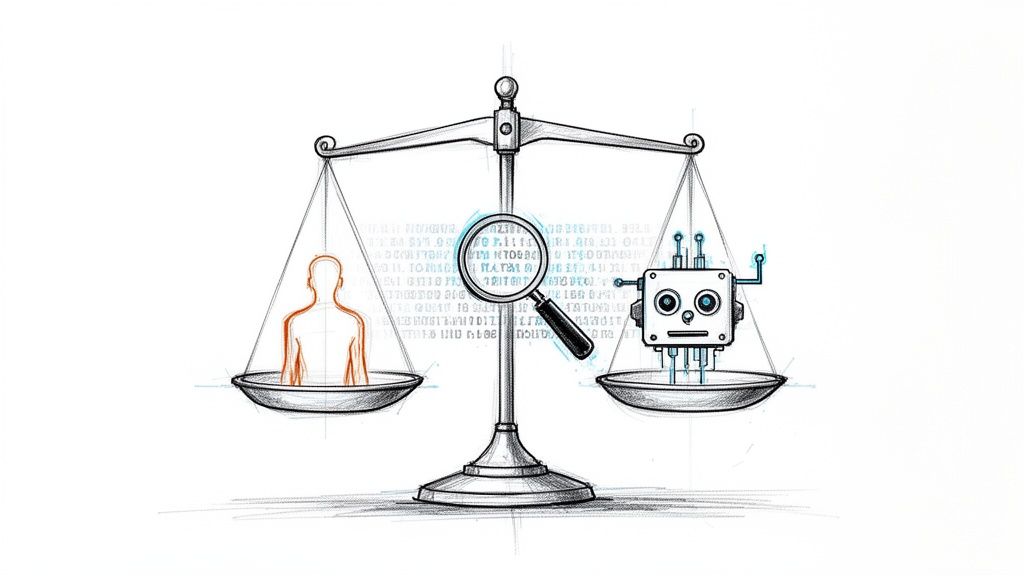
Before we get into the "how," let's quickly cover the "what" and "why." Understanding what these detectors are looking for is half the battle, and it's a growing concern for everyone from students to professional content creators.
At their core, AI detectors are just sophisticated pattern-recognition tools. They've been fed enormous amounts of text—some written by humans, some by machines—and have learned to spot the subtle signatures that give AI-generated content away.
Think of it like a detective who isn't looking for a single clue, but a combination of tells that all point in the same direction.
Key Differences Between AI-Generated vs Human-Written Text
This table breaks down the common traits that AI detectors are trained to spot. Understanding these differences is the first step to knowing what you need to change in your own writing.
| Characteristic | Typical AI-Generated Text | Typical Human-Written Text |
|---|---|---|
| Sentence Structure | Often uniform in length and structure (e.g., subject-verb-object). | Varied sentence lengths and complex structures mixed with short, punchy ones. |
| Word Choice | Tends to use common, safe, and sometimes repetitive vocabulary. | Employs a richer, more diverse vocabulary, including idioms and colloquialisms. |
| Flow & Rhythm | Can feel overly logical, smooth, and predictable. | Has a natural "burstiness"—a mix of simple and complex sentences that creates rhythm. |
| Tone of Voice | Usually neutral, formal, and overly helpful or cautious. | Varies greatly; can be personal, opinionated, humorous, or analytical. |
| Originality | Synthesizes existing information without adding new insights or personal experience. | Often includes unique perspectives, anecdotes, original analysis, and emotion. |
By focusing on shifting your text from the "AI" column to the "Human" column, you're not just avoiding detection—you're fundamentally improving the quality of the content.
What Happens When You Get Flagged?
Getting flagged by an AI detector is more than a minor hiccup; it can have serious consequences. For a student, a high AI score on an essay could trigger an academic dishonesty investigation. For a marketer, content that reads like it was written by a machine might get penalized by search engines or simply fail to connect with an audience.
The real problem with raw AI content isn't just that it's detectable; it's that it often lacks the originality, critical thinking, and genuine expertise that people are looking for. Learning to bypass AI detection is really about learning to add that value back in.
This has become a massive field. The AI content verification market was valued at USD 3,831.0 million in 2024 and is expected to explode to over USD 12 billion by 2030. That growth shows just how critical this has become as AI tools become a standard part of our work.
It's About Enhancing, Not Cheating
Let's get one thing straight: the goal isn't to find some magic loophole to "cheat" the system. That's a losing game, as the detectors are always getting smarter.
A much better, more sustainable approach is to use AI as a powerful assistant—a tool to help you brainstorm or get a rough draft on the page. The real work, the human touch, begins after that initial output.
When you learn to rewrite, edit, and inject your own voice into the text, you're doing more than just dodging a detector. You're creating something better. For a deeper dive into these distinctions, the comparison of AI vs. human experts in document translation offers some great insights. It's a process that turns a generic, robotic draft into a polished piece of work that actually connects with people.
2. Laying the Groundwork: Prepping Your AI Draft
You can’t build a solid house on a shaky foundation, and the same goes for writing. If you start with a generic, robotic AI draft, you’re just making your job ten times harder. The real secret to getting past AI detectors efficiently starts before you even think about rewriting a single word. It all comes down to the quality of your initial prompt.
A lazy prompt gets you a lazy draft. Just asking an AI for "a blog post about digital marketing" is a recipe for a bland, easily detectable piece of content. This first step is your chance to steer the AI away from its default, predictable patterns.
Crafting a Smarter Prompt
To get a draft that already feels more human, you need to give the AI specific instructions on style and structure, not just the topic. Think of it as teaching the AI to break its own rules from the get-go.
Here are a few tricks I use all the time:
- Define a personality. Instead of just "professional tone," get descriptive. Try something like, “Write in a confident yet approachable tone, like a seasoned expert sharing advice with a mentee over coffee.”
- Tell it what not to do. This is a big one. Add negative constraints to your prompt. For example: "Do not use corporate jargon like 'leverage' or 'synergy.' Avoid common clichés like 'in today's fast-paced world'." This one instruction alone can slash your editing time.
- Demand rhythmic sentences. AI loves uniformity, but human writing has a natural cadence. I often add this line to my prompts: "Vary sentence length for a better flow. Mix short, direct sentences (5-8 words) with longer, more descriptive ones (20-25 words)."
When you’re proactive like this, the AI gives you a draft that already has some of that human texture baked in. This is especially true for shorter content. For instance, anyone using an AI LinkedIn Post Generator knows that specific tonal guidance is the only way to generate posts that sound authentic and actually connect with people.
The First Pass: Your "Triage" Scan
Once you have the draft, don't just dive in and start editing line by line. That's a rookie mistake. Instead, do a quick "triage" scan to spot the most obvious AI tells. This helps you target your energy where it will make the biggest impact.
As you scan, keep an eye out for these red flags:
- Robotic Paragraph Starters: Does every paragraph kick off with "Furthermore," "Additionally," or "In conclusion"? That’s a dead giveaway.
- Perfectly Balanced Lists: AI often generates bullet points that are all perfectly parallel in structure. Human lists tend to be a little less symmetrical.
- Weak, Hedged Language: Watch out for phrases like "It is important to consider..." or "It can be argued that..." These are classic AI filler words. A human writer is usually more direct.
By spotting these patterns first, you’re basically creating a roadmap for your edits. Instead of getting bogged down in tiny comma splices, you can go straight for the jugular and fix the core problems that scream "this was written by a robot."
This prep work is the most critical part of the whole process. A well-prompted, strategically scanned draft is infinitely easier to mold into something that not only passes detection but is also genuinely good to read.
Adding That Human Touch: The Art of the Rewrite
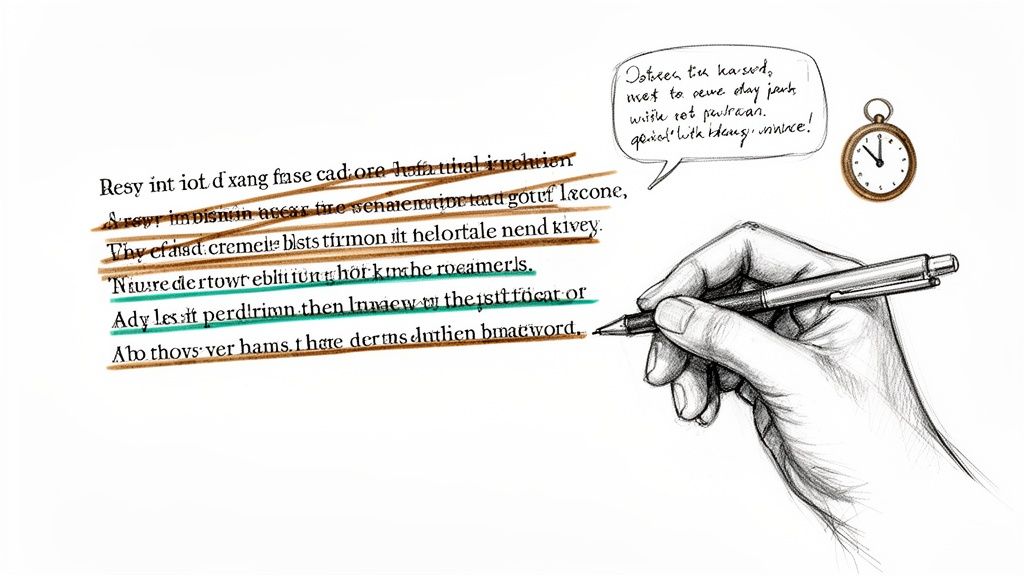
This is where the magic really happens. Once your draft is prepped, it's time to dive into a rewrite focused on breaking down the very patterns AI detectors are built to find. Think of it less like swapping out a few words and more like rewriting the text's DNA to give it a genuine, human feel.
The biggest giveaway of AI-generated text is its predictability. It almost always falls back on a very logical, almost mathematical sentence structure and keeps the complexity flat and even. Human writing, on the other hand, is wonderfully messy.
Your job is to bring some of that controlled chaos into the writing.
First, Try It by Hand
Before you even think about using a tool, it's worth getting your hands dirty with a manual rewrite. This process helps you build an instinct for what feels human. You're aiming to be an author here, not a machine just paraphrasing.
Try focusing your efforts on these three areas:
- Mix Up Your Sentences: Actively look for monotonous sentence patterns and smash them. Are there a bunch of short, choppy sentences in a row? Combine them into one longer, more detailed thought. Got a long, winding sentence? Break it into two or three quick, punchy statements. This creates a rhythm that AI just can't seem to get right.
- Inject Your Own Voice: This is your secret weapon. Where can you add a quick personal story, a firm opinion, or even a bit of self-awareness? Instead of a flat statement like, "It is important to consider SEO," you could say, "I learned the hard way that ignoring SEO is a mistake you only make once."
- Ask Questions: Why does this work so well? Because it pulls the reader in and feels like a real conversation. Sprinkling in questions like, "But what does this actually mean for your bottom line?" or "Sounds pretty straightforward, right?" instantly shatters the formal, robotic tone.
Here's a key takeaway from recent studies: AI is great at passing tests, but the content it produces rarely has a unique point of view. By adding personal anecdotes and strong opinions, you're layering in an authenticity that algorithms find incredibly difficult to create or spot.
Remember, the goal isn't just to slip past a detector. It's about making the content better and more interesting for the person reading it. For a deeper look into this process, check out our guide on how to rewrite AI-generated text.
Using Rewritify to Speed Things Up
Doing this all by hand is effective, but let's be honest—it takes time. This is where a specialized tool like Rewritify can slide right into your workflow, acting as a smart assistant to speed up the whole humanizing process.
Unlike a basic article spinner that just messes with synonyms, Rewritify is built to completely restructure sentences and rephrase ideas to sound more natural. Its 'Undetectable' mode, in particular, is designed specifically to dismantle the linguistic tells that trigger AI detectors.
Let’s look at a quick before-and-after.
Before (Raw AI-Generated Text):
"The implementation of artificial intelligence in business operations has led to significant enhancements in efficiency. It allows for the automation of repetitive tasks, which consequently frees up human employees to focus on more strategic and creative endeavors. Therefore, businesses that adopt AI technologies often report higher levels of productivity and innovation."
Classic AI. It's perfectly logical, clear as day, and has absolutely zero personality. The sentences are all structured the same, and the word choice is incredibly safe.
Now, let's run it through Rewritify's Undetectable mode.
After (Rewritten with Rewritify):
"Bringing artificial intelligence into the workplace is changing the game by seriously boosting how much we can get done. When you hand over the boring, repetitive work to AI, your team is suddenly free to tackle the bigger picture—the kind of creative, strategic thinking that actually pushes the company forward. It's no surprise that companies embracing AI are seeing a real spike in both their output and their ability to come up with fresh ideas."
You can feel the difference immediately. The rewritten version feels more conversational ("changing the game," "seriously boosting"), the sentence flow is varied, and it has a confident, energetic tone. It's the same information, but delivered in a way that actually connects with a reader, making it a go-to strategy for anyone trying to figure out how to pass AI detection without sacrificing quality.
Editing for an Authentic and Natural Flow
If rewriting gives your text a new skeleton, editing is what breathes life into it. This is where you apply that final, crucial polish—smoothing out the robotic tells and infusing a genuinely human feel. These subtle adjustments are often what make the difference between content that feels slightly off and content that truly connects.
The goal here is simple: break the monotony that AI models fall into. They love consistency and predictable patterns, but real human communication is full of rhythm, quirks, and even imperfections. Your job is to bring those organic elements back into the writing.
Varying Your Sentence Rhythm
One of the most powerful edits you can make is to deliberately mix up your sentence lengths. AI-generated text often settles into a comfortable, uniform rhythm where every sentence is roughly the same length and structure. It's a dead giveaway for detectors.
To fix this, you need to create a more dynamic flow. Think of your writing like music; it needs a beat.
- Short, punchy sentences: Use these for emphasis. They grab attention. They make a point.
- Longer, descriptive sentences: Follow up with these to provide detail, context, or a more elaborate thought, giving the reader a moment to absorb the information.
This mix of short and long creates a natural "burstiness" that is a hallmark of human writing. It keeps your reader engaged and stops the text from sounding like a machine reading from a script.
I’ll say it again: read your content out loud. It’s a non-negotiable step. Your ears will catch awkward phrasing, clunky transitions, and monotonous rhythms that your eyes might just skim over. If a sentence makes you stumble when you say it, it’s going to trip up your audience, too.
Hunting for AI's Favorite Words
Certain words are like a calling card for AI. Models have their go-to vocabulary—safe, often overly formal words that they tend to overuse. Terms like "delve," "leverage," "tapestry," "utilize," and "harness" are major red flags for detection tools.
Put on your word detective hat. Scan your document specifically for these repeat offenders and swap them out for more precise, interesting language. This isn't just about fooling an algorithm; it's about making your writing stronger and more memorable.
| AI's Overused Word | A More Human Alternative | Example Sentence |
|---|---|---|
| Delve | Explore, dig into, look at | "Let's dig into the data from last quarter." |
| Leverage | Use, take advantage of | "We need to use our existing customer base to grow." |
| Tapestry | Mix, collection, range | "She has a rich mix of skills from her past jobs." |
By ditching these generic terms, you inject personality and specificity into your work. It starts to sound less like a template and more like a thoughtful piece of communication.
Adopting a Conversational Tone
Finally, don't be afraid to make your writing sound like a real person talking. Unless you tell it otherwise, AI defaults to a stiff, formal tone. But small tweaks can make a massive difference.
Start by using contractions. Sprinkling in words like "it's," "don't," and "you'll" where they feel natural instantly makes the writing more approachable. You can also add a few carefully chosen idioms or colloquialisms to inject some personality, as long as they fit the context and your audience.
The idea is to move away from the sterile perfection of a machine and embrace the slightly messy, engaging, and rhythmic nature of human conversation. These final editing passes are what transform a functional AI draft into a piece of content that not only helps you figure out how to pass AI detection but also genuinely resonates with your readers.
Testing Your Content and Interpreting the Results
You’ve rewritten, edited, and polished your text. So, how do you know if you’ve actually succeeded? It's time to put your work to the test. Running your content through a few AI detectors is the only way to get real feedback on whether it reads like a human wrote it or if it still has some of that robotic stiffness.
Forget about chasing a perfect 0% AI score—it’s a fool's errand. Every detector uses its own secret sauce, so your score will inevitably jump around from one platform to the next. The real goal is to get a consistent "human" or "likely human" result from a couple of different, reputable tools.
Think of this step less as a final exam and more as a training exercise. It sharpens your instincts and helps you spot the subtle, machine-like patterns you might otherwise miss. Over time, you’ll get much better at this.
Choosing Your Detection Tools
Let’s be clear: not all AI detectors are created equal. Some are notoriously trigger-happy, flagging perfectly good human writing as AI-generated. To get a reliable read, you need to stick with well-known tools that are generally trusted in the industry.
My advice is to always cross-reference. Run your text through at least two different detectors. If one flags a section but another gives it the all-clear, you’re probably on the right track. It just means a few final tweaks might be in order.
A high AI score on a single detector isn't a final verdict; it's just one piece of the puzzle. Use it as a guide for your next round of edits, not as a reason to panic. The real win is creating content that actually connects with people, not just tricking an algorithm.
What to Do with a High AI Score
If your text still gets flagged as AI, don't sweat it. This happens all the time. It just means you need to put on your editor's hat one more time. You don’t need to tear everything down and start from scratch, but you do need to look at specific parts of the writing with a more critical eye.
This flowchart gives you a great visual guide for where to focus your attention when you need to refine the text.
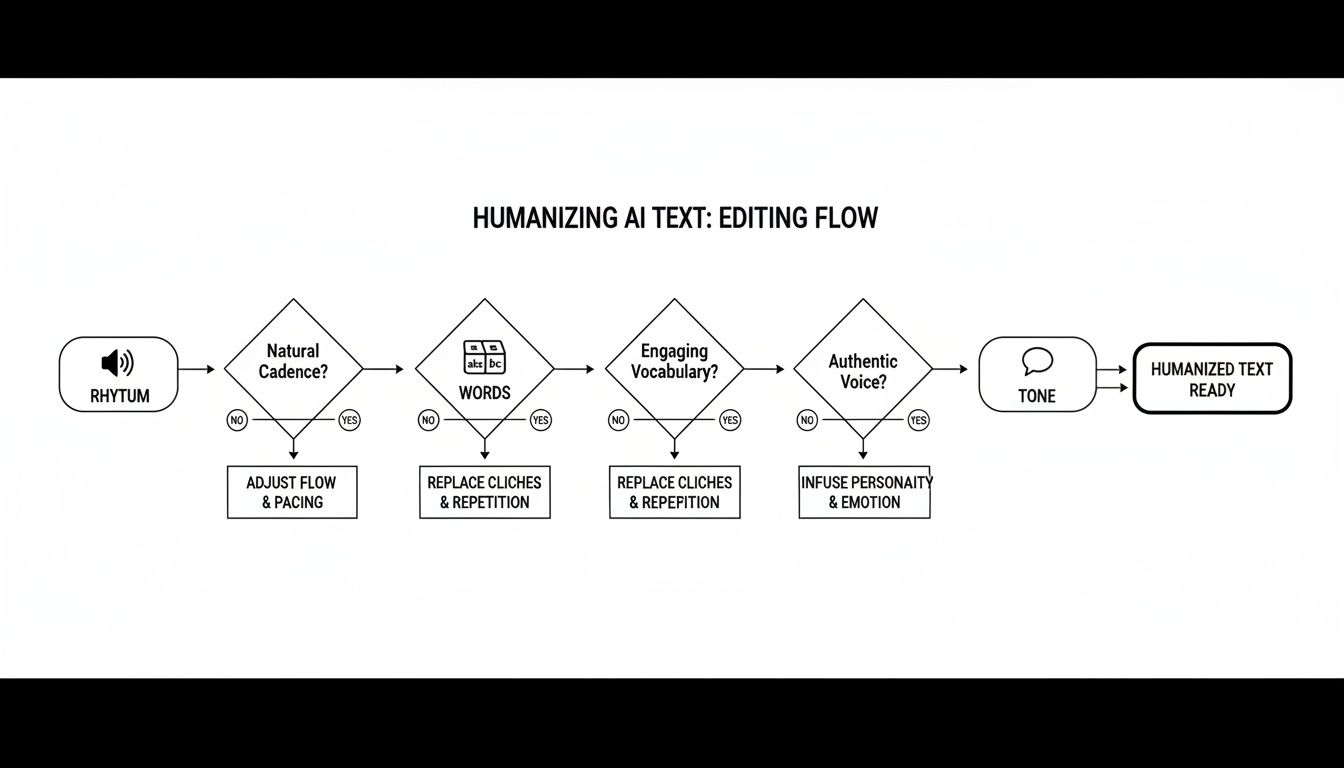
As you can see, the main culprits are almost always the rhythm of the sentences, your word choice, and the overall tone. Nail these three things, and you're most of the way there.
Here’s a quick action plan if you get a high score:
- Check the Rhythm: Read the flagged paragraphs out loud. Do they sound flat or monotonous? Start breaking up long sentences and mix in some shorter, punchier ones.
- Hunt for AI Cliches: Look for those overused, stuffy words that AI loves, like "leverage" or "delve." Swap them out for words that are more specific, active, and interesting.
- Inject Some Personality: Is the writing too formal? Try adding a personal story, a strong opinion, or even just a question to make it feel more conversational.
This back-and-forth process of testing and refining is the key to getting good at this. And it’s a skill worth having. In just six months of 2024, global searches for AI detection tools shot up by a staggering 256%. What’s fascinating is that interest in paraphrasing tools is still much higher, which tells us people are more focused on changing AI content than just identifying it. You can read more about the growing AI content trend on antlerzz.com.
For anyone in academia, understanding how specific platforms like Turnitin work is even more important. If that’s you, you might want to explore our article on whether Turnitin checks for AI. Ultimately, getting into the habit of testing your work is what transforms the vague idea of "humanizing" into a practical, repeatable skill.
5. Staying Honest in the Age of AI
Navigating the world of AI-generated content brings up a critical question that goes way beyond technology: what does it mean to be honest in your work? Figuring out how to responsibly lower an AI detection score should never be about fooling anyone. It’s about creating a clear, ethical framework for using these powerful tools as assistants—not as replacements for your own thinking.
The line is simple but crucial. Using AI to brainstorm ideas, structure an outline, or bust through writer's block is a smart use of modern tech. But passing off a raw, unedited AI draft as entirely your own work? That crosses into misrepresentation. The real goal is to enhance your unique ideas, not to outsource the essential work of critical thinking and creativity.
Guidelines for Students
For students, this distinction is everything. Academic integrity policies are the bedrock of education, and it’s non-negotiable to understand your institution's specific rules on AI. Most policies draw a hard line against submitting work you didn't personally create.
- Make it Your Own: Treat AI as a launchpad. The final submission must be a product of your own analysis, synthesis, and voice.
- Cite Your Sources: If an AI tool helps you find information or summarize concepts, you are still responsible for verifying and properly attributing that information. Plagiarism rules haven't changed, and you can get a refresher by reading our guide on how to avoid plagiarism.
- When in Doubt, Ask: If you're unsure about a specific use case, talk to your instructor or consult your university's academic integrity office. Clarity is your best friend here.
Ignoring these principles doesn't just risk a bad grade; it fundamentally undermines the purpose of your education.
Best Practices for Professionals
In the professional world, the stakes shift from grades to reputation and trust. Whether you're a marketer, researcher, or business writer, your audience and clients rely on your expertise and authenticity. Using AI responsibly means upholding that trust above all else.
The core responsibility for any professional is to be the final human validator. You must fact-check every claim, verify every statistic, and infuse the content with your unique industry insights and experience. AI can generate text, but it can't replicate your credibility.
At the end of the day, your name is on the final product. It has to reflect your standards for accuracy, quality, and originality. When you treat AI as a powerful tool that augments your skills—rather than replaces them—you protect your integrity and produce work that is both genuinely valuable and trustworthy.
Frequently Asked Questions About AI Detection
Trying to understand the ins and outs of AI detection can feel a bit like a moving target. To clear things up, here are some practical answers to the questions we hear most often from writers, students, and professionals trying to use AI tools ethically and effectively.
Can AI Detectors Be Wrong?
Yes, they absolutely can be. It's a common misconception that these tools are infallible, but the reality is that false positives—where human writing gets flagged as AI-generated—are a real issue.
Research from 2024 highlights this problem. While top-tier systems like Turnitin have managed to get their false positive rates down to around 1-2%, many of the free checkers you find online are much less accurate. Some have been shown to misidentify human text as much as 50% of the time.
This is why you should never take one tool's score as the final word. Think of it as a guide, not a verdict. It's always a good idea to check your text with a couple of different detectors to get a more balanced view before you start revising.
Will Using a Paraphrasing Tool Make My Content Undetectable?
Probably not, at least not reliably. The first generation of AI detectors could sometimes be fooled by simple paraphrasing tools that just swap out words for synonyms. But today's best detectors are far more sophisticated. They've been trained to recognize the tell-tale signs of automated rewriting, like predictable sentence patterns and awkward phrasing.
A simple synonym swap doesn't fool anyone anymore. To truly humanize a text, you need to go deeper. It’s about changing the rhythm of your sentences, adjusting the tone, and weaving in your own unique insights—things a basic paraphraser just can’t replicate.
This is where specialized "humanizer" tools like Rewritify come in. They do more than just rephrase; they completely restructure the text to mimic the natural flow and cadence of human writing, making them a much more effective solution.
What Is the Most Important Thing to Change to Avoid Detection?
If you're going to focus on one thing, make it this: vary your sentence structure and length. This is hands-down the most powerful change you can make. AI models often fall into a very predictable rhythm, churning out sentences that are all roughly the same length and complexity. It sounds robotic because it is.
To break this pattern, you need to introduce what linguists call "burstiness." Mix it up. Follow a long, detailed sentence with a short, punchy one. This creates a natural ebb and flow that is a hallmark of human writing.
The easiest way to check for this is to read your work out loud. Does it sound flat and monotonous? If so, it’s time to rewrite some sentences to give them more rhythm. This single technique will do more to lower your detection score than almost any other edit.
Is It Unethical to Try to Pass AI Detection?
This is a great question, and the answer really boils down to your intent. If you're using an AI to write an entire paper from scratch and then trying to disguise it as your own original work, that crosses the line into academic dishonesty.
But that's not how most people use AI ethically. If you're using it as a smart assistant to brainstorm ideas, get past writer's block, or help you structure your thoughts, then polishing the output to sound more human isn't cheating—it's just good editing.
The ethical path is to use AI to amplify your own thinking, not to replace it. Always inject your own expertise, double-check every fact, and make sure the final piece truly represents your voice and your understanding of the topic.
Ready to transform your AI drafts into polished, human-quality content? Rewritify gives you the power to rewrite text for clarity, originality, and undetectability in a single click. Try Rewritify for free and see the difference it makes.
Relevant articles

Is ZeroGPT accurate? We tested its AI detection using 2026 data. See how it performs on false positives and reliability for students, writers, and marketers.
Discover the best AI writing detector to ensure content authenticity. We tested and ranked 12 top tools for accuracy, false positives, and specific use cases.
Learn how to rewrite this sentence for clarity and engagement, with practical tips and real-world examples.
Discover how to improve my writing ai with a practical human-AI workflow that turns rough drafts into clear, original, and authentic content.
Learn how to detect AI generated content with this complete guide. We cover AI detectors, linguistic clues, and manual verification to spot AI writing.
Learn how to make AI writing undetectable. Our guide shows you how to transform robotic AI drafts into authentic, human-quality content that bypasses detectors.