How to Make AI Writing Undetectable And Sound Human
Learn how to make AI writing undetectable. Our guide shows you how to transform robotic AI drafts into authentic, human-quality content that bypasses detectors.
Making AI-generated text truly undetectable is about much more than just running it through a paraphrasing tool. It's a hands-on process of injecting your own voice, smoothing out those clunky, robotic sentences, and checking your work with a few different tools. The aim isn't just to fool a machine; it's to transform a soulless AI draft into a piece of writing that's genuinely high-quality and sounds like you.
Why AI Detectors Often Miss The Mark
Let's get one thing straight: AI detectors are not foolproof. Not even close.
Tools like Turnitin and GPTZero are causing a ton of anxiety for students and marketers. Students are terrified of getting a false positive on a paper they wrote themselves, and content marketers are worried their AI-assisted articles will get dinged by Google for sounding robotic.
This anxiety stems from a fundamental problem—the detection technology itself is inconsistent and often flawed. These tools aren't all-knowing; they simply scan for statistical patterns. They look for predictable word choices (what's called low perplexity) and suspiciously uniform sentence lengths (low burstiness), which are tell-tale signs of machine-generated text.
The Inconsistency Problem
The biggest issue with AI detectors is that they often just get it wrong. They've been known to flag completely human-written text as AI-generated, especially if the writing is very formal or follows a simple, structured pattern. On the flip side, a few simple manual edits can sometimes trick them completely. It's a messy, unreliable system.
The unpredictability of these tools is their greatest weakness. Trusting a single detector's score is a huge mistake, as you'll see wildly different results from one platform to the next.
This forces us to change our approach. Instead of obsessing over a "100% human" score, the real goal should be to create content that's so good, so authentic, that it naturally bypasses the detectors. When you prioritize quality, your writing sheds those robotic traits that the scanners are looking for. To learn more about this, check out this deep dive on how tools like Undetectable AI work and where their blind spots are.
What The Data Reveals
This isn't just a hunch; the data backs it up. A major study that tested 10 free AI detectors found their ability to spot AI-generated text was all over the map, ranging from 0% to 100%. When the AI text was paraphrased or rewritten, the results got even worse, with accuracy tanking on most platforms.
It's no surprise that OpenAI shut down its own detector in July 2023. Their tool was only able to correctly identify 26% of AI text, and to make matters worse, it falsely flagged 9% of human writing as being AI-generated. The numbers speak for themselves. You can dig into more of the fascinating (and frankly, alarming) data in the full AI detection study.
Adopt a Workflow for Humanizing AI Drafts
The secret to turning robotic AI text into something that reads like a human wrote it isn't a single trick—it's a process. I've found the best approach is to treat AI as a junior research assistant or a first-draft machine. It's fantastic for getting ideas on the page and creating a basic outline, but it should never, ever be the final author.
The magic happens in the "humanizing" stage. This is where you inject your unique voice, weave in personal insights, and vary your sentence structures in ways that AI just can't seem to nail on its own. Before diving in, it helps to understand the fundamentals of AI-powered content creation to better spot and fix the common tells.
To show you what I mean, let's compare the before and after.
AI Draft vs Humanized Content Key Differences
This table breaks down the typical traits of raw AI output versus content that has been carefully refined to sound natural and pass detectors.
| Characteristic | Typical AI-Generated Text | Humanized and Undetectable Text |
|---|---|---|
| Sentence Structure | Repetitive, uniform length, often starts with the same phrases. | Varied mix of short, punchy sentences and longer, complex ones. |
| Vocabulary | Predictable word choices, often uses overly formal or generic terms. | Natural language with niche-specific jargon, idioms, and synonyms. |
| Tone of Voice | Neutral, sterile, and lacks personality or emotion. | Authentic, conversational, and reflects a distinct brand or personal voice. |
| Flow and Transitions | Abrupt or uses clunky transitional phrases like "In conclusion..." | Smooth, logical flow between paragraphs with natural segues. |
| Originality | Often rephrases existing information without unique insights. | Includes personal anecdotes, original analysis, and specific examples. |
The goal is to move your content from the middle column to the right column through a deliberate, hands-on process.
A Three-Part Humanizing Strategy
The most reliable way to make AI writing undetectable is with a clear, repeatable workflow. Simply trying to edit a raw AI draft line-by-line is a massive time sink, and you’ll likely miss the subtle patterns that detectors are trained to find. A structured approach gets you better results, faster.
The whole process can be boiled down to a simple flow:
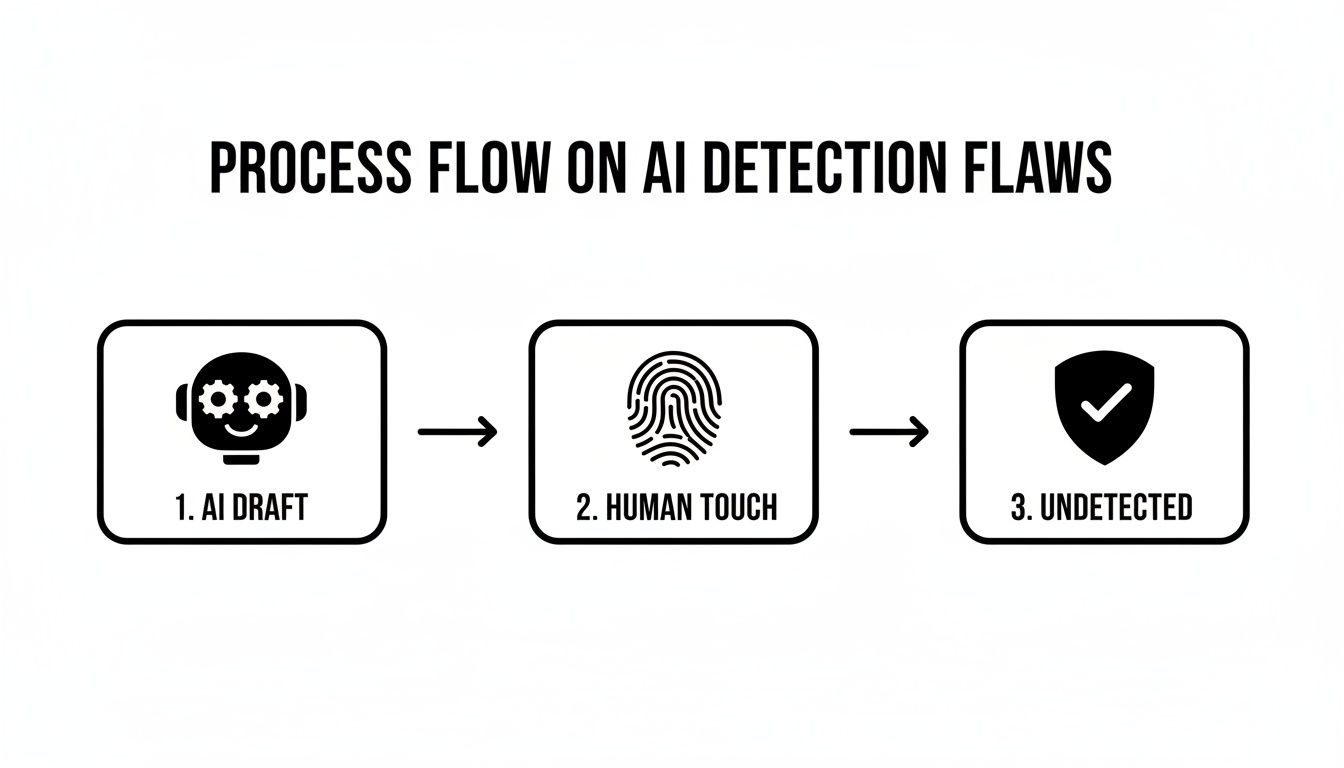
That middle step—the "human touch"—is absolutely non-negotiable. It's the bridge between a robotic draft and high-quality, undetectable content.
Here’s how to put this into practice:
- Generate Your Raw Material. Use an AI model like ChatGPT or Claude to get your initial draft. The more detailed your prompt, the better your starting point will be. But remember, this is just the clay.
- Run it Through a Rewriter. This is the secret weapon. A specialized tool built for humanizing, like Rewritify, does the heavy lifting. It’ll restructure sentences, swap out common AI words, and break up those predictable patterns that scream "robot."
- Do a Final Polish. Now it's your turn. Read the rewritten text out loud. Does it sound natural? Fix any awkward phrasing, add a personal story or a specific example, and make sure the tone is genuinely yours. This final pass is what adds the soul.
Combining these three parts is what makes the system work. If you skip the rewriter, you're left with a mountain of manual editing. If you skip the final polish, the text might pass detectors but will still feel a bit soulless to a human reader. This method gives you both efficiency and authenticity.
Find Your Authentic Voice and Inject It Into the Draft
This is where the magic really happens. If you want to know how to make AI writing undetectable, injecting your authentic voice into the draft is the most powerful thing you can do. It’s what takes a piece of content from simply “not AI” to genuinely human.
Think about it: AI models learn from enormous datasets, which makes them masters of the average. They churn out text that is grammatically flawless, logically structured, and completely predictable. Your unique voice is the perfect antidote to that blandness.
For marketers, this is all about leaning into your brand’s personality. Are you witty and a bit irreverent? Or is your style more professional and authoritative? A huge part of humanizing AI content is first getting crystal clear on how to define your newsletter's tone and voice so you can apply it consistently.
Weave In Personal Stories
Anecdotes are a dead giveaway of human writing. An AI can't just invent a personal experience that creates a real, emotional connection with your reader. It just doesn't work that way.
Imagine you're writing a blog post about productivity tools. Instead of just listing features, you could start with a quick story about that one time you were drowning in deadlines and how a specific workflow pulled you back from the brink. That personal touch builds immediate trust and makes your content stick.
Adding personal stories isn’t just for flavor. It naturally introduces unique phrasing and narrative arcs that AI detectors really struggle with. It’s the ultimate authenticity signal.
This technique is so effective because it shatters the standard AI output mold. You’re shifting from objective reporting to subjective experience—a fundamentally human way of communicating. This is a key step in moving past basic rewrites and using a more advanced AI text enhancer to truly shape your message.
Break the Rules… On Purpose
Perfect, sterile grammar is often a flashing red light for AI-generated text. Real people don't always write in flawless, complete sentences. We use fragments. For effect.
We also use conversational language that might not be textbook-perfect English but feels right to the reader. Try sprinkling in some of these:
- Sentence Fragments: When used carefully, they create a punchy, conversational rhythm that sounds more like how people actually talk.
- Industry Slang: Dropping in jargon specific to your field shows you’re part of the community, not just a machine scraping a Wikipedia page.
- Rhetorical Questions: See how this pulls you in? It creates a dialogue instead of a monologue, making the reader feel involved.
These little stylistic quirks are subtle, but they make a massive difference. They add what's known as "burstiness"—natural variations in sentence length and complexity—which is a key indicator of human writing that detectors often look for.
And this isn't just theory; it works. Studies have shown that even small human edits can send detection scores plummeting. One found that simple tweaks by students dropped ChatGPT detection from 74% down to 42%. Another study at UCLA showed how AI detection tools falter against humanized text, with even clever prompting fooling them completely. The data speaks for itself.
Get Hands-On with Advanced Editing and Rewriting
Once you’ve defined your authentic voice, it's time to roll up your sleeves and dive into the structural edits. This is where the real work happens—transforming a logical but lifeless AI draft into something that sounds like it was written by a real person. We're targeting the robotic sentence patterns and predictable vocabulary that are dead giveaways for AI content.
Simply tweaking a few words here and there won’t cut it. You have to be willing to deconstruct the text and rebuild it. That starts with spotting and nuking those painfully obvious AI phrases like "In conclusion," "Furthermore," or the classic "It is important to note that."
Hunt Down and Eliminate Robotic Phrases
Your first big win is going on a search-and-destroy mission for those clunky, overly formal phrases. AI models lean on these because they’re statistically common in the massive datasets they were trained on. Your job is to swap them out for something that sounds more natural and conversational.
Keep an eye out for these common culprits:
- "Furthermore..." or "Moreover..." Often, you can just start a new paragraph without a formal transition. If you need one, try a simple "Plus," or "On top of that,".
- "In conclusion..." Never announce your conclusion. Just write a strong, memorable final sentence or two that leaves a lasting impression.
- "It is crucial to..." This is pure filler. Get straight to the point and explain why something is so important.
This quick cleanup immediately makes the text feel less stiff and paves the way for the more substantial structural work to come.
This process isn't just about deleting words. It's about replacing predictable, low-perplexity language with the kind of varied and slightly imperfect phrasing a real person would use.
While nothing beats a final manual polish, a dedicated tool can handle the initial heavy lifting. Platforms like Rewritify are built specifically to diversify sentence patterns and vocabulary, taking care of the bulk of the structural rewrite for you. Once it gives you a solid new foundation, you can jump in and sprinkle in your own unique perspective. To see these methods in action, check out this guide on how to rewrite AI-generated text for a more human touch.
Reshape Sentence Structure for Better Flow
Now, let's talk about rhythm. AI-generated text often falls into a monotonous pattern of similarly structured sentences, which feels flat and unnatural when you read it aloud. The fix is simple: introduce variety.
Take this AI-generated example:
The system uses advanced algorithms. The algorithms analyze the data. The data helps to identify patterns. These patterns are used for predictions.
It’s choppy. It’s robotic. But we can easily fix the flow by combining and restructuring those ideas.
Here's the humanized version:
By using advanced algorithms to analyze data, the system identifies key patterns that drive its predictions.
See the difference? We turned four short, repetitive sentences into a single, cohesive thought that flows smoothly. Don't be afraid to do the opposite, either—if the AI gives you a long, rambling sentence, break it into a few short, punchy ones to create impact. The goal is to mix it up constantly.
Finally, attack the bland vocabulary. Instead of "very important," try "essential," "critical," or even "non-negotiable." Better yet, use a quick metaphor or analogy to illustrate your point. These creative flourishes are distinctly human and add a layer of personality that AI just can't replicate on its own.
How To Verify Your Content Quality
Before you even think about hitting “publish” or “submit,” there's one last crucial phase: the final quality check. It's not enough for the text to just feel human. You need to be sure.
This final pass is your insurance policy. It guarantees your content is not only undetectable but also accurate, credible, and genuinely polished.
Think of it like this: first, you check for robotic fingerprints, then you check for human quality. For the first part, run your edited text through a couple of different AI detectors. Don't just settle for one. I usually use a combination like GPTZero and Copyleaks because they use different detection models and can give you wildly different scores on the same text.
Using at least two tools gives you a much more reliable picture of where you stand.
A quick word of advice: don't obsess over getting a perfect "100% human" score. The real goal is to confirm your edits have scrubbed the most obvious AI tells. These scores are a guide, not a final verdict.
Beyond The Detectors: The Final Human Review
While detectors are great for spotting patterns, the most important verification step is still you. A final, careful human read-through is where you catch the subtle stuff that automated tools will always miss. This is your last chance to make sure the content truly resonates.
Here’s my personal checklist for that final review:
- Read It Out Loud: This is the best trick in the book for testing natural flow. If you find yourself stumbling over a sentence or a phrase sounds awkward, your reader will too. Rework it until it sounds like something a real person would actually say.
- Fact-Check Everything: AI tools are infamous for "hallucinating." They'll confidently invent facts, statistics, and even sources. You absolutely have to verify every claim, number, and name. An undetectable but inaccurate article can do way more damage to your credibility than a slightly robotic one.
- Check for Coherence: Does the article actually make sense? Read it from start to finish and make sure the argument flows logically from one point to the next. The introduction should set a promise that the conclusion fulfills.
This last, careful review is what elevates your work. It's the step that separates content that simply avoids detection from content that is genuinely valuable and safe to publish.
Common Questions About Undetectable AI Writing
Even with a solid workflow, it's natural to have questions. Let's dig into some of the most common concerns I hear from people trying to get this right, from navigating ethical gray areas to troubleshooting stubborn flags.
Is This Ethical For School Or Work?
This is a big one, and the answer really boils down to your intent. The goal isn't to trick people or pass off a robot's work as your own original thought. It’s about using AI as a seriously powerful assistant, not a ghostwriter.
For students, this line is pretty clear. Using AI to brainstorm, build an outline, or untangle a complicated sentence is usually fine. But turning in an essay that a machine wrote from start to finish? That’s academic dishonesty, plain and simple.
In the professional world, things are a bit more flexible. It’s become standard practice to use AI for a first draft of a marketing email or a blog post. The crucial difference is that a human expert always takes the wheel to finish the job—fact-checking, adding real-world insights, and making sure it sounds like it’s coming from the actual brand.
Is Simple Paraphrasing Enough To Avoid Detection?
Not anymore. In the early days, you could often get away with running AI text through a basic paraphrasing tool. A few swapped-out synonyms and reordered sentences were enough to fool the first-generation detectors.
But today's tools are much smarter. They're not just looking at the words; they’re analyzing deep linguistic patterns that scream "AI."
- Perplexity: How predictable and simple the word choices are.
- Burstiness: The natural mix of long, complex sentences with short, punchy ones.
- Vocabulary Richness: How diverse and nuanced the language is.
A simple paraphraser might change the outfit, but it doesn't change the robotic skeleton underneath. This is exactly why you need a more hands-on humanizing process that involves adding a genuine voice and making significant structural edits.
Why Is My Content Still Getting Flagged?
It’s incredibly frustrating to spend time editing your text, only to see it flagged by a detector. If this happens, take a deep breath and go back to your draft. It’s usually one of a few common culprits.
Did you truly gut all those classic AI filler phrases, like "In summary" or "It is important to note"? Did you make sure your sentences don't all start the same way? Sometimes, a few paragraphs can still have that tell-tale, uniform rhythm even after a rewrite.
The scale of this issue is massive. Since April 2023, Turnitin has scanned over 200 million student papers and found that a staggering 11% contained significant AI-generated text. You can discover more insights about AI in student papers to see just how prevalent this has become.
Here's my go-to trick if a piece of content keeps getting flagged: read it out loud. Seriously. Your ear will catch what your eyes miss. If a sentence sounds awkward, clunky, or just plain weird when you say it, that's almost always what's triggering the detector.
Ultimately, the best strategy is to focus on creating genuinely great content first and making it undetectable second. When you prioritize authentic, valuable communication, you naturally erase the robotic patterns that AI detectors are built to find.
Ready to transform your AI drafts into undetectable, human-quality content? Rewritify is your go-to tool for rewriting AI text to be clear, original, and ready for any audience. Try Rewritify for free and see the difference for yourself.
Relevant articles

Is ZeroGPT accurate? We tested its AI detection using 2026 data. See how it performs on false positives and reliability for students, writers, and marketers.

Learn how to humanize AI generated text with proven strategies. Move beyond robotic writing to create authentic, engaging content that connects with readers.
Learn how to pass AI detection by ethically humanizing AI-generated drafts. Our guide covers rewriting, editing, and using tools to create authentic content.
Discover how to improve my writing ai with a practical human-AI workflow that turns rough drafts into clear, original, and authentic content.
Learn how to rewrite ai text to human and turn robotic drafts into natural, engaging writing. Get practical tips to connect with readers.

Discover how to humanize ai text free with practical tips and tools to produce natural, engaging AI writing.