How to Rewrite AI Generated Text for Maximum Impact
Learn how to rewrite AI generated text into engaging, human-quality content that ranks. Master voice, SEO, and fact-checking with our proven workflow.
It's tempting to think you can rewrite AI generated text with just a quick once-over. But to create content that actually connects with people and ranks on Google, you have to go deeper. The raw output from AI tools is a starting point, not a finished product. It needs a human touch to transform it from generic filler into something genuinely valuable.
Why You Can't Just Publish Raw AI Text
The allure of instant content is strong, I get it. But hitting "publish" on a raw AI draft is a shortcut that often leads to a dead end. That unedited text usually feels hollow, misses the mark with your audience, and can seriously damage your brand's credibility. The time you save upfront is rarely worth the long-term risks.
These aren't just abstract concerns—they create real problems for your content's performance and your brand's reputation. Here’s what you're up against with unedited AI text:
- Generic Phrasing: AI models learn from a massive ocean of existing internet content, so they tend to spit out the most common, uninspired phrases. The result? Your content sounds cliché and lacks a unique point of view, which is a surefire way to bore your readers.
- Factual Inaccuracies: AI is notorious for "hallucinations." It can state completely wrong information with absolute confidence. If you publish those errors without fact-checking, you've instantly torched your credibility.
- Lack of Brand Voice: Your brand has a personality—maybe it's witty, professional, or super technical. Raw AI text is sterile and can't replicate that nuance, creating a jarring experience for your audience.
- Missed SEO Nuances: Sure, an AI can stuff keywords into a post. But it doesn't understand the strategic finesse required for real SEO success. It misses opportunities for semantic keywords, smart internal links, and headings that truly match search intent.
The Performance Gap Between Human and AI Content
The numbers tell a pretty clear story. AI-written articles have exploded, now making up 39% of all articles published online. But that growth has hit a wall, mostly because the content just doesn't perform well in search.
Digging into the data, you'll find that around 86% of articles that show up in Google Search results are written by humans. AI-generated content? It's sitting at only about 14%. For a deeper dive into these trends, check out the analysis on Graphite.io.
This performance gap exists because quality, expertise, and originality are what truly matter. AI can pull information together, but it can't build real authority or earn a loyal audience on its own.
The Invisibility of Raw AI Drafts
If you want to understand why rewriting is so critical, it helps to know why your content might not appear in ChatGPT or other models. These systems are designed to learn from unique, authoritative sources.
A generic, unedited article that sounds like a thousand others is never going to be seen as a valuable source. It's just noise.
Ultimately, choosing to rewrite AI generated text isn't an extra step—it's the heart of any smart content strategy today. It's how you turn a soulless draft into a powerful asset that connects with readers, builds trust, and actually drives results.
Getting Your AI Draft Ready for a Human Touch
Before you can work your magic on an AI-generated draft, you need a solid foundation. I’ve learned this the hard way: skipping the initial prep work means you'll spend twice as long cleaning up the mess later. The real goal here is to get from a raw, often robotic, draft to a structured piece that’s actually ready for your expertise.
This whole process kicks off long before you start editing—it begins with the prompt. The quality of what the AI spits out is a direct reflection of the instructions you give it. If you feed it a vague, one-sentence prompt, you’re pretty much guaranteed to get generic, uninspired content that needs a complete overhaul.
Think of your prompt as a detailed creative brief. You need to be specific. Tell the AI who the target audience is, what tone of voice you're aiming for, and which key topics it must cover. It's also smart to include negative constraints—things the AI should absolutely avoid mentioning. A well-designed prompt is your first and best defense against bland, cookie-cutter content.
This is a perfect illustration of what happens when you just run with a raw AI draft without any real prep.
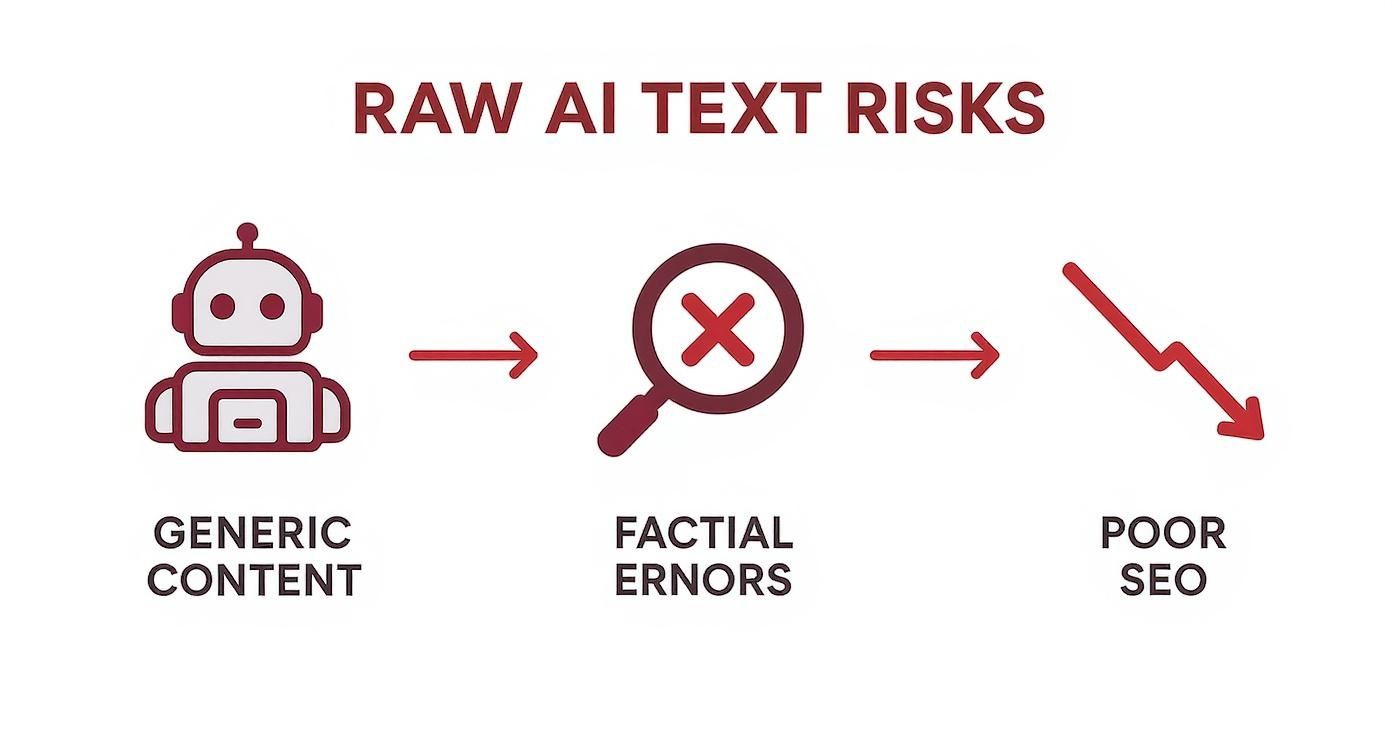
As you can see, generic text is a slippery slope. It often leads to factual mistakes and tanks your SEO, creating a domino effect that completely undermines what you were trying to achieve.
Start With a High-Level "Macro Edit"
Once you have that first draft, resist the temptation to start fixing commas and rewording sentences. That comes later. Your first pass should be a "macro edit," where you look at the big-picture structure and flow. At this stage, you’re not a writer; you're an architect reviewing the blueprints.
Skim through the entire draft. Does the intro actually grab you? Do the sections flow logically, or does it feel like a random collection of thoughts? AI models are famous for repeating themselves and stuffing in filler paragraphs that add zero value. Be ruthless. Cut anything that feels redundant or out of place.
Pro Tip: Your main goal during this macro edit is to find and fix structural problems. A beautifully written sentence is wasted if it’s sitting in a section that shouldn’t even be there.
This structural check ensures your core message holds up before you waste time polishing the details. To learn more about building a strong foundation, take a look at these content creation best practices, which apply whether you're writing from scratch or with AI's help.
A better prompt from the start can drastically reduce the time you spend on this macro edit. It’s all about giving the AI specific, actionable instructions.
AI Prompting Techniques for Better First Drafts
The table below shows how a few simple tweaks to your prompting style can produce a much better starting draft, saving you a ton of editing time.
| Prompting Element | Standard (Vague) Prompt Example | Advanced (Specific) Prompt Example | Impact on Rewriting Effort |
|---|---|---|---|
| Audience | "Write about SEO." | "Write for a small business owner who is new to SEO and feels overwhelmed." | High. The advanced prompt generates targeted, empathetic content. |
| Tone of Voice | "Use a professional tone." | "Write in a helpful, expert, and slightly informal tone, like a trusted mentor." | High. Prevents robotic, overly formal language from the start. |
| Structure | "Include an intro, body, and conclusion." | "Structure this as a 5-step guide with H2 headings for each step. Include a short FAQ at the end." | Medium. Gives you a coherent structure instead of a wall of text. |
| Negative Constraints | "Explain link building." | "Explain link building but do not mention PBNs or any black-hat tactics." | Medium. Prevents the AI from including irrelevant or harmful information. |
By being more specific upfront, you guide the AI toward producing a draft that already aligns with your goals, making the entire rewriting process much smoother.
A Quick Checklist for Your First Pass
To keep your macro edit focused and efficient, use a simple checklist. This helps you spot the most common AI-generated flaws without getting lost in the weeds.
During your initial review, ask yourself these questions:
- Does it flow? Does each section transition smoothly into the next, or are there awkward, jarring jumps?
- Is the structure sound? Is there a clear beginning, middle, and end that makes sense for the topic?
- Is it repetitive? Watch out for the AI saying the same thing in slightly different words. Find those spots and merge them.
- Is the argument cohesive? Does the article build a clear point from start to finish, or does it just feel like a random list of facts?
Tackling these big-picture issues first gives you a much cleaner, more organized draft to work with. From there, you can dive into the more creative work of adding your unique voice and expertise. You've now got a solid skeleton, and you're ready to bring it to life.
Injecting Your Brand Voice and Unique Perspective
Okay, this is where the magic really happens. You've got the AI's first draft, the structure is there, but now it's time to breathe some life into it. The goal is to take that robotic, generic text and make it sound like it came directly from you. This isn't just about swapping a few words—it's about fundamentally reshaping the content to reflect your brand's personality and your unique point of view.
Let's be honest, AI-generated text is inherently bland. It’s built on a massive dataset, so its default voice is an average of everything it’s ever read. But your brand isn't average. It has its own quirks, its own sense of humor, its own way of looking at the world. To truly rewrite AI generated text, you have to infuse that DNA into every sentence.
Defining Your Brand Voice
Before you can add your voice, you need to know what it sounds like. Is your brand witty and a little bit sarcastic? Or is it more formal, academic, and authoritative? Maybe you aim for a conversational and friendly tone, like a helpful mentor. If you haven't nailed this down, now's the time.
A strong brand voice really boils down to a few core elements:
- Tone: The overall attitude you're projecting (e.g., professional, humorous, empathetic).
- Diction: The specific words you lean on (e.g., saying "team up" instead of "collaborate").
- Rhythm: The flow of your sentences (are you using short, punchy phrases or longer, more descriptive ones?).
Having a guide for this is a game-changer. You can check out our brand style guide template to get started on documenting these crucial elements. This document becomes your north star, ensuring every piece of content you touch feels consistent and authentic.
From Robotic to Relatable: A Practical Example
Let's see this in action. Imagine an AI spit out this paragraph for a blog post about productivity software.
AI-Generated Text (Before):
"The utilization of productivity software is paramount for modern enterprises seeking to optimize operational workflows. These digital solutions facilitate enhanced collaboration among team members and provide robust mechanisms for task management, thereby increasing overall efficiency and output."
Technically correct? Sure. But it’s also stale, stuffy, and packed with corporate jargon nobody actually uses. Now, let’s rewrite it with a more conversational and helpful brand voice.
Human-Rewritten Text (After):
"If your team is drowning in scattered tasks and endless email chains, the right productivity tool can be a lifesaver. It’s all about bringing everyone together in one place, making it easy to see who’s doing what, and finally getting projects across the finish line without the usual chaos."
See the difference? The rewritten version connects on a human level. It uses relatable language ("drowning in scattered tasks") and focuses on the real-world benefits ("getting projects across the finish line") instead of just listing abstract features. That's the heart of rewriting for brand voice.
Weaving in Your Unique Perspective
Your brand's voice isn't just how you say things; it's also what you say that no one else can. This is your chance to add value that an AI simply can't invent on its own.
Personal Anecdotes and Experiences
Share a quick story about a time you struggled with the very problem your content is solving. Did you make a mistake that your readers can learn from? These personal touches build trust and make your content stick.
Proprietary Data and Insights
Do you have internal data, survey results, or unique case studies lying around? Sprinkling these into the content instantly boosts its authority. An AI can't access your company's private findings, which makes this a powerful way to add originality.
Brand-Specific Examples
Instead of using generic examples, tie them directly back to your own products, services, or company culture. This not only reinforces your brand but also makes the advice feel much more tangible for your audience.
The goal is to layer in elements that are uniquely yours. That's how you rewrite AI generated text to become more than just a rephrased article—it becomes a genuine asset. To get a head start, you can even explore how to tell AI to write like a human from the get-go, which makes the editing process that much smoother.
Using AI in content is pretty much standard practice now. In fact, 90% of content marketers plan to use AI, with the top tasks being outlining (71.7%), idea generation (68%), and initial drafting (57.4%). This isn't just about saving time; it's driving real results. Some businesses have even reported a 36% higher conversion rate on landing pages that incorporate well-refined AI content.
Ultimately, your perspective is your greatest advantage. It’s that human element that builds real authority and forges a genuine connection, turning passive readers into loyal fans.
Weaving in SEO and Nailing Factual Accuracy
Alright, you've molded the AI draft with your brand's unique voice. Now comes the part that separates amateur content from professional, high-performing assets. It's time for a two-pronged attack: rigorous fact-checking and smart SEO integration.
AI tools are notorious for "hallucinations"—they can invent facts, statistics, and quotes with stunning confidence. Publishing even one of these errors can obliterate your credibility in an instant. At the same time, if your content isn't optimized for search engines, the right audience will never find it.
Getting this stage right ensures your work is both authoritative and discoverable. It's how you turn a generic AI article into something people trust and search engines reward.
Your Blueprint for Bulletproof Fact-Checking
Trust is the currency of great content. You simply can't afford to publish a single statistic or claim that isn't 100% accurate. AI-generated drafts are often riddled with outdated data, misattributed quotes, or outright falsehoods, which makes a methodical verification process non-negotiable.
Don't just scan the text for things that seem off. You have to actively hunt for and verify every single claim. Treat every number, date, and factual statement as guilty until proven innocent.
Here’s how I tackle it:
- Isolate Every Claim: Go through your draft and highlight every verifiable statement. This means numbers, percentages, historical facts, direct quotes—anything that can be proven true or false.
- Hunt for Primary Sources: Never, ever trust another blog post as your final source. You need to dig deeper. Find the original study, the official press release, or the government report where the information first appeared.
- Cross-Reference with Multiple Sources: For major claims, I always try to find two or three independent, reputable sources that confirm the same information. This is your safety net against repeating a mistake someone else published.
This methodical approach is your best defense against misinformation. Remember, one glaring error can sink the credibility of your entire piece, no matter how well-written it is.
Weaving in Keywords for Search Visibility
Once your facts are locked down, it's time to put on your SEO hat. The mission is to integrate your target keywords without sounding like a robot—a common trap when you rewrite AI generated text. Good SEO is simply about helping the right people find your amazing content.
Start with your primary keyword and a handful of related, secondary terms. You'll want to sprinkle these into the most important parts of your article.
- Headings and Subheadings: Your H1, H2s, and H3s carry a lot of weight with search engines. Rewrite them to include keywords naturally while still telling the reader exactly what the section is about.
- Body Paragraphs: Look for opportunities to rewrite sentences to include your keywords. The trick is to make it feel completely organic and unforced.
- Image Alt Text: Every image needs descriptive alt text. When it makes sense, include a relevant keyword to give search engines more context.
A huge mistake I see people make is "keyword stuffing"—jamming the same keyword into the text over and over. This not only makes your writing clunky but can also get you penalized by Google. Focus on using your keywords thoughtfully to add clarity and context.
For example, if the AI wrote, "This method is good for making content," a better version would be, "This method is essential when you need to rewrite AI generated text for a professional audience." It's more specific, more helpful, and it includes the keyword perfectly.
The AI Content Verification Checklist
Combining fact-checking and SEO can feel like juggling, so a checklist is a lifesaver. It keeps you organized and ensures you don't miss a critical step before hitting "publish."
This table lays out a simple but effective workflow to guarantee your rewritten content is both accurate and optimized.
| Verification Step | Action Required | Recommended Tools/Sources | Common Pitfall to Avoid |
|---|---|---|---|
| Verify Statistics | Check every number, percentage, and data point against its original source. | Google Scholar, Statista, original research reports, government publications. | Accepting data from a secondary source without checking the primary one. |
| Confirm Quotes | Ensure quotes are attributed correctly and are verbatim. | Official transcripts, published interviews, reputable news archives. | Trusting a quote found on a social media graphic or aggregation site. |
| Check Timeliness | Confirm that all data and facts are current and still relevant. | Look for the publication date on sources; add the year to your searches. | Citing a five-year-old statistic for a rapidly changing industry. |
| Keyword Placement | Integrate primary and secondary keywords into headings, body text, and meta descriptions. | Ahrefs, Semrush, Google Keyword Planner. | Forcing keywords where they don't fit, creating awkward phrasing. |
By dedicating real effort to both factual accuracy and SEO, you build a powerful foundation of trust with your audience and with search engines. This dual focus is what ensures your carefully rewritten content gets the attention and respect it deserves.
The Final Polish for Quality and Originality
You’ve done the heavy lifting. The structure is solid, your brand's voice is coming through loud and clear, and you've already fact-checked and optimized everything. But before you hit that publish button, there's one last, crucial quality check. This final pass is all about protecting your reputation by making sure the text is completely original and sounds genuinely human.
This isn't about more major edits. Think of it as the fine-tuning that separates good content from truly great content. We're looking closely at sentence structure, word choice, and, most importantly, ensuring total originality.
How to Handle AI Detection Tools (Without Losing Your Mind)
AI detection tools are everywhere now, but it’s so important to use them with the right perspective. Their scores aren't the final word on your content's quality; they're more of a guidepost for refinement. Honestly, chasing a 100% human score is usually a waste of time and can lead you to over-edit your work until it barely makes sense.
Instead, treat these tools as a diagnostic. If a certain paragraph gets flagged, don't just rewrite it to "trick" the system. Step back and ask why it got flagged in the first place.
- Is the sentence structure too rigid or predictable?
- Does the vocabulary sound a bit unnatural or overly formal?
- Is the rhythm of the text feeling a little monotonous?
These are the real issues you should be fixing. The goal isn't to fool a machine—it’s to create a better reading experience for your audience. This last polish is a key part of what makes the process to rewrite AI generated text so effective.
Refining Your Sentence Flow and Word Choice
To make your content feel more human, variety is your best friend. AI models often get stuck in ruts, using the same sentence starters or predictable phrasing over and over. Your job is to break those patterns.
Start by varying your sentence length. Mix short, punchy statements with longer, more detailed ones. This creates a natural rhythm that keeps people engaged and reading.
Next, take a hard look at your vocabulary. AI sometimes drops in unnecessarily complex words trying to sound authoritative. Swap those out for simpler, clearer alternatives that actually match your brand's voice.
Here's a simple rule I live by: If you wouldn't say a phrase out loud in a conversation with a colleague, it probably doesn't belong in your content. Reading your work aloud is the fastest way to catch awkward phrasing and robotic sentences.
The rise of generative AI is changing content workflows everywhere. The global market, which was valued at around $44.89 billion in early 2025, is expected to soar past $66.62 billion by the end of the year. This boom is fueled by massive adoption, with 76% of marketers already using generative AI to create content.
The Plagiarism Check: Your Non-Negotiable Last Step
While making your content feel human is important, guaranteeing its originality is absolutely critical. This is the final gate your content must pass through, and it’s non-negotiable. Running your text through a trusted plagiarism checker is an essential part of the workflow.
Even after you've done a ton of rewriting, it’s still possible for an AI to generate phrases that are accidentally too close to something already published online. This is especially true when you're writing about common topics or definitions.
Using a tool like Copyscape or the checker built into your writing platform provides that final peace of mind. It protects your site's SEO integrity and, more importantly, upholds your professional credibility. It only takes one instance of accidental plagiarism to damage the trust you’ve worked so hard to build. To make sure you're covered, it's always a good idea to review some practical strategies on how to avoid plagiarism in your writing.
By pairing a smart approach to AI detection with a strict originality check, you ensure your final piece is polished, professional, and ready to make an impact. This last step validates all your hard work, turning a good draft into a trustworthy asset for your brand.
Answering Your Top Questions About Rewriting AI Content
Stepping into the world of AI-generated content can feel like a whole new ballgame. As you start working these tools into your process, you’re bound to have questions. Let's tackle some of the most common ones we hear so you can move forward with confidence.
How Much of an AI Draft Should I Actually Rewrite?
Everyone wants a magic number, but there isn't one. A good starting point is to aim for at least 30-50% significant changes, but honestly, the real goal isn't about hitting a percentage. It's about infusing the text with genuine human value—the stuff an AI just can't fake.
That means you keep refining until the content truly sounds like your brand. Weave in your own stories, add specific examples, and include data or insights that can't be scraped from the public web.
The real test of a great rewrite isn't how many words you changed. It's whether the final piece showcases your expertise and truly connects with your reader in a way the original draft never could. Focus on transforming the ideas, not just shuffling the words.
Can Google Detect AI Content? Will I Get Penalized?
This is the big one, and the answer isn't a simple yes or no. Google's top priority has always been rewarding high-quality, helpful content that genuinely serves the reader, regardless of how it was made.
They don't penalize content simply because AI was part of the process. What they do penalize is spammy, low-effort content created just to game the search rankings.
So, if you rewrite AI generated text to be:
- Original and insightful, offering something new to the conversation.
- Accurate and trustworthy, with every fact double-checked.
- Full of expertise (hitting all the marks for Google's E-E-A-T guidelines).
Then you're playing by the rules. The problem isn't the tool; it's the quality of the work you publish. Raw, unedited AI output is a risk, but thoughtfully rewritten and enriched content is perfectly fine.
What Are the Best Tools for This Job?
Honestly, the best "tool" is a skilled human editor. Nothing beats your own critical thinking. That said, a few platforms can definitely help streamline the work.
For polishing your final draft, you can't go wrong with staples like Grammarly and Hemingway Editor. They’re fantastic for catching sneaky grammar mistakes and tightening up your sentences, making sure your human touch is presented as cleanly as possible.
When it comes to originality, a tough plagiarism checker like Copyscape is non-negotiable. This should be the absolute final gate your content passes through before going live.
But what about those "AI humanizer" tools? My advice is to proceed with caution. They can sometimes help shake up robotic sentence patterns, but they often strip out nuance and can make your text sound even more generic if you're not careful. It’s almost always better to do the core rewriting yourself to ensure your brand's voice and authority shine through.
Ultimately, a hybrid approach works best. Use technology for the mechanical stuff—grammar, spelling, and plagiarism checks—but rely on your own brain for the heavy lifting of rewriting, adding value, and making the content uniquely yours.
Ready to turn your AI drafts into polished, original content? Rewritify offers specialized modes to help you rewrite text while preserving your unique voice. Try our AI-powered rewriter for free and see how easy it is to create human-quality content that connects with your audience and meets your goals. Get started with Rewritify today
Relevant articles

Learn how to humanize AI generated text with proven strategies. Move beyond robotic writing to create authentic, engaging content that connects with readers.
Learn how to pass AI detection by ethically humanizing AI-generated drafts. Our guide covers rewriting, editing, and using tools to create authentic content.
Discover how to improve my writing ai with a practical human-AI workflow that turns rough drafts into clear, original, and authentic content.
Learn how to optimize content for SEO with this actionable guide. Master keyword research, on-page optimization, and content strategy to boost your rankings.
Learn how to make AI writing undetectable. Our guide shows you how to transform robotic AI drafts into authentic, human-quality content that bypasses detectors.
Learn how to rewrite ai text to human and turn robotic drafts into natural, engaging writing. Get practical tips to connect with readers.