How to Optimize Content for SEO and Rank Higher
Learn how to optimize content for SEO with this actionable guide. Master keyword research, on-page optimization, and content strategy to boost your rankings.
Figuring out how to optimize content for SEO isn't a one-and-done task. It's a craft that blends technical know-how with a genuine understanding of what your audience actually wants. The whole game boils down to a few key things: smart keyword research, creating content that truly solves a problem, and nailing all the on-page details.
Why Modern Content Optimization Is More Than Keywords
If you think SEO is still about stuffing keywords onto a page, you're living in the past. Search engines like Google have gotten incredibly smart, and their main goal is to reward content that provides real value to real people. This means your strategy needs to be about more than just appeasing a robot; it's about creating a great experience for your reader.
The focus has completely shifted from just targeting a keyword to understanding the question behind the search. It’s about building the best, most complete resource on the internet for that topic. When you do that, you don't just rank higher—you build real authority and earn your audience's trust.
The Modern SEO Workflow
To consistently create content that ranks, you need a process you can rely on. A solid workflow ensures you cover all your bases, from the first spark of an idea all the way to analyzing how your content performs after it's published.
This flowchart lays out the modern SEO process, breaking it down into three simple phases: research, creation, and measurement.
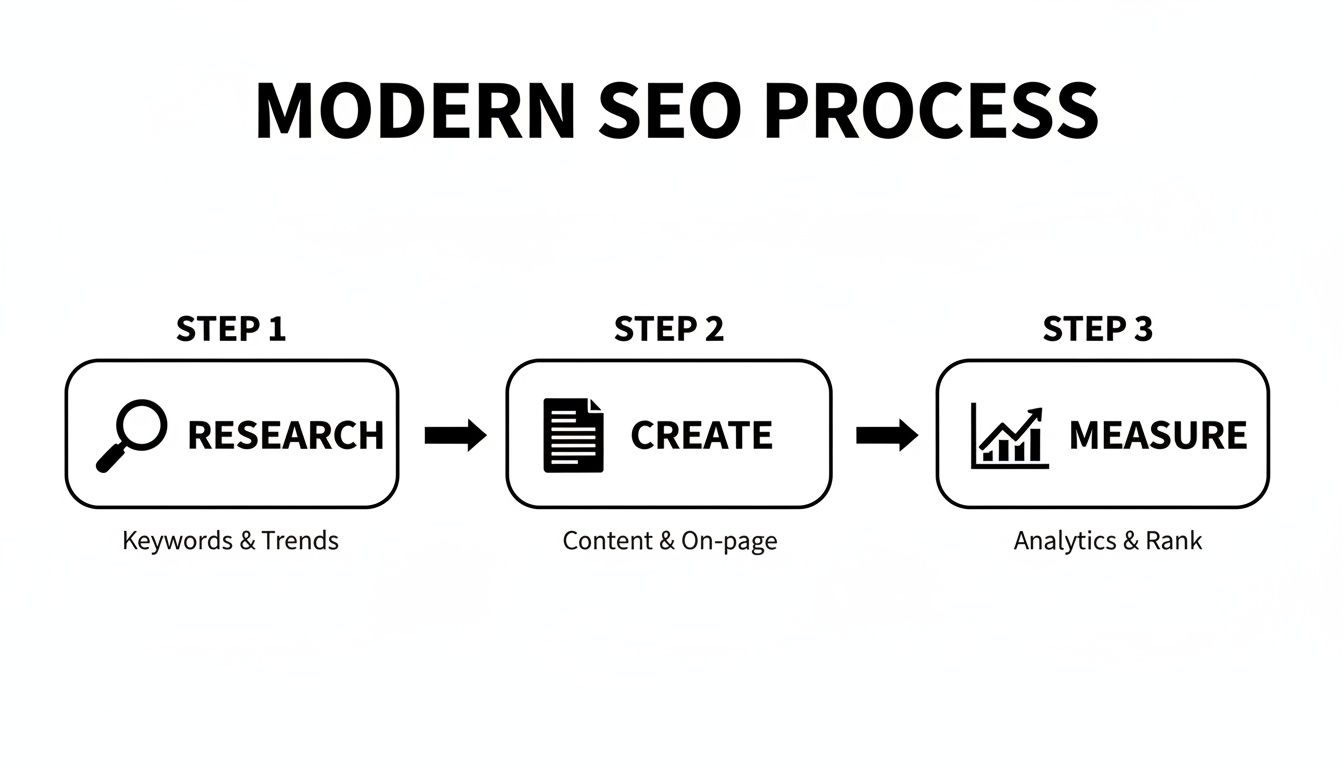
Think of it as a continuous loop. SEO isn't a "set it and forget it" activity. It's a cycle of creating, measuring, and improving based on what the data tells you.
Before we dive into the step-by-step process, let's get a high-level view of the core pillars we'll be covering. This framework is the foundation for everything that follows.
Key Pillars of Modern Content SEO
| Pillar | Core Focus | Key Outcome |
|---|---|---|
| Research & Intent | Understanding what users are really looking for behind their search queries. | Content that perfectly matches audience needs and search intent. |
| Structure & Readability | Organizing content logically with clear headings and a great user experience. | Higher engagement, lower bounce rates, and better rankings. |
| On-Page SEO | Optimizing technical elements like titles, meta descriptions, and URLs. | Improved click-through rates and better search engine visibility. |
| Authority & Linking | Building credibility through internal links and demonstrating expertise. | Stronger site authority and improved content discovery. |
| Performance & Iteration | Tracking key metrics and continuously refining your content based on data. | Sustainable, long-term organic growth. |
This table maps out our journey. By mastering each of these pillars, you'll be well-equipped to create content that not only ranks but also resonates with your audience.
Beyond SEO to AEO
As search changes, so do our tactics. It's no longer just about SEO; we're now optimizing content for AI search (AEO). This means structuring your content to give clear, direct answers that AI assistants and generative search can easily pull from. It's a subtle but crucial evolution in how we need to think about content.
The best results always come from a mix of smart automation and human strategy. AI tools can speed up your research and find patterns you might miss, but it's that human touch that creates content that actually connects with people.
When you combine these modern tactics with proven content creation best practices, you build a powerful, reliable engine for organic growth. In this guide, we'll walk through this entire framework, giving you practical, actionable advice every step of the way.
Finding Keywords That Actually Drive Results
Every great piece of SEO content starts with one thing: the right keywords. But let's be clear—this isn't about chasing high-volume vanity metrics. It's about getting inside your audience's head and understanding the intent behind their search. After all, a flood of traffic is useless if none of those visitors are actually looking for what you offer.
The real goal is to map out a keyword strategy that follows your audience through their entire journey. You want to be there with the answer when they first ask a question and guide them all the way to a solution. This is how you attract not just eyeballs, but engaged readers and potential customers.
Decoding Search Intent
Search intent is simply the "why" behind a Google search. Is someone looking to learn, buy, or find a specific website? Honestly, getting this right is more important than search volume.
Google's number one job is to give users what they want. If your content doesn't line up with the intent of a keyword, you're not going to rank. It doesn't matter how perfectly you’ve optimized the page.
Here’s a quick breakdown of the main intent types:
- Informational: The user needs information. "How to optimize content for SEO" is a perfect example.
- Navigational: They're trying to get to a specific site. Think "Rewritify blog."
- Commercial: They're in research mode, weighing their options before a purchase. A classic query is "best content rewriting tools."
- Transactional: They've got their wallet out and are ready to buy. "Rewritify pricing plans" signals this intent.
For a comprehensive guide like this one, our focus is squarely on informational intent. Matching your content to the right intent is the first domino to fall in a successful SEO strategy.
Building Your Keyword Arsenal
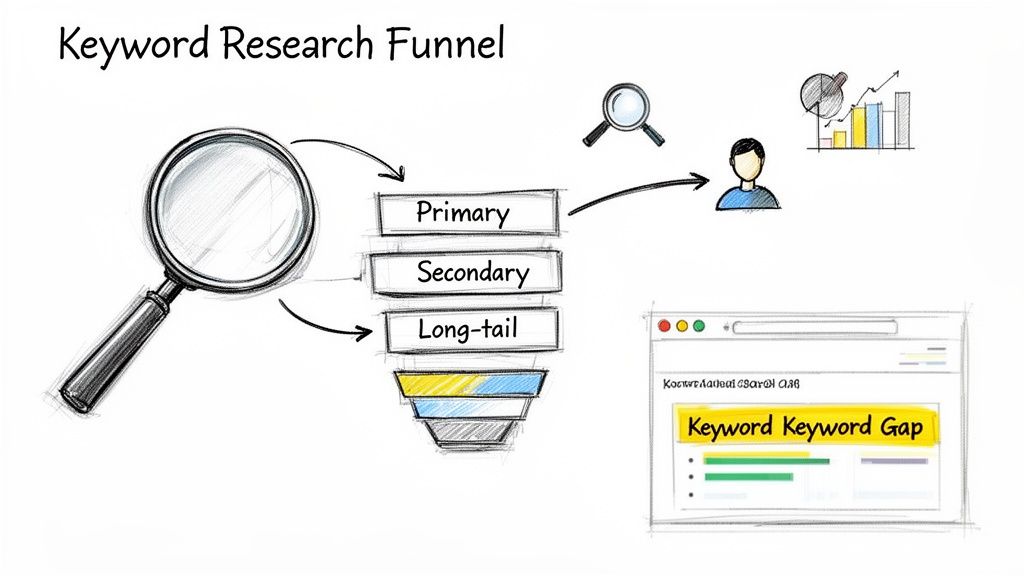
With a clear understanding of intent, you can start building your list. The best approach is a balanced one, mixing primary, secondary, and long-tail keywords to create a truly comprehensive article.
Your primary keyword is the big idea, the central theme of your content. For us, that’s "how to optimize content for seo."
Secondary keywords are the supporting pillars that add depth and context. Things like "on-page SEO techniques," "content structure," or "keyword research for blogs" all help flesh out the main topic.
Finally, long-tail keywords are those longer, more specific phrases. They usually have less competition but much higher conversion rates because the user's need is so specific. A query like "how to find long-tail keywords for a new blog" is a great example of someone with a very precise problem you can solve.
Think of keyword research as assembling a toolkit. Your primary keyword is the hammer, but you still need screwdrivers, wrenches, and measuring tape—your secondary and long-tail keywords—to build something sturdy and complete.
Practical Keyword Research Methods
You don't need a massive budget to unearth valuable keywords. A few smart tactics using both free and paid tools will give you everything you need.
Start with the most obvious tool: Google itself. Type your primary keyword into the search bar and watch the autocomplete suggestions. These are real-time queries from real people.
Then, scroll down the search results page. The "People Also Ask" and "Related searches" sections are absolute goldmines for finding secondary and long-tail keywords straight from the source.
When you're ready for a more structured approach, you can turn to dedicated tools:
- AnswerThePublic: This free tool is fantastic for visualizing the questions, prepositions, and comparisons people search for around your topic.
- Ahrefs or Semrush: These premium platforms are the industry standard. They offer deep dives into keyword difficulty, search volume, and competitor analysis, helping you spot gaps in the market.
Speaking of competitors, analyzing what they rank for can reveal incredible opportunities. Look for keywords where the top-ranking content is a bit thin, outdated, or just doesn't fully answer the user's question. That’s your opening to create a better resource and swoop in. Building out this keyword map is the foundational first step in truly mastering how to optimize content for SEO.
Structuring Your Content for Readers and Search Engines
Even the best keyword strategy will fall flat if your content is just a wall of text. A solid structure is what transforms raw information into a clear, engaging experience—one that keeps people on the page and sends all the right signals to Google. Think of it as drawing a map for both your readers and the search engine crawlers.
When you really dig into how to optimize content for SEO, you'll see that user experience and technical optimization aren't separate things. They're two sides of the same coin. An article with a logical flow and clear hierarchy doesn't just look good; it helps search engines understand how your ideas connect, which is a huge part of ranking well.
Building a Logical Hierarchy with Headings
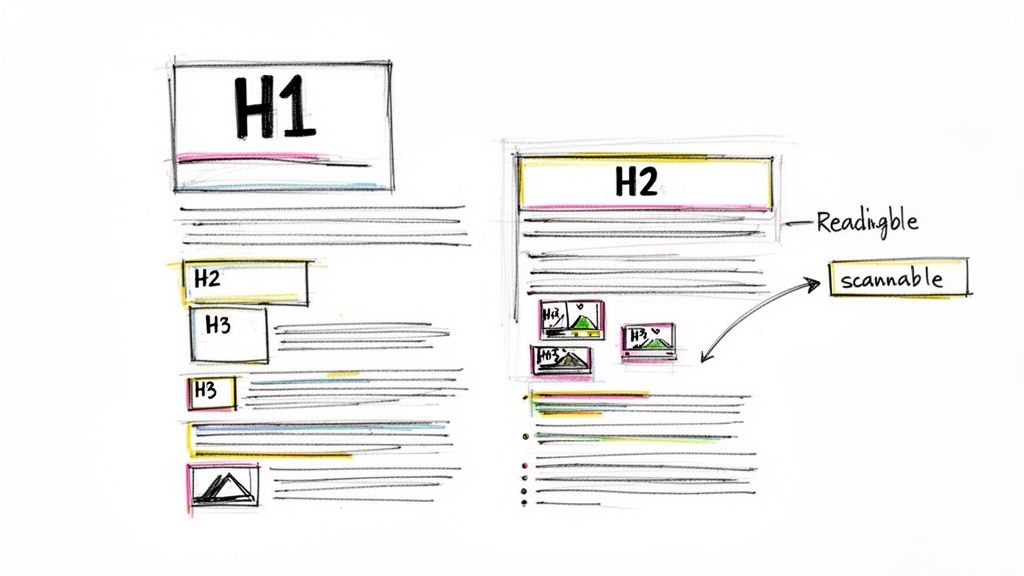
Headings are the backbone of your article. They break up massive blocks of text, creating a scannable outline that lets people find exactly what they need, fast. For search engines, they’re like signposts that explain your content's main topics and subtopics.
Your heading structure should be simple and predictable.
- H1 (Your Title): You only get one of these per page. This is your article's main title and should almost always include your primary keyword.
- H2s (Main Sections): These are the major pillars of your article. Think of them as chapters in a book. For this guide, "Finding Keywords That Actually Drive Results" is an H2.
- H3s (Sub-sections): Use these to dive deeper into the topics under each H2. They add more granularity and make complex subjects much easier to follow.
This nested structure gives your content a clear information hierarchy. Someone can get the gist of your entire article just by scanning the headings, which is a massive win for keeping them engaged.
Crafting an Introduction That Hooks Readers
You’ve got about three seconds. That's it. Your introduction is your one chance to grab a visitor's attention and convince them they've found the solution to their problem. A weak intro sends your bounce rate skyrocketing, telling Google your page isn't the right answer.
Forget the long, meandering wind-up. Get straight to the point. Acknowledge their problem and tell them exactly what they'll gain by reading your article.
Your introduction should make one simple promise: "You're in the right place. Keep reading, and you'll get the answer you came for." Delivering on that promise is what keeps people on your page.
Once you’ve hooked them, the rest of your content has to be just as easy to consume. That means making it scannable and breaking things down into bite-sized pieces.
Making Your Content Scannable and Engaging
People don't read online; they scan. Your job is to make your content incredibly easy to scan. This is where your formatting choices become a secret weapon.
Keep your paragraphs short. I’m talking one to three sentences, maximum. This creates white space, which makes the content feel less overwhelming, especially since over 50% of all web traffic now comes from mobile devices.
Next, use visual elements to break up the monotony of text:
- Bulleted Lists: They’re perfect for calling out features, benefits, or key takeaways without bogging the reader down in a dense sentence.
- Numbered Lists: Use these for step-by-step instructions or ranking items. They provide a clean, logical flow that's easy to follow.
- Bold Text: Use it strategically to make key terms, stats, or important phrases pop. But don't overdo it, or it loses all its power.
By structuring your content this way, you’re working with modern reading habits, not against them. You give the scanners quick answers while still providing deep value for the people who want to read every word. It's a fundamental part of creating content that actually works for both people and search engine algorithms.
Nailing Your On-Page SEO
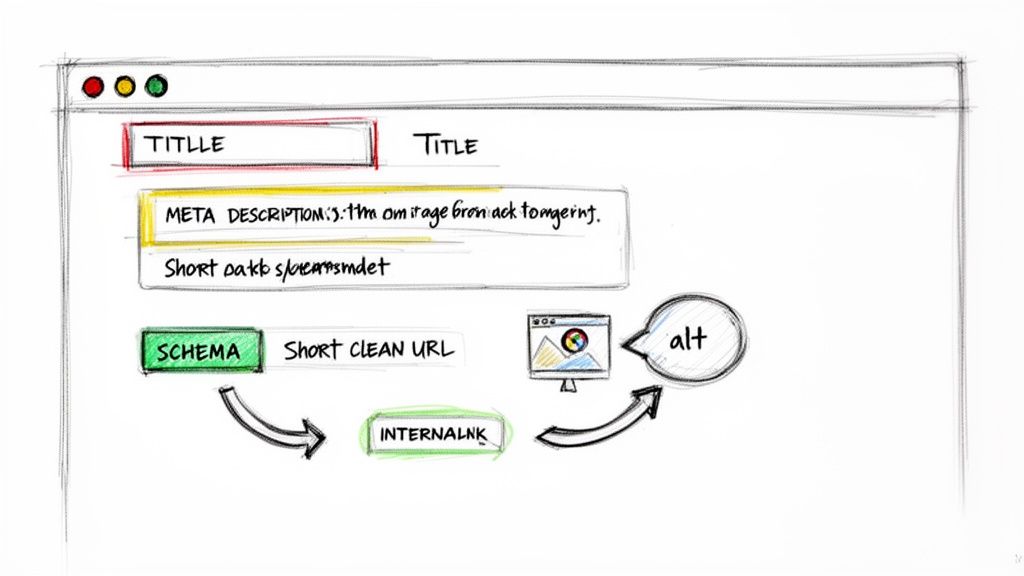
Alright, you’ve done the heavy lifting with keywords and you've got a solid content structure. Now it's time to zoom in on the technical on-page details. These are the direct signals you send to search engines, telling them exactly what your content is about and why it deserves to rank.
Think of this as the final polish. It's about crafting killer metadata, cleaning up your URLs, and strategically using links to build authority. Each one of these elements is a powerful signal to Google, and getting them right can be the difference-maker that pushes a great article into the top spot.
Optimizing Titles and Meta Descriptions
Let's be blunt: your title tag is probably the single most important on-page SEO factor. It's the first thing anyone sees in the search results, and it's what makes them click. A great title is a careful dance between slotting in your primary keyword and writing a headline that genuinely piques someone's interest.
Your meta description, on the other hand, won't directly boost your rankings, but it has a massive impact on your click-through rate (CTR). This is your 160-character sales pitch in the SERPs. You need to use this tiny space to sell the value of your article and maybe even nudge them with a subtle call to action.
- For Title Tags: Aim for under 60 characters, get your main keyword in early, and never, ever duplicate titles across pages.
- For Meta Descriptions: Write a unique, compelling summary around 155-160 characters. Tell the user exactly what they're going to get.
Your title and meta description are your digital handshake with a potential reader. A limp, generic one gets scrolled past. A firm, confident one gets the click. Make it count.
Crafting Clean URLs And Alt Text
Beyond the metadata, a few other technical pieces play a crucial supporting role. Your URL, for example, should be simple and logical. It needs to be instantly understandable to both people and search engine crawlers. A clean URL acts as a signpost for your page's topic.
A messy URL like yourblog.com/archive/2024/10/post?id=123 is just noise. It tells Google nothing. Compare that to yourblog.com/how-to-optimize-content-for-seo — it’s clean, keyword-rich, and immediately signals what the page is about.
Likewise, every single image needs descriptive alt text. This isn't optional. Alt text is essential for web accessibility (for users with screen readers) and it gives search engines vital context about your visuals, helping them show up in image searches. Ditch "image1.jpg" and use something descriptive, like "diagram of SEO elements showing title tag and URL structure."
The Power of Content Depth And Internal Linking
Google consistently rewards comprehensive content that digs deep into a topic. This is why you'll often see longer articles dominating the top search results. It’s not about word count for the sake of it; it's about providing real, thorough value.
The data backs this up. Top-ranking pages often land between 1,450 and 2,500 words, and businesses that blog consistently can see up to 350% more traffic. Even better, simply updating and republishing old content with more depth can boost its traffic by over 100%.
Internal linking is the glue that binds your site's authority together. Whenever you publish a new article, you should immediately look for older, relevant posts to link from. This simple action passes "link juice" to your new piece and helps Google discover and index it way faster.
A smart internal linking map guides both users and search crawlers through your site, demonstrating the relationships between your content. When done right, it can give your most important pages a significant ranking boost.
Before hitting publish, it's always a good idea to run through a quick checklist to make sure you've covered all your on-page bases.
On-Page SEO Checklist
| Element | Best Practice | Impact Level |
|---|---|---|
| Title Tag | Under 60 characters, primary keyword upfront. | High |
| Meta Description | 155-160 characters, compelling and unique. | Medium (CTR) |
| URL | Short, descriptive, and includes the keyword. | Medium |
| H1 Tag | One per page, matches user intent. | High |
| Subheadings (H2, H3) | Break up content, use secondary keywords. | Medium |
| Image Alt Text | Descriptive text for all important images. | Medium |
| Internal Links | Link to/from other relevant pages on your site. | High |
| Keyword Placement | Naturally in the first 100 words, body, and H2s. | Medium |
This checklist serves as a final quality control step, ensuring every piece you create is primed for search engine success.
Weaving Keywords Naturally
Finally, let's talk about actually placing your keywords. The days of "keyword stuffing" are long gone—and doing it now will get you penalized. The real goal is to work your primary and secondary keywords into the text where they feel completely natural.
Your first priority should always be creating a great reading experience. As you write, you'll find that your target keywords fit perfectly into your introduction, your conclusion, and a few key subheadings without any effort. This is where mastering SEO copywriting best practices becomes so valuable. You're writing for people, but in a way that search engines can't help but understand.
6. Polish, Rewrite, and Refresh Your Content
Putting words on the page is just the start. The real work—and where you get a serious competitive edge—begins with polishing and refining that content. A first draft, whether it’s your own raw thoughts or a starting point from an AI, is almost never ready to go live. The magic happens during the rewrite.
This is where you inject clarity, personality, and strategic SEO into the text. You’re transforming a good idea into a high-performing asset that's not just informative but also unique, easy to read, and perfectly in sync with what your audience needs. Nailing this step is a huge part of learning how to optimize content for SEO.
Turning a Draft into a Polished Asset
We’ve all been there, staring at a clunky paragraph or a decent but soulless AI draft. The real challenge is elevating that text into something that sounds genuinely human and actually connects with people. It all comes down to flow, tone, and originality.
Here’s a simple trick I use all the time: read your draft out loud. Seriously. You’ll immediately catch awkward phrasing, robotic sentences, and clunky transitions that your eyes might have skimmed over. Does it sound like a real person talking? If not, it's time to tweak it.
Your goal is to make sure the final piece sounds like you while being incredibly easy for your audience to digest. This is where the right tools can save you from hours of painful wordsmithing.
Using Rewritify for Readability and a Human Touch
Instead of agonizing over every single sentence, an AI-powered rewriting tool can give you a massive head start. Take Rewritify, for example. It lets you pop in a chunk of text and get multiple fresh versions of it in a single click.
Let's say you have a paragraph that's technically correct but completely dry. Paste it in, choose a mode like "Natural" or "Simple," and you'll instantly get alternative ways to say the same thing, but with better flow and clarity.
I find this workflow is a game-changer for a few key tasks:
- Humanizing AI Content: It helps you smooth out those robotic edges and make the text more engaging and less predictable.
- Smashing Writer's Block: Stuck on a section? Seeing a few different takes on your own idea can be the spark you need to get moving again.
- Staying Original: It’s great for rephrasing source material or common industry knowledge in your own unique voice, helping you avoid any hint of plagiarism.
Once you’ve got a rewritten version you love, your expertise comes back into play. You’ll still need to fact-check it, weave in your keywords naturally, and make sure it fits perfectly within the larger article. This blend of smart automation and human oversight is how you produce great content, fast.
The best content optimization happens when you let technology handle the grunt work. Use tools to generate options, but always let your own expertise and judgment make the final call.
The Art of the Content Refresh
Don't forget about the content you already have—it's an absolute goldmine of SEO potential. That blog post that was a star performer two years ago might be slowly sliding down the rankings simply because it's getting stale. Refreshing old content is one of the highest-impact things you can do for your SEO.
A proper content refresh is way more than just changing the publication date. It's a strategic overhaul that tells both users and Google, "Hey, this is still the most relevant, up-to-date answer out there." In fact, some studies have shown that updating and republishing old blog posts can boost their organic traffic by over 100%.
Start by hunting for pages with decaying traffic or slipping keyword rankings. You're looking for content that's still fundamentally relevant but is showing its age with outdated stats, broken links, or old examples.
A Quick Workflow for Refreshing Content
Once you've flagged a piece of content for an update, here’s a straightforward process to get the most out of it.
- Check Search Intent (Again): Has the "why" behind the keyword shifted? A search for "best social media tools" in 2024 is very different from 2021. Make sure your content is still the best answer for what people want today.
- Update Your Data: Swap out old statistics, dates, and examples for the latest ones you can find. A post from 2022 that's still citing 2020 data feels instantly untrustworthy.
- Go Deeper: Where are the gaps? What new questions are people asking? Check Google’s "People Also Ask" box for your target keyword to find easy ideas for new H3 sections you can add.
- Polish the On-Page SEO: Rewrite your title tag and meta description. Make them more compelling for a 2024 searcher. Double-check your internal links—do they still point to the best, most relevant resources on your site?
Refreshing your existing library of content should be a regular part of your SEO routine. But don't stop there. Learn how to repurpose content for maximum impact by turning that killer blog post into a video, an infographic, or a series of social media updates. For even more ideas, check out our guide on content repurposing strategies. This holistic view ensures every piece of content you create—or update—works as hard as it possibly can for you.
How to Measure Your Content's SEO Performance
Learning how to optimize content is only half the battle. If you aren't measuring your results, you're essentially flying blind. SEO isn't a "set it and forget it" task; it's a constant loop of creating, measuring, and refining. Tracking your content's performance is the only way to truly understand what's working and where you should focus your energy next.
This feedback loop is what separates good SEOs from great ones. The data you gather shows you exactly how both users and search engines are responding to your efforts, giving you a clear roadmap for what to improve.
Key Metrics to Monitor
To get a complete picture of your SEO performance, you need to look beyond a simple traffic graph. A handful of key metrics, mostly found in Google Search Console and Google Analytics, will tell you the real story.
I always start by focusing on these essential data points:
- Organic Traffic: This is your most direct indicator of SEO success. Are more people finding your content through search engines this month compared to last month?
- Keyword Rankings: Keep an eye on the positions of your main target keywords. Watching them climb the search results is one of the most satisfying signs that your hard work is paying off.
- Click-Through Rate (CTR): You'll find this in Search Console, and it's a crucial metric. It shows the percentage of people who saw your page in the search results and actually clicked. A low CTR often means your title tag or meta description isn't compelling enough.
- User Engagement Signals: Metrics like bounce rate and average time on page in Google Analytics tell you what happens after the click. High engagement is a powerful signal to Google that your content is a great answer to the user's query.
By watching this combination of metrics, you get a view of both your visibility in the search results and the quality of the experience you're delivering once someone lands on your page.
Interpreting the Data and Making Decisions
Data is useless if you don't act on it. The next step is to analyze these numbers to find opportunities. For instance, if you have a page with a high ranking but a disappointingly low CTR, that's a prime candidate for a title and meta description refresh. You've already done the hard part of ranking; now you just need to earn that click.
On the other hand, a page with tons of traffic but a sky-high bounce rate points to a content problem. The topic is clearly in demand, but the content itself might not be satisfying user intent, or it could just be poorly structured and a pain to read.
Your data tells a story about user behavior. A spike in traffic after a content update means your changes resonated. A sudden drop in rankings could signal a competitor just published a better resource. You have to listen to what the numbers are telling you.
Conducting Regular Content Audits
To keep your site healthy in the long run, make content audits a regular part of your routine. A simple quarterly audit is usually enough for most sites. Just create a spreadsheet listing your most important content pages and pull in the core metrics we just discussed.
Based on this data, you can make an informed decision for each piece of content:
- Update: The content is solid but needs a refresh. Maybe it's time to add new data, more current examples, or just go deeper into the topic.
- Consolidate: You might find you have several pages competing for the same keywords. It's often best to combine them into one definitive, comprehensive resource.
- Leave as-is: Hey, if it ain't broke, don't fix it. If a page is performing well and meeting its goals, you can leave it alone for now.
This data-driven approach ensures you’re consistently improving your content library. That's the ultimate goal when you're learning how to optimize content for SEO effectively.
Got Questions About Content Optimization? I've Got Answers.
As you start digging into content optimization, you're bound to have some questions pop up. It happens to everyone. Let's tackle some of the most common ones I hear so you can move forward with confidence.
How Often Should I Really Be Updating My Content?
There's no single magic number here, but I always tell people to review their most important "evergreen" articles at least once a year. If you're writing about a fast-moving topic, you might need to jump in quarterly or whenever a big industry shift happens. The real goal is simple: keep your content accurate, fresh, and genuinely useful.
A great, data-backed way to start is by keeping an eye on your traffic in Google Search Console. If you see a page's traffic starting to dip and slide over time, that's your cue. It's a clear signal that the content needs a refresh to hold onto its rankings.
Don't look at content updates as a tedious chore. Think of them as a massive opportunity. Honestly, refreshing a high-potential post that's gone a bit stale is often way faster and gets better results than building a new one from the ground up.
Does Every Single Blog Post Need to Target a Keyword?
Yes. A thousand times, yes. Every piece of content you publish should have a clear job to do, and for SEO, that job is directly linked to a target keyword. When you optimize for a specific phrase, you give your article a purpose and make it crystal clear to search engines who should see it.
If you don't have that keyword focus, your content is floating in the digital void. Sure, you might get a few clicks from social media, but you'll miss out on the steady, reliable organic traffic that truly builds a business over the long haul.
Is Word Count Actually a Big Deal for SEO?
This is a classic question. While word count itself isn't a direct ranking signal, what does matter is how comprehensive your content is. The reality is that longer content often performs better simply because it has the space to cover a topic in more detail, answering all the little follow-up questions a reader might have. In fact, many studies show that pages ranking on the first page of Google often have more than 1,500 words.
But—and this is a big but—never add words just for the sake of it. Don't stuff your articles with fluff to hit a random number. The ideal length is however long it takes to fully and satisfyingly answer the searcher's question. A crisp 500-word post that perfectly solves a simple problem will always beat a rambling 3,000-word beast. Focus on delivering value, not just hitting a word count.
Struggling to get your drafts to sound just right? Rewritify can help you refine your text, ensuring it’s clear, original, and connects with your audience. It’s a great tool for creating human-quality articles that readers love and search engines reward. Try Rewritify for free and see the difference.
Relevant articles
Learn how to optimize blog posts for SEO with actionable strategies. This guide covers everything from keyword intent to technical checks for higher rankings.
Discover the top 10 SEO copywriting best practices for 2025. Learn to craft content that ranks higher, engages users, and converts with our expert guide.

Learn how to rewrite AI generated text into engaging, human-quality content that ranks. Master voice, SEO, and fact-checking with our proven workflow.