Rewrite AI Text to Human - rewrite ai text to human
Learn how to rewrite ai text to human and turn robotic drafts into natural, engaging writing. Get practical tips to connect with readers.
Rewriting AI text is about more than just swapping a few words around. It's about taking a robotic, generic draft and breathing life into it, giving it an authentic voice that truly connects with a human reader. This means fundamentally rethinking sentence structures, injecting a bit of personality, and making sure the final piece feels genuine. Get this right, and you'll not only avoid AI detectors but also build trust and get real engagement.
Why AI-Generated Content Often Misses the Mark
Let's be honest, AI writing tools are everywhere, and they're incredibly useful for getting a first draft down. But leaning on that raw output without a heavy human touch is a gamble. The content often feels hollow because it's missing the subtle nuances, personal stories, and emotional texture that we, as human writers, bring to the table. It might be grammatically perfect, but it can also be painfully bland and predictable.
This isn't just a stylistic preference; it has real-world consequences. Readers are getting savvy and can spot that robotic tone a mile away. The result? Lower engagement, higher bounce rates, and a serious blow to your credibility. If your content sounds like it was spat out by an algorithm, it’s hard for anyone to trust what it has to say.
The Tell-Tale Signs of AI Writing
AI-generated text tends to leave behind a few digital fingerprints. One of the most obvious giveaways is a perfectly uniform sentence structure. You'll see paragraph after paragraph where every sentence is roughly the same length and follows the same rhythm, creating a monotonous drone that feels completely unnatural to read.
Another dead giveaway is the total lack of a unique voice. AI models are trained on an unimaginable amount of text from across the internet, so they naturally produce content that’s an "average" of everything they've learned. This means no strong opinions, no personal anecdotes, and none of the little quirks that make human writing so compelling. The content might be informative, but it's also sterile.
To fix these common issues, it helps to know what you're looking for. The table below breaks down the typical flaws in AI text and gives you a clear goal for your rewrite.
Common AI Writing Flaws and Their Human-Centric Solutions
| AI Text Characteristic | Impact on Reader | Human Rewriting Goal |
|---|---|---|
| Uniform Sentence Structure | Creates a monotonous, boring reading experience. | Vary sentence length and structure to create a natural rhythm. |
| Lack of a Distinct Voice | Content feels generic, impersonal, and untrustworthy. | Inject personality, opinions, and a unique point of view. |
| Overly Formal or Vague Language | Sounds robotic and fails to connect on an emotional level. | Use conversational language, specific examples, and storytelling. |
| Absence of Personal Experience | Information is presented without context or human insight. | Add personal anecdotes, real-world scenarios, and expert reflections. |
| Repetitive Phrasing | Reuses the same words or phrases, making it sound lazy. | Replace common AI phrases with fresh, original language. |
By consciously targeting these areas, you can start transforming sterile AI output into something that genuinely resonates. It’s all about adding that human layer of thought and experience.
The real difference between human and AI content comes down to curiosity and personal reflection. An AI can organize facts, but it can't replicate the messy, unpredictable journey of human thought that invites a reader into a real conversation.
The Growing Demand for the Human Touch
The explosive growth of the AI writing assistant market shows just how much we need to bridge this gap. Valued at USD 1.77 billion this year, the market is rocketing forward at a 22.49% compound annual growth rate and is expected to hit USD 4.88 billion within five years. This trend tells a clear story: while businesses are eager to use AI for speed, they're also realizing that the raw output just isn't good enough on its own.
Ultimately, the goal isn't just to fool an AI detector. The real win is learning how to effectively rewrite AI text to human-quality standards so your message lands with authenticity. This strategy aligns with proven content creation best practices that prioritize genuine audience connection over churning out massive volumes of content. For anyone serious about creating content that actually performs, mastering this skill is no longer just a nice-to-have—it’s essential.
A Practical Framework for Humanizing AI Content
Turning a robotic draft into something that sounds genuinely human starts with a clear plan. The first step isn’t even rewriting—it's understanding. On your initial read-through, your main job is to pinpoint the core message and slice away all the generic fluff AI models love to add for filler.
Think of yourself as a sculptor. The raw idea is there in the block of AI-generated text; you just need to chip away the excess to reveal the real shape underneath. This is where you decide what’s worth keeping, what needs a complete overhaul, and what can be deleted without a second thought.
This disconnect between a raw AI draft and what a reader actually wants is a common problem. Here’s a simple visual of what that journey looks like and why a human touch is so essential.

As you can see, there's a huge gap between the sterile output of an AI and a reader’s need to connect with the content. Your goal is to bridge that gap by adding depth and authenticity.
Inject Your Unique Voice and Experience
Once you’ve stripped the content down to its key points, it’s time to rebuild it with your own voice. This is the single most important part of the process if you want to rewrite AI text to human standards. Raw AI content is bland because it has no experiences, no opinions, and no real feelings.
Look for places to inject your own stories or real-world examples. Instead of a generic statement like, "Good customer service is important," you could share a personal anecdote.
For instance: "I recently had an issue with an online order, and the company's quick, personal response turned me from a frustrated customer into a loyal advocate." That one small story makes the content instantly more relatable and credible.
GenAI is a fantastic tool for organizing information, but it can't truly engage with it. It doesn't think through the material the way a person does.
That's the difference between content that just informs and content that actually connects. Your personal insights are the one thing no algorithm can ever replicate.
Master Sentence Rhythm and Flow
Another dead giveaway of AI writing is a monotonous sentence structure. The models often spit out paragraphs where every sentence is roughly the same length and follows the same pattern. It’s robotic, and frankly, it's boring.
Your goal is to create variety. Follow a long, detailed sentence with a short, punchy one. It just feels better. Mix simple statements with more complex thoughts that use different clauses and transitions.
Try these simple techniques to nail the rhythm:
- Vary Sentence Length: Intentionally mix it up. A good blend of short, medium, and long sentences makes the text much more dynamic to read.
- Switch Up Your Starters: Don’t start three sentences in a row with "The study..." or "The data shows..." It’s a sure-fire way to sound like a machine.
- Read It Out Loud: This is the ultimate test. If it sounds clunky or awkward when you say it, your reader will feel it too. Reading aloud is the best way to catch unnatural phrasing you'd otherwise miss.
Add Specificity and Concrete Details
Vagueness is an AI's best friend. Because they lack real-world experience, the models lean heavily on abstract language and generalizations. Your job is to replace all that fuzzy language with sharp, concrete details.
For example, an AI might write: "Implementing new software can offer many benefits." While true, it’s completely useless information.
A humanized version would be specific: "By adopting the new CRM, our sales team cut administrative work by 15%, which freed them up to focus on building client relationships."
Adding hard numbers, specific examples, and even sensory details makes your writing more vivid and trustworthy. Every concrete detail you add pulls the text further away from its robotic origins and closer to a genuine human connection.
Advanced Techniques to Make Your Writing Undetectable

Once you've nailed the basics, it's time to layer in the creative and emotional elements that AI just can't replicate on its own. This is where you really learn how to rewrite AI text to human prose. Think of it as giving the machine's perfectly structured output a soul. The goal isn't just to fool a detector, but to build a genuine connection with your reader.
A great way to start is by weaving in storytelling. Instead of just listing facts, why not frame them within a short narrative? Or use a powerful analogy to make a complex idea click. For example, explaining a tricky business process by comparing it to something universally understood—like building a house, piece by piece—makes the concept immediately stick.
This approach hits AI right where it's weakest. AI is brilliant at gathering and organizing information, but it can't truly engage because it doesn't have lived experience to draw from. It doesn’t think, it just predicts the next word.
Weave in Cultural and Conversational Language
Another trick I use all the time is sprinkling in natural, idiomatic expressions that are common for my target audience. Phrases like "a mile a minute" or "get the ball rolling" can instantly warm up a sterile AI draft, making the text feel more grounded and culturally relevant.
The key here is to be subtle. If you overdo it with slang, it sounds forced and inauthentic. You want the writing to mirror how real people actually talk and write, which is full of slight imperfections and personality—something algorithms struggle to mimic consistently.
Add Sensory and Emotional Depth
To truly elevate your writing, you have to go beyond logic and appeal to the senses. Incorporate details that help the reader see, hear, or feel what you're describing. Don't just say, "the product was successful." Instead, try something like, "You could feel the buzz in the room as sales notifications lit up everyone's screens." See the difference? That detail adds an immediate emotional punch.
This method transforms your content from a dry report into a vivid experience. When you tap into your reader's emotions, you create a much stronger and more memorable impact.
AI delivers the facts, neatly packaged. It doesn't invite the reader into a larger conversation because it avoids uncertainty. Your job is to add that messy, human process of exploration back into the text.
The demand for these skills is exploding. As more AI-generated content hits the market, the need for writers who can humanize it is growing. This niche is projected to balloon from USD 12.88 billion to a staggering USD 53.79 billion within the next decade.
To see these techniques in action, let's look at a direct comparison.
AI vs Humanized Content A Side-by-Side Comparison
The table below breaks down a raw AI-generated paragraph and shows how applying these humanizing techniques transforms it into something far more engaging and natural.
| Rewriting Technique | Before (Raw AI Text) | After (Humanized Text) |
|---|---|---|
| Add a Conversational Hook | The company’s new software was launched last quarter. The objective was to increase user productivity by 25%. It features a streamlined interface and automated workflows. | So, what happened when the company rolled out its new software last quarter? The big goal was to boost user productivity by a solid 25%, and they planned to do it with a cleaner interface and smarter workflows. |
| Inject Storytelling & Analogy | To utilize the software, users must complete a multi-step onboarding process. This ensures they understand all the key features before full implementation. | Getting started isn’t just a click-and-go affair. Think of the onboarding as a guided tour—it walks you through every important feature so you know the lay of the land before you dive in headfirst. |
| Incorporate Sensory Details | Initial feedback from the beta testers was positive. They reported that the system was efficient and the dashboard was easy to understand. | The feedback from beta testers was more than just positive; you could hear the relief in their voices. They kept saying how "clean" the dashboard felt and how the whole system just flowed without the usual clunky interruptions. |
As you can see, the "After" column doesn't just convey information—it tells a story and creates a feeling, making the content far more compelling.
To help create more unique phrasing and break away from robotic patterns, you might look into tools like a Spintax Generator. For a deeper look into making AI content truly pass as human-written, check out our guide on whether undetectable AI really works.
The Final Polish: Editing and Fact-Checking
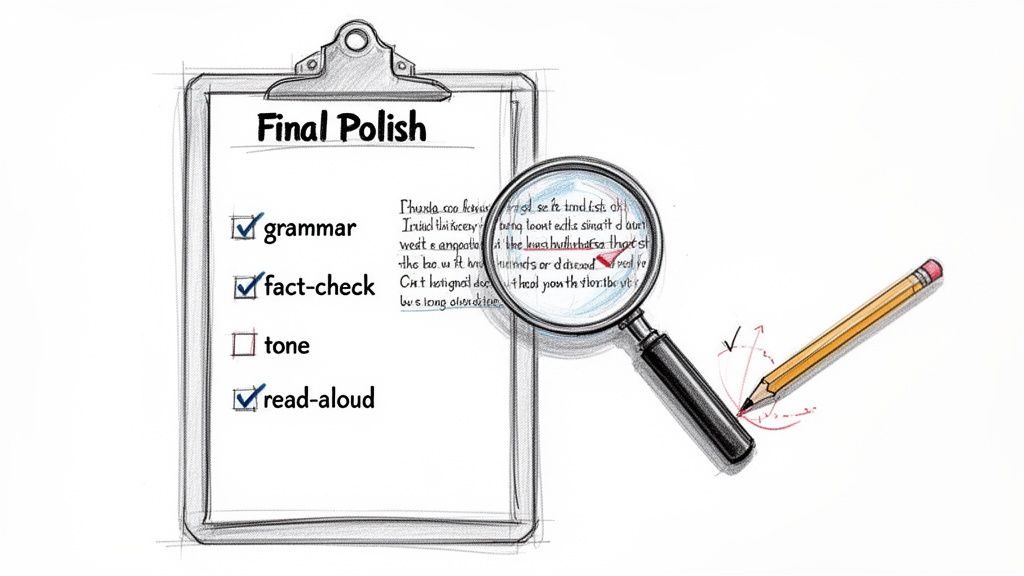
You've done the heavy lifting of rewriting, but don't hit "publish" just yet. This last stage is what separates good content from truly great, credible work. It's where you hunt down the small mistakes that can completely undermine a reader's trust.
Think of it as your final quality control. While you were focused on the bigger picture of how to rewrite AI text to human prose, it's easy for little errors to slip past. This final pass is your safety net.
Your Essential Editing Checklist
Before you send your work out into the world, it needs a thorough inspection. This isn't just a quick spell-check; it's a comprehensive review of the entire piece.
Here’s a practical checklist to guide you:
- Grammar and Spelling Scan: Run it through a reliable tool like Grammarly or ProWritingAid for the first pass. But don't rely on software alone—it often misses errors that require human context.
- Tone and Voice Consistency: Read from start to finish. Does the voice you established in the intro carry through to the conclusion? A consistent tone is crucial for building a connection with your audience.
- Flow and Readability: Look for clunky sentences or awkward transitions between paragraphs. Does every section logically lead to the next?
Here's a pro tip I swear by: read your content out loud. Your ears will immediately catch awkward phrasing, repetitive sentence structures, and robotic rhythms that your eyes might just skim over.
The Critical Step: Verifying Facts
This is absolutely non-negotiable. AI models are infamous for "hallucinations"—they can invent facts, statistics, and sources with complete confidence. A single wrong number or a misattributed quote can wreck your credibility with an expert reader in an instant.
As you review, constantly ask:
- Is this statistic still current and accurate?
- Does the source I'm linking to actually back up my claim?
- Did I attribute all data, quotes, and ideas correctly?
AI delivers facts as if they're finished products. It doesn't invite the reader into a conversation because it avoids uncertainty. Your job is to add that messy, human process of exploration—and verification—back into the text.
The explosive growth of AI text generators makes this final check more critical than ever. The Natural Language Processing (NLP) market, which is the engine behind many of these tools, is expected to jump from USD 24.1 billion to USD 112.3 billion in just a few years. You can discover more about the AI text generator market growth to see why creating accurate, human-verified content gives you a serious edge.
Ultimately, this final polish ensures all your hard work pays off, leaving you with a piece that is not only engaging but completely trustworthy.
Weaving Rewriting Tools into Your Workflow
If you want to consistently turn AI drafts into human-sounding content, you need a solid process. Just generating text and then painstakingly editing it line-by-line is a massive time sink. The real trick is to blend the raw speed of AI with your own critical judgment.
It’s all about creating a hybrid workflow. This approach helps you get to that polished final draft much faster without cutting corners on quality. Think of it not as replacing your skills, but as supercharging them with the right tools so you can focus on what truly matters: the story, the insights, and the connection with your reader.
My Go-To Three-Stage Hybrid Workflow
I like to think of my content creation process as a three-stage assembly line. Each step has a very specific job, which ensures the final piece doesn't just sound good, but feels authentic. This system gives you the speed of automation where it helps most and keeps you in control where it counts.
Here’s a breakdown of how it works in practice:
Generation (The Blueprint): First, I use a large language model like ChatGPT or Claude to get the initial draft down. My prompt focuses on the core structure, the main talking points, and the necessary research. I'm not worried about the tone at this point; it’s all about getting the raw materials on the page.
Rewriting (The Heavy Lifting): This is where a specialized rewriting tool comes in. Instead of me manually rephrasing every clunky AI sentence, I run the raw draft through the rewriter. Its job is to do the initial humanization—it breaks up those robotic sentence patterns and swaps out the all-too-common AI phrases we all recognize.
Polishing (The Final Touch): With the tedious work out of the way, I can finally step in and apply my own expertise. This final manual pass is where the magic happens. I'll add personal anecdotes, double-check the facts, tweak the tone to perfectly match my brand's voice, and make sure the whole piece flows naturally.
This structured process is the key to maintaining quality when you're producing a lot of content. Marketers can keep their brand voice consistent, students can ensure their work is original, and businesses can churn out great material far more efficiently than by starting from a blank page every time.
GenAI is fantastic for organizing information, but it can’t fake the messy, unpredictable journey of human thought. Use AI for structure and a rewriter for the initial clean-up, but always save your own brainpower for adding those essential human elements of reflection and genuine insight.
Making Your Content Production Effortless
Bringing rewriting tools into your process does more than just save you a few hours. It builds a sustainable engine for your content creation. When you can get from a rough concept to a nearly-finished draft in a fraction of the time, you free up mental energy for high-level strategy and creative brainstorming.
This method is especially powerful when you combine it with other types of automation. For example, if you're creating video content, you can use this exact workflow to generate and humanize scripts in record time. To learn more about how to streamline your video process while maintaining quality, check out these effective YouTube automation tools that work perfectly with this writing strategy.
And for more on taking your refined text to the next level, our guide on using an AI text enhancer offers some great additional tips. Ultimately, a smart workflow turns content creation from a manual chore into a strategic advantage.
Common Questions About Humanizing AI Content
As you start turning AI drafts into genuinely human-sounding content, you'll inevitably run into a few common questions. I've been through this process countless times, and getting these hurdles cleared up early on can save you a lot of headaches. Let's dig into some of the things people ask most often.
Can AI Detectors Still Catch My Rewritten Text?
This is the big one, isn't it? The short answer is yes, they can, but a proper rewrite makes it highly unlikely. The key is to go much deeper than just swapping out a few words here and there.
Think of it this way: AI detectors are trained to spot predictable sentence structures and overly formal, even-toned language. To beat them, you have to break those patterns. That means completely rethinking sentence flow, injecting your own voice, and adding specific details or a quick story that only you could provide.
My go-to strategy is a one-two punch: I'll run the initial draft through a solid rewriting tool to handle the heavy lifting of restructuring. Then, I dive in manually to add that final human layer—the personality, the anecdotes, the unique perspective. This combination is incredibly effective at getting past detectors because it addresses both the foundational structure and the stylistic nuance.
How Much Time Does This Actually Take?
The time it takes really boils down to the length and complexity of the piece. For a standard 1,000-word article, a good rewriting tool can give you a solid new draft in seconds. That's the easy part.
The real work—your manual edit—is where you add the magic. This is where you'll be fact-checking, weaving in your own insights, and polishing the tone. For me, this typically takes about 15 to 30 minutes for a blog post of that length. When you stack that up against the hours it takes to write from scratch, it’s a game-changer.
The real difference between human and AI content often comes down to curiosity and personal reflection. An AI can organize facts, but it can't replicate the messy, unpredictable journey of human thought that invites a reader into a real conversation.
What's the Single Most Important Thing to Change?
If you only do one thing, focus on the voice and tone. Hands down, this is the most critical element. Raw AI output is bland and impersonal by design; it averages everything out. Your job is to inject a point of view.
I always ask myself one simple question: "Does this sound like something a real person would actually say?"
To get there, I lean on a few simple tricks that make a massive impact:
- Real-life examples from my own work or experiences.
- A bit of personality—maybe a touch of humor or a slightly skeptical tone.
- A strong, clear opinion that shows a human is behind the keyboard.
These are the elements that transform a dry, robotic article into something that connects with and persuades a reader. It’s what builds trust.
Ready to turn your AI drafts into compelling, human-quality content? Rewritify gives you the power to rewrite any text in seconds, ensuring it’s clear, original, and undetectable. Try Rewritify for free and see the difference for yourself.
Relevant articles

Is ZeroGPT accurate? We tested its AI detection using 2026 data. See how it performs on false positives and reliability for students, writers, and marketers.

Learn how to humanize AI generated text with proven strategies. Move beyond robotic writing to create authentic, engaging content that connects with readers.
Learn how to make AI writing undetectable. Our guide shows you how to transform robotic AI drafts into authentic, human-quality content that bypasses detectors.

Discover how to humanize ai text free with practical tips and tools to produce natural, engaging AI writing.
Learn how to rewrite AI generated text into engaging, human-quality content that ranks. Master voice, SEO, and fact-checking with our proven workflow.