Improve My Writing with improve my writing ai: A Human-AI Workflow
Discover how to improve my writing ai with a practical human-AI workflow that turns rough drafts into clear, original, and authentic content.
Think of using AI to improve your writing less like hiring a ghostwriter and more like teaming up with a brilliant, but very literal, assistant. The idea isn't to let a machine do the thinking for you. Instead, you're using it to sharpen your own ideas and polish your words, all while you stay firmly in the driver's seat.
Why Your AI Needs a Human Editor
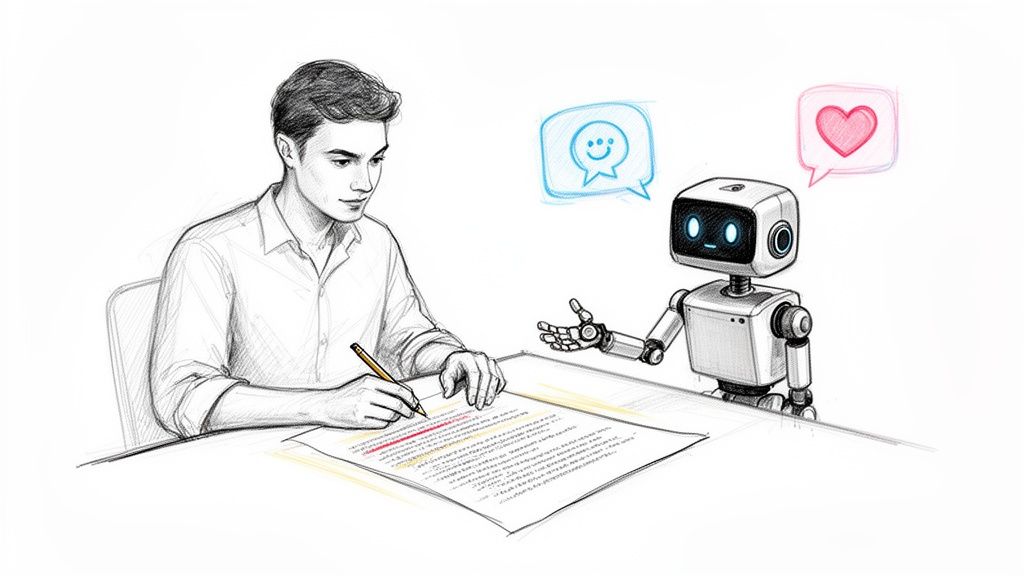
Let's be real—raw AI text usually misses the mark. It can sound stiff, lack emotional depth, and often has a weird, unnatural rhythm that just screams "robot." This guide isn't about letting AI write for you; it's about making AI work for you.
The fundamental issue is that AI doesn't have memories, feelings, or a unique point of view. It's a master of patterns, not personal experience, which is why its output can feel so generic. It's critical to understand these gaps and recognize why AI-generated content still falls short when left to its own devices.
The Human-in-the-Loop Workflow
This is exactly why a human editor—you—is so crucial. Your job is to steer the AI with your original thoughts and then meticulously refine what it gives back. It's a true collaboration, but one where you always have the final say.
Here's how this partnership works in practice:
- You bring the core idea. The initial spark comes from your expertise, your stories, your unique perspective. AI can’t invent that.
- AI provides the refinement. A tool like Rewritify can smooth out clunky phrasing, offer better word choices, or help you nail a specific tone.
- You make the final edits. You're the one who fact-checks, tweaks the language, and weaves the best suggestions into a final piece that feels authentic.
This "human-in-the-loop" model ensures your voice isn't lost in the process. You need a human brain to judge whether the AI's output actually works.
You aren't just passively accepting the AI's first draft; you're actively directing it. This simple shift in mindset turns a basic tool into an incredible partner, helping you create better content, faster, without ever sacrificing your personality.
Once you embrace this approach, you'll sidestep the common traps of unedited AI text and start producing work that's clear, compelling, and truly your own.
Choosing the Right AI Mode for Your Content Goal
Before you even think about hitting that "rewrite" button, you have to know what you're trying to accomplish. It’s a lot like giving a GPS directions—just saying "take me downtown" is useless without telling it which city you're in.
When you're asking an AI to improve your writing, you need to give it a specific destination. Are you trying to take a dense, jargon-filled report and make it understandable for the whole team? Or maybe you want to turn a casual blog post into something with a bit more authority? Each of these jobs calls for a completely different tool.
Match the AI's Mode to Your Mission
This is where the real magic happens. Most sophisticated rewriting tools, like Rewritify, aren't just one-trick ponies. They come with different modes built for specific tasks. Picking the right one is probably the most crucial decision you'll make in this whole process. It's how you tell the AI not just what to change, but how to change it.
Think about a student staring at a confusing paragraph from a scientific journal. They could use a ‘Simple’ mode to have the AI break down the complex language into plain English, making the core ideas much easier to digest.
On the flip side, imagine a freelance writer polishing a pitch for a major client. Switching to a ‘Professional’ or ‘Formal’ mode would be the smart move. This tells the AI to tighten up the language, refine the tone, and add a layer of polish that can make or break a first impression.
Selecting a mode isn't just a setting you toggle. It's your main lever for steering the AI's output. Get this right, and you'll save yourself a ton of editing time down the road.
To help you get a better handle on this, here's a quick guide to choosing the best Rewritify mode for what you're working on.
Choosing the Right Rewritify Mode for Your Task
| Your Goal | Content Type | Recommended Rewritify Mode | Key Outcome |
|---|---|---|---|
| Simplify complex ideas for a broad audience. | Academic Papers, Technical Reports, Legal Documents | Simple | Content becomes clear, digestible, and free of jargon. |
| Add polish and credibility for business comms. | Client Emails, Business Proposals, Corporate Memos | Formal or Professional | Tone is authoritative, polished, and context-appropriate. |
| Make writing sound less stiff and more human. | AI-Generated Drafts, Stale Blog Posts | Natural | The text flows smoothly with a conversational, human-like rhythm. |
| Refine language for scholarly publications. | Essays, Research Papers, Dissertations | Academic | Vocabulary and sentence structure are elevated for a scholarly context. |
| Avoid AI detection and ensure originality. | SEO Articles, Web Content, Student Assignments | Undetectable | Sentence patterns and word choices are varied to appear human-written. |
As you can see, the mode you select directly impacts the final result.
Taking a moment to define your objective first is what separates sloppy AI use from a smart, strategic workflow. This simple step turns the tool from a basic paraphraser into a real writing partner that helps you get exactly the outcome you need.
A Practical Workflow for AI-Assisted Rewriting
Alright, let's get practical. Using an AI to polish your writing isn't a "one and done" deal. The best results come from a hands-on, back-and-forth process where you guide the tool, review what it gives you, and mix the best bits with your own expertise. This isn't about letting a machine do your thinking; it’s about making your own thinking sharper and more resonant.
Some writers even pair their primary rewriting tool with dedicated AI support applications like SupportGPT to manage different parts of the content workflow.
The whole thing starts with your raw text. This could be a messy first draft, a clunky paragraph from an old blog post, or even a raw chunk of text another AI spat out. Don't stress about making it perfect at this stage—just get the main ideas on the page.
Generate and Analyze Multiple Versions
First things first: paste your text into a tool like Rewritify and generate a few different versions. This is a step I see people skip all the time, but it’s absolutely crucial. Don't just take the first thing it gives you. Create two or three variations using different modes or instructions, like one that’s more 'Natural' and another that’s more 'Simple'.
Now, it’s time to put on your editor's hat. Lay out the different versions and compare them against your original text and against each other.
- Clarity: Which one gets the point across with the least amount of friction?
- Tone: Does one sound more professional? More casual? More academic? Pick the one that matches your goal.
- Flow: Read them aloud. Which one has a better rhythm and just sounds better?
Comparing a few options lets you cherry-pick the strongest phrases and sentence structures. You’re not locked into a single interpretation; you're getting a second, third, and fourth opinion in a matter of seconds.
This is the core loop: define your goal, pick a mode, and then carefully assess the output.
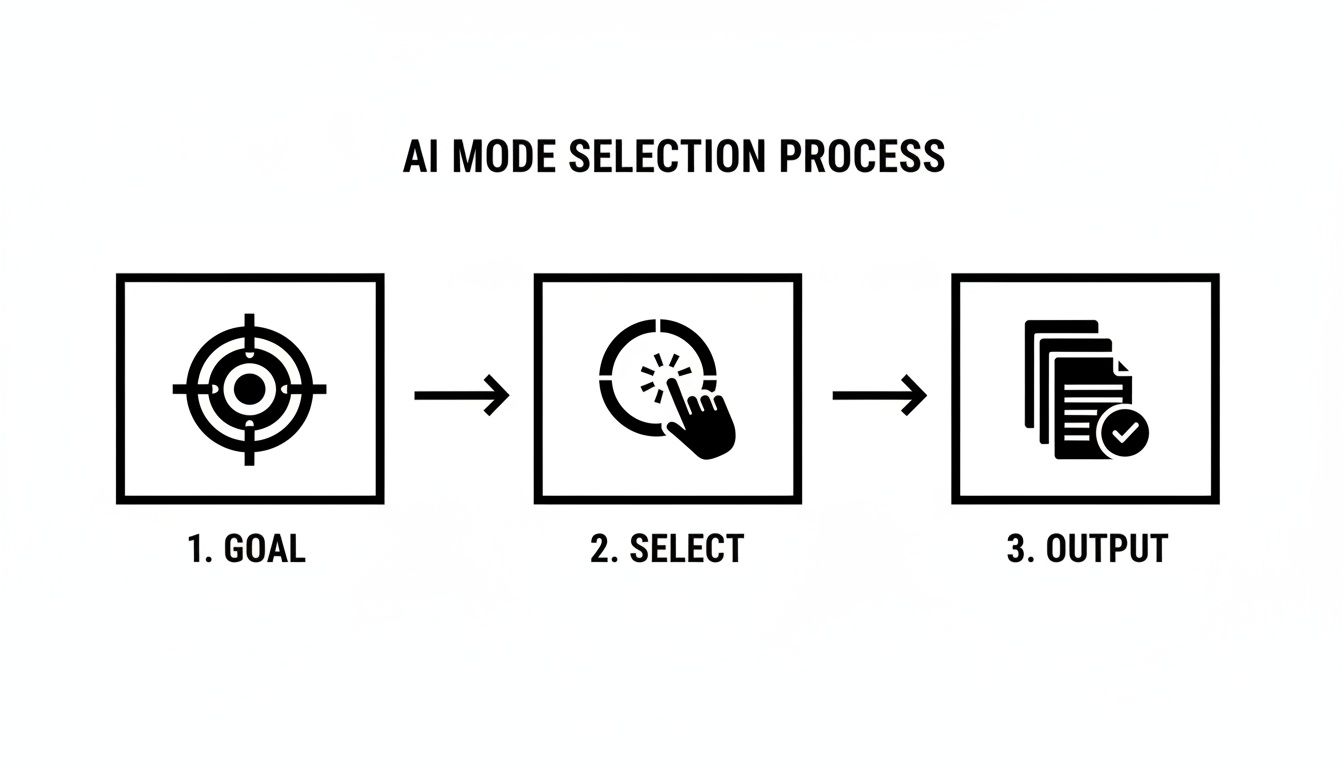
This simple, three-stage approach keeps your rewriting focused and ensures every change is intentional.
The Crucial Revision and Blending Loop
This is where you come in. The AI can suggest, but you have to steer. Your real job is to create a hybrid draft—a version that combines the AI's polished language with your unique voice and knowledge.
I usually start by picking the strongest AI-generated version as my new foundation. From there, I manually weave in the things an AI simply can't invent.
- Personal anecdotes: Add a quick, relevant story from your own experience.
- Specific data: Drop in a key statistic you found during your research.
- Expert insights: Share a unique observation that only someone in your field would know.
For instance, an AI might give you a generic sentence like, "Using technology can help businesses grow." It’s true, but it's flat. This is your chance to give it life.
Before: "Using technology can help businesses grow." After: "In my experience, small businesses that adopt simple project management tools often see a 25% reduction in project delays within the first quarter."
See the difference? That revision loop is how you use AI to truly improve your writing, not just shuffle the words around. This kind of efficiency boost is why businesses using AI writing tools are reporting a 77% jump in content output, with users saving an average of 2.2 hours per week.
Ultimately, this workflow turns the AI from a simple paraphrasing machine into a powerful writing partner. The process of generating, analyzing, and blending forces you to think more critically about your own work while using the tool to sand down the rough edges. You end up with a final piece that’s both exceptionally well-written and authentically yours.
If you want to dig deeper into this, our guide on https://www.rewritify.com/blog/rewrite-ai-generated-text is a great next step.
Creating Original Content That Passes AI Detection
Authenticity is the new currency. With so much content now created with a helping hand from AI, the work that feels genuinely human is what truly stands out. It’s not just about sounding good, though—it’s about making sure your work doesn’t get flagged by the AI detection tools that are popping up everywhere.
Raw drafts from an AI often get caught for a reason. They tend to have a certain rhythm, a predictable cadence that detectors are trained to spot. Think of it like a musician who only knows three chords; after a while, you can hear the pattern. A smart rewrite is how you add new chords to the song.
Beyond a Simple "Undetectable" Mode
Using a specific feature like Rewritify's ‘Undetectable’ mode is a great first step. It’s built to automatically vary sentence structures and vocabulary to sidestep those obvious AI fingerprints. But if you just click the button and call it a day, you're missing a huge opportunity to actually improve your writing with AI.
The real goal isn’t just to disguise the AI but to create content that’s inherently original. That means layering in the things only a human can bring to the table. This is where you graduate from being a machine operator to a true content creator.
Here are a few practical things you can do:
- Mix Up Your Sentences: Scan your paragraphs. If you see a string of sentences that are all roughly the same length, that’s a red flag. Manually combine a few short ones for flow, or break a long, winding sentence into two punchier ones. This simple edit immediately breaks the robotic rhythm.
- Tell a Quick Story: An AI can’t pull from your life experiences. Weaving in a brief, relevant personal anecdote or a case study is one of the most powerful ways to stamp your human signature on a piece of writing.
- Bring Your Own Data: Have you run a survey? Tracked your own results? Citing specific stats or findings that aren't floating around on the first page of Google adds a layer of originality that no AI can replicate.
This human touch is what takes your content from merely passable to genuinely compelling. It’s a strategy that builds trust and authority.
Your unique insights, personal stories, and specific data are the key ingredients for originality. An AI rewriter can perfect the language, but you must provide the soul.
Your Best Defense is The Human Element
At the end of the day, AI detectors are looking for predictable patterns. The most human thing you can do is be a little unpredictable. When you blend the refinement of an AI tool with your own irreplaceable knowledge, you get a final piece that’s both polished and authentic.
This collaborative approach is quickly becoming the new normal. Projections show that 82% of businesses will be using AI for content creation by 2026, driven by incredible results like 77% higher output and 42% cost reductions. As AI becomes more common, the demand for high-quality, human-verified content will only skyrocket.
Let the tool do the heavy lifting—fixing grammar, refining flow, and suggesting better words. That frees you up to focus on what really matters: adding the unique insights and expertise that no machine can replicate.
For a deeper dive into these strategies, check out our complete guide on how to make AI writing undetectable. By making this a core part of your workflow, you ensure your content is not only safe from detectors but, more importantly, genuinely valuable to your audience.
Final Polish: Aligning for SEO and Your Authentic Voice
So, you've run your text through an AI rewriter. The new version is clearer, more original, and maybe even a bit sharper. But don't hit publish just yet. This last step is where the real magic happens—transforming a solid draft into a piece of content that actually performs.
Weaving in Keywords for Search
If you’re a content marketer or a blogger, this final polish is all about SEO. You've worked hard to create a natural, human flow; now, it’s time to strategically place your keywords without making things sound clunky or forced.
Think of it like adding the final seasoning to a meal. You want to enhance the flavor, not overwhelm it.
- Your Primary Keyword: Make sure your main keyword, like "improve my writing ai," shows up in a few key places. I always check the title, the very first paragraph, and at least one subheading.
- Your LSI Keywords: Next, I sprinkle in related phrases like "ai writing assistant" or "make writing clearer." These LSI (Latent Semantic Indexing) keywords give search engines extra context, helping them understand what your article is truly about.
Done right, this process guides search algorithms to your content without sacrificing the reader's experience.
Finding Your Voice Again
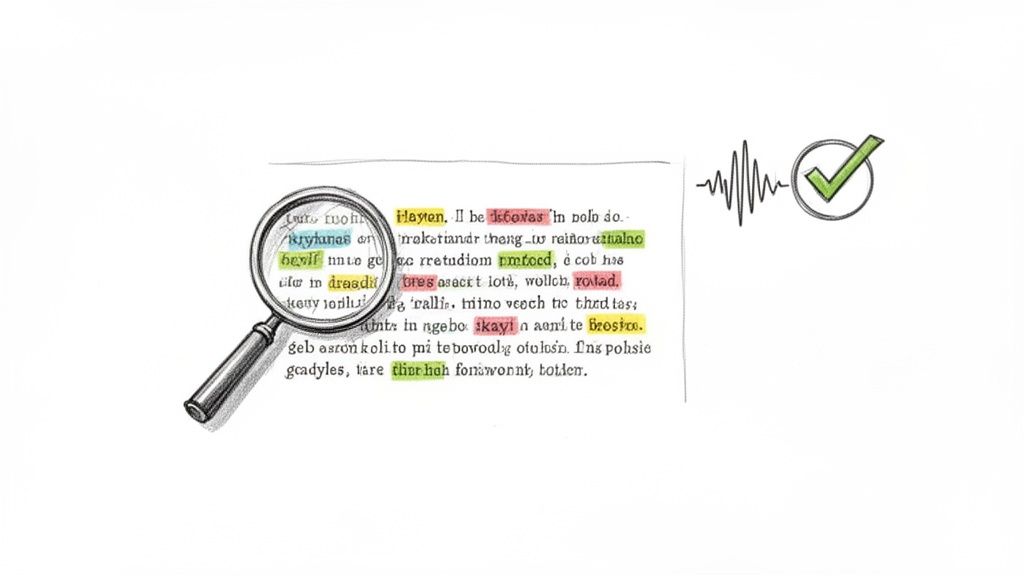
For academics, professionals, or anyone writing for a specific brand, this stage is less about keywords and all about voice. Does the revised text still sound like you? Here’s a simple trick I swear by: read the entire piece out loud.
It sounds basic, but you’d be amazed at what you catch. Your ears will immediately pick up on awkward sentences and robotic phrasing that your eyes might just glide over.
As you read, ask yourself a few questions:
Would I actually say this in a conversation? Is the tone right—is it confident, informative, or casual? Does it match my company's established style?
This simple auditory check is your final defense against any lingering AI-ness. It ensures the writing is not just technically correct but also a true reflection of your personal or professional brand. If you want to dive deeper, we have a helpful guide on establishing your tone of voice in writing.
This focus on human oversight is exactly why by 2026, an estimated 90% of content marketers will be using AI tools. It's not about replacing writers, but about making our workflows smarter. With 71% already using AI for brainstorming and ideation, that final human touch is what separates good content from great content. You can explore more stats on the rise of AI in content creation on humanizeai.com.
Answering Your Top Questions About Writing with AI
Jumping into AI-powered writing tools is exciting, but it's totally normal to have a few questions pop up. Let's dig into some of the most common ones I hear from people just starting out.
Will AI Steal My Voice?
This is probably the biggest fear, and it's a completely valid one. But here's the good news: it won't, as long as you stay in the driver's seat.
Think of an AI rewriter like a skilled co-editor, not the author. You provide the raw material—your ideas, your perspective, your rough draft. The AI's job is to suggest ways to make it sharper and clearer. Your unique stories, your specific examples, and your final edits are what keep the writing authentically you.
It’s not about asking the AI, "What should I write?" It's about asking, "How can I make what I've written even better?" That small change in mindset makes all the difference and keeps you in full control.
Is It Cheating to Use an AI Rewriter?
The answer really depends on the context. It's always a good idea to check the specific policies of your school, company, or publication. For the most part, using AI to help you brainstorm or fix grammar is no different than using a thesaurus or a tool like Grammarly. It's just a way to support your own work.
Where you run into trouble is passing off unedited, raw AI output as your own. That’s a big no-no. The ethical approach is to use these tools as an assistant to refine your original draft. The core argument, structure, and ideas should always come from you. If you're ever unsure, just be transparent about the tools you used.
How Can I Make Sure My Writing Doesn't Get Flagged by AI Detectors?
Making your writing "undetectable" isn't about finding a magic button. It's about adding your human touch back into the text after the AI gives you a starting point. While a dedicated 'Undetectable' mode is a great first step, your own revisions are what truly seal the deal.
Here are a few things that work every time:
- Mix up your sentences. AI tends to fall into a predictable rhythm. Break it up by consciously mixing short, direct sentences with longer, more descriptive ones.
- Add your own flavor. Weave in personal stories, specific data points, or opinions that only you could have. An AI can't invent your experiences.
- Read it out loud. This is my non-negotiable final step. Your ear will catch awkward phrasing or robotic sentences that your eyes might miss.
These little touches are what separate your writing from generic AI content, making it sound genuine and pass any scrutiny.
Ready to see how a smart AI partner can fit into your writing routine? Start turning your drafts into clear, polished, and undetectable content with Rewritify. You can explore all the different modes for free and feel the difference it makes.
Relevant articles
Discover what is text fluency and why it's a game-changer for writers. Learn actionable strategies to make your writing flow and engage readers effortlessly.
Discover the best article rewriter online free from our 2026 list. Compare features, limits, and quality to find the perfect tool for your content needs.
Learn how to pass AI detection by ethically humanizing AI-generated drafts. Our guide covers rewriting, editing, and using tools to create authentic content.
Learn how to rewrite this sentence for clarity and engagement, with practical tips and real-world examples.
Learn how to make AI writing undetectable. Our guide shows you how to transform robotic AI drafts into authentic, human-quality content that bypasses detectors.
Learn how to rewrite AI generated text into engaging, human-quality content that ranks. Master voice, SEO, and fact-checking with our proven workflow.