What Is Text Fluency and How to Instantly Improve Readability
Discover what is text fluency and why it's a game-changer for writers. Learn actionable strategies to make your writing flow and engage readers effortlessly.
Have you ever read something that just… flowed? The words seemed to melt away, leaving you with a crystal-clear understanding of the message. That effortless quality is text fluency.
It’s the secret ingredient that turns a jumble of facts into a smooth, compelling narrative. Think of it as the difference between a conversation that feels natural and one that’s just a series of awkward, disconnected statements. When writing is fluent, it connects with the reader without any friction.
What Is Text Fluency Really About?
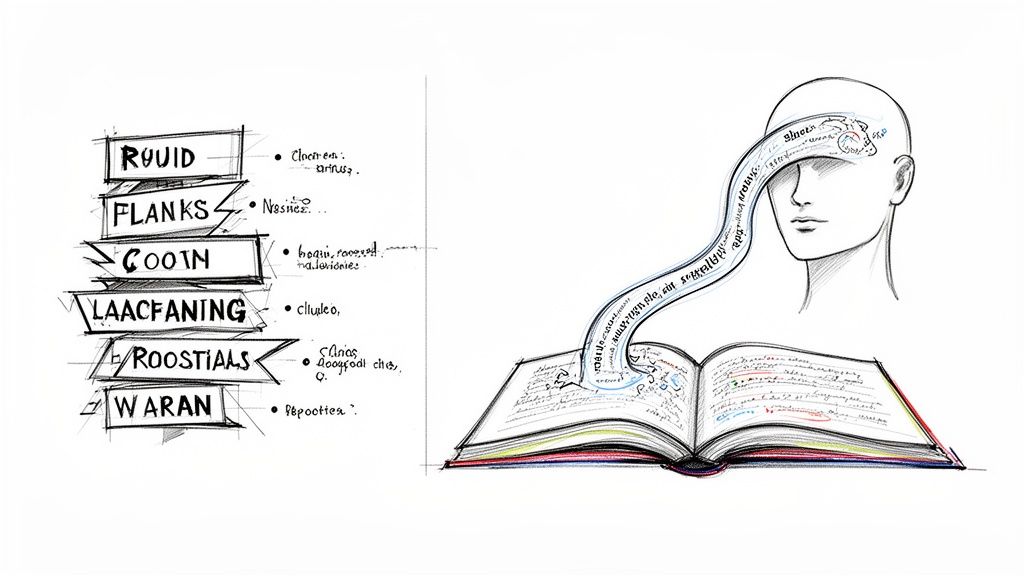
Think of text fluency as the invisible architecture supporting your writing. It goes way beyond just having perfect grammar and spelling. It’s about crafting an experience so seamless that your reader never has to stumble, pause, or re-read a sentence just to figure out what you’re trying to say.
The concept actually has its roots in reading education, where fluency means reading with accuracy, a good pace, and the right expression. We can apply those same principles directly to writing. A fluent writer builds sentences that are not only correct but are also arranged to guide the reader effortlessly from one idea to the next.
The Core Components of Text Fluency
So, what makes a piece of writing feel so smooth? It’s not just one thing, but a combination of several key elements working in harmony. Once you understand them, you can start consciously weaving them into your own work.
Here’s a quick breakdown of the core components that create that fluent reading experience.
The Core Components of Text Fluency
| Component | What It Means | Why It Matters for Readers |
|---|---|---|
| Coherence | All the ideas connect logically and build on each other. The whole piece feels unified. | The reader can easily follow your train of thought without getting lost or confused. |
| Clarity | The meaning is completely unambiguous. You use precise words and direct sentences. | Readers don't have to waste mental energy guessing what you mean. The message is instantly clear. |
| Rhythm and Pace | The writing has a natural cadence, created by mixing short and long sentence structures. | It prevents the text from feeling monotonous and keeps the reader engaged from start to finish. |
Each of these components plays a vital role. Without them, even the most brilliant ideas can fall flat.
Ultimately, text fluency is about removing cognitive load from the reader. When your writing is fluent, your audience can focus entirely on your message, not on the mechanics of deciphering your words.
Getting a handle on this is a game-changer for anyone who needs their message to stick. Whether you're a student building a persuasive essay or a marketer writing ad copy, fluent writing ensures your ideas don't just get read—they make a real impact.
Why Text Fluency Is Your Secret Weapon for Impact
So, you know what text fluency is. But understanding why it matters is what really gives you an edge. Fluent writing isn’t some stuffy academic concept; it's a practical tool that directly shapes how people receive, trust, and act on your message.
Think of it like this: trying to read clunky, confusing text is like driving down a road riddled with potholes. You slow down, get frustrated, and maybe even give up and turn around. Fluent writing, on the other hand, is a freshly paved highway. It lets your reader cruise along comfortably, focusing on the destination—your message.
This smooth experience does more than just make reading easier. It quietly builds trust. When communication is clear, readers subconsciously see you as an expert.
Boosting Engagement and Comprehension
For anyone creating content, the payoff is real and measurable. Fluent writing grabs attention and keeps it, which can give your key metrics a serious lift.
- Lower Bounce Rates: When people land on your page and find the content easy to follow, they’re much more likely to stick around.
- Increased Time on Page: A smooth read encourages users to get through the whole article, not just skim the first paragraph and leave.
- Higher Conversion Rates: A clear, logical message is simply more persuasive. It’s easier to convince someone to sign up or make a purchase when your writing flows.
The bottom line is that fluent writing reduces friction. When you remove the barriers to understanding, you make it easy for your audience to connect with your ideas and hard for them to look away.
This whole idea is grounded in how we learn to read. Research on reading speed clearly shows the link between fluency and understanding. For instance, the 2018 NAEP Oral Reading Fluency Study found the average passage reading speed was 120 words per minute, while proficient adult readers average closer to 178 WCPM. As fluency improves, so does the ability to truly grasp the material—a critical insight for any writer.
Driving Success in School and at Work
The power of text fluency goes way beyond marketing. For students and academics, it can be the difference between a good argument and a great one. A fluent research paper presents complex ideas with such clarity that the arguments become more persuasive and easier for a professor to follow.
In the professional world, a fluent proposal, report, or even just an email commands respect. It shows you’re a professional and ensures your message is understood correctly the first time, which saves everyone time and avoids mix-ups. By mastering how to make content easy to understand, you give your ideas the best possible chance to make an impact.
Ultimately, fluency is what carries your expertise out into the world.
How to Measure and Identify Fluent Writing
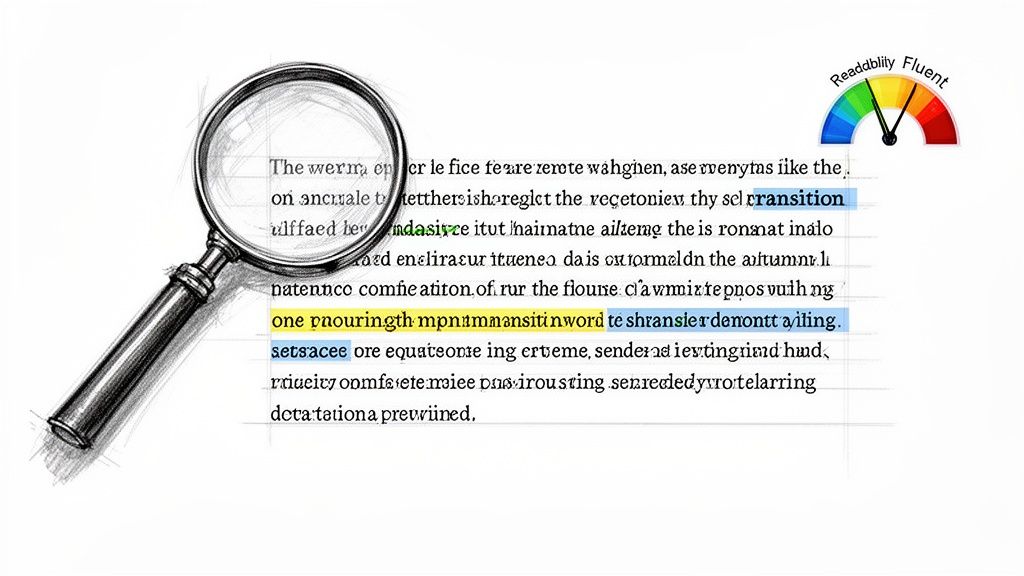
It’s one thing to have a gut feeling about whether a piece of writing flows well, but it's another thing entirely to measure it. The real key to improving your writing is learning how to turn that abstract "feel" into concrete, measurable data. When you can pinpoint why a sentence is clunky or a paragraph feels disconnected, you can start making targeted fixes.
A great place to start is with readability scores. Tools that use metrics like the Flesch-Kincaid Grade Level test give you a quick snapshot of your writing's accessibility. They analyze things like sentence length and word complexity to give you an idea of the education level someone needs to easily understand your text. A high score doesn't automatically mean your writing is a masterpiece, but it's a fantastic first-pass diagnostic.
But to truly get a handle on fluency, you have to look beyond the numbers and dive into the rhythm and structure of your prose.
Key Qualitative Indicators of Fluency
To really get what text fluency is all about in your own writing, you need to develop an ear for its more artistic qualities. This is where mechanical writing gets left behind and content that genuinely connects with people begins.
Here are the main things to look out for:
- Logical Argument Flow: Does one idea naturally lead to the next? A fluent article takes the reader on a journey, with each paragraph building on the last. There are no sudden detours or dead ends.
- Effective Use of Transitions: Words like "however," "in fact," or "on the other hand" are the glue that holds your ideas together. They signal to the reader how two thoughts are related, preventing jarring jumps in logic.
- Sentence Structure Variation: Nothing kills engagement faster than a long string of sentences that all sound the same. Great writing mixes it up, using short, punchy statements for impact and longer, more descriptive ones to add detail. This creates a rhythm that keeps the reader hooked.
One of the most underrated parts of fluency is simple accuracy. Every time a reader stumbles over a typo or a grammatical error, the spell is broken. The flow is gone. This is why a handful of mistakes can do so much damage.
For instance, research from a 2018 NAEP study drives this point home. It found that students at a below-basic reading level had only 82% word accuracy—they were misreading nearly one out of every six words. Even proficient readers at 92% accuracy were still missing about one word per sentence. You can explore the full study on reading accuracy to see just how critical this is for comprehension.
Fluent vs Disfluent Examples
Let’s make this practical. Look at the two examples below and notice how the second one feels so much easier to read. It's not just the words; it's how they're put together.
Disfluent Example: The company launched a new product. The product has many features. The marketing team created a campaign. The campaign will run next month. Customers should be excited.
Fluent Example: The company just launched an exciting new product packed with innovative features. To support the release, the marketing team developed a comprehensive campaign that will run next month. The goal is to build anticipation and show customers exactly why they should be excited.
The first version is choppy and robotic. Each sentence is an island. The second version, however, uses connecting phrases and varied sentence structures to create a smooth, logical narrative. Once you start spotting these differences, you'll be able to diagnose and fix disfluent writing anywhere you find it.
Actionable Strategies to Improve Your Text Fluency
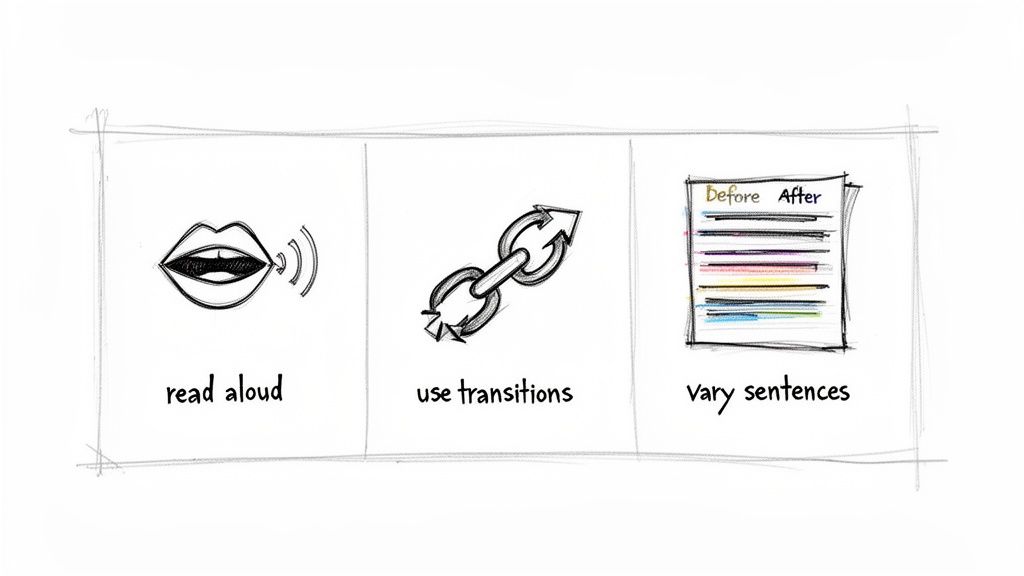
Knowing what text fluency is and actually achieving it are two different things. The good news is, you don't need to be a literary master to make your writing flow. A few focused techniques can make an immediate difference in how clear and rhythmic your work feels to the reader.
Think of these strategies as simple yet powerful tools. They aren't just for blog posts or creative essays; they work for everything from business reports to emails by sharpening the core elements that make text effortless to read.
Master the Art of Reading Aloud
This might be the single most effective trick in a writer's playbook. Reading your work aloud forces you to hear it the way your audience will. You'll immediately notice the awkward phrasing, repetitive words, and clunky sentences that your eyes simply skimmed over.
Your ear is an incredibly honest critic. If you find yourself stumbling over a phrase or running out of breath mid-sentence, that's a red flag. It’s a clear signal that the sentence needs a rewrite for better flow.
Hearing your own words is the ultimate fluency test. If a sentence sounds unnatural when you speak it, it will feel just as clunky to your reader. This auditory feedback is crucial for refining the natural cadence of your writing.
Think of it as a final quality check for your prose. By catching these rough spots yourself, you can smooth them out before anyone else does. For a deeper look at refining sentences, our guide on how to reword a paragraph has some great tips.
Weave a Web with Transition Words
Transition words are the glue holding your ideas together. Words and phrases like "consequently," "on the other hand," and "for instance" are signposts that guide your reader from one point to the next, showing how your ideas relate.
Without them, your writing can feel like a disjointed list of facts. With them, you create a logical bridge between sentences and paragraphs, making your argument feel cohesive and intuitive.
- To Add Information: Use words like "furthermore," "moreover," or "additionally."
- To Show Contrast: Employ phrases such as "however," "conversely," or "nevertheless."
- To Illustrate a Point: Words like "for example," "specifically," or "to illustrate" are perfect.
- To Conclude: Use "in summary," "therefore," or "as a result."
Getting comfortable with these connectors is one of the quickest ways to elevate your writing from good to great.
Vary Your Sentence Structure for Rhythm
Nothing kills engagement faster than monotony. If every sentence has the same subject-verb-object structure, your reader's brain will check out. The key to creating a compelling rhythm is to consciously vary your sentence length and style.
Try mixing short, punchy sentences with longer, more detailed ones. A quick, declarative sentence can land a point with force, while a longer one can unpack nuance and add descriptive color. This variety creates a dynamic pace that keeps your reader hooked.
Before: The team completed the project. The project was on time. The client was happy.
After: After completing the project on schedule, the team was thrilled to find that the client was exceptionally happy with the results.
See the difference? The "after" version turns a choppy list into a smooth, cohesive thought. It's also worth noting that strong reading skills often lead to better writing; you can find targeted exercises to improve reading fluency, which will help you internalize these rhythms naturally.
Using AI Tools to Enhance Writing Fluency
Manual editing is a fantastic skill, but let's be honest—it can be a slog. Technology gives us a way to speed up the journey to more fluent writing. Think of modern AI writing assistants as your personal co-pilot, helping you spot and fix the subtle hitches that trip up a reader. These are often the very things we're blind to in our own work.
These tools are a world away from your basic grammar checker. Instead of just catching typos, they dig into the very structure of your sentences. They can point out when you're using the same sentence format over and over, suggest a more powerful word to replace a bland one, and even check if your tone is consistent from start to finish. It’s all about refining your writing without sacrificing your unique voice.
The idea isn't to let a robot do the writing for you. It's about letting it handle the grunt work so you have more brainpower for what really matters: your message, your ideas, and your creativity.
Your AI-Powered Fluency Co-Pilot
Imagine having an objective second pair of eyes on your work, available 24/7. That's what a good AI writing tool provides. It doesn't have your personal attachment to a sentence you struggled with, so it can mercilessly flag awkward phrasing or confusing logic that you might have glossed over.
This is a game-changer for boosting clarity and coherence. A quality AI, for instance, can show you how to break up a monstrously long sentence or restructure a paragraph to put the main point front and center. If you want to go deeper, our guide on using an AI text enhancer walks through exactly how these tools can lift your content to the next level.
Here’s a quick look at how a tool like Rewritify gives you instant alternatives to improve your flow.
As you can see, the interface is straightforward. You pop in your text and get back several rewritten options, each one tweaked for better readability. This kind of immediate feedback lets you see your words from different angles and choose the version that sounds best to you.
Going Beyond Basic Corrections
The real magic of these tools is how they understand context. They don't just make generic suggestions; they offer improvements that help you hit your specific goals, helping you maintain a polished, professional style every time you write.
AI assistants can seriously streamline your editing workflow, helping you produce high-quality, fluent writing in less time. They're like a safety net, catching the clumsy mistakes and awkward phrases that would otherwise slip past.
Whether you're polishing a blog post, a research paper, or a business proposal, bringing AI into your process can make a real difference. You can see just how much this technology helps in professional fields by looking at resources that cover the top AI resume writer tools, where creating clear and impactful documents is absolutely critical.
By making AI a part of your writing toolkit, you can save a ton of time, sharpen your skills, and make sure every piece of content you create is as clear and effective as possible.
Common Fluency Pitfalls and How to Avoid Them
Writing with true fluency means steering clear of some common traps that can make your text feel awkward or hard to follow. Even experienced writers can slip into these habits, but spotting them is the first step toward crafting a much smoother experience for your readers.
One of the biggest culprits is the overuse of jargon and technical buzzwords. Sure, these terms might be second nature in your field, but for anyone outside that bubble, they’re just roadblocks. When you force a reader to stop and puzzle over specialized language, you've completely shattered the flow.
The Problem of Awkward Phrasing
Another major pitfall is clunky sentence construction. This tends to happen when we try to sound overly formal or edit a sentence into oblivion, stripping it of its natural rhythm. You end up with long, tangled sentences that might be grammatically correct but are a real chore to read.
These sentences often suffer from a couple of key issues:
- Poor Pacing: When every sentence is the same length, your writing takes on a monotonous, almost robotic drone. It’s a surefire way to put your audience to sleep.
- Abrupt Transitions: Leaping from one idea to another without a smooth connection leaves your reader disoriented and struggling to keep up.
The goal is to make your writing invisible. The moment a reader has to pause to untangle a sentence or guess your meaning, the magic is gone. This is really the heart of the challenge in mastering what text fluency is.
So, what’s the fix?
It often comes down to a simple piece of advice: write more like you speak. Seriously, read your work out loud. If you find yourself stumbling over a phrase or running out of breath, that’s your cue to rework that sentence. Break those long, winding thoughts into shorter, punchier ones.
And always, always think about your audience. If you absolutely have to use a technical term, explain it right away in plain English. By keeping an eye out for these pitfalls and putting clarity first, you can make sure your message doesn’t just get sent—it actually gets received.
Got Questions About Text Fluency? We’ve Got Answers.
People often have a few questions when they first start digging into text fluency. Let's clear up some of the most common ones.
Is “Text Fluency” Just Another Word for “Readability”?
That’s a great question, but no, they aren’t exactly the same thing. Think of it like this: readability is one of the key ingredients in the recipe for fluency.
Readability scores, like the Flesch-Kincaid grade level, give you a technical measurement based on things like sentence length and word difficulty. They tell you how easy the text is to physically read. But fluency is much broader. It’s about the entire experience—the rhythm, the logical connections, and the overall feel of the writing.
A piece of writing can get a perfect readability score but still feel clunky, disjointed, or just plain awkward. That’s a sign of poor fluency.
Will an AI Rewriter Make My Writing Sound Like a Robot?
It's a valid concern, and the honest answer is: it depends entirely on the tool. The internet is littered with basic article spinners and older AI models that spit out stiff, unnatural text. We've all seen it.
But the good news is that technology has come a long way. Modern tools are built differently. They’re designed to function more like a skilled human editor, focusing on enhancing your message and improving clarity while keeping your unique voice intact. The goal isn’t to sound like AI; it’s to sound like the best version of you.
How Can I Make Really Technical Topics More Fluent?
Writing about complex or technical subjects is where fluency really gets put to the test. The key here is to lean heavily on clarity and structure. Don't assume your reader knows all the jargon.
- Use analogies: Compare a complex process to something simple and familiar. It’s a powerful shortcut to understanding.
- Define your terms: When you introduce a technical term for the first time, briefly explain what it means.
- Break it up: Use clear headings, bullet points, and short paragraphs to guide your reader through the information. Mix short, punchy sentences with longer ones that provide more detail.
This approach keeps your writing from becoming a dense, intimidating wall of text. It creates a path for the reader, making the journey through the topic smooth and engaging.
Ready to make your writing flow effortlessly? Rewritify helps you turn clunky drafts into clear, fluent text in just one click. Try our AI-powered rewriter for free and see the difference!
Relevant articles

Learn how to correct the sentence with practical grammar tips, proofreading tricks, and clear examples that boost clarity and confidence.
Unlock the secrets of influence with our guide to 10 powerful persuasive writing techniques. Learn ethos, pathos, logos, and more to elevate your copy.
Discover how to improve my writing ai with a practical human-AI workflow that turns rough drafts into clear, original, and authentic content.
Master communication with our top 10 professional email writing tips. Learn to write clear, concise, and effective emails that get results. Read now!
Discover how to make your writing easy to understand. Our guide offers practical tips on clarity, structure, and word choice for better engagement.
Elevate your writing by mastering the compound sentence semicolon. This guide explains the rules with clear examples to help you connect ideas perfectly.