Make Your Writing Easy to Understand A Practical Guide
Discover how to make your writing easy to understand. Our guide offers practical tips on clarity, structure, and word choice for better engagement.
In a world drowning in information, the single biggest advantage you can give your content is making it easy to understand. It’s not just a nice-to-have; it’s the bedrock of building trust, driving engagement, and actually connecting with your audience.
Why Easy to Understand Content Wins Every Time
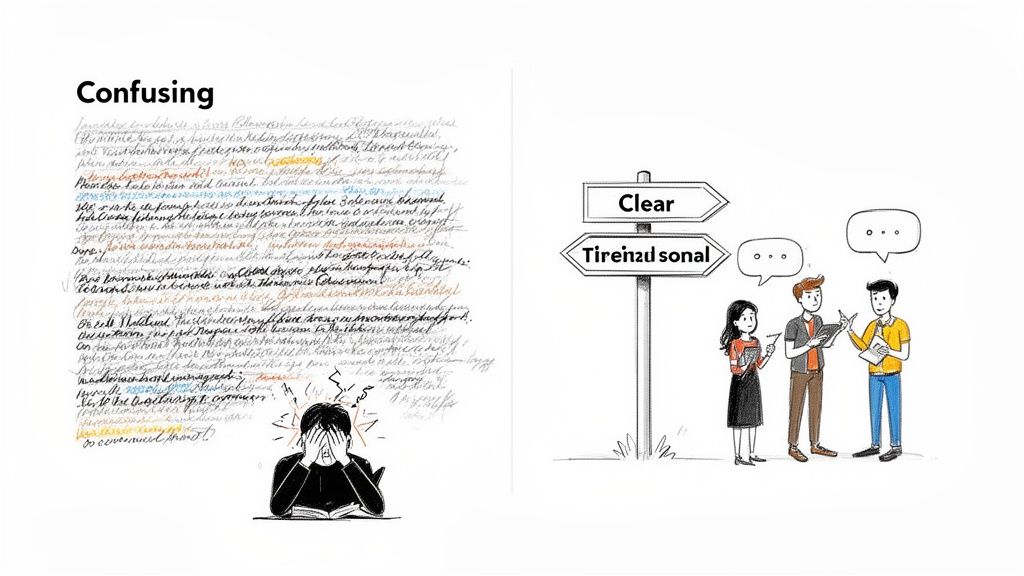
Let's be honest. When you land on a page and get hit with a wall of dense text stuffed with jargon, what do you do? You leave. I know I do. It’s not about being lazy; it's about cognitive load. When our brains have to work too hard just to decipher a sentence, we get frustrated and simply move on.
Your message, no matter how brilliant, is completely lost if nobody sticks around to read it. By putting clarity first, you're respecting your reader's time and mental energy, which makes them far more likely to listen to what you have to say.
The High Cost of Complexity vs The ROI of Clarity
The choice between complex and clear writing isn't just about style—it has a direct impact on your bottom line. We're talking about real, measurable results. Let's break down the stakes.
| Metric | Complex Content (The Problem) | Easy-to-Understand Content (The Solution) |
|---|---|---|
| User Engagement | High bounce rates, low time-on-page. Readers leave quickly. | Increased engagement, longer session durations. |
| Conversion Rates | Low conversion. Confused users don't buy or sign up. | Higher conversion. Clarity guides users to take action. |
| Audience Trust | Erodes trust. Jargon and complexity create distance and doubt. | Builds strong trust. Simplicity feels honest and authentic. |
| Accessibility | Excludes readers with cognitive disabilities or language barriers. | Highly inclusive. Reaches a much wider audience. |
| Brand Perception | Perceived as intimidating, out of touch, or unhelpful. | Seen as helpful, authoritative, and user-focused. |
As you can see, simplifying your message isn't "dumbing it down." It's a strategic move that pays off in every key area, from user experience to revenue.
The Tangible ROI of Clarity
Making your writing easy to grasp isn't just theory; it delivers tangible results. Consumers are tired of corporate-speak and complicated messaging. In fact, they are 54% more likely to buy from creators who communicate in a simple, relatable way. You can dig deeper into these trends in this report on content creator statistics.
This principle holds true everywhere you communicate:
- Marketing Emails: A clear subject line and a direct call-to-action will always outperform a clever but confusing one.
- Business Reports: Simple summaries and scannable charts ensure your key stakeholders actually get the point.
- Website Copy: Straightforward language keeps people on your site and helps them find what they need, drastically reducing bounce rates.
The real goal isn't just to be understood, but to be impossible to misunderstand. When you nail that, you build a foundation of trust that turns casual visitors into loyal fans.
Avoiding the Complexity Trap
I've seen so many writers fall into the trap of thinking complex language makes them sound smarter or more authoritative. It's a common mistake, but the opposite is true.
Real expertise is the ability to take a complicated subject and make it feel simple. Puffy paragraphs and industry jargon don't impress anyone; they just push people away. By focusing on clear, direct language, you make your content more inclusive and, ultimately, more powerful. This mindset is a core part of our recommended content creation best practices.
At the end of the day, the clearest message always wins.
Build Your Writing on a Foundation of Simple Sentences
Here’s a secret I’ve learned over years of writing and editing: making your work easy to understand isn't about "dumbing it down." It’s about building your ideas with strong, simple sentences. Think of each sentence as a brick. If the bricks are clean and sturdy, the whole structure stands tall.
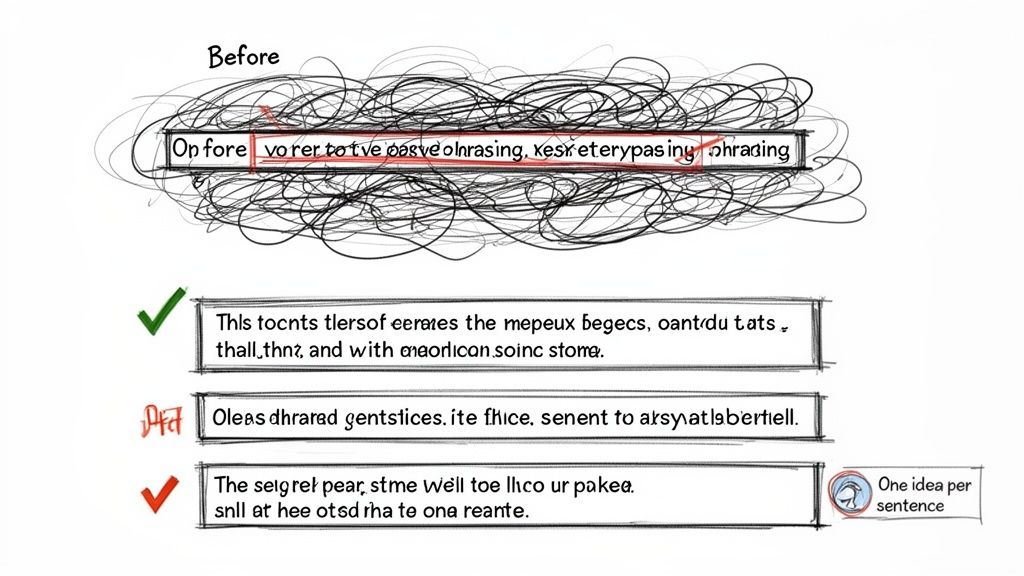
When you try to cram too much into a single sentence, you create a cognitive traffic jam for your reader. They’re forced to slow down, reread, and untangle a mess of clauses. That's friction, and friction is where you lose them. The fix is surprisingly straightforward: stick to one main idea per sentence.
Master the "One Idea" Rule
This one simple rule can instantly make your writing clearer. It forces you to break down complex thoughts into a series of digestible steps, creating a logical path for your reader to follow. Instead of a dense wall of text, you offer a clear, guided journey.
Let's look at a classic example from a business memo that probably feels all too familiar.
Before:
Due to the recent market analysis which indicated a significant downturn in Q3 sales, a new marketing strategy has been developed that will be implemented by the team, and it is imperative that all departments are briefed on the upcoming changes before the end of the week.
That sentence is a beast. It’s trying to do three jobs at once: explain the reason, state the action, and give the deadline.
After:
Our recent market analysis showed a significant downturn in Q3 sales. In response, we have developed a new marketing strategy. The team will begin implementing it soon. We must brief all departments on these changes before the end of the week.
Feel the difference? We have four simple sentences, and each one has a clear purpose. The message is the same, but the delivery is effortless. The writing is direct, confident, and much more likely to be read and understood.
Ditch the Passive Voice
Another common culprit that muddies the water is the passive voice. It makes writing feel weak, indirect, and just plain wordy. Sentences written in the passive voice put the object first, making it seem like things are just happening without anyone responsible.
Think of the classic non-apology: "mistakes were made." The active voice equivalent is "I made a mistake." Actively hunting down and rewriting passive sentences will make your writing more direct and dynamic.
My Go-To Tip: Active voice puts the person or thing doing the action front and center. It leads to shorter, more powerful sentences and is one of the fastest ways to inject clarity into your work.
Cut the Fluff and Filler Words
Once your sentences are active and focused, it's time for the final polish: trimming the fat. Filler words are the empty calories of writing; they take up space without adding any real substance or meaning.
Keep an eye out for these common offenders:
- Really and very: These adverbs are usually just clutter. "It was difficult" is often stronger than "It was very difficult."
- Just and that: Read your sentence without them. More often than not, they’re unnecessary. "I think that we should..." works perfectly well as "I think we should..."
- In order to: This can almost always be shortened to just "to."
- Basically and essentially: These words tell your reader you're about to simplify something. So why not just get straight to the simple version?
When you ruthlessly cut these extra words, your core message shines through. Every word that remains has a job to do, making your writing sharp, concise, and incredibly easy to understand.
Choose Words That Connect and Clarify
Once your sentences are solid, the next layer of clarity comes from the specific words you pick. Think of your vocabulary as a bridge between your ideas and your reader’s mind. That bridge needs to be built with simple, direct language to be effective.
True expertise isn't about using the biggest words you know. It's about making complex topics feel simple. Choosing "use" instead of "utilize" isn't dumbing down your content—it's sharpening it. Each simple word you choose removes a tiny bit of friction, making the reader's journey that much smoother.
This is more important than ever now that AI tools are so common. With 78% of marketers saying AI has boosted their content quality, the human touch of refining that text for clarity is a critical skill. The fact that writing marketing copy is the most common use for AI—at 46%—shows just how much demand there is for text that truly connects with an audience. You can see more on how AI is shaping content in this digital trends report.
Replace Jargon with Plain Language
Corporate jargon and academic buzzwords are the fastest way to make your reader feel like an outsider. They create an exclusive club that most people aren't a part of. The fix is simple: translate those insider terms into everyday language.
Instead of relying on abstract concepts, use words that paint a clear picture.
- Instead of "synergize," just say "work together" or "combine."
- Instead of "leverage," why not just "use"?
- Instead of "paradigm shift," explain what's actually changing, like "a new way of thinking" or "a fundamental change in our approach."
Making this shift makes your writing feel more grounded, direct, and relatable.
Your reader should never have to open a new tab to look up a word you used. Every single word should feel like an invitation, not a roadblock.
Use Concrete Nouns and Strong Verbs
Vague language forces your reader to do all the hard work of interpretation. Concrete nouns and strong, active verbs do that work for them by creating a vivid mental image. They are the building blocks of writing that is not only easy to understand but also memorable.
Look at the difference here:
- Vague: "The new initiative resulted in a positive outcome for organizational efficiency."
- Concrete: "The new software cut our project delivery time by three days."
The first sentence is a cloud of corporate-speak. The second gives the reader something tangible to grab onto—software, project time, three days. This level of detail makes your points far more credible and impactful. Using precise language also helps you steer clear of the common traps of frequently misused words that can muddy your message. When you choose words with clear, unambiguous meanings, you ensure your writing connects every time.
Structure Your Content for Effortless Reading
You can write the clearest sentences in the world, but if they're crammed together in a massive wall of text, nobody will read them. After you've tightened up your sentences, it's time to zoom out and look at the big picture: the structure.
Getting the structure right is the key to guiding your reader's eye smoothly through your most important points. It’s what separates a cluttered, intimidating page from one that feels inviting and easy to scan. When you use formatting well, you make your key takeaways pop right off the page.
Give Them the Punchline First
Ever heard of the inverted pyramid? It's a classic trick from the journalism world that works wonders online. The idea is simple: put your most important piece of information right at the very beginning. Lead with your main conclusion or key finding.
Once you’ve stated your core message, you can then flesh it out with supporting details, background context, and less critical points. This whole approach is about respecting your reader's time. Even if they only stick around for the first paragraph, they'll still leave with the main takeaway.
This is especially crucial online, where you're fighting for every second of attention. By giving people the "answer" upfront, you provide a solid foundation that makes the rest of your content much easier to absorb.
Don't make your reader work to find your main point. Put it front and center, then use everything that follows to back it up.
Break It Down for Scanners
Let's be honest, long paragraphs are a huge turn-off online. They look like a chore to read and make it nearly impossible for people to quickly find what they're looking for. The fix is to consciously break up your text.
Here are a few simple ways to make your writing feel more approachable:
- Short paragraphs are your friend. Seriously, stick to a three-sentence max. This creates white space, which is a visual relief for your reader's eyes.
- Use subheadings like signposts. Good, descriptive subheadings let people scan your article and jump straight to the parts they actually care about.
- Lean on lists and bullet points. Anytime you're explaining steps, listing examples, or highlighting features, a bulleted list is far easier to digest than a long, clunky sentence.
This isn't just about making things look pretty; it's about making your information usable. Think about the creator economy—it's booming because the content feels authentic and is incredibly easy to consume. In fact, 94% of companies find that creator content delivers a better ROI than old-school ads, a success driven by clear, human communication.
The demand for scannable, engaging content is only getting bigger. To get better at hooking readers and keeping them engaged, check out this proven framework for writing engaging posts. When your structure is easy to follow, your message has a much better chance of landing.
Putting Theory into Practice with the Right Tools
It's one thing to talk about clear writing principles, but it’s another to see them work their magic. Let's move from theory to action and see how a smart tool can help. Using an editor like Rewritify can do a lot of the heavy lifting, quickly turning a clunky first draft into something polished and readable.
This isn't about handing over your voice to a machine. Think of it more like having a sharp-eyed assistant. It spots the tedious stuff—like passive voice or overly complicated sentences—freeing you up to focus on the bigger picture: refining your core message, injecting your personality, and making sure every detail is spot on. Let's see it in action.
From Corporate Jargon to Crystal Clear: A Rewritify Example
Imagine you've just drafted a paragraph for a business report. It’s got all the necessary info, but it's drowning in corporate-speak.
The Original (Before):
Subsequent to the Q4 performance analysis, it has been ascertained by our team that the implemented strategic initiatives, while multifaceted, have not yet yielded the anticipated synergistic outcomes in terms of market penetration. It is therefore imperative that a comprehensive review of our operational workflows be undertaken in order to identify and mitigate underlying inefficiencies, thereby facilitating an optimization of resource allocation for the forthcoming fiscal period.
Technically correct? Sure. A headache to read? Absolutely. Now, let’s pop this into Rewritify and see what happens.
The Rewrite (After):
Our team analyzed the Q4 performance and found our new strategies haven't improved market penetration as expected. We need to review our workflows to find and fix any problems. This will help us use our resources more effectively next quarter.
The difference is night and day. The rewritten version is direct, clear, and gets the message across without losing any of the original meaning. It’s a great demonstration of how an AI text enhancer can instantly elevate your writing.
What Got Fixed? A Quick Breakdown
So, what exactly did the tool do? It automatically applied the very principles we've been discussing:
- Switched to Active Voice: "It has been ascertained by our team" became the much punchier "Our team analyzed."
- Used Simpler Words: Gone are words like "ascertained," "synergistic outcomes," and "facilitating." In their place are "found," "improved," and "help."
- Shortened the Sentences: Those two long, winding sentences were broken into three short, easy-to-digest thoughts.
This isn't just about the words themselves; structure is just as important. A good structure guides the reader effortlessly through the content.
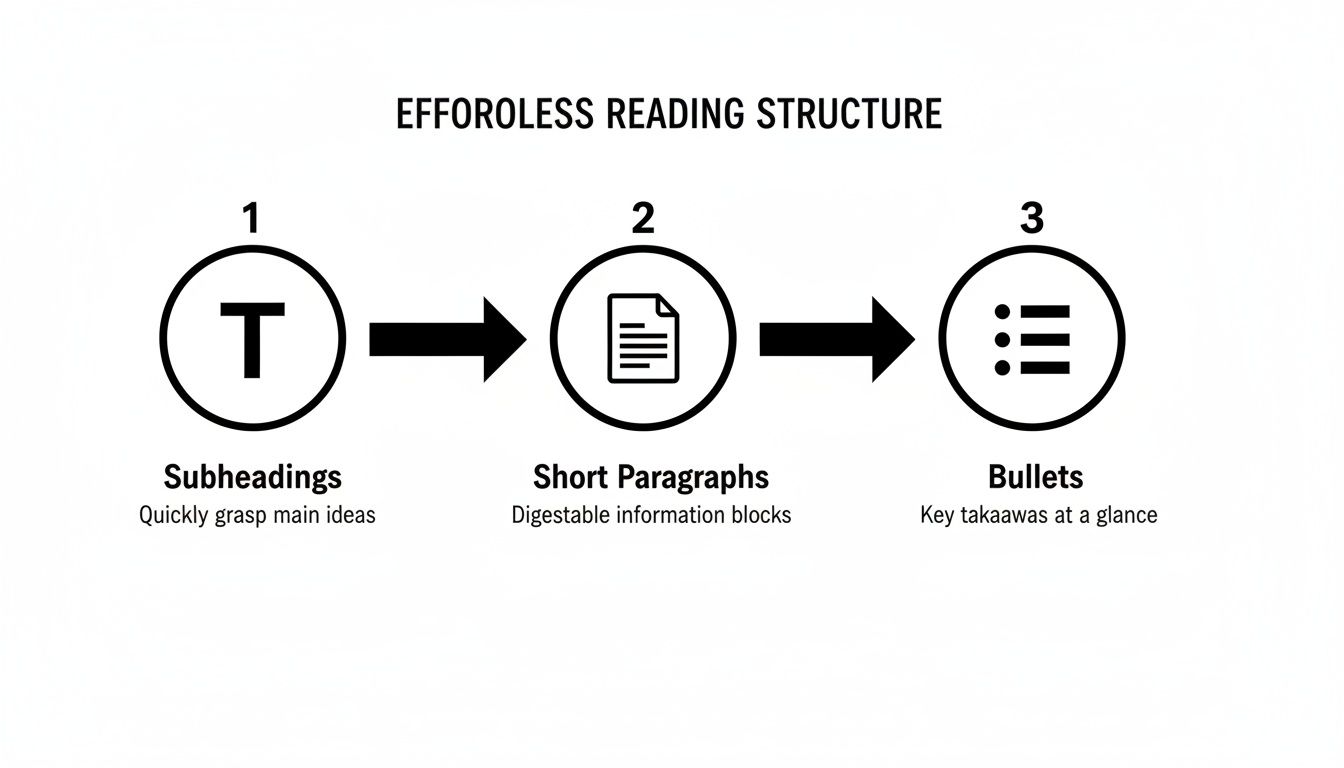
As you can see, breaking up your text with clear subheadings, short paragraphs, and bullet points makes a world of difference. It creates a scannable, reader-friendly experience that keeps people engaged.
And clarity isn't limited to the written word. If you're creating video, for instance, you can utilize a subtitle generator to make your content more accessible. This helps everyone, from viewers in noisy places to those with hearing impairments, understand your message. It's all part of the same goal: making information accessible to the widest audience possible.
Got Questions About Clear Writing? Let's Talk.
Making the switch to a simpler writing style can feel a bit strange at first, I get it. It often brings up some totally valid concerns about how people will perceive your work. Let's tackle a few of the most common questions I hear so you can start writing with more confidence.
"Will Simple Writing Make Me Sound Dumb?"
This is hands-down the biggest myth about clear writing, and honestly, it’s completely backward. Real intelligence isn't about flexing a big vocabulary; it's about making a difficult subject easy for someone else to understand.
Think about the best teachers you've ever had. They didn't try to impress you with jargon. They broke down complex ideas into simple, memorable pieces. When you write clearly, you're showing you have such a deep command of your topic that you can explain it to anyone. That’s a sign of true mastery, not a lack of smarts.
"How Do I Simplify Technical Stuff Without Losing Important Details?"
This is a classic challenge, especially for subject matter experts. The trick is to shift your mindset from everything you know to what your audience really needs to know. You're not "dumbing it down"; you're translating it for a different audience who sees the world differently.
Here are a few things that have always worked for me:
- Lean on analogies. Compare a complex process to something familiar. Explaining data caching? It's like keeping salt and pepper on the kitchen counter instead of digging them out of the pantry every time.
- Define your terms (briefly!). The first time you introduce a must-know technical term, give a quick, plain-language definition right then and there.
- Focus on the "so what?". Instead of just describing what a technical feature is, explain why it matters to the reader. What problem does it solve for them?
The goal is always to keep the meaning intact while removing the jargon-filled barriers that stop non-experts from getting your point.
"What's a Quick Way to Check if My Writing is Clear?"
You don't have to guess. There are a couple of straightforward ways to get a quick gut check on your writing.
One easy method is to use a readability tool. Most word processors have a Flesch-Kincaid grade level score built right in. It's not a perfect science, but aiming for a score around grade 8 or 9 is a solid target for most business and web content. It just means more people will be able to read and understand it without struggling.
But my favorite low-tech trick? Read your writing out loud. If you stumble, run out of breath, or have to re-read a sentence, that’s your red flag. Your ear will always catch awkward phrasing that your eyes gloss over.
"Are AI Writing Tools Actually Any Good for This?"
Yes, absolutely—as long as you use them as a smart assistant, not a ghostwriter. The current generation of tools is fantastic at doing the first round of cleanup, quickly turning a dense, clunky draft into something much more approachable.
They can instantly spot and fix things like passive voice, offer simpler word choices, and chop up those monster sentences that go on forever. A great workflow is to let the AI handle the initial heavy lifting. Then, you step in to add your own voice, check the facts, and make sure the final piece sounds exactly like you.
Ready to transform your drafts into clear, polished text that's easy for anyone to understand? With modes like Simple, Natural, and Undetectable, Rewritify helps you refine your message while preserving your unique voice. Try it for free and see the difference clarity makes at https://www.rewritify.com.
Relevant articles

Master the difference between complement and compliment with our guide. Learn the definitions, grammar, and usage with clear examples to perfect your writing.

Learn how to structure an argumentative essay with our expert guide. We break down the thesis, body paragraphs, and counterarguments for a powerful paper.
Discover 8 expert-approved concluding sentence starters with examples. Learn how to write powerful, memorable conclusions for essays, reports, and more.
Discover what is text fluency and why it's a game-changer for writers. Learn actionable strategies to make your writing flow and engage readers effortlessly.
Explore formal writing style examples across academic and professional contexts. Learn tone, structure, and vocabulary to write with clarity.

Learn how to write executive summaries that capture attention and drive action. Our guide covers structure, examples, and expert tips for busy professionals.