Master the Compound Sentence Semicolon A Guide to Clearer Writing
Elevate your writing by mastering the compound sentence semicolon. This guide explains the rules with clear examples to help you connect ideas perfectly.
A compound sentence semicolon is your secret weapon for connecting two closely related, complete thoughts—all without needing a conjunction like and or but. Think of it as a super-comma. It signals a stronger pause than a comma but a more connected one than a full stop.
The Semicolon: From Feared to Favored

Let's be honest—the semicolon has a bit of a reputation. It can feel intimidating, and many writers simply sidestep it, unsure of where it fits in modern writing. But it's time to reframe the semicolon not as a stuffy grammatical hurdle, but as a powerful tool for creating sophisticated, flowing sentences.
It’s the key to adding a rhythm and nuance that a simple period or conjunction just can't match. Our goal here is to demystify its role in linking two ideas that belong together. By the end, you'll see the semicolon as an essential and even elegant part of your writing toolkit.
Why Semicolons Still Matter
It might feel a little old-fashioned, but the semicolon serves a very precise and valuable function. It adds clarity and style, especially when you want to show a tight, logical connection between two complete thoughts without spelling it out.
Of course, its popularity has changed over time. While semicolons were all the rage in the 19th century, their use has declined as modern writing favors shorter sentences. One study even estimates a 56% drop in its use since 1781. Still, its precision remains highly valued in professional and academic writing where nuance is key. You can read more about the changing trends in semicolon use.
The semicolon is a bridge, not a wall. It connects two complete ideas that are too intertwined to be separated by a period but too distinct to be joined by a simple comma and conjunction.
Ultimately, mastering the compound sentence semicolon gives you the power to:
- Add Variety: Break up the monotony of short, choppy sentences.
- Create Flow: Guide your reader smoothly from one idea to the next.
- Emphasize Relationships: Signal that two thoughts are intimately linked in a cause-and-effect, contrast, or sequential way.
Understanding Your Sentence Building Blocks
Before we can really get into the nitty-gritty of the semicolon in a compound sentence, we need to go back to basics. Let's talk about the core components you’re working with.
Think of it like this: sentences are built from fundamental pieces, much like a Lego structure. The most important piece is the independent clause. This is simply a complete thought—it has a subject and a verb, and it can stand perfectly fine on its own.
It's a single, solid Lego brick. It makes sense all by itself.
Example of an independent clause:
The design team finalized the new logo.
See? We have a subject (the design team) and a verb (finalized), and the idea is complete. You don't need any more information to get the point.
Creating a Compound Sentence
So, what happens when you decide to connect two of these complete thoughts? You've just created a compound sentence. It's the equivalent of clicking two Lego bricks together to build something a little more complex. A compound sentence joins two or more independent clauses to link related ideas into a smoother, more meaningful statement.
Let's look at our two "bricks":
- Brick 1 (Independent Clause): The presentation is scheduled for Tuesday.
- Brick 2 (Independent Clause): The final report is due on Friday.
When you join them, you get a single, cohesive unit that shows the relationship between these two deadlines much more clearly than two separate sentences would. Getting this structure right is a cornerstone of strong writing. In fact, learning how to improve academic writing (https://www.rewritify.com/blog/how-to-improve-academic-writing) often starts with mastering this kind of sentence variety. This principle also applies to professional settings, where solid business communication best practices demand clarity and flow.
In a moment, we'll dive into how the semicolon acts as the perfect, sophisticated connector for these building blocks—creating a powerful link that a simple comma often can't handle. This is where you graduate from building basic structures to crafting truly elegant sentences.
The Semicolon's Main Job: Connecting Related Ideas
At its core, the semicolon has one primary mission: to link two independent clauses that are tightly connected. Think of it as a super-connector, a step above a comma but not quite the full stop of a period. It tells your reader, "Hey, these two thoughts could stand on their own, but they're much stronger together."
The main rule is refreshingly simple. You can use a semicolon to join two complete sentences without adding a coordinating conjunction like and, but, or so. This creates a sophisticated, seamless connection that a period would just chop in two.
This flowchart helps visualize that basic logic.
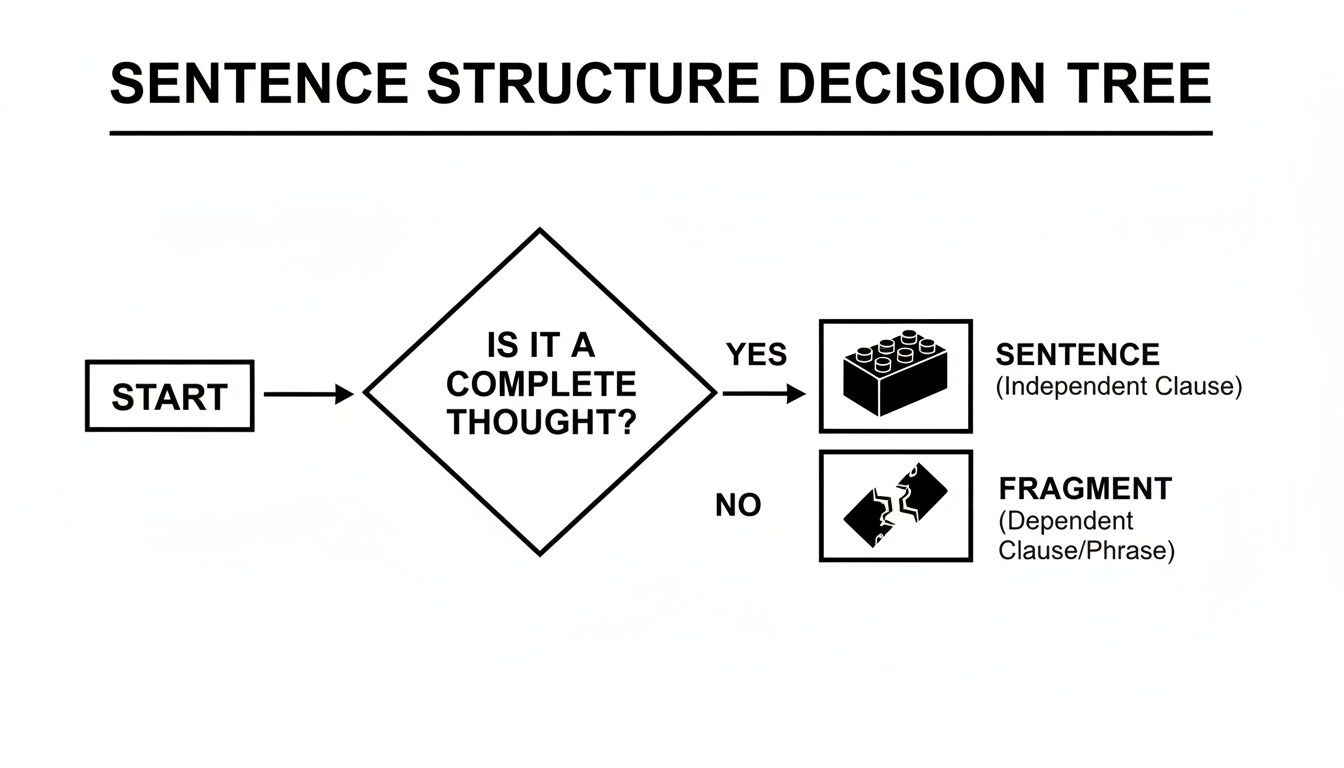
The big takeaway here is that both sides of the semicolon must be a full, standalone thought. When you want to show that two ideas are intimately related—without spelling out that relationship with a conjunction—the semicolon is the perfect tool for the job.
Semicolons in Action
Let's look at this in practice. Pay attention to the subtle but important shift in tone when we swap a period for a semicolon.
Two Separate Sentences:
- The project deadline is tomorrow. The team is working late to finish it.
- The ideas are obviously connected, but the period creates a hard stop, making them feel like two separate facts.
With a Semicolon:
- The project deadline is tomorrow; the team is working late to finish it.
- See how much smoother that feels? The second clause directly explains the why behind the first. The semicolon signals to the reader that these two pieces of information are deeply intertwined.
A semicolon is a stylistic choice. It suggests a close logical link—like cause-and-effect, a direct contrast, or a simple elaboration—between two complete sentences.
Here’s another example, this time showing a contrast:
- Before: My brother prefers to work in the morning. I am much more productive at night.
- After: My brother prefers to work in the morning; I am much more productive at night.
The semicolon elegantly highlights the opposition between the two work styles within a single, balanced sentence. It makes the comparison more direct and impactful, giving your writing a little extra polish.
Level Up Your Sentences with Conjunctive Adverbs
Think of a semicolon with a conjunctive adverb as a major upgrade for your sentences. This combination doesn't just link two complete thoughts; it builds a specific, logical bridge between them. These special adverbs act as transitions, telling the reader exactly how the second idea connects to the first.
They're like signposts on a highway. Words like however, therefore, consequently, and moreover signal whether you're about to contrast a point, show a result, or add more information. It's a fantastic way to add precision to your writing, making your arguments tighter and your explanations easier to follow.
The structure is pretty simple once you get the hang of it:
Independent Clause + ; + Conjunctive Adverb + , + Independent Clause
Don't forget that comma after the conjunctive adverb! It’s a tiny piece of punctuation, but it’s crucial for getting the rhythm right. This whole setup creates a sophisticated compound sentence semicolon structure that helps you guide readers through more complex ideas without losing them. For example: "The initial data was inconclusive; therefore, the team decided to run more tests."
Choosing the Right Word for the Job
The specific adverb you pick really matters—it completely changes the meaning of the sentence. Getting it right is key to making sure your logic is airtight, especially in any kind of formal or professional writing where clarity is everything.
In fact, many professional and scientific fields have editorial guidelines that specifically recommend using a semicolon before a conjunctive adverb to keep the relationship between findings clear. You can dig deeper into these standards by checking out professional style manuals.
Here’s a quick guide to some common conjunctive adverbs and what they do:
To Show Contrast: Use words like however, instead, or nevertheless.
- Example: The marketing team loved the first design; however, the CEO chose the second option.
To Show a Result: Words like therefore, consequently, or as a result work perfectly here.
- Example: The flight was delayed by three hours; consequently, we missed our connection.
To Add Information: Grab moreover, furthermore, or in addition.
- Example: The new software is far more efficient; moreover, it costs 20% less than the one we were using.
Getting comfortable with this structure does more than just make your sentences grammatically correct. It makes them logically sound and stylistically sharp. It’s a technique that takes your writing from just "getting the point across" to being truly articulate.
Common Semicolon Mistakes and How to Fix Them
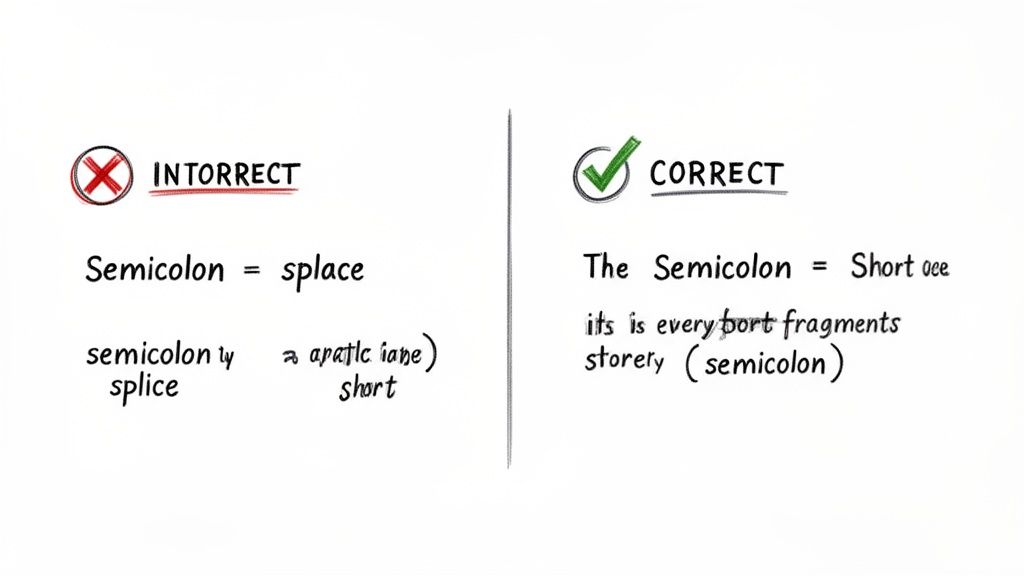
Wielding the semicolon with confidence is all about sidestepping a few common traps. Most writers fall into the same handful of mistakes, but once you learn to spot them, they’re surprisingly easy to fix.
The biggest offender by far is using a semicolon to connect a complete sentence to a phrase or a dependent clause. The golden rule is that a compound sentence semicolon needs a full, independent sentence on both sides.
Incorrect: The team worked all night; to finish the project.
Correct: The team worked all night; they were determined to finish the project.
See how "to finish the project" can't stand on its own? That’s the red flag. The semicolon has no business being there.
The Capitalization Question
Next up is a simple but common point of confusion: should you capitalize the word that comes after the semicolon? The answer is almost always no. Do not capitalize the first word of the second independent clause unless it's a proper noun, like a person's name or a city.
Think of the semicolon as a soft stop, not a hard reset like a period. Since you’re continuing the same core thought, the word after it stays lowercase, just as it would after a comma.
Incorrect: The audit was a success; We passed with flying colors.
Correct: The audit was a success; we passed with flying colors.
The Semicolon Splice and Comma Confusion
Finally, let’s talk about mixing up semicolons and commas. This happens in a few ways, but it always muddies your writing. Using punctuation incorrectly can obscure your message, much like getting frequently misused words mixed up.
Here’s a quick guide to fixing these common scenarios:
Connecting a Clause to a Phrase: This is the most common error. A semicolon should never link a main clause to a fragment.
- The Fix: Check that the group of words after the semicolon could be its own complete sentence. If not, don't use a semicolon.
Semicolon vs. Comma Splice: A comma splice is the opposite problem—using only a comma to link two complete sentences.
- The Fix: This is a perfect job for the semicolon! Swap that weak comma for a strong semicolon to correctly join the two independent clauses.
Put Your Semicolon Skills into Practice
Alright, you've got the rules down. But knowing what a semicolon does and actually using it with confidence are two different things. Now it's your turn to take what you've learned about the compound sentence semicolon and make it second nature.
This is where the rubber meets the road. The best way to get comfortable with any grammar rule is to put it into practice. These short exercises are designed to help you connect sentences, spot common errors, and start using semicolons like a pro. And for those times when you're polishing a final draft, a good AI text enhancer can be a great tool for refining sentence flow and catching tricky mistakes.
Exercise 1: Combine These Sentences
Let's start by joining two related ideas. Use a semicolon to connect these pairs of independent clauses into a single, smooth compound sentence.
- The company met its quarterly goals. The CEO announced a company-wide bonus.
- The storm knocked out the power. We had to use flashlights for hours.
Exercise 2: Spot the Error
Time to play editor. Take a look at the sentences below and rewrite them to fix the semicolon mistakes.
- The presentation was a huge success; winning us the new contract.
- She finished her report ahead of schedule; Therefore, she took the afternoon off.
Think you've got it? The answers are waiting for you below, along with a quick explanation of the logic behind each correction.
Your Semicolon Questions Answered
Even after you learn the rules, a few tricky questions always seem to come up when you start using semicolons to link sentences. Let's tackle those common head-scratchers so you can punctuate with confidence.
Think of this as the final polish on your newfound semicolon skills.
Can I Use a Conjunction After a Semicolon?
This is a big one, and the short answer is no. A semicolon's main job in a compound sentence is to take the place of a comma and a conjunction (like and, but, or so). Using both is like wearing a belt and suspenders—you only need one to do the job.
The semicolon is already handling the connection on its own.
Example:
Incorrect: The market is volatile; but we remain optimistic.
Correct: The market is volatile; we remain optimistic.
How Do I Know if Clauses Are "Closely Related"?
This is where art meets grammar. There's no hard-and-fast rule, but you can trust your gut. A good test is to ask yourself: does the second clause directly explain, expand on, or contrast with the first?
If the two clauses feel like two sides of the same coin or two parts of one complete thought, the semicolon is probably a perfect fit. The connection should feel natural and obvious to your reader without you needing to spell it out.
Is It Bad to Use Too Many Semicolons?
Absolutely. Overusing semicolons is a classic sign of trying too hard, and it can make your writing feel stuffy, dense, or overly academic. Like a strong spice, a little goes a long way.
Save them for moments when you really want to create a sophisticated link between two powerful ideas. For most writing, aiming for one or two per page is a good target. This adds stylistic flair without overwhelming your reader.
Ready to turn your drafts into polished, clear, and engaging text? Rewritify uses AI to enhance readability and coherence, ensuring your writing is always professional and plagiarism-free. Start rewriting for free at https://www.rewritify.com.
Relevant articles

Learn how to correct the sentence with practical grammar tips, proofreading tricks, and clear examples that boost clarity and confidence.
Struggling with the compound sentence with semicolon? This guide breaks down the rules with clear examples to help you write with precision and style.
Unlock the secrets of influence with our guide to 10 powerful persuasive writing techniques. Learn ethos, pathos, logos, and more to elevate your copy.
Discover what is text fluency and why it's a game-changer for writers. Learn actionable strategies to make your writing flow and engage readers effortlessly.
Master communication with our top 10 professional email writing tips. Learn to write clear, concise, and effective emails that get results. Read now!