Mastering the Compound Sentence With Semicolon
Struggling with the compound sentence with semicolon? This guide breaks down the rules with clear examples to help you write with precision and style.
A compound sentence with a semicolon is one of the most effective tools in a writer's kit. It lets you join two complete, closely related thoughts without a connecting word like 'and' or 'but'. Think of it as creating a more intimate, sophisticated link than a period ever could, telling your reader that these two ideas are meant to be together.
The Semicolon as a Bridge
Let's break this down. The best way to think of a semicolon is as a sturdy bridge connecting two separate islands of thought. Each of these "islands" is an independent clause—a group of words with a subject and a verb that could stand on its own as a complete sentence.
When you have two independent clauses that are tightly linked, you could just separate them with a period. But that can make your writing feel choppy. You could also connect them with a comma and a conjunction (like and, but, or so). The semicolon gives you an elegant third path. It signals to the reader that the second idea is a direct result, explanation, or contrast to the first.
A semicolon creates a pause that's stronger than a comma but softer than a full stop. It tells your reader, "These two ideas are separate, but they're closely related—pay attention to how they connect."
So, Why Bother With It?
Why not just stick to periods and commas? Because using a semicolon correctly adds rhythm and sophistication to your writing. It shows you can move beyond simple sentence structures, which helps build a more professional and authoritative tone. This is incredibly useful across different types of writing:
- Marketing Copy: It creates a seamless flow, guiding a reader from a feature to its direct benefit.
- Academic Writing: It allows you to link complex ideas or research findings with precision.
- Business Reports: It’s perfect for presenting related data points or building a concise, powerful argument.
Let's look at the difference it makes.
- With a Period: The quarterly profits exceeded expectations. Our new marketing strategy was a success.
- With a Semicolon: The quarterly profits exceeded expectations; our new marketing strategy was a success.
See the difference? The second version doesn't just state two facts; it implies a direct cause-and-effect relationship. The successful strategy is the reason profits were high. By mastering the compound sentence with a semicolon, you can add this kind of nuance to your writing, making it far more persuasive and engaging.
Semicolon vs Other Punctuation for Connecting Ideas
Choosing the right punctuation to connect ideas is crucial for clarity. A semicolon is just one option, and it's not always the best one. This table breaks down how it compares to other common methods and points out frequent mistakes.
| Punctuation Method | Structure | Example | When to Use |
|---|---|---|---|
| Semicolon | Independent Clause ; Independent Clause. | The project was a success; everyone on the team contributed. | The two clauses are closely related, and you want to show a strong, direct connection without a conjunction. |
| Period (Full Stop) | Independent Clause. Independent Clause. | The project was a success. Everyone on the team contributed. | The ideas are related but distinct enough to stand as separate sentences. Good for a simple, direct style. |
| Comma + Conjunction | Independent Clause, [and/but/so] Independent Clause. | The project was a success, and everyone on the team contributed. | You want to show a specific relationship (e.g., addition with 'and', contrast with 'but'). This is the most common method. |
| Comma Splice (Error) | Independent Clause, Independent Clause. | The project was a success, everyone on the team contributed. | Never. This is a grammatical error. A comma alone is too weak to join two complete sentences. |
Ultimately, the semicolon gives you a stylistic choice that sits perfectly between the definitive separation of a period and the explicit connection of a conjunction. It’s a mark of a confident writer.
Understanding the Three Core Semicolon Rules
To really get a handle on compound sentences with semicolons, you only need to master a few key principles. These aren't just stuffy grammar points; think of them as practical tools that give you more control over your writing's rhythm and meaning. Once you internalize them, you'll find yourself connecting ideas with much more precision.
The good news is that grammar experts pretty much all agree on three core jobs for the semicolon. The first and most common rule is to join two closely related independent clauses without a conjunction. The second involves using it with conjunctive adverbs, and the third is for organizing messy, complex lists. Nail these three, and you've unlocked nearly all of the semicolon's power. If you want a deeper dive, the folks at Grammarly have a great breakdown of these fundamentals.
This simple flowchart is a great way to visualize the main decision you need to make when thinking about using a semicolon to connect two ideas.
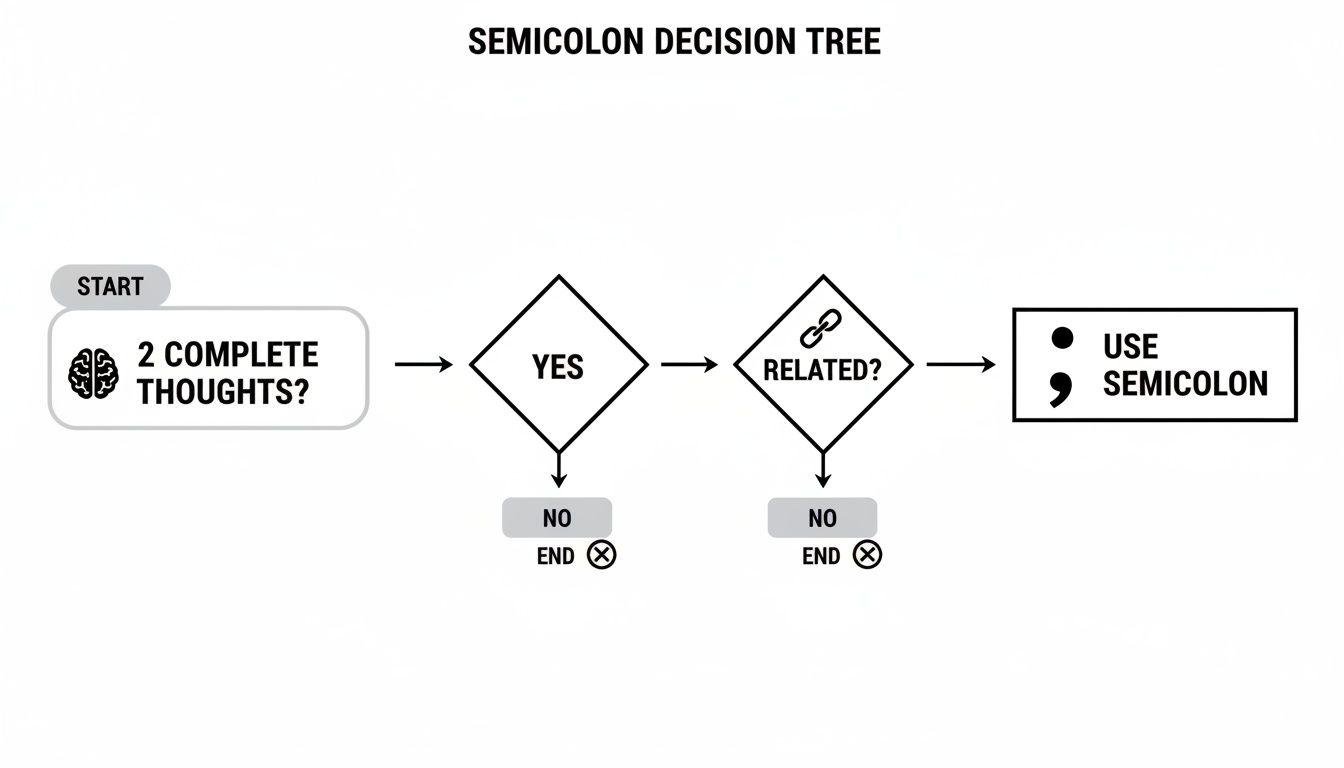
As you can see, a semicolon really only works when you have two complete, closely related thoughts. Let's unpack each of these rules with some clear examples.
Rule 1: Connect Two Related Independent Clauses
This is the semicolon's bread and butter—its most frequent and fundamental use. When you have two complete sentences that are tightly linked in meaning, the semicolon can join them. Maybe one shows a cause and the other an effect, or perhaps they present a direct contrast.
It essentially steps in to replace a period or a comma and a conjunction (like and, but, or so). The result is a stronger, more immediate connection between the two clauses.
- Example: The presentation was a success; the clients approved the new budget on the spot.
See how the second clause directly explains the outcome of the first? The semicolon signals that tight relationship much more effectively than a period would, which would feel more like a full stop.
Think of the semicolon as a pivot point. It gracefully balances two complete thoughts, showing the reader how one idea turns into, or reflects upon, the other. Using one shows you're thoughtfully building your argument or narrative.
Rule 2: Use With Conjunctive Adverbs
Conjunctive adverbs are just transition words that show a specific relationship between two independent clauses. You use them all the time: words like however, therefore, consequently, and furthermore.
The standard rule here is to place a semicolon before the conjunctive adverb and a comma after it. This structure creates a strong, logical bridge between your ideas.
- Correct: We submitted the report on time; however, we still need to send the appendix.
- Incorrect: We submitted the report on time, however, we still need to send the appendix. (This common mistake is a comma splice.)
Rule 3: Separate Items in a Complex List
Ever tried to write a list where the items themselves already contain commas? It can get messy and confusing fast. This is where the semicolon comes to the rescue, acting as a "super-comma" that clearly separates the main items in the list.
You'll see this a lot when listing things like cities and states, job titles with their departments, or any multi-part concepts.
- Confusing: Our guest speakers were Jane Doe, a CEO from Boston, Mark Smith, a researcher from Chicago, and Sarah Lee, an author from Miami.
- Clear: Our guest speakers were Jane Doe, a CEO from Boston; Mark Smith, a researcher from Chicago; and Sarah Lee, an author from Miami.
The semicolons make it instantly obvious where one list item ends and the next begins. The clarity is night and day.
Putting Theory Into Practice With Annotated Examples
It’s one thing to know the rules, but it's something else entirely to see them working in the wild. The fastest way to get a real feel for using a semicolon in a compound sentence is to see how it behaves in different situations. Let's move past the theory and look at the real stylistic punch this punctuation can deliver.
We'll break down a few sentences and dig into why a semicolon is the best tool for the job. Each example shows a different kind of relationship between two ideas, from a simple contrast to a logical flow.
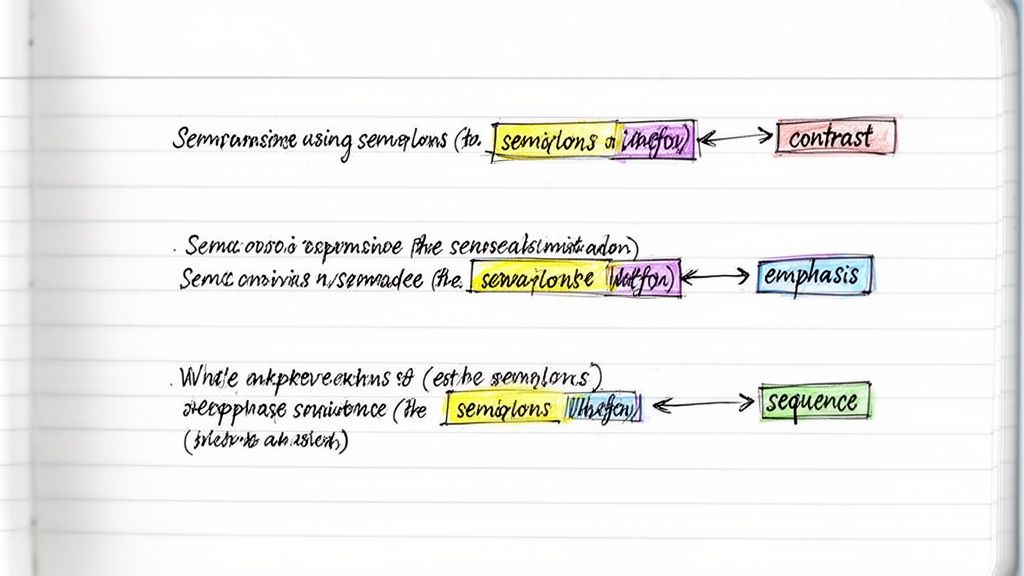
Example 1: Highlighting Contrast
A semicolon is brilliant for setting two opposing ideas side-by-side. It creates an immediate, powerful contrast that really makes the reader think.
- Sentence: The marketing team focused on short-term gains; the product team prioritized long-term stability.
Annotation: Think of the semicolon here as a fulcrum on a seesaw, perfectly balancing two competing philosophies. It forces you to compare "short-term gains" right next to "long-term stability." A period would create too much separation, and a comma with "but" would soften the impact. The semicolon, however, creates a sharp, concise statement about the strategic split within the company.
Example 2: Showing a Logical Sequence
When one idea flows directly from another, the semicolon helps create a smooth, logical bridge, guiding your reader from one step to the next.
- Sentence: First, we must analyze the user data; then, we can develop a targeted content strategy.
Annotation: In this sentence, the semicolon comes right before the conjunctive adverb "then," establishing a clear, ordered process. The first clause lays out the prerequisite, and the second presents the logical follow-up. You'll see this structure a lot in reports and instructions because it adds a touch of formal authority while keeping things crystal clear. It makes the connection feel strong and almost inevitable.
The semicolon doesn't just connect sentences; it adds a layer of meaning. It tells the reader that the second idea is a direct consequence, explanation, or counterpoint to the first, all without needing a single extra word.
Example 3: Adding Emphasis or Explanation
Sometimes, the second part of the sentence isn't about contrast or sequence. Instead, it’s there to add a critical detail or drive a point home with more force.
- Sentence: The project was a resounding success; it came in under budget and two weeks ahead of schedule.
Annotation: Here, the second clause offers the proof that makes the first clause believable. Simply saying the project was a success is a bold claim. The semicolon lets you immediately follow up with the hard evidence, reinforcing your statement with concrete facts. This technique makes your writing far more efficient and persuasive. As you get more comfortable, you'll learn how to reword a paragraph with semicolons to build sentences that are more dynamic and convincing.
How to Avoid Common Semicolon Mistakes
Mastering the semicolon can elevate your writing, giving it a sophisticated, professional feel. But get it wrong, and it can do the opposite, making your sentences clunky and confusing. The good news is that most semicolon slip-ups fall into just a few categories.
Once you learn to spot these common patterns, you’ll be able to self-edit with confidence and make your writing flow effortlessly. Let's break down the most frequent mistakes so you can avoid them entirely.
Mistake 1: Connecting an Incomplete Thought
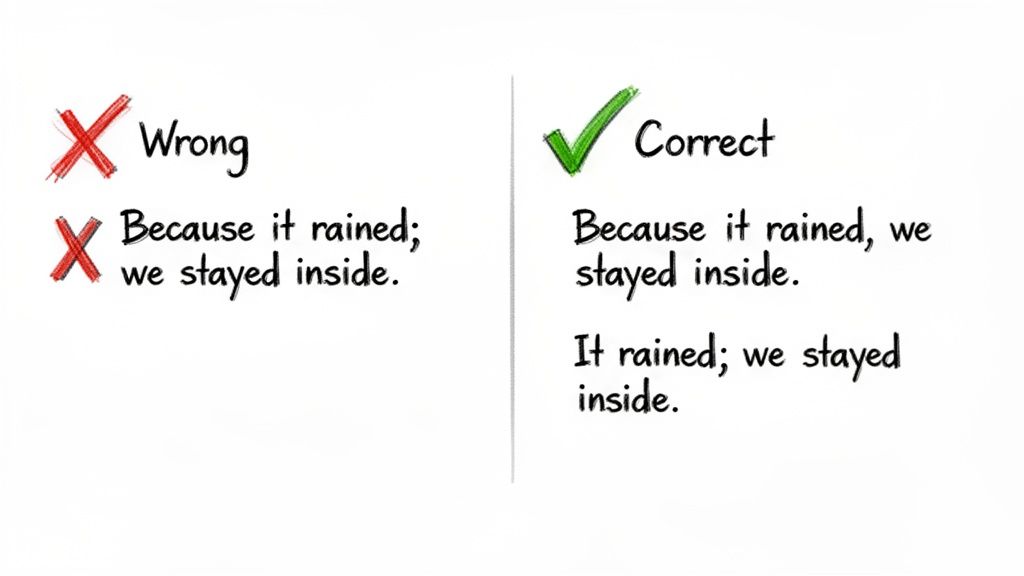
This is the big one. The number one rule of using a semicolon is that it must connect two complete, independent sentences. Each side has to be able to stand on its own. A classic error is linking a full sentence to a fragment or a dependent clause.
- Incorrect: The team worked overtime for weeks; because the deadline was approaching.
- Why it's wrong: The second half, "because the deadline was approaching," can't stand alone. It’s a dependent clause, a fragment that leaves the reader hanging.
- Correct: The team worked overtime for weeks; the deadline was approaching.
See the difference? Now both sides of the semicolon have equal grammatical weight. That’s the semicolon's primary job in this role—balancing two related ideas.
Mistake 2: Using a Semicolon Like a Colon
They might look alike, but a semicolon and a colon are not interchangeable. They have very different jobs. A colon acts like a trumpet fanfare, announcing what's to come: a list, a quote, or an explanation. A semicolon, in contrast, is more like a firm handshake between two equal partners.
A common mix-up is using a semicolon to introduce a list.
- Incorrect: The project required three key elements; user research, wireframing, and prototype testing.
- Why it's wrong: This is a colon's job, not a semicolon's. The semicolon isn't built for introductions.
- Correct: The project required three key elements: user research, wireframing, and prototype testing.
Key Takeaway: Think of it this way—a colon says, "Here's what I mean," while a semicolon says, "And here's a closely related thought."
Mistake 3: The Comma Splice With a Transition Word
This one is sneaky and incredibly common. It usually happens when writers use conjunctive adverbs like "however," "therefore," or "consequently." It's tempting to put a comma before these words, but a simple comma just isn't strong enough to join two complete sentences. Doing so creates a dreaded comma splice.
- Incorrect: The data looked promising, however, the final results were inconclusive.
- Why it's wrong: You have two complete sentences here: "The data looked promising" and "the final results were inconclusive." A lonely comma can't legally join them.
- Correct: The data looked promising; however, the final results were inconclusive.
Using a semicolon here creates a sturdy, grammatically sound bridge between the two ideas, guiding your reader smoothly from one point to the next.
To make it even easier to spot these issues in your own writing, here's a quick reference guide for fixing the most frequent semicolon blunders.
Quick Fix Guide for Semicolon Errors
| Common Mistake | Incorrect Example | The Fix | Corrected Example |
|---|---|---|---|
| Semicolon + Fragment | The presentation was a success; although we went over time. | A semicolon must join two complete sentences. Use a comma or rewrite the sentence. | The presentation was a success, although we went over time. |
| Introducing a List | I need to buy a few things; milk, bread, and coffee. | Use a colon to introduce a list, not a semicolon. | I need to buy a few things: milk, bread, and coffee. |
| Comma Splice | He missed the bus, therefore, he was late for the meeting. | Use a semicolon before a conjunctive adverb that connects two full sentences. | He missed the bus; therefore, he was late for the meeting. |
| Separating Unrelated Ideas | I love hiking; the stock market is volatile this year. | The two sentences must be closely related. Use a period instead. | I love hiking. The stock market is volatile this year. |
This table serves as a handy cheat sheet. Keep it nearby when you're editing, and you'll find yourself catching these little mistakes before they ever make it to the final draft.
Why Semicolons Still Matter in Modern Writing
In a world of bite-sized content and rapid-fire tweets, the semicolon can feel like an old-fashioned grammar rule. Has its time passed? It's true that its usage has dipped over the years; some studies even showed its frequency in British literature fell by 50% after 2000.
But don't write it off just yet. A well-placed semicolon does something a period or a comma can't. It tells your reader that you’re a thoughtful writer, one who sees the subtle connections between ideas. Using it correctly adds a layer of sophistication to your work, building trust and showing your audience they're in capable hands.
The Strategic Value of Clarity and Flow
Beyond just sounding smart, the semicolon has a very practical job: it massively improves text fluency. Think of it as creating a pause that’s stronger than a comma but softer than a full stop. This little trick gives your writing a natural rhythm and makes it easier to read.
That improved flow is a bigger deal than you might think. When your content is clear and readable, people stick around longer, which search engines love. A compound sentence with a semicolon is the perfect tool for breaking down a complex idea without chopping it into a series of short, disconnected sentences.
The semicolon is a mark of confidence. It shows you have control over the pace and structure of your sentences, guiding your reader through related ideas without interruption. It’s a subtle tool for building a more engaging and persuasive narrative.
Learning how to use semicolons is a key part of effectively using a range of sentence structures. It adds polish and precision, especially in professional or academic writing where clarity is everything. In a noisy digital world, that kind of careful construction helps you stand out.
Ultimately, this isn't about memorizing an old rule. It's about adding a powerful tool to your writing toolkit. The semicolon lets you:
- Create nuanced connections: You can show a relationship—like cause and effect or contrast—without needing extra words.
- Control the reading pace: Mixing up your sentence structure with semicolons keeps your writing from sounding monotonous and robotic.
- Signal expertise: It’s a small detail that demonstrates a real command of the language, which serious readers always appreciate.
Using Semicolons in Academic and Professional Writing
In formal settings—think research labs, university classrooms, and corporate boardrooms—precision is everything. Getting your point across clearly and authoritatively isn't just a bonus; it's a requirement. This is where the compound sentence with a semicolon becomes more than a stylistic flair. It becomes an essential tool.
When you're writing formal prose, especially in academic writing, the semicolon has a specific and powerful job. It lets you connect complex ideas with a kind of logical grace, linking a hypothesis to its outcome or a business problem to its solution. Using one shows your reader you’ve intentionally structured your argument, joining two complete thoughts so tightly they form a single, compelling statement.
Building Credibility with Punctuation
In the worlds of science and academia, semicolons are perfect for joining closely related independent clauses. They help clarify complicated concepts without getting tangled in run-on sentences.
Take a research paper, for example. A sentence like, “The experiment succeeded; the results exceeded all initial expectations,” uses the semicolon to build a seamless bridge between cause and effect. This kind of structural clarity is vital, especially when you consider that nearly 70% of peer-reviewed journals demand impeccable formatting that follows specific style guides like APA or MLA.
Semicolons act as a signal of careful thought. In a formal report or essay, they demonstrate that the writer has deliberately connected two ideas, reinforcing the logic of their argument and enhancing their professional credibility.
Practical Applications in Formal Contexts
So, where does this punctuation really add value in your day-to-day work? Getting this right can seriously elevate the quality of your documents.
- Business Proposals: Use a semicolon to link a client's problem directly to your proposed solution. It creates a persuasive one-two punch. Example: The current system is inefficient; our software provides a streamlined alternative.
- Academic Essays: Connect a theoretical concept with a concrete piece of evidence. Example: The theory of cognitive dissonance is well-established; participants consistently altered their beliefs to match their actions.
By using semicolons correctly, you're meeting the high standards expected in these professional and academic fields. To sharpen your skills even more, check out these formal writing style examples to see how punctuation contributes to a polished final product.
Semicolon FAQs: Your Top Questions Answered
Even after you get the hang of the rules, a few tricky questions always seem to pop up. Let's walk through some of the most common sticking points to make sure you're using semicolons with confidence.
Can I Use a Semicolon With 'And' or 'But'?
This is a classic grammar trap, but the answer is a firm no. The semicolon’s job is to replace the comma and the coordinating conjunction (like and, but, or). Using both at the same time is like wearing a belt and suspenders—it's redundant.
- Incorrect: The research was complete; but the report was not yet written.
- Correct: The research was complete; the report was not yet written.
- Alternative: The research was complete, but the report was not yet written.
You have to pick a lane. Either go with the semicolon for a strong, direct link, or stick with the comma and conjunction for a more standard connection.
How Do I Know if Two Sentences Are Closely Related?
This is where the art of writing comes in. There's no hard-and-fast rule, but the best test is to see if the second clause directly explains, contrasts, or builds upon the first. The two ideas should feel like they belong together, like two sides of the same coin.
A good rule of thumb is to ask yourself: Does the second sentence feel like an immediate and necessary follow-up to the first? If the ideas feel random or disconnected, just use a period.
For example, "The server went down; we lost three hours of work" works perfectly. You can feel the cause-and-effect relationship. But a sentence like, "The server went down; I have a meeting tomorrow," feels disjointed. The two thoughts don't have a clear, logical bridge connecting them.
Is It Possible to Overuse Semicolons?
Oh, absolutely. The semicolon is like a potent spice—a little goes a long way. Sprinkling them everywhere can make your writing feel dense, stuffy, and maybe even a little pretentious.
A good guideline is to aim for no more than one or two semicolons per paragraph. Their power lies in their rarity. Save them for those moments when you really want to forge a special connection between two important ideas and make your reader pause and think.
Ready to transform your drafts into polished, professional text? Rewritify uses advanced AI to refine your sentences, enhance clarity, and ensure your writing is original and undetectable. Try it now to see how effortlessly you can elevate your content. Learn more at https://www.rewritify.com.
Relevant articles
Elevate your writing by mastering the compound sentence semicolon. This guide explains the rules with clear examples to help you connect ideas perfectly.