How to Reword a Paragraph and Transform Your Writing
Discover how to reword a paragraph to improve clarity, voice, and SEO. Learn practical manual techniques and how to leverage AI tools for great results.
Knowing how to reword a paragraph is a skill that separates good writers from great ones. It's not just about swapping out a few words to dodge plagiarism—it's about fundamentally reshaping an idea to make it clearer, more persuasive, and a better fit for your audience.
This means digging into the sentence structure, hand-picking the right vocabulary, and making sure the original tone and meaning shine through.
Why Mastering Paragraph Rewording Transforms Your Content
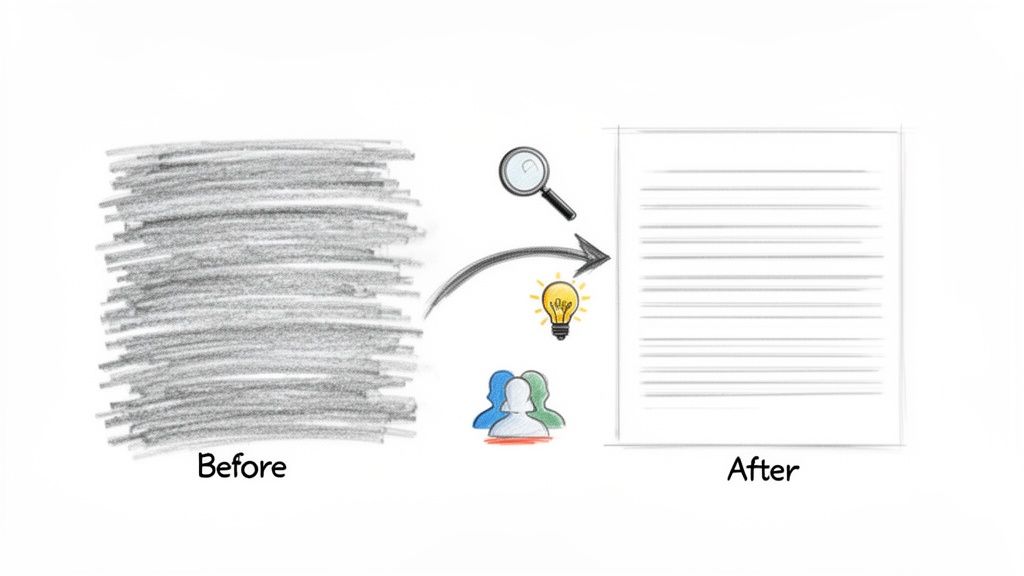
Being able to effectively reword a paragraph gives you a real strategic edge. It’s what turns a piece of content that just sits there into one that actually connects with people. For a student, it’s the key to proving you understand a topic while upholding academic integrity. For a marketer, it’s how you sharpen a message until it gets a response.
This isn't just about moving words around on a page. It's a much deeper edit that makes your writing more effective. By rephrasing a paragraph, you can:
- Improve Readability: Unpack dense, complicated sentences and turn them into concepts that are a breeze for your audience to follow.
- Strengthen Your Voice: Take generic ideas and inject them with your unique style and perspective, making your work feel far more authentic.
- Boost SEO Performance: Weave in keywords and related search terms naturally, helping you rank higher without sounding like a robot.
We're all swimming in a sea of information, and the things that make content float to the top are originality and clarity. The demand for writers who can deliver high-quality, original material is exploding—the content writing services market is expected to jump from USD 22.63 billion in 2025 to USD 35.63 billion by 2032.
In a climate where 90% of marketers see content creation as a critical skill, knowing how to thoughtfully reword a paragraph isn't just nice to have; it's essential. You can learn more about these content marketing trends and what they mean for writers today.
The Strategic Value of Rewording
Think of rewording as a form of translation. You’re not just swapping one word for another; you’re translating an idea from one context to another. Maybe you're taking a complex academic study and turning it into a digestible blog post, or refining a messy first draft into a polished final piece.
This whole process forces you to get up close and personal with the material. You can't explain it well if you don't truly get it first.
Rewording is the ultimate test of understanding. If you can't explain an idea in your own words, you haven't truly grasped it yet. This practice sharpens your thinking and makes your final output significantly more impactful.
Ultimately, mastering how to reword a paragraph is one of the most powerful tools in a writer's toolkit. It lets you build on existing knowledge ethically, tailor your message for different channels, and create content that is clear, compelling, and truly yours.
The table below breaks down the main reasons why this skill is so crucial.
Core Reasons to Reword a Paragraph
| Goal | Why It Matters | Best For |
|---|---|---|
| Improve Clarity | Untangles complex sentences and jargon, making the content accessible to a broader audience. | Technical writing, academic summaries, and explaining complex topics to non-experts. |
| Avoid Plagiarism | Ensures all borrowed ideas are expressed in your own unique voice, upholding academic and professional integrity. | Student essays, research papers, journalism, and any content relying on source material. |
| Enhance Engagement | Rephrasing can make a dry topic more dynamic and interesting, hooking the reader from the start. | Blog posts, marketing copy, social media updates, and website content. |
| Refine Tone & Voice | Adjusts the language to match the intended audience, whether it's formal, casual, or persuasive. | Brand messaging, email marketing, and adapting content for different platforms. |
| Integrate Keywords | Allows for the natural placement of SEO keywords to improve search rankings without sacrificing quality. | SEO content writing, product descriptions, and articles aiming for organic traffic. |
Each of these goals shows that rewording goes far beyond simple substitution—it's a thoughtful process of refinement that elevates the entire piece.
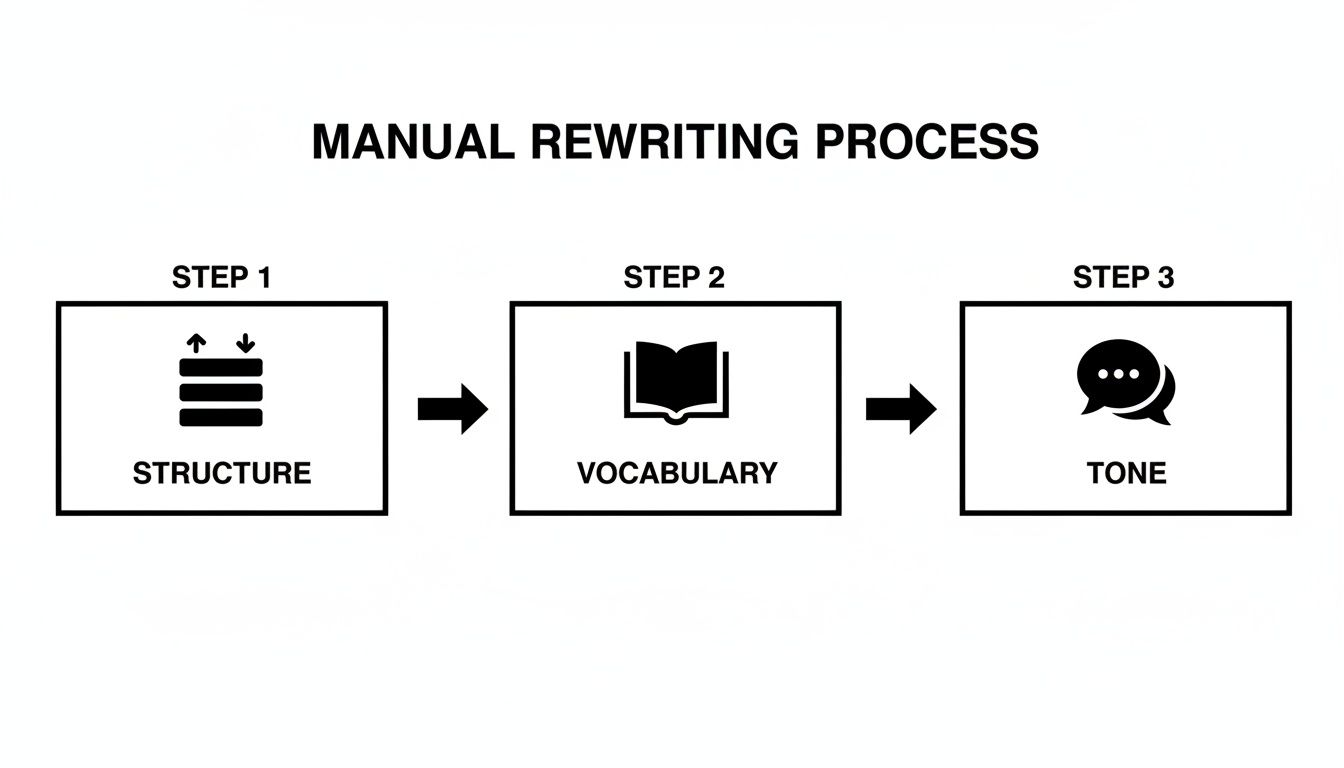
Getting Hands-On: Manual Rewording for Authentic Results
Before you even think about using an AI tool, it's worth mastering the art of manual rewording. This isn't just about avoiding plagiarism; it's about truly understanding the material you're working with. When you rewrite something by hand, you gain complete control over the final piece, ensuring your unique voice and perspective shine through.
The idea is to take the original paragraph apart and rebuild it from scratch. This forces you to internalize the core message, which almost always results in a clearer, more authoritative version. Let's dig into the strategies that separate a simple word-swap from a genuinely professional rewrite.
Restructure Sentences for a Fresh Perspective
The single most effective way to reword a paragraph is to tear down and rebuild its sentence structure. If you just swap out words but keep the original sentence framework, it can still feel too similar to the source material—and might even get flagged by plagiarism checkers. You have to change the paragraph's DNA.
Here are a few ways to rethink the structure:
- Combine Choppy Sentences: If the original text feels stilted, try merging a few related ideas into a single, more fluid sentence. This often creates a more sophisticated flow and helps clarify the relationship between points.
- Break Down Long Sentences: On the flip side, a long, rambling sentence can easily lose a reader. Splitting it into two or three shorter, punchier statements can make the information much easier to digest and far more impactful.
- Vary Your Sentence Openers: It’s a common trap to start every sentence with the same subject ("The study found... The study also showed..."). Try leading with a prepositional phrase or a dependent clause instead. This one simple trick can dramatically improve the rhythm and readability of your writing.
When you actively reshape the structure, you’re not just rephrasing—you’re re-architecting the entire idea.
Choose Your Synonyms with Surgical Precision
Using a thesaurus is a classic move, but it requires a delicate touch. A huge mistake I see people make is just grabbing the first synonym they find, which can completely twist the original meaning or create a clunky, unnatural tone.
Words have subtle shades of meaning. The right synonym doesn't just replace a word; it refines the message.
The best synonym isn't just a word with a similar dictionary definition. It's the one that perfectly fits the context, tone, and rhythm of your sentence. Always prioritize precision over variety.
Take the word "important." You could swap it for "significant," "crucial," "vital," or "pivotal." Each one has a different weight. "Crucial" implies something is absolutely necessary, while "significant" just suggests a noteworthy impact. Always ask yourself: Does this new word keep the exact nuance I’m trying to convey? It’s also critical to leave technical terms or branded phrases alone to maintain accuracy.
Hold On to the Original Voice and Tone
A great rewrite always preserves the spirit of the original piece. Is the source material a formal academic paper or a fun, breezy marketing email? Your word choices and sentence structures have to align with that intended tone.
Think of it like you're translating the paragraph for a new audience. You wouldn't use dense, academic jargon in a blog post aimed at beginners. In fact, one of the most powerful uses of rewording is to make complex topics more accessible. For more on this, our guide on how to make your writing easy to understand offers some fantastic, practical tips for simplifying language without dumbing it down.
See It in Action: Practical Examples of Manual Rewording
Let's look at how these techniques come together. In the "After" versions below, notice how the sentence structure, word choice, and overall flow have changed, all while the core message remains perfectly intact.
Example 1: Marketing Blog Post
- Before: Our new software platform is designed to help marketing teams improve their workflow efficiency. It has many features that automate repetitive tasks, which saves a lot of time. Teams can therefore focus more on creative strategy and campaign development.
- After: By automating repetitive tasks, our new software platform frees marketing teams from inefficient workflows. This significant time savings allows them to shift their focus from administrative duties to high-impact creative strategy and campaign development.
Example 2: Academic Summary
- Before: The study's findings indicate a strong correlation between regular physical exercise and improved cognitive function in elderly participants. The research involved monitoring 500 individuals over a ten-year period. It consistently showed that memory retention and problem-solving skills were enhanced.
- After: Over a decade, researchers monitored 500 elderly participants and found that regular physical exercise significantly improves cognitive function. The study consistently revealed enhancements in key areas like memory retention and problem-solving skills, demonstrating a strong link between physical activity and mental acuity.
2. Using AI Tools to Reword Paragraphs Intelligently
Manually rewriting is a fantastic skill, but let's be realistic—AI tools are now a huge part of a smart writer's toolkit. Think of them as a creative partner, not a replacement. They’re perfect for smashing through writer's block and speeding things up, but you still need to be the one in the driver's seat.
The best way to work with AI is what's often called a "human-in-the-loop" approach. You give the AI a paragraph, see what it comes up with, and then you—the human expert—step in to pick, choose, and polish the best bits. This keeps your authentic voice and ensures the final result actually sounds like you.
Choosing the Right AI Rewriter and Mode
Not all AI rewriters are created equal. Modern tools give you a ton of control, so the first step is picking the right one for your specific task. Some platforms, like Jasper AI, are packed with features for generating text in different styles.
A good tool will let you select different "modes" to guide the output. These are like little creative guardrails that tell the AI what you're aiming for.
- Natural or Simple Mode: This is great for taking dense, complicated text and making it easy for anyone to understand. It gives your writing a more conversational, approachable vibe.
- Academic or Formal Mode: When you need to sound authoritative for a research paper or a business report, this mode ensures your language is precise and professional.
- Undetectable Mode: Let's face it, some AI-generated text just sounds like a robot wrote it. This mode focuses on creating content that flows naturally and avoids those tell-tale AI patterns.
Choosing the right mode from the start saves a ton of editing time on the back end. You’re essentially giving the AI a solid brief before it starts writing, which means you get a much better first draft to work with.
Your AI-Assisted Workflow in Action
So, what does this actually look like in practice? Instead of just copying and pasting, think of yourself as a creative director.
Start by dropping your original paragraph into the tool. Now, generate a few different versions using one or two modes that fit your goal. Don't just grab the first one and run. Lay them out and compare them. One version might have the perfect opening line, while another absolutely nails the main point in a new way. Your job is to Frankenstein them together.
Here’s a glimpse of how different modes in an AI tool can spin the same text in completely different directions.
As you can see, a single paragraph can be reshaped for totally different contexts, giving you a palette of options to work from.
After you've cherry-picked the best phrases and ideas, it’s time for the final human touch. This is where you inject your unique personality, add a relevant example, and make sure the tone is spot-on for your brand. This final polish is also a good time to run it through an AI text enhancer. An enhancer can catch clunky phrasing you missed and suggest improvements to the overall flow. To learn more about this final step, check out our guide on using an AI text enhancer.
Why a Human-AI Partnership Is the New Normal
Working with AI isn't some future trend; it's happening right now. A 2023 study revealed that a staggering 83.2% of marketers plan to use AI for content creation. That's a huge shift, and it presents both an opportunity and a risk. While AI speeds things up, it can also lead to a flood of bland, generic content online.
This is exactly why a thoughtful, human-guided approach is so critical. By using AI to generate drafts and then manually refining them, you get the best of both worlds: the speed of automation and the nuance of human creativity.
This hybrid process is what helps you stand out. Your content will feel more original and engaging, and it’s far less likely to get flagged by AI detectors. Ultimately, it’s about creating content that truly connects with readers and performs better in the long run.
Staying on the Right Side of Plagiarism, Citations, and SEO
Figuring out how to reword a paragraph is one thing, but doing it responsibly is what separates good writers from great ones. It’s surprisingly easy to fall into the “patchwriting” trap—where you just swap out a few words here and there. That’s a fast track to plagiarism, even if you don’t mean it.
Genuine paraphrasing goes much deeper. It’s about fundamentally rethinking and restructuring the original text.
Remember, even after a masterful rewrite, you’re still working with someone else's idea, data, or argument. Giving credit isn't just for academic papers; it’s a non-negotiable part of building trust and credibility with any audience.
On top of that, rewriting is a golden opportunity to boost your content’s performance. A thoughtfully reworded paragraph lets you weave in important keywords naturally, helping your work show up in search results.
Paraphrasing vs. Plagiarism: Drawing a Clear Line
The line between clever paraphrasing and outright plagiarism can feel a bit hazy, but the difference is crucial. Plagiarism is passing off someone else's work as your own, whether you intended to or not.
Paraphrasing, done correctly, is a legitimate way to borrow an idea by explaining it entirely in your own voice and sentence structure. The two magic ingredients are transformation and attribution.
True paraphrasing isn’t about hiding your source; it's about showing you actually understand it. If you can explain the concept without just mimicking the original sentence flow or unique phrases, you’re on the right path.
This means you have to do more than just hunt for synonyms. You need to deconstruct the sentences and filter the idea through your own lens. For a closer look at the nuts and bolts, our guide on how to paraphrase without plagiarizing breaks down the techniques you need to stay original.
To help you stay on track, use this simple checklist. It's a great way to gut-check your work before you publish.
Paraphrasing vs Plagiarism Checklist
| Checklist Item | Description | Pass / Fail |
|---|---|---|
| Complete Restructuring | Have you completely changed the sentence structure from the original? | |
| Unique Word Choice | Have you used your own vocabulary, not just synonyms for key terms? | |
| Core Idea Preserved | Does your version accurately reflect the original author's main point? | |
| Attribution Included | Have you credited the original source, even if it's just a link? | |
| No "Patchwriting" | Did you avoid simply swapping a few words in the original sentence? |
If you can confidently answer "Pass" to all of these, you're in great shape. If not, it's time to go back and refine your paragraph a bit more.
Knowing When and How to Cite Your Sources
Here's a simple rule of thumb: if an idea isn't common knowledge, you need to cite it. This is true even if you've reworded it brilliantly. Skipping a citation is a common mistake that can instantly damage your credibility.
You should always provide a citation when you:
- Use any kind of statistics, data, or specific figures from a source.
- Reference a unique theory, idea, or opinion that belongs to someone else.
- Summarize the findings from a specific study, report, or survey.
Citing sources doesn't make your writing look weak—it does the opposite. It shows you've done your homework and gives real weight to your arguments.
How to cite in different situations:
- For blog posts & web content: A simple, descriptive in-text link usually does the trick. For example: "Research from Nielsen Norman Group shows that 79% of web users scan rather than read."
- For academic papers: Stick to the required style guide (like APA, MLA, or Chicago), which means an in-text citation and a full reference list.
- For business reports: A clean footnote or endnote is a professional way to show where your information came from.
The goal is always transparency. Make it easy for your readers to trace your information back to the original source.
Weaving in SEO Keywords Without Sounding Like a Robot
The rewriting process is the perfect time to think about SEO. Instead of trying to cram keywords in after you’ve finished writing, you can bake them right into your new sentences. This helps your content get found without sacrificing quality.
First, identify your main keyword (like "how to reword a paragraph") and a few related phrases. As you’re reworking the content, look for natural places to include them.
For instance, if the original text was about "changing the words," you could rephrase it to be about "rewording a paragraph for clarity." This small adjustment aligns the content with what people are actually searching for while making the sentence better. To learn more about how this works, check out these powerful AI SEO Strategies to Dominate Search Rankings.
The best SEO is invisible. When you prioritize writing something genuinely valuable for your reader, the search engine benefits almost always follow.
Your Final Rewriting and Polishing Checklist
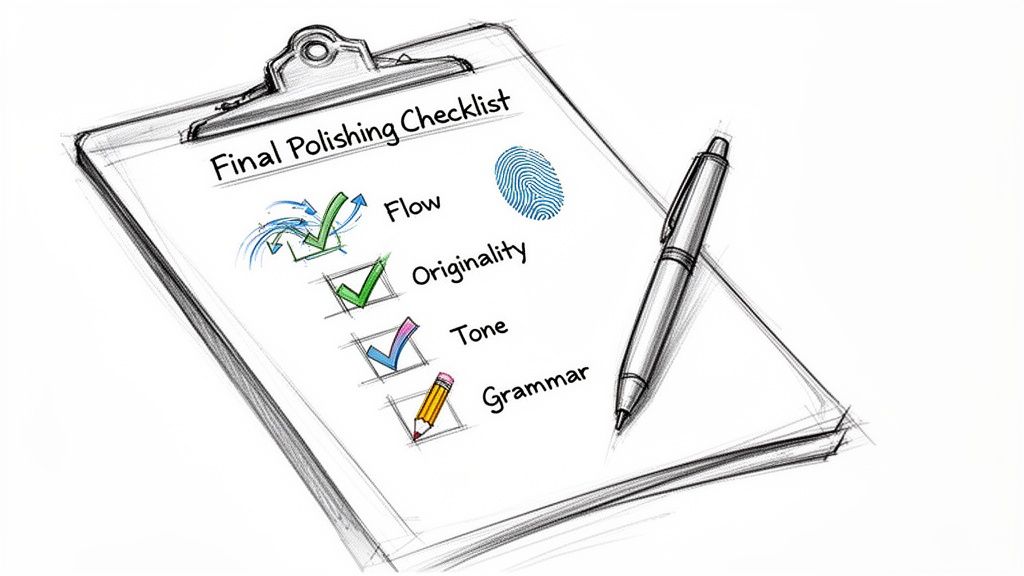
Before you call it a day, one last pass can make all the difference. This isn’t about another heavy rewrite; it's about the final polish that turns good work into great work. Think of it as the quality control phase that catches the little things that matter.
This checklist is your guide for that final review. We’ll walk through four key areas to ensure your reworded paragraph is clear, original, on-brand, and error-free.
Check for Clarity and Logical Flow
A paragraph can be grammatically perfect and still fail if it’s confusing. Your first task is to read it through the eyes of your audience. Does it make sense? Is it easy to follow?
I always find that reading the paragraph out loud is the best way to catch clunky sentences and awkward phrasing. If you stumble while reading it, your audience will stumble, too. Make sure each sentence flows logically into the next, using transitional words if needed to bridge any gaps.
To really nail this, ask yourself:
- Is the main point crystal clear? A reader shouldn't have to work to figure out what you're trying to say.
- Is there any room for misinterpretation? Hunt down and destroy any ambiguous language.
- Does this paragraph actually serve a purpose? Every piece of content should support the larger message of your article.
Answering these questions ensures your message lands exactly as you planned.
Verify Originality and Proper Attribution
Now, let's talk about staying out of trouble. Even with the best intentions, it's easy for bits and pieces of the original source to sneak into your rewrite. This step is about making sure your work is truly your own.
Put your new paragraph side-by-side with the original text one last time. Are there any unique phrases or sentence structures that are a little too similar? True paraphrasing means internalizing an idea and explaining it in your own words—not just shuffling the original author's vocabulary.
The real goal of rewording isn't to disguise the source. It’s to prove you understand it well enough to explain it from a new angle or with greater clarity.
Finally, don’t forget to check your citations. If you’ve used any stats, data, or direct quotes, make sure the attribution is present and correct. This is non-negotiable for building trust and credibility.
Assess Your Voice and Tone
A great rewrite doesn't just convey facts; it does so with a consistent voice. Read your paragraph again and ask, "Does this sound like me?" A sudden shift from a casual, friendly tone to something formal and academic can be jarring for your reader.
This is especially critical if you used an AI tool to help with the first draft. AI outputs can sometimes feel a bit generic or robotic, and it’s your job to infuse them with your unique personality.
Here’s what to look for:
- Does it match your brand or personal style? Tweak word choices to stay consistent.
- Is the tone appropriate for your audience? Content for a B2B blog post will feel very different from a casual travel guide.
- Have you added your own perspective? A small insight or a relevant example can make the content uniquely yours.
This final touch of personalization is what makes your writing connect with people.
Conduct a Final Proofread
Okay, last step. It's time to hunt for any lingering typos or grammatical slip-ups. These small mistakes can distract readers and subtly chip away at your authority.
Don't just rely on a spell-checker—it won't catch everything. A great trick is to read your paragraph backward, sentence by sentence. This forces your brain to slow down and look at each word individually, making it easier to spot errors you'd normally skim right over.
Double-check every comma, make sure every word is spelled correctly, and ensure your grammar is solid. This final polish is what gives your work that professional sheen.
Your Top Questions About Rewording Paragraphs, Answered
Even after you've got the basics down, a few questions always seem to come up when you're in the middle of a rewrite. Let's tackle some of the most common ones I hear from writers.
Getting these straight will help you reword your content with confidence, knowing you're doing it effectively and ethically. We'll clear the air on everything from avoiding plagiarism to using AI assistants and keeping your SEO goals in sight.
How Many Times Do I Need to Reword Something to Avoid Plagiarism?
This is a classic question, but there’s no magic number. It’s not about how many times you hit the "rewrite" button or swap out a few words. The real goal is complete transformation.
Forget counting your edits. Instead, think about it like this:
- Read the source paragraph until you genuinely understand its core idea.
- Then, hide the original. Seriously—close the tab, turn the paper over, whatever it takes.
- Now, explain that idea out loud or write it down as if you were teaching it to a colleague.
When your version uses a completely different structure and vocabulary to explain the same concept, you’ve done it right. It’s a test of comprehension, not just a word-shuffling game. Proper citation, of course, is still a must.
Can an AI Rewriter Really Nail My Unique Writing Style?
Let's be real: AI tools are getting incredibly sophisticated at mimicking tone, but they can't be you. They are best thought of as a very capable assistant, not a ghostwriter who can perfectly capture your voice.
Your unique perspective comes from your experiences, your specific industry knowledge, and the little quirks in your phrasing. An AI doesn't have that.
An AI gives you a fantastic starting block, but you're the one who has to add the final layer of personality. Let the tool do the heavy lifting, then you step in to provide the human touch that makes the writing connect with your audience.
I always recommend using an AI rewriter to get a first draft on the page or to break through a creative block. But the final pass has to be yours. That’s when you add your own insights, sprinkle in industry jargon that you know your readers use, and make sure the rhythm feels natural.
Is It Better to Reword Manually or Just Use a Tool?
Honestly, the best approach is nearly always a mix of both. I find that savvy writers learn to lean on each method for its specific strengths.
- Manual Rewording: This is your go-to for honing your craft. It’s essential for content that needs a ton of nuance or a very specific, carefully crafted tone. When you rewrite manually, you're forced to truly engage with the material, which almost always results in a sharper, more authoritative piece.
- AI Tools: These are lifesavers for speed. Stuck on a sentence? Need three different ways to phrase a marketing headline for A/B testing? An AI tool is perfect for generating options and helping you scale up content production without staring at a blank screen.
My personal workflow for really important content—like a cornerstone blog post or critical website copy—is a hybrid one. I'll often use a tool to get the initial ideas flowing, then I'll switch over to a deep, manual edit to refine every single word until it's perfect.
How Does Rewording a Paragraph Actually Affect SEO?
This is a huge one, and it's a powerful SEO tactic that often gets overlooked. When you reword content thoughtfully, you're directly helping your search engine performance in a few key ways.
First, and most obviously, you're creating original content and steering clear of duplicate content penalties. Search engines want to see unique value. Second, by making your text clearer and more engaging, you improve the reader's experience. This sends positive signals to Google, like longer time on page, which can boost your rankings.
Finally, the rewriting process is the perfect time to weave in your target keywords and related phrases (often called LSI keywords) in a way that feels completely natural. You can make your content more relevant for a whole range of search queries without ever sounding like a robot who just stuffed a bunch of keywords into a paragraph.
Ready to transform your drafts into polished, original content? Rewritify is your AI-powered partner for creating clear, compelling, and undetectable text. Whether you're a student, marketer, or professional, Rewritify helps you rewrite with confidence. Try it for free and see the difference.
Relevant articles
Learn how to rewrite this sentence for clarity and engagement, with practical tips and real-world examples.
Learn how to rewrite a paragraph for clarity, originality, and impact. Our guide offers professional techniques and real-world examples to elevate your writing.