Boost Engagement: rewrite this sentence for clarity and impact
Learn how to rewrite this sentence for clarity and engagement, with practical tips and real-world examples.
Knowing how to rewrite this sentence is all about taking its core idea and giving it a new form—changing its structure, tone, and words without losing the original meaning. It’s a fundamental skill that sharpens your communication, whether you're polishing an academic paper or crafting killer marketing copy.
Why Mastering How to Rewrite Sentences Matters
Learning to rewrite sentences effectively is much more than a simple trick to sidestep plagiarism. It’s a powerful communication tool. For a student, it means expressing complex ideas with academic integrity. For a marketer, it’s about creating fresh, engaging content from existing material. And for any professional, it's about making sure that crucial email hits just the right note.
This skill is absolutely vital in our content-heavy world. Just look at the numbers: 46% of B2B organizations plan to boost their content marketing budgets in 2025, while 75% of global B2C brands are set to increase their digital media spending. These trends, highlighted in recent content marketing statistics and insights, show a massive demand for high-quality, original content.
For anyone using a tool like Rewritify, this isn't just about changing words. It's about turning a basic draft into a polished, plagiarism-free piece that truly connects with its audience.
Paraphrasing vs Strategic Rewriting
Most people use "paraphrasing" and "rewriting" as if they're the same thing, but there's a world of difference between them. A simple paraphrase is really just about swapping out a few words to avoid direct copying. A strategic rewrite, on the other hand, is a much deeper and more thoughtful process.
A strategic rewrite doesn't just change the words; it enhances the message. The goal is to improve clarity, adjust the tone for a new audience, or make the sentence more persuasive and impactful.
Think of it this way: paraphrasing is like giving a room a quick coat of paint. Strategic rewriting is like a full remodel—you’re fundamentally improving the structure and function for a better result.
This quick table breaks down the core differences at a glance, helping you decide which approach your task really needs.
Paraphrasing vs Strategic Rewriting At a Glance
| Aspect | Simple Paraphrasing | Strategic Rewriting |
|---|---|---|
| Primary Goal | Avoid direct plagiarism by changing vocabulary and basic structure. | Enhance clarity, impact, and tone for a specific purpose or audience. |
| Depth | Surface-level changes, often word-for-word substitution. | Deeper structural and stylistic transformation. |
| Focus | Similarity to the original idea. | Improvement of the original message. |
| Typical Use Case | Summarizing a source for academic notes; basic content spinning. | Creating high-impact marketing copy; adapting content for new platforms. |
Seeing it in action makes the distinction even clearer.
A simple paraphrase might look like this:
- Original: "The company's quarterly earnings demonstrated a significant increase due to new market strategies."
- Paraphrase: "The business's profits for the quarter showed a large rise because of its latest marketing plans."
It works, but it’s a bit clunky. Now, contrast that with a strategic rewrite that aims for greater impact:
- Rewrite: "New market strategies drove a significant surge in the company's quarterly earnings."
This version is punchier and more professional. It uses a strong, active verb ("drove"), flows better, and sounds more confident. It’s not just about avoiding plagiarism—it’s about actively making the communication better.
Core Techniques for Rewriting Any Sentence
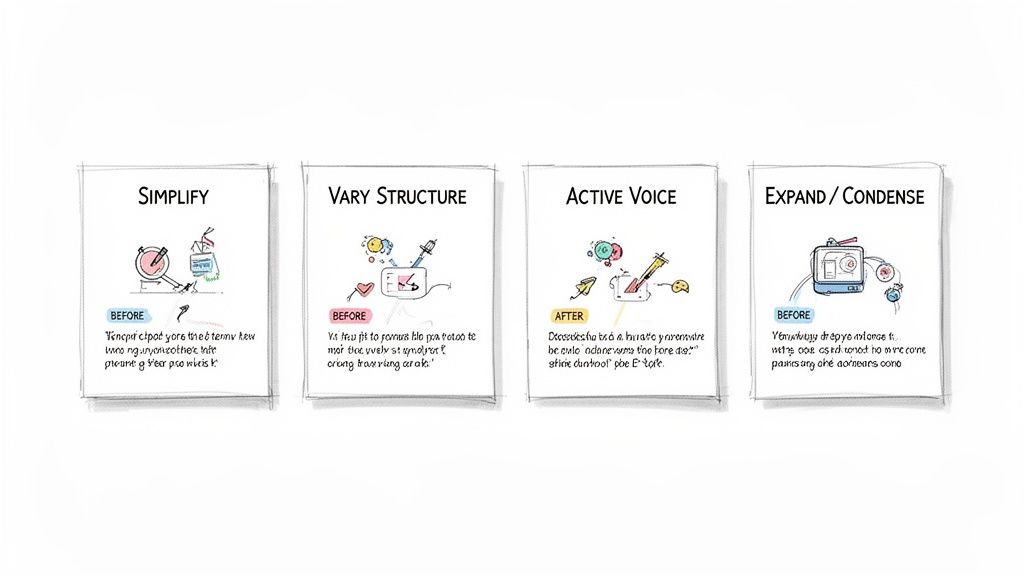
Alright, let's get practical. Knowing why you should rewrite a sentence is one thing, but knowing how is where the real skill lies. Once you have a few core techniques in your back pocket, you can tackle almost any piece of text and make it sharper, clearer, and more engaging.
These aren't complicated tricks. They're foundational strategies that every good writer uses, whether they realize it or not. We’ll walk through four of the most effective methods for transforming your sentences.
Simplify for Maximum Clarity
Often, the main reason you need to rewrite this sentence is simply to make it easier to follow. It's easy for complex ideas to get tangled up in jargon, long clauses, and academic fluff. The art of simplifying is about cutting through that noise to get straight to the point. This isn’t about "dumbing down" your content; it's about making it direct and accessible.
Think about dense technical or academic writing. Your goal is to translate it for a wider audience without losing the original's precision.
- Before: "The methodological framework necessitated the utilization of a longitudinal study to ascertain the long-term impacts of the intervention."
- After: "We used a long-term study to understand the intervention's lasting effects."
See the difference? The "after" version is shorter, uses everyday words like "used" instead of "utilization," and is instantly understandable. The meaning is perfectly preserved, but the delivery is a world apart. Making your writing easy to understand is the cornerstone of effective communication.
Vary Your Sentence Structure
Ever read a paragraph where every sentence sounds the same? It’s monotonous. That robotic, repetitive rhythm is a surefire way to make your reader's eyes glaze over. The fix is to consciously vary your sentence structure to create a more natural, engaging flow.
This means mixing it up. Use short, punchy sentences for impact and follow them with longer, more descriptive ones to add detail. You can also reorder clauses or begin your sentences with different grammatical elements to keep things fresh.
Good writing has a musical quality to it. By alternating between different sentence lengths and structures, you create a rhythm that keeps your reader engaged and makes your points more memorable.
Let's look at how to break up a clunky, repetitive paragraph:
- Before: "The team gathered the data. They analyzed the results carefully. They prepared a final report. The report was presented to the stakeholders."
- After: "After gathering the data, the team carefully analyzed the results. They then prepared a final report, which was presented to the stakeholders."
The second version connects related ideas and flows like a story, not a list of chores. It’s just a much better reading experience.
Make it Active, Not Passive
Switching from passive to active voice is one of the fastest ways to add energy and authority to your writing. In an active sentence, the subject does the action. In a passive sentence, the subject receives the action, which can make the writing feel weak, indirect, or even a bit evasive.
While passive voice has its uses, active voice is almost always the stronger choice.
- Passive: "The decision was made by the committee."
- Active: "The committee made the decision."
The active version is more direct and tells you exactly who did what. When you need a sentence to hit with more impact, this is your go-to technique.
Expand or Condense Your Ideas
A great rewrite isn't always about small tweaks; sometimes it's about changing the length and scope of the entire sentence. You might need to expand a short idea with more detail for a formal report, or you might need to condense a long explanation into a bite-sized chunk for social media.
- Expanding: This involves taking a core concept and fleshing it out with more context, examples, or descriptive language.
- Condensing: This is the art of stripping a sentence down to its bare essentials for clarity and punch.
For example, imagine taking a complex research finding and turning it into something shareable.
- Original: "Our extensive market research indicates a statistically significant preference among the 18-25 demographic for products that feature sustainable packaging materials."
- Condensed for Social Media: "Younger customers prefer sustainable packaging. ♻️"
This kind of flexibility lets you repurpose a single piece of information for different channels, which is incredibly valuable.
Preserving Your Original Meaning and Voice
When you set out to rewrite a sentence, a common fear creeps in: Will the new version sound like a robot wrote it? Will it strip away your personality and water down the core message? I get it. But the best rewriting doesn't erase your style; it actually sharpens it.
The trick is learning to separate the message from the delivery. Before you touch a single word, nail down the sentence's essential building blocks—the main subject, the key action, and the one thing you absolutely need the reader to take away. These are your anchors.
Everything else is fair game. The adjectives, the extra clauses, the specific phrasing—all of it can be tweaked, rearranged, or swapped out to make the sentence land with more impact. This way, the foundational meaning stays put while you get the freedom to polish the execution.
Find Your Authentic Voice
Your voice is that unique fingerprint you leave on your writing. It's a mix of the words you choose, the rhythm of your sentences, and the overall feeling you create. A great rewrite doesn't just improve clarity; it also works on finding your authentic voice in writing to make sure your content truly connects.
After all, you want your blog posts to sound like they came from the same person who writes your social media updates. That consistency is what builds trust.
So, how do you protect your voice during the process?
- Read It Aloud: Seriously, this is a game-changer. Does the new sentence sound like something you'd actually say in a conversation? If it feels clunky or awkward coming out of your mouth, it needs another look.
- Check Word Choice: Did the rewrite tool swap out your favorite words for bland, generic synonyms? Don't be afraid to swap them right back. Your vocabulary is part of your brand.
- Analyze the Tone: If your original was friendly and informal, the rewritten version shouldn't sound like a stuffy academic paper. Make sure the energy matches.
This focus on authenticity isn't just a "nice-to-have" anymore. In the creator economy, brands are pouring huge budgets into partnerships that feel real and genuine.
With U.S. ad spend on creators projected to hit $37 billion in 2025, the demand for authentic, human-sounding content is absolutely exploding. For marketers, this means that rewriting a creator's draft into a polished but still genuine piece is a vital skill for scaling up content without losing that unique magic.
A Practical Framework for Voice Preservation
Let's walk through a real-world example. Imagine you're a financial advisor rewriting a dense sentence for your client newsletter.
- Original: "It is imperative for individuals to undertake a meticulous portfolio diversification strategy to mitigate the inherent risks associated with market volatility."
Sure, it's accurate, but it's also packed with jargon and feels completely impersonal. A good rewrite will simplify the language while keeping your authoritative and helpful tone.
First, let's distill the core meaning and the desired voice.
- Core Meaning: Diversifying your portfolio reduces market risk.
- Your Voice: Authoritative, clear, and reassuring.
Now, let's try a rewrite that captures both.
- Rewrite: "To protect your investments from market swings, it’s essential to build a diversified portfolio."
See the difference? This version is clear, direct, and keeps a professional tone without sounding robotic. It holds onto the core message but delivers it in a way that sounds like real advice from a real person—which is always the goal. When you focus on both meaning and voice, you can transform any sentence with confidence.
Using AI Rewriters Without Sounding Like AI
AI rewriters are fantastic for getting a first draft on the page, but that initial output rarely has the spark of a real human writer. The trick is to stop thinking of AI as a replacement and start treating it as a collaborator. Let it do the heavy lifting—building the basic structure and getting ideas down—then you step in as the expert editor to add nuance, personality, and your unique voice. This tag-team approach lets you move much faster without ever compromising on quality.
The content game has changed. As of 2025, articles generated by AI started to outnumber those written by people. This shift makes the ability to rewrite and refine content more critical than ever. Sure, 73% of marketers now see AI as a key tool for creating personalized content, but readers have gotten incredibly good at spotting robotic, generic text. You can read more about these trends and discover insights on AI's impact on social media. Humanizing that AI draft is what makes the difference between content that gets ignored and content that builds trust.
Choose Your Rewriting Mode Wisely
You wouldn't use the same tone for a casual blog post and a formal business proposal, right? A good AI rewriter understands this. Tools like Rewritify offer different modes for this exact reason. Picking the right mode isn't just a small step; it's the most important decision you'll make to guide the AI toward the result you actually want.
Think of it as giving the AI a creative brief. Be specific from the start, and you'll get a much better result. If you need to rewrite this sentence for a friendly blog, modes like 'Natural' or 'Simple' are your best bet. But for a research paper, the 'Academic' mode will ensure the formal structure and tone are just right.
Choosing the Right Rewriting Mode in Rewritify
To help you get started, here’s a quick guide on how to pick the perfect Rewritify mode for your specific project.
| Mode | Best For | Key Outcome |
|---|---|---|
| Natural | Blog posts, articles, and general web content that needs a conversational and engaging flow. | A readable, human-sounding text that connects with a broad audience. |
| Academic | Research papers, essays, and scholarly articles that require formal language and structure. | A polished, professional piece that adheres to academic standards. |
| Formal | Business proposals, reports, and official communications that demand a professional tone. | Crisp, authoritative language that conveys credibility and seriousness. |
| Undetectable | Content that needs to pass AI detection checks while maintaining a completely human feel. | A refined output that reads as if it were written by a person from scratch. |
Making this choice first saves you a ton of editing time on the back end. You're essentially pointing the AI in the right direction before it even starts writing.
The Human Touch After the AI Rewrite
Once the AI has done its part, it's your turn. This is where you transform a decent draft into a compelling final piece. The goal here isn't just to make the text sound human; it's to make it sound like you and to ensure it hits strategic goals, like SEO.
Your editing pass should focus on a few key things:
- Refine Word Choice: AI often picks words that are technically correct but feel a bit lifeless. Scan through and swap out any bland synonyms for words that better reflect your brand's voice.
- Check for Rhythm and Flow: Read the whole thing out loud. Seriously. You'll instantly catch awkward phrasing, sentences that drag on too long, or choppy sections that need to be smoothed out.
- Add Your Own Insights: This is what makes your content truly unique. Weave in personal anecdotes, expert opinions, or specific examples that an AI could never come up with on its own.
- Strategically Insert Keywords: Wait until the core rewrite is finished, then go back and gently place your target SEO keywords. This ensures they feel natural and don't disrupt the reader's experience.
Remember, the goal isn't just to make the text undetectable; it's to make it genuinely connect with your reader. The final pass is about adding personality, not just polishing grammar.
By approaching AI writing as a partnership, you truly get the best of both worlds: the incredible speed of AI and the authentic, nuanced touch that only a human can provide. For a more detailed breakdown of this process, take a look at our complete guide on how to rewrite AI-generated text effectively.
Rewriting Ethically and Avoiding Plagiarism
When you set out to rewrite a sentence, you’re walking a tightrope. On one side, you have an effective, ethical transformation of an idea. On the other, you have plagiarism. The difference isn't about swapping a few words—it's about fundamentally recasting the original thought into your own voice while giving credit where it's due.
A true rewrite requires deep changes. You need to shake up the sentence structure, rephrase concepts with your own vocabulary, and weave the idea into the flow of your own argument. A common mistake is just hitting a few keywords with a thesaurus, but that's something plagiarism checkers spot a mile away. Think of it like a new coat of paint on a stolen car; it doesn't change the underlying ownership.
What Does Originality Really Mean?
Being original in your writing doesn't always mean inventing a concept out of thin air. Most of the time, it's about taking existing information and presenting it from a fresh angle, filtered through your unique perspective. The real goal is to show you've actually processed the information, not just copy-pasted it.
This is a critical skill in so many areas:
- For Students: Your essay isn't just a summary. It's about engaging with sources, understanding their arguments, and then building your own. Proper rewriting proves to your instructor that you've internalized the material well enough to explain it yourself.
- For Content Creators: Taking industry news and turning it into a blog post means you need a fresh take. Your readers want your analysis, not a rehashed press release.
- For Researchers: When you write a literature review, you’re summarizing past studies to build a case for your new work. Ethical rewriting makes it clear where their work ends and your contribution begins.
A Practical Approach to Ethical Rewriting
To make sure you stay on the right side of that ethical line, you need a solid process. First, read the source material until you genuinely understand its meaning. Don't just skim it.
Then, put the original text away—seriously, close the tab or turn the page over—and write the main idea from memory. This simple step is a game-changer because it forces you to use your own sentence structure and words right from the start.
The point of rewriting ethically isn't just about not getting caught. It's about academic and professional integrity. It's about truly engaging with the source material and adding your own intellectual value to the conversation.
Once you have your own version written down, bring the original back and compare them. Did you accidentally mimic any unique phrases or sentence patterns? If you did, it's time for another revision. As you get deeper into this, it's also smart to explore the wider conversation around the ethical considerations of AI translation and content creation to stay current.
Finally, always, always cite your source, even if you've completely rewritten the idea. A proper citation isn't a sign of weakness; it's a sign of respect for the original author and a hallmark of trustworthy writing. It tells your readers where the idea came from, which actually strengthens your own authority.
For a deeper dive into specific techniques, check out our guide on how to paraphrase without plagiarizing.
Your Go-To Sentence Rewriting Checklist
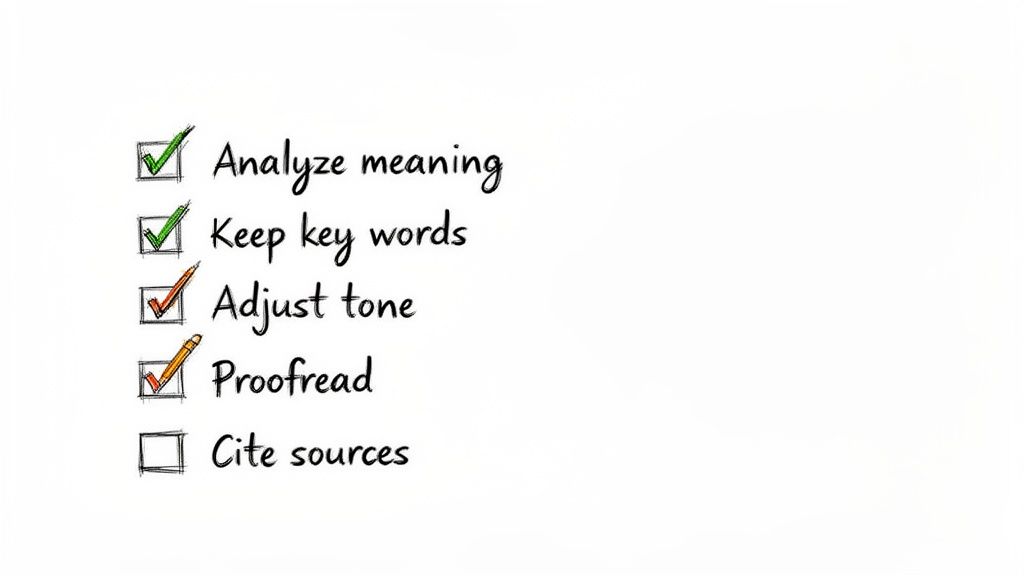
When you’re staring at a sentence that just isn't working, a solid process can be a lifesaver. It’s easy to get lost in the weeds, but having a quick mental checklist helps you stay on track and rewrite with purpose.
Think of this as your go-to reference guide for turning a clunky phrase into something clear, concise, and impactful. It pulls together everything we’ve talked about into a simple, repeatable workflow.
The Rewriting Process Step-By-Step
Here’s a breakdown of the mental steps I run through for almost every sentence I rewrite.
Pinpoint the Core Meaning: Before you touch a single word, stop and ask yourself: What is this sentence really about? Nail down the non-negotiable parts—the main subject, the key action, and the one thing you need your reader to understand.
Pick Your Approach: What’s the goal here? Are you trying to untangle a complicated idea? Maybe you just need to shake up the sentence structure to improve the rhythm of the paragraph. Or, you might want to switch to the active voice to give your writing more energy. Decide what you're trying to fix.
Draft the New Version: Now, it's time to write. Your main focus should be on changing up the structure and word choice while carefully protecting that core meaning you identified. Try to put it in your own words as if you were explaining it to someone in person.
A great rewrite doesn't just change the words; it preserves the original message and still sounds like you. A trick I always use is to read the new sentence out loud. If it feels awkward or doesn't sound like something you'd actually say, it’s not done yet.
- Polish and Proofread: Finally, give your new sentence a quick check for clarity, tone, and any grammatical slip-ups. Does it fit seamlessly with the sentences before and after it? Most importantly, does your unique voice still shine through?
Answering Your Top Questions About Rewriting Sentences
You've got the basics down, but as you start applying these techniques, a few practical questions always seem to come up. I've heard these a lot over the years, so let's clear up some of the most common sticking points.
How Much of a Sentence Do I Really Need to Change?
Forget about magic numbers or percentages. I've seen people get bogged down trying to change 30% of the words, but that's the wrong way to think about it.
The real secret is to focus on the sentence's DNA—its structure. If the original sentence is a simple "Subject-Verb-Object," try flipping it. Start with a prepositional phrase or a subordinate clause. The goal isn't just to swap out words; it's to show you’ve truly understood the idea and can express it in your own way.
Can AI Detectors Spot a Rewritten Sentence?
The short answer is yes... and no. It really depends on the tool you're using.
Older, more basic "spinners" that just swap synonyms are painfully obvious. They often create clunky, unnatural sentences that AI detectors (and human readers) can spot from a mile away.
But modern rewriting tools are a different breed. The good ones don't just find synonyms; they re-engineer the entire sentence structure to produce something that flows naturally. When you use a quality tool as your starting point and then layer on your own final polish, the result is virtually indistinguishable from something you wrote from scratch.
Think of the AI's output as a solid first draft. Your final pass—where you tweak the flow and inject your personal voice—is what makes the writing genuinely yours and truly undetectable.
What’s the Smartest Way to Work in SEO Keywords?
Whatever you do, don't just shoehorn them in. Keyword-stuffing creates awkward sentences that read poorly and can actually get you penalized by search engines.
Here’s a much more effective approach I always recommend:
- Rewrite for Clarity First: Get the sentence sounding great without even thinking about the keyword.
- Look for a Natural Opening: Read your newly crafted sentence. Is there a smooth, logical place to insert the keyword?
- Make Minor Adjustments: Often, a small tweak is all it takes to make the keyword fit perfectly.
If it still feels forced after a quick adjustment, just leave it out. It's always better to find a more natural home for your keyword elsewhere in the article than to ruin a perfectly good sentence.
Ready to turn your rough ideas into polished, original content? Rewritify is built to help you rewrite sentences and paragraphs with total confidence. Try Rewritify for free and feel the difference.
Relevant articles
Learn how to pass AI detection by ethically humanizing AI-generated drafts. Our guide covers rewriting, editing, and using tools to create authentic content.
Discover how to improve my writing ai with a practical human-AI workflow that turns rough drafts into clear, original, and authentic content.
Discover how to reword a paragraph to improve clarity, voice, and SEO. Learn practical manual techniques and how to leverage AI tools for great results.
Learn how to rewrite a paragraph for clarity, originality, and impact. Our guide offers professional techniques and real-world examples to elevate your writing.