10 Powerful Persuasive Writing Techniques to Master in 2026
Unlock the secrets of influence with our guide to 10 powerful persuasive writing techniques. Learn ethos, pathos, logos, and more to elevate your copy.
In a world saturated with content, the ability to not just inform but influence is a superpower. Whether you're crafting a thesis, driving conversions on a landing page, or pitching a groundbreaking idea, your success often hinges on the power of your words. But what truly separates a forgettable message from an argument that inspires decisive action?
The answer lies in mastering specific, psychologically-backed persuasive writing techniques. This guide moves beyond generic advice to provide a practical, scannable roundup of 10 high-impact methods that work across any field. We will dissect each technique, revealing the core reason it connects with an audience, how to apply it with clear before-and-after examples, and how you can practice it effectively.
Forget abstract theories; this is a toolkit for implementation. You will learn to build credibility, forge emotional connections, and present airtight logic. From crafting the perfect call-to-action to leveraging the subtle power of scarcity, this article is designed to make your writing more effective. By the end, you'll have a complete framework to transform your text from passive to persuasive, ensuring every word counts toward your goal.
1. Ethos (Credibility & Authority)
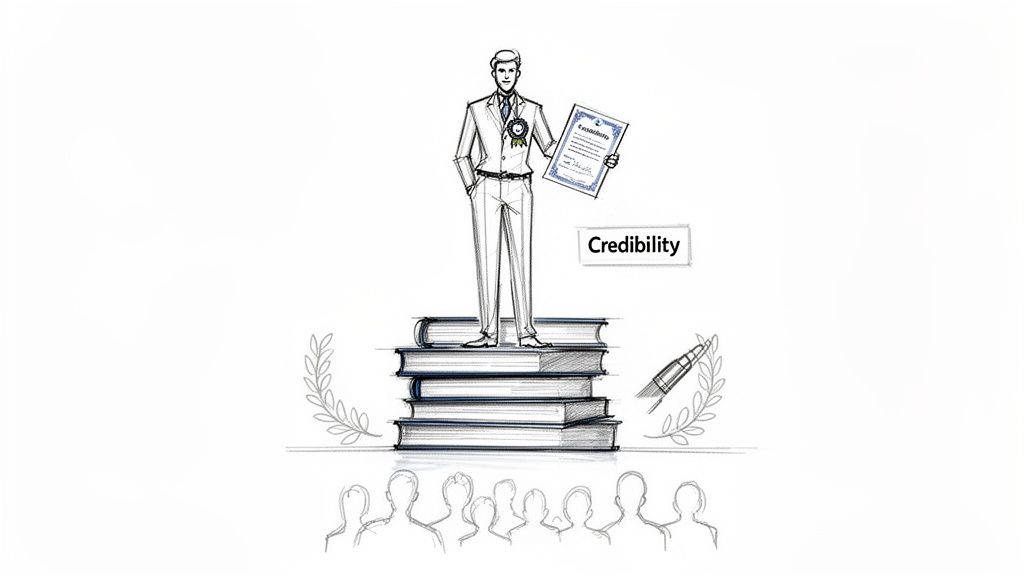
Ethos is one of the most fundamental persuasive writing techniques, focusing on establishing your credibility and authority. Before an audience will accept your message, they must first trust you, the messenger. Ethos answers the reader's unspoken question: "Why should I listen to you?" By demonstrating expertise, honesty, and good character, you build a foundation of trust that makes your arguments significantly more compelling.
Why It Works
People are naturally inclined to trust experts and authoritative figures. When you establish ethos, you trigger a cognitive shortcut in the reader’s mind that associates your message with reliability and accuracy. This reduces skepticism and makes them more receptive to your ideas. For instance, an academic paper citing peer-reviewed studies immediately gains more credibility than an unsubstantiated blog post.
How to Implement Ethos
Here are actionable ways to build credibility in your writing:
- Cite Reputable Sources: Back up your claims with data, statistics, and quotations from well-regarded experts or institutions.
- Showcase Expertise: Subtly mention relevant credentials, experience, or qualifications. For professionals, this could mean sharing case studies or highlighting industry experience.
- Maintain a Consistent Voice: A steady, professional tone builds a recognizable and trustworthy persona. Learn more about how the right tone of voice in writing can bolster your authority.
- Leverage Social Proof: Mention affiliations with respected organizations or publications. Beyond building general credibility, you can further enhance your authority by learning, for example, how to write an article on LinkedIn to position yourself as a thought leader in your field.
2. Pathos (Emotional Connection)
Pathos is a powerful persuasive writing technique that appeals to the reader's emotions, values, and personal experiences. Rather than relying solely on logic, pathos aims to create a resonant connection by triggering feelings like empathy, joy, inspiration, or even fear. It answers the reader’s implicit question: "Why should I care about this?" By tapping into shared human emotions, you can transform a neutral message into something deeply personal and motivating.

Why It Works
Humans are emotional beings, and our decisions are often driven by feelings more than by pure reason. Pathos works by creating an emotional bridge between your message and the audience, making them feel invested in the outcome. A compelling story about a single person can be more persuasive than a statistic about thousands because it makes the issue tangible and relatable. This emotional buy-in makes your audience more likely to agree with your argument and take action.
How to Implement Pathos
Here are effective ways to foster an emotional connection in your writing:
- Tell Compelling Stories: Use anecdotes, case studies, or personal narratives to illustrate your points. Charity campaigns, for example, often use beneficiary testimonials to evoke empathy.
- Use Vivid and Sensory Language: Describe sights, sounds, and feelings to paint a picture in the reader’s mind. You can explore examples of visual imagery to learn how to make your descriptions more impactful.
- Understand Your Audience's Values: Align your message with what your readers hold dear, whether it's community, family, innovation, or security. Apple's marketing often emphasizes creativity and human connection.
- Employ a Conversational Tone: Write in a way that feels personal and direct. Using "you" and "we" can create a sense of shared purpose and intimacy with the reader.
3. Logos (Logic & Evidence)
Logos is a persuasive writing technique that appeals to the reader's sense of reason and logic. It involves using facts, data, statistics, and well-structured arguments to build a convincing case. While ethos establishes the messenger's credibility and pathos appeals to emotion, logos focuses on the message itself, proving its validity through undeniable evidence. It answers the reader’s question: "Is this argument logical and supported by facts?"
Why It Works
The human brain is wired to identify patterns and follow logical sequences. When you present an argument based on clear reasoning and verifiable evidence, you appeal directly to this rational processing. A logos-driven argument feels objective and irrefutable, making it difficult for a skeptical reader to dismiss. For example, a business proposal filled with specific ROI projections and market data is far more persuasive than one based on vague promises.
How to Implement Logos
Here are actionable ways to integrate logic and evidence into your writing:
- Use Verifiable Data: Incorporate specific, quantifiable data like statistics, survey results, and case study metrics to substantiate your claims.
- Construct a Logical Flow: Organize your argument so that each point logically follows the last. A common structure is to present a premise, provide supporting evidence, and then draw a clear conclusion.
- Cite Authoritative Sources: Reference studies, reports, and findings from respected institutions like McKinsey & Company or the Pew Research Center to add weight to your evidence.
- Prioritize Clarity: Your reasoning must be easy to follow. You can improve academic writing and professional reports by ensuring your logical arguments are presented with maximum clarity and coherence.
4. Social Proof & Consensus
Social proof is a powerful persuasive writing technique that leverages the psychological principle of consensus. It operates on the idea that people are more likely to adopt a belief or perform an action if they see evidence that many others have already done so. This technique answers the reader's subconscious question: "Are other people like me doing this?" By showing that an idea, product, or service is popular and trusted, you reduce perceived risk and create a sense of belonging.
Why It Works
Humans are social creatures who often look to others for cues on how to behave, especially in unfamiliar situations. This is a mental shortcut known as informational social influence. When you present evidence of widespread approval, like customer testimonials or impressive user statistics, you signal safety, quality, and value. In the digital realm, achieving consensus often translates into visible metrics; for instance, effectively gaining Producthunt Upvotes can signal the perceived value and quality of an offering to a broader audience.
How to Implement Social Proof
Here are actionable ways to integrate consensus into your writing:
- Showcase Testimonials and Reviews: Feature direct quotes from satisfied customers, clients, or users. Include their name and a photo for added authenticity.
- Use Specific Numbers: Instead of saying "many users," write "Trusted by over 50,000 marketing professionals." Specificity is more convincing.
- Highlight Expert Endorsements: Mention any industry experts, well-known companies, or authoritative publications that have featured or approved your work.
- Display Case Studies: Write detailed stories that show how a real person or company benefited from your idea or product, outlining their journey from problem to solution.
5. Call-to-Action (CTA)
A Call-to-Action (CTA) is one of the most critical persuasive writing techniques because it tells your audience exactly what to do next. After you’ve built your argument and engaged the reader, the CTA provides a clear, direct path from passive reading to active engagement. It answers the reader’s final question: "What now?" A strong CTA is the crucial bridge between persuasion and action, turning interest into a tangible outcome.
Why It Works
The human brain appreciates clarity and direction. A compelling CTA eliminates decision fatigue and ambiguity, making it easy for the reader to take the next step. By providing a specific instruction, you channel the momentum you've built throughout your writing into a desired action. This is based on the psychological principle of closure; readers who are persuaded by your message want a clear resolution, and the CTA provides it, whether it's signing up, downloading a guide, or making a purchase.
How to Implement a CTA
Here are actionable ways to create effective calls-to-action:
- Be Specific and Action-Oriented: Use strong, active verbs that clearly state what the reader will do. Instead of a generic "Click Here," use a benefit-focused command like "Download Your Free Guide Now."
- Create a Sense of Urgency: Encourage immediate action by incorporating time-sensitive language. Phrases like "Claim Your Discount Today" or "Limited-Time Offer" motivate readers to act before they miss out.
- Focus on the Benefit: Frame the CTA around what the user gains. "Start Your Free Trial" is more compelling than "Submit" because it highlights the value proposition directly.
- Align with Audience Intent: Tailor your CTA to the reader's stage in their journey. An early-stage reader might respond better to "Learn More," while a late-stage prospect is ready for "Buy Now."
6. Rhetorical Questions
Rhetorical questions are a powerful persuasive writing technique used to prompt reflection and guide the reader toward a specific conclusion. Instead of seeking a direct answer, these questions are designed to make the audience think and implicitly agree with your perspective. They create an interactive experience, making readers feel as if they are arriving at the conclusion on their own, which strengthens their commitment to the idea.
Why It Works
This technique taps into the psychological principle of active engagement. When a reader is asked a question, their brain is naturally stimulated to formulate an answer, even if unconsciously. By posing a question with an obvious or suggested answer, you frame the conversation and steer the reader’s thought process. It feels less like being told what to believe and more like a shared journey of discovery, reducing resistance to your argument.
How to Implement Rhetorical Questions
Here are actionable ways to use rhetorical questions in your writing:
- Guide the Narrative: Start a paragraph with a question to introduce a new point. For example, a blog post might ask, "But how can you apply this in a real-world scenario?" before providing examples.
- Challenge Existing Beliefs: Use questions to gently challenge your reader's assumptions. A common example in marketing is, "Are you still relying on outdated methods?"
- Emphasize a Benefit: Frame a key feature as a solution to an unspoken problem. A software description could ask, "Ready to reclaim hours of your work week?"
- Create an Inclusive Tone: Use "we" or "us" to foster a sense of shared purpose. For instance, "Shouldn't we all strive for a more sustainable future?" This is one of the most effective persuasive writing techniques for building rapport.
7. Storytelling & Narrative
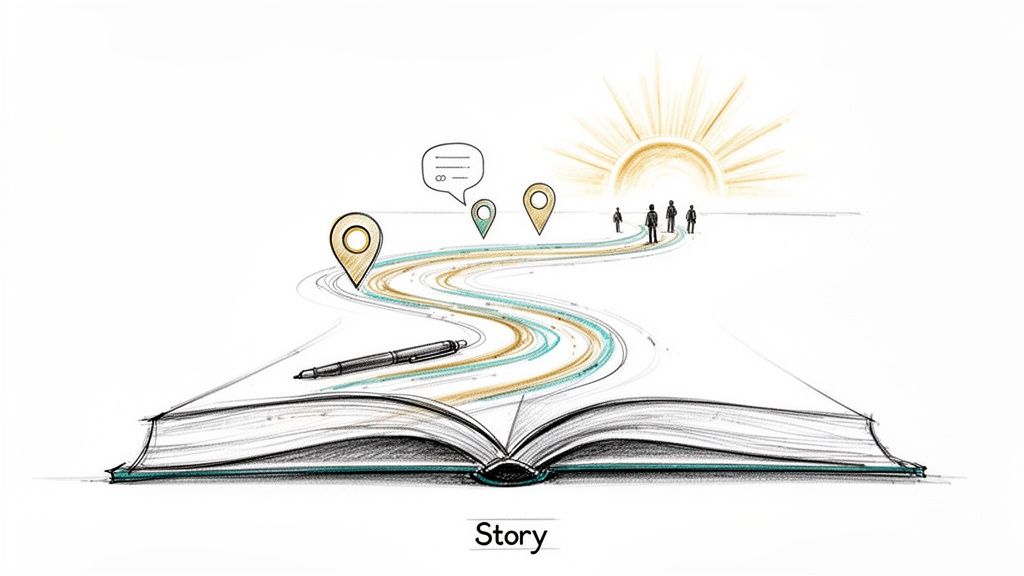
Storytelling is a powerful persuasive writing technique that frames information within a narrative structure, complete with characters, conflict, and resolution. Instead of presenting dry facts, you weave them into a relatable and memorable journey. This approach makes abstract concepts tangible and forges a strong emotional connection with the audience, making your message far more impactful and convincing.
Why It Works
Humans are hardwired for stories. Narratives engage both the logical and emotional parts of our brains, making the information more engaging and easier to remember than simple data points. When a reader follows a story, they experience "transportation," where they become immersed in the narrative and are less likely to counter-argue. This makes them more open to the underlying message, as seen in TOMS Shoes' origin story, which links every purchase to a social mission.
How to Implement Storytelling & Narrative
Here are actionable ways to integrate storytelling into your writing:
- Structure with a Narrative Arc: Frame your content with a clear beginning (the problem), middle (the journey or struggle), and end (the resolution or transformation). This is effective in customer success stories or case studies.
- Create Relatable Characters: Center your narrative on a specific person or persona your audience can identify with. Nonprofit campaigns often do this by highlighting an individual beneficiary's journey.
- Show, Don't Just Tell: Use vivid descriptions and sensory details to bring the story to life. Instead of saying a product is "efficient," describe a character saving hours of frustrating work.
- Connect to a Core Message: Ensure your story directly supports your main argument. A compelling narrative is only persuasive if it clearly reinforces the point you want to make.
8. Scarcity & Urgency
Scarcity and urgency are powerful persuasive writing techniques that motivate action by highlighting limited availability or time-sensitive opportunities. This approach taps directly into the psychological principle of loss aversion, where the fear of missing out (FOMO) is a stronger motivator than the prospect of gaining something of equal value. By framing an offer as scarce or temporary, you create an immediate reason for the reader to act now rather than later.
Why It Works
This technique triggers a sense of urgency, compelling readers to make a decision quickly to avoid a potential loss. When something is perceived as rare or fleeting, its value automatically increases in our minds. Messages like Booking.com's "Only 2 rooms left at this price!" or a flash sale with a countdown timer are effective because they shift the reader’s focus from "Do I want this?" to "Do I want to miss out on this?"
How to Implement Scarcity & Urgency
Here are actionable ways to incorporate scarcity and urgency into your writing:
- Emphasize Genuine Limitations: Clearly state any real constraints. This could be "Limited spots in our beta program," "Early-bird pricing ends Friday," or "Only 100 copies will be signed."
- Use Time-Sensitive Language: Incorporate words and phrases that create a sense of immediacy, such as "Offer expires soon," "Last chance," or "Don't miss out."
- Showcase High Demand: Mentioning that others are interested can create social proof and urgency. For example, "Over 500 people have already registered this week."
- Maintain Authenticity: Ensure all claims of scarcity are truthful and verifiable. Fabricating urgency can damage credibility and erode trust with your audience. Avoid overusing this technique; reserve it for genuinely time-sensitive offers to maintain its impact.
9. Contrast & Comparison
Contrast and comparison are powerful persuasive writing techniques that work by placing two or more ideas, products, or outcomes side-by-side. This direct juxtaposition makes the differences and unique benefits of your preferred option immediately obvious. By framing your argument against an alternative, you guide the reader's thought process, making your conclusion seem logical and clear.
Why It Works
The human brain is wired to understand things in relation to one another. When presented with a stark contrast, we can process information more quickly and make decisions with greater confidence. This technique simplifies complex choices by highlighting key differentiators, effectively answering the question, "Why is this better than that?" A side-by-side software comparison, for example, is far more persuasive than a simple list of features because it provides crucial context.
How to Implement Contrast & Comparison
Here are practical ways to use this technique in your persuasive writing:
- Create Comparison Tables: Use charts or tables to visually compare your product, service, or idea against competitors or alternatives. This is highly effective for landing pages and proposals.
- Show Before-and-After Scenarios: Illustrate the transformative impact of your solution. A weight-loss case study showing a "before" photo next to an "after" photo is a classic and effective example.
- Juxtapose Problems and Solutions: Frame a common problem and then immediately present your solution as the definitive answer. This creates a satisfying narrative for the reader.
- Highlight a Unique Selling Proposition (USP): Compare a standard industry feature with your unique, superior approach. For instance, you could contrast a generic AI-generated paragraph with a nuanced one refined by a specialized tool.
10. Reciprocity & Generosity
Reciprocity is a powerful persuasive writing technique that operates on the principle of giving value first to create a psychological desire in the recipient to give something back. This technique taps into a fundamental human social norm: when someone does something nice for us, we feel an innate obligation to return the favor. By offering genuine, unsolicited value upfront, you build goodwill and make your audience more receptive to a future request.
Why It Works
The principle of reciprocity is deeply ingrained in social psychology. When you provide free tools, valuable information, or a helpful guide without asking for anything in return, you are not just being generous; you are creating a positive social debt. The recipient feels a sense of gratitude and is more likely to comply with a subsequent request, such as signing up for a newsletter, trying a premium service, or making a purchase. This approach shifts the dynamic from a hard sell to a helpful exchange.
How to Implement Reciprocity
Here are actionable ways to leverage generosity in your writing:
- Offer Valuable Freebies: Provide genuinely useful resources like free templates, ebooks, or a limited version of your software. HubSpot’s free CRM is a classic example that leads users to its paid services.
- Create High-Value Content: Develop insightful blog posts, tutorials, or webinars that solve a real problem for your audience, establishing your brand as a generous expert.
- Frame the "Ask" Carefully: When you do make a request, frame it as the next logical step. Your messaging should feel like a natural continuation of the value you’ve already provided.
- Emphasize No-Strings-Attached Value: Clearly communicate what users get for free. On a landing page, explicitly state the benefits of the free offer without immediately pushing a sale, which builds trust and encourages engagement.
Comparison of 10 Persuasive Writing Techniques
| Item | Implementation complexity | Resource requirements | Expected outcomes | Ideal use cases | Key advantages |
|---|---|---|---|---|---|
| Ethos (Credibility & Authority) | Moderate–High (ongoing effort) | Subject-matter expertise, citations, consistent voice | Strong trust, professional credibility, higher conversions | Academic papers, proposals, brand positioning | Long-term trust; differentiates from low-quality content |
| Pathos (Emotional Connection) | Low–Medium (creative crafting) | Storytelling skills, user stories, sensory language | Increased engagement, motivation to act | Marketing, fundraising, emails, landing pages | Boosts memorability and emotional motivation |
| Logos (Logic & Evidence) | High (rigorous research) | Data, statistics, peer-reviewed sources, fact-checking | Rational persuasion, defensible arguments, cross-audience trust | Research reports, technical content, whitepapers | High credibility; withstands scrutiny |
| Social Proof & Consensus | Low–Medium (collection & verification) | Testimonials, reviews, user metrics, endorsements | Reduced perceived risk, higher conversions | Product pages, case studies, landing pages | Powerful conversion driver via validation |
| Call-to-Action (CTA) | Low (copy + placement) | Clear copywriting, A/B testing, placement strategy | Direct conversions, measurable actions | All content types, emails, CTAs on pages | Converts intent into action; measurable impact |
| Rhetorical Questions | Low (strategic use) | Minimal — phrasing skill, contextual fit | Reader engagement and reflection | Blog posts, headers, speeches, persuasive copy | Engages reader mentally; guides to conclusion |
| Storytelling & Narrative | High (crafting authentic arcs) | Real stories, characters, time to craft, narrative skill | Deep engagement, emotional resonance, retention | Brand stories, case studies, talks, long-form content | Highly memorable; differentiates messaging |
| Scarcity & Urgency | Low–Medium (ethical execution) | Genuine limits, timing, truthful claims | Immediate action, conversion spikes | Promotions, flash sales, limited offers | Drives fast conversions when authentic |
| Contrast & Comparison | Medium (clear framing) | Comparative data, competitor info, visuals | Clear differentiation, easier decision-making | Product pages, competitive positioning, before/after | Highlights unique benefits; simplifies choices |
| Reciprocity & Generosity | Medium (value-first setup) | Free trials, guides, templates, freemium features | Trust building, long-term conversions, loyalty | Freemium SaaS, lead magnets, onboarding flows | Encourages goodwill and higher lifetime value |
Putting Persuasion into Practice: Your Next Step
You have just explored a powerful arsenal of ten persuasive writing techniques, from the ancient rhetorical appeals of Ethos, Pathos, and Logos to modern psychological drivers like Social Proof and Scarcity. We've seen how a well-placed Story can captivate an audience, how a pointed Rhetorical Question can guide their thinking, and how a clear Call-to-Action can turn passive readers into active participants. Each technique is a distinct tool, designed to connect with your audience on different levels-intellectually, emotionally, and socially.
But understanding these concepts is only the first step. The true power of persuasive writing isn't found in memorizing definitions; it's discovered through deliberate application. The journey from knowledge to mastery is built on consistent, intentional practice.
The Bridge from Theory to Impact
The most important takeaway is this: persuasion is a skill, not a secret. Like any skill, it improves with focused effort. You don't need to become a master overnight. The key is to start small and build momentum. Your next email, project proposal, or social media post is the perfect laboratory for experimentation.
Choose just one technique from this article to focus on this week.
- For a team update: Try incorporating Ethos by citing a recent success metric to bolster your credibility before making a recommendation.
- For a marketing email: Weave in a brief customer Story (Pathos) to create an emotional connection before presenting your offer.
- For a blog post: Use a Rhetorical Question in your introduction to immediately engage the reader’s thought process.
This focused approach makes the process manageable and allows you to observe the direct impact of each technique. You'll begin to develop an intuitive sense for which tool works best in a given context, transforming your communication from merely informative to truly influential.
A Framework for Continuous Improvement
Mastering these persuasive writing techniques is an ongoing process of refinement. The goal is to make their application second nature, so you can craft compelling messages with greater speed and confidence. Think of it as developing muscle memory for your writing.
To accelerate your progress, consider this simple framework:
- Identify Your Goal: What specific action do you want your reader to take?
- Select a Technique: Choose one or two techniques from this guide that align with that goal.
- Draft and Apply: Write your message, intentionally integrating the chosen technique.
- Review and Refine: Read your draft from the audience's perspective. Is the message clear? Is the persuasion effective or forced? Adjust as needed.
By consistently following this cycle, you will move beyond simply using persuasive writing techniques and begin to embody them. Your ability to inform, convince, and inspire will grow with every word you write, opening doors to new opportunities in your academic, professional, and personal life.
Ready to see these persuasive writing techniques in action and accelerate your learning curve? Rewritify helps you instantly refine your text, applying principles of clarity and impact to transform your first draft into a polished, powerful message. See how your writing improves at Rewritify and start communicating with greater influence today.
Relevant articles

Learn how to correct the sentence with practical grammar tips, proofreading tricks, and clear examples that boost clarity and confidence.
Discover what is text fluency and why it's a game-changer for writers. Learn actionable strategies to make your writing flow and engage readers effortlessly.
Discover copywriting tips for beginners to write persuasive copy, avoid common mistakes, and boost conversions.
Master communication with our top 10 professional email writing tips. Learn to write clear, concise, and effective emails that get results. Read now!
Elevate your writing by mastering the compound sentence semicolon. This guide explains the rules with clear examples to help you connect ideas perfectly.
Discover the top 10 SEO copywriting best practices for 2025. Learn to craft content that ranks higher, engages users, and converts with our expert guide.