Copywriting Tips for Beginners: copywriting tips for beginners that drive sales
Discover copywriting tips for beginners to write persuasive copy, avoid common mistakes, and boost conversions.
Staring at a blank screen, wondering how to turn your ideas into words that actually sell, engage, or persuade? You're not alone. The journey from aspiring writer to confident copywriter can feel daunting, filled with confusing advice and abstract rules. But what if you had a clear, actionable roadmap? This guide provides exactly that. We're cutting through the noise with practical copywriting tips for beginners, designed to give you the foundational skills to write compelling copy today.
Each tip is packed with real-world examples, simple formulas, and mini-exercises to help you immediately apply what you learn. We’ll cover everything from grabbing attention with a powerful headline to focusing on benefits over features and crafting a call-to-action that gets results. These principles are the building blocks of effective communication, whether you're a marketer driving conversions, a professional building your brand, or a student aiming for clearer, more persuasive arguments.
Think of this as your starter kit for persuasive writing. To truly embark on your copywriting journey and master the art of persuasive writing, delve deeper into the nuances of writing website copy that sells. This listicle will equip you with the essential tools and confidence needed to transform your writing from flat to fantastic, one word at a time. Let’s get started.
1. Know Your Audience and Speak Directly to Them
The most fundamental rule of effective copywriting is to know who you are talking to. Before you write a single word, you must have a crystal-clear picture of your target audience. This goes beyond basic demographics; it's about understanding their deepest pain points, their most ambitious goals, and the specific language they use to describe them. This is one of the most crucial copywriting tips for beginners because it shifts your focus from what you want to say to what your reader needs to hear.
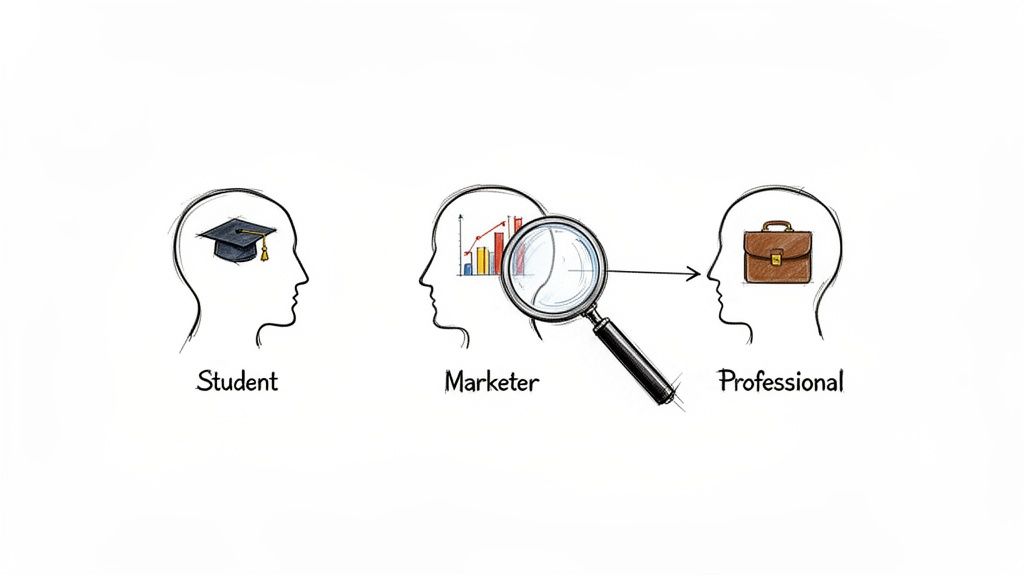
When you speak directly to a specific person’s problems and aspirations, your copy transforms from a generic broadcast into a compelling, one-on-one conversation. This principle, championed by advertising legends like David Ogilvy, is the foundation of copy that converts.
How to Apply This: A Rewritify Example
Consider how a tool like Rewritify tailors its message to different user personas:
- For Students: The focus is on achieving academic integrity and clarity. The copy might say, "Paraphrase complex sources without accidental plagiarism and improve your grades."
- For SEO Specialists: The message shifts to efficiency and performance. An example could be, "Rewrite articles to pass AI detection and preserve crucial keywords, scaling your content strategy."
- For Business Professionals: The copy emphasizes credibility and polish. It might state, "Refine your reports and proposals to communicate with authority and win over stakeholders."
Each message addresses a unique need, using language that resonates with that specific group. This targeted approach is a core element of successful content strategy, and you can discover more by exploring these content marketing best practices.
Quick Tips for Implementation
- Create a Buyer Persona: Outline one ideal customer. Give them a name, job, challenges, and goals. Write directly to this person.
- Use Their Language: Scour forums, reviews, and social media comments related to your industry. Note the exact words and phrases your audience uses.
- Segment Your Messaging: If you have multiple audiences, don't try to speak to all of them at once. Create different versions of your copy for each segment.
2. Lead with a Compelling Headline or Hook
Your headline is the gatekeeper to your content. Advertising legend David Ogilvy famously stated that five times as many people read the headline as read the body copy. This single line of text determines whether readers continue or click away, making it arguably the most important element of your writing. This is one of the most effective copywriting tips for beginners because mastering headlines directly impacts your content's reach and engagement.
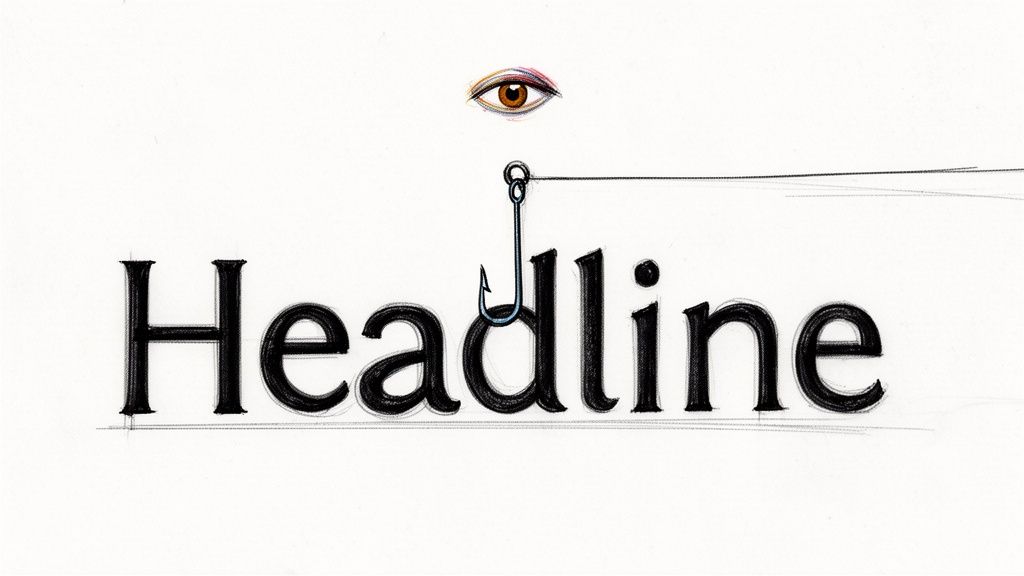
A compelling headline must spark curiosity, promise tangible value, or address a specific problem your audience faces. It’s the first impression that sets the stage for everything that follows, from blog posts and emails to landing pages that drive conversions.
How to Apply This: A Rewritify Example
Imagine using Rewritify to generate content for different audiences. The core message can be framed in multiple ways, each with a headline designed to hook a specific reader:
- For Students: A powerful headline would be, "How to Write Plagiarism-Free Essays in Half the Time." This directly addresses the pain points of academic pressure and integrity.
- For Marketers: To capture their attention, you might use, "5 AI Detection Evasion Techniques That Actually Work." This headline promises insider knowledge and a competitive advantage.
- For Publishers: A compelling option could be, "The Complete Guide to Rewriting Content Without Losing Your Voice." This speaks to their need for quality, authenticity, and scale.
Each headline is tailored to a unique user goal, demonstrating how a strong opening can dramatically increase your copy's relevance and appeal.
Quick Tips for Implementation
- Use Power Words: Sprinkle in words like 'proven,' 'essential,' 'ultimate,' or 'secret' to add impact and authority.
- Be Specific: Headlines with numbers and data-backed claims (e.g., "Increase Your Traffic by 50%") often outperform vague ones.
- Promise a Benefit: Clearly state what the reader will gain. Will they save time, learn a new skill, or solve a nagging problem?
- Test Angles: Use a tool like Rewritify to quickly generate different headline variations. Test a question, a "how-to" format, and a controversial statement to see what resonates.
3. Focus on Benefits, Not Just Features
A common mistake beginners make is listing what a product is (its features) instead of what it does for the customer (its benefits). People don’t buy a drill because they want a drill; they buy it because they want a hole in the wall. This distinction is one of the most powerful copywriting tips for beginners because it shifts your message from technical specs to emotional outcomes, which is what truly motivates people to act.
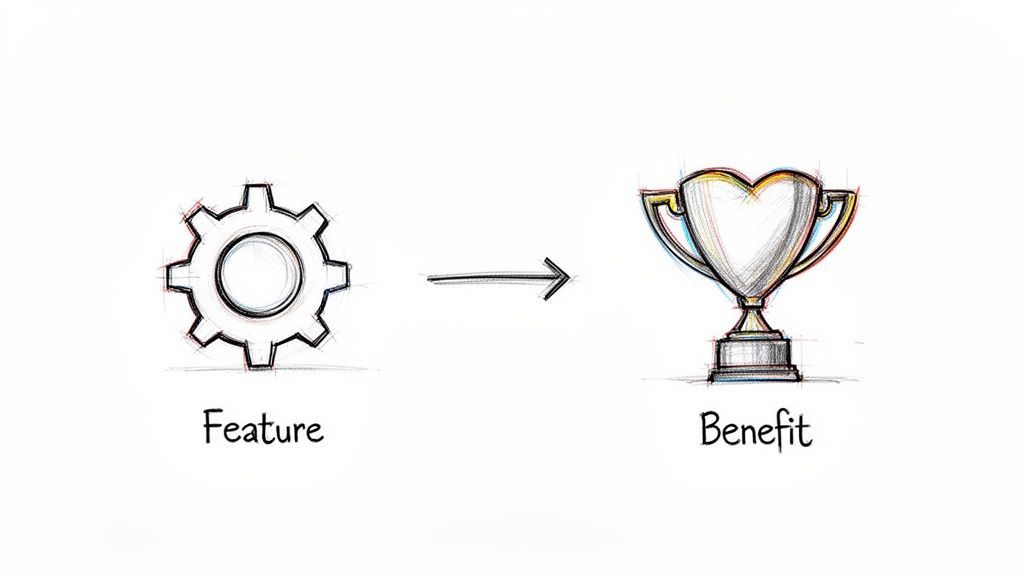
Legendary marketers like Gary Halbert built entire careers on this principle. A feature is logical, but a benefit is emotional. By translating features into tangible improvements in your customer’s life, you create a connection that goes beyond a simple transaction and builds genuine desire for your solution.
How to Apply This: A Rewritify Example
Rewritify could market itself by listing its advanced algorithms, but that wouldn't resonate. Instead, it focuses on the direct benefits those features provide:
- Feature: Multiple rewriting modes (e.g., "Formal," "Simple," "Creative").
- Benefit: Maintain your unique authorial voice while improving clarity, ensuring your work sounds like you, only better.
- Feature: AI content detector compatibility.
- Benefit: Submit your assignments and articles with complete confidence, eliminating the stress and fear of being flagged by AI detectors.
- Feature: One-click paragraph regeneration.
- Benefit: Save hours on tedious revision cycles and meet even the tightest deadlines without sacrificing quality.
Each benefit answers the reader’s silent question: "What's in it for me?" This approach makes the value immediately clear and compelling.
Quick Tips for Implementation
- Use the "So What?" Test: After stating a feature, ask "So what?" The answer is your benefit. Keep asking it to drill down to the core emotional driver.
- Focus on Transformation: Frame your copy around the "before" and "after." Before: stressed about deadlines. After: finishing work ahead of schedule.
- Use Outcome-Oriented Language: Incorporate powerful verbs and phrases that signal a positive result, such as "achieve," "eliminate," "gain," and "reduce."
4. Use Clear, Simple Language and Avoid Jargon
One of the most common mistakes beginners make is trying to sound "smart" by using complex words and industry-specific jargon. In reality, the best copy is simple, clear, and instantly understandable. Your goal is to communicate, not to impress readers with your vocabulary. This is a vital entry in our list of copywriting tips for beginners because it ensures your message reaches the widest possible audience without confusion.
Great copy feels like a natural conversation. Think of writers like George Orwell or Stephen King; their power lies in expressing profound ideas with straightforward language. When your reader doesn't have to stop and decipher what you mean, they are more likely to stay engaged and absorb your core message.
How to Apply This: A Rewritify Example
Imagine you're marketing a sophisticated software solution. The temptation is to use technical terms to sound authoritative. Let's see how Rewritify can help clarify the message for a broader audience:
- Complex Original: "Leverage our algorithmically-optimized content obfuscation mechanisms to enhance semantic uniqueness."
- Simple Rewrite (using Rewritify's 'Simple' or 'Natural' modes): "Our AI rewrites your work to sound naturally human and avoid plagiarism."
- Slightly More Technical (for an expert audience): "Our tool rewrites content to pass AI detection while preserving key SEO terms."
Even when writing for experts, clarity trumps complexity. The simplified versions are direct, benefit-driven, and far more persuasive. Making sure you use the right words is crucial, and you can sharpen this skill by reviewing these frequently misused words.
Quick Tips for Implementation
- Read It Aloud: If a sentence feels awkward or unnatural to say, it will be even more awkward for your audience to read.
- Aim for an 8th-Grade Reading Level: For general audiences, this is the sweet spot. Tools like the Hemingway App can check this for you.
- Swap Jargon for Plain English: Instead of "synergize," say "work together." Instead of "utilize," just say "use."
- Break Up Long Sentences: A sentence with multiple clauses can often be split into two or three shorter, punchier ones for greater impact.
5. Create a Strong Call-to-Action (CTA) That Drives Specific Action
After you've captured your reader's attention and persuaded them of your value, you must tell them exactly what to do next. The call-to-action (CTA) is the most critical part of your copy for driving conversion. Vague instructions like 'Learn more' or 'Click here' are weak because they fail to convey value or inspire urgency. This is one of the most vital copywriting tips for beginners because a strong CTA acts as the bridge between passive reading and active engagement.
An effective CTA is clear, compelling, and action-oriented. It gives the reader a specific instruction that promises a clear outcome, making the decision to act easy and logical. As conversion experts like Ryan Deiss have demonstrated, optimizing this single element can dramatically boost results.
How to Apply This: A Rewritify Example
Imagine Rewritify wants to convert a visitor who has just read a blog post about academic writing. Instead of a generic button, they can use targeted CTAs that speak directly to the reader's immediate needs:
- Weak CTA: "Submit"
- Strong, Benefit-Focused CTA: "Get an A-Quality Rewrite in 60 Seconds"
- Urgent CTA: "Rewrite My Essay Before the Deadline"
- Friction-Removing CTA: "Start Your Free Rewrite - No Credit Card Needed"
Each strong CTA tells the user precisely what to do and what benefit they will receive, making the action feel both valuable and low-risk. To truly master this, delve deeper into understanding what a call to action is and how to craft truly effective ones.
Quick Tips for Implementation
- Start with Action Verbs: Use powerful command words like 'Start,' 'Claim,' 'Discover,' or 'Get' to initiate the action.
- Include the Benefit: Tie the action directly to the value proposition. Instead of "Download," try "Download Your Free Guide to SEO."
- Use First-Person Language: Make the CTA personal. "Get My Free Rewrite" often outperforms "Get Your Free Rewrite" because it puts the user in control.
- Create Urgency: Incorporate words like 'Now,' 'Today,' or 'Limited Time' to encourage immediate action and combat procrastination.
6. Build Trust Through Social Proof and Credibility Signals
People rarely want to be the first to try something. They look for signals that others have tried it and had a positive experience. This is the power of social proof, a psychological principle where people assume the actions of others reflect correct behavior. In copywriting, this means showcasing evidence that your product or service is trusted, valued, and effective. This is one of the most powerful copywriting tips for beginners because it outsources the job of persuasion to your existing happy customers.
When a potential customer sees testimonials, case studies, or impressive user numbers, it reduces their perceived risk and builds confidence. Popularized by psychologist Robert Cialdini, social proof leverages the human tendency to follow the crowd, making it a cornerstone of high-converting copy. It answers the reader’s subconscious question: "Do other people like me use and trust this?"
How to Apply This: A Rewritify Example
Rewritify can leverage social proof to build credibility with its diverse user base by highlighting specific, relevant successes:
- For Students: "Join 10,000+ students who submit plagiarism-free work with confidence. See how Sarah raised her essay grade from a B- to an A."
- For SEO Specialists: "Trusted by content marketers to be undetectable by leading AI detectors and Turnitin (tested 2024). Don't just take our word for it; read our case studies."
- For Business Professionals: Display a testimonial like, "Rewritify helped me clarify my quarterly report, leading to a 15% faster project approval. - Mark T., Project Manager."
Each piece of proof is tailored to address a key concern for that audience segment, whether it's academic integrity, SEO performance, or professional impact. This targeted validation is far more effective than a generic claim.
Quick Tips for Implementation
- Be Specific: Instead of "great tool," use a quote that says, "This tool cut my editing time in half." Specific numbers and outcomes are more believable.
- Show, Don't Just Tell: Use real names, photos, and job titles (with permission) to make testimonials feel authentic.
- Leverage Metrics: Highlight impressive data like "95% of users report improved clarity" or "trusted by professionals in 50+ countries."
7. Tell Stories and Use Emotional Triggers to Connect
Facts inform, but stories and emotions persuade. While features and data can appeal to logic, a compelling narrative creates an unforgettable connection with your reader. This is because humans are hardwired to process information through stories, making them far more memorable and relatable than dry statistics. This is one of the most powerful copywriting tips for beginners because it shifts your copy from a sales pitch into a shared experience.
When you frame your message as a story, you tap into universal human emotions like hope, fear, frustration, and ambition. This approach, championed by marketing experts like Donald Miller, helps your audience see themselves in the narrative, making your solution feel less like a product and more like a pivotal part of their own journey.
How to Apply This: A Rewritify Example
Imagine how Rewritify could use storytelling to connect with its users instead of just listing features:
- For Students: A story could begin, "Maria stared at her screen, a plagiarism warning flashing. Her GPA was on the line." The narrative would show her discovering Rewritify and transforming her AI-drafted paper into an original, well-cited piece that earned her an A.
- For Marketers: The story might feature David, whose content pipeline stalled after multiple articles were flagged by AI detectors. It would then illustrate how Rewritify's undetectable mode helped him scale content confidently, hitting his traffic goals.
- For Professionals: A narrative could describe Sarah, whose promotion-worthy proposal was initially rejected for being "unclear." The story would show how a quick polish with Rewritify transformed it into a persuasive document that won immediate approval.
Each story presents a relatable hero facing a common problem, positioning the tool as the guide that leads them to success.
Quick Tips for Implementation
- Use the "Before-and-After" Structure: Show the struggle your audience faces before your solution and the success they achieve after.
- Get Specific: Instead of saying "improved results," say "our website traffic doubled in three months." Details make stories believable.
- Focus on Transformation: The hero of your story should be the customer. Your product is the tool that helps them overcome their challenge.
8. Optimize for Skimming and Use Formatting to Guide Attention
Most people don't read content online; they scan it. Research from usability experts like the Nielsen Norman Group confirms that readers hunt for information, grabbing keywords and phrases that catch their eye. This is one of the most practical copywriting tips for beginners because it forces you to make your message digestible at a glance. By using formatting strategically, you can guide your reader’s attention to the most important points, improving both comprehension and engagement.
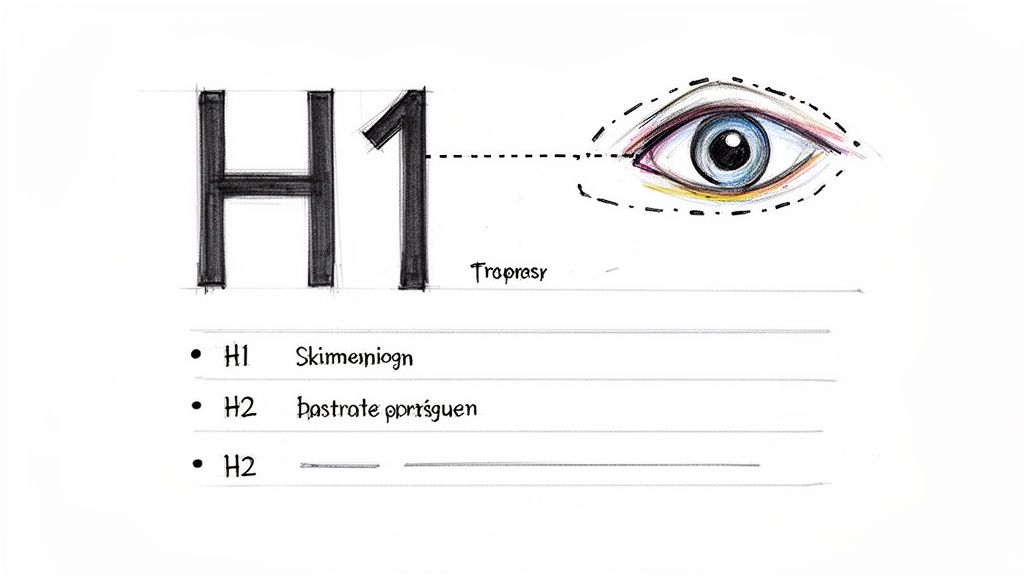
Effective formatting isn't just about aesthetics; it’s about clarity and respect for your reader's time. A wall of text is intimidating and often gets skipped entirely. Subheadings, bullet points, bold text, and ample white space act as signposts, breaking up complex information and making your copy far more inviting and effective.
How to Apply This: A Rewritify Example
Imagine a blog post explaining the benefits of an AI rewriting tool. Without formatting, it's just a dense block of text. With strategic formatting, it becomes scannable and persuasive:
- Dense Paragraph: Rewritify helps users enhance their writing by improving clarity, checking for plagiarism, and optimizing for SEO. It can rephrase sentences to sound more professional and can rewrite entire articles to pass AI detection, all while maintaining the original meaning and keywords, which is useful for students and marketers.
- Formatted for Skimming: Need to elevate your writing? Rewritify helps you:
- Improve Clarity & Professionalism: Refine your message for maximum impact.
- Ensure Originality: Paraphrase sources to avoid accidental plagiarism.
- Boost SEO Performance: Rewrite content that passes AI detection and ranks higher.
The second version immediately communicates value, even to someone just skimming the page. This approach is fundamental to creating content that performs well, and you can explore more in these SEO copywriting best practices.
Quick Tips for Implementation
- Break Up Your Text: Keep paragraphs to a maximum of 2-3 sentences. Use subheadings every 150 words or so.
- Use Lists: Convert dense sentences into bullet points for benefits or numbered lists for step-by-step instructions.
- Emphasize Key Ideas: Use bold text sparingly to highlight the most crucial words or benefits you want the reader to remember.
- Prioritize Mobile: Most traffic is mobile. Ensure your formatting creates a clean, easy-to-read experience on small screens.
8 Essential Copywriting Tips Compared
| Title | Implementation complexity | Resource requirements | Expected outcomes | Ideal use cases | Key advantages |
|---|---|---|---|---|---|
| Know Your Audience and Speak Directly to Them | Medium–High (research, segmentation) | Analytics, user research, time for persona development | Higher engagement, relevance, improved conversions | Targeted campaigns, segmented email, persona-driven landing pages | Tailored messaging, stronger emotional connection, better SEO |
| Lead with a Compelling Headline or Hook | Low–Medium (writing + testing) | Copywriting skill, A/B testing tools, headline generators | Increased click-through and initial engagement | Blog posts, ads, subject lines, landing pages | Boosts CTR, frames content, easy to test |
| Focus on Benefits, Not Just Features | Medium (feature→benefit translation) | Customer insights, messaging frameworks, editorial time | More persuasive copy and higher conversion rates | Sales pages, product descriptions, onboarding flows | Makes value tangible, drives action, emotional resonance |
| Use Clear, Simple Language and Avoid Jargon | Low–Medium (editing and simplification) | Editors, readability tools, style guides | Improved comprehension, accessibility, and trust | Broad audience content, help docs, educational material | Wider reach, clearer messaging, better SEO |
| Create a Strong Call-to-Action (CTA) That Drives Specific Action | Low (copy + placement + testing) | Design assets, A/B testing, analytics tracking | Direct conversion lift and measurable actions | Landing pages, emails, checkout flows, CTAs in content | Removes ambiguity, increases conversions, easy to optimize |
| Build Trust Through Social Proof and Credibility Signals | Medium (collecting & curating proof) | Customer testimonials, case studies, verification assets | Reduced perceived risk and higher trust-driven conversions | Pricing pages, signup flows, product pages, case studies | Enhances credibility, differentiates, boosts conversions |
| Tell Stories and Use Emotional Triggers to Connect | Medium–High (narrative crafting) | Skilled writers, customer interviews, time for drafting | Greater memorability, emotional engagement, stronger brand recall | Brand pages, long-form content, campaigns, fundraising | Creates emotional bonds, makes messages memorable |
| Optimize for Skimming and Use Formatting to Guide Attention | Low–Medium (structure + visual hierarchy) | Editors, designers, CMS tools, style templates | Improved scannability, lower bounce, better UX and SEO | Blog posts, long articles, emails, landing pages | Improves readability, guides attention, aids mobile users |
Putting It All Together: Your Next Steps to Great Copy
You’ve just navigated a comprehensive guide filled with practical, actionable copywriting tips for beginners. From understanding your audience on a deep level to crafting irresistible headlines and guiding readers with strategic formatting, you now possess the fundamental toolkit for writing persuasive and effective copy. We’ve broken down how to shift from listing features to highlighting transformative benefits, the importance of building trust with social proof, and the magnetic power of a well-told story.
However, knowing these principles is only the first step. The real growth happens when you move from theory to consistent practice. Great copywriters aren't born overnight; they are forged through the relentless process of writing, editing, and refining their work. The journey to mastering this craft is a marathon, not a sprint, and every piece you write is an opportunity to improve.
Your Action Plan for Copywriting Success
Don't let this knowledge sit idle. To truly internalize these concepts and see a tangible improvement in your writing, you need a plan. Here are your immediate next steps:
- Choose One Tip to Master: Instead of trying to implement all eight tips at once, pick just one to focus on for your next project. Perhaps you'll concentrate on writing a more compelling, benefit-driven headline or on strengthening your call-to-action. Once you feel confident, layer on another tip.
- Create a "Swipe File": Start collecting examples of great copy you encounter online. When an ad, email, or landing page captures your attention, save it. Analyze why it worked. Did it tell a great story? Did it use powerful social proof? This library of inspiration will become an invaluable resource.
- Embrace the Rewrite: Your first draft is never your final draft. The most critical part of the writing process is editing. Read your copy aloud to catch awkward phrasing. Step away from it for a few hours and come back with fresh eyes. Be ruthless in cutting unnecessary words and clarifying your core message.
Ultimately, the goal of all these copywriting tips for beginners is to help you connect with your reader and inspire them to take a specific action. By focusing on clarity, empathy, and value, you build a bridge between your message and their needs. This is the essence of powerful communication and the key to achieving your goals, whether that's making a sale, growing an audience, or driving engagement.
The path forward is clear: practice, analyze, and refine. Take these building blocks and start constructing copy that not only reads well but also delivers measurable results. Your journey from a beginner to a confident copywriter starts with the very next sentence you write.
Ready to elevate your drafts from good to great? Rewritify helps you apply these principles by refining your language, clarifying your message, and polishing your final text. Transform your rough ideas into professional, high-impact copy by visiting Rewritify and see how AI-powered editing can accelerate your learning curve.
Relevant articles

Learn how to structure an argumentative essay with our expert guide. We break down the thesis, body paragraphs, and counterarguments for a powerful paper.

Learn how to write a position paper with our expert guide. Discover proven strategies for research, structuring arguments, and persuasive writing.
Unlock the secrets of influence with our guide to 10 powerful persuasive writing techniques. Learn ethos, pathos, logos, and more to elevate your copy.
Discover the top 10 SEO copywriting best practices for 2025. Learn to craft content that ranks higher, engages users, and converts with our expert guide.
Discover 10 actionable content repurposing strategies to maximize your reach and ROI. Turn blogs, webinars, and data into powerful marketing assets.