Difference between paraphrasing and plagiarism: A concise integrity guide
Difference between paraphrasing and plagiarism explained with clear examples and actionable tips to protect academic integrity.
At its core, the difference between paraphrasing and plagiarism boils down to originality and attribution. It's really that simple. Paraphrasing is when you take someone else's idea, digest it, and then explain it using your own words and sentence structure—always giving credit back to the original source. Plagiarism, on the other hand, is passing off someone else's work as your own, plain and simple.
Defining the Core Concepts
Getting a firm grip on what separates these two is non-negotiable for any serious writer, whether in an academic or professional setting. One is a valued skill that shows you understand the material, while the other is a major ethical breach. Knowing where that line is drawn is the first and most important step to protecting your credibility.
What is Ethical Paraphrasing?
Think of ethical paraphrasing as a form of translation. It’s not about just swapping out a few words for synonyms—that’s a rookie mistake called "patchwriting" and it can still get you in trouble. True paraphrasing demands that you fully absorb the source material, understand its core message, and then re-express that idea entirely in your own voice and style.
The final, crucial step? You must always include a citation. This isn't just a formality; it's how you acknowledge the original creator's intellectual property.
The point of paraphrasing isn't to hide where an idea came from. It's to weave that idea smoothly into your own work, demonstrating you understand it while giving full credit where it's due.
What Constitutes Plagiarism?
Plagiarism is, frankly, intellectual theft. It’s using another person's words, ideas, data, or creative work without giving them credit. This can be a deliberate act, like copying and pasting a chunk of text from a website, or it can be an honest mistake, like forgetting to add a citation after you’ve rephrased something.
Regardless of intent, the consequences are almost always severe because you've misrepresented someone else's work as your own. And this happens more often than you might think. Research from the International Center for Academic Integrity found that a staggering 58% of high school students admitted to plagiarism, like lifting sentences without citation. You can dig into more of their findings in their comprehensive research on the topic.
Paraphrasing vs Plagiarism At a Glance
To make the distinction crystal clear, it helps to see the core differences side-by-side. The table below breaks down exactly what separates ethical paraphrasing from academic plagiarism.
| Attribute | Paraphrasing | Plagiarism |
|---|---|---|
| Originality | You use your own unique words and sentence structure to explain an idea. | The words, structure, or ideas are directly copied or barely changed. |
| Citation | Required. Proper citation is a non-negotiable part of the process. | Missing. The key element is the failure to give proper credit. |
| Intent | To show you understand a source by integrating it into your work. | To deceive the reader into thinking borrowed work is your own. |
| Academic Standing | An essential and highly encouraged academic skill. | A serious ethical violation with severe consequences. |
Ultimately, a good paraphrase shows you've engaged with the material, while plagiarism is a shortcut that sidesteps the learning process entirely. Keeping these distinctions in mind is key to producing honest, credible work.
Annotated Examples of Paraphrasing Gone Wrong
Knowing the definitions is one thing, but seeing them in action is what really makes the difference between paraphrasing and plagiarism click. Let's walk through an example using a single source text to see how a writer can handle it correctly—and how they can get it dangerously wrong.
First, here's our original source material from a fictional journal article by a Dr. Alistair Finch.
Original Source Text: "The intricate migratory patterns of the Arctic Tern are a biological marvel, driven by an innate geomagnetic sense that allows these birds to navigate over 50,000 miles annually. This internal compass, which is highly sensitive to the Earth's magnetic fields, is not fully understood but is believed to involve quantum-level interactions within the bird's retinal proteins." (Finch, 2023)
Now, let's break down three attempts to use this information: one that gets it right, and two that fall into the plagiarism trap.
The Good: An Ethical Paraphrase
A good paraphrase isn't just about changing words; it's about showing you truly understand the original idea. You internalize the information and then explain it in your own unique way, always giving credit where it's due.
Example of a Good Paraphrase:
Dr. Finch (2023) explains that Arctic Terns achieve their astonishing yearly migration of over 50,000 miles by using a natural ability to sense the planet's magnetic fields. He notes that while this biological navigation system is not completely explained, scientists theorize it may be linked to quantum processes in the birds' eyes.
Annotation:
- Complete Rephrasing: The core concept is the same, but the language is entirely new. "Astonishing yearly migration" and "biological navigation system" show the writer has processed the information, not just substituted words.
- Structural Change: The original's long, complex sentence has been broken into two simpler ones. This demonstrates a complete restructuring of the idea.
- Proper Citation: The author, Dr. Finch, is credited right at the start. This smoothly integrates the source into the writer's own work.
This is what success looks like. It’s an active process of engaging with the material, not just copying it.
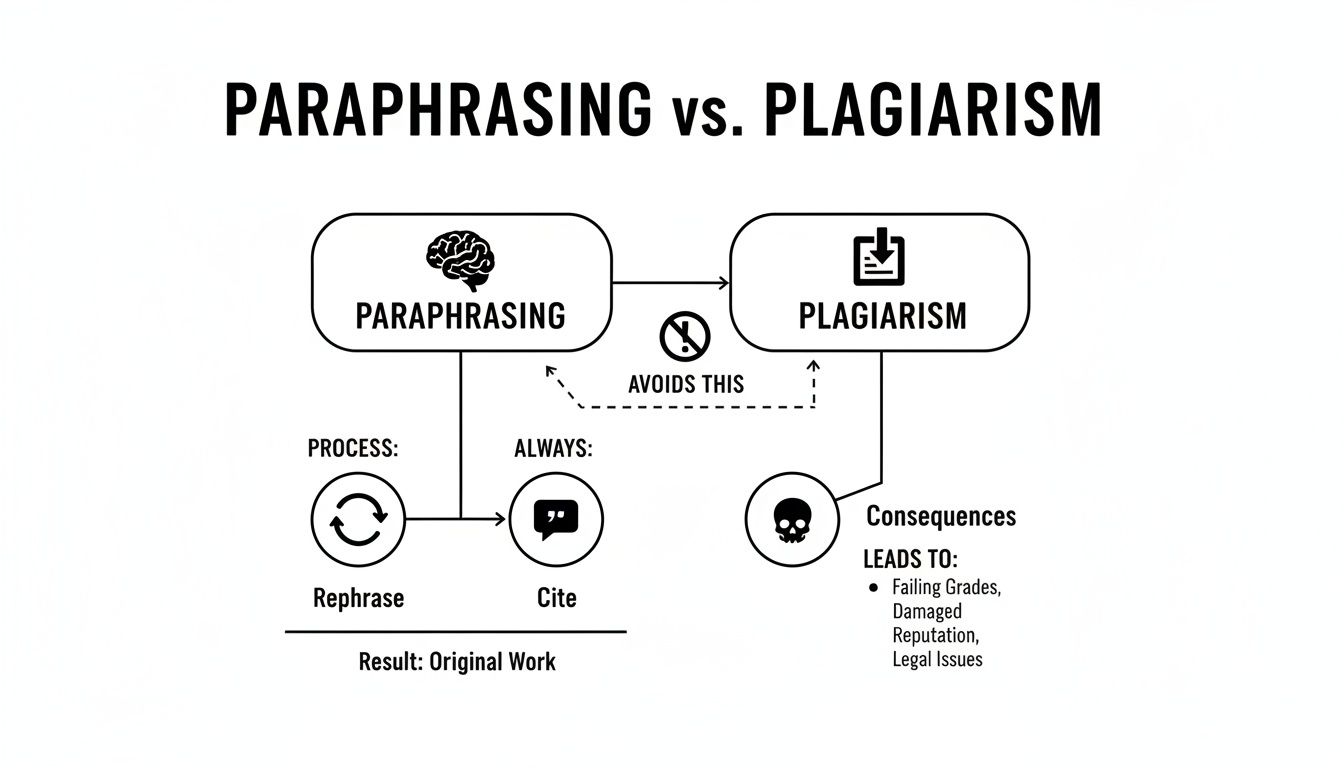
Ultimately, ethical paraphrasing proves you've done the intellectual work yourself.
The Bad: Mosaic Plagiarism (or "Patchwriting")
This is probably the most common way students and writers accidentally plagiarize. It happens when you take the original text and just swap out some keywords for synonyms while leaving the original sentence structure almost untouched. It’s a lazy shortcut often called "patchwriting."
Example of Mosaic Plagiarism:
The complex travel patterns of the Arctic Tern are a natural wonder, powered by an inborn geomagnetic sense that lets the birds travel over 50,000 miles each year. This internal guide, which is very sensitive to the planet's magnetic fields, is not totally understood but is thought to involve quantum interactions in the bird's retinal proteins.
Annotation:
- Superficial Changes: Notice how "intricate migratory patterns" simply becomes "complex travel patterns." These are just surface-level synonym swaps.
- Identical Sentence Structure: The grammatical framework is a mirror image of the original. The writer has essentially just pasted new words onto the old skeleton.
- No Citation: This is the critical failure. Without giving credit to Finch, all those minor word changes mean nothing. It's still theft.
Patchwriting is sneaky because it feels like you're doing the work of rephrasing. But if you haven't fundamentally changed the structure and cited the source, you're presenting someone else's thinking as your own.
The Ugly: Direct Plagiarism
This one is the most clear-cut and serious offense. It's copying and pasting text directly from a source, word for word, without using quotation marks or citing the author. There's no gray area here; it's just academic dishonesty.
Example of Direct Plagiarism:
The intricate migratory patterns of the Arctic Tern are a biological marvel, driven by an innate geomagnetic sense that allows these birds to navigate over 50,000 miles annually. This internal compass is not fully understood but is believed to involve quantum-level interactions within the bird's retinal proteins.
Annotation:
- Verbatim Copying: The text is lifted straight from the source. The writer made a tiny edit by removing one clause, but the rest is a direct clone.
- No Quotation Marks: Even if the writer had cited Finch, failing to put this borrowed text in quotation marks would still be plagiarism. It misleads the reader into thinking these are paraphrased words.
- No Attribution: The complete absence of any mention of Dr. Finch seals the deal. This is a total failure to acknowledge the source.
By putting these three examples side-by-side, the difference between paraphrasing and plagiarism becomes crystal clear. It all comes down to genuine re-creation and honest credit versus simple imitation and theft.
Understanding the Academic and Professional Stakes
The line between paraphrasing and plagiarism isn't just about grammar or writing style; it’s a bright red line marking the boundary of intellectual honesty. Crossing it, even accidentally, carries real, high-stakes consequences that can follow you from the classroom to the boardroom.
In academia, the fallout from plagiarism is swift and can seriously disrupt a student's educational journey. Submitting work that isn't truly yours, whether you meant to or not, sets off a chain reaction of penalties that get more severe with each offense.
What Happens in School
A single instance of plagiarism can leave a permanent mark. For a minor, first-time mistake, you might just get a zero on that specific assignment. But if the act is more deliberate or a repeat offense, the consequences escalate quickly.
Here’s what students can face:
- Failing the Course: Many professors and institutions have zero-tolerance policies. One clear case of plagiarism can mean an automatic F for the entire semester, wiping out all your hard work.
- Academic Suspension: If it happens again, a university might suspend you for a semester or even a full year. This not only delays your graduation but also leaves a major stain on your academic record.
- Expulsion: For the most serious cases, like in a doctoral thesis or organized cheating rings, a school can expel you permanently.
Beyond these direct punishments, a record of academic dishonesty can haunt you for years. It can threaten your chances of getting into graduate school or other professional programs that demand a clean history.
The Stakes in the Professional World
The consequences don't magically disappear after graduation. In fact, in the professional world, they can be even more damaging to your career and long-term reputation. The concept of "intellectual property" is the bedrock of countless industries, from marketing and journalism to scientific research.
Plagiarism in a professional setting is not just poor form—it's a betrayal of trust that can destroy credibility, end careers, and even lead to legal battles over copyright infringement.
At work, plagiarism could mean anything from lifting a competitor's ad copy to using unlicensed photos or passing off a colleague's analysis as your own. The fallout is often immediate and unforgiving, frequently resulting in immediate termination of employment. Once you’re fired for an ethical breach like that, your professional reputation can be shattered, making it incredibly tough to find another job in your industry.
Then there are the legal troubles. Plagiarism often crosses into copyright infringement, which is a federal crime. The original creator or company can sue for damages, dragging you into expensive lawsuits that can drain your finances.
A Widespread Problem with a High Risk
Upholding academic integrity is a massive challenge, particularly when cheating is so common. The numbers paint a grim picture: one major study found that a staggering 95% of students admitted to some form of cheating, with plagiarism high on the list. While this is a global issue, detection tools have gotten incredibly sophisticated, now flagging between 40-62% of suspicious papers. In short, the odds of getting caught are higher than ever.
These statistics highlight a simple truth: cutting corners might seem tempting, but the tools designed to catch you are getting better every day. The long-term damage from one act of plagiarism—to your grades, your degree, or your career—is never worth the short-term gain. Learning to paraphrase and cite correctly isn't just about avoiding punishment; it's about building a reputation for integrity that will benefit you for life. To get started, take a look at our guide on how to avoid plagiarism and make sure your work is always ethical and original.
Your Practical Checklist for Ethical Paraphrasing
Knowing the theory behind paraphrasing versus plagiarism is one thing, but putting it into practice is where it really counts. The best way to stay on the right side of the line is to have a consistent, repeatable process.
This checklist isn't just about avoiding trouble; it's a framework that genuinely sharpens your understanding and makes your own writing stronger. Follow these steps every time you work with source material, and you'll build a habit of creating original, ethically sound work.
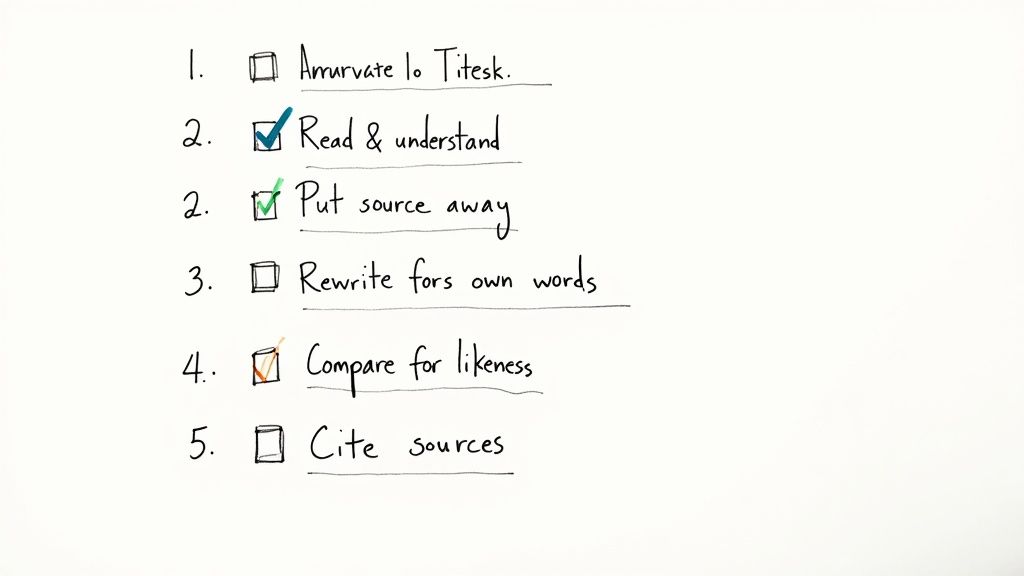
Step 1: Read for Full Comprehension
Before you even think about writing, read the original passage a few times. The goal here isn't to memorize it word-for-word. It's to fully understand its core meaning, the author's tone, and the context.
Here's a good test: if you can't explain the main point to someone else without peeking at the text, you're not ready to paraphrase. This first step is the most important one. Rushing it almost always leads to a weak paraphrase that clings too closely to the original.
Step 2: Set the Original Aside and Write
This is a simple but incredibly effective trick. Close the book, minimize the browser tab, or physically cover the text. You need to break your brain's reliance on the author's specific words and sentence patterns.
Now, write down the idea from memory, using your own voice. Focus on getting the central message across in a way that feels natural to you. This forces you to actively process the information instead of just swapping out a few synonyms.
By forcing yourself to recall the concept, you are not just rephrasing; you are reformulating. This is the essence of true paraphrasing and the clearest way to avoid unintentional plagiarism.
Step 3: Compare Your Version to the Original
Okay, now you can bring the original text back and compare it side-by-side with what you wrote. Think of this as your quality control check. You're looking for three key things:
- Accuracy: Did you nail the author's meaning? Make sure you haven't twisted or misinterpreted their idea.
- Unique Phrasing: Is it truly in your own words? Keep an eye out for any distinctive phrases or unique terms you might have accidentally borrowed.
- Sentence Structure: Does your sentence flow differently? If the grammar and structure look like a mirror image of the original, it’s time for another pass.
If your version still feels too close for comfort, go back to Step 2 and give it another shot. For a deeper dive, our guide on how to paraphrase without plagiarizing has even more strategies.
Step 4: Use Quotation Marks and Cite Immediately
As you compare, you might find a specific phrase or a few key words from the original that are just too perfect or essential to change. That’s fine! Just put them in quotation marks. You don’t have to paraphrase 100% of an idea if a direct quote works better.
Most importantly, add your citation right away. Don't tell yourself you'll do it later. As soon as you integrate an idea from a source, add the in-text citation and a note for your bibliography. This simple habit is the best defense against accidental plagiarism from forgotten sources. Of course, the better you are with language, the easier it is to find your own words. You can find some great tips to improve your grammar skills which will make articulating complex ideas much more natural.
Using AI Paraphrasing Tools Ethically
The rise of AI writing assistants like ChatGPT and QuillBot has definitely blurred the lines around the difference between paraphrasing and plagiarism. These tools are fantastic for getting past writer's block or finding a better way to phrase something, but you have to know their limits to use them ethically.
The real trouble starts when you let an AI do your thinking for you. Just plugging a source into a tool and copying the output is a form of academic dishonesty some call 'AI plagiarism.' Sure, the words might be different, but you've skipped the most important part: understanding and analyzing the material yourself.
Think of it this way: AI should be your assistant, not your author. At the end of the day, you're the one responsible for the work—its accuracy, its originality, and, of course, proper citation.
The Risks of Over-Reliance on AI
Trusting an AI paraphrasing tool completely is a big gamble. These models are great at shuffling words based on patterns, but they don't actually understand the meaning or context of what they're rewriting. This can backfire in a few serious ways.
For one, AI tools often keep too much of the original sentence structure or unique phrasing, which can easily slip into mosaic plagiarism. A 2024 study that put ChatGPT to the test found its paraphrased outputs had an average plagiarism score of 45%. That's way over the 15-20% limit most academic institutions allow, showing just how risky it is to use these tools without careful editing.
AI models are also notorious for "hallucinating"—basically, they make stuff up. If you rely on an AI to summarize a source without checking it yourself, you could end up with factual errors that destroy your credibility.
Guidelines for Ethical AI Use
The key to using AI responsibly is to treat it like a brainstorming partner, not a ghostwriter. Your final work has to be a product of your own intellectual effort. To stay on the right side of academic integrity, here’s a simple breakdown.
What AI Is Great For:
- Brainstorming Ideas: Ask an AI to suggest different angles on a topic or help you build an outline.
- Improving Clarity: If a sentence you wrote sounds clunky, a tool can offer smoother alternatives.
- Checking Grammar and Style: AI is an excellent proofreader for catching typos and polishing your writing.
What You Should Never Use AI For:
- Generating Full Paragraphs from a Source: This is the fastest way to commit AI plagiarism.
- Paraphrasing Without Citing: Even if the words are new, the idea isn't yours. It still needs a citation.
- Replacing Your Own Research: Never take AI-generated facts at face value. Always go back to the original source and verify everything.
As AI tools become more integrated into our workflows, understanding the nuances of AI detection and ethical content creation is more important than ever for students and professionals.
Ultimately, you want to produce work that is genuinely yours. That means wrestling with your sources, forming your own arguments, and writing in your own voice. If you're looking to turn a rough AI draft into something truly human and original, our guide on how to rewrite AI-generated text has some great strategies. By sticking to these principles, you can use AI as a helpful tool while keeping your integrity intact.
Frequently Asked Questions About Paraphrasing
Even when you know the rules, some situations can get a little fuzzy. It's easy to get confused about where paraphrasing ends and plagiarism begins. Let's tackle some of the most common questions writers and students run into, so you can handle these gray areas like a pro.
Is Changing a Few Words Enough to Avoid Plagiarism?
Absolutely not. Just swapping out a few words with synonyms is a classic mistake. This is often called patchwriting, and it's one of the most common ways students accidentally plagiarize.
Real paraphrasing goes much deeper. It means you’ve digested the original idea and can now explain it in your own words, with your own sentence structure. Think about it this way: you’re not just redecorating the original sentence; you’re building a new one from the ground up to house the same idea. It’s about showing you understand the concept, not just that you can use a thesaurus.
What Is Self-Plagiarism?
Self-plagiarism is when you reuse your own work from a previous class or assignment without getting permission from your instructor. It sounds harmless—after all, you wrote it, right? But most schools consider it a form of academic misconduct.
The issue is that every assignment is supposed to be a fresh demonstration of your learning for that specific course. Turning in old work shortcuts that process. Before you ever think about building on previous research, always check your school's policy and get the green light from your professor first.
The problem with self-plagiarism isn't about stealing ideas. It’s about misrepresenting the work as new, which sidesteps the whole point of the assignment and undermines the academic process.
What Should I Do If I Accidentally Plagiarize?
If you have that sinking feeling that you’ve accidentally plagiarized—maybe you forgot a citation or your paraphrase stuck too close to the source—the best thing you can do is face it head-on. Don't hide from it.
Contact your instructor right away. Explain what happened, own the mistake, and ask if there’s an opportunity to fix it and resubmit. Most professors appreciate the honesty. It shows integrity and a genuine desire to learn, which looks a lot better than getting caught later. Treat it as a tough but valuable lesson to tighten up your citation game for the future.
Ready to turn your drafts into clear, original text? Rewritify can help you refine your writing to steer clear of accidental plagiarism while keeping your unique voice intact. Give it a try and start writing with more confidence.
Relevant articles

Learn how to write an annotated bibliography with this comprehensive guide. Get actionable tips, real examples, and formatting advice for APA and MLA.
Master apa footnote example with a clear, step-by-step guide to APA 7th edition footnotes and citations.
Are AI detectors accurate? This guide unpacks the data, revealing why 99% claims are misleading and how to navigate the risks of false positives in your work.
Explore turnitin similarity score meaning and how it reflects originality, citation practices, and steps to improve your paper before submission.
Tired of confusing APA footnote citation rules? This guide offers clear examples and practical steps for formatting footnotes correctly in your research papers.
Learn how to check for plagiarism with confidence. Our guide covers the best tools, manual techniques, and a clear workflow to ensure your content is original.