Mastering APA Footnote Citation A Practical Guide
Tired of confusing APA footnote citation rules? This guide offers clear examples and practical steps for formatting footnotes correctly in your research papers.
In APA Style, a footnote is your secret weapon for two very specific jobs: adding extra, useful information that would otherwise clutter your main text (content footnotes) or properly crediting copyrighted material you've used (copyright footnotes). Think of them as a way to provide clarity and give credit where it's due without interrupting the reader.
Knowing When and Why to Use APA Footnotes
Footnotes can feel a bit old-school in APA, but knowing when to use them is a sign of a seasoned writer. It's all about deciding what information is truly supplemental versus what's essential to your argument. The goal is to add value without derailing your reader's train of thought.
We'll walk through the practical scenarios where a footnote is the perfect tool—whether it's to clarify a complex idea or handle a necessary copyright attribution. This isn't just about following rules; it's about making your writing stronger and more professional.
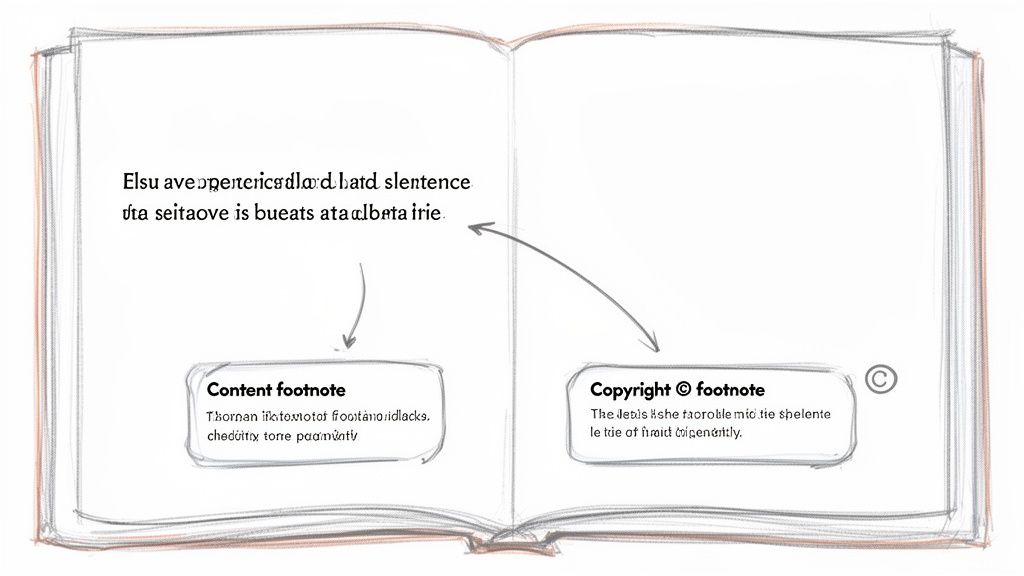
Differentiating Content and Copyright Footnotes
First things first, let's get clear on the two types. They serve completely different functions.
A content footnote is for adding a quick, helpful aside. Let's say you've used a technical term that only specialists would know. A content footnote is the perfect place to drop in a short definition without bogging down your main paragraph. It's also great for briefly touching on a related but tangential point that's interesting but not central to your argument.
A copyright footnote, however, is a non-negotiable legal requirement. You absolutely must use one if you're reproducing a long quote (that's anything over 500 words), a table, or a figure from a source someone else owns the copyright to. This is all about respecting intellectual property rights. Getting this right is a huge part of maintaining academic integrity, and you can dive deeper into this by reading our guide on how to avoid plagiarism.
The core principle is simple: use content footnotes for helpful asides and copyright footnotes for required permissions. If the information is essential to your main argument, it belongs in the text, not at the bottom of the page.
To help you decide at a glance, here's a quick breakdown of the two footnote types and their primary uses.
APA Footnote Types and When to Use Them
| Footnote Type | Primary Purpose | Common Use Case Examples |
|---|---|---|
| Content Footnote | To provide brief, supplemental information that clarifies or elaborates on the main text. | Defining a technical term, adding a brief tangential comment, acknowledging a study's limitation, or providing extra source context. |
| Copyright Footnote | To provide a formal attribution for reproduced copyrighted material, as required by publishers. | Citing a reproduced table or figure, or giving credit for a long quotation (over 500 words). |
Ultimately, choosing the right footnote comes down to its purpose—are you adding helpful context or fulfilling a legal obligation?
Real-World Scenarios for Footnotes
Deciding whether to add a footnote often comes down to improving the reader's experience. While APA is famous for its author-date in-text citations, footnotes have always been a formal part of the system, especially in dissertations and complex journal articles where these extra clarifications are needed.
Let’s look at a few times you might use one:
- Defining Technical Jargon: You mention "allostatic load" in your paper. A footnote can quickly clarify it for non-experts: ¹The cumulative wear and tear on the body's systems from chronic stress.
- Providing Source Context: You're discussing a study but know there's a key detail that affects the results. A footnote is perfect: ²The survey data from Smith (2021) was collected prior to the policy change, which may influence the results.
- Acknowledging Nuance: You present a dominant theory but want to show you're aware of other perspectives without going on a tangent: ³While this theory is widely accepted, an alternative explanation is offered by Jones (2019).
In each case, the footnote adds valuable information without breaking the flow of the main argument. That’s the mark of a well-placed APA footnote.
Getting Your APA Footnote Formatting Right
When it comes to academic writing, the little things make a huge difference. A perfectly formatted APA footnote isn't just about following rules; it’s a subtle signal to your reader that you’re a careful, credible scholar. Let's break down exactly how to get it right.
First up is that tiny superscript number in your main text. This is what links your sentence to the note at the bottom of the page. A common slip-up is putting it in the wrong spot. The number should always come after any punctuation, like a period or a comma.
For example: "The study's results were surprisingly ambiguous, which opened up new avenues for the research team.¹" Placing it after the period keeps the sentence clean and readable.
The footnote itself needs to appear at the bottom of the very same page as its superscript number. This makes it easy for your reader to glance down, get the extra information, and jump right back to your main argument without losing their place. Thankfully, most word processors handle this part for you automatically.
The Nitty-Gritty of Formatting
Once you create the footnote, there are a few core APA 7th edition rules you need to follow every time. Getting these details right ensures your paper looks professional and consistent.
- Numbering: The notes are numbered consecutively, starting with ¹. In the footnote section itself, use a regular number, not a superscript.
- Indentation: You need to indent the first line of every footnote. The standard is 0.5 inches, the same as a normal paragraph indent.
- Spacing: Keep your footnotes double-spaced. This applies to the text within a single note and the space between different notes on the same page.
- Font: Stick with the same font you're using for the rest of your paper. While APA is flexible, 12-point Times New Roman is still the go-to for many.
Pro Tip: Think of it this way: a properly formatted footnote looks like a mini-paragraph. It has an indented first line, is double-spaced, and matches your main text's font. The only difference is the number at the beginning.
What a Formatted Footnote Looks Like in Practice
Seeing an example makes it all click. Imagine you’re writing a paper and need to clarify a technical term for your reader. The footnote at the bottom of your page would be structured just like this:
¹ The term ecological validity refers to the extent to which the findings of a research study can be generalized to real-life settings. This concept was particularly relevant given the controlled laboratory environment of the experiment.
See how the first line is indented and the "1" isn't a superscript? That's the correct format. It's a small detail, but it’s one that professors and reviewers definitely notice.
Mastering these specific points—the superscript placement, indentation, spacing, and font—ensures your APA footnotes are not just correct but also add to the overall polish and authority of your work.
Citing Different Source Types in Footnotes
While the basic rules for APA footnotes are consistent, the details you need to include will change based on what you're citing. A book citation looks different from a journal article, which looks different from a government report. Nailing these specifics is what allows your reader to track down the exact source you're referencing.
Think of this as your field guide for formatting the most common sources you'll come across in your research.
Books
When you're citing an entire book in a content footnote, the format is pretty simple. All you really need is the author's last name, the year it was published, and maybe a page number if you're referencing a specific passage. This gives your reader just enough to find the full entry in your reference list.
Let's say you want to add a quick note about a key concept without disrupting your paragraph. It would look something like this:
¹ For a comprehensive discussion on cognitive biases, see Kahneman (2011), particularly his analysis of heuristics in Chapter 3.
This keeps your main text clean and points the reader right where they need to go.
Journal Articles
Journal articles are the lifeblood of academic writing, so you'll be citing these constantly. The format is similar to books—author and year are key—but adding a specific page number is even more helpful here.
Imagine you're referencing a particular method used in a study:
² The researchers used a double-blind protocol to minimize experimenter bias (Chen & Lee, 2020, p. 45).
This footnote doesn't just point to the article; it directs the reader to the exact page describing the protocol. For more insights on building strong academic arguments, check out our guide on research paper writing tips.
Websites and Online Sources
Citing online sources can feel a bit like hitting a moving target. They don't have page numbers, and the content can be updated or even disappear. The goal is to provide as much detail as you can to help your reader find the exact page you looked at.
Make sure to include the author (or the organization), the publication date, the page title, the website's name, and the URL. If you can't find a publication date, it's good practice to use the date you accessed the page instead.
Here’s what that looks like in practice for a webpage citation:
³ According to the National Institute of Mental Health (2021), early intervention is a key factor in successful treatment outcomes for anxiety disorders. Retrieved from https://www.nimh.nih.gov/health/topics/anxiety-disorders
Key Takeaway: With web sources, traceability is everything. A URL is non-negotiable, and including a retrieval date is crucial if the content is likely to change. It tells your reader which version of the page you saw.
Government and Technical Reports
A lot of modern research leans heavily on data from government or institutional reports. Citing these sources correctly is a big focus in APA Style, especially since a single paper might reference dozens of datasets.
When you cite one, be sure to include the authoring agency, the year, the report's title, and any report or publication numbers.
Here’s an example:
⁴ U.S. Department of Education, National Center for Education Statistics. (2019). Digest of Education Statistics 2018 (NCES 2020-009).
This format gives anyone all the unique identifiers they'd need to pull up that specific government document. And as research methods evolve, so do citation practices. For instance, knowing how to cite AI-generated images in APA 7 is a skill that's becoming more essential every day.
Avoiding Common APA Footnote Mistakes
Even seasoned writers can get tripped up by the finer points of APA footnotes. These small mistakes, while seemingly minor, can really detract from a well-written paper. They can signal a lack of attention to detail that might make a reader question your work's credibility.
Let's walk through some of the most common traps I've seen over the years so you can learn to spot and fix them.
Superscript Placement and Numbering Woes
One of the most frequent slip-ups is putting the superscript number in the wrong spot. It's a tiny detail, but it has a big impact on flow and correctness. The rule is simple: the number must go after all punctuation. That means after the period, after the comma, and even after the closing quotation mark. Sticking it anywhere else is an instant giveaway that you've missed a key APA convention.
Another classic error is jumbled numbering. When you're deep into drafting and revisions, it's surprisingly easy to skip a number, repeat one, or forget to renumber everything after deleting a note. This creates a confusing roadmap for your reader. Before you call it done, do a final scan to make sure your notes run in a clean, sequential order from ¹ onward.
Mixing Up Content Notes and Citations
This is a big one. A critical mistake is using a content footnote to do the job of an in-text citation. Content footnotes are for adding a little extra context or a brief aside—think of them as a quick, "by the way..." comment. They are not for citing evidence.
If you are bringing in a statistic, a direct quote, or a paraphrased idea from another source, that information needs a standard (Author, Date) in-text citation pointing to your reference list. Shoving a full citation into a footnote isn't how APA style works for most cases, and it can muddy the waters of proper attribution.
I always tell students that if the information is important enough to mention, it's usually important enough to integrate into the main text. Overusing footnotes can make your paper feel disjointed and can frustrate readers who have to keep jumping to the bottom of the page.
A Quick Pre-Flight Checklist
Before you submit your paper, take five minutes to run through this checklist. It’s a simple way to catch those little errors that are so easy to overlook.
- Placement: Did I put every superscript number after the punctuation?
- Numbering: Is the sequence of my footnotes perfect (1, 2, 3...)? No gaps, no duplicates?
- Purpose: Am I using footnotes only for brief, supplemental comments? Are all my sources cited in the main text?
- Moderation: Have I kept my footnotes to a minimum? Does each one add necessary value without being a distraction?
- Formatting: Is the first line of every footnote indented? Is the text double-spaced, just like the rest of my paper?
Keeping these points in mind will help you steer clear of the most common pitfalls. This level of care shows you're serious about scholarly quality and makes your arguments clearer and more convincing.
Letting Software Handle Your Footnotes
Trust me, trying to manage footnotes manually in a long research paper is a recipe for disaster. I've been there. You delete one paragraph, and suddenly your entire numbering system is a mess, sending you down a rabbit hole of tedious, frustrating corrections. This is exactly why we have software—it's built to prevent this kind of headache and keep your citations accurate from start to finish.
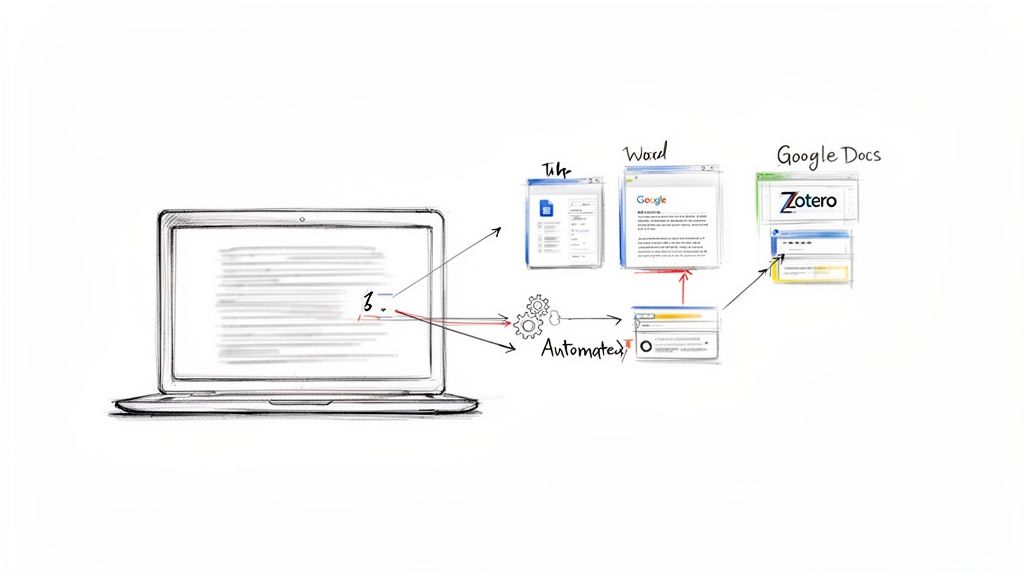
Chances are, you already have some powerful tools right on your computer. Both Microsoft Word and Google Docs have solid, built-in footnote functions that take care of the numbering and placement for you. In Word, you just pop over to the "References" tab and hit "Insert Footnote." In Google Docs, it’s under the "Insert" menu.
These built-in features are great for shorter papers or when you just need to add a few content notes here and there. Their biggest selling point is that they automatically renumber everything if you add, delete, or move a footnote. The catch? They don't format the actual citation for you. That part is still your responsibility.
For Serious Projects, Use a Citation Manager
If you're tackling a dissertation, a thesis, or any long-form academic article, a dedicated citation manager isn't just nice to have—it's essential. These tools do way more than just number your notes.
- Zotero: This is the go-to for many academics, and for good reason. It's free, open-source, and has a browser extension that can pull source information with a single click. Its word processor plugin then drops perfectly formatted footnotes right into your document.
- Mendeley: Also free, Mendeley is part reference manager, part academic social network. It's fantastic for organizing your entire research library and handling all the citation formatting for you.
- EndNote: This is the premium, heavy-duty option. Many universities provide a license for it. If you're managing thousands of sources for a massive project, EndNote's power and extensive style options are hard to beat.
These programs plug directly into your word processor. All you do is pick the source you want to cite, and the software instantly inserts the superscript number in your text and the full APA-formatted footnote at the bottom of the page. This level of automation practically guarantees you won't have formatting errors and will save you hours of work.
The real magic of these managers is how they connect your footnotes to your final reference list. As you add footnotes, the software automatically builds your bibliography, ensuring every cited source is included and formatted correctly. It's a lifesaver.
While citation-specific tools are a must, don't overlook other software that can make the whole process smoother. For instance, using the best dictation software for writers can help you get your ideas down much faster during the drafting stage. This lets you focus on the substance of your argument first, before you start adding in all the necessary APA footnotes. At the end of the day, working smarter with the right tools protects the integrity of your work and lets you focus on what really matters: your research and writing.
Got Questions About APA Footnotes? We've Got Answers.
Even with the APA manual in hand, a few tricky questions always seem to pop up when you're in the middle of writing. Let's tackle some of the most common issues writers run into with footnotes so you can get unstuck and back to work.
Can I Just Put the Full Citation in a Footnote?
I see this question all the time, and the short answer is almost always no. Under the APA 7th edition, footnotes have a very specific job: they're for adding a little extra information or handling copyright permissions. They aren't meant for your primary citations.
All the sources that back up your arguments need to be cited directly in your text using the classic (Author, Year) format. This approach points your reader to the full details in the reference list at the end of your document. Dropping full citations into footnotes can really throw off a reader who's used to the standard APA flow.
My rule of thumb: If the info is essential for crediting a source, it goes in the text as an author-date citation. If it's just an interesting side note, it might work as a content footnote.
How Do I Cite Multiple Sources for the Same Point?
So, you've made a claim and you have three different studies to back it up. What's the best way to handle that? The answer is to group them all together right there in the text, inside a single set of parentheses.
Just list them alphabetically and separate each one with a semicolon. It should look something like this:
- Several studies have confirmed these findings (Chen & Lee, 2020; Jones, 2019; Smith, 2021).
Resist the urge to create a footnote just to list a bunch of sources. Keeping them in the text is the correct APA format, and it makes your writing much cleaner and easier for your reader to follow.
What if a Website Doesn't Have an Author or a Date?
This is a classic problem, especially with online sources. You'll often find a great article or report, but there's no author's name or publication date in sight. Thankfully, APA has a straightforward way to handle these common situations.
- No Author? Look for the organization or group responsible for the content. Instead of an individual's name, you’ll use the organization's name. For example, your citation might be (American Psychological Association, 2023).
- No Date? When you've looked everywhere and can't find a date, simply use the abbreviation "n.d." (which stands for "no date"). Your citation would look like this: (Smith, n.d.).
Handling these sources correctly shows that you're not just following the rules, but you're applying them thoughtfully to real-world situations. It keeps your work consistent and credible.
When your draft is complete but the language needs refinement, Rewritify can help. Our AI-powered tool polishes your text for clarity and academic tone, ensuring your final paper is as professional as your research. Perfect your writing and maintain your unique voice at https://www.rewritify.com.
Relevant articles

Learn how to structure an argumentative essay with our expert guide. We break down the thesis, body paragraphs, and counterarguments for a powerful paper.

Learn how to write an annotated bibliography with this comprehensive guide. Get actionable tips, real examples, and formatting advice for APA and MLA.

Learn how to write an effective essay rough draft. This guide provides actionable steps for turning messy ideas into a coherent and compelling paper.

Discover differences between formal and informal writing, with practical tips, examples, and syntax cues to choose the right tone every time.

Learn how to write a critical analysis with our guide. We cover everything from developing a thesis to structuring your argument and refining your final draft.

Learn how to write a position paper with our expert guide. Discover proven strategies for research, structuring arguments, and persuasive writing.