Mastering APA Footnote Format A Comprehensive Guide
Unlock the secrets to the APA footnote format with this complete guide. Learn how to correctly format content and copyright footnotes with clear examples.
The APA footnote format isn't for your everyday citations. It's reserved for just two specific situations: providing supplemental information that would otherwise disrupt your narrative flow, or for giving copyright attribution.
It's a common point of confusion, so let's be crystal clear: APA Style does not use footnotes for citing sources. That's the job of in-text parenthetical citations and your comprehensive reference list at the end of the paper.
Understanding When to Use Footnotes in APA Style
If you're coming from a discipline that uses a style like Chicago, you might be used to putting all your citations in footnotes. APA, however, takes a different path. The entire system is built around the author-date parenthetical citation, like (Smith, 2023), which is designed to keep the reader's focus locked on your argument with minimal interruption.
Footnotes are treated as a secondary tool, brought out only when absolutely necessary to avoid cluttering your paper.
The American Psychological Association's guidelines are all about promoting clear, direct scientific communication. This philosophy goes all the way back to 1929, when a group of academics first met to standardize the chaotic state of scientific writing. If you're curious, you can read more about the history of APA style and see how it evolved. The strict rules for footnotes are a direct result of this focus on clarity.
The Two Main Roles of APA Footnotes
So, when do you use a footnote? Your decision will almost always fall into one of two categories. Getting this right is key to following the APA 7th edition guidelines correctly.
To help you decide, here's a quick summary of the only two approved uses for footnotes in APA style.
Quick Guide to Approved APA Footnote Types
| Footnote Type | Primary Purpose | Common Use Case |
|---|---|---|
| Content Footnotes | To provide brief, supplemental information | Defining a technical term or briefly elaborating on a tangential point. |
| Copyright Attribution Footnotes | To give legal credit to a copyright holder | Noting permission for a long quotation or a reproduced figure/table. |
These are the only scenarios where a footnote is the right tool for the job. Anything else, like a standard source citation, belongs elsewhere.
This simple decision tree can help you figure out if a footnote is the right move.
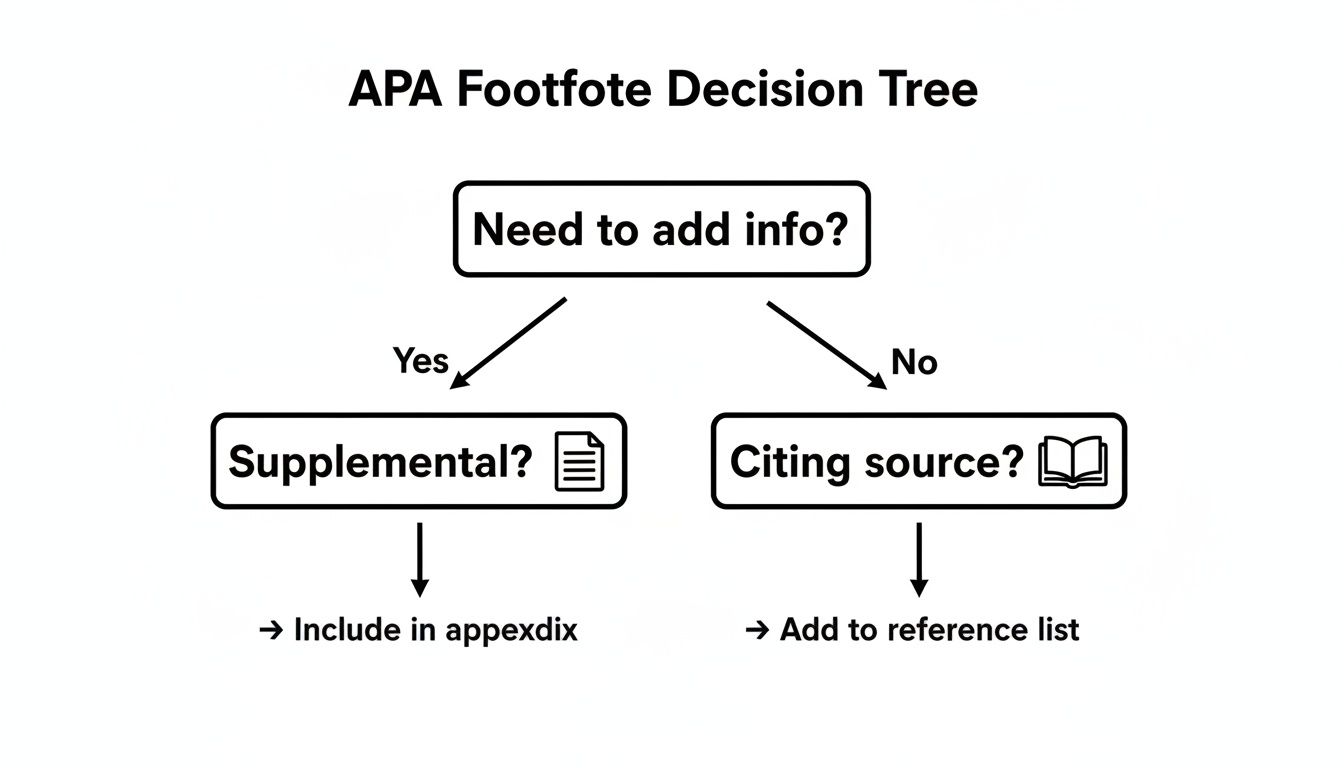
As the diagram shows, the core question is whether the information is a brief, supplemental thought or a direct citation of a source. If it's a standard citation, it always belongs in the reference list.
How to Format Content Footnotes with Examples
In APA style, the main job of footnotes is to provide supplemental information. These are called content footnotes, and they’re your secret weapon for adding quick, helpful asides that would otherwise interrupt the flow of your main argument. Think of them as a way to add extra clarity without making your reader lose their place.
A good content footnote is short and sweet, focused on a single idea. If a piece of information is absolutely essential for your reader to understand your point, it really belongs in the body of your paper. But if it's just an interesting, non-critical detail, a content footnote is the perfect spot.
Expert Tip: Don't go overboard with content footnotes. Using too many can be just as distracting as putting the information in the main text. The goal is to enhance your writing, not clutter it.
A classic example is using a footnote to define a technical term your reader might not know, or to point them toward other resources if they want to dig deeper into a related concept.
What Goes in a Content Footnote?
Knowing what to tuck away in a footnote can feel a bit subjective. The best test is to ask yourself: does this information add value without being critical to my main point?
Here are a few great reasons to use a content footnote:
- Defining a Term: Perfect for a quick explanation of a specialized term.
- Brief Elaboration: A great place to offer a short, tangential thought that adds a layer of richness.
- Suggesting Further Reading: You can point readers to another source if they're interested in learning more.
- Clarifying a Nuance: Sometimes a quick note can clear up a potential misunderstanding without a lengthy explanation.
Keep in mind, if your "quick note" starts turning into a long paragraph, that’s a signal it might belong in an appendix instead. And don't forget—if you mention a source in a footnote, you still need to include a proper in-text citation and a full entry on your reference page.
Practical Examples of Content Footnotes
Let's look at how this works in practice. Below are a couple of examples showing a sentence from the main text with its superscript number, followed by the actual footnote as it would appear at the bottom of the page.
Example 1: Defining a Technical Term
- In-Text Sentence: To analyze the longitudinal data, the study employed a repeated measures ANOVA.¹
- Footnote: ¹ Analysis of variance (ANOVA) is a statistical method for testing the differences between the means of two or more groups.
Example 2: Elaborating on a Concept
- In-Text Sentence: This effect, often called cognitive dissonance,² can cause people to change their beliefs to better match their actions.
- Footnote: ² Festinger’s (1957) work provides the foundational theory on this topic. When summarizing well-established theories, knowing how to paraphrase without plagiarizing is a crucial skill.
As you can see, the footnotes add useful context without breaking the reader's concentration on the main argument. It's a simple technique that can make your writing much more effective.
Getting Copyright Attribution Footnotes Right
Footnotes in APA aren't just for extra commentary; they serve a crucial legal and ethical purpose: copyright attribution. You'll need this specific type of footnote whenever you reproduce a significant piece of someone else's copyrighted work. Think long block quotes, psychological scales, test items, or even tables and figures.
Nailing the format is non-negotiable for avoiding plagiarism and upholding academic integrity. This usually comes up when your use of a source goes beyond "fair use." For instance, quoting over 400 words from a book or lifting an entire table often requires you to get formal permission from the copyright holder. The copyright footnote is how you show you've done your due diligence.
Unlike a content footnote that you might add for clarity, a copyright footnote is mandatory once you've been granted permission to reprint material. It's on you, the author, to secure that permission before your work is published.
Key Components of a Copyright Footnote
A proper copyright attribution footnote, according to the APA 7th edition, has a very specific structure. It's designed to give complete and transparent credit to the original creator and publisher.
Make sure your copyright footnote includes these elements, in this exact order:
- Source Description: Begin with "From" (if you copied it verbatim) or "Adapted from" (if you modified it). Follow this with the title of the book or article.
- Author(s): Include the author's initials and last name.
- Publication Year: The year the original work was published.
- Publication Details: For a journal article, list the journal title, volume, and page number. For a book, you'll need the publisher's name.
- Copyright Holder: State the year of the copyright and the name of the entity that holds it.
- Permission Statement: End with the phrase "Reprinted with permission" or "Adapted with permission."
Following this formula ensures anyone reading your work can easily find the original source and see that you have permission to use it.
Examples of Copyright Attribution Footnotes
Let's look at how this plays out with a couple of common scenarios. The wording changes slightly depending on the source type and whether you reproduced the material exactly as is or adapted it.
Example 1: Quoting from a Book
- In-Text Usage: A student includes a long quotation from a copyrighted book in their dissertation.¹
- Footnote: ¹ From Theories of Academic Writing (p. 45), by J. M. Smith, 2021, University Press. Copyright 2021 by University Press. Reprinted with permission.
Example 2: Reproducing a Figure from a Journal
- In-Text Usage: A research paper features a figure copied directly from a published journal article.²
- Footnote: ² From "Cognitive Mapping in Urban Environments," by A. B. Carter and L. Davis, 2019, Journal of Environmental Psychology, 34(2), p. 123. Copyright 2019 by the American Psychological Association. Reprinted with permission.
Using these templates provides a clear, consistent method for handling attribution, making sure your work is both professional and ethically sound.
A Step-By-Step Guide to Inserting Footnotes
Knowing the APA footnote format rules is one thing, but getting them into your document correctly is a whole other challenge. Thankfully, modern word processors handle most of the heavy lifting, making sure your numbering and placement are spot-on.
The main rule is pretty simple: number your footnotes one after another throughout the paper using superscript Arabic numerals (like ¹, ², and ³). Always place the superscript number right after the punctuation of the sentence or clause it relates to—no space needed. For instance: "...as the data clearly indicated.¹"
Inserting Footnotes in Microsoft Word
Microsoft Word's built-in footnote feature is a lifesaver. It completely automates the numbering and placement, which takes a lot of the manual work off your plate. The tool not only adds the superscript number in the text but also creates the corresponding note area at the bottom of the page.
Here’s how to do it in Word:
- Click your cursor in the exact spot where you want the number to appear. Again, this is usually just after a punctuation mark.
- Go to the References tab in the ribbon at the top of the window.
- Click the Insert Footnote button. Word instantly drops the right number into your text and jumps your cursor down to the page's footer, ready for you to type the note.
This image from Microsoft's official support page shows you exactly where to find that "Insert Footnote" button.
The best part? If you add, delete, or move footnotes later on, Word automatically renumbers everything. It’s a huge relief.
Inserting Footnotes in Google Docs
Google Docs makes the process just as easy. It handles all the formatting and placement for you, so you can focus on the content without worrying about manual numbering.
Adding a footnote in Google Docs is a breeze:
- Place your cursor right where you need the footnote reference.
- Navigate to the Insert menu at the top.
- Choose Footnote from the menu. You can also use the keyboard shortcut Ctrl+Alt+F (or Cmd+Option+F on a Mac).
Like Word, Google Docs puts a superscript number in your text and creates a space at the bottom of the page for your note. This kind of automation is key to maintaining accuracy in a professional document. If you're looking for more ways to polish your work, take a look at these helpful research paper writing tips.
A Quick Tip for Placement: Sometimes you need a footnote for something inside parentheses. If the note applies only to the text within the parentheses, put the number inside the closing parenthesis (like this¹). But if the note applies to the whole sentence, the number goes outside, after the final period.
Your Quick Reference for APA Footnote Format Rules
So, you've decided a footnote is the way to go. The next step is getting the format right, and thankfully, the American Psychological Association has a clear set of rules to keep your work looking clean, consistent, and professional. Following these guidelines for things like indentation, spacing, and font is key to maintaining a scholarly tone.
These rules are the same whether you put your footnotes at the bottom of the page or group them all together on a dedicated "Footnotes" page after the reference list. While most word processors handle the heavy lifting, knowing the rules yourself helps you catch and correct any formatting quirks.
Core Formatting Elements Explained
The APA 7th edition lays out a few specific rules for the footnote text. These details are what visually separate the footnote from your main text, clearly signaling to your reader that it's supplemental information.
Here’s a breakdown of the essential rules you need to know:
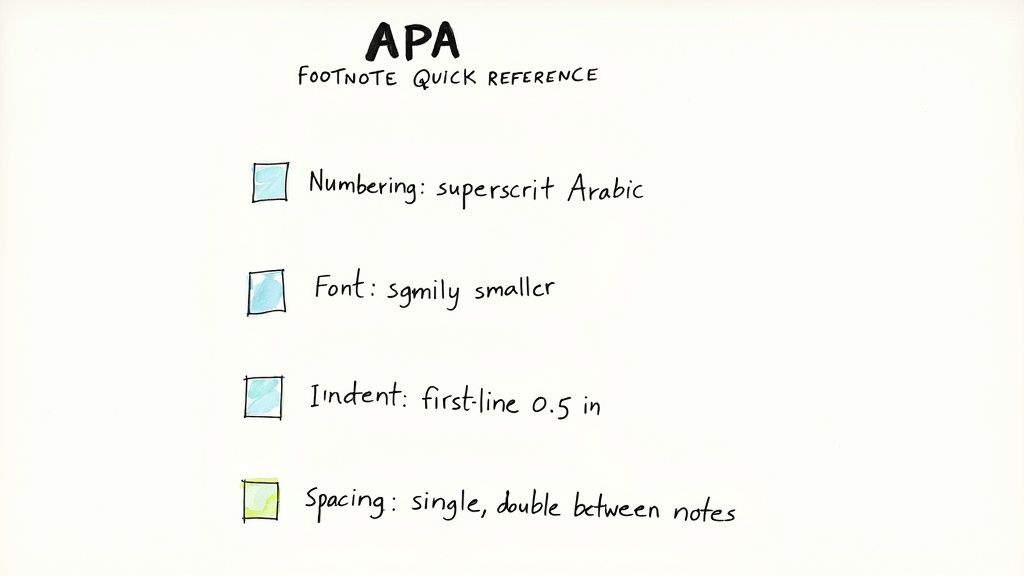
- Indentation: The very first line of every footnote needs to be indented 0.5 inches from the left margin, just like you would for a new paragraph.
- Numbering: Kick off the note with its matching superscript number (e.g., ¹). Critically, do not put a period after the number.
- Spacing: Leave a single space between that superscript number and the first word of the note.
- Line Spacing: The text inside a footnote should be single-spaced. If you have more than one footnote on a single page, however, you'll use a standard double space between them.
- Font: Stick with the same font you're using for the rest of your paper (like Times New Roman). The font size should also match your main text, though some instructors or journals might allow a slightly smaller size, like 10-point. It's always best to double-check your specific assignment guidelines.
Getting these details right gives the bottom of your page a polished, organized look, making the extra information easy to read without pulling focus from your main argument.
APA Footnote Formatting Rules and Templates
To make this even easier, I've put together a reference table with the specific rules and copy-paste templates for the most common footnote situations. You can use these as a foundation and adapt them to your specific source or note, ensuring your formatting is spot-on every time.
This table breaks down each component of the APA footnote format for quick and easy application.
| Formatting Element | APA 7th Edition Rule | Example |
|---|---|---|
| First-Line Indent | Indent the first line 0.5 inches. | ¹ The theory was later expanded... |
| Superscript Number | Match the number from the text. | ¹ |
| Line Spacing | Single-space within the note, double-space between notes. | ¹ This is a single-spaced note. ² This is the next note. |
| Content Note | Provide a brief, supplemental explanation. | ¹ For a detailed discussion of this methodology, see Smith (2020). |
| Copyright Attribution | Follow the "From/Adapted from..." structure. | ² From A Guide to Academic Research, by J. Doe, 2022, p. 54, Academic Press. Copyright 2022 by Academic Press. Reprinted with permission. |
With these examples, you have a solid blueprint for building properly formatted content and copyright footnotes in your own work.
The evolution from APA 6th to 7th edition highlights adaptation to technology. The 7th edition streamlined citations by axing publisher locations for books and removing the need for access dates for stable online sources, slashing reference lengths by an average of 15-20% per entry. For a deeper dive into these changes, you can discover more insights about the APA style evolution.
For an even more exhaustive overview of all APA guidelines and best practices, I highly recommend consulting this external resource: a clear and comprehensive guide to APA footnotes format.
Common Mistakes to Avoid with APA Footnotes
Even with the official APA manual in hand, a few common slip-ups can happen when you're formatting footnotes. Getting these details right is what separates a good paper from a great one, and it helps you avoid losing easy points on formatting. Let's walk through the most frequent mistakes I see students and even some professionals make.
By far, the biggest mistake is using footnotes for routine source citations. Remember, APA style is built on its efficient parenthetical in-text citation system—think (Smith, 2023)—which points readers to your reference list. Footnotes have a very specific job: they are only for supplemental information (content notes) or copyright permissions. That's it.
Incorrect Numbering and Placement
The tiny superscript number might seem trivial, but its placement and sequence are crucial for a reader to follow your train of thought. Messing this up can trip them up and disrupt the flow of your argument. Always place the superscript number right after the punctuation of the word, phrase, or sentence it relates to, with no space.
Keep an eye out for these common errors:
- Inconsistent Numbering: Forgetting to number footnotes consecutively from the beginning of the paper to the end. You never restart the numbering on a new page.
- Wrong Placement: Placing the superscript before punctuation (like this¹. ) instead of after it (like this.¹).
- Incorrect Parenthetical Placement: If your note only applies to the text inside parentheses, the number goes inside, too (like this¹). If it applies to the whole sentence, it goes outside.
Key Takeaway: There's a reason APA is so strict about its parenthetical system. Studies have found it's up to 25% more efficient for reader comprehension in scientific papers compared to footnote-heavy styles. This efficiency is the core reason the rules are so specific.
Formatting the Footnote Text Itself
Once you get to the bottom of the page, the footnote text has its own formatting rules. This is another area where small errors can make a paper look sloppy. The most common mistake I see is forgetting to indent the first line of the footnote. It needs a 0.5-inch indent, just like any other paragraph.
Spacing is another frequent trip-up. The text within a footnote should be single-spaced, but you need to double-space between separate footnotes if you have more than one on a page. Getting this wrong makes the footnote section clunky and hard to read. It's a small detail, but it has a big impact on the overall look of your page.
Finally, don't forget that if you mention a source in a content footnote, it still needs a full citation in your main reference list. This is a step many people miss. It’s absolutely essential for academic honesty; you can learn more about how to avoid plagiarism in our detailed guide on the topic. Properly citing every source, even in your notes, is a non-negotiable part of academic writing.
Frequently Asked Questions About APA Footnotes
Even with clear rules, APA footnotes can feel a bit tricky, especially if you're used to styles like Chicago. It's perfectly normal to have a few questions. Let's tackle some of the most common ones I hear from students and researchers to make sure you're using them correctly.
Think of this as your final check-in. Getting these details right ensures your paper is polished and perfectly aligned with APA 7th edition standards.
Can I Use Footnotes to Cite My Sources in APA Style?
This is the big one, and the answer is a firm no. In APA Style, you must use in-text parenthetical citations, like (Walker, 2023). These citations point your reader to the full source details in your reference list.
Using footnotes for your primary citations is probably the most common mistake people make, but it's a critical error in APA. Footnotes are reserved for just two specific situations:
- Content Notes: Adding a brief, supplemental piece of information that's interesting but would disrupt the flow of your main argument.
- Copyright Attribution: Providing the formal permission statement when you reproduce a long quotation or a full table or figure.
Should I Use a Footnote or Just Put the Information in the Text?
Here’s the key question to ask yourself: "Is this detail essential for my reader to understand my point?"
If the answer is yes, that information belongs right in the body of your text. But if it's more of a side note, a quick clarification, or a tangential thought that adds context without being critical, then a content footnote is the perfect place for it.
A word of caution: use them sparingly. A paper littered with footnotes can pull your reader's attention away from your core argument. The goal is always clarity, not clutter.
What Is the Main Difference Between APA and Chicago Footnotes?
The biggest difference comes down to their fundamental purpose. In the Chicago notes-bibliography system, footnotes are the primary method of citation. They contain all the bibliographic information for a source right there at the bottom of the page. A Chicago-style paper is expected to have many footnotes.
In APA, it's the complete opposite. Footnotes are a secondary tool used only for supplemental information, never for primary citation. An APA paper will have very few footnotes, if any at all, because it relies entirely on the author-date system.
Where Do I Place Endnotes if I Choose Them Over Footnotes?
APA does give you the option to use endnotes instead of footnotes. The format of the note itself—indented first line, single-spaced—doesn't change, but its location does.
As we know, footnotes appear at the bottom of the same page as the superscript number. Endnotes, on the other hand, are grouped together on a separate page. You should place this page immediately after your main text but before your reference list. And here's a quirky APA rule: the title of this page should be "Footnotes" (centered and bold), not "Endnotes."
Struggling to rephrase complex academic ideas or AI-generated text into clear, original writing? Rewritify helps you refine your drafts into human-quality prose that’s ready for submission. Perfect your academic papers, reports, and essays by visiting https://www.rewritify.com to get started for free.
Relevant articles
Master apa footnote example with a clear, step-by-step guide to APA 7th edition footnotes and citations.

Learn how to write a case study that builds trust and drives results. Our guide covers planning, data gathering, storytelling, and design.
Tired of confusing APA footnote citation rules? This guide offers clear examples and practical steps for formatting footnotes correctly in your research papers.
Tired of confusing advice? Learn how to write a thesis statement that is clear, arguable, and powerful. This guide provides practical steps and real examples.