How to Write a Case Study That Converts
Learn how to write a case study that builds trust and drives results. Our guide covers planning, data gathering, storytelling, and design.
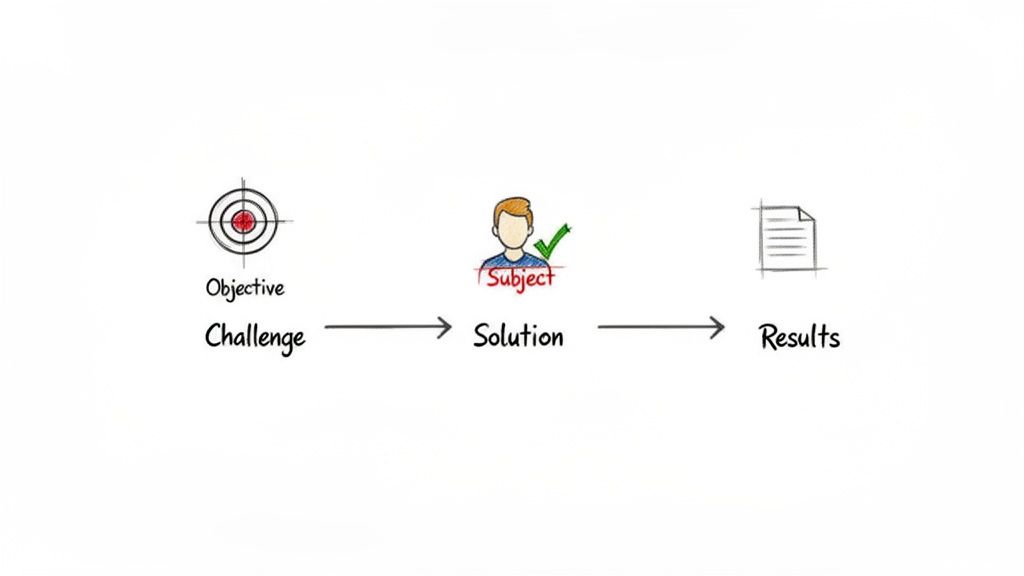
Writing a great case study is about more than just reporting facts. It’s about telling a compelling story. The process boils down to a few key stages: defining your objective, picking a subject that has a great story to tell, gathering both the hard numbers and the human experience, and then weaving it all into a narrative that clearly shows a problem, your solution, and the real-world results. This turns a customer's success into a powerful tool that builds trust and proves your value.
Your Blueprint for a Powerful Case Study
The best case studies are built on a solid foundation of careful planning, long before you even think about writing. This initial planning stage is your strategic guide, making sure every part of your story has a clear purpose. Think of it like building a house—skip the blueprint, and you'll end up with a shaky structure that won't impress anyone. This is where you lay the groundwork to turn a simple report into a story that actually connects with your audience.
This method of storytelling has deep roots. It was first pioneered by the Harvard Business School way back in 1924 to bring real-world business problems into the classroom. Fast forward to today, and its value is undeniable. The global market for case study writing services hit a staggering $1.5 billion in 2023 and is on track to reach $3.2 billion by 2032. That's a lot of demand for proven success stories.
Before diving in, a quick checklist can keep your planning on track.
Case Study Planning Checklist
Here's a quick-reference table outlining the essential planning steps to take before you start writing your case study.
| Planning Phase | Key Action | Why It Matters |
|---|---|---|
| Objective | Clearly define what you want the case study to achieve. | Shapes the tone, content, and call-to-action for the right audience. |
| Audience | Identify who you're writing for (e.g., C-suite, tech managers). | Ensures your language and data points resonate with their specific needs. |
| Subject | Select a customer with a strong success story and get their buy-in. | A willing and successful subject is the core of a compelling, authentic story. |
| Distribution | Decide where and how you will share the case study. | Determines the final format (e.g., PDF, webpage, video script). |
| Timeline | Set clear deadlines for research, interviews, drafting, and approval. | Keeps the project moving and ensures everyone stays on the same page. |
Having these elements locked down from the start prevents a lot of headaches and rework down the line.
Define Your Core Objective
First things first, you need to know why you're creating this case study. What’s the end goal? This single decision will influence everything from the tone to the format.
Are you building a:
- Sales Enablement Tool? The goal here is to give your sales team solid proof to help them close deals. It needs to be punchy and focused on ROI.
- Marketing Asset? This will live on your website or in campaigns to attract new leads and establish your company as an expert.
- Academic Paper? This requires a much deeper, more analytical approach to explore a specific theory in a real-world setting.
Knowing your objective is absolutely critical. A case study for a sales pitch should be direct and results-driven, much like the focused content discussed in our guide on writing executive summaries. An academic piece, on the other hand, needs to be heavy on methodology and theoretical context.
Identify the Perfect Subject
The hero of your story is your subject—the client or company whose journey you're sharing. Picking the right one is what makes a case study feel authentic and impactful.
I always look for subjects who have:
- Achieved Remarkable Results: The bigger the transformation, the better the story. Think metrics that make people say, "Wow."
- A Recognizable Brand Name: A well-known company can lend instant credibility to your own brand.
- Switched from a Competitor: This is a goldmine. It creates a powerful side-by-side comparison that shows exactly why you're the better choice.
Once you have a candidate in mind, you need to get them excited about participating. I find it helps to frame it as a win-win situation—they get free publicity and are positioned as an industry innovator. The key is to make it incredibly easy for them. Be organized, respect their time, and have your questions ready to go.
A great case study is less about how great your company is and more about how great your customer became because of your company. The focus must always remain on their journey and their success.
Weaving Your Narrative with Real-World Proof
A great case study isn't just a story—it's a true story, backed by undeniable proof. This is where your work shifts from planning to investigation. You're now gathering the raw materials that give your narrative its weight and credibility.
Without solid evidence, your case study is just a collection of claims. But with it, it becomes a trustworthy account of real-world success that your audience can believe in.
The trick is to blend two types of proof: the hard numbers that show the impact and the human stories that make it relatable. This combination creates a narrative that appeals to both logic and emotion, making your message far more persuasive. Think of this process as the core of your research—if you're working on more academic or technical projects, our guide on how to write a methodology can help you formalize this approach.
The Human Element: Uncovering Qualitative Data
Qualitative evidence gives you the "why" behind the numbers. It's the voice of your customer, injecting color, emotion, and authenticity into their journey. This is where you capture the raw, human experience of the transformation.
You'll find this kind of evidence in a few key places:
- Customer Interviews: Nothing beats a direct conversation for getting compelling quotes. This is your chance to hear the story in their own words and capture the little details you’d otherwise miss.
- Testimonials and Reviews: Have a look through existing reviews, emails, or survey responses. You can often find golden nuggets of praise that you can ask permission to use.
- Anecdotes: Collect specific stories about how your solution made someone's job easier or solved a frustrating, day-to-day problem.
When you're running interviews, stay away from generic questions. Instead of "Were you happy with the result?" try something like, "Can you walk me through what your team's workflow looked like before, and how it's changed now?" This encourages storytelling, not just one-word answers.
Pro Tip: Always record your interviews (with permission, of course!). This lets you be fully present in the conversation instead of frantically taking notes, which almost always leads to a more natural and insightful discussion.
Your goal here is to pull out powerful quotes you can sprinkle throughout your case study. A direct quote like, "We were spending 15 hours a week on manual data entry, and now it takes less than one," is infinitely more powerful than you simply paraphrasing it.
The Hard Proof: Proving Your Impact with Quantitative Data
While stories create a connection, numbers are what truly convince. Quantitative data provides the hard, irrefutable evidence of success. This is the stuff that gets the attention of executives and decision-makers who need to see a clear return on investment.
Look for specific metrics that tie directly back to the original challenge. Did your customer want to increase efficiency, boost revenue, or cut costs? Find the numbers that prove you delivered on your promise.
Finding the Right Metrics to Showcase
Here are some of the most compelling types of quantitative data you can use:
- Revenue and Sales Growth: This is the ultimate proof of business impact. Showcasing a 25% increase in quarterly revenue or a 15% rise in average deal size is incredibly persuasive.
- Productivity and Efficiency Gains: Translate your solution into time or money saved. For example, "Reduced report generation time from 8 hours to 15 minutes."
- Customer Metrics: Highlight improvements in user acquisition, retention, or satisfaction. A metric like a 40% decrease in customer support tickets shows a tangible product improvement.
- Website and Marketing Analytics: Data points like a 70% increase in organic traffic or a 50% boost in conversion rates are perfect for marketing-focused case studies.
Your mission is to find the one or two key metrics that tell the most dramatic story of transformation. Don't drown the reader in a dozen different charts. Instead, zero in on the numbers that best illustrate the "before and after" picture, making the value of your solution impossible to ignore.
Crafting a Compelling Narrative
Once you have all your evidence and data points, it’s time to weave them into a story that actually sticks. A great case study is much more than a dry report; it’s a narrative with a clear beginning, middle, and end that walks the reader through a transformation. The classic storytelling structure—Challenge, Solution, Results—is what gives the most powerful case studies their punch.
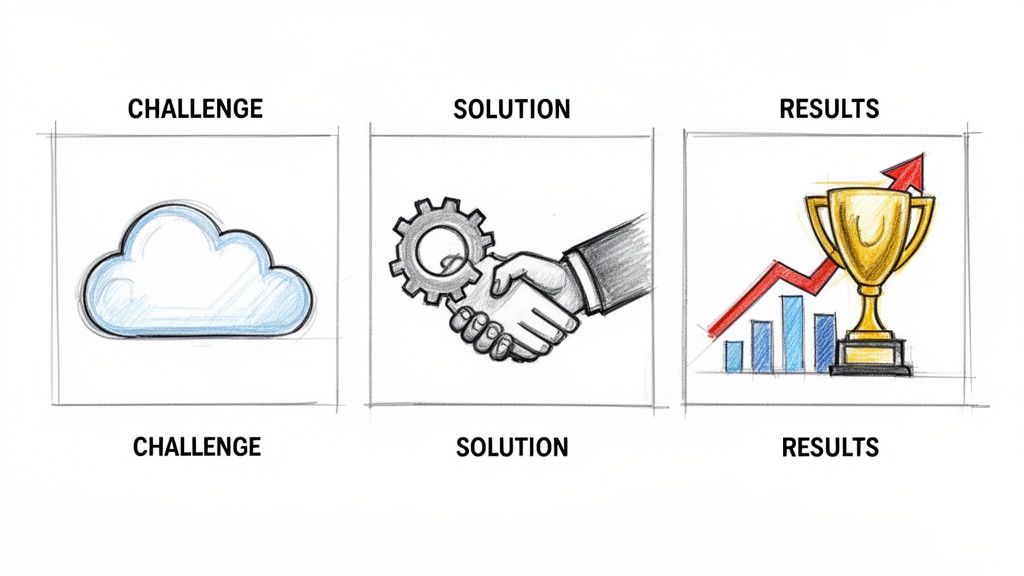
This isn’t just a marketing gimmick, either. This structure works because it’s how people process information. You’re setting up a relatable problem, presenting a logical fix, and delivering a powerful, satisfying conclusion.
Frame the Initial Challenge
You have to hook your reader right away. The best way to do that is by painting a vivid picture of the problem your subject was dealing with before they found you. Don't be vague here. Get into the nitty-gritty of their pain points.
What was the real business cost? Were they bleeding revenue, wasting countless hours on manual tasks, or dealing with frustrated, burnt-out teams? This is where you pull out those killer quotes from your interviews. A client describing their struggles in their own words is infinitely more powerful than you summarizing it for them.
Your goal is to get the reader nodding along, thinking, “I know exactly what that’s like.” That shared struggle builds an instant connection and makes them lean in, eager to hear how you solved it.
Present a Strategic Solution
With the problem clearly established, you can now introduce your solution—your product, service, or methodology. A huge mistake I see people make is just rattling off a list of features. That’s a brochure, not a case study.
Instead, you need to frame your solution as a direct and strategic answer to the challenges you just laid out.
Connect every part of your solution back to a specific pain point. If they were drowning in manual data entry, explain how your automation feature threw them a lifeline. If their teams were working in silos, show how your collaboration tools knocked down those walls.
This shows you don't just sell a one-size-fits-all product; you provide targeted answers to real problems. It makes you look like a partner, not just another vendor. To really nail this, it helps to brush up on the fundamentals of creating engaging content that gets results.
The most effective case studies present the solution from the customer's perspective. It's not about what your product does; it's about what it enabled them to do. Keep the focus on their journey and their empowerment.
This is also where the purpose of a business case study diverges sharply from an academic one. One aims to persuade, while the other is built for analysis.
Case Study Focus: Business vs Academia
The table below breaks down how the core components of a case study shift depending on whether you're writing for a business or academic audience. Notice how the "what" stays similar, but the "why" and "how" are completely different.
| Section | Business Focus (Marketing) | Academic Focus (Research) |
|---|---|---|
| Challenge | Presents a relatable business problem to attract prospects. | Outlines a research question or a theoretical gap to be explored. |
| Solution | Details how the company's product or service solved the problem. | Describes the methodology used to analyze the situation or test a hypothesis. |
| Results | Highlights clear ROI, metrics, and customer testimonials. | Presents findings, analysis, and contributions to existing knowledge. |
While the goals differ, the need for a clear, logical structure is universal. A well-organized narrative makes the information accessible, whether the reader is a potential customer or a peer reviewer.
Showcase Transformative Results
This is the climax of your story—the grand finale. The results section is where you deliver the undeniable proof of your impact. It’s not enough to say things got better; you have to show it with cold, hard data.
Use the quantitative metrics you collected to create a powerful before-and-after snapshot. I always recommend leading with your single most impressive statistic. Grab their attention immediately.
- Did you help them increase revenue by 45% in six months?
- Did they cut operational costs by $20,000 annually?
- Did team productivity skyrocket by 200%?
Make these numbers impossible to miss. Bold them, put them in a pull quote, or create a simple chart. Once you’ve laid out the data, back it up with a strong quote from your client that puts a human face on those numbers.
Remember, people scan online. Case studies using clear subheadings and visuals can see 2-3 times higher engagement. Start with the client's core problem, explain your approach without getting lost in jargon, and finish by showing the ripple effects—from better market position to a healthier bottom line. By combining solid data with a compelling human story, you create a piece of content that’s both credible and memorable.
Writing and Refining Your Draft
You've done the heavy lifting—the research is solid, your evidence is organized, and you have a clear outline. Now it’s time for the fun part: telling the story. This is where you transform all those facts and figures into a compelling narrative that connects with your audience, whether they're in a boardroom or a university lecture hall.
Your first draft is all about getting the story out. Don't get hung up on making every sentence perfect; that comes later. Just focus on weaving the information together in a way that feels human and makes sense.
The single biggest mistake I see people make is writing a case study that’s all about their own company. Flip that script. Your customer is the hero of this story, and your product or service is the powerful tool that helped them win the day. The core principles of how to write a good article that actually ranks are just as important here—it's all about delivering genuine value to the reader.
Drafting a Human-Centered Narrative
Before you type a single word, picture a specific person. Imagine you’re at a coffee shop, explaining this incredible success story to one ideal client. This simple trick helps you ditch the stiff corporate jargon and adopt a tone that’s direct, clear, and relatable.
Lead with your strongest punch. A great headline can make or break your case study's effectiveness. Instead of something generic like "Company X Case Study," grab their attention with a big, quantifiable win. For example, “How Company X Slashed Operational Costs by 40% in Just Six Months” is impossible to ignore.
As you write, let your customer's own words do the heavy lifting. Weave those direct quotes you collected into the narrative. They provide powerful social proof and a layer of authenticity you simply can't manufacture on your own. Let their enthusiasm tell the story.
Strengthening Your Story Through Revision
Finished the first draft? Great. Now, walk away. Seriously, give it at least a day before you look at it again. Coming back with fresh eyes is the secret to transforming a good draft into a great one. This stage is about more than just fixing typos; it's about sharpening your message for maximum impact.
When you dive back in, focus your revision on three key areas:
- Clarity: Is the story a straight line, or does it wander? Hunt down any technical jargon or confusing sentences. If a 10th grader couldn't understand it, simplify it.
- Impact: Does the story land with a punch? Are the most impressive results buried in a dense paragraph? Bold your key numbers and make sure they pop off the page.
- Flow: Read it from start to finish. Does the story move logically from the initial challenge to your solution and the final results? Make sure each section hands off smoothly to the next.
Don’t be afraid to be ruthless during this phase. As Stephen King famously said, "kill your darlings." If a sentence, a paragraph, or even a whole section doesn't directly serve the story of your customer's transformation, it has to go.
Polishing the Final Details
The final polish is all about the reader's experience. My best tip? Read the entire case study out loud. This is the fastest way to catch awkward phrasing and clunky sentences. If you stumble saying it, your audience will stumble reading it.
This is also a great time to lean on a tool like Rewritify. If you spot a paragraph that feels too dense or a sentence that’s just not landing right, its Simple or Natural modes can help you find clearer alternatives. It helps you keep that authentic, human voice consistent from start to finish.
Finally, run through a last-minute quality check:
- Verify All Data: Double-check every number, percentage, and statistic for accuracy.
- Check Names and Titles: Confirm the spelling of your client's name, their official title, and their company's name. It's a small detail that shows respect.
- Get Final Approval: Always send the final draft to your client for their official sign-off before publishing. This is a crucial step for maintaining a great relationship.
This careful refining process is what elevates your case study from a simple report to a polished, persuasive asset that builds trust and proves your value.
Making Your Case Study Easy on the Eyes
You've poured hours into crafting the perfect narrative, but even the most groundbreaking story will fall flat if it looks like a solid wall of text. The final, crucial step is designing your case study so people actually want to read it. Good design isn't just about looking pretty; it's about guiding your reader through the story and making sure your key points land with impact.
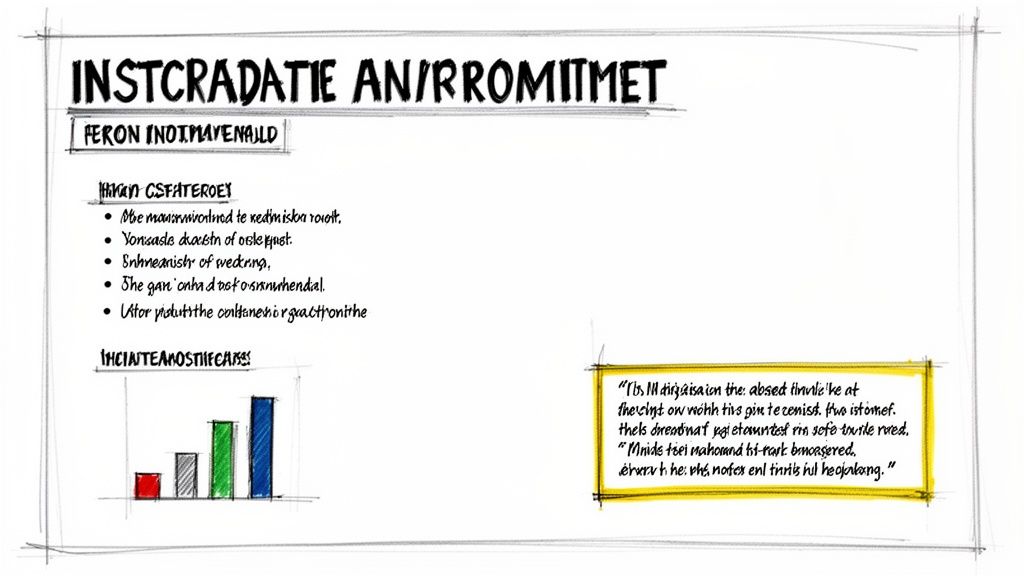
Let's be honest—we all scan. When we see a dense page, our eyes immediately hunt for headings, bullet points, and standout numbers. Your audience does the exact same thing. Let's make it easy for them.
Break It Down for Skimmers
Nothing kills engagement faster than long, dense paragraphs. You need to give your content room to breathe. This is where smart formatting becomes your secret weapon.
Keep your paragraphs short and sweet, ideally just two or three sentences. Use clear, descriptive H3 subheadings to segment your ideas, giving readers a roadmap of what's coming next.
Pro Tip: Your goal is to pass the "one-minute scan test." A busy manager should be able to grasp the entire story—the problem, your solution, and the incredible results—in under 60 seconds just by reading your headings and bolded stats.
This approach ensures that even the busiest readers walk away with your core message.
Let Visuals Do the Heavy Lifting
A picture is worth a thousand words, and a good chart is worth a thousand data points. Visuals don't just decorate the page; they make complex information digestible and compelling.
Pick visuals that directly reinforce your story:
- Charts & Graphs: These are fantastic for showing growth or comparing before-and-after scenarios. A simple bar chart that illustrates a 45% jump in revenue is far more powerful than just writing the number down.
- Screenshots: If you're showcasing software, annotated screenshots provide concrete proof of your solution in action. They show, they don't just tell.
- Pull Quotes: Take the most impactful quote from your client and blow it up. Displaying it in a stylized format makes their voice stand out and adds a powerful layer of social proof.
- Infographics: Have a lot of data or a complex process to explain? An infographic can simplify the narrative and create a highly shareable asset for social media.
These elements act as visual speed bumps, stopping skimmers in their tracks and pulling them deeper into your narrative.
Spotlight Your Wins
Your most impressive results deserve to be in the spotlight. Never bury the good stuff! Use formatting to make your key data points practically jump off the page.
Think about how you can draw the reader's eye:
- Go Bold: Use bold text for your best numbers, percentages, and game-changing metrics. A phrase like "slashed support tickets by 75%" is impossible to ignore.
- Use Bullet Points: Don't cram a list of achievements into a long sentence. Break them out into a bulleted list. It’s cleaner, easier to digest, and much more memorable.
- Add Icons: Pairing a simple icon with a key stat adds a bit of visual flair and helps communicate the idea almost instantly.
By weaving these design principles into your final draft, you'll create a document that's not only professional but incredibly persuasive. For more tips on making your writing more accessible, check out our guide on how to write content that is easy to understand. After all, a readable case study is one that actually gets results.
Answering Your Top Case Study Questions
Even with a great plan, you're bound to have questions. This is where we get into the nitty-gritty and tackle the common issues I see pop up time and time again.
Getting these details right is what separates a case study that genuinely connects from one that just gets skimmed and forgotten.
How Long Should a Case Study Be?
There’s no magic word count. The right length depends entirely on who you’re writing for and what you need the document to achieve. The real goal is to be as direct as possible while still giving your reader all the proof they need to believe in the story.
- For marketing or sales? Keep it between 500 and 1,500 words. That’s the sweet spot for telling a full story—the problem, how you solved it, and the results—without making a busy professional’s eyes glaze over. It's the perfect length for a webpage or a downloadable PDF.
- For an academic paper? This is a completely different ballgame. Academic case studies are much heavier, often running from 3,000 to over 10,000 words. They have to go deep into methodology, literature reviews, and exhaustive data analysis.
At the end of the day, focus on impact, not length. If you can deliver a knockout punch in 800 words, don't water it down to 1,500 just for the sake of it.
What Are the Biggest Mistakes to Avoid?
Knowing what not to do is half the battle. If you can sidestep these common blunders, your case study will be far more credible and effective.
The number one mistake I see is writing a thinly disguised sales pitch. Your company isn't the hero of the story—your customer is. Your role is the trusted guide who helped them succeed. Keep the focus entirely on their journey.
Another huge error is using vague, fluffy claims like "we improved their efficiency." That means nothing. You need hard data to build trust. A specific metric like "we reduced their processing time by 42%" is infinitely more powerful.
Other things that can sink your case study:
- A boring headline that doesn’t scream the main result.
- A wall of text with no images, pull quotes, or charts to break it up.
- Filling it with internal company jargon your audience won't understand.
- Forgetting to get explicit, written approval from your client for the final draft and any quotes used.
Authenticity is non-negotiable. Always get a final sign-off before you hit publish.
A case study fails the moment it reads like an advertisement. Success comes from telling an authentic customer story where your solution is a natural and essential part of their victory.
How Do I Convince Someone to Be in a Case Study?
Getting a client to say "yes" starts with making them an offer they can't refuse. Don't ask for a favor; present them with an opportunity. This is all about the win-win.
Frame it as a spotlight on their success. You're offering them free publicity and a professionally written story that highlights them as an innovator in their field. That's a powerful asset they can use for their own marketing.
Then, make the process absolutely painless for them. You do all the heavy lifting. Show up to the interview hyper-prepared, be respectful of their schedule, and handle every bit of the writing and design. Crucially, promise them they get the final say before anything goes public. This removes friction and builds the trust you need to get them on board.
How Can I Repurpose My Case Study?
A finished case study isn't the end of the line—it's a content goldmine. Once it’s done, the real work of getting it seen begins. Slicing and dicing it for different channels is how you squeeze every drop of value out of your hard work.
Think of it as a "pillar" piece of content that can fuel your marketing for weeks.
- Social Media: Pull out the most impressive stat or a killer quote and turn it into a sharp, shareable graphic.
- Blog Content: Write a post that summarizes the case study in a more conversational, narrative style.
- Video: Ask your client to record a short video testimonial talking about their experience.
- Sales Decks: Drop the most persuasive results and quotes directly into your sales presentations.
- Email Campaigns: Weave the customer's story into your email sequences as powerful social proof.
By breaking the story into smaller, platform-specific bites, you make sure the right message finds the right person in the right place.
Feeling stuck turning your client's success into a compelling narrative? Rewritify can help you refine your draft, ensuring every sentence is clear, engaging, and professional. Transform your raw data and interview notes into a polished case study that converts. Visit https://www.rewritify.com to get started.
Relevant articles
Unlock the secrets to the APA footnote format with this complete guide. Learn how to correctly format content and copyright footnotes with clear examples.