How to Write a Thesis Statement That Commands Attention
Tired of confusing advice? Learn how to write a thesis statement that is clear, arguable, and powerful. This guide provides practical steps and real examples.
To write a thesis statement, you need to combine your specific topic with a debatable claim and then explain why it matters. This single sentence, usually found at the end of your introduction, is a promise to your reader, laying out the exact argument you’re about to prove.
What a Strong Thesis Statement Actually Does
Let's cut through the academic jargon for a second. A thesis statement is the single sentence that anchors your entire paper. Think of it as the spine holding your argument together—without it, your ideas would just be a jumble of disconnected thoughts. It’s not simply your topic; it's your specific, debatable argument about that topic. It's the promise you make to your reader about the point you're going to prove.
A great thesis gives your paper focus, a solid backbone, and a clear sense of purpose. It tells your reader precisely what to expect and, just as importantly, why they should care about what you have to say.

The Blueprint for Your Paper
Your thesis is far more than just a box to check off for an assignment. It's a genuinely practical tool that guides both you and your reader from start to finish. As the writer, it’s your compass, making sure every paragraph and piece of evidence you use directly supports your main claim. For the reader, it’s a clear roadmap of the intellectual journey you’re about to take them on.
Here’s what a thesis really accomplishes:
- It narrows your focus. Instead of tackling a huge topic like "climate change," a thesis forces you to argue something specific, like how local carbon taxes disproportionately affect small businesses in the service industry.
- It establishes your argument. A thesis isn't a statement of fact that everyone agrees on. It’s a position that someone could reasonably argue against, and it requires evidence and analysis to back it up.
- It provides structure. The points you make in your thesis directly map onto the body paragraphs of your essay, creating a logical flow that’s easy for anyone to follow.
A strong thesis essentially summarizes your entire argument clearly and concisely. If you want to get better at boiling down complex information into a powerful core idea, this guide to writing clear, unbiased summaries offers some really helpful techniques.
A thesis is the controlling idea of your essay. It's the one sentence that, if removed, would cause the entire structure of your argument to collapse.
The impact of getting this right is huge. Research from Indiana University on developing effective thesis statements shows that students who craft strong, specific thesis statements are 3-4 times more likely to keep their papers focused. Even more telling, papers with a weak or missing thesis score an average of 15-20 percentage points lower than those with a well-developed one.
Basically, a killer thesis sets you up for a better grade before you've even written the first body paragraph.
To help you distinguish between a thesis that works and one that falls flat, here's a quick comparison.
Strong vs Weak Thesis Statements At a Glance
| Characteristic | Strong Thesis Statement | Weak Thesis Statement |
|---|---|---|
| Specificity | Pinpoints a narrow, specific aspect of a topic. | Is broad, vague, or covers too much ground. |
| Arguability | Presents a debatable claim that requires proof. | States a fact or an opinion that can't be proven. |
| Clarity | Uses clear, direct language. The reader knows the exact point. | Is confusing, uses jargon, or hides the main argument. |
| Focus | Centers on a single main idea. | Tries to argue multiple points at once. |
| Confidence | Takes a firm stance with assertive language. | Sounds hesitant or uses phrases like "I think" or "In my opinion." |
Keep this table handy as you start drafting. It's a great gut-check to make sure your thesis has the right DNA to support a compelling paper.
Finding Your Angle Before You Start Writing
A great thesis doesn’t just pop into your head fully formed. It’s something you build, piece by piece, starting with a bit of curiosity and some initial digging. Before you can ever hope to craft a sharp argument, you have to find an interesting angle—one that’s manageable enough for your paper but still has some punch. Getting this prep work right makes writing the actual statement a whole lot easier.
First things first: tear apart your assignment prompt. I can’t tell you how many students go off-track because they glossed over the instructions. Your professor has hidden clues in there, so look for those action words like “analyze,” “compare,” “argue,” or “evaluate.” These verbs are your road signs; they tell you exactly what kind of thinking you’re expected to do and shape the claim you need to make.
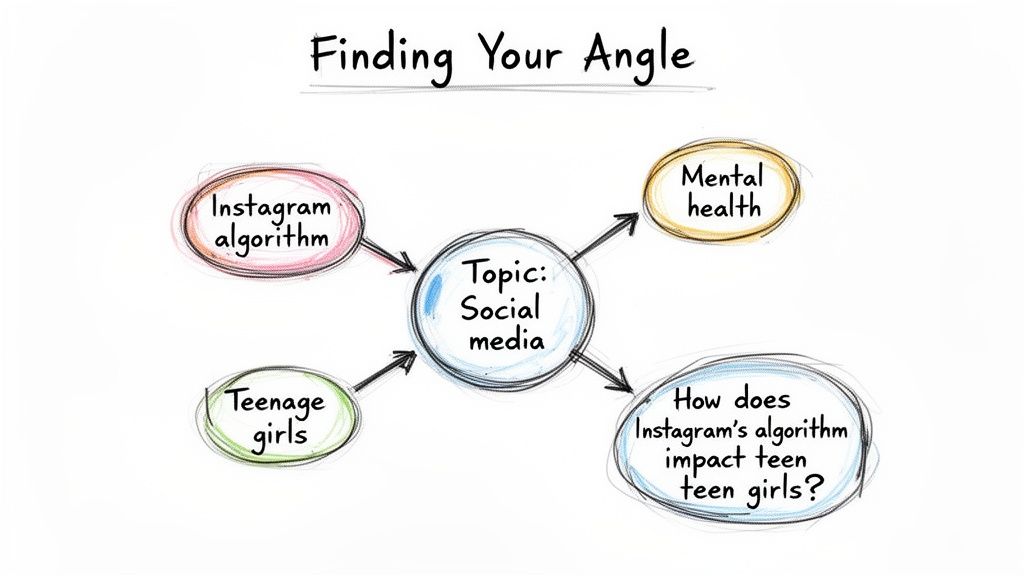
Move from a Broad Topic to a Sharp Focus
Once you’ve got a handle on the assignment’s goals, it’s time to get specific. Most ideas start out way too big for a standard essay. A topic like "social media," for example, is more of a universe than a destination. You can't possibly cover it.
Your job is to find a specific, debatable question hiding inside that massive territory. A little brainstorming can help you zero in on a compelling angle.
- Mind Mapping: Put your general topic in the middle of a page and let your brain run wild, branching out with related ideas, questions, and smaller sub-topics. Visually mapping it out often reveals connections you’d never see otherwise.
- Questioning: Start asking the hard questions. Who is most affected by this? Why is this even an issue? What are the real-world consequences? Where’s the conflict?
- Freewriting: This one feels weird, but it works. Set a timer for five minutes and just write nonstop about your topic. Don’t edit, don’t second-guess—just get it all out. You’d be surprised what insights are buried in there.
Let's take that "social media" idea. By asking who it affects and how, you might land on a much sharper question: "How does Instagram's algorithm specifically impact the mental health of teenage girls?" Now that's an angle you can actually research and argue.
Think of your topic as a large, unexplored territory. Your thesis statement is the specific destination you’re leading your reader to, complete with a map of how you'll get there.
Conduct Quick Preliminary Research
With a focused question in hand, it’s time to do a little reconnaissance. This isn't the deep-dive research for the paper itself; this is just a quick search to see if there’s a conversation worth joining. Spend an hour or so poking around academic databases and credible sources. What are the experts already saying?
You're looking for the debate. The tension. The gap in what's already been said. If everyone already agrees, you don't have an argument. Finding that point of friction is what gives your thesis a real purpose.
This initial search helps you confirm your angle is solid and can be backed by actual evidence. Exploring different perspectives early on is one of the most effective research paper writing tips because it stops you from building an entire argument on a flimsy foundation. This is how you find an angle that isn’t just interesting to you, but one that actually contributes something to the ongoing conversation.
Crafting Your Argument From Topic to Thesis
So you've narrowed your topic down. Now for the fun part—turning that focused idea into a sharp, argumentative sentence that will drive your entire paper. A great thesis isn't just a statement of fact; it's a promise to your reader, a roadmap for the analytical journey you're about to take them on.
To get there, I've always relied on a simple but incredibly effective framework. Think of your thesis as having three essential ingredients. When you combine them, you transform a simple observation into a compelling argument that can anchor a whole essay.
The Thesis Formula: Specific Topic + Debatable Claim + 'So What?' Factor
Let’s unpack what each of these pieces actually does and how they snap together to create a thesis that’s clear, arguable, and genuinely interesting.
Start with Your Specific Topic
This is the "what" of your paper. It's not the broad subject you started with, but the laser-focused version you landed on after some preliminary research. So, not just "The Great Gatsby," but something much more precise, like "the symbolism of 'new' versus 'old' money in The Great Gatsby."
Getting this specific is non-negotiable. I've seen it time and again: vague topics lead to vague, wandering arguments. In fact, writing guides from major universities suggest that around 95% of successful academic papers start with a thesis that makes a crystal-clear, specific assertion. Nail this first piece, and you're already halfway there.
Add a Debatable Claim
Now we get to the engine of your thesis—the arguable point you're going to prove. This is where you graduate from stating an obvious fact to taking a stance that someone could reasonably challenge.
Saying "Fitzgerald uses wealth as a symbol" isn't a claim; it's just an observation. A real claim offers an interpretation. It digs deeper, answering a "how" or "why" question about your topic. This is a crucial skill for any kind of academic assessment, by the way. You can even find tips for handling AP Exam Free-Response Questions (FRQs) that emphasize the need for a strong, debatable claim right out of the gate.
To check if your claim is truly debatable, ask yourself a few questions:
- Could a reasonable person disagree with me?
- Does this statement need evidence to back it up?
- Am I offering a unique angle or interpretation?
If you can answer "yes" to these, you're in good shape. This is the part of your thesis that sparks curiosity and invites your reader to see the topic through your unique lens.
Explain the 'So What?' Factor
This final piece is, in my experience, the most critical—and the one most often forgotten. The 'So What?' factor is where you explain the significance of your argument. It answers the reader's unspoken question: "Okay, interesting point, but why should I care?" This little component is what elevates your thesis from a simple classroom exercise to a meaningful piece of analysis.
It connects your specific interpretation to a bigger picture—a broader theme, a modern-day implication, or a surprising consequence. This is what gives your argument depth and proves it has value beyond the pages of your essay. Without it, even a well-argued thesis can fall flat.
Let’s see how it all comes together with our Gatsby example:
- Specific Topic: The motif of 'new' vs. 'old' money in The Great Gatsby.
- Debatable Claim: Fitzgerald uses this motif not just to critique the American Dream...
- 'So What?' Factor: ...but to argue that social mobility is an illusion controlled by an entrenched class system.
The resulting thesis is focused, provocative, and it matters. Developing this ability to connect your specific point to a larger significance is a huge part of growing as a writer. For more strategies on sharpening your arguments, you can explore our guide on how to improve academic writing.
How to Stress-Test and Refine Your Thesis
Let's be honest: your first draft of a thesis is almost never your best one. It's a starting point, a working hypothesis. Now it's time to put it through the wringer to see if it can actually hold up the weight of an entire paper. This is where a decent idea transforms into a powerful, defensible argument.
Before you even think about writing your first body paragraph, put that thesis on trial. You need to ask some tough questions and be brutally honest with yourself. It’ll save you hours of pain later. A strong thesis isn't just a good idea; it's a practical roadmap for your writing.
The Essential Stress-Test Checklist
Run your current thesis through this quick diagnostic. If you can't give a firm "yes" to each of these, it's time to head back to the drawing board.
- Is it actually specific? A thesis like, "World War II changed society," is so vague it's useless. Get granular. Try something like, "The mass entry of women into the American workforce during World War II was the primary catalyst for the second-wave feminist movement." See the difference?
- Can you realistically support it? This is a big one. Can you find enough credible evidence to back up every part of your claim within the word count you've been given? Don't try to prove something that would require a 300-page book.
- Does it directly answer the prompt? Seriously, go back and read the assignment instructions again. If your professor asked you to analyze a poem's use of metaphor, a brilliant thesis about its historical context completely misses the point.
This is where a little help can make a huge difference. When you're stuck trying to find the perfect wording, tools like Rewritify can help you rephrase and sharpen your sentences.
Playing with different phrasings helps you move from a clunky, rough idea to a precise, assertive, and polished argument. It's about finding the exact language that makes your claim as strong as possible.
Tailoring Your Thesis to the Assignment
Not all essays are created equal, and your thesis needs to reflect the job it's supposed to do. The kind of claim you make will look very different if you're writing to persuade versus writing to analyze.
For an argumentative essay, your thesis has to take a clear, debatable stand.
- Before: "This paper will discuss the pros and cons of year-round schooling." (This is an announcement, not an argument.)
- After: "Implementing a year-round school calendar would improve academic outcomes by reducing summer learning loss and providing more consistent instructional support for at-risk students." (This is a specific, debatable claim.)
For an analytical essay, your thesis needs to offer a specific interpretation—your unique take.
- Before: "The movie Inception is about dreams." (Well, yes. That's the plot, not an analysis.)
- After: "In Inception, Christopher Nolan uses the architectural paradoxes of dreamscapes to argue that personal reality is a fragile construct, ultimately shaped more by emotional conviction than objective truth." (This offers a specific reading of the film's techniques and themes.)
Think of your thesis as a dynamic tool, not a static sentence set in stone. As you research and write, you’re going to uncover new evidence and fresh insights. Be ready—and willing—to circle back and tweak your thesis to reflect your most sophisticated understanding of the topic.
This constant refinement also serves another purpose: it helps ensure your work is truly your own. As you rephrase and rework your core ideas, you naturally move away from the original language of your sources, which is fundamental to academic integrity. For more on this, check out our guide on how to avoid plagiarism.
Common Thesis Statement Mistakes and How to Fix Them
Even experienced writers can hit a snag when crafting a thesis. The good news? Most issues are pretty common and, once you know what to look for, surprisingly easy to fix. Getting this one sentence right is crucial—it's the difference between an essay that fizzles out and one that commands attention from the very beginning.
Think of this as your field guide to thesis troubleshooting. By learning to spot these classic blunders in other examples, you'll be able to diagnose and correct them in your own work, turning a shaky idea into a powerful, arguable claim.
Spotting and Correcting Common Errors
Let's dive into the most frequent missteps. We won't just list them; we'll dissect weak examples to understand why they fail and then rebuild them into something much stronger. This side-by-side approach is the best way to see the theory in practice.
A thesis can feel rock-solid in your head, but you need to put it under a bit of pressure to see if it holds up. A quick "stress test" can reveal weaknesses before you've written a single paragraph of your paper.
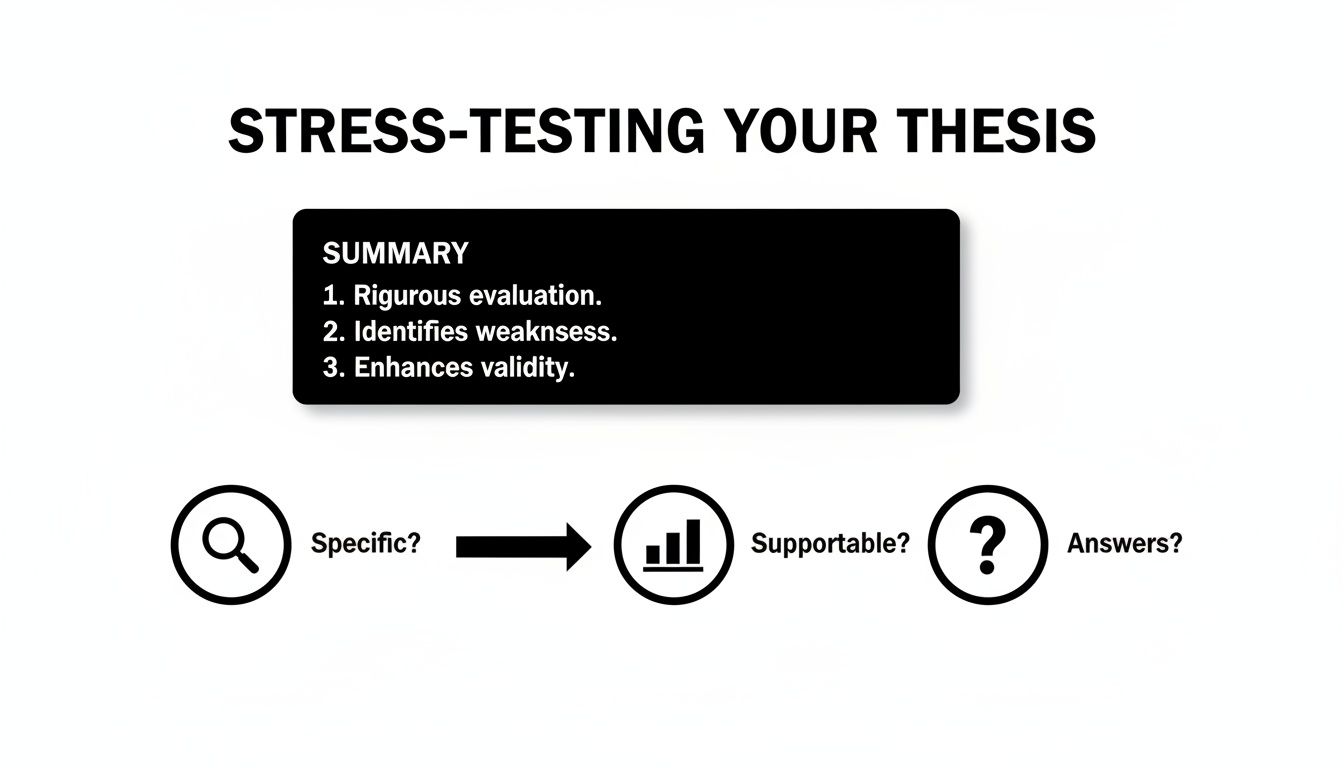
This simple check helps ensure your thesis is specific, defensible with evidence, and actually answers the prompt. If you get a "no" on any of these questions, it’s a clear sign you need to head back to the drawing board for a revision.
To make this even clearer, let's break down the most common mistakes people make when writing a thesis statement. The table below shows you what not to do and, more importantly, how to fix it.
Fixing Common Thesis Statement Errors
This table identifies common thesis statement mistakes, shows why they don't work, and provides corrected examples to guide your revisions.
| Common Mistake | Weak Example | Why It's Weak | Strong Revision |
|---|---|---|---|
| The Announcement | This paper will discuss the benefits of solar energy. | This is a statement of intent, not an argument. It tells the reader what you're about to do but makes no actual claim. | The widespread adoption of decentralized solar energy is the most effective strategy for reducing national carbon emissions and strengthening grid resilience against climate-related disasters. |
| Too Broad | Social media has had a big impact on society. | The terms "big impact" and "society" are far too vague. You could write a whole book on this and still not cover it all. | The rise of algorithm-driven content on platforms like TikTok has fundamentally altered youth political engagement by prioritizing emotional appeal over factual accuracy, leading to increased polarization. |
| Statement of Fact | Abraham Lincoln was the 16th president of the United States. | This is an undisputed fact. There's nothing to argue or analyze here, so there's nowhere for the essay to go. | Abraham Lincoln's strategic suspension of habeas corpus during the Civil War, while controversial, was a necessary executive action to preserve the Union against internal threats. |
| A Simple Question | Should schools require students to wear uniforms? | A thesis is the answer to a driving question, not the question itself. It needs to take a stand. | School uniforms should be mandatory in public schools because they reduce socio-economic disparities among students, minimize classroom distractions, and foster a greater sense of community identity. |
Looking at these fixes, you can see how a weak or vague idea becomes a focused, arguable, and infinitely more interesting roadmap for an essay.
Expert Tip: Try reading your thesis statement out loud. Does it sound like a confident, debatable assertion, or does it sound more like a hesitant observation? A powerful thesis uses assertive language and avoids qualifiers like "I think" or "in my opinion." Your argument should be strong enough to stand on its own.
By steering clear of these common pitfalls, you're not just avoiding mistakes; you're building a solid foundation for a compelling and persuasive paper.
Frequently Asked Questions About Thesis Statements
Knowing the rules is one thing, but when you're staring at a blank page, the real questions start to bubble up. It's totally normal. Let's tackle some of the most common hurdles students face when crafting their thesis statements.
Where Should My Thesis Statement Go?
Your thesis statement should almost always be the last sentence of your introductory paragraph.
Think of your introduction like a funnel. You start with a broad, attention-grabbing hook, then you provide a bit of essential background on the topic. Finally, you narrow everything down to one specific, focused point—your thesis. Placing it here gives your reader a crystal-clear roadmap of the argument you're about to make. It's the perfect handoff from your introduction to the body of your paper.
Can a Thesis Statement Be More Than One Sentence?
For most academic essays, especially at the undergraduate level, the answer is a firm no. Aim for a single, powerful sentence.
Why? Because forcing your entire argument into one sentence is a fantastic exercise in clarity. It makes you distill a big idea down to its absolute core. If you feel like you need two sentences, that's often a red flag that your argument isn't quite focused enough yet. Take it as a challenge to merge those two ideas into one stronger, more unified claim.
A thesis that feels too long or complicated is usually a sign of an underdeveloped argument. Pushing yourself to fit it into one clear sentence forces you to clarify your own thinking before you start writing.
Getting this right from the start makes the rest of the writing process so much smoother.
What if My Argument Changes While I Am Writing?
That's not just okay—it's a sign you're doing it right! Writing is an act of discovery. You aren't just transcribing fully-formed ideas; you're developing them as you go.
Your first draft of a thesis is just a "working thesis." Think of it as a hypothesis you're setting out to test.
As you dive into your research and build your arguments in the body paragraphs, your perspective will inevitably deepen and shift. You should go back and revise your thesis to reflect the argument you ultimately ended up making. A thesis finalized at the end of the writing process is always more accurate and powerful. It shows what you actually proved, not just what you intended to.
Feeling stuck trying to get the wording just right? Rewritify can help you rephrase your ideas to be clearer, more academic, and more original. It's a great way to turn a rough working thesis into a polished, powerful final statement.
Relevant articles

Learn how to structure an argumentative essay with our expert guide. We break down the thesis, body paragraphs, and counterarguments for a powerful paper.

Learn how to write an annotated bibliography with this comprehensive guide. Get actionable tips, real examples, and formatting advice for APA and MLA.

Learn how to write an effective essay rough draft. This guide provides actionable steps for turning messy ideas into a coherent and compelling paper.

Discover differences between formal and informal writing, with practical tips, examples, and syntax cues to choose the right tone every time.

Learn how to write a critical analysis with our guide. We cover everything from developing a thesis to structuring your argument and refining your final draft.

Learn how to write a position paper with our expert guide. Discover proven strategies for research, structuring arguments, and persuasive writing.