How to Write a Research Abstract That Gets Your Paper Read
Learn how to write a research abstract that is clear, concise, and impactful. Get expert tips and real-world examples to make your research stand out.
An abstract isn't just a summary; it's the front door to your entire study. It’s a self-contained, high-impact paragraph that distills your motivation, methods, results, and conclusions into a single, powerful snapshot. Think of it as the first impression that determines whether someone opens that door to read the rest of your work. The goal is simple: be clear, be accurate, and be brief.
Your Abstract Is The Handshake
Before a single person reads your full paper, they'll read your abstract. This one paragraph is your research’s handshake, its elevator pitch, and its first impression—all rolled into one. It’s the gatekeeper for busy journal editors, conference reviewers, and fellow researchers scrolling through endless database results.
A well-written abstract immediately signals that your work is worth their time. Its role in academic communication has exploded over the last century. Back in 1900, a mere 1% of articles had substantial abstracts. Fast forward to 2020, and that figure has jumped to an incredible 95%. This trend underscores a critical reality: a compelling summary is now the primary vehicle for gaining visibility and citations.
For a deeper dive into this historical shift, you can explore the full study published in Quantitative Science Studies, which tracks the growth of abstracts from 1900 to 2020.
The Four Essential Functions of a Research Abstract
Your abstract serves several key functions for different audiences. It acts as a screening tool, a summary, a search aid, and a standalone piece of information. Each function is critical for getting your work noticed and read.
| Function | Who It Helps | Why It Matters |
|---|---|---|
| Screening Tool | Researchers & Editors | Allows for a quick decision on whether the full paper is relevant to their interests or the journal's scope. |
| Quick Summary | Busy Readers | Provides the key findings and conclusions for those who may not have time to read the entire article. |
| Indexing & Search | Databases (e.g., Scopus, PubMed) | Helps search algorithms find your paper when others are looking for research on your topic, boosting discoverability. |
| Standalone Info | Conference Programs & Proceedings | Often published on its own, it must convey the full value of the research without the context of the main paper. |
Ultimately, a strong abstract ensures your research doesn't get lost in the noise. It’s about making your work accessible and compelling from the very first glance.
The Four Building Blocks of an Abstract
To deliver that powerful first impression, your abstract needs to be built on four core pillars. These components work together to answer a reader’s most immediate questions.
- Motivation (Why did you do it?): Start by clearly stating the problem or research gap. What prompted this study in the first place?
- Methods (What did you do?): Briefly describe your approach. What key experiments, data collection techniques, or analytical frameworks did you use?
- Results (What did you find?): This is the heart of it. Share your most important findings, using specific data or statistics when you can.
- Implications (What does it all mean?): End with the big takeaway. What is the broader significance of your findings? Why should anyone care?
A great abstract doesn’t just list these elements; it weaves them into a compelling narrative. It tells a concise story of your research journey, from the initial question to the final conclusion.
Thinking about what captures an audience's attention can provide a useful perspective. If you learn how to make your content appealing and widely accessed, you can apply similar principles to ensure your research gets the engagement it deserves.
Building Your Abstract Sentence by Sentence
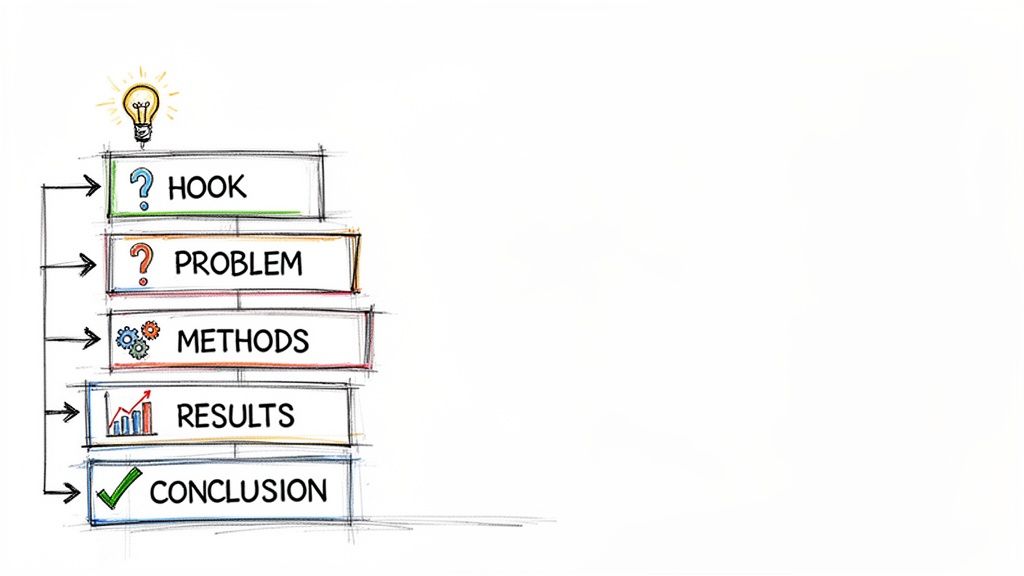
The best way to think about your abstract isn't as a boring summary. See it as a very short, very compelling story. Every single sentence has a specific job to do, taking the reader from a wide, general context right down to your unique contribution.
When you frame the task this way, writing an abstract becomes less about filling in a template and more about building a tight, logical narrative. Let's walk through how to construct this story, piece by piece.
The Hook And The Problem
Your first couple of sentences have to get the reader grounded immediately. You want to start with a broad statement that sets the stage and shows why your general research area matters. This is your hook. It’s not about being overly dramatic; it's about establishing relevance.
For a biology paper, you might start with something like, "Antibiotic resistance is a growing global health crisis threatening the efficacy of modern medicine."
Right after that, you need to pivot to the specific problem or gap in knowledge that your study is all about. This sentence narrows the focus and introduces a sense of urgency. Picking up from our biology example: "However, the specific mechanisms by which E. coli develops resistance to last-resort carbapenem antibiotics remain poorly understood."
This one-two punch does two things perfectly:
- It lets readers know right away if the paper is in their wheelhouse.
- It shines a spotlight on an unanswered question, which is the whole reason for your research.
Describing Your Methods And Results
With the "why" established, it's time for the "how." You need to briefly explain your methods. The key here is to signal rigor without drowning the reader in technical jargon. You don’t need to detail every single step—just state your core approach. For our ongoing example, you could write, "We employed whole-genome sequencing and proteomic analysis on 50 carbapenem-resistant E. coli isolates."
That sentence sets the stage for the absolute heart of your abstract: the results. State your main finding as clearly and directly as you can. If you have numbers, use them. Steer clear of wishy-washy phrases like "results indicated" or "a significant effect was found."
Be specific. Don't say, "Our findings suggest a strong correlation." Instead, write something like, "Our analysis revealed a novel gene, blaXYZ, present in 92% of resistant isolates, which confers a tenfold increase in antibiotic tolerance."
That level of detail gives your work instant credibility. It's concrete and powerful. Honing this skill is crucial, and you can find more great advice in our guide on how to summarize a research article.
The Conclusion And Broader Impact
Finally, you have to answer the "So what?" question. Your conclusion shouldn't just repeat the results; it needs to explain what they mean. What are the larger implications of what you found? This is your mic-drop moment, the final sentence that sticks with the reader and drives home the value of your work.
To wrap up our biology abstract, a strong conclusion would be: "The identification of blaXYZ provides a new diagnostic marker and a potential target for therapeutic interventions to combat multidrug-resistant infections." See how that connects your specific finding right back to the big-picture crisis you mentioned in the hook? It brings the story full circle and leaves no doubt about the impact of your research.
Adapting Your Abstract for Journals and Conferences
It’s tempting to think of your abstract as a one-and-done deal, but that’s rarely the case. The summary you craft for a top-tier journal needs a different touch than the one you’d write for a bustling conference. Knowing how to tweak your abstract for each specific audience is a skill that ensures your research actually connects with the people you want to reach.
Your first move should always be to meticulously review the submission guidelines. This isn't just a suggestion; it's a hard rule. Journals are often inflexible, imposing strict limits like a 250-word maximum. Conferences, however, might give you a bit more breathing room to help draw a crowd to your session.
Tailoring for Journal Submissions
When you’re aiming for a journal, think precision and substance. You’re writing for editors and peer reviewers—experts who demand a dense, fact-driven summary. They need to see, in just a few hundred words, exactly how your paper pushes the field forward.
The tone here should be formal, objective, and straight to the point. You're trying to convince a skeptical audience that your work is a genuine, significant contribution. Framing your abstract with the rigor of a process like the Tri-Agency Interdisciplinary Peer Review in mind can really sharpen its focus and effectiveness.
Crafting a Conference Abstract
Conference abstracts have a bit of a double life. Yes, they need to pass the review committee, but they also act as a billboard for your presentation or poster. This is your chance to be a little more engaging and build some buzz.
- Lead with the Hook: Start with the core problem and your most compelling findings. You need to grab their attention as they scroll through the program.
- Streamline the Methods: You don't need to get bogged down in methodological details. Focus on the what and why, not the nitty-gritty how.
- Drive Home the Takeaway: Make your conclusion impossible to forget. Give attendees a clear and compelling reason to choose your session over the one next door.
Keep in mind that the research world is more connected than ever. International collaborations shot up from just 4.7% in 1980 to 25.7% by 2021. This means your abstract will likely be read by a broad, interdisciplinary audience. Cut the niche jargon, spell out your acronyms, and aim for clarity above all. You can read more about the rise of multilingual abstracts and global research on reference-global.com.
Key Takeaway: It all comes down to audience. A journal abstract is a direct pitch to a specialized reviewer, while a conference abstract is an invitation to a potential audience member. Adjust your tone, detail, and focus accordingly. For more on this, dive into our research paper writing tips.
Avoiding Common Abstract Writing Mistakes
Even seasoned researchers can stumble into a few common traps when writing an abstract. Learning to spot these issues in your own draft is what takes an abstract from just "good enough" to genuinely compelling. These aren't just small stylistic preferences; they're fundamental errors that can hide your research's impact and turn away readers before they even get to page one.
One of the biggest culprits is using vague, uninformative language. You see it all the time—phrases like "the results are discussed" or "important implications were found." These statements tell the reader absolutely nothing. Your abstract is prime real estate; every single word needs to earn its place. Don't just hint at your findings—state them directly and with confidence.
Key Takeaway: The goal is to inform, not to persuade with flowery language. Scientific integrity gains more respect than hype. Always opt for clarity and directness over ambiguity.
Vague Language vs. Specific Statements
Another classic mistake is burying the lead. Your most significant finding should never be tucked away at the end of a long sentence. Get right to the point! Put your main result front and center where it can't possibly be missed. Think of it as the hook that convinces someone your paper is worth their valuable time.
Here's a quick rundown of other common problems I see time and again:
- Including Citations: Your abstract needs to stand on its own. It's a summary of your work, so there's no reason to cite other researchers within this small space.
- Overloading on Jargon: Sure, some technical terms are necessary. But the goal is accessibility. A good rule of thumb: if a colleague from a different field can't grasp the core message, you've probably gone too far with the jargon.
- Ignoring the Word Count: This is an immediate red flag for any journal editor. It signals that you might have trouble following instructions and, more importantly, that you can't be concise.
To help you troubleshoot your own drafts, I've put together a quick guide to common mistakes and how to fix them.
Abstract Mistake Quick-Fix Guide
| Common Mistake | Why It's a Problem | How to Fix It |
|---|---|---|
| Too Vague | Fails to inform the reader about your actual findings or methods. | Replace phrases like "results are discussed" with a specific result, like "30% of participants showed improvement." |
| No Clear "So What?" | The reader is left wondering why your research matters. | Directly state the implication or contribution. For example, "This finding suggests a new therapeutic target." |
| Excessive Jargon | Alienates readers outside your immediate niche, limiting your paper's reach. | Define essential acronyms and substitute complex terms with simpler ones where possible. Have a colleague from another field read it. |
| Exceeding Word Limit | Shows a lack of discipline and can lead to automatic rejection. | Ruthlessly edit for conciseness. Cut every unnecessary word. Turn complex sentences into two simpler ones. |
| Including Citations | An abstract should be a self-contained summary of your work, not a literature review. | Remove all citations. Your full paper is the place for referencing the work of others. |
Think of this table as your pre-submission checklist. Catching these issues before you hit "submit" can make all the difference.
Adapting your abstract for different venues—like a journal versus a conference—is also a crucial skill, and avoiding these mistakes is key in every context.
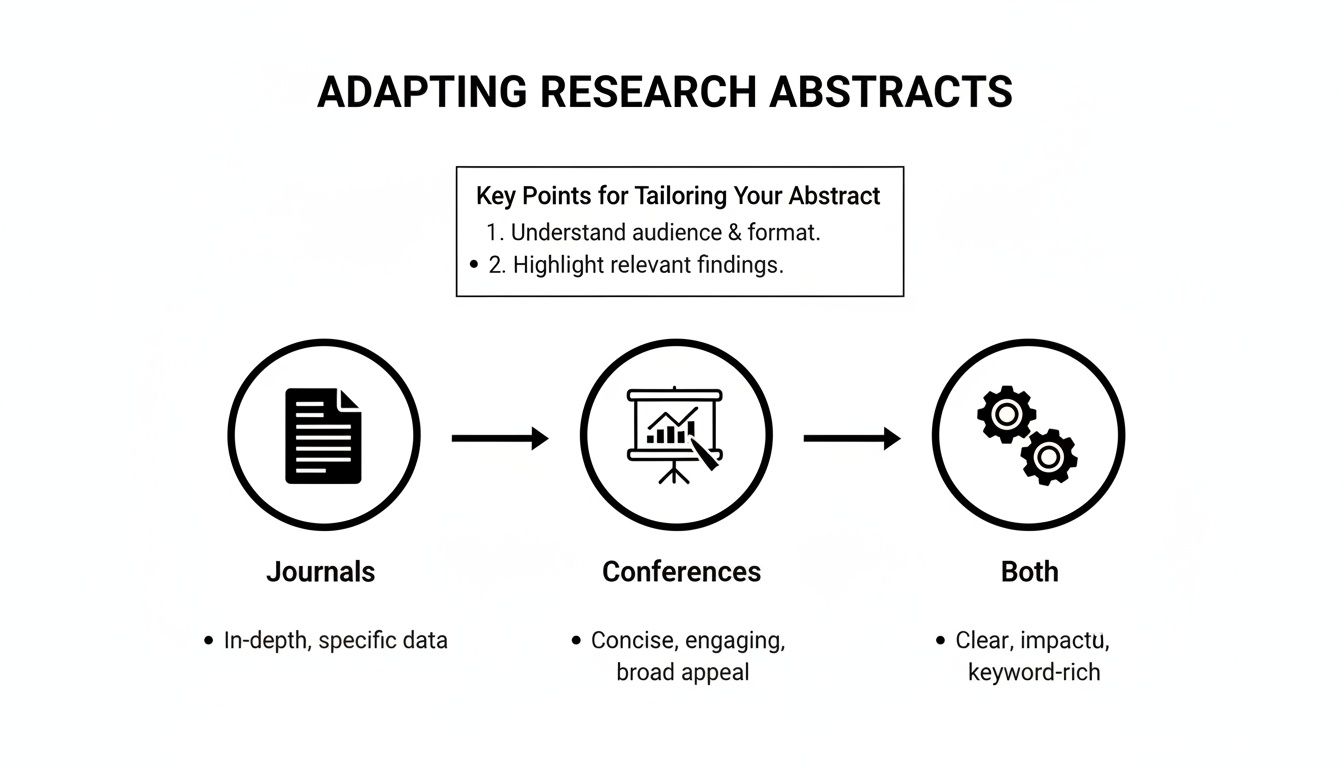
As you can see, while journals demand precision and conferences might call for more of a hook, they both share a core need for clarity and impact. Getting a handle on how to write a great research abstract means steering clear of these common pitfalls so your work can get the attention it truly deserves.
Your Final Polish Before You Submit
That final once-over can be the difference between a good abstract and a great one. Before hitting that submit button, it's worth running through a quick, practical checklist to make sure your work is as polished as it can be.
First, sweat the small stuff. Double-check the journal or conference's word count limit and make sure you're within it. It's a simple, non-negotiable rule that can get you an instant desk rejection if ignored. Also, quickly scan to confirm you've clearly covered all the essential bases: the motivation, methods, results, and conclusion.
A Fresh Perspective Is Crucial
Here’s a trick I swear by: read your abstract out loud. It feels a bit strange at first, but it’s a surprisingly effective way to catch awkward phrasing and sentences that just don’t flow right. If it sounds clunky when you say it, it’s going to read that way, too.
For the ultimate clarity check, have a colleague—preferably one from a different field—give it a read. If they can’t quickly understand your main point and why it matters, you've probably leaned too heavily on jargon. This kind of feedback is gold for making your work more accessible.
The goal is to inform, not to persuade with overly complex language. Scientific integrity gains more respect than hype. Always opt for clarity and directness over ambiguity.
With the explosion in scientific publishing, your abstract is fighting for attention among millions of new articles every year. Its quality isn't just a matter of pride; it's a critical factor for getting noticed. You can read more about the impact of publication growth on research visibility.
Finally, take one last look at your keywords. Are they specific enough? Do they truly capture the core of your paper? These are what search databases use to find your work, so getting them right is crucial for discovery. If you're looking for more guidance, check out our guide on how to improve your academic writing.
Got Questions About Writing Your Research Abstract?
Writing an abstract can feel tricky, and it's normal to have a few questions. Let's tackle some of the most common ones that come up for researchers.
Indicative vs. Informative: Which One Do I Need?
You'll come across two main types of abstracts: informative and indicative.
An informative abstract is a mini-version of your paper. It lays out the whole story—your methods, key results, and the main conclusion. Think of it as a complete summary.
On the other hand, an indicative abstract (sometimes called a descriptive one) just describes what the paper is about without giving away the findings. It’s more of a teaser.
For nearly all scientific and academic papers, you're going to write an informative abstract. Your goal is to give readers a full snapshot of your work upfront.
Should I Write the Abstract First or Last?
This one's easy: always write it last.
It’s tempting to start with the abstract to map out your paper, but it’s a trap. Your abstract needs to summarize the research you've actually done, not what you plan to do. Your findings might shift, and your conclusions will definitely get sharper as you write the full paper.
Think of it this way: you can't write a good summary of a book until you've finished reading it. The same logic applies here. Wait until your manuscript is complete, then distill it into a powerful abstract.
How Do I Pick the Best Keywords?
Keywords are your paper's lifeline to being discovered. The key is to get inside the head of someone searching for your research. What words would they type into a search bar?
Here are a few practical tips:
- Borrow from yourself: Pull the most important terms directly from your title, research questions, and even your main findings.
- Look at the leaders: See what keywords are used in the top-cited papers in your specific niche. This shows you what terms your community is already using.
- Get specific: Vague keywords will get your paper lost in the noise. "Climate change" is too broad; "Arctic sea ice melt rate" is much better.
Finding the right words to make your research stand out can be a challenge. If you're struggling to make your writing clear and compelling, Rewritify can help you refine complex sentences and polish your drafts. Give our AI-powered rewriter a try at https://www.rewritify.com.
Relevant articles

Learn how to structure an argumentative essay with our expert guide. We break down the thesis, body paragraphs, and counterarguments for a powerful paper.

Learn how to write an annotated bibliography with this comprehensive guide. Get actionable tips, real examples, and formatting advice for APA and MLA.

Learn how to write an effective essay rough draft. This guide provides actionable steps for turning messy ideas into a coherent and compelling paper.

Discover differences between formal and informal writing, with practical tips, examples, and syntax cues to choose the right tone every time.

Learn how to write a critical analysis with our guide. We cover everything from developing a thesis to structuring your argument and refining your final draft.

Learn how to write a position paper with our expert guide. Discover proven strategies for research, structuring arguments, and persuasive writing.