How to Summarize a Research Article Like an Expert
Learn how to summarize a research article with our expert guide. Master the process of reading, drafting, and refining for clear and accurate summaries.
Summarizing a research article is all about boiling it down to its four essential parts: the central question, the key methods used, the main findings, and the final conclusion. This isn't just about shortening the text; it's about transforming a dense, complex paper into a quick, digestible overview that captures its soul in your own words.
Why Summarizing Research Is a Core Academic Skill
In a world drowning in data, knowing how to summarize a research article is less of an academic chore and more of a survival skill. It’s the critical link between just reading pages and actually understanding what the author is trying to say. For anyone in academia or a research-driven field, this skill is absolutely fundamental for staying on top of new developments and building solid arguments without getting buried in information.
The Challenge of Information Overload
The amount of new research published every year is simply staggering. In 2022 alone, researchers published a whopping 3.3 million science and engineering articles. That number jumped by 59% in just ten years. You can dive deeper into these publication trends to really appreciate the scale.
With this explosion of knowledge, you can't possibly read everything. That’s where good summarizing comes in.
Instead of getting lost in the weeds, a well-crafted summary lets you:
- Quickly Grasp Key Findings: You can absorb the most important results without having to read every single word of the paper.
- Build Stronger Arguments: It helps you weave evidence from multiple sources into your own work, whether it's a literature review or a term paper.
- Improve Retention: The mental heavy lifting of processing and rephrasing information helps it stick in your memory far better than just passively reading.
Moving Beyond Simple Shortening
Learning how to summarize a research article properly isn't about trimming the word count. It’s an active, strategic exercise in comprehension. It forces you to find the logical backbone of the paper—the question, the methods, the results, and what it all means.
A great summary doesn't just report what a study says; it explains what a study means. It translates complex data and academic jargon into a clear, concise, and accurate snapshot of the research's real contribution.
This process is also your best defense against accidental plagiarism. By making you use your own words from the get-go, you internalize the material and protect your academic integrity. For a deeper dive, check out our guide on the crucial difference between paraphrasing and plagiarism.
Ultimately, summarizing turns dense scholarly work into actionable insights that will fuel your own academic and professional journey.
A Strategic Reading Method for Maximum Comprehension
You can't just dive into a research paper and expect to come out with a great summary. Reading it cover-to-cover like a novel is a surefire way to get lost in the weeds. I've learned from experience that a more strategic, multi-pass approach works best.
Think of it like assembling furniture. You glance at the finished picture first to get your bearings before you start screwing pieces together. The same goes for a research article. Your first pass is all about getting the lay of the land—the basic framework of the study.
The First Pass: Skimming for Structure
This initial read should be fast, no more than 5 to 10 minutes. You're not trying to understand every detail yet; you're just orienting yourself.
Here’s what to focus on:
- Title and Abstract: This is the ultra-condensed version of the study. It tells you the question, methods, and key findings right away.
- Introduction: Zero in on the first and last paragraphs. This is where you'll usually find the core problem and the author's hypothesis.
- Headings and Subheadings: A quick scan gives you a roadmap of the paper's logical flow.
- Conclusion: Jump to the end to see the authors' final claims and their main contribution to the field.
After this quick skim, you'll have a mental map that makes the next, deeper read far more efficient.
The Second Pass: Reading for Key Information
With the basic structure in mind, it's time to go back in for a more focused read. This is an active process where you'll pull out the essential ingredients for your summary. If you really want to make this information stick, you need to go beyond just highlighting. Learning how to take study notes that actually work will make a huge difference here.
I like to think of this whole process in three distinct phases, which this diagram illustrates nicely.
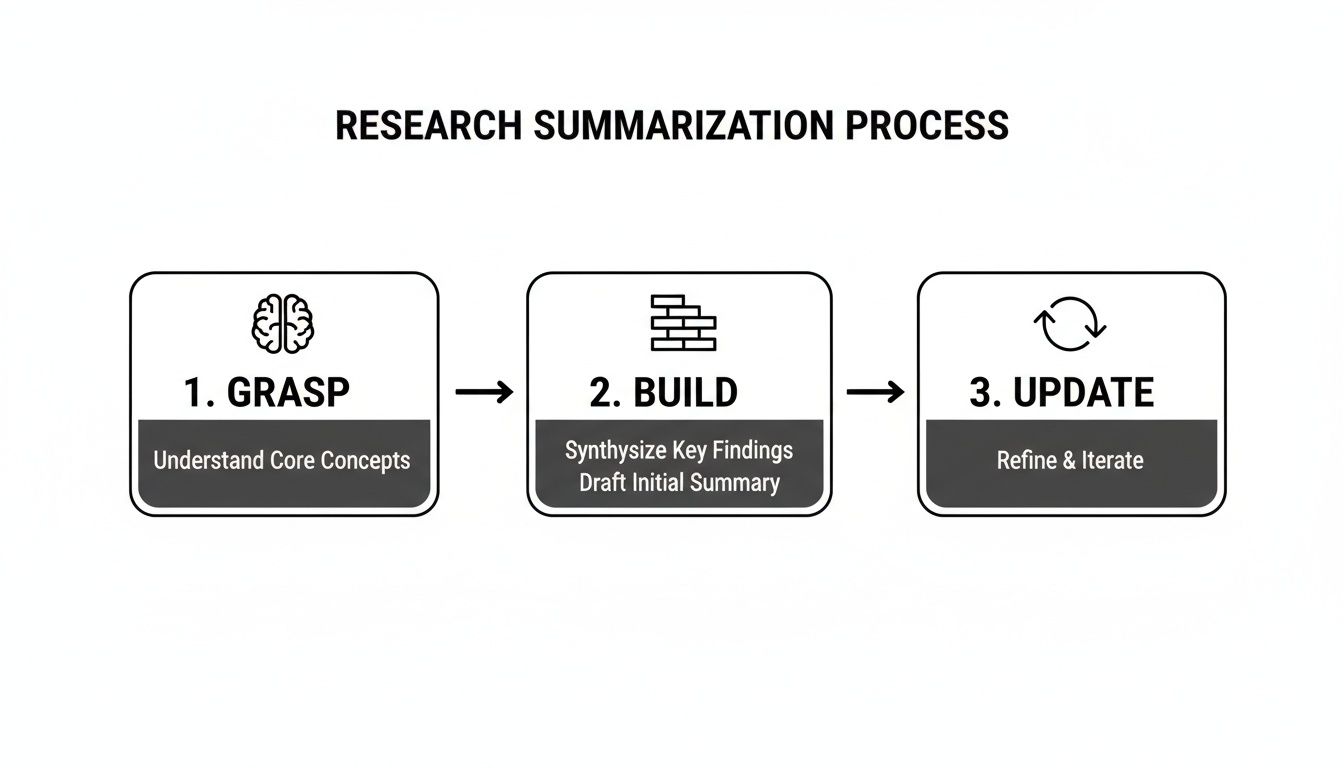
As you can see, you have to truly grasp the core ideas before you can build a draft and then update it as you gain more insight.
During this second read, you're on a mission. Actively hunt for the answers to these questions in each section:
- Introduction: What specific problem or question are the authors tackling?
- Methods: How did they do it? Note the main techniques, sample size, and any important materials they used.
- Results: What did they find? Look for the most important statistics or data, but rephrase them in your own words.
- Discussion/Conclusion: How do the authors interpret their findings? What are the bigger implications, and what limitations did they mention?
Your notes should be a collection of answers, not a list of copied sentences. This active engagement is the foundation for an original and accurate summary.
By separating the main ideas from all the supporting details, you end up with a clean set of notes to work from. This makes drafting a breeze and is incredibly helpful when you're pulling from multiple sources for something bigger, like a literature review. You can actually learn more about writing a literature review in our article. This turns reading from a passive chore into an active hunt for information.
Turning Your Notes Into a Solid First Draft
Alright, you've got your notes. They're probably a collection of bullet points, highlighted phrases, and maybe a few questions you scribbled in the margins. Now comes the fun part: turning that raw material into a coherent first draft.
This is where you move from just collecting facts to telling a story—the story of the research.
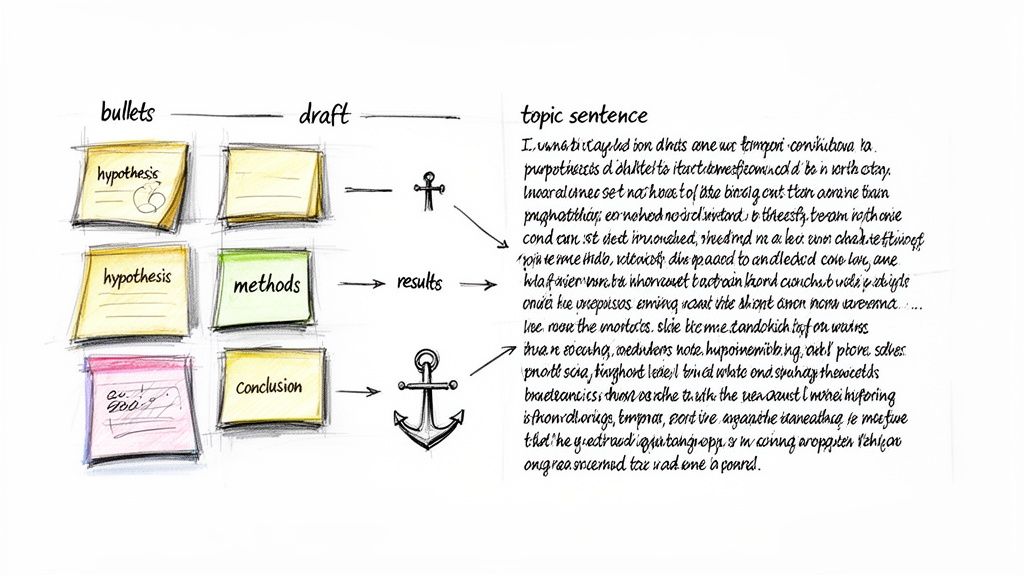
Before you do anything else, write one single sentence that nails the entire point of the paper. This isn't just a throwaway line; it's your anchor. It should capture the main question and the most important answer the researchers found. Everything else you write will hook back to this core idea.
Weaving the Main Points Together
With your anchor sentence down, it's time to build out the body of your summary. You’ll be explaining the key components of the research, but the trick is to do it in your own words, making it all flow together smoothly.
Here’s the order I usually follow:
- The Research Question: Start by clearly stating what the authors were trying to figure out. What problem were they tackling?
- The Methods: Give a quick rundown of how they did it. You don't need to get bogged down in every technical detail—just the general approach is fine.
- The Key Findings: What were the most important results? Stick to the highlights.
- The Conclusion: Finally, what did the authors make of it all? Explain their interpretation and why the study matters.
I can't stress this enough: paraphrasing is non-negotiable. From the very first sentence, write in your own voice. It's the best way to prove you actually understand the material and, more importantly, to keep plagiarism at bay.
A huge mistake I see people make is just listing facts or, even worse, lifting phrases directly from the paper. A good summary does more than that. It connects the dots between the findings and their implications, telling a complete story.
This is all about synthesis. You’re not just repeating information; you’re reframing it, which is the whole point of learning how to summarize a research article in the first place.
Dealing with Data and Numbers
Research papers are packed with stats, tables, and graphs. Your job isn't to copy-paste them. It’s to explain what they mean.
Instead of dumping raw numbers into your summary, describe the results in plain English. For example, don't write, "Group A's score was 87.3 while Group B's was 65.2." Instead, try something like, "The results showed that Group A performed significantly better than Group B." See how that focuses on the takeaway?
Descriptive statistics are your friend here. They help you boil down complex data into simple, powerful insights. For instance, stating that global science and engineering publications grew from 2.1 million in 2012 to 3.3 million in 2022—a 59% rise—quickly conveys the magnitude of change without getting lost in the weeds.
This approach makes your summary far more readable. If you've written a draft and it still feels a bit clunky or too close to the original text, you might find it helpful to improve your writing with AI tools. They can help you find better phrasing and polish your sentences while making sure you stick to the facts. This gets your first draft into solid shape, ready for the next round of revisions.
Refining Your Draft for Clarity and Precision
Getting that first draft down is a huge milestone, but don't stop there. The real work—the kind that elevates a good summary into a great one—happens during revision. This is where you'll sharpen your language and polish your draft until it’s a crystal-clear reflection of the original research.
Think of it as your final quality control pass. You're aiming to be precise, objective, and completely accurate.
Cross-Checking for Accuracy and Objectivity
Your number one job is to make sure your summary is a faithful representation of the article. It sounds simple, but it's easy to get this wrong. Pull up the original paper and put it side-by-side with your summary. Go through it, sentence by sentence.
Here's what I always ask myself:
- Did I nail the main hypothesis and the authors' final conclusion?
- Are the methods and results I described exactly what the paper reported, with no misinterpretations?
- Did any of my own opinions or judgments sneak in? Your summary needs to be 100% neutral.
This is your chance to go on a hunt for subjective words. Things like "impressive," "disappointing," or "groundbreaking" have to go—unless, of course, the original authors used similar language to describe their own work. Your role is to report, not to critique.
A summary is a mirror, not a painting. It should reflect the original work with as much clarity and as little distortion as possible. Your voice should be invisible, allowing the author’s findings to speak for themselves.
I know this part can feel a bit tedious, but it’s what separates a mediocre summary from an excellent one. It's how you build trust with your reader and maintain academic integrity.
Using AI Tools for Sophisticated Rewriting
Once you're confident your summary is factually perfect, it's time to work on the prose. This is where a little help from modern tools can be a game-changer, as long as you use them ethically. AI-powered rewriters like Rewritify are brilliant for untangling complex sentences, improving the flow, and making sure your writing is truly your own.
Maybe you have a clunky sentence you pulled straight from your notes. An AI tool can give you several clearer, more elegant ways to say the same thing, all while keeping the original meaning intact.
Take a look at how a tool like Rewritify can help you polish your text for clarity and originality.
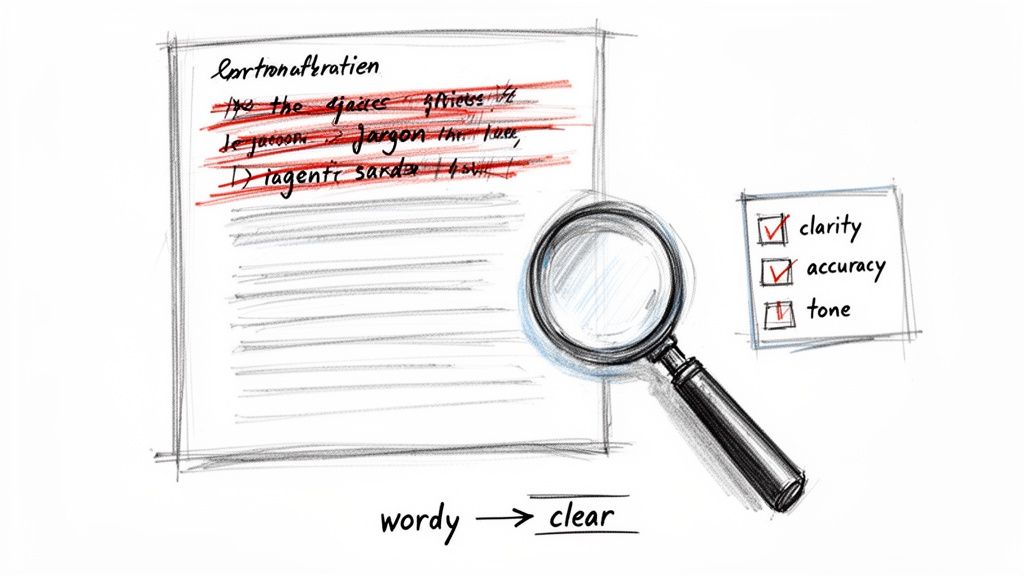
The best tools let you select different modes—like "Academic" or "Formal"—to make sure the tone is spot-on for what you're writing.
The technology behind this isn't magic; it's built on massive datasets. For example, the CNN/DailyMail dataset, which contains over 300,000 articles, is a common benchmark for training these AI models. The progress in this field shows just how good AI has become at rewriting text that sounds natural and sidesteps plagiarism detectors. You can learn more about these AI summarization findings if you're curious about the technical side.
Ultimately, using a tool like Rewritify isn't about letting a machine do the writing. It's about using AI as a partner to help you elevate your own work, making it clearer, more precise, and ready for any audience you throw at it.
Common Summarizing Mistakes and How to Avoid Them
Learning to summarize a research article well takes practice. Even experienced academics can fall into a few common traps. The good news is that once you know what these pitfalls look like, they’re much easier to sidestep.
Getting these right is what separates a truly professional summary from an amateur one. Most of these mistakes actually come from good intentions, but they can accidentally weaken the impact and credibility of your work.
Misrepresenting the Author's Intent
One of the biggest blunders is letting your own opinions or analysis sneak into the summary. Your job is to be a neutral reporter, presenting what the author said and discovered—nothing more. The moment you start critiquing their methods or adding your own "two cents" on their conclusions, it's no longer a summary.
On the flip side, being too generic is just as unhelpful. A summary that says, "The researchers studied a new drug and found it had some positive effects" is practically useless. It’s missing the specifics that give the information value. You have to find that sweet spot between being brief and providing meaningful detail.
The goal is to create a faithful miniature of the original work. It should provide enough detail for a reader to understand the study's core contribution without needing to read the entire paper, but it must never speak for you.
Getting Lost in the Weeds
Another frequent misstep is packing in way too much detail. It's easy to think every single statistic and secondary finding is critical, but this just buries the main point. Think of your summary as the highlight reel, not the full play-by-play.
To stay on track, keep asking yourself one simple question as you write: "Is this detail absolutely essential for someone to grasp the main takeaway?" If the answer is no, cut it.
Overusing Quotes and Ignoring Flow
Relying on a string of direct quotes is a classic rookie move. While one short, powerful quote might have its place, filling your summary with them suggests you haven't fully processed the material yourself. Paraphrasing—putting the ideas into your own words—is how you demonstrate real understanding.
Finally, don't just dump a list of facts on the page. A good summary is a smooth, readable paragraph. Make sure your sentences connect logically, carrying the reader from the initial research question all the way to the final conclusion.
Here’s a quick look at some of the most common issues I see and how to fix them on the fly.
Mistake vs. Solution: A Quick Troubleshooting Guide
| Common Mistake | Effective Solution |
|---|---|
| Too Much Detail | Stick to the primary findings. Leave out secondary data, minor statistics, and tangents. |
| Injecting Personal Opinion | Use neutral, reporting language and stick strictly to the author's claims and conclusions. |
| Being Too Vague | Include the key methods and specific results (with numbers) that support the main conclusion. |
| Overusing Direct Quotes | Paraphrase everything. This forces you to understand the material and shows you’ve processed it. |
Keeping these points in mind will sharpen your summarizing skills dramatically. You'll end up producing work that is not only clear and accurate but also ethical and professional.
Answering Your Top Questions About Summarizing Articles
Once you get the hang of summarizing a research article, a few questions inevitably surface. Nailing the answers to these will help you fine-tune your summaries for any situation, making sure they always hit the mark.
Let's dig into some of the most common ones. Getting these details right can be the difference between a summary that works and one that falls flat, whether it's for your professor, your team, or a wider audience.
How Long Should My Summary Be?
Ah, the classic "it depends" question. But there's a pretty solid rule of thumb to follow. For most academic purposes, aim for a summary that’s about 10-15% of the original article's length. So, if you're tackling a standard ten-page paper (roughly 3,000 words), your summary should land somewhere in the 300-400 word range.
But context is king. The real answer depends on your goal:
- Personal Notes: If it's just for you, a handful of sharp bullet points covering the core ideas might be all you need.
- Literature Review: When weaving it into a larger paper, you might only need two or three powerful sentences to capture the study's main takeaway.
- Class Assignment: Always defer to your instructor's guidelines. If they haven't given any, stick to the 10-15% rule—it's a safe and respected standard.
Is a Summary the Same as an Abstract?
This is a common point of confusion. While they look similar, an abstract and a summary play very different roles.
An abstract is the short, punchy overview written by the article's authors. It's published with the paper and is designed to help you quickly decide if the article is worth reading. They are typically very concise, usually around 150-250 words.
A summary, however, is created by you, the reader. You write it for your own benefit or to explain the research to someone else. Because of this, summaries are often a bit longer and can include more context about the methods or implications than a stripped-down abstract.
Think of it this way: An abstract is the official movie trailer produced by the studio. A summary is you explaining the entire plot to a friend who missed it.
How Do I Summarize for Different Audiences?
Learning to tailor your summary to the reader is a game-changing skill. The language, jargon, and level of detail you use should shift based on who you're writing for.
For Experts: Writing for colleagues or peers in your field? You can freely use technical language and assume they have foundational knowledge. Here, you can zero in on the finer points of the methodology and the specific implications of the results.
For Non-Experts: If you're writing for the general public or people outside your discipline, your role is to be a translator. Ditch the jargon. Use simple analogies to explain tricky concepts. Most importantly, focus on the "so what"—why do these findings actually matter in the real world? This often takes more skill, as you have to simplify without losing the core meaning.
And if you need to get the gist of a long document quickly, a dedicated PDF summarization tool can give you a solid first draft to work from.
Ready to take your draft from good to great? Rewritify can help you polish your summaries for absolute clarity and originality, making sure your writing always stands out. Check it out at https://www.rewritify.com.
Relevant articles

Learn how to write an annotated bibliography with this comprehensive guide. Get actionable tips, real examples, and formatting advice for APA and MLA.
Master your next assignment with our top 10 research paper writing tips. Learn to structure, argue, cite, and edit like a pro for better grades.