Discover rewrite my essay free: Quick Tips for Flawless, Confident Writing
Discover how to rewrite my essay free using trusted tools and proven steps to improve clarity, flow, and originality - click to elevate your paper now.
Before you even think about plugging your work into a tool to rewrite my essay free, you need to do a bit of prep work. Trust me, this small upfront investment of time is what separates a truly improved paper from one that’s just had a few words shuffled around. It’s all about breaking down your original draft to figure out what’s working and what isn’t. This gives you a clear game plan, ensuring any tool you use actually strengthens your argument instead of just changing the vocabulary.
Laying the Groundwork for a Successful Rewrite
Diving headfirst into a rewriting tool without a strategy is a recipe for disaster. It’s like trying to build a house without a blueprint—you might end up with something standing, but it won’t be sturdy. The best rewrites always start with a hard, honest look at what you’ve already got on the page. This isn't about hunting for typos yet; it’s about examining the core structure and substance of your essay.
A great first step is simply reading your draft out loud. It sounds almost too simple, but it works. This forces you to slow down and really hear your own words. You'll immediately catch awkward sentences, clunky phrasing, and logical jumps that your eyes just glide over when reading silently.
Deconstruct to Reconstruct
After a general read-through, it's time to put on your detective hat. The objective here is to pinpoint the essential building blocks of your paper and see how well they hold up. Don't start rewriting anything yet—this is purely the diagnostic phase.
Here’s how you can tackle it:
- Find Your Thesis: Is it sharp, debatable, and easy to spot? If you have to search for it, your reader is already lost.
- Check Your Topic Sentences: Go paragraph by paragraph and highlight the first sentence. Does it actually set up the point of that paragraph? More importantly, do they all logically build on each other to support your main thesis?
- Spot Weak Support: Be ruthless. Look for any claims you've made that are backed by flimsy evidence, vague examples, or missing citations. Flag these as your top priority for improvement.
Doing this gives you a bird's-eye view of your essay’s skeleton. You’ll see where the bones are strong and where things are about to fall apart.
Create a Reverse Outline
One of the most powerful techniques I’ve ever used for this is the "reverse outline." Instead of creating an outline of what you want to write, you make one based on what you’ve already written.
It’s easy. Just go through your essay one paragraph at a time. In a separate document, jot down a single sentence summarizing the main point of each paragraph. Once you’re done, read only that new outline you've created.
Think of the reverse outline as an X-ray of your essay. It immediately exposes if your arguments are out of order, if you're repeating the same point, or if a paragraph is just floating there, not contributing to your thesis at all.
This diagnostic work is what makes the difference. You move from a fuzzy goal like "make my essay better" to a concrete to-do list: "sharpen the thesis," "swap paragraphs 3 and 4 for better flow," and "find a better statistic for my second point." With that kind of clarity, you're ready to use a rewriting tool as a surgical instrument, not a sledgehammer.
Using Free Rewriting Tools the Right Way
Once your plan is in place, it’s time to see how a tool can help you rewrite my essay free. This is where the real work begins, but don't just dump your entire essay into a rewriter and click a button. That's a classic rookie mistake, and it almost always results in a jumbled mess that sounds nothing like you.
Think of these tools as a smart collaborator, not a magic fix.
The secret is to work in smaller, more focused chunks. Tackle one paragraph at a time, or maybe just a couple of tangled sentences. This method keeps you in the driver's seat, making sure every revised piece fits perfectly back into your overall argument. For example, if your topic sentence feels weak, isolate it. See what alternatives the tool spits out. If an entire paragraph feels clunky, feed it in and look for new ways to structure the ideas.
Working this way prevents the tool from losing the plot—a common issue when you ask it to process too much text at once.
Selecting the Right Mode for Your Task
Modern rewriting tools like Rewritify aren't one-size-fits-all; they come with different "modes" or settings. Picking the right one is absolutely critical because each is designed for a specific job. Matching the mode to your goal is the key to getting suggestions that are actually helpful.
For instance, you wouldn't use a "Simple" mode to make an argument more sophisticated. Understanding what each setting does gives you surgical control over the final tone and quality of your essay.
This decision path is a great way to visualize the process.
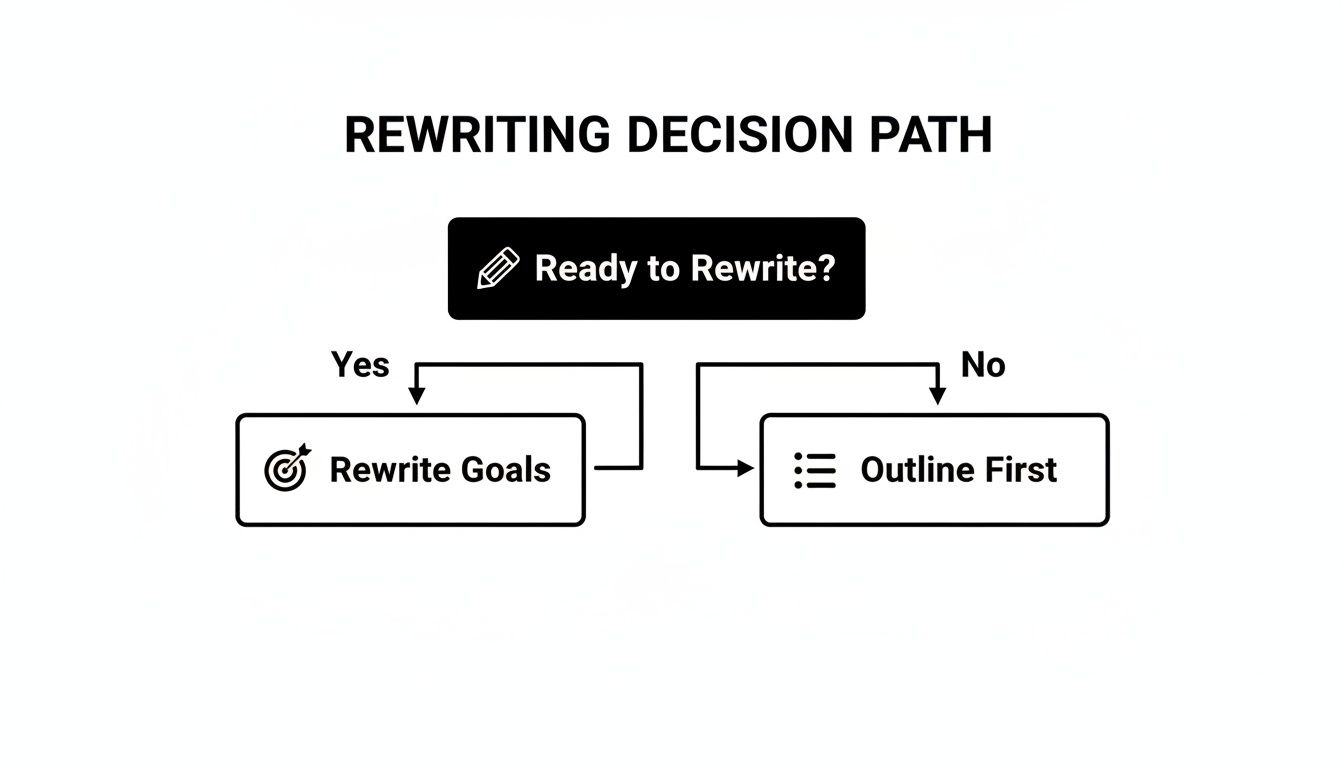
As you can see, knowing what you want to achieve is the first step. It guides whether you need to step back and plan more or if you're ready to start revising.
Choosing the right mode is one of the most important steps. This table breaks down some common options you'll find in tools like Rewritify and explains where they shine.
Choosing the Right AI Rewriting Mode for Your Essay
| Rewriting Mode | Best For | Key Feature |
|---|---|---|
| Academic | Strengthening arguments, elevating vocabulary, and meeting formal standards. | Prioritizes complex sentences and a scholarly tone appropriate for papers. |
| Formal | Professional documents, reports, or essays requiring a respectful tone. | Cleans up colloquialisms and ensures language is polished and clear. |
| Simple/Clear | Breaking down overly complex sentences or clarifying difficult concepts. | Improves readability by simplifying jargon and convoluted phrasing. |
| Natural | Smoothing out awkward or robotic-sounding text from previous AI edits. | Focuses on flow and cadence to make the writing sound more human. |
Think of these modes as different lenses. Each one helps you focus on a specific aspect of your writing, so you can make targeted improvements instead of just hoping for the best.
Critically Evaluating the AI Output
Okay, the tool has generated some new text. Your job isn't done—it's just begun. The AI gives you suggestions, not a finished product. You have to step in as the editor-in-chief and scrutinize every single change. This is the human element that no algorithm can ever replace.
An AI rewriter is a powerful brainstorming partner. It can show you a dozen ways to phrase an idea, breaking you out of a writing rut. Your role is to select, refine, and integrate the best suggestions into your own authentic voice.
The technology behind these tools is growing fast. The AI-powered content creation market is expected to hit $2.74 billion by 2026, up from $2.15 billion in 2024. As the market expands, so do your options. When looking for the right tool, considering a good Quillbot Alternative can give you access to specialized features that might better suit your paraphrasing needs.
But even with better tools, your critical eye is non-negotiable. Here's what I always check for when reviewing AI-generated text:
- Did it change my meaning? This is the biggest danger. The AI might swap a word and accidentally alter your entire argument.
- Is the tone consistent? The new text needs to blend seamlessly with the rest of your essay. A sudden shift from academic to casual is a dead giveaway.
- Does it still flow? Read the new sentence aloud with the ones before and after it. Does it connect logically, or does it feel tacked on?
- Is the word choice right? A thesaurus isn't a brain. The AI might pick a synonym that's technically correct but completely wrong for the context.
When you treat the tool as a starting point, not a final destination, you can avoid these pitfalls and produce an essay that is polished, coherent, and genuinely better. If you're looking to get even more out of these tools, our guide on how to use an AI text enhancer offers some next-level tips.
Applying the Human Touch with Manual Revisions
An AI-generated draft is a fantastic starting point, but it's never the final destination. The real magic happens when you bring your own critical eye and human intuition to the text. This manual revision process is what elevates a decent draft into a polished and persuasive essay. When you're trying to rewrite my essay free, this step is absolutely non-negotiable for getting the grade you want.
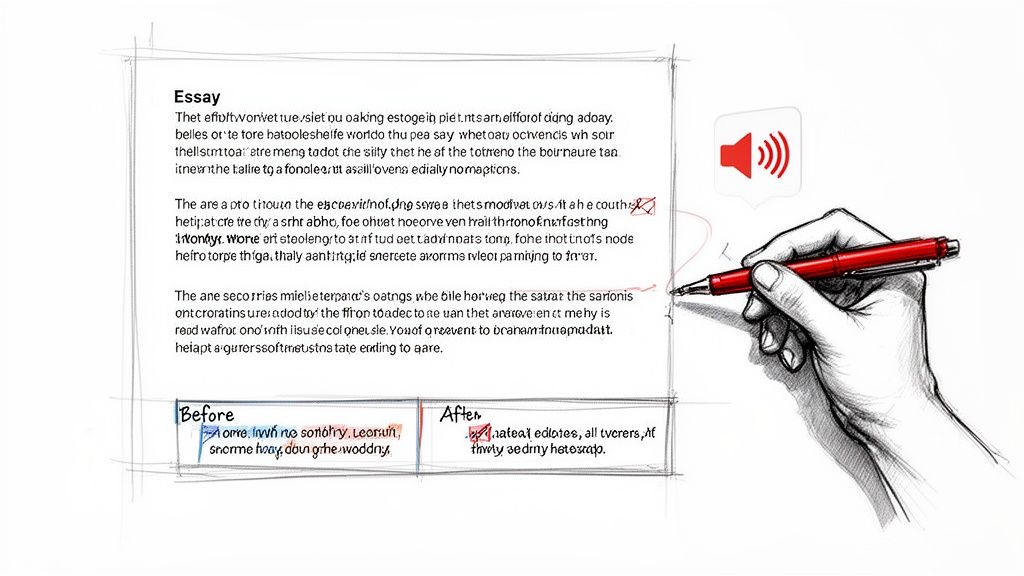
Think of the AI's output like a block of marble. It has the basic shape of your essay, but it lacks the fine details and personal signature that make it yours. Your job now is to carve in those details, smooth out the rough edges, and make sure the final piece perfectly reflects your original intent.
Read Your Work Aloud
This is one of the oldest tricks in the book for a reason: it works. Reading your essay out loud forces you to slow down. Your eyes can easily skim over awkward phrasing, but your ears will catch it immediately. You'll hear exactly where the rhythm feels off, where sentences drag on too long, or where the tone suddenly changes.
When a sentence makes you stumble, that’s your cue to stop and fix it. This simple technique helps bridge the gap between how we write and how we speak, making your paper sound far more natural and authoritative.
Deconstruct and Simplify Sentences
AI tools sometimes lean into complex sentences and overly formal vocabulary. Your next job is to act as a translator, breaking down these dense ideas into clear, impactful statements. Hunt for sentences packed with multiple clauses and see if you can split them into two or three shorter, punchier ones.
For example, an AI might spit out something like this:
- Before: "The proliferation of digital communication platforms has subsequently resulted in a demonstrable alteration of interpersonal relational dynamics."
It's technically correct, but it's also clunky and a pain to read. A quick manual revision brings it back to earth:
- After: "Digital communication platforms are changing how we interact with each other. These tools have fundamentally altered our personal relationships."
The second version is direct, easy to understand, and carries much more weight. Getting good at this is a core part of rewriting. If you want more practice, our team put together a helpful guide on how to rewrite a paragraph that digs deeper into these techniques.
Strengthen Your Topic Sentences
Your topic sentences are the signposts for your reader, guiding them through the logic of your argument one paragraph at a time. An AI might generate a functional sentence, but it may not perfectly introduce the specific evidence you're about to present.
Go back through each paragraph and ask yourself: "Does this first sentence truly capture the main point I'm making here?"
A strong topic sentence does more than introduce a topic; it makes a specific claim or presents a clear argument that the rest of the paragraph will defend. It should be your idea, sharpened and clarified.
By focusing on these manual touches, you reclaim ownership of the text. You ensure the final essay not only reads well but also holds onto your unique voice and analytical perspective. This "human-in-the-loop" approach is the real key to turning a good rewrite into a great one.
Ensuring Originality with Plagiarism and Citation Checks
So, you've run your draft through a rewriter. You might feel like you're at the finish line, but there's one critical, non-negotiable step left: checking for originality and verifying your citations.
It’s easy to think that rewriting a sentence makes it yours, but sometimes the new version stays a little too close to the original. This is how accidental plagiarism happens, and unfortunately, it comes with the exact same academic penalties as deliberate cheating.
Running your paper through a plagiarism checker isn't just about covering your bases. It’s about being confident that the work you're submitting is truly a reflection of your own understanding and effort. Plenty of free, reliable tools can scan your essay against billions of web pages and academic papers, flagging any phrases that are a bit too familiar.
Think of it as a final quality control check that gives you peace of mind before you hit "submit."
Don't Forget to Double-Check Your Citations
This part is just as important. When an AI tool rephrases a sentence, it can sometimes twist the original meaning just enough to make your citation inaccurate. The last thing you want is for your in-text citation to point to an idea that the original author never actually expressed.
Always, always go back to the source material. After your essay is rewritten, pull up the original article or book. Read your new sentence, then read the source. Ask yourself, "Does my version still faithfully represent what the author said?"
This isn't just busywork; it's fundamental to academic integrity. Misrepresenting a source, even unintentionally, undermines your argument and can seriously hurt your credibility.
Here’s a quick mental checklist for each citation:
- The Claim: Is the core point of your rewritten sentence the same as the source?
- The Context: Has the new wording accidentally stripped away important context?
- The Data: If you're citing a number or a specific fact, double-check that it hasn't been altered.
The use of AI writing assistants is exploding. The global user base for these kinds of intelligent tools is expected to jump by a staggering 826.2 million people between 2025 and 2031. You can see how fast this is moving by looking at the latest AI marketing statistics on seo.com. With so many people relying on these tools, using them responsibly has never been more important.
This final review makes sure your arguments are solid and properly supported. For a more detailed breakdown, take a look at our guide on how to check for plagiarism.
Giving Your Essay a Final Polish
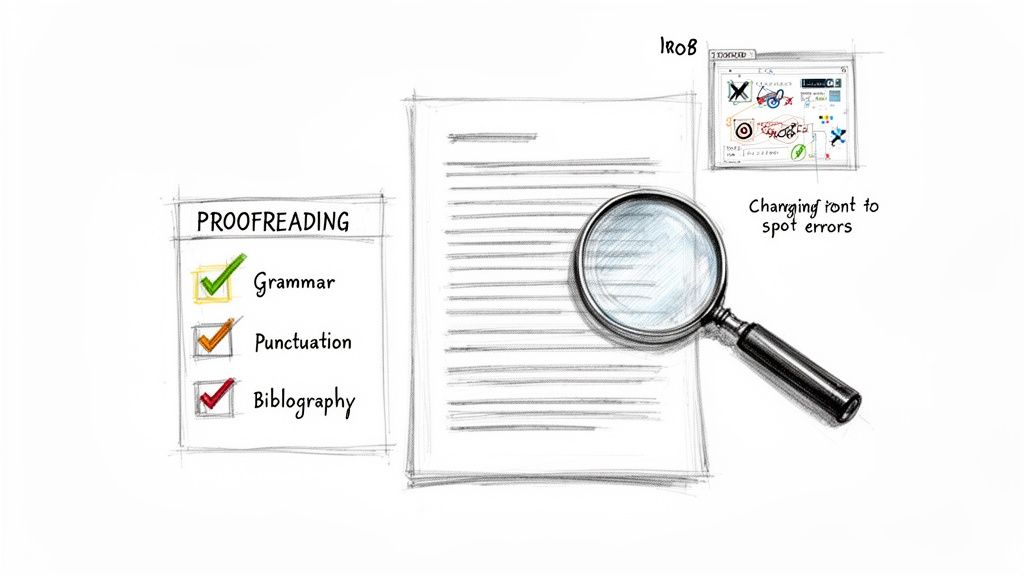
You’re almost there. After all the hard work of rewriting, this final proofread is your last line of defense. It’s easy to skip, but this is where you catch the small, pesky errors that can drag down your grade and undermine everything you’ve accomplished.
Think of it this way: the heavy lifting is done. Now, you’re just focusing on the details that create a professional, polished impression—things like grammar, punctuation, and consistent formatting. A single misplaced comma or a wonky heading can distract a professor and suggest carelessness. This last pass ensures your essay is ready for a critical eye.
Tricks to Spot Those Sneaky Errors
When you’ve stared at the same text for hours, your brain starts playing tricks on you. It knows what you meant to write and automatically corrects mistakes as you read. To catch what’s really there, you need to force yourself to see the text with fresh eyes.
Here are a few proven techniques that actually work:
- Change the scenery. Try temporarily changing the font, upping the text size, or even switching the background color of your document. This simple visual change makes the text look unfamiliar, causing typos and awkward phrases to suddenly stand out.
- Read it backward. Seriously. Start with the very last sentence of your essay and read it. Then read the second-to-last sentence. Working your way to the beginning in this disjointed way breaks the narrative flow, forcing your brain to focus purely on the mechanics of each sentence.
- Print it out. There's something about seeing your words on physical paper that changes your perspective. Grab a ruler to guide your eyes line by line and use a pen to mark up any mistakes you find. It’s old school, but it’s effective.
Double-Check Citations and Formatting
Even a brilliantly argued essay can lose points over sloppy citations. This is the time to meticulously check every single in-text citation and your reference list against the required style guide, whether it’s APA, MLA, or Chicago. Make sure every comma, period, and italicized title is perfect.
A clean, consistently formatted paper signals professionalism and respect for academic standards. It shows your professor you've taken the time to get every detail right, not just the main arguments.
To add another layer of quality control, consider using a dedicated grammar checker. A tool like Grammarly can be a lifesaver for catching subtle grammatical mistakes. Many students find the premium version worth it, especially if you can find a Grammarly Student Discount.
This final step is all about showing the care you put into your work. It's interesting to note that businesses using AI writers have seen a 55% reduction in revision cycles. This highlights how technology can speed up the initial drafting, freeing up more time for this crucial final review. Taking this last step ensures your essay isn't just well-written, but impeccably presented.
Answering Your Top Questions About Rewriting Essays
When you're thinking, "I need to rewrite my essay for free," a few questions are bound to pop up. Let's be honest, using AI writing assistants is still pretty new territory for a lot of students, and figuring out how to use them the right way is a big deal for your grades.
So, let's tackle the big concerns I hear all the time. Getting these questions answered upfront will help you use these tools for what they're good at—being a writing assistant—without accidentally crossing a line.
Is It Cheating to Use an AI to Rewrite My Essay?
This is the million-dollar question, isn't it? The answer isn't a simple yes or no. It really comes down to how you're using the tool.
If you just copy-paste a prompt and let the AI write the whole paper for you, that's almost guaranteed to be a major academic integrity violation. But that's not what smart rewriting is about.
Using a rewriter to help you clean up awkward sentence structures, find a stronger word, or rephrase a paragraph you already wrote yourself? That’s usually fine. Think of it as a super-powered grammar checker or thesaurus.
The key is that the research, the core arguments, and the critical thinking must be 100% your own. The AI is just helping you polish how you say it. Always, always double-check your school's specific policy on using AI tools before you start.
Can Rewriting Tools Make My Essay Sound Robotic?
Oh, absolutely. This is one of the biggest red flags. If you just accept the first thing the AI spits out, you can end up with an essay that sounds unnatural, uses weird synonyms that don't quite fit, or completely misses the point you were trying to make. It's a classic rookie mistake.
Treat the AI’s output as a first draft suggestion, not the final word. You are the editor-in-chief here, and it's your job to make sure the final text flows naturally and still sounds like you.
This is exactly why the manual review process is non-negotiable. You have to read through the rewritten text, make your own tweaks, and smooth everything out so it fits seamlessly with the rest of your paper. Never, ever just copy and paste without a critical read-through.
What's the Real Difference Between Rewriting and Paraphrasing?
People often use these terms interchangeably, but in the academic world, they mean very different things. Getting this right is crucial for avoiding plagiarism.
- Paraphrasing is when you take someone else’s idea (from a book, an article, a study) and restate it in your own words. The golden rule? You must include a citation to credit the original author.
- Rewriting is something you do to your own writing. The whole point is to improve the clarity, tighten up the language, and make your work stronger. It’s about refining your own thoughts, not borrowing someone else's.
So, you might paraphrase a quote from a research paper to back up a point, but you'd rewrite your own conclusion to make it more powerful. One is about integrating sources, the other is about improving your own work.
Ready to polish your essays with confidence? Rewritify helps you refine your own work, ensuring clarity and originality while keeping your voice front and center. Try our free paragraph rewriter today!
Relevant articles

Learn how to structure an argumentative essay with our expert guide. We break down the thesis, body paragraphs, and counterarguments for a powerful paper.

Learn how to write an annotated bibliography with this comprehensive guide. Get actionable tips, real examples, and formatting advice for APA and MLA.

Learn how to write an effective essay rough draft. This guide provides actionable steps for turning messy ideas into a coherent and compelling paper.

Discover differences between formal and informal writing, with practical tips, examples, and syntax cues to choose the right tone every time.

Learn how to write a critical analysis with our guide. We cover everything from developing a thesis to structuring your argument and refining your final draft.

Learn how to write a position paper with our expert guide. Discover proven strategies for research, structuring arguments, and persuasive writing.