How to Write a Conclusion Paragraph That Leaves a Lasting Impression
Learn how to write a conclusion paragraph that elevates your writing. Discover key components, powerful examples, and common mistakes to avoid.
Let's be honest, the conclusion is often an afterthought. After pouring all your energy into research, drafting, and polishing your main arguments, it’s all too easy to just slap a quick summary on the end and call it done. But that final paragraph? It might just be the most crucial part of your entire piece.
Think of your conclusion less like a recap and more like your closing argument. It's your last opportunity to drive your point home, reinforce your message, and make your ideas stick. A weak ending can undermine all your hard work, leaving your reader feeling underwhelmed or unconvinced. A powerful one, on the other hand, solidifies your credibility and makes your message resonate long after they've finished reading.
Why Your Final Words Carry So Much Weight
The impact of a well-crafted conclusion isn't just a hunch; it's something you can actually measure. Take academic writing, for instance. A strong final paragraph can seriously lift your overall grade. Feedback from IELTS examiners reveals that a compelling conclusion can boost an essay's score by as much as 25%. It's clear that how you wrap things up can make a massive difference.
This isn't just for students, either. For anyone writing for a business or marketing purpose, the conclusion is where the real work gets done.
- It sparks action: A clear, persuasive call-to-action can transform a casual reader into a customer or subscriber.
- It builds trust: A confident, insightful closing reinforces your expertise and authority on the subject.
- It sticks in their mind: Ever heard of the "recency effect"? It’s a psychological principle that says we remember the last things we see or hear most clearly.
Think of your conclusion as the final handshake. A firm, confident one leaves a lasting, positive impression. A limp, rushed one suggests you don't fully believe in what you just wrote.
A strong conclusion is built on a simple but effective structure. Getting these three elements right is the key to leaving your reader with a sense of closure and conviction.
Three Core Components of an Effective Conclusion
Let's break down what goes into a conclusion that truly works. These three components provide a reliable framework for ending any piece of writing on a high note.
| Component | Purpose | What to Do |
|---|---|---|
| Revisit the Thesis | To remind the reader of your central argument. | Rephrase your original thesis statement using fresh, confident language. Avoid copying it word-for-word. |
| Synthesize Key Points | To show how your arguments connect and support the thesis. | Briefly summarize your main supporting points, but focus on their collective meaning. Show the "so what?" |
| Provide a Final Insight | To give the reader something to think about or do. | Offer a final thought, a look to the future, or a clear call-to-action. This is your mic-drop moment. |
Ultimately, learning how to write a great conclusion is a fundamental writing skill. It pays off everywhere, whether you're chasing a better grade or trying to create more effective content. If you're focused on the latter, you might find our guide on SEO copywriting best practices helpful.
Anatomy of a Powerful Conclusion
Staring at a blank page trying to figure out how to wrap up your entire argument can be tough. But a killer conclusion isn't magic; it follows a clear, reliable structure. The trick is to move beyond a simple summary and create a sense of closure that makes your main argument stick. Once you understand the core components, writing a powerful ending becomes a lot less intimidating.
This simple flow shows the three essential moves you need to make to build an impactful conclusion.
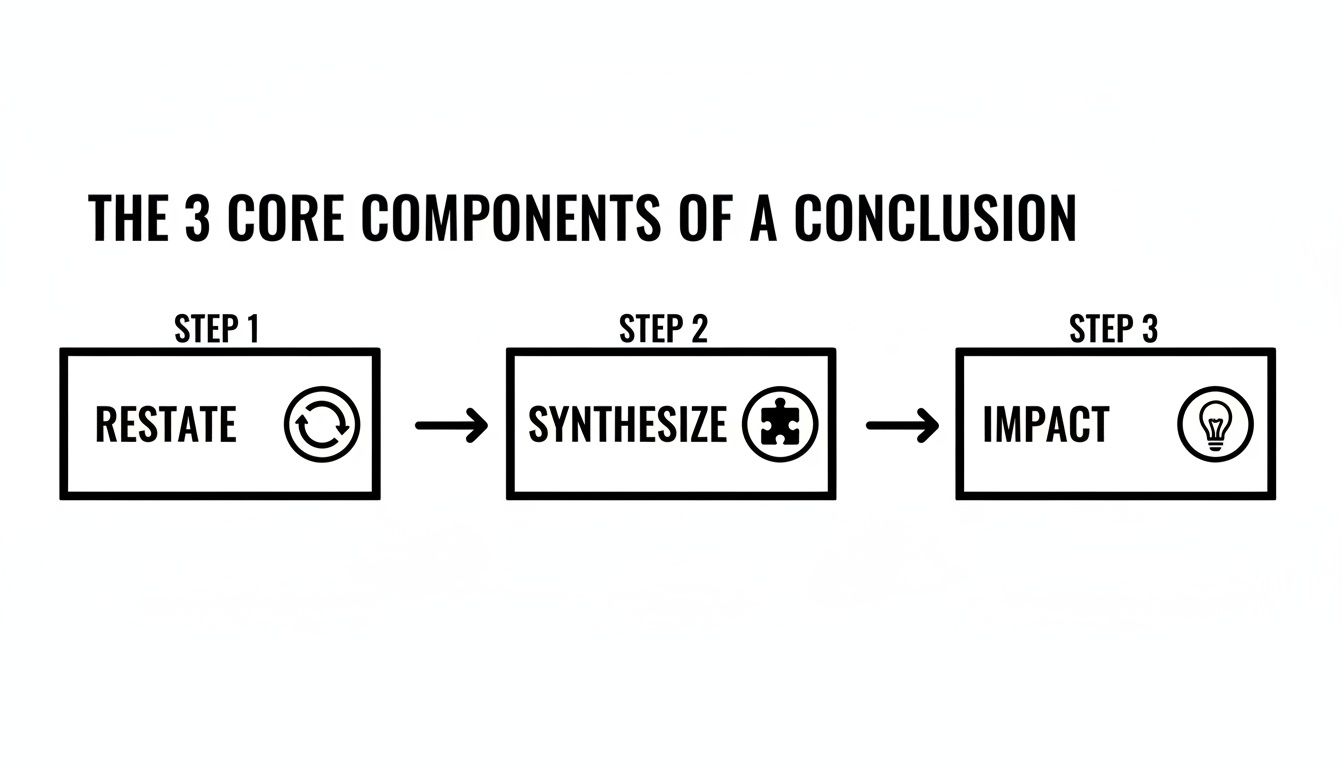
As you can see, it's a sequence. You move from reminding the reader of your core idea, to connecting the dots for them, and finally, leaving them with something memorable to think about.
Restate Your Thesis with Fresh Language
First things first, circle back to your thesis statement. But—and this is a big one—never copy and paste it from your introduction. That’s a rookie mistake that immediately makes your writing feel stiff and uninspired.
Your goal here is to rephrase your central argument using new words and a different sentence structure. This shows the reader (and your professor) that you have a deeper, more evolved understanding of your own point.
For example, if your intro thesis was, "Implementing a four-day work week increases employee productivity and well-being," your conclusion might rephrase it like this: "Ultimately, a shortened work week demonstrably boosts not only corporate output but also the overall health of the workforce." Same message, but delivered with more confidence and style. If you want to dig deeper into this, mastering the art of structure in writing has some fantastic guidance.
Synthesize Your Main Points
This is where a lot of conclusions fall flat. Many writers just re-list their main points: "First I argued X, then I showed Y, and finally I proved Z." That's not synthesis; that's a laundry list.
True synthesis is about showing how your points connect to form a single, powerful argument. You’re revealing the "so what?" of your essay. It’s your chance to explain how points A, B, and C all work together to prove your thesis. This demonstrates critical thinking and makes your entire piece feel unified and complete. For academic writers, this skill is non-negotiable, and you can explore more techniques for https://www.rewritify.com/blog/how-to-improve-academic-writing in our other guides.
Leave a Lasting Final Impression
Your very last sentence is your mic drop. It's the one thing that will echo in your reader's mind after they've put your piece down. Don’t waste this opportunity with a generic sign-off. Go for impact.
A great final impression doesn’t just end the discussion; it elevates it. It prompts the reader to think, feel, or act, ensuring your message has a life beyond the page.
Here are a few proven ways to stick the landing:
- Pose a thought-provoking question: "If this trend continues, what will our cities look like in the next decade?"
- Offer a forward-looking statement: "The research suggests we are on the cusp of a major breakthrough in renewable energy."
- Issue a compelling call to action: "By adopting these simple habits, we can collectively make a significant environmental impact."
Conclusion Paragraphs in Action
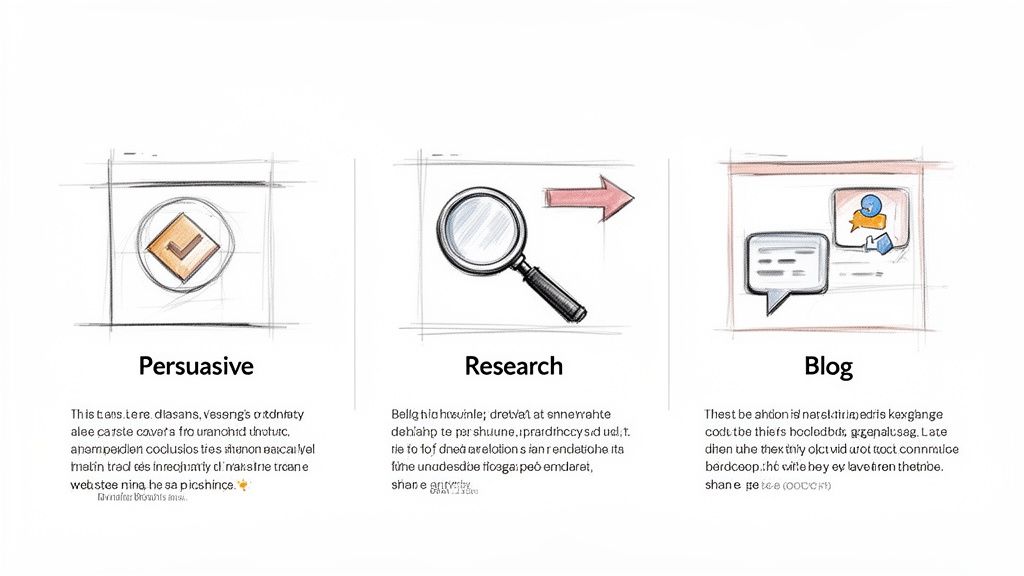
It's one thing to talk about the theory behind a good conclusion, but seeing it in practice is where the lessons really click. That core structure we covered—restate, synthesize, impact—is surprisingly flexible and works across all kinds of writing.
Let's look at a couple of real-world examples. You'll see how the same principles adapt to fit completely different goals, whether that's winning an argument or presenting academic findings.
The Persuasive Essay Conclusion
When you're trying to persuade someone, your conclusion has to be more than just a recap. The goal is to drive your argument home and leave the reader feeling convinced, inspired, or ready to act. You need to end with confidence and a powerful final thought.
Topic: The importance of funding public libraries.
"Ultimately, the debate over funding for public libraries is a debate about the value we place on equitable access to knowledge. By weaving together community support, educational resources, and a safe space for discovery, these institutions do far more than just lend books—they build stronger, more informed citizens. To reduce their funding is to willingly dim the lights on a cornerstone of democracy. Therefore, we must not only protect our libraries but champion them as the essential public good they have always been."
How It Works:
- Revisits the Thesis: It starts by framing the core argument: libraries are essential for equal access to knowledge.
- Connects the Dots: It synthesizes the key functions mentioned earlier (community hubs, educational resources) and links them to the bigger outcome of creating informed citizens.
- Leaves a Lasting Impression: The final sentence is a memorable, inspiring call to action that sticks with the reader.
The Research Paper Conclusion
A research paper conclusion has a different job. It needs to be objective and grounded in the data you've presented. Here, you summarize your findings, explain their significance, and point to what should happen next—all without making claims your research can't support.
Topic: The effect of remote work on employee productivity.
"The data gathered in this study indicates a moderate but statistically significant increase in self-reported productivity among employees who transitioned to a fully remote work model. Synthesizing survey responses with performance metrics reveals that factors like autonomy and reduced commute times are key drivers of this trend. While these findings are promising, they are limited by the study's focus on the tech sector. Future research should therefore explore whether these productivity gains are replicable across different industries and organizational cultures to develop a more complete understanding of remote work's broader economic implications."
How It Works:
- Revisits the Thesis: It gets straight to the point, restating the study's main finding about increased productivity.
- Connects the Dots: It explains why this happened by linking the survey data (autonomy) with performance metrics.
- Leaves a Lasting Impression: It responsibly acknowledges the study's limitations and offers a clear, specific suggestion for future research, adding to the academic conversation.
4 Common Conclusion Mistakes to Avoid
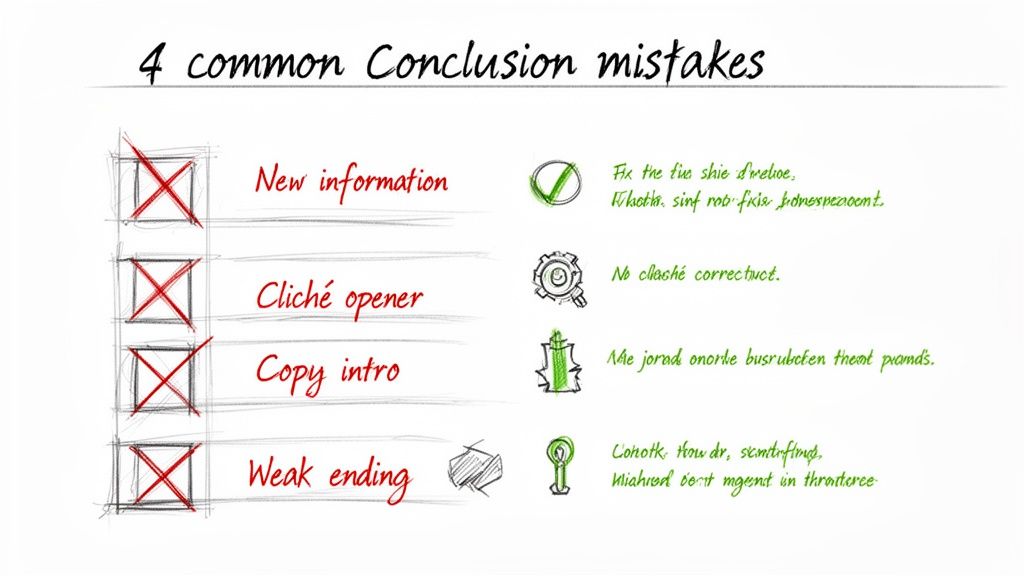
Knowing what not to do is just as important as knowing what to do. A fantastic argument can fall flat at the last second with a clumsy ending. I've seen it happen countless times.
By learning to spot these classic blunders, you can make sure your final words pack a punch instead of just fizzling out.
The most common mistake? Introducing new information or a brand-new argument. The conclusion is your victory lap, not the time to introduce another runner. It’s for wrapping things up, not for tossing in one last piece of evidence you forgot. A sudden new point just leaves the reader confused and feeling like the essay isn't truly finished.
Sidestepping Clichés and Repetition
Next up is the reliance on tired, overused phrases. Starting with "In conclusion," "To summarize," or "In closing" is a dead giveaway of an uninspired ending. They're basically a crutch, and you don't need them.
In fact, research shows these phrases pop up in 40% of low-grade papers. The best conclusions flow so naturally they don't need a signpost. It's also worth noting that a strong final paragraph can influence up to 92% of citation decisions in academic circles—it really matters.
Another major misstep is simply copying and pasting your introduction. Yes, you need to revisit your thesis, but it has to be rephrased. When you just repeat the same sentences verbatim, it tells the reader your perspective hasn't grown at all. This is where solid paraphrasing skills come in. If you're shaky on this, check out our guide on how to paraphrase without plagiarizing.
Expert Tip: Think of your conclusion as the "so what?" moment. You've laid out all the evidence. Now, from this more informed vantage point, tell your reader what it all means when you put it together.
Finally, never end on a weak or apologetic note. Ditching phrases like, "This is just one perspective on the issue..." is critical. Statements like that undercut the authority you've spent the entire paper building. Your job is to end with confidence, leaving no doubt about the strength of your argument.
Your Quick Revision Checklist
Before you call it a day, a quick final pass is the secret to making sure your conclusion truly lands. I like to think of it as a final quality check to ensure all that hard work pays off.
This isn't about rewriting the whole thing. It’s about a few quick tweaks that can take a conclusion from just "okay" to genuinely powerful.
The Four-Point Inspection
Run through these questions. They'll help you spot weaknesses and sharpen your ending.
- Fresh Thesis Restatement: Did I restate my core argument with fresh wording? Or did I just copy and paste from the intro?
- True Synthesis: Have I actually connected the dots between my main points to reveal the bigger picture? Or is it just a boring laundry list?
- Sense of Closure: Does this feel like a real ending? Your reader should feel satisfied, not left hanging with unanswered questions.
- Impactful Final Sentence: Is my last sentence a throwaway? Or does it pack a punch with a compelling thought or a clear call to action?
An effective conclusion provides both a summary of what’s been said and a true concluding thought that pushes the conversation forward. It ties everything together while giving the reader something to take away.
Don't just take my word for it. Good data shows that 65% of effective reports skillfully blend summary with a forward-looking statement. Keeping that ending brief and punchy can even increase reader retention by up to 28%—proof that a strong finish makes your message stick. You can discover more insights about effective technical writing conclusions to see the data for yourself.
Common Questions About Writing Conclusions
Even with a solid plan, a few questions always seem to pop up when it's time to write the conclusion. Let's walk through some of the most common ones I hear from other writers.
How Long Should a Conclusion Be?
A good rule of thumb is to aim for 3 to 5 sentences. This typically accounts for about 5-10% of your total word count.
So, for a 1000-word essay, you’re looking at a conclusion of around 50-100 words. The goal is to be concise. You want to land your final point with impact, not drag things out with fluff.
Is It Okay to Ask a Question in My Conclusion?
Absolutely! Ending with a thoughtful question can be a really powerful move. It gets your reader thinking and keeps your topic on their mind long after they’ve finished the last sentence.
The key is to make sure the question feels like a natural end to your argument. It should cap things off, not crack open a whole new can of worms. When done right, it can be the perfect final touch.
A summary just lists what you said; a synthesis explains what it means. A summary is a list of ingredients, while a synthesis is the finished dish, showing how those ingredients came together to create something new.
What’s the Real Difference Between a Summary and a Synthesis?
This is a fantastic question because it gets to the heart of what makes a conclusion great. Think of it this way: a summary is just a mechanical recap of your points. It’s like saying, "First, I covered this, and then I talked about that." It's repetitive and doesn't add much value.
A synthesis, on the other hand, is all about connection. It’s where you weave your main points together to show how they collectively support your big idea—your thesis. A synthesis reveals the "so what?" of your argument, demonstrating a much deeper level of understanding.
Ready to transform your rough drafts into polished, impactful writing? Rewritify helps you rephrase and refine your content, ensuring every paragraph—especially your conclusion—is clear, compelling, and original. Learn more about how Rewritify can elevate your writing today.
Relevant articles

Learn how to structure an argumentative essay with our expert guide. We break down the thesis, body paragraphs, and counterarguments for a powerful paper.

Learn how to write an annotated bibliography with this comprehensive guide. Get actionable tips, real examples, and formatting advice for APA and MLA.

Learn how to write an effective essay rough draft. This guide provides actionable steps for turning messy ideas into a coherent and compelling paper.

Discover differences between formal and informal writing, with practical tips, examples, and syntax cues to choose the right tone every time.

Learn how to write a critical analysis with our guide. We cover everything from developing a thesis to structuring your argument and refining your final draft.

Learn how to write a position paper with our expert guide. Discover proven strategies for research, structuring arguments, and persuasive writing.