How to Write a Research Proposal That Wins Funding
Learn how to write a research proposal with our expert guide. We cover everything from structure and methodology to securing funding.
Think of a research proposal as your project's master plan. It’s more than just a document; it’s a formal, structured argument that lays out exactly what you plan to study. At its core, it’s a tool of persuasion, designed to convince your supervisors, a review committee, or a funding body that your research question is important and your plan to answer it is sound.
Your Blueprint for a Winning Research Proposal
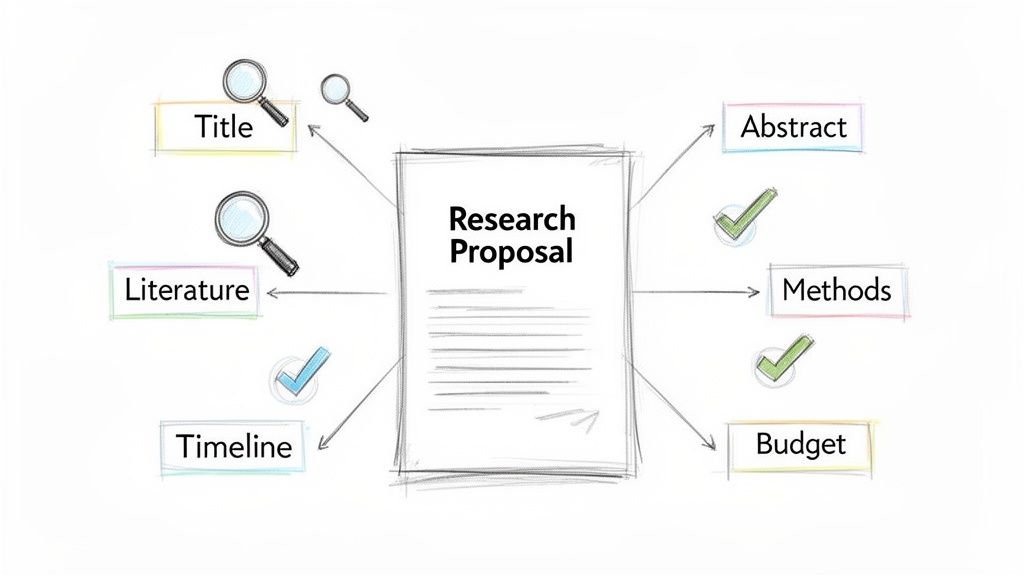
Staring at a blank page can feel overwhelming, but don't see this as just another academic assignment. Your research proposal is your strategic roadmap—the document that proves you have a compelling, viable, and significant idea worth pursuing.
A strong proposal isn't just about what you want to study; it’s about why it matters and precisely how you’ll uncover the answers. It’s your opportunity to demonstrate your command of the subject, show you understand the current scholarly conversation, and prove you have the skills to manage a complex project from start to finish. This is where you make that critical first impression and secure the support you need.
The Anatomy of a Strong Proposal
Before you start writing, it’s essential to understand how the pieces of a proposal fit together to create a convincing argument. Each section logically builds on the last, guiding the reader through your entire thought process. It's a lot like building a house—you need a solid foundation (your introduction and literature review) before you can erect the walls and roof (your methodology and timeline).
This structured approach has become so critical that the global proposal management software market was valued at $2.33 billion in 2022 and is expected to hit $5.81 billion by 2030. This growth, tracked by Fortune Business Insights, highlights how vital clear, structured planning is in getting any project approved.
A research proposal acts as a business case for why your book should exist, and—for many authors—persuades a publisher to make an investment in your work before you sit down to write it.
The principles for winning academic funding aren't so different from those in other sectors. In fact, if you want to see how these concepts apply elsewhere, the guide on how to write grants for nonprofit organizations offers some fantastic, practical steps and examples.
Core Components of a Research Proposal at a Glance
To help you get organized, this table breaks down the essential sections you'll need to include. Think of it as a quick-reference guide to make sure you're hitting all the right notes as you build your proposal.
| Component | Primary Purpose | Pro Tip for Success |
|---|---|---|
| Title | To grab attention and provide a clear, concise label for your study. | Make it specific and informative. Use keywords that capture your research's core focus. |
| Abstract | To offer a snapshot of the entire proposal in about 250-300 words. | Write this last. It’s much easier to summarize a project once it’s fully planned out. |
| Introduction | To establish the context, state the research problem, and argue for its significance. | Hook your reader immediately by clearly identifying the specific gap your research will fill. |
| Literature Review | To show you’ve done your homework and to situate your work within the existing field. | Don't just list summaries. Synthesize sources to build an argument that leads to your research question. |
| Objectives & Questions | To state precisely what you aim to achieve and the specific questions you'll answer. | Keep them SMART: Specific, Measurable, Achievable, Relevant, and Time-bound. |
| Methodology | To detail exactly how you will conduct the research, step-by-step. | Justify every choice. Explain why your chosen methods are the best fit for answering your research questions. |
| Timeline | To prove the project is feasible within a specific timeframe and show you can manage your time. | Be realistic. Break the project into phases with clear deadlines for each major milestone. |
| Budget | To outline all anticipated costs and justify the financial resources needed. | Itemize everything and provide clear justifications. Don’t forget smaller costs like printing or software. |
| Ethical Considerations | To identify and address any potential ethical issues related to your research. | Be proactive. Show the review board you’ve thought carefully about participant rights and data privacy. |
| References | To properly credit all the sources you’ve cited throughout the proposal. | Be meticulous. Use the required citation style (e.g., APA, MLA, Chicago) consistently. |
Getting a handle on what each component is meant to do is the first step toward writing a proposal that not only gets approved but also sets you up for a successful research journey.
Crafting Your Proposal's First Impression: Title, Abstract, and Introduction
Think of your title, abstract, and introduction as the gatekeepers of your research proposal. Before anyone even gets to your brilliant methodology or carefully planned budget, they'll form an opinion based on these first few hundred words. If this opening doesn't immediately grab their attention and communicate your project's importance, the rest of your hard work might never get a fair shake.
These sections aren't just summaries; they are your opening argument. They have to quickly answer the big questions: What’s the problem? Why should we care about it now? And what makes your approach the right one to solve it?
The Title: Your First and Best Hook
Your title is much more than a simple label—it’s the most critical hook you have. A vague title can make your entire project feel unfocused before the reader even starts page one. The key is to strike a balance between being informative and engaging, giving a crystal-clear preview of your research.
A truly effective title works hard. It should include keywords about your topic, the methods you'll use, and the scope of your study. This isn't just for show; it helps people find your work in academic databases and immediately tells readers what they're getting into.
Weak Title Example: A Study on Social Media Usage
Strong Title Example: The Impact of Instagram on Adolescent Self-Esteem: A Mixed-Methods Study in Urban High Schools
See the difference? The second title is a powerhouse. It names the platform (Instagram), the population (adolescents), the core concept (self-esteem), the methodology (mixed-methods), and the context (urban high schools). It leaves no room for guessing.
The Abstract: Your Entire Pitch in 300 Words
The abstract is a short, potent summary of your whole project, usually clocking in at around 250-300 words. For a busy committee member, this might be the only thing they read to decide if your proposal is worth their time. It has to stand on its own as a perfect piece of persuasive writing.
A common pitfall is trying to write the abstract first. Here’s a pro tip: write the abstract last. After you’ve wrestled with every other section and have a complete picture of your project, summarizing it accurately and powerfully becomes so much easier.
A killer abstract touches on these four points:
- The Problem: One sentence that nails the research problem or knowledge gap.
- The Objective: A clear statement of what you plan to accomplish.
- The Methods: A quick look at your research design (e.g., qualitative interviews, quantitative surveys).
- The Expected Outcomes: A preview of your anticipated findings and why they matter.
The Introduction: Building the Narrative
This is where you set the stage and pull your reader into the story of your research. A great introduction works like a funnel, starting with the broad context and gradually narrowing down to the specific problem you're tackling. It shouldn't just be a list of facts; it needs to build a narrative that creates a sense of urgency and relevance.
Begin by giving just enough background information for someone to understand the larger academic conversation you're stepping into. From there, you must explicitly define the research problem—the specific gap or unanswered question your work is designed to fill.
The biggest mistake writers make in their proposals is focusing too much on what the book is about. Instead, focus on why this book matters right now to the intended readership. Why is it going to resonate? How is it addressing an urgent need?
That insight, from publishing expert Jane Friedman, is spot-on for research proposals, too. Your introduction needs to make a strong case for why your project is significant. What are the consequences if this problem isn't addressed? What are the potential benefits of your findings? This story should lead directly to a sharp, clear thesis statement or research question.
Getting this section right often comes down to mastering your academic voice, a topic we dive into in our guide on how to improve academic writing. Ultimately, a powerful introduction convinces the reader that your research isn't just interesting—it's absolutely essential.
Building Your Argument with the Literature Review
Let’s be honest: the literature review is where many research proposals fall flat. It's often treated like a book report—a dry, chronological summary of one study after another. But a truly great literature review is so much more than that. It’s an active, critical argument that builds a rock-solid case for your research.
Think of yourself as a detective. You’re not just listing clues; you’re connecting them to map out what’s known, what’s debated, and most importantly, what’s missing. That "gap" is precisely where your research will make its mark. A well-crafted review proves you’ve done your homework and shows that your study is both original and absolutely essential.
Moving from Summary to Synthesis
The biggest mental shift you need to make is from summarizing to synthesizing. Synthesis isn't about restating what others have found; it's about weaving their insights together to create a new, coherent picture of the academic conversation.
Instead of writing a paragraph about Author A’s study and another about Author B’s, try discussing a single theme, pulling from both authors to back up your point. You’re building a narrative, not a list.
"More importantly, when we map out debates, we are also doing an inventory of who has said what about an issue, who has studied X and from which perspectives. This is where knowing how to conduct a solid review of the literature comes handy."
This approach helps you pinpoint the key debates, common methodologies, and competing theories in your field. It transforms your review from a passive list into a powerful analytical tool that carves out a unique space for your work.
Organizing Your Findings Thematically
One of the most effective ways to structure your review is thematically, not chronologically or by author. This is how you build a logical argument that guides the reader straight to your research question.
Start by identifying the main concepts or debates circling your topic. You could organize your review around:
- Theoretical Debates: Pit the dominant theories against each other. Show which ones hold up under scrutiny and where they start to crack.
- Methodological Approaches: Discuss the different research methods others have used. What are the pros and cons of the qualitative vs. quantitative studies in your area?
- Chronological Developments: Trace how thinking on your topic has evolved. This is a great way to highlight a recent shift or a newly discovered gap in knowledge.
When you group sources by theme, you create a story. It’s a story about how the scholarly conversation got to where it is today and why your research is the logical next chapter. Organizing your ideas this way is also a crucial first step in building a solid conceptual framework. For a better sense of how these pieces connect, take a look at these conceptual framework examples to see it in action.
Highlighting the Research Gap
Everything you’ve done in the literature review leads to this one critical moment: identifying the research gap. This is the specific, unanswered question your study will tackle. Don't be subtle about it—you need to state it explicitly.
There are a few classic ways to frame a research gap. Here’s a breakdown of the most common types:
| Gap Type | Description | Example Sentence |
|---|---|---|
| The Knowledge Gap | A topic or population that has been overlooked. | "While extensive research exists on urban adolescent mental health, very little is known about the unique challenges faced by their rural counterparts." |
| The Methodological Gap | A limitation in the methods used in past studies. | "Previous studies have relied exclusively on self-report surveys, which may not capture the full complexity of participants' lived experiences." |
| The Theoretical Gap | An existing theory that needs to be tested in a new context or challenged. | "Although Theory X has been widely applied to corporate settings, its applicability in the nonprofit sector remains untested." |
Clearly articulating the gap is the most persuasive part of your proposal. It’s your "so what?" moment. It’s how you convince the reader that your project isn’t just an academic exercise—it’s a vital contribution that will push the entire field forward.
Detailing Your Research Design and Methodology
This is where the rubber meets the road in your research proposal. If your introduction and literature review answered the why, this section meticulously explains the how. You’re moving from making a case for your project to proving it’s actually doable. A strong, clear methodology shows your reviewers you not only have a compelling idea but also a concrete, bulletproof plan for executing it.
Your primary goal here is to be so clear that the reader can visualize every step you'll take. This builds tremendous confidence in your ability to manage the project and deliver sound, reliable findings.
Think of your methodology as having three core phases: the initial design, the data collection, and finally, the analysis.
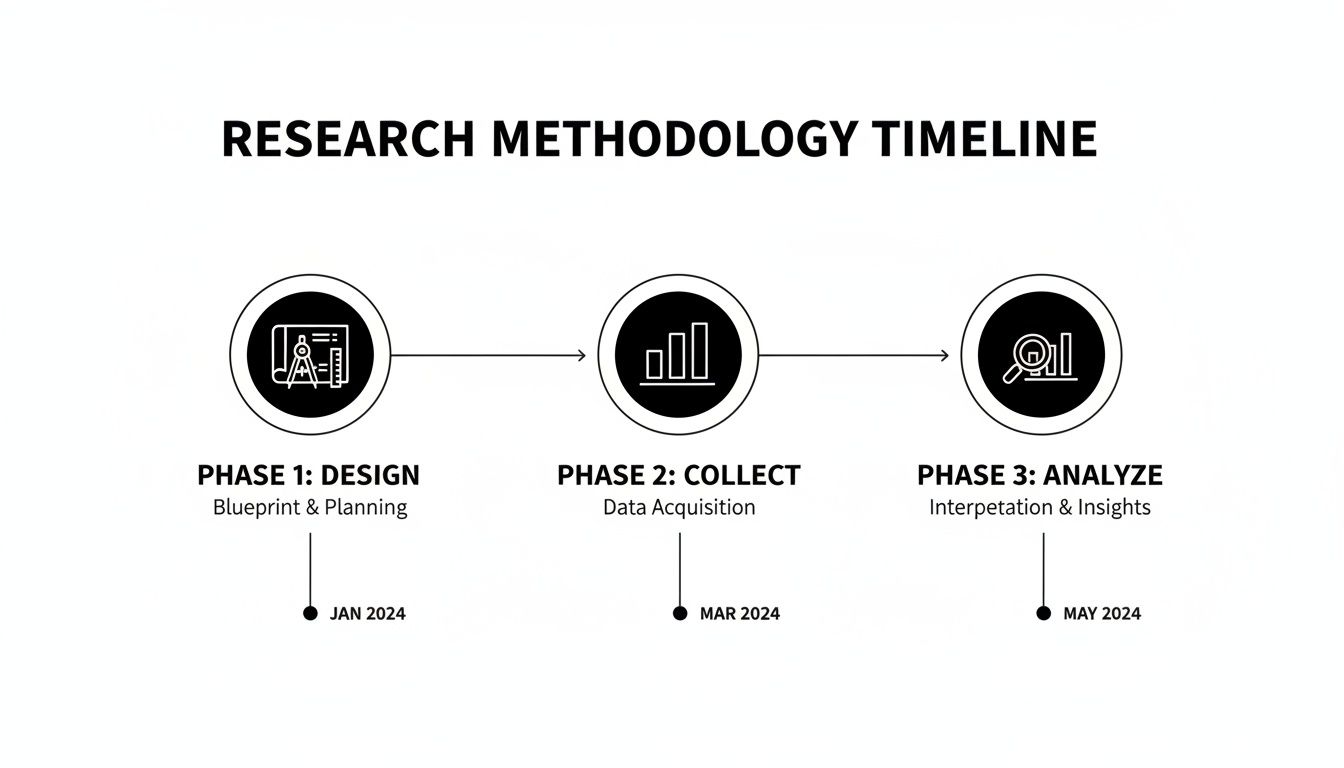
Mapping out your plan this way ensures that each stage flows logically from the one before it, creating a coherent and realistic blueprint for your work.
Choosing Your Research Design
First things first, you need to declare your overarching research design. Will you be taking a quantitative, qualitative, or mixed-methods approach? This decision isn't arbitrary; it has to be directly linked to your core research question. What you want to find out determines the best way to find it.
Quantitative Research: This is all about the numbers. It’s the right choice when you need to test a hypothesis, find correlations between variables, or generalize your findings to a larger population. Think surveys, controlled experiments, and structured observations.
Qualitative Research: This design dives deep into understanding experiences, motivations, and social contexts. It's perfect for exploring complex "why" and "how" questions through methods like in-depth interviews, focus groups, or case studies.
Mixed-Methods Research: By blending both quantitative and qualitative approaches, this design gives you the best of both worlds. You can use quantitative data to spot broad trends and then use qualitative data to understand the stories and reasons behind those trends.
It's not enough to just name your design. You have to defend it. Explain why a qualitative approach is the only way to truly capture lived experiences, or why a mixed-methods design is essential to both measure an intervention's impact and understand how it was perceived by participants. That justification is what separates a good methodology from a great one.
Outlining Data Collection Procedures
With your design set, it's time to get into the nitty-gritty of how you'll gather your data. This is often the most heavily scrutinized part of any proposal, so precision is key.
If you plan to conduct interviews, for example, who are you interviewing? How will you find and recruit them? This is your sampling strategy. Will you use purposive sampling to handpick individuals with specific knowledge, or will you use random sampling to ensure your results can be generalized?
Be explicit about your research instruments. If you're using a survey, attach it as an appendix or include sample questions. If you're running semi-structured interviews, list the guiding questions or themes you'll explore. This level of detail proves you’ve thought through the practicalities.
Detailing Your Data Analysis Plan
Collecting the data is just the beginning. How will you make sense of it all? A vague promise to "analyze the data" is a massive red flag for reviewers. Your analysis plan needs to be just as specific as your collection plan.
For quantitative data, name the specific statistical tests you’ll perform. Will you be running t-tests, a regression analysis, or something else? Mention the software you'll use, like SPSS or R.
For qualitative data, describe your interpretive framework. Are you using thematic analysis to identify recurring patterns? Or perhaps discourse analysis to unpack the use of language? Understanding the different qualitative research analysis methods is crucial for choosing—and justifying—the right approach for your project.
Funders and review committees now expect to see rigorous, data-backed plans. The days of getting by on a good idea alone are over; you have to prove your project’s potential impact with a solid analytical strategy.
Addressing Limitations and Ethical Considerations
No study is perfect, and a strong methodology acknowledges that. Showing that you’re aware of your study's potential limitations—like a small sample size or reliance on self-reported data—demonstrates critical thinking. Crucially, you should also briefly explain how you plan to mitigate these issues.
Finally, ethics are absolutely non-negotiable. You must clearly outline how you will protect your participants. This includes:
- Obtaining informed consent
- Guaranteeing participant anonymity and confidentiality
- Detailing your plan for secure data storage
- Mentioning your intent to seek Institutional Review Board (IRB) approval
When you cover these elements thoroughly, your methodology becomes more than just a to-do list. It becomes a powerful argument for your project's rigor, feasibility, and integrity.
Planning for Success: Nailing Your Timeline and Budget
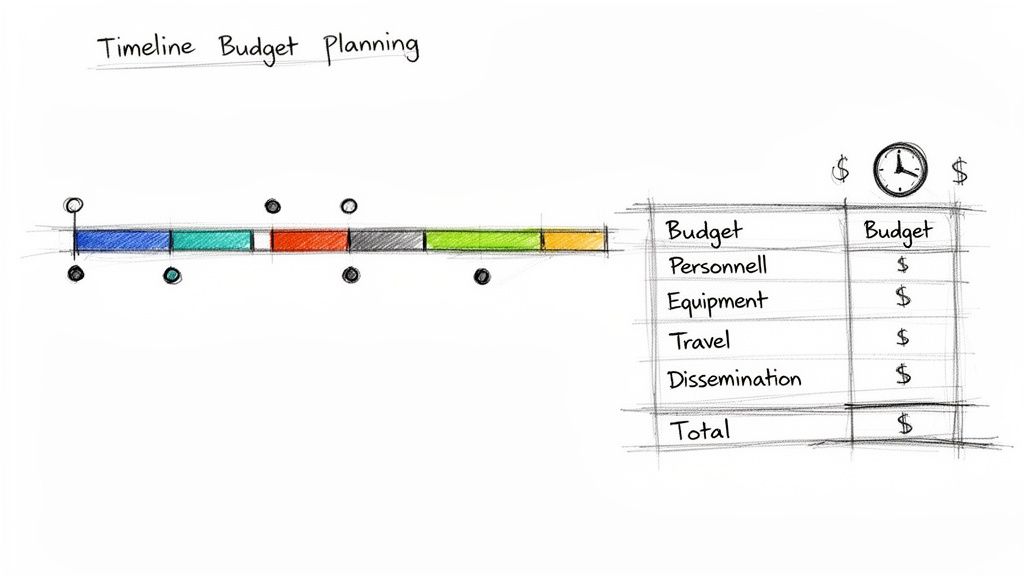
A fantastic idea only gets you so far. To really sell your research proposal, you have to prove that your project is not just brilliant, but also logistically sound and professionally managed. This is where your timeline and budget come in. These sections are your chance to show the review committee that you’ve thought through the practicalities.
Think of it this way: the timeline and budget transform your abstract concepts into a concrete, actionable plan. They’re not just bureaucratic hoops to jump through; they’re how you build trust. A well-crafted timeline shows you can steer a complex project to completion, and a detailed budget proves you'll be a responsible steward of their funds. Frankly, getting these right can make or break your proposal.
Charting Your Course with a Realistic Timeline
Your timeline is more than just a list of tasks—it's the strategic roadmap for your entire project. It breaks down the work into manageable stages and assigns deadlines, proving you understand the full scope of what you're undertaking. The key is to show how each part connects to the next.
For this, your best friend is the Gantt chart. It’s a simple bar chart that visually lays out your project schedule, showing the start and end dates for every major phase. It gives reviewers an at-a-glance understanding of your plan.
Here’s a typical way to structure it:
- Phase 1: Research Prep (Months 1-2): This is your setup phase. Think finalizing the literature review, getting that crucial Institutional Review Board (IRB) approval, and creating your tools, like survey questions or interview guides.
- Phase 2: Data Collection (Months 3-6): Often the heaviest lift. Get specific here. Are you conducting interviews? Running experiments? Distributing online surveys? Detail it.
- Phase 3: Data Analysis (Months 7-9): This is where you make sense of what you've found. You’ll be transcribing interviews, coding qualitative data for themes, or running statistical tests.
- Phase 4: Writing & Dissemination (Months 10-12): The final stretch. This covers drafting your paper, incorporating feedback, and submitting your work to journals or conferences.
A crucial piece of advice: be ambitious but not naive. Reviewers can spot an overly optimistic timeline from a mile away—it's a classic rookie mistake. Always build in a little buffer for the inevitable hiccups. Research never goes exactly to plan.
Justifying Every Dollar in Your Budget
The budget section isn’t just about asking for money; it’s about explaining why you need it. Every single cost you list must be a direct and necessary expense tied to the activities you've already outlined in your methodology and timeline.
A transparent, well-reasoned budget shows you're serious and professional. It builds immense credibility. In fact, the demand for well-written funding requests is so high that the global market for proposal writing services is expected to grow at a 7.1% compound annual rate from 2025 to 2035. You can dig deeper into these market trends to see just how important this skill has become.
Essential Budget Categories to Include
Organize your budget into clear, itemized categories. This makes it easy for reviewers to see exactly where the money is going.
| Category | Description and Justification Examples |
|---|---|
| Personnel | Include salaries or stipends for yourself, research assistants, or data transcribers. Justify their time (e.g., "Research Assistant at 10 hours/week for 6 months to assist with survey distribution and data entry."). |
| Equipment | List any essential hardware or software, like an audio recorder for interviews or a subscription to NVivo for qualitative analysis. You need to explain why you can’t use existing resources. |
| Travel | If you're doing fieldwork or plan to present at a conference, detail the costs for flights, lodging, and daily expenses. Always justify why the travel is necessary for the research. |
| Dissemination | Think about the costs of sharing your work. This could be journal publication fees (often called article processing charges) or printing costs for a conference poster. |
| Other Direct Costs | This is your catch-all for smaller items. Think participant incentives (like gift cards), printing and copying, or transcription services. Even small costs need a clear justification. |
By meticulously planning your project's schedule and finances, you’re sending a powerful message: your exciting research idea is firmly grounded in reality and ready for success.
10. Polishing Your Proposal and Avoiding Common Mistakes
This is it—the final hurdle. You've poured weeks, maybe even months, into shaping your research idea. The last thing you want is for a sloppy typo or a confusing sentence to derail all that effort. Polishing your proposal isn't just about catching errors; it's about making sure your hard work shines through.
Think of this stage as a final quality control inspection. You’re moving beyond just writing and into the realm of persuasion. This is your last chance to make your arguments tighter, your language clearer, and your overall document a powerful signal of your competence and attention to detail.
A Final Checklist Before You Submit
Don’t just give your proposal a quick once-over. A systematic review is the only way to catch everything. Before you even think about hitting that "submit" button, put your document through its paces with a checklist.
Here’s a practical guide for that final read-through:
- Clarity Check: Is your core research question completely unambiguous? Could someone from a different field read your introduction and immediately grasp what you're trying to achieve?
- Consistency Check: Look for disconnects. Do the objectives you laid out early on perfectly match the methods you describe later? Have you used key terms consistently from start to finish?
- Coherence Check: Read it for flow. Does your argument build logically from the literature review to the research gap and then to your proposed solution? Each section should feel like the natural next step.
A huge red flag for reviewers is a mismatch between the research question and the methodology. Double-check that every single data collection technique and analysis plan is there for one reason: to directly answer the questions you posed.
Refining Your Academic Tone and Originality
The final polish is also about tuning your academic voice. Your tone needs to strike a balance—confident but not arrogant, objective without being dry. Avoid casual language, but don't hide behind jargon. Every claim you make must be solidly anchored, either by evidence from the literature or by the logic of your methodology.
Of course, academic integrity is non-negotiable. It’s more than just a works cited page; it’s about genuinely synthesizing information and presenting it in your own voice. If you’re unsure about the finer points, taking some time to learn how to avoid plagiarism is a worthwhile investment. It’s a skill that will serve you throughout your career.
When you've been staring at the same sentences for weeks, getting the tone just right can be tough. This is where a tool like Rewritify can be a huge help. Its different modes are designed to help you rephrase clunky sentences, elevate your academic vocabulary, and ensure your arguments are presented with the precision your research deserves. It's the perfect final touch to make your proposal stand out.
Your Top Research Proposal Questions Answered
When you're staring down the barrel of a research proposal, a few common questions always seem to pop up. Let's tackle them head-on, because getting these sorted out early can save you a ton of headaches down the road.
How Long Should It Be, Really?
This is probably the most asked question, and the honest answer is: it depends. There’s no magic number. For a master's thesis, you might be looking at 10-15 pages. For a full-blown doctoral dissertation proposal, that number can easily climb to 20-40 pages.
The real key? Your institution's or funder's guidelines. Grant applications, in particular, often have very strict page limits you can't ignore. Always start by finding the official rulebook and treating it as your guide.
What's the One Mistake I Absolutely Have to Avoid?
If I had to pick just one, it’s an unclear or unfocused research question. This is the foundation of your entire project, and if it's shaky, the whole structure will collapse.
Your reviewer needs to understand exactly what you’re investigating from the get-go. A vague question leads to a weak proposal. Make sure yours is specific, measurable, and logically connected to the methodology you plan to use. If you can’t explain it clearly in a sentence or two, it’s not ready.
Can I Use AI Writing Tools to Help?
You can, but you have to be smart about it. AI can be a fantastic brainstorming partner. Use it to kickstart ideas, sketch out an outline, or find a better way to phrase that one awkward sentence you've been stuck on for an hour.
But here’s the critical part: never, ever just copy and paste what an AI gives you. The risk of accidentally plagiarizing or including a made-up "fact" is just too high. Treat AI as an assistant, not the author.
When it comes to the final polish, specialized academic rewriters are a much safer and more effective choice. They're built to refine your work—improving clarity and sharpening your academic tone—while keeping your original ideas and voice intact. You stay in complete control of the final submission, which is exactly where you want to be.
Ready to turn your draft into a document that commands attention? Rewritify is designed to help you polish your academic writing. It refines your tone and clarifies your arguments without changing your core message. Give it a try and see how easily you can perfect your research proposal.
Relevant articles

Learn how to structure an argumentative essay with our expert guide. We break down the thesis, body paragraphs, and counterarguments for a powerful paper.

Learn how to write an annotated bibliography with this comprehensive guide. Get actionable tips, real examples, and formatting advice for APA and MLA.

Learn how to write an effective essay rough draft. This guide provides actionable steps for turning messy ideas into a coherent and compelling paper.

Discover differences between formal and informal writing, with practical tips, examples, and syntax cues to choose the right tone every time.

Learn how to write a critical analysis with our guide. We cover everything from developing a thesis to structuring your argument and refining your final draft.

Learn how to write a position paper with our expert guide. Discover proven strategies for research, structuring arguments, and persuasive writing.