How to Write a Memo That Actually Gets Read
Tired of memos getting ignored? Learn how to write a memo that commands attention, drives action, and gets results with our expert guide and practical examples.
Writing a memo isn't just about throwing facts on a page. It's a structured, professional communication tool. You've got the standard format—TO, FROM, DATE, and SUBJECT—followed by a direct opening that gets straight to the point. The body fills in the necessary details, and the conclusion spells out exactly what needs to happen next. The magic formula? Be concise, factual, and focused on one single topic. This ensures your message lands cleanly and gets the quick action it needs.
Why Your Memos Still Matter in a World of Slack and Email
In a workplace flooded with instant messages and never-ending email chains, the classic memo might seem a bit old-school. But that’s precisely where its power lies. A memo is designed to cut through the digital chatter and serve as an official, permanent record of an important internal message.
This formality is its biggest asset. It’s a signal to everyone that the information is significant and demands attention. Think about it: a quick chat message is casual, but a formal memo carries weight. When you need to document a policy change, kick off a major project, or provide a definitive summary of a meeting, a memo establishes an authoritative voice that an email or Slack message just can't match.
Establishing an Official Record
At its core, a modern memo creates a paper trail. This is absolutely critical for a few key situations:
- Policy Updates: Making sure every team member is officially notified of new procedures or guidelines.
- Major Announcements: Documenting significant company shifts, like a restructuring or a new strategic plan.
- Formal Requests: Submitting a detailed request that needs official sign-off and documentation.
- Meeting Summaries: Providing a formal record of decisions and action items for everyone involved.
Of course, memos have moved from paper to pixels, a shift that makes them far more efficient in today's globalized work culture. With so many people working on virtual teams across different time zones, clear and official communication is more important than ever. Going digital also cuts down on printing and distribution costs—some estimates suggest savings of 20-30% on communication expenses. For more on this, you can dig into the latest communication statistics.
A well-structured memo doesn't just inform; it creates clarity and alignment. It ensures that critical information isn't buried in a long email thread or lost in a fast-moving chat channel, protecting both the sender and the organization.
Memos and Modern Productivity
Learning to write a solid memo is a direct investment in your professional influence. It streamlines communication by presenting information logically and concisely, which saves your readers precious time. In today's work environment, we're all looking for an edge. Using tools like dictation for Gmail can help you draft these documents much faster, letting you maintain a professional tone without slowing down. Mastering this skill shows a real commitment to clear and effective https://www.rewritify.com/blog/corporate-communication-best-practices, boosting your credibility and ensuring your most important messages are always received and understood.
The Anatomy of a Powerful Memo: Format and Structure
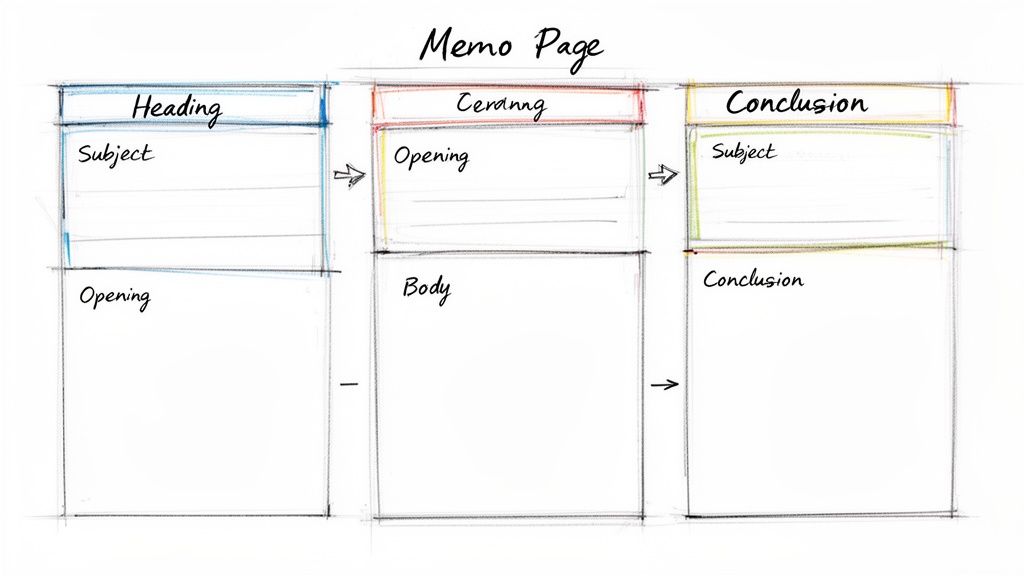
Every memo that actually gets read and acted on is built on a simple, powerful structure. Think of it less as a rigid template and more as a logical roadmap that guides your reader from one point to the next without any confusion.
This standard format is so widely recognized that people instinctively know where to look for key information. It all starts with a clear, no-nonsense heading.
The Essential Memo Heading
This isn't just a formality; it's your memo's business card. It instantly tells everyone who it's for, who sent it, when it was sent, and—most importantly—what it’s all about.
- TO: List the names and titles of your recipients. Get specific.
- FROM: Your full name and title.
- DATE: The complete date you’re sending the memo.
- SUBJECT: This is your headline. Keep it short, sharp, and descriptive.
The subject line is probably the single most important part of the heading. A vague subject like "Meeting Follow-Up" is a one-way ticket to being ignored. A much better option? "Action Items from the Q3 Project Kickoff Meeting." It's specific and signals that something needs to be done.
Crafting the Body of Your Memo
With the heading out of the way, the body of the memo is where you deliver the core message. I've always found it helpful to think of it in three distinct parts, each with a specific job.
First up is the opening statement. Get straight to the point here. In one or two sentences, state exactly why you're writing the memo. Are you announcing a new policy? Requesting information? Summarizing a decision? Your readers are busy—give them a reason to care from the very first line.
Next is the context and discussion section. This is where you fill in the necessary background or supporting details. Explain the problem or the reasoning behind your main point, but keep it lean. Only include what’s absolutely essential for your reader to understand the message. This focused approach is very similar to what you'd use when you learn how to write executive summaries.
Finally, you have the closing and action items. This part is all about clarity. State precisely what needs to happen next, who is responsible for doing it, and any deadlines. This is where you remove all guesswork and ensure your memo actually leads to a result.
Don't make your reader hunt for the takeaway. A powerful memo presents its purpose, provides lean context, and specifies the next steps with precision. The goal is clarity, not comprehensiveness.
Choosing the right structure often comes down to the purpose of your message. A quick request will naturally have a much shorter body than a detailed policy announcement. Before you even start writing, it helps to know what kind of memo you need to send.
Choosing the Right Memo Type for Your Message
Different situations call for different kinds of memos. This table breaks down the most common types to help you match your message to the right format for maximum impact.
| Memo Type | Primary Purpose | When to Use It |
|---|---|---|
| Request Memo | To ask for information, resources, or specific actions from colleagues. | When you need to formally document a request for budget approval, data from another department, or participation in a project. |
| Confirmation Memo | To officially document a decision, agreement, or conversation. | After a verbal agreement or meeting to ensure everyone has a shared, written understanding of what was decided. |
| Informational Memo | To announce changes, updates, or new information to a group. | Announcing a new company policy, sharing key findings from a report, or notifying staff of an upcoming event. |
| Directive Memo | To issue a clear instruction or command that requires compliance. | When a manager needs to communicate a new mandatory procedure, work schedule, or safety protocol. |
| Progress Report Memo | To provide a status update on an ongoing project or initiative. | For regularly scheduled updates to stakeholders, highlighting milestones achieved, challenges faced, and next steps. |
Ultimately, the key is to adapt the format to fit your message, not the other way around. Once you’re clear on your memo's purpose, you can build a structure that delivers your message efficiently and effectively.
Writing Frameworks That Command Attention
To get your memos read—and acted upon—you need more than just the right format. You need a framework. Think of these as proven communication strategies, not complex theories, designed to make your message clear, persuasive, and easy for a busy person to digest.
I've found that the most effective frameworks are often the simplest. Let's start with my personal favorite.
Get to the Point with BLUF
BLUF stands for Bottom Line Up Front. If you're writing for senior leaders, this isn't just a good idea; it's practically a requirement.
This communication style, born from the military, completely inverts how we're naturally taught to tell stories. You don't build up to the big reveal. You lead with it.
Why is this so effective? Executives are drowning in information and short on time. They need the most critical takeaway immediately to make a call. When you lead with your recommendation or key finding, you show respect for their schedule and prove you know what's important. Many of the same principles that apply to how to write executive summaries are just as crucial here for ensuring clarity and impact.
Let's say you're pitching a new software subscription. A BLUF opening gets straight to it:
I recommend we approve the purchase of ProjectFlow software for $15,000 annually. This will improve cross-departmental project efficiency by an estimated 20%.
In one sentence, the reader knows what you want, what it costs, and why it matters. The rest of your memo is simply there to back up that claim. It's a powerful approach that forces you to be crystal clear from the get-go.
Build a Persuasive Case with SCR
While BLUF is king for directness, some situations need a little more setup to get people on board. That's where the Situation-Complication-Resolution (SCR) framework comes in handy. It's a storytelling tool, made famous by consulting firms, that builds a logical and compelling argument.
The SCR structure guides your reader through a simple, three-part narrative:
- Situation: First, you state the current reality. This should be a neutral, factual overview that everyone can agree on. It establishes a common starting point.
- Complication: Next, you introduce the problem or challenge within that situation. This is the "so what?" of your memo—it creates urgency and explains why you’re writing.
- Resolution: Finally, you present your solution as the clear, logical answer to the complication you just outlined.
SCR has a stellar track record in high-stakes business. For example, McKinsey famously used it in a 2010 memo to help the US Postal Service tackle $3.5 billion in annual losses. They used it again to guide the global steel sector through a crisis, which led to reforms that restored an estimated $50 billion in profits by 2018. SCR provides a structured way to turn a complex mess into a clear, actionable plan.
Let’s look at our software proposal again, but this time using SCR:
- Situation: "Our marketing, sales, and product teams are all collaborating on the upcoming Q4 product launch."
- Complication: "However, they are using separate project management tools—Trello, Asana, and spreadsheets—which is causing missed deadlines, communication breakdowns, and duplicated work."
- Resolution: "By implementing ProjectFlow, we can bring all project tasks and communication into one unified platform, streamlining the entire launch process."
Mastering frameworks like BLUF and SCR will turn your memos from simple updates into influential tools that get things done.
Finding the Right Tone for Your Audience
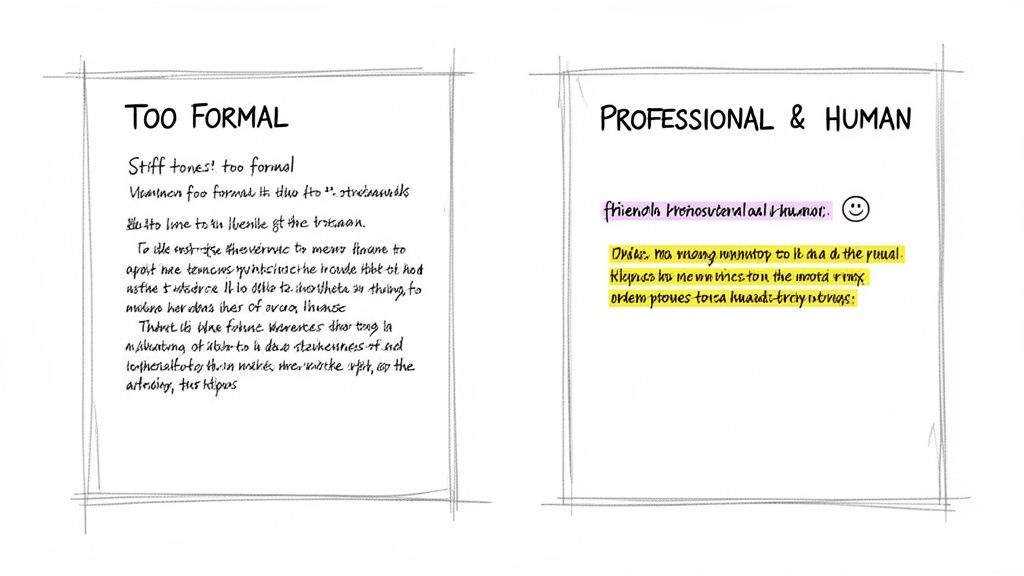
What you say in a memo is important, but how you say it is what gets people to actually listen. I've found that mastering a professional yet human tone is the real secret to writing a memo that people respect and act on. It’s all about striking that perfect balance—being authoritative without sounding cold, and clear without coming across as a robot.
The key is knowing your audience. A memo for the C-suite needs a different touch than one for your direct reports. Before I even start writing, I always ask myself: Who am I talking to, and what do they really need to know?
Adapting Your Language for Impact
The words you choose have a direct impact on how your memo is received. When you’re writing for leadership, get straight to the point. They’re busy, they care about the bottom line, so focus on outcomes and skip the granular details.
When you're communicating with your peers or team, you can afford to be a bit more collaborative. You might want to explain the "why" behind a new process or use language that encourages teamwork. It’s about being relatable while still being the person in charge.
One of the biggest mistakes I see people make is cramming their memos with corporate jargon and convoluted sentences. It doesn't make you sound smart; it just makes your message confusing. Always, always aim for clarity. Use simple, direct language that anyone can understand on the first read.
Writing with clarity and confidence is a form of respect for your reader's time. A memo that is easy to understand is a memo that is more likely to be acted upon.
This isn't just about sounding good—it has a real impact. Companies with strong internal communication see 47% higher returns for their shareholders over five years. A 2025 Staffbase study also found some interesting perception gaps: 66% of US employees thought their internal comms were great, but only 55% of German managers agreed, showing how much writing style can affect credibility.
Simple Tricks for a More Confident Tone
You don't need to be a literary genius to build a strong, professional tone. It really just comes down to a few simple habits. For a deeper dive, check out our guide on finding your tone of voice in writing.
Here are a few tricks you can start using right away:
- Write in the active voice. Instead of "A decision was made to update the software," say, "We decided to update the software." See the difference? The active voice is direct and shows clear ownership.
- Cut the weak phrases. Get rid of qualifiers like "I think," "it seems that," or "sort of." State your points with conviction. It projects confidence.
- Use formatting strategically. Bolding key dates, deadlines, or action items isn't just for looks. It makes your memo scannable and guides your reader’s eye to the most important information.
By being deliberate with your words and structure, you build trust with every memo you send. This isn't just about passing along information; it's about leading through clear, effective communication.
Your Pre-Delivery Checklist for a Perfect Memo
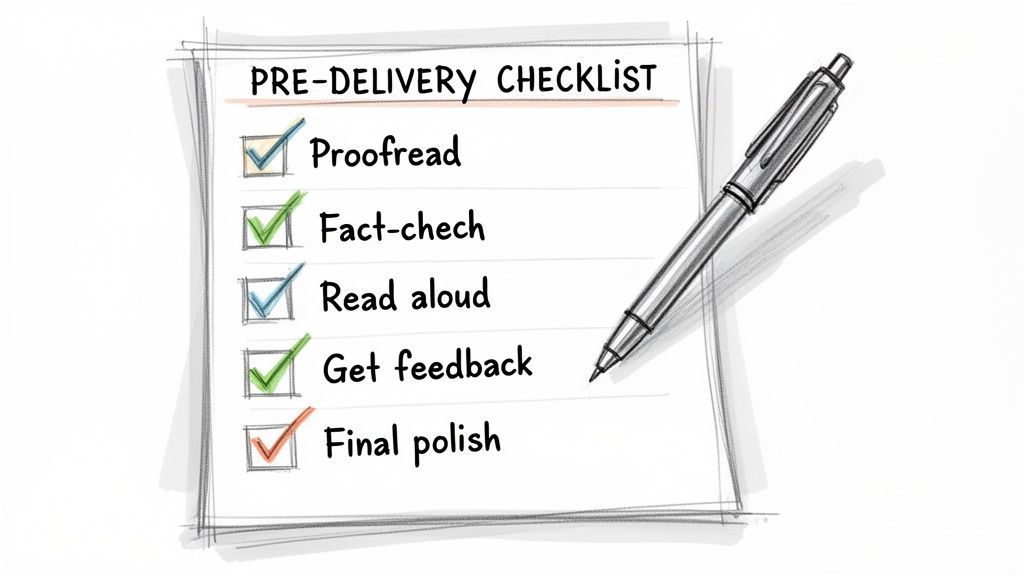
That final review is what separates a decent memo from a great one. Before you even think about hitting send, taking a few extra minutes to give your draft a final polish can make all the difference. This isn't just about catching typos; it's about making sure your message is completely foolproof.
Think of it as quality control for your ideas. A single unclear sentence or a small factual error can completely undermine your credibility. Start with the basics: hunt down any spelling and grammar mistakes, and then double-check every date, number, and name. Accuracy is non-negotiable.
Fine-Tuning Your Message
Once you've cleaned up the obvious errors, it's time to refine the delivery. One of the best tricks I've learned over the years is to read your memo out loud. It might feel a bit strange, but it forces you to slow down and listen to the rhythm of your writing.
This simple habit helps you instantly spot awkward phrasing, sentences that run on forever, or a tone that just doesn't land right. If you stumble while reading a sentence aloud, your reader is guaranteed to get tripped up. This is your chance to simplify your language and make sure your points flow naturally.
Next, find a fresh pair of eyes. Grab a trusted colleague and ask them to read your draft, specifically checking for clarity.
- Is the main point obvious right from the start?
- Are the action items crystal clear?
- Is there anything in the memo that feels confusing or ambiguous?
This kind of feedback is gold. Someone who isn't deep in the context can immediately point out gaps in your logic that you're too close to see. Be open to their suggestions—the goal is to create a document that works for your audience, not just for you.
A memo is only as good as its clarity. The final review isn't about chasing perfection; it's about removing every possible point of friction or misunderstanding for your reader.
Leveraging AI for a Final Polish
This is where modern tools can be a secret weapon. After you’ve manually refined the core message, an AI rewriter like Rewritify can give your memo that final, professional polish. It’s fantastic for fine-tuning your tone without erasing your own voice.
For instance, you could use it to rephrase a paragraph to sound a bit more authoritative or to simplify a few complex sentences for easier reading. AI tools are also great at finding stronger verbs and zapping repetitive phrases, which makes your writing feel more dynamic. It’s the last step to ensure your memo is clear, professional, and ready to make an impact. This isn’t about letting a robot write for you—it's about sharpening your own work to its finest point.
Answering Your Lingering Memo Questions
Even with a solid plan, a few questions always seem to surface right when you're about to start writing. Getting these details right is what separates a good memo from a great one, turning a simple update into a truly effective piece of communication. Let's dig into some of the most common questions I hear from professionals trying to master the art of the memo.
Think of this as the final polish—the small adjustments that ensure you’re handling every situation with confidence.
Memo vs. Email: What’s the Real Difference?
It’s easy to get these two mixed up, but the distinction is crucial. Think of a memo as an official internal broadcast, while an email is more like a direct conversation. Memos carry a certain formality and are built for significant internal news—think policy changes, major project kick-offs, or company-wide announcements. They create a permanent, official record.
Emails, on the other hand, are the workhorse of our daily lives. They're less formal and perfect for the constant back-and-forth with colleagues, clients, and vendors. A memo has weight; an email keeps the workflow moving.
Here's a simple rule I live by: If the information needs to be officially documented and easily found later by a group, write a memo. If you're starting a dialogue or just need a quick reply, stick with email.
How Long Should a Memo Be?
Keep it short. Seriously. The most effective memos are almost always one page or less. Your goal is to get essential information across quickly, and nothing buries a key message faster than a wall of text. Brevity is a sign of respect for your reader's time.
If you find yourself needing to include a ton of data or background context, don't cram it into the memo. Summarize the absolute must-know points in the memo itself and then attach the detailed reports or spreadsheets as a supplement. This strategy ensures your main message gets read and understood right away.
Can I Use Visuals Like Charts or Graphs?
Absolutely, and you often should. A well-chosen visual can do the heavy lifting for you, especially in a digital memo. A simple, clean chart can explain complex data or a performance trend far better than a dense paragraph ever could. It makes your point instantly more persuasive and memorable.
The key is to keep it relevant. Make sure any chart or graph directly supports your core message, is clearly labeled, and is easy to understand at a glance. It’s there to clarify, not to complicate things or show off your data skills.
Who Is the Audience for a Memo?
This one’s simple: a memo's audience is always internal. Memos are strictly for communication within your organization. You might be writing to a single person, a specific team, an entire department, or even everyone in the company. Unlike an email, which can go to anyone inside or outside your business, a memo stays home.
Ready to turn your drafts into polished, professional memos that get results? Rewritify can help you sharpen your tone, untangle complicated sentences, and make sure your message hits the mark. Give it a try and see what a difference it makes at https://www.rewritify.com.
Relevant articles

Discover differences between formal and informal writing, with practical tips, examples, and syntax cues to choose the right tone every time.

Learn how to write executive summaries that capture attention and drive action. Our guide covers structure, examples, and expert tips for busy professionals.