How to Write Product Descriptions That Actually Sell
Learn how to write product descriptions that connect with customers and boost sales. Our guide covers buyer personas, SEO, copywriting, and using AI tools.
Before you even think about writing, you need to know who you're writing for. A great product description isn't about your product—it's about your customer. The goal is to get so deep into their world that you can frame your product as the only logical solution to their problems. This is what turns a boring list of features into a conversation that sells.
First, Get Inside Your Customer's Head

This is the most critical step, and it happens before you write a single word. Generic descriptions fall flat because they try to appeal to everyone and end up connecting with no one. To write copy that actually resonates, you need a crystal-clear picture of your ideal buyer.
This goes way beyond basic demographics like age or location. You need to dig into the why behind their purchase. What's that nagging frustration they deal with every day? What big goal are they trying to reach? Your product isn't just an object; it's the tool that helps them get where they want to go.
In the exploding world of e-commerce, this customer-centric approach is everything. The copywriting market is expected to rocket from USD 27.96 billion in 2025 to USD 42.83 billion by 2030, all because businesses are realizing that emotional, engaging descriptions are what drive sales. You can discover more about the growth of the copywriting market and see just how vital this skill has become.
Building a Practical Buyer Persona
Let’s get practical. Imagine we're selling a durable, eco-friendly backpack designed for city commuters. Instead of just guessing what they want, we need to do some real detective work.
So, where do you find this goldmine of information?
- Customer Reviews: Dive into the reviews on your site and your competitors' sites. Are people constantly complaining about "flimsy straps," "disorganization," or being "worried about rain"? Those are your keywords.
- Online Forums and Communities: Hang out where your customers hang out. For a backpack, that might be subreddits like r/onebag or r/BuyItForLife. Listen to how they talk. What do they rave about? What are their biggest pet peeves?
- Social Media Comments: Your own social channels are a treasure trove. What questions pop up again and again? The language your followers use is the language you should be using.
This research helps us sketch out a real person. Let's call her "Sustainable Sarah."
Sustainable Sarah, 28, Graphic Designer
- Motivations: She values ethical brands and products built to last. Her goal is to feel organized and ready for anything, from a client meeting to an after-work yoga class.
- Frustrations: Cheap zippers that break are her enemy. She hates bags that turn into a "black hole" where everything gets lost and feels guilty about contributing to fast fashion.
- Language: She uses phrases like "thoughtful design," "investment piece," and "peace of mind."
From Persona to Persuasive Copy
Armed with this persona, your entire approach to writing shifts. You're no longer describing a backpack; you're talking directly to Sarah. You know exactly what bothers her, so you can present your product as the answer she's been searching for.
Instead of writing this: "This backpack has five compartments and a waterproof zipper."
You write this: "Finally, a backpack that ends the morning chaos. With five thoughtfully designed compartments, you'll never have to dig for your keys again. And that waterproof zipper? It gives you total peace of mind during unexpected downpours, keeping your laptop and sketchbook perfectly safe."
See the difference? We moved from listing features to solving Sarah's specific problems. This simple change is the foundation of every product description that works. It turns a generic pitch into a genuine connection, making your ideal customer feel seen, understood, and ready to click "buy."
Turn Features Into Compelling Benefits
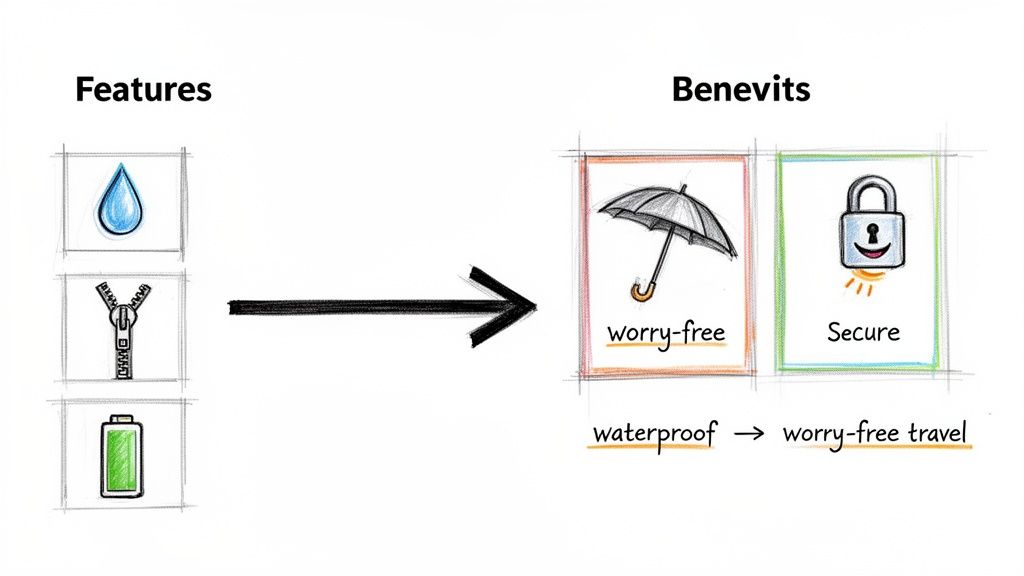
Okay, now that you know exactly who you’re talking to, it's time for a crucial mindset shift. Stop selling a product and start selling an outcome. It’s the classic marketing mantra: people don't buy a drill because they want a drill; they buy it because they want a hole in the wall.
This simple distinction is where persuasive copywriting really comes to life. A feature is a factual, often technical, statement about your product. Think "10-hour battery life" or "made with 100% organic cotton." But a benefit is the positive change that feature brings to your customer's life—"stream music all day without a single worry" or "soothe your baby's sensitive skin with the softest, safest material."
Mastering this shift is a game-changer. It's a core principle in modern content marketing, an industry set to blow past $107 billion by 2026. Why? Because it works. Benefit-focused descriptions can boost conversions by a whopping 20-40%, making this one of the most powerful tweaks you can make. If you want to dig into the numbers, these content writing statistics and insights are a great resource.
A Simple Trick to Uncover Real Benefits
Here’s a dead-simple technique I use all the time: the "So What?" test. For every feature you list, just ask yourself, "So what?" Keep asking that question until you land on a genuine emotional or practical win for the customer.
Let's try it with a smart thermostat:
- Feature: It has geofencing technology. (So what?)
- Answer 1: It senses when you're home or away. (So what?)
- Answer 2: It adjusts the temperature automatically. (So what?)
- Benefit: You always walk into a perfectly comfortable home and you save money on your energy bill without ever lifting a finger.
See? That final answer is the gold. It hits on convenience, comfort, and savings—the real reasons someone actually pulls out their credit card.
Feature vs Benefit Transformation Examples
Seeing this transformation side-by-side really makes it click. Here’s a quick table showing how to reframe some common product specs into benefits that actually resonate with a buyer.
| Product Feature (What it is) | Customer Benefit (What it does for them) |
|---|---|
| Noise-canceling headphones: Active noise cancellation technology | Benefit: Block out distractions and find your focus, whether you're on a plane or in a busy office. |
| Hiking boots: GORE-TEX waterproof membrane | Benefit: Keep your feet dry and comfortable through streams and surprise rainstorms. No more soggy socks. |
| Laptop: Solid-State Drive (SSD) | Benefit: Boot up in seconds and open apps instantly. Stop waiting and start doing. |
| Coffee maker: Programmable auto-start | Benefit: Wake up to the smell of freshly brewed coffee every single morning, right on schedule. |
This simple re-framing moves the conversation from your product’s specs to your customer’s life, which is exactly where you want it to be.
See It in Action: A Before-and-After Rewrite
Let's put this into practice with a real-world example. Here's a typical, feature-first description for a natural skincare serum.
Before: Feature-Focused Copy
"Our serum contains 2% hyaluronic acid and Vitamin C. It comes in a 30ml amber glass bottle with a dropper for application. The formula is vegan and cruelty-free."
Accurate? Yes. Compelling? Not a chance. It’s a list of ingredients, not an invitation to a better experience. Now, let’s inject some life into it by focusing on the benefits.
After: Benefit-Driven Copy
"Tired of dull, dehydrated skin? Our powerhouse serum delivers that dewy, youthful glow you've been searching for. A potent blend of hyaluronic acid quenches your skin's thirst for all-day hydration, visibly plumping fine lines. Meanwhile, Vitamin C brightens your complexion, fading dark spots for a more even, radiant tone. Feel great about your glow, knowing our formula is 100% vegan and cruelty-free."
Night and day, right? The second version speaks directly to the customer’s desires—a youthful glow, hydration, and an even skin tone. It translates technical jargon into tangible results, creating a much stronger emotional connection.
Key Takeaway: Always lead with the benefit. Start your sentences by describing what the customer gets, then explain the feature that makes it possible. This keeps the spotlight right where it belongs: on them.
A fantastic way to structure this is with a classic copywriting formula like PAS (Problem, Agitate, Solution).
- Problem: Pinpoint a real frustration your customer has. (e.g., "Hate juggling a tangled mess of chargers when you travel?")
- Agitate: Pour a little salt in the wound. ("You're always digging through your bag, only to realize you forgot the one adapter you actually needed.")
- Solution: Present your product as the hero. ("Our all-in-one travel adapter ends the chaos. One sleek cube powers your laptop, phone, and headphones at the same time.")
Using a framework like PAS naturally forces you to frame your product as the answer to a real-world problem. When you consistently translate what your product is into what it does for the customer, your descriptions stop just informing and start persuading.
Weaving in SEO Without Sounding Like a Robot
You can write the most beautiful, persuasive product description in the world, but if no one can find it, it’s not going to sell a thing. That’s where search engine optimization (SEO) comes in, but it’s a tricky balancing act.
The old-school approach of stuffing keywords everywhere is dead. Today, the goal is to naturally weave in the exact phrases your ideal customers are typing into Google. This gets your product discovered without making your copy sound robotic.
Finding the Right Keywords
First things first: you need to figure out what those phrases are. This takes a bit of detective work to understand what your customers are actually looking for. Your main keyword is usually pretty obvious—think "eco-friendly backpack."
The real gold, though, is in the long-tail keywords. These are the longer, more specific phrases that signal someone is much closer to buying. Think "waterproof commuter backpack for laptop" or "durable backpack with vegan leather." Someone searching for that knows exactly what they want.
Here are a few simple ways to uncover these gems:
- Google Autocomplete: Just start typing your main keyword into the search bar. The suggestions that appear are a direct look into what people are actually searching for.
- "People Also Ask" Section: This little box in the search results is a treasure trove of customer questions and concerns. Answer them in your description!
- Check Out the Competition: Take a look at the product titles and descriptions of the top-ranking products for your keyword. What language are they using?
Key Insight: Don't guess what people are searching for. Use real data from Google and your competitors to find the exact language your customers use. It makes all the difference.
Strategic Keyword Placement
Okay, you've got your list of keywords. Now, where do you put them? Tossing them in randomly won’t cut it. You need to be strategic.
For the biggest SEO impact, focus on these key areas:
- Product Title (H1): This is prime real estate. Your most important keyword needs to go here, preferably near the beginning.
- First 100 Words: Get your main keyword and a key secondary one into the first paragraph. This immediately tells both Google and your reader that they're in the right place.
- Subheadings (H2s or H3s): Use those long-tail keywords as subheadings. It’s a great way to break up the text and improve scannability.
- Image Alt Text: This is a frequently missed opportunity. Describe your images for visually impaired users (and search engines) using a relevant keyword.
If you want to go deeper on this, our guide on SEO copywriting best practices is packed with more detailed techniques.
Formatting for Humans and Search Engines
Believe it or not, how your description looks is almost as important as what it says. A giant wall of text will send shoppers running for the back button, and search engines don't like it much either.
Make your copy easy to scan. This drastically improves the user experience and helps search engines understand the most important parts of your content.
Here’s a simple but effective plan:
- Use Super Short Paragraphs: I’m talking one to three sentences, max. White space is your friend. It makes the page feel open and easy to read.
- Embrace Bullet Points: Got a list of features or benefits? Put them in a bulleted list. It's perfect for skimmers who just want the highlights.
- Bold What Matters: Draw the reader's eye to the most critical information. Bold key terms, benefits, or anything you absolutely need them to see.
When you pair smart keyword research with reader-friendly formatting, you get a product description that fires on all cylinders. To really boost your visibility, look into applying some proven SEO strategies to dominate search rankings. This two-pronged approach ensures you get found by the right shoppers and have the persuasive copy ready to turn them into customers.
Finding Your Brand's Authentic Voice
A product description is so much more than a list of features. It’s a conversation with your customer, and your brand's voice is the personality you bring to that chat. Getting it right is what makes a brand stick in someone's mind long after they've left the page.
Think about it this way: a witty, playful tone is perfect for a company selling quirky dog toys. It makes people smile. But that same voice would be a total misfire for, say, a high-end financial software firm where a confident, knowledgeable tone is what builds trust. The words you choose, the rhythm of your sentences—it all works together to create a distinct personality.
What's Your Brand's Personality?
A simple but powerful trick is to imagine your brand as a person. If your brand walked into a party, who would it be? The funny one telling jokes in the corner? The serious, insightful one everyone turns to for advice? Or the rebellious one challenging the status quo?
Thinking in terms of archetypes can really help you nail this down.
- The Sage: This is the expert. Think knowledgeable, trustworthy, and authoritative. A top-tier tech review site uses this voice, relying on precise language to educate its readers.
- The Jester: Playful, witty, and never takes itself too seriously. This is the voice of brands like Oatly or the early Dollar Shave Club ads that used humor to cut through the noise.
- The Nurturer: This voice is all about being caring, supportive, and reassuring. A brand selling natural baby skincare would use a gentle, comforting tone to connect with new parents.
Once you know who you are, the right words follow naturally. The Sage might talk about “precision engineering,” while the Jester would call something “ridiculously good.”
Your brand voice isn't just about what you say, but how you say it. It’s the consistent personality that shows up in every product description, email, and social media post, building a cohesive and memorable customer experience.
Keeping Your Voice Consistent
Consistency is everything. When your voice is clear and consistent across all your product listings, it builds recognition and, eventually, loyalty. Customers start to know you.
To make sure this happens, you have to write it down. Creating a simple style guide ensures everyone on your team—from copywriters to social media managers—is singing from the same hymn sheet. To get started, you can explore a comprehensive brand style guide template that covers everything from tone to punctuation. This becomes your North Star for all things content.
Let's look at a quick example. Imagine a company selling rugged outdoor gear that wants to be "The Explorer."
Product: A waterproof, all-weather tent.
- Weak Voice (Generic): "This tent is made from durable ripstop nylon. It has waterproof seams and can fit two people. The poles are aluminum."
- Strong Voice (The Explorer): "Built for the wild, not the backyard. Our tent dares storms to do their worst with rugged ripstop nylon and fully-taped seams. When the wilderness calls, this is your reliable shelter for every adventure."
See the difference? The second one isn't just selling a tent; it's selling the promise of adventure. It speaks directly to the customer's aspirations. That's how an authentic voice turns a simple description into a powerful sales tool.
Using AI to Write Descriptions at Scale
Let’s be honest: manually writing unique, persuasive copy for hundreds—or even thousands—of products is a soul-crushing amount of work. This is exactly where AI stops being a buzzword and becomes your most valuable assistant for scaling e-commerce content.
The goal isn't to let a robot take over. Think of it as a tool that can crank out solid first drafts, freeing you up to focus on the stuff that really matters: refinement, branding, and strategic tweaks. The right workflow lets you pump up your output without sacrificing quality.
This isn’t just a niche trick anymore; it’s becoming central to e-commerce. The market for AI text generators is expected to hit USD 1,402.3 million by 2030, and e-commerce was already grabbing a 24.6% revenue share back in 2022. That growth is all about the need for automated, SEO-friendly descriptions. The catch? Raw AI text often sounds flat and inauthentic, which is why a smart human-in-the-loop process is non-negotiable.
Crafting Prompts That Actually Get Results
The quality of your AI-generated draft is a direct reflection of the quality of your prompt. Vague requests get you generic, uninspired mush. If you want a draft that’s already 80% of the way there, you need to give the AI the right building blocks from the start.
Your prompt should be treated like a detailed creative brief. Don't just ask for a "product description." You need to feed it the core ingredients you've already figured out.
- Your Buyer Persona: Hand over your summary of "Sustainable Sarah." Tell the AI about her motivations, what drives her crazy, and the kind of language she connects with.
- Your Brand Voice: Define your brand's personality clearly. Are you "The Explorer" or "The Jester"? Give it a few keywords to capture your tone, like "adventurous, rugged, and reliable."
- The Benefit List: Don't just list features. Give it the feature-to-benefit translations you’ve already done. For instance, input "Feature: GORE-TEX waterproof membrane -> Benefit: Keeps your feet bone-dry and comfortable, whether you're crossing a stream or caught in a surprise downpour."
- Your Keywords: Feed it your primary and secondary SEO keywords so it can weave them in naturally from the get-go.
When you pack your prompt with this level of detail, you're not just asking the AI to write—you're guiding it. You're pointing it directly toward a draft that’s already aligned with your audience, brand, and SEO goals. As AI becomes more integral to how people find information, it also pays to understand how to rank content in ChatGPT for an extra edge.
The Human Touch: A Workflow from Draft to Final Copy
Getting a good draft from an AI generator is just the beginning. The real magic happens when you step in to edit and refine, adding the human touch that makes the copy compelling and truly original. This is where a rewriting tool like Rewritify becomes indispensable.
This graphic breaks down a simple workflow for zeroing in on and applying your brand voice.
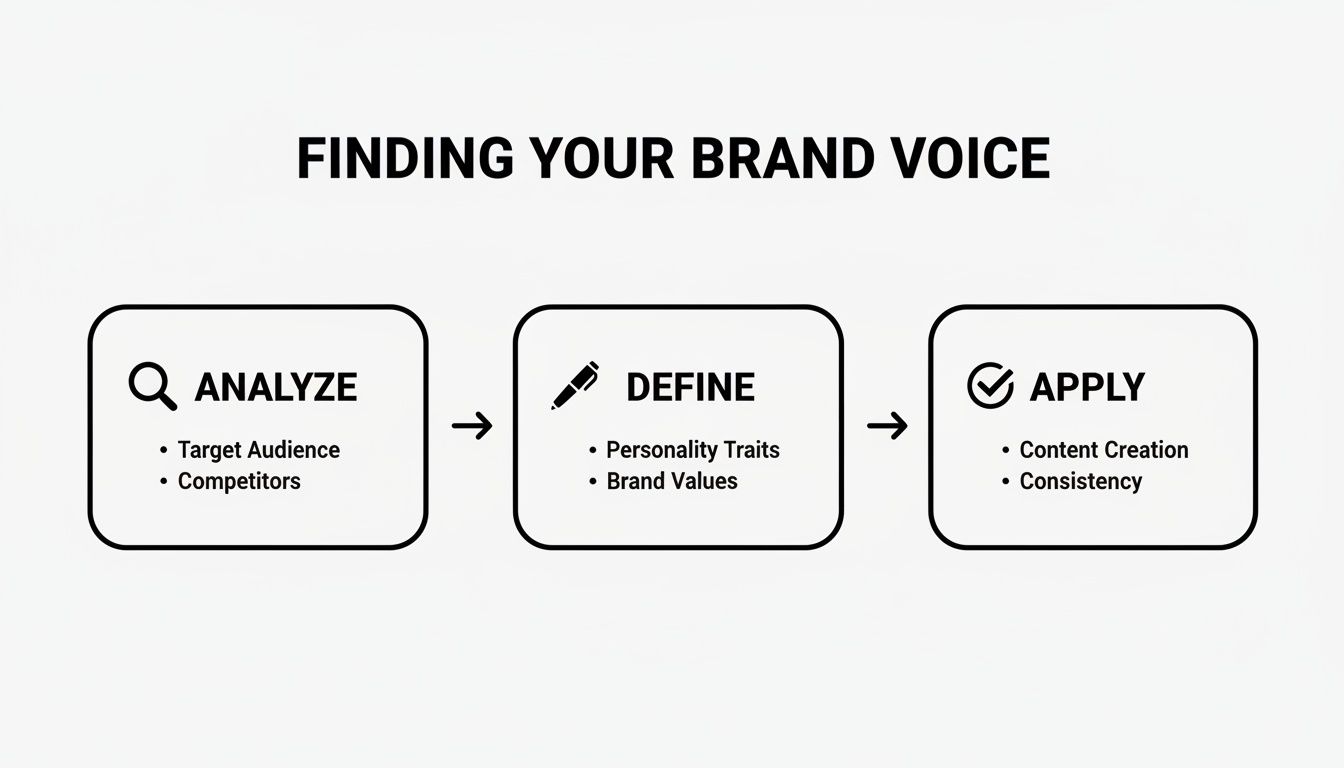
This process makes sure every piece of content, whether it started with AI or was written from scratch, consistently sounds like you.
Once you have that AI draft, it’s time to make it yours. Raw AI text can sound a bit formulaic and often lacks that unique spark your brand has. It can also get flagged by AI detectors, which is a growing concern for both content quality and SEO.
Key Takeaway: The best workflow is a partnership. Use AI for speed and scale to get the first draft done, then use a specialized tool to refine, humanize, and ensure the final copy is undetectable and perfectly on-brand.
This is where you can rewrite AI-generated text to take it from good to great. A tool like Rewritify is built for this exact job. It lets you cycle through different tones and phrasing until the description sounds exactly like something your brand would say. It also helps you check for originality and makes sure the copy flows naturally, sailing past even the toughest AI detectors. This final step is what transforms a generic AI draft into a polished, conversion-focused product description that feels 100% human.
Answering Your Top Product Description Questions
Even once you've gotten the hang of writing benefit-focused copy and nailing your brand voice, a few practical questions always pop up. It's the small details that elevate good copy into great copy, so let's dig into some of the most common questions I hear from people learning to write descriptions that actually sell.
Getting these right will help you polish your approach, making sure every description is clear, effective, and works hard for both your customers and for Google.
What's the "Right" Length for a Product Description?
Honestly, there's no magic word count that works for every single product. The ideal length really boils down to two things: how complex your product is and what your audience needs to know to feel confident buying it.
A simple item, like a graphic tee, probably only needs 50-100 words and a few clear bullet points. The customer gets it almost instantly, so a short, punchy description is all you need.
But for a bigger purchase—think a high-tech drone or a piece of handmade jewelry—you might need 300 words or more. These customers have more questions and need a lot more reassurance. A detailed description that walks them through every feature, benefit, and spec is what builds that crucial trust.
Here's a great strategy I always recommend: layer your information. Kick things off with a short, compelling paragraph to hook them. Follow that with scannable bullet points for the key benefits. Then, for those who want all the details, you can add a more in-depth description further down. This way, you cater to both the skimmers and the deep-divers.
The bottom line? Always prioritize clarity and answering your customer's questions over hitting some arbitrary word count.
How Many SEO Keywords Should I Actually Use?
When it comes to SEO, your mantra should be natural integration, not keyword stuffing. You're writing for a person, not just a search engine. A description that sounds robotic or repetitive will kill a sale, no matter how well it ranks.
As a general rule, a good balance to aim for is:
- One primary keyword: This is your main target, like "wool running shoes."
- Two to three related secondary keywords: These are variations or longer phrases, such as "merino wool sneakers" or "all-weather athletic shoes."
Your primary keyword should absolutely be in your product title and, if possible, somewhere in the first sentence or two of the description. This tells both readers and search engines what the page is all about. From there, weave your secondary keywords into the rest of the copy—in the main paragraphs, subheadings, or bullet points—wherever they fit naturally.
If the text starts to sound clunky or you find yourself repeating a phrase awkwardly, you've gone too far. A natural keyword density is usually around 1-2%, but readability is always more important. Don't sacrifice a smooth, persuasive flow just to cram in another keyword.
Can I Just Use the Manufacturer's Description?
I know it's tempting, especially when you have a ton of products to list, but please don't do this. Using the manufacturer's copy is one of the biggest—and most common—mistakes I see e-commerce stores make.
First off, it's a duplicate content nightmare. Search engines like Google want to show unique, valuable results. If your site has the exact same description as a hundred other retailers, it confuses Google and can seriously tank your product's chances of showing up in search results.
More importantly, the manufacturer's copy is almost always dry, generic, and totally lacks your brand's personality. It’s written for everyone, which means it truly connects with no one.
Writing your own descriptions is your chance to:
- Stand out from all the lazy competitors using the same text.
- Inject your unique brand voice and build a real relationship with shoppers.
- Focus on the specific benefits you know your customers care about.
- Boost your SEO with fresh, original content that Google loves.
If you're short on time, use the manufacturer's spec sheet as a reference for the technical stuff. But always, always rewrite the description from scratch to match your tone and speak directly to your ideal customer. It's one of the highest-impact things you can do to build trust and drive sales.
Ready to turn those AI drafts into compelling, original product descriptions that sound like you? Rewritify helps you refine your copy to perfectly match your brand voice while flying past AI detectors. Try Rewritify for free and see the difference.
Recent articles

Is ZeroGPT accurate? We tested its AI detection using 2026 data. See how it performs on false positives and reliability for students, writers, and marketers.

Master the difference between complement and compliment with our guide. Learn the definitions, grammar, and usage with clear examples to perfect your writing.

Discover our top 8 company bio example formats for websites, social media, and sales. Get templates and tips to write a bio that converts.

Discover 10 powerful not understandable synonyms to enhance your writing. Explore examples, tips, and contexts to improve clarity and precision.

Learn how to humanize AI generated text with proven strategies. Move beyond robotic writing to create authentic, engaging content that connects with readers.

Learn how to correct the sentence with practical grammar tips, proofreading tricks, and clear examples that boost clarity and confidence.