How to Write a Marketing Proposal That Wins Clients
Learn how to write a marketing proposal that turns prospects into partners. Our guide offers actionable tips on structure, pricing, and closing the deal.
Writing a great marketing proposal is about a lot more than just listing out your services. It’s a strategic deep dive. You need to start with some serious client research, nail down their actual goals, and then build a solution that solves their specific business problems. When you do that foundational work, your proposal stops looking like a cost and starts feeling like an essential investment in their future.
The Pre-Work That Wins the Deal
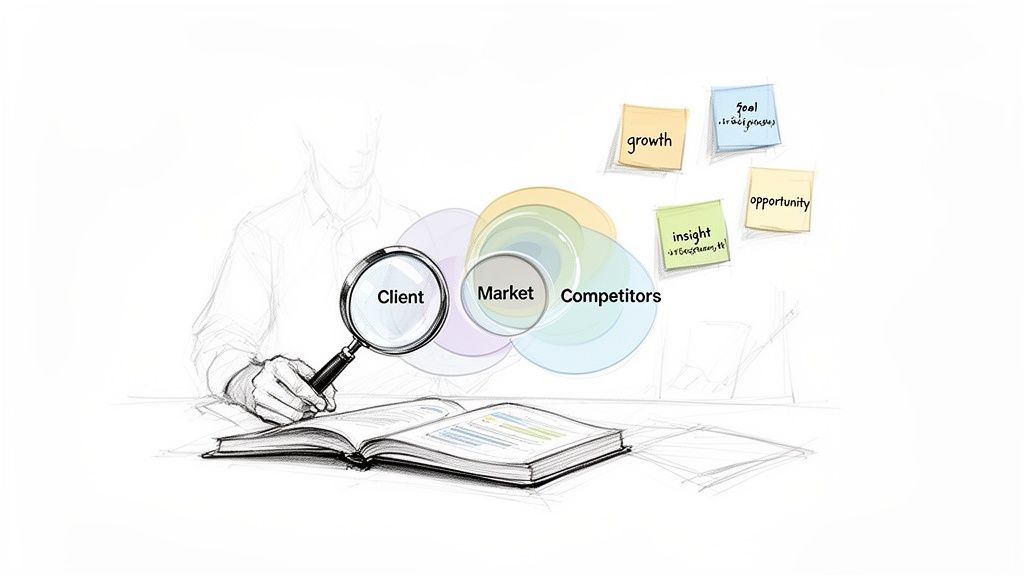
Before a single word of your proposal is written, the real work begins. This is your chance to stop being just another vendor and become a strategic partner. It’s a step too many agencies rush, which is why their proposals end up feeling generic and completely miss the mark. Doing your homework is how you prove you understand the client’s world better than anyone else.
The goal here is to get past their surface-level request. A client might say, "we need more social media engagement," but what they really mean is, "we need to boost qualified leads from social media by 25% to hit our Q4 sales target." Getting to that deeper "why" is what makes a good proposal impossible to turn down.
Uncovering the Real Problem with a Discovery Session
A focused discovery session is your best friend for digging deep. This isn't just a friendly chat; it's a strategic interview designed to pull out the exact information you'll need to build your entire strategy.
Your discovery process should zero in on a few key areas:
- Business Objectives: What are the company's big-picture goals for the next year? How does marketing fit into that vision?
- Target Audience: Who are their perfect customers? What keeps them up at night, and where do they hang out online?
- Competitive Landscape: Who are their top competitors? What are they crushing, and where are they dropping the ball?
- Past Efforts: What have they tried before? What worked, what didn't, and what did they learn?
Asking the right questions gives you the raw material to craft a solution that fits them like a glove. It also helps you spot any internal misalignments or unspoken assumptions on the client's side.
The secret to a winning proposal isn't a flashy design or a low price. It’s demonstrating an unshakable understanding of the client’s business and presenting a clear, logical path from their current pain to their desired future state.
Conducting Thorough Market Research
Once you've heard it from the client, it’s time to verify and expand on their perspective with your own market research. This shows you're proactive and an expert in your own right. Dive into industry trends, run a quick SEO analysis on their competitors, and see what you can learn from their social media presence.
This independent research often uncovers fresh ideas the client hasn't even thought of. Maybe you’ll find an untapped keyword opportunity or a content gap their competitors are completely ignoring. This is how you add value and build trust before they’ve even signed on the dotted line.
Keeping everything on-brand is crucial, so make sure you understand their brand guidelines inside and out. If they don't have a solid one, helping them develop one can be a huge value-add. You can learn more about this by checking out our guide on creating a brand style guide template.
The time you put in upfront really does pay off. The global market for proposal writing services was estimated at USD 1.89 billion in 2024, and strong proposals have been shown to hit win rates as high as 45%. In a crowded field, this level of research and professionalism is what turns a potential client into a long-term partner.
Crafting a Compelling Proposal Narrative
The best marketing proposals aren't just documents; they're stories. They need to guide your potential client from where they are now—stuck with a problem—to where they want to be, with you as the clear solution. Forget the dry, templated proposals you’ve seen before. Your job is to create a compelling narrative that makes them feel understood and confident in your ability to deliver.
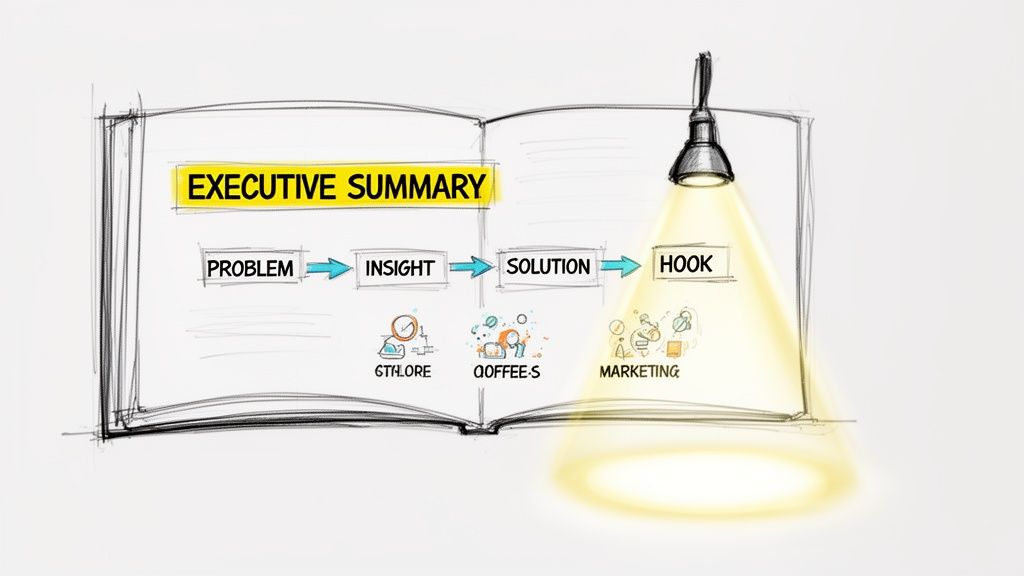
This story always starts with the executive summary. Think of it as the movie trailer for your entire strategy. If it doesn't grab them immediately, they're not sticking around for the feature presentation. This is your one and only shot to prove you get it.
Starting with a Powerful Executive Summary
Let's be real: many clients will read the executive summary and nothing else before deciding if you're even a contender. It has to be sharp, concise, and focused entirely on them.
The biggest mistake I see is agencies leading with information about themselves. Don't. Start by talking about the client's world. Hit them with their primary challenge right in the first sentence, using the same language they used with you on the discovery call. This immediately shows you were listening and builds instant rapport. Only then should you introduce your solution as the answer to that specific pain point.
A simple framework that always works:
- The Hook: Nail their core problem or main goal in a single, clear sentence.
- The Solution: Briefly introduce your strategy as the direct path to solving that problem.
- The Outcome: Paint a vivid picture of the results they can expect, tying it to real business impact like revenue or market share.
- The Differentiator: End with a quick line on why your team is uniquely equipped to make it happen.
Keep it tight. No jargon, no fluff. You're aiming for a high-level overview that communicates your entire value in just a few paragraphs. If you want to dig deeper into the mechanics, this guide on how to write executive summaries is a great resource.
A killer executive summary answers the client’s silent question: “Do these people actually understand my business?” If you can get a resounding “yes” in the first 200 words, you’re already halfway to closing the deal.
Structuring Your Solution and Strategy
Once you've hooked them with the summary, the rest of the proposal needs to unfold like a well-structured plan. This isn't the place to just dump a list of services. You have to frame every tactic as a critical piece of a larger strategy designed to solve their specific problem.
First, go deeper into their challenges and goals than you did in the summary. Show them you understand the nuances of their situation. This validates their concerns and perfectly sets the stage for your big reveal: the solution.
When you present your plan, connect every single service directly back to their objectives. The real magic of a winning proposal is showing why your offer is the best path forward, which is a lot easier when you follow a clear customer value proposition template.
Let’s look at a common scenario.
An E-commerce Brand with Stagnant Sales
- The Lazy Approach: "We will provide SEO services, a social media package, and two blog posts per month."
- The Expert Approach: "To reverse the decline in organic traffic and win back market share, we’ll execute a precision SEO strategy targeting high-intent buyers. We'll then amplify this by launching a social media campaign engineered to funnel qualified traffic straight to your product pages. To support this, we’ll build your site's authority with blog content that captures customers early in their buying journey."
See the difference? The second option tells a story. It links every action to a business outcome, making the value crystal clear even to someone who isn't a marketing pro. Always use benefit-driven language. Instead of saying, "we'll do keyword research," try, "we'll uncover the exact phrases your ideal customers are typing into Google to find products just like yours."
By structuring your proposal this way, you're not just sending a document—you're building an undeniable case for a partnership. Your proposal becomes the first chapter of their success story, written by you.
Defining a Scope That Protects You and Your Client
Let’s be honest: vague proposals are a one-way ticket to project chaos. They’re the single biggest cause of scope creep—that all-too-familiar nightmare where a project slowly bleeds beyond its original plan, killing your profit margins and frustrating your client. The only way to prevent this is to define your scope with absolute, undeniable clarity.
This isn't about being rigid; it's about being a professional. When you spell everything out, you’re protecting both sides. Your team knows exactly what to build, and your client knows exactly what they’re paying for. That kind of clarity builds trust right out of the gate and sets the stage for a great partnership.
Ambiguity is the enemy here. Vague promises like "ongoing social media management" or "SEO optimization" are red flags. Your job is to break those down into a specific list of what you will actually do.
Outlining Your Concrete Deliverables
Think of your scope of work as a detailed checklist, not a fluffy mission statement. You need to quantify everything possible. This is how you set clear expectations and show the client exactly what their money is buying.
Let's look at a real-world example of how to transform a vague promise into a rock-solid deliverable:
- What they hear (Vague): "Monthly social media support."
- What you deliver (Specific): "Monthly social media management for Instagram and LinkedIn, which includes:
- 12 static posts per month (8 for Instagram, 4 for LinkedIn).
- 4 short-form videos (Reels/Shorts) per month, up to 60 seconds each.
- A monthly content calendar, sent for approval by the 25th of the prior month.
- Community management for up to 1 hour per weekday (Mon-Fri, 9 am-5 pm EST).
- One 30-minute monthly performance review call."
See the difference? There's zero room for misunderstanding. The client can see the tangible value, which makes your pricing feel justified and gives them the confidence to sign off. The same goes for content. Don't just say "blog posts." Define the word count, the number of revisions included, and whether keyword research is part of the deal. Getting this right means you have to understand how each piece works together, which means applying solid content marketing best practices.
Think of your scope of work as the blueprint for your partnership. A detailed, well-defined blueprint ensures a stable structure, while a vague sketch is a recipe for collapse.
The Power of Defining Exclusions
Just as crucial as listing what you will do is clearly stating what you won't. This is your best defense against scope creep and saves you from having difficult conversations later. By setting these boundaries upfront, you show you've thought things through and are serious about protecting your time and resources.
A lot of clients simply don’t know what’s involved in the work. They might assume that when you say "social media ads," you're also covering the ad budget. Defining exclusions educates them and manages those expectations from the start.
I always include a section called "What’s Not Included" or "Project Exclusions." It’s a lifesaver. Here are a few common ones I use:
- Ad Spend: "This proposal covers the strategy, creation, and management of your ad campaigns. All ad spend is a separate cost and will be billed directly to the client's credit card on file with the ad platform."
- Stock Photography/Assets: "The fee does not include costs for premium stock photography, video footage, or font licensing. These assets will require separate client approval and will be billed accordingly."
- Website Code Changes: "While we will provide technical SEO recommendations, the implementation of any changes to the website's source code is not included. This must be handled by the client's own web developer."
This proactive step removes any guesswork. When you explicitly list what's out of scope, you ensure everyone is on the same page about the project's limits. It’s a simple move that fosters a partnership built on transparency and respect.
Presenting Timelines and Tiered Pricing
Once you've nailed down the scope, it's time to translate that strategy into a tangible plan. This is where you show the client not just what you’ll do, but when you’ll do it and what the investment looks like. Honestly, a clear timeline and smart pricing can make or break the deal, turning a solid proposal into one they can't wait to sign.
A project timeline is more than a list of dates; it’s a visual roadmap to their success. It proves you have a repeatable, structured process for getting results. I've found that breaking the project into clear phases—like discovery, strategy, execution, and reporting—goes a long way in managing expectations and building their confidence in you from day one.
Building a Realistic and Visual Timeline
Your timeline needs to be dead simple. So simple that someone who knows nothing about marketing can understand it at a glance. Ditch the technical jargon and focus on the big milestones that connect directly back to their business goals. Think in terms of phases that show real, tangible progress.
Here’s a typical flow I often use:
- Phase 1: Kickoff and Onboarding (Week 1-2): This is where we have our initial strategy meeting, get access to all the accounts we need, and do a deep-dive audit of what they're currently doing.
- Phase 2: Strategy and Content Development (Week 3-4): Next, we present the finalized content calendar, ad creative concepts, and the overall campaign framework for them to approve.
- Phase 3: Campaign Launch and Optimization (Week 5-8): This is the fun part. Campaigns go live, and we get into the daily rhythm of monitoring and fine-tuning performance.
- Phase 4: Reporting and Review (Ongoing): We'll schedule regular check-ins, usually weekly or bi-weekly, to go over KPIs and talk about any strategic adjustments.
Visuals are everything here. A simple graphic can make the entire scope of work feel concrete and manageable. It’s the easiest way to show the relationship between your deliverables, the project boundaries, and the outcomes they care about.
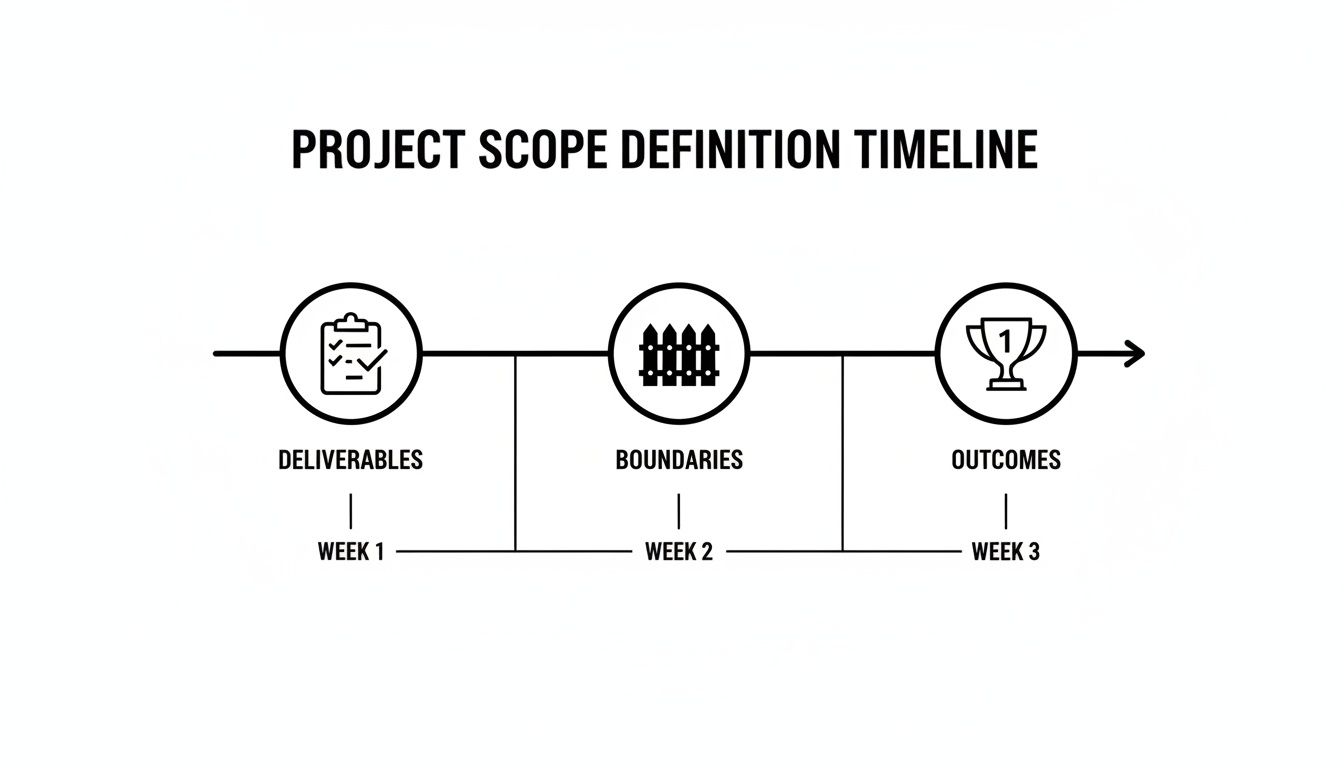
This kind of visual instantly communicates the project’s flow and reassures the client that you know exactly when each milestone will be hit.
Closing More Deals with Tiered Pricing
The old-school, single-price, take-it-or-leave-it proposal is dead. The best proposals today give clients a choice. When you present tiered pricing options, you immediately shift the conversation from "Is this too expensive?" to "Which option is the best fit for us?" That little psychological trick empowers the client and has dramatically increased my own closing rate over the years.
This approach shows you're a flexible partner who gets that different businesses have different budgets and goals. It's also a fantastic upselling tool, as it clearly lays out the extra value they get by investing just a bit more.
A classic three-tier structure often looks something like this:
| Tier Name | Best For | Key Feature Focus |
|---|---|---|
| Starter | Businesses new to marketing or with a limited budget. | Core, foundational services (e.g., SEO audit, basic social media). |
| Growth | Companies looking to scale their existing efforts. | A comprehensive mix of services (e.g., content creation, ad campaigns). |
| Accelerator | Market leaders aiming for aggressive expansion. | Premium, high-touch services (e.g., advanced analytics, dedicated strategist). |
The secret is to make your middle tier—the level you actually want them to choose—the most compelling option. Position it as the best value, offering a major jump in services from the starter package without the premium price tag of the top tier.
Tiered pricing isn’t just about money; it's about control. Giving clients the power to choose their investment level makes them feel respected and understood, which is the foundation of any great long-term partnership.
The quality of your proposal is everything, especially when you consider the competition. The global digital advertising and marketing spend is projected to hit USD 786.2 billion by 2026. That number shows just how much companies are willing to invest, and your proposal has to be sharp enough to earn a piece of that budget. For more on the massive growth in this space, you can find some great insights on B2B marketing and content strategy on Siege Media.
By laying out a clear timeline and smart pricing, you're not just selling services—you're demonstrating the professionalism needed to manage their investment effectively.
Bringing It All Home: Polishing and Presenting Your Proposal
You’ve put in the hours. The research is done, the strategy is sharp, and you've built a compelling case. But the final impression is often the one that sticks, and the last thing you want is a sloppy typo or a fumbled presentation to tank all your hard work. This is where you bring it home.
A clean, professional proposal doesn't just look good—it screams competence. It shows you care about the details, which is a quality every single client is looking for in a partner. Before you even dream of hitting that "send" button, it's time for a top-to-bottom quality check.
Your Pre-Flight Checklist
This isn't just about running a quick spell-check. Think of this as a comprehensive audit of your work. I've found it helps to review the document in a few separate passes, each time looking for something different.
First off, read it out loud. It feels a bit silly at first, but this trick is gold for catching clunky sentences and grammatical mistakes your brain automatically corrects when reading silently. You’ll hear exactly how the text flows—or doesn't.
Next, you need a fresh set of eyes. You’re simply too close to it now. Grab a trusted colleague and ask them to give it a once-over for clarity, consistency, and any glaring errors. An outside perspective will catch things you've become completely blind to.
Finally, do a quick formatting sweep.
- Consistent Branding: Do your fonts, colors, and logo look the same on every page?
- Easy on the Eyes: Is there enough white space? Have you used headings and bullet points to break up big blocks of text and make it scannable?
- Smart File Naming: Name your PDF something professional like
[Client Name] Marketing Proposal - [Your Agency Name].pdf. It’s a tiny detail that shows you’re organized from the get-go.
A proposal with typos is like showing up to a big meeting with a coffee stain on your shirt. It makes the client question your attention to detail and wonder what else you might overlook if they hire you.
Nailing the Presentation
How you deliver the proposal is just as important as what's in it. Never, ever just email it over with a generic, "Let me know what you think!" Always schedule a call to walk them through it, whether it's in person or over video.
Your goal isn't to read the document to them—they can do that themselves. You're there to tell the story behind the document, guiding them through your thinking and painting a picture of what success will look like. It's a performance. And to really deliver with impact, knowing how to create a perfect presentation deck can make a world of difference in your confidence and persuasiveness.
Keeping the Momentum Going
Your job isn't done after you hang up. A smart follow-up sequence keeps you top of mind without being annoying. I've had a lot of success with a simple three-step rhythm:
- The 24-Hour Recap: A day later, send a brief thank-you email. Summarize the key takeaways from your conversation and restate the core value you’re bringing to the table.
- The Gentle Nudge (3-4 days later): If you haven't heard back, send a quick, no-pressure note asking if they have any follow-up questions. You can even include a link to a relevant case study or article to add value.
- The Final Check-In (1 week later): One last friendly email to see if they've had a chance to make a decision. This closes the loop respectfully and professionally.
This structured, professional approach is becoming the standard. In fact, the market for proposal management software was valued at USD 3.2 billion in 2025 and is projected to hit USD 9.0 billion by 2035. This huge growth, detailed by Future Market Insights, shows just how seriously businesses are taking this process. Putting that final polish on your proposal isn't just a "nice-to-have"—it's how you compete and win.
Fielding the Tough Questions on Your Marketing Proposal
No matter how airtight your proposal is, clients will have questions. And that's a good thing. Questions mean they’re engaged, they’re thinking seriously, and they’re picturing what it’s like to work with you. The way you handle these conversations is what separates the seasoned pros from the rest.
Think of it less as "handling objections" and more as an opportunity. It’s your chance to clarify your value, showcase your expertise, and build the trust that truly closes a deal. Let’s walk through the big ones you’re almost guaranteed to hear.
What to Say When They Question the Price
This is the classic. "Your price is higher than we expected." It's a phrase that can make even experienced marketers sweat a little. Your gut reaction might be to jump into a defensive justification of your costs, but that's a losing game.
A better approach? Gently guide the conversation back to value and return on investment.
When a client brings up the budget, they’re rarely hung up on the number itself. What they're really asking is, "Can you guarantee this investment will be worth it for my business?" The absolute worst thing you can do is offer a discount right away—it instantly cheapens your work.
Instead, try framing the conversation like this:
- Tie it back to their goals. "That's a completely fair question. Let's look back at the revenue goals we talked about. This plan is engineered to generate a return that makes this investment look small. We aren’t just running campaigns; we're building a system to drive $X in new pipeline."
- Show them where the money goes. You don't need to give them a line-item breakdown, but you can explain the 'why' behind the cost. "The investment covers the strategy, the creative, the daily management, and the expertise needed to hit those specific targets we mapped out."
- Point to your pricing tiers. If you offered options, now is the time to leverage them. "I understand if the Accelerator package is a stretch right now. The Growth package is designed to get the foundational work done and deliver significant results, and we can always scale up from there."
When a client questions your price, they aren't looking for a bargain. They're looking for confidence. Your job is to connect the dots between your fee and their biggest business goals.
What to Do When They Want Results Yesterday
"This looks great, but can we get it done in three months instead of six?" Ah, the rush job. The desire for speed is totally understandable, but as the expert in the room, it's your job to set expectations that are grounded in reality.
Promising the moon on an impossible timeline is a surefire way to end up with a failed project and a torched relationship.
Your best bet is to explain why your timeline is structured the way it is. It’s not arbitrary; it's strategic. It's built for sustainable, long-term growth, not a flash-in-the-pan spike in vanity metrics. Sometimes, a simple analogy does the trick.
You could say something like: "I get it. You're eager to see results. Think of it like building a house. Sure, we could throw up the walls in a week, but the foundation would be weak, and it would start cracking in a year. Our timeline makes sure we build a rock-solid marketing foundation that will support your growth for years, not just months."
Show them your timeline visually. Explain how Phase 1 (research and strategy) is the essential groundwork for Phase 2 (campaign launch) to succeed. When they see each step as a necessary building block, the timeline suddenly feels logical and completely justified.
How to Answer, "How Will We Measure Success?"
Honestly, this is the best question you can get. It means the client is already thinking about results, which is exactly where their head should be. Before diving into a sea of acronyms, bring it back to the big picture—the business goals you're both aiming for.
Your answer should really have two layers:
- The C-Suite KPIs: Start with the numbers the CEO and investors actually care about. Connect your work directly to metrics like Customer Acquisition Cost (CAC), Lifetime Value (LTV), lead-to-customer conversion rate, and—the most important one of all—revenue.
- The In-the-Weeds Metrics: These are the tactical numbers that show how you're driving those bigger goals. This is where you talk about click-through rates, cost per lead, organic traffic growth, and social media engagement rates.
The key is to show them you have a clear plan for reporting. Propose a weekly, bi-weekly, or monthly meeting where you'll review a dashboard that tracks both sets of metrics. This shows you’re all about transparency and accountability.
By clearly defining what success looks like from day one, you build immense confidence. You’re not just a vendor executing tasks; you’re a strategic partner managing their investment with a laser focus on tangible business growth.
Ready to create proposals that not only impress but also convert? Rewritify helps you refine every section, from the executive summary to the final call-to-action, ensuring your message is clear, persuasive, and professional. Transform your drafts into winning documents at https://www.rewritify.com.
Relevant articles
Discover winning business proposal format examples that secure more clients. Learn the essential structure and insider tips to make your proposals stand out.