Winning Business Proposal Format Examples That Actually Close Deals
Discover winning business proposal format examples that secure more clients. Learn the essential structure and insider tips to make your proposals stand out.
A solid business proposal is your ticket to getting noticed and, more importantly, closing the deal. The format you choose isn't just about making things look good; it's a strategic tool that organizes your ideas, guiding a potential client smoothly from their problem to your solution. I’ve seen some of the best business proposal format examples act as a roadmap, proving a company's competence long before the pricing page is even clicked.
Why Your Proposal Format Is Your Secret Weapon
Let's be real: a brilliant idea can absolutely die on the vine if it's presented poorly. The structure of your proposal is just as important as the solution you're selling because it's the very first impression you make. It’s not just about appearing professional—it’s about respecting your client's time and building a foundation of trust right out of the gate.
A clear, scannable format does more than just look clean. It subtly steers the client's decision-making process, showing them that you're organized, you care about the details, and you’re focused on them from the start. This simple act of clarity can give your chances of winning the project a serious boost.
The Psychology Behind a Strong Format
A well-organized proposal actually gives you a psychological edge. When you lay out information in a predictable, easy-to-digest way, you lower the mental effort required from the reader. This frees them up to focus on the incredible value you’re offering instead of hunting for key details.
Think of it like this:
- Executive Summary: This is your hook. A powerful summary can make or break the entire proposal. If you want to dive deeper, check out our guide on how to write executive summaries.
- The Problem: This section proves you've been listening and that you truly get their specific pain points.
- Your Solution: Here, you clearly connect what you do to what they need, always framing it in terms of the benefits they'll see.
- Pricing: Your pricing should be transparent and straightforward, leaving no room for doubt or confusion.
Your format is a silent promise to the client: working with you will be just as clear and organized as the document they're holding. It's a powerful non-verbal cue that builds confidence.
Stand Out in a Crowded Inbox
The hard truth is that most businesses only win 20-30% of the project proposals they submit. That’s a lot of potential revenue left on the table, often due to clunky formatting and uninspired content. A winning proposal usually falls somewhere between 5-20 pages, and with a third of readers now opening documents on their phones, a mobile-friendly format isn't a "nice-to-have"—it's a necessity. You can find more proposal statistics over at TimelyText.
In the end, a strategic format is what pulls your proposal out of the pile and puts it on top.
Anatomy Of A Winning Business Proposal
To help you get started, here's a quick breakdown of the essential components every effective business proposal should have. Think of this as your checklist for success.
| Section Component | Purpose And Key Focus |
|---|---|
| Title Page | Makes a professional first impression with your brand, client's info, and a clear title. |
| Executive Summary | A concise, high-level overview that hooks the reader and summarizes the entire proposal. |
| Problem Statement | Clearly defines the client's challenge, showing you've done your homework and understand their needs. |
| Proposed Solution | Details your specific plan, methodology, and the services you'll provide to solve their problem. |
| Deliverables & Timeline | Outlines what the client will receive and when, setting clear expectations from the start. |
| Pricing / Investment | Presents a clear, transparent breakdown of costs, fees, and payment terms. |
| About Us / Case Studies | Builds credibility by showcasing your company's experience, team, and past successes. |
| Terms & Conditions | The legal fine print covering the scope of work, confidentiality, and payment schedules. |
| Call to Action | Tells the client exactly what to do next to move forward, such as signing the proposal. |
Getting these sections right provides a logical flow that makes it easy for a client to say "yes."
Deconstructing The Core Elements Of A Winning Proposal
Every truly great proposal tells a story. While the details shift from one industry to another, a core structure has proven itself time and again. Think of it less as a rigid template and more as a narrative arc that guides your prospect from understanding their own problem to seeing your solution as the inevitable conclusion.
Most winning proposals are built around 7-8 key sections: a title page, a table of contents (don't skip this for anything over 8 pages), an executive summary, a deep dive into the problem, your proposed solution, your qualifications, pricing, and the terms. This isn't just a random assortment; it's a blueprint designed to build a persuasive case, a structure you'll see echoed by top proposal software and industry experts.
This visual really captures how these elements work together.
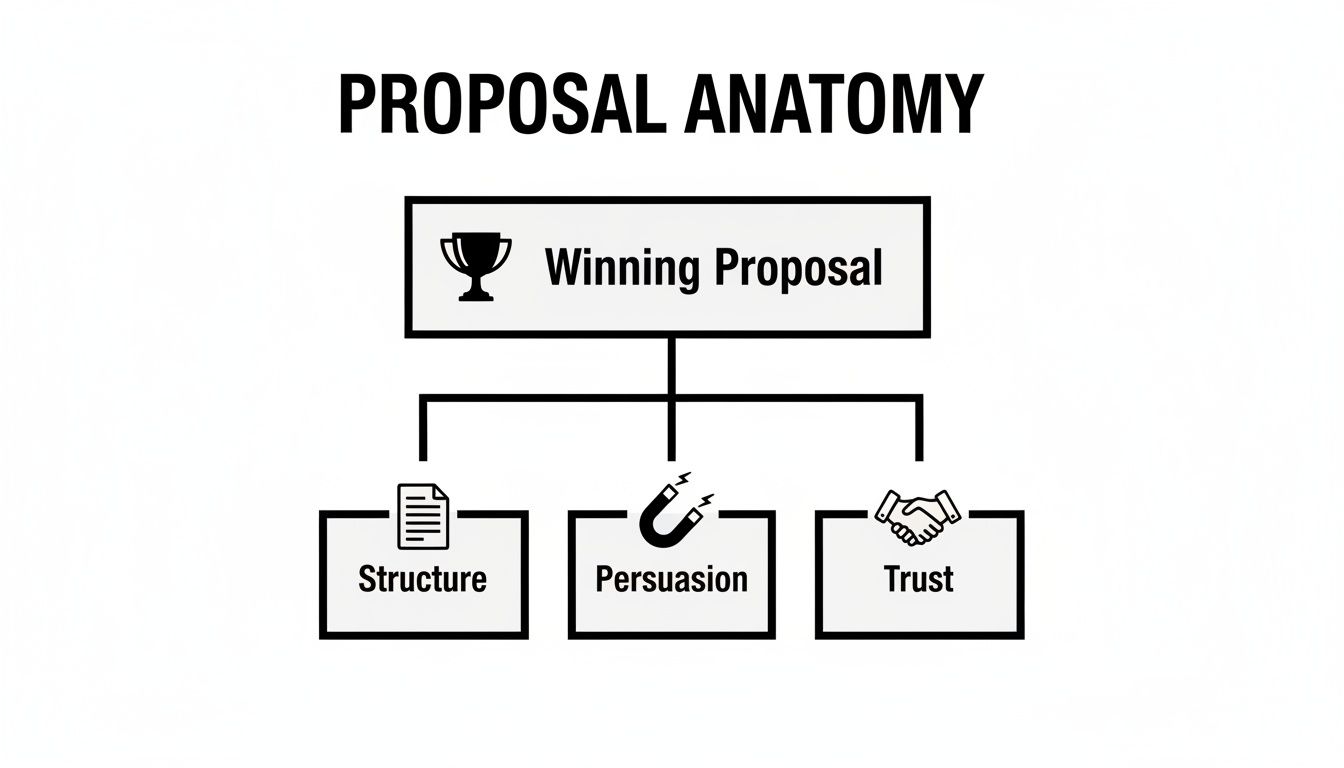
As you can see, the document’s structure is just the skeleton. The real magic happens when you layer on persuasion and build genuine trust. Every single section you write needs to support one of these three pillars.
The Opening Hook: Title Page and Executive Summary
First impressions matter. Your Title Page is the digital handshake—it needs to be professional, branded, and state exactly what the document is for. Right after that comes the Executive Summary, which I’d argue is the most important page in the whole document. This isn't a fluffy intro; it's your entire pitch, boiled down to its most potent form.
Let's be real: busy executives might only read this one page. It has to hook them immediately by summarizing their core problem, teasing your brilliant solution, and spelling out the incredible value you bring to the table. If this summary doesn't grab them, the rest of your proposal might as well be invisible. For a deeper look at this, check out our complete guide on how to write business proposals.
Building The Case: Problem, Solution, and Qualifications
Once you have their attention, it's time to build your argument, piece by piece. You start with the Problem Statement. This is your chance to prove you've been listening. Go deep into their challenges and show you’ve done your homework. It builds immediate rapport.
Next up is the Proposed Solution. This is where you draw a direct line from their pain points to your services. Always, always frame this in terms of benefits, not just features. Don't say, "We offer SEO services." Instead, try something like, "We will boost your organic traffic by 40% in six months, which will deliver a steady stream of qualified leads directly to your sales team." See the difference?
Finally, the Qualifications (or "About Us") section is where you back it all up with proof. This is prime real estate for:
- Short, punchy case studies
- Client testimonials that showcase real numbers
- Team bios that highlight experience directly relevant to this client's needs
A rookie mistake is to treat the "About Us" section like a boring company history lesson. Nobody cares when your company was founded. Tailor it. Show them precisely why your team's specific background makes you the only logical choice for their project.
When you follow this flow, you build so much credibility that the final pricing and terms sections feel less like a hurdle and more like a simple, final step to getting started.
Real-World Business Proposal Format Examples
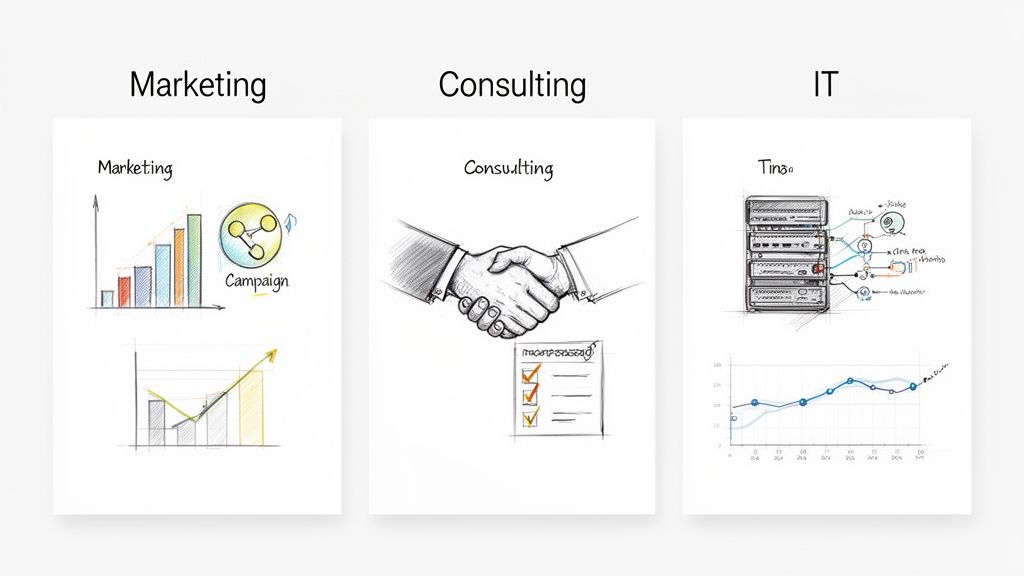
Theory is one thing, but seeing how proposals actually land deals in the real world is where you really learn the ropes. The core components we’ve covered are your essential ingredients, but the best proposals adapt their structure to the specific industry and, more importantly, the client. A creative pitch from a marketing agency is going to feel completely different from a highly detailed bid for a complex IT project.
Let's break down a few common scenarios to see how the format shifts to highlight what truly matters to each type of client.
The Digital Marketing Services Proposal
When you're pitching marketing services, the client is buying one thing: results. They need to see a clear path to return on investment. Your proposal's format has to build immediate confidence that you can deliver tangible outcomes, whether that's more leads, higher traffic, or a direct boost in sales.
This means you should pour most of your energy into the Proposed Solution and Deliverables & Timeline sections. Get specific. What’s the strategy? What can they expect to see month after month?
Here are a few formatting choices that work wonders for marketing proposals:
- Tiered Pricing Tables: Laying out your packages—think "Basic," "Pro," and "Enterprise"—in a simple table makes comparison easy. It also subtly nudges clients toward higher-value options.
- Visual Timelines: Don't just write about your plan. Show it. A simple Gantt chart or a visual roadmap that outlines the project phases (e.g., Month 1: SEO Audit, Month 2: On-Page Optimization) makes your process feel concrete and manageable.
- Bulleted Deliverables: Skip the long, winding paragraphs. Use clean bullet points to list exactly what they get. Be specific: "2 blog posts per month," "1 monthly analytics report," "4 social media campaigns."
The Freelance Consulting Pitch
A consulting proposal is less about a list of services and more about selling your expertise and a trusted partnership. The client isn't just hiring a company; they're hiring you. Because of this, your format needs to build credibility from the first sentence and show you have a deep, nuanced understanding of their specific business challenges.
Here, the Problem Statement and your Qualifications are the stars of the show. This is where you prove you're the right expert for the job.
Your problem statement shouldn't just be a mirror, reflecting what the client told you. It needs to show you've connected the dots they haven't, offering a fresh perspective that proves you understand their world better than the competition.
These proposals benefit hugely from a personal touch. Adding a professional headshot and a short, tailored bio can make a real difference. If you want to see how to pack a compelling story into a concise format, check out a startup pitch deck template for some great ideas on impactful storytelling.
The Complex IT Project Bid
When you're proposing a major IT project, like a full software implementation or an infrastructure overhaul, the client's biggest fears are risk, scope creep, and poor technical execution. Your proposal format has to be meticulous and air-tight, leaving zero room for misinterpretation.
The most critical sections here are the Scope of Work, the Timeline, and the fine print in your Terms & Conditions. Every single detail matters. Use numbered lists for technical specifications and detailed tables to break down project phases, complete with clear milestones and sign-off points. This kind of structured approach screams competence and assures the client you can handle the complexity.
Proposal Format Comparison For Different Industries
Every proposal has the same goal—to win business—but the path to "yes" looks different depending on who you're talking to. The table below breaks down how the structure and emphasis shift across different industries to meet client expectations.
| Proposal Type | Key Section Emphasis | Ideal Length | Best For |
|---|---|---|---|
| Marketing Services | Proposed Solution, Deliverables, ROI | 5-10 pages | Agencies & freelancers focused on driving measurable growth and clear outcomes for clients. |
| Consulting Pitch | Problem Statement, Qualifications | 3-7 pages | Independent consultants & boutique firms selling expertise and a trusted partnership. |
| IT Project Bid | Scope of Work, Technical Specs, Timeline | 10-25+ pages | Tech companies & service providers bidding on complex projects where detail and risk mitigation are key. |
| Sales Proposal | Product/Service Benefits, Pricing | 2-5 pages | B2B sales teams presenting a straightforward solution to a well-defined need. |
Ultimately, the best format is the one that speaks your client's language and directly addresses their primary concerns, making it easy for them to choose you.
Weaving Data Into Your Proposal to Make It Irresistible
Let's be honest: a proposal without solid data is just a bunch of nice-sounding opinions. If you want to transform your pitch from a simple sales document into a strategic business case, you need to back up your claims with hard facts. This is what makes your solution feel like the only logical choice.
Think of data as the undeniable proof behind your promises. When you bring in market analysis, growth projections, or even relevant case studies, the conversation shifts. It's no longer about "what you'll do" but about "what we'll achieve together." This approach builds a foundation of tangible evidence that's incredibly hard to ignore.
Put Your Data Where It Packs the Biggest Punch
Having the right numbers is only half the battle; you also need to know where to put them. Don't just create a "Data" section and dump everything in there. Instead, sprinkle your stats throughout the proposal to reinforce your story at just the right moments.
Here’s how you can do that:
- Open with market growth stats in your Problem Statement to create a sense of urgency.
- Slot your ROI projections right into the Solution section to immediately quantify the value.
- Showcase success metrics from past projects in your Qualifications section to build rock-solid credibility.
This isn’t just about adding numbers—it’s about connecting them directly to the client's goals. You're showing them, not just telling them, why your plan is the best investment. For example, using insights gained from AI-powered lead generation can give you a much deeper understanding of your client's specific context, making your data even more relevant.
Your goal is to make the data tell a story. Each number should serve a purpose, turning your proposal into a compelling argument for why they should partner with you.
Imagine you're pitching a global marketing plan. Highlighting a target market that's projected to explode from 103.8 million to 248.9 million potential customers in four years makes a powerful statement. Including powerful data like this, as seen in a sample plan from LivePlan, is what justifies a bigger budget and gets contracts signed.
Using hard numbers from reputable sources in your business proposal format examples builds an undeniable case for your solution. If you want to get better at presenting your own success stories with data, you might find some great ideas in our guide on how to write a case study.
Common Formatting Mistakes That Cost You Deals
I've seen it happen countless times: a brilliant solution, a great price, but the proposal itself is an absolute train wreck. The truth is, how you present your ideas is just as important as the ideas themselves. A few simple formatting blunders can make your proposal look unprofessional and get it tossed aside before the client even glances at your pricing.
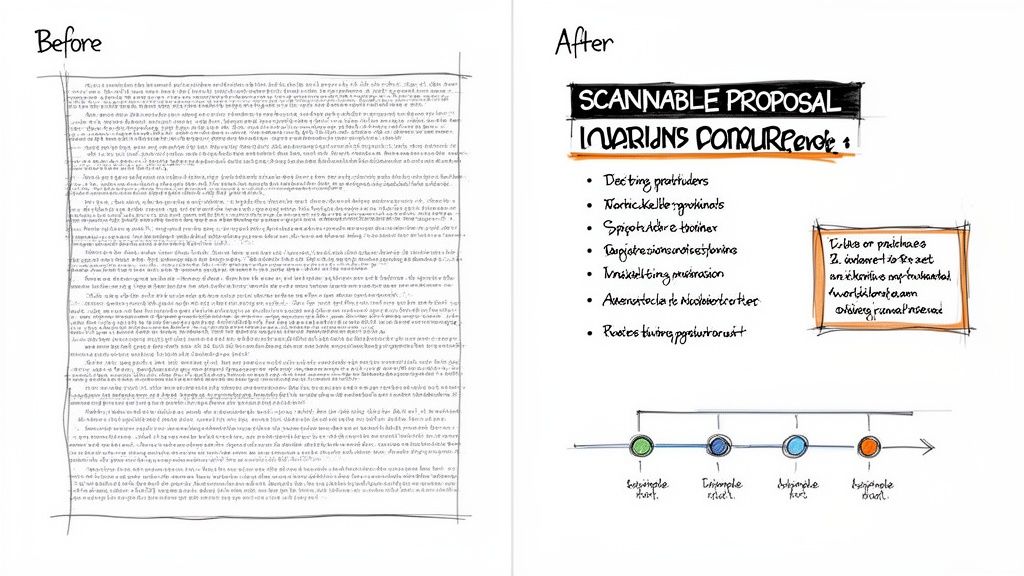
Let's start with the most common—and most damaging—mistake: the wall of text. Think about it from the client's perspective. They open your document and are greeted by a solid block of dense, unbroken paragraphs. Their immediate reaction? "I don't have time for this." They'll skim, miss your most compelling points, and move right along to your competitor’s easy-to-read proposal.
Another deal-killer is using vague, fluffy language. Phrases like "we'll improve your social media" don't mean anything. They're empty promises that fail to build any real trust. Specificity is your best friend here.
Making a Stronger First Impression
Sending a generic, one-size-fits-all proposal is a red flag for any client. It screams that you haven't done your homework. Decision-makers can spot a template from a mile away, and it tells them you don't really understand their unique problems. Take the time to tailor your content to their specific challenges and goals.
Finally, forgetting about mobile is a critical error in today's world. More than a third of professionals review documents on their phones or tablets. If they have to pinch and zoom just to read your proposal, you've already created a frustrating experience. It makes you look outdated.
A great proposal format respects the client's time. By making your document scannable, specific, and mobile-friendly, you're showing them that you are organized, professional, and easy to work with—qualities that close deals.
So, how do you sidestep these common pitfalls?
- Break it up. Ditch the long paragraphs. Use short sentences, bolded keywords, and clear subheadings to make the document inviting.
- Get specific. Instead of "increase engagement," try "boost post interactions by 25% in Q3." Quantifiable goals show you mean business.
- Create a visual path. Guide the reader's eye using strong headings, bullet points, and plenty of white space. Let the layout do some of the work for you.
- Do a mobile check, always. Before hitting send, open the proposal on your own phone. If it's a pain for you to read, it will be for them, too.
Answering Your Top Questions About Proposal Formats
When you're in the thick of writing a proposal, you're bound to hit a few snags or second-guess your approach. Let's clear up some of the most common questions that come up so you can finalize your document with confidence.
What's the Right Length for a Business Proposal?
I get this question all the time, and the honest answer is: it depends. There's no one-size-fits-all page count.
For a straightforward service, you can often cover everything you need to in 5-8 pages. But if you're tackling a complex, multi-phase project, you might be looking at something closer to 15-20 pages to do it justice.
The real goal here isn't to hit a specific number of pages, but to be clear and comprehensive.
My personal rule of thumb: if your proposal stretches beyond eight pages, add a clickable table of contents. It's a small touch that busy clients really appreciate because it helps them find exactly what they need, fast.
Business Proposal vs. Business Plan: What's the Difference?
It's easy to get these two mixed up, but they serve completely different purposes. Think of it this way:
- A business proposal is a sales tool. You write it for one specific client to win one specific project. It's all about them and their problem.
- A business plan is an internal roadmap. It lays out your entire company's vision, financial forecasts, and operational strategy. You'd use this for investors or your own team.
Essentially, a proposal sells a project, while a plan sells the company.
Should I Offer Different Pricing Options?
Yes, you absolutely should. This is one of the most powerful things you can do in a proposal.
Presenting a few pricing tiers—maybe a Basic, Pro, and Premium option—puts the client in the driver's seat. It gives them a sense of control over the decision, and you'd be surprised how often they choose a higher-tier package than they might have if you only gave them one price.
Just make sure to lay out the options in a simple, side-by-side table. Clearly spell out what they get at each level so they can easily see the value in upgrading.
Ready to transform your drafts into polished, professional proposals? Rewritify uses advanced AI to refine your text, ensuring every word is clear, compelling, and ready to win deals. Visit Rewritify to get started for free.
Relevant articles
Tired of proposals that get ignored? Learn how to write business proposals that resonate with clients and close more deals with our practical, expert guide.
Learn how to write a marketing proposal that turns prospects into partners. Our guide offers actionable tips on structure, pricing, and closing the deal.