How to Write Business Proposals That Actually Win Deals
Tired of proposals that get ignored? Learn how to write business proposals that resonate with clients and close more deals with our practical, expert guide.
Writing a winning business proposal is less about filling in a template and more about building a rock-solid case for why you are the right choice. A powerful proposal doesn't just list what you do; it tells a compelling story. It hooks the reader with an executive summary that gets straight to the point, builds trust with a clear scope of work, and frames your pricing as a no-brainer investment.
The real trick is to stop thinking of it as a sales document and start seeing it as a strategic conversation that directly solves your client's most pressing problems.
The Blueprint for a Persuasive Proposal
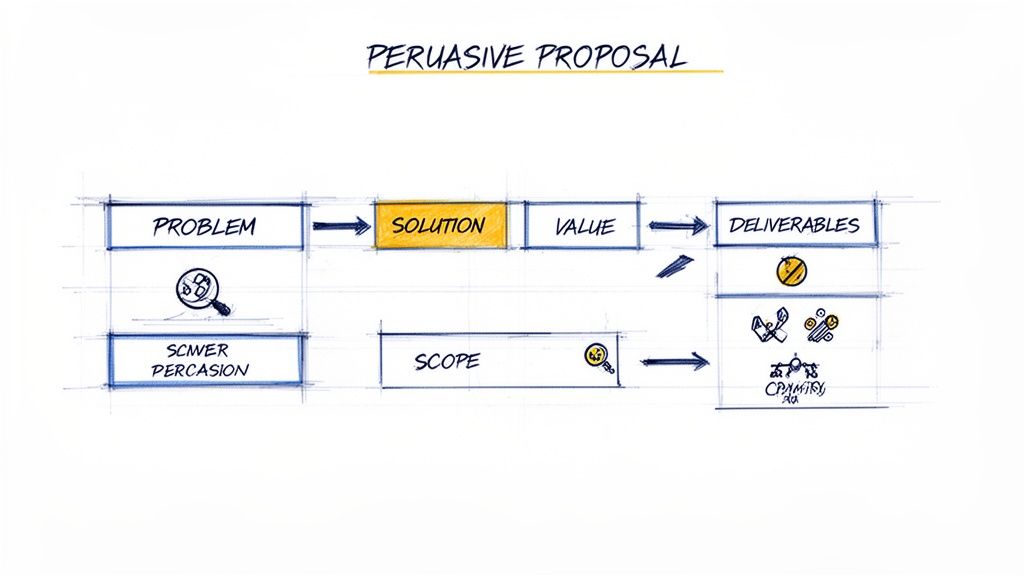
Before you type a single word, you need a strategy. Think of your proposal as a guided journey. You’re leading the client from the problem they’re stuck with to your solution, making it feel like the most natural and logical next step for their business. It’s about building a bridge from their pain point to their desired outcome, with you as the architect.
This strategic approach isn't just a "nice to have" anymore; it's essential. The proposal management software market was valued at USD 2.33 billion in 2022 and is expected to hit USD 5.81 billion by 2030. That’s a clear signal that businesses are investing heavily in creating structured, persuasive documents to win deals.
Deconstructing the Core Components
A truly great proposal is made up of several distinct parts, each with a specific job. When they all work together seamlessly, they create a narrative that’s hard to ignore. Understanding this anatomy is what separates the pros from those who just download a generic template and hope for the best.
Here are the non-negotiable building blocks every winning proposal needs:
- A Captivating Introduction: This is more than just a title page. A short, personalized cover letter sets a professional tone and gives the reader immediate context.
- A Powerful Executive Summary: Think of this as your elevator pitch on paper. It has to nail the client's problem, your solution, and the value you bring in just a few paragraphs.
- A Crystal-Clear Scope of Work: This is where you get granular. Meticulously detail the tasks, deliverables, and timelines to eliminate any confusion and prevent scope creep later.
- Value-Oriented Pricing: Don't just list numbers. Frame your pricing as an investment with a clear return. Using tables or tiered options here works wonders.
- Credibility-Building Social Proof: This is your chance to show, not just tell. Use case studies, testimonials, and a bit about your company to prove you can deliver on your promises.
A great proposal doesn't just answer the client's questions; it anticipates them. It shows you’ve done your homework and understand their challenges on a deep level, building instant trust and setting you miles apart from the competition.
Laying the Groundwork for Persuasion
Getting the structure right is just the first step. The real magic happens when you weave a persuasive thread through every single section. Each part should echo your core message: "We get your problem, and we are uniquely equipped to solve it." For a closer look at the strategy behind winning high-stakes bids, this guide on how to write a tender bid that actually wins is a fantastic resource.
To help you visualize this, the table below breaks down each component and its strategic role in the overall argument. This isn't just a checklist; it's a blueprint for building a document that persuades, not just informs. And if you're in the marketing world, you might want to check out our deep dive on how to write a marketing proposal for more tailored examples.
https://www.rewritify.com/blog/how-to-write-a-marketing-proposal
The Core Components of a Winning Proposal
This table acts as a quick-reference guide, breaking down the strategic purpose behind each section of your proposal.
| Component | Strategic Purpose |
|---|---|
| Executive Summary | To hook the decision-maker by summarizing the problem, solution, and value in a compelling, skimmable format. |
| Problem Statement | To demonstrate empathy and a deep understanding of the client's specific challenges, making them feel heard. |
| Proposed Solution | To present your methodology as the most logical, effective, and tailored approach to solving their problem. |
| Scope & Deliverables | To build trust and manage expectations by clearly defining what will be done, when it will be done, and what the final output will be. |
| Pricing & Terms | To justify the cost as a worthwhile investment by connecting it directly to the value and ROI you will deliver. |
| About Us / Social Proof | To eliminate risk and build confidence by showcasing your expertise, experience, and past successes. |
Think of these components as the essential ingredients. When you combine them with a deep understanding of your client's needs, you create a proposal that's not just professional—it's persuasive.
Building Your Proposal, Section by Section
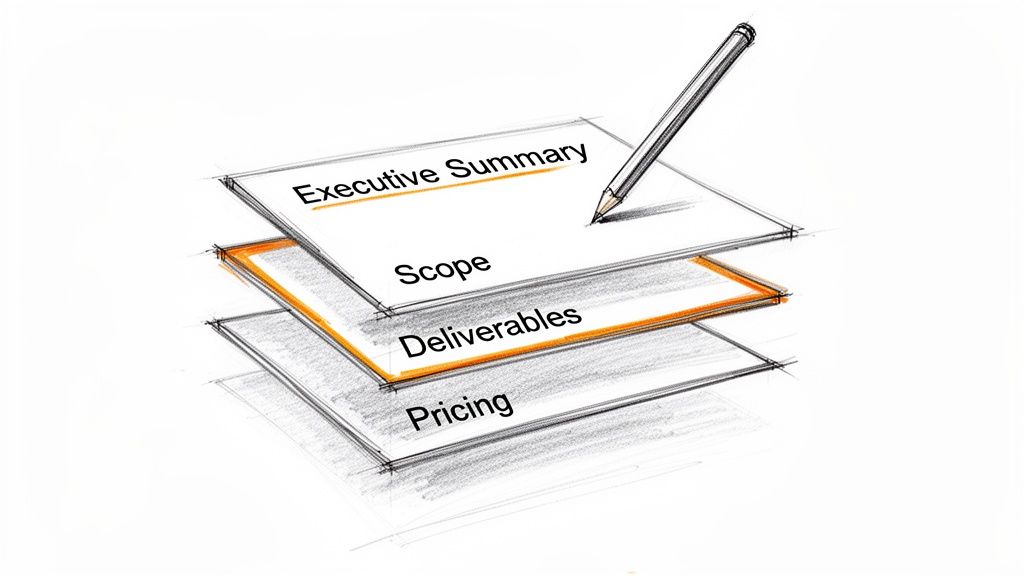
Alright, you've done the prep work and have a solid strategy. Now it's time to build the actual proposal. Think of each section as a building block; they need to fit together perfectly to create a structure that's not just sound, but also persuasive.
When you do this right, you guide your client on a journey. They start by seeing their problem through your eyes and end by seeing your solution as the only logical choice. Let's walk through the make-or-break components of a proposal that wins.
Crafting a Powerful Executive Summary
Let’s be honest: the executive summary is where the magic happens. If a busy decision-maker only has 60 seconds to spare, this is the page they'll read. It needs to be a knockout, a potent shot of your entire proposal distilled into a few compelling paragraphs.
This isn’t just a fluffy intro. It’s your entire argument in miniature. A weak summary gets your proposal tossed on the "maybe later" pile, which usually means "never."
A truly effective summary answers three questions, in this order:
- What’s their biggest headache? Hit them with their core problem right away. Show them you’ve been listening and you genuinely get it.
- What’s your fix? Briefly outline your solution and connect it directly to the pain point you just described.
- What’s the payoff? End with the results. What tangible value are you bringing to the table? We’re talking ROI, saved time, or a bigger slice of the market.
A great executive summary should work as a standalone document. If someone reads only that page, they should still know exactly what the problem is, how you’ll solve it, and the brilliant outcome they can expect.
Keep in mind, you're not the only one vying for their attention. The average organization responds to 153 RFPs a year, with win rates floating around 45%. A killer executive summary is your secret weapon to stand out and make an immediate impact. You can get more stats on RFP win rates on Loopio.com.
For a deeper dive into making this section shine, check out our guide on how to write executive summaries.
Defining Scope and Deliverables with Precision
Okay, you've hooked them. Now, it's time to build their confidence with absolute clarity. The Scope and Deliverables section is where you lay out, in no uncertain terms, exactly what you will do and, just as importantly, what you won't.
Vagueness is the enemy here. It’s the single biggest cause of scope creep, client headaches, and projects that go from profitable to painful. Your mission is to leave zero room for interpretation.
I recommend breaking this down into a few key areas:
- Project Goals: Start by quickly restating the main objectives to keep everyone focused on the big picture.
- Specific Deliverables: This is where you get granular. Use a bulleted list to spell out every single thing the client will get. Don't say "social media report." Say, "Monthly Social Performance Report (PDF) covering Instagram & Facebook KPIs, delivered by the 5th of each month."
- Key Milestones & Timeline: Show them you have a plan. A simple timeline with major phases helps them see the project's flow and builds trust in your process.
- Exclusions: This part is critical for protecting yourself. Clearly state what’s out of scope. For example: "This proposal includes two rounds of revisions on all mockups. Any additional rounds will be billed at our standard hourly rate of $150/hr."
A Real-World Example: Web Design Project
Here’s how a web design agency could define its scope to prevent misunderstandings down the road:
- Included:
- Custom design and build of five core website pages (Home, About, Services, Blog, Contact).
- Development on the WordPress platform, ensuring full mobile responsiveness.
- Implementation of basic on-page SEO (meta titles, descriptions, alt text).
- One 60-minute training session for your team on updating website content.
- Not Included:
- Copywriting, stock photography, or video production.
- E-commerce functionality (product pages, shopping cart, etc.).
- Ongoing website hosting, security, and maintenance plans.
This level of detail doesn't just manage expectations; it positions you as a thorough, professional partner they can count on.
Presenting Pricing as a Clear Investment
The pricing section is often where a client’s heart starts to race. Your job is to calm their nerves by framing your fee not as a cost, but as an investment. Never, ever just drop a number and run. You have to give it context.
Your price should be a logical extension of the value you've already established. The client needs to draw a straight line from the cost to the deliverables you just outlined.
Tactics for Effective Price Presentation
- Offer Tiered Options: Giving clients a choice (e.g., Bronze, Silver, Gold packages) is psychologically brilliant. It changes their mindset from "Should I hire them?" to "Which of their options is right for me?"
- Break It Down: Use a simple pricing table to show where the money is going. Transparency builds immense trust and justifies your total.
- Circle Back to ROI: Whenever you can, tie your pricing to a potential return. Something like, "This $5,000 investment in our SEO campaign is projected to generate over $25,000 in new qualified leads within six months."
Here’s a simple table structure that works wonders:
| Service / Deliverable | Description | Cost |
|---|---|---|
| Phase 1: Discovery & Strategy | In-depth workshops, competitor analysis, and a full strategic roadmap. | $2,500 |
| Phase 2: Design & Development | Custom website design, WordPress build, and two rounds of client revisions. | $8,000 |
| Phase 3: Launch & Training | Site deployment, final SEO checks, and a 1-hour team training session. | $1,500 |
| Total Investment | $12,000 |
This approach turns a big, scary number into a logical sum of tangible, valuable activities. By thoughtfully building your proposal section by section, you create a compelling argument that makes saying "yes" feel like the easiest, smartest decision your client could make.
Speaking Your Client's Language
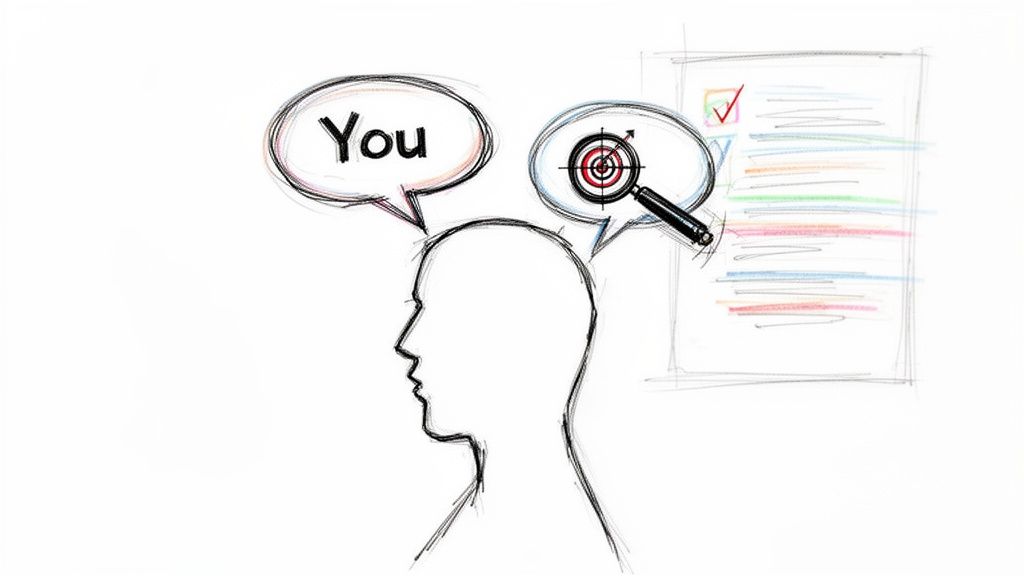
Let's be blunt: a generic proposal is a dead proposal. Sending a one-size-fits-all document is the business equivalent of showing up to a job interview and talking about skills for a completely different role. It screams that you haven’t done your homework, and it's the fastest way to get your hard work sent straight to the trash.
Real persuasion happens when the client feels completely seen and understood. This means getting out of your own head and adopting a client-centric tone. It's a simple but powerful shift: stop saying “we offer” and start saying “you will gain.” Replace “our services include” with “your team will achieve.”
This isn't just about playing with words. It's a fundamental change in perspective that turns your proposal from a sales brochure into a strategic plan built just for them.
Becoming a Client Detective
Before you type a single word, you need to put on your detective hat. Your mission is to uncover the client’s specific pain points, their internal jargon, and the vibe of their company culture. This deep dive is what allows you to tailor every section, making your solution feel less like a pitch and more like a pre-built partnership.
So, where do you find these crucial insights?
- Company Website and Blog: Their "About Us" page and recent blog posts are treasure troves. Look at their mission, their values, and the overall tone. Is it buttoned-up corporate speak or a casual, conversational style?
- Social Media Channels (Especially LinkedIn): See what the company and its key players are posting. This gives you a real-time look at their priorities, recent wins, and the industry conversations they care about.
- Quarterly Reports and Investor Calls: For public companies, these are pure gold. They spell out challenges, strategic goals, and key performance indicators (KPIs). Sprinkling these exact terms into your proposal shows you’re already aligned with their biggest objectives.
- Discovery Call Notes: This is your most valuable asset. Go back through your notes and highlight the exact phrases the client used to describe their problems and what they hope to achieve.
Shifting to a Client-Centric Tone
Once you’ve gathered your intel, it's time to weave it into the fabric of your proposal. This is where you adopt their language and frame every single point through the lens of their needs.
It’s the difference between these two statements:
How most people write (Company-Centric):
"We provide a comprehensive suite of social media marketing services, including content creation and platform management."
How you should write (Client-Centric):
"You will expand your reach and engage more customers with a dynamic social media strategy built for your brand, featuring compelling content and proactive platform management."
See the difference? The second example immediately connects the dots between your service and a tangible benefit for them. This approach should be your north star for the entire document, from the executive summary all the way to the pricing table. Truly mastering the right tone of voice in writing can be the deciding factor in how your message lands.
The goal is to make the client nod along as they read, thinking, "Yes, they get it." When your proposal mirrors their own internal conversations, you stop being a vendor and start becoming a partner.
Weaving Your Insights Throughout the Proposal
True customization isn't just slapping their logo on your template. It’s about proving you've been paying attention in every single section.
In the Problem Statement: Don't use a generic description of their challenge. Use their own words. If they told you, "Our current lead generation feels like shouting into the void," use that exact phrase. It proves you were listening.
In the Proposed Solution: Tie your solution directly to their stated goals. If their annual report highlights a strategic objective to "increase market share in the Midwest region," frame your solution as the tool to get them there. For instance, "This marketing campaign is designed to directly support your Q4 objective of increasing market share in the Midwest."
In the Case Studies: Don't just pull any random success story from your files. Select a case study from a client in a similar industry or, even better, one who faced an almost identical problem. This makes your past success feel relevant and, most importantly, achievable for them.
By digging deep and speaking your client's language, you do more than just write a better proposal. You build a bridge of trust that makes your solution feel like the only logical choice. This level of personalization is what turns a good proposal into a signed contract.
Avoiding Common Proposal-Killing Mistakes
You’ve poured hours into understanding the client and crafting the perfect solution. The strategy is brilliant. But even the best ideas can be shot down by a proposal that feels sloppy, arrogant, or just plain unconvincing. The last thing you want is a simple, preventable error to torpedo all your hard work.
Think of this as your final pre-flight check. We’re going to hunt down the red flags that make you look unprofessional and untrustworthy, ensuring your proposal is as polished as the work you promise to deliver.
Forgetting Who the Hero Is
This is hands-down the most common mistake I see. The proposal becomes a monologue about "our award-winning team," "our proprietary process," and "our cutting-edge platform." Frankly, the client doesn't care. They care about their problems and their results.
Your proposal has to be relentlessly client-focused. Every single sentence should connect back to their goals, their pain points, and what success looks like for them.
- Instead of this: "We offer a powerful analytics dashboard."
- Try this: "You will have 24/7 access to an analytics dashboard, giving you real-time insights to make smarter marketing decisions."
That simple shift from "we" to "you" changes everything. It turns a self-serving brochure into a strategic plan for their victory.
A winning proposal doesn't sell a service; it sells an outcome. The client is the hero of this story, and you are the trusted guide who will help them achieve their goals. When they feel like the focus, they are far more likely to trust you with their business.
Using Vague, Non-Committal Language
Wishy-washy words destroy confidence. Phrases like "we aim to improve," "we hope to achieve," or "this could potentially lead to" scream uncertainty. Your client isn't looking for a partner who is hedging their bets; they need a confident expert with a clear plan.
Ditch the vague promises and get specific. Make measurable commitments.
- Vague: We will improve your social media engagement.
- Specific: We will increase your average post engagement rate by 25% within 90 days.
That kind of precision shows you’ve done your homework and aren't afraid to be held accountable. It turns a hopeful platitude into a concrete objective. There's a reason the proposal management software market is projected to skyrocket to USD 9.0 billion by 2035, up from USD 3.2 billion in 2025. Businesses are moving away from generic templates toward data-driven proposals that inspire this exact kind of confidence.
Making Claims Without Any Proof
Saying you’re the "industry leader" or offer "unmatched service" is meaningless noise. Every one of your competitors is saying the exact same thing. These are empty claims until you prove them.
You have to back up every assertion with cold, hard evidence.
Incorporate social proof and data wherever you can:
- Case Studies: Show, don't just tell. Detail how you solved a similar problem for another company.
- Testimonials: Let a happy customer do the talking for you with a powerful, direct quote.
- Data Points: Use specific numbers. "We helped Company X reduce their customer acquisition cost by 18%" is infinitely more powerful than "we help reduce costs."
This meticulous approach should extend to every part of your proposal, right down to the legal terms. Using modern tools for things like AI contract review can help ensure you’re not making any accidental missteps that could derail the deal. Without proof, your proposal is just a collection of promises. With it, it becomes a compelling, fact-based argument for why you’re the safest and best choice.
Adding the Final Polish for Maximum Impact
You’ve done the heavy lifting. You've built a solid argument, tailored the language, and sidestepped the common mistakes. But the race isn't over yet. That final 10% of effort—the polish—is what separates a good proposal from an irresistible one.
Think of it like a chef plating a dish. The ingredients can be perfect, the recipe followed to the letter, but it's the final presentation that makes you want to dig in. A polished proposal does the same thing. It’s not just about looking pretty; it’s a silent signal of your competence and meticulous attention to detail.
Elevate with Professional Design and Formatting
Let's be honest: a wall of text is a chore to read. Your job is to make it incredibly easy for the client to see your value. Smart design isn't fluff; it’s a tool that guides their eye, emphasizes your most important points, and builds trust before they've even read a full paragraph.
Here’s how to make your formatting do the work for you:
- Be Unmistakably You: Your proposal should feel like it came from your company. Use your brand’s fonts, colors, and logo consistently to create a professional, unified experience.
- Give Your Words Room to Breathe: White space is your best friend. Resist the urge to cram every inch of the page with text. Generous margins and spacing make the entire document feel less intimidating and far easier to scan.
- Show, Don't Just Tell: Why describe a projected ROI in a dense paragraph when a simple, clean chart can show it in seconds? Use high-quality images, graphs, and visuals to back up your claims and make your data pop.
A thoughtfully formatted proposal shows you respect the reader's time. When you make it easy to scan and visually engaging, you keep their attention locked on your core message.
Conduct a Ruthless Final Review
This isn't your average spell-check. The final review is your last chance to step into the client's shoes. Read the proposal from their perspective. It’s not about what you meant to say; it's about what they will actually understand.
If you can, grab a fresh pair of eyes. Someone who isn't buried in the project will immediately spot confusing sentences or logical jumps that you’ve become blind to.
Your Pre-Submission Polish Checklist
Before that proposal leaves your outbox, run it through one last gauntlet. This is your final quality control.
- Proofread for Perfection: Hunt down every typo, grammatical error, and clunky phrase. Read it out loud if you have to.
- Verify Every Single Number: Triple-check all dates, statistics, and especially your pricing. A single wrong digit can shatter your credibility.
- Check the Persuasive Flow: Read it from start to finish. Does the story make sense? Does each section build on the last? Is your core message clear and consistent throughout?
- Confirm Personalization: This is a big one. Make absolutely certain the client’s name, their company, and their project details are correct everywhere. Nothing screams "copy-paste job" faster than a stray
[Client Name].
This final polish is your closing argument. By ensuring your proposal looks professional, is free of errors, and reads persuasively, you’re demonstrating a level of care that builds immediate trust and puts you in the best possible position to win.
Answering Your Top Proposal Writing Questions
Crafting the perfect proposal often feels like you're trying to hit a moving target. It's natural to have questions, especially when a big opportunity is on the line. Let's tackle some of the most common ones that come up time and time again.
What’s the Right Length for a Business Proposal?
I get this question all the time, and the honest answer is: it depends. There's no one-size-fits-all page count. The real driver is the complexity of the project and what the client needs to see to feel confident.
We've seen data from millions of proposals, and the average hovers around nine pages. But don't get hung up on that number. A simple, straightforward project might be perfectly covered in 5-10 pages. On the other hand, if you're responding to a formal Request for Proposal (RFP) for a massive enterprise project, you could easily be looking at a document well over 100 pages.
The goal isn't to hit a specific length; it's to be thorough yet concise. Your real focus should be on making every single page count, cutting the fluff, and giving the client exactly what they need to make a decision.
Which Part of the Proposal Matters Most?
If you only have time to perfect one section, make it the Executive Summary. Hands down, it's the most critical piece of the entire document.
Think about it: your client is busy. They might only have five minutes to glance at your proposal before a meeting. The executive summary is your one shot to hook them. It needs to tell a compelling, miniature version of the whole story—their problem, your unique solution, and the incredible results you'll deliver. A flat or vague summary is a killer; it almost guarantees the rest of your hard work gets ignored.
If a stakeholder reads only the executive summary, they should walk away with a complete understanding of the problem, your solution, and the value you deliver. It's your proposal's powerhouse.
Should I Offer Different Pricing Options?
Yes, you absolutely should. This is one of the most effective strategies I've seen for boosting win rates.
When you offer a few well-defined options—think "Basic," "Standard," and "Premium" packages—you shift the entire dynamic. The client's decision is no longer a simple "yes" or "no" to your single price. Instead, it becomes a conversation about "which of these options is the best fit for us?" This gives them a sense of control and makes it much easier to find a solution that fits their budget and ambition. Just make sure you clearly spell out what's included in each tier to avoid any confusion down the line.
How Do I Make My Proposal Genuinely Stand Out?
Moving beyond a generic template is the key. You want your proposal to feel less like a document and more like a direct conversation with the client. It’s all about deep personalization and proving you were actually listening.
Here are a few ways to make your proposal memorable:
- Mirror Their Language: Did they use a specific phrase to describe their problem in your discovery call? Use that exact phrase back. It shows you paid attention.
- Prove You Did the Research: Mention something specific about their industry, a recent company milestone, or a key competitor. This shows you've invested time in understanding their world.
- Talk About Them, Not You: Frame every feature of your service as a direct solution to their pain point. Instead of "We offer SEO services," try "Our SEO strategy will get you in front of the customers you're currently losing to Competitor X."
- Look the Part: A clean, professionally branded design with visuals is far more engaging than a wall of black-and-white text. It makes your proposal easier to read and remember.
When a client feels like a proposal was written just for them, you’re already halfway to a "yes."
Feeling overwhelmed trying to get the tone just right? Rewritify can help you transform your drafts into polished, client-centric text that wins deals. Refine your proposal’s language for clarity, professionalism, and impact at https://www.rewritify.com.
Relevant articles
Discover winning business proposal format examples that secure more clients. Learn the essential structure and insider tips to make your proposals stand out.