How to Write a Policy Brief That Actually Influences People
Learn how to write a policy brief that gets read. Our guide covers crafting evidence-based arguments, structuring for impact, and reaching decision-makers.
A policy brief is your single best tool for translating complex research into a clear, persuasive argument that can actually shape decisions. At its core, you’re doing three things: identifying a problem, presenting the evidence, and recommending a specific course of action.
It’s not an academic paper. It's a strategic document designed for a non-expert audience with very little time, bridging the gap between deep analysis and tangible policy.
Understanding the Power of a Policy Brief
Think of a policy brief as an advocacy tool, not just an informational one. This is the document that lands on a legislator's desk, gets passed around at a non-profit board meeting, or sparks a real conversation among community leaders. Its job is to persuade.
A great brief cuts through the noise of dense reports and lengthy studies, delivering a concise, evidence-based case for change that a busy person can absorb in minutes.
The real magic happens when you translate complex data into a compelling story. For instance, a brief on urban food deserts wouldn't just list statistics about grocery store locations. It would paint a picture of the daily challenges residents face, connect that reality to data on health outcomes, and then propose a clear, sensible solution—like zoning incentives for fresh food retailers.

This approach makes the issue feel urgent and the solution feel achievable—exactly what a decision-maker needs. They don't have time to become an expert on everything; they rely on you to give them the essentials and a clear path forward.
Who Uses Policy Briefs and Why
Policy briefs are a universal currency in circles where decisions get made. The audience is incredibly diverse, so knowing who you're writing for is the first step to getting it right.
- Government Officials: Legislators, staffers, and agency heads depend on these summaries to grasp issues quickly before making critical votes or policy changes.
- Non-Profit Organizations: Advocacy groups use briefs to power their campaigns, educate the public, and lobby for action on their core missions.
- Think Tanks and Researchers: These institutions produce briefs to push their findings beyond academic journals and into the public discourse where they can make a real difference.
- Corporate and Industry Leaders: Businesses often use briefs to weigh in on regulations that affect their sector, presenting data on economic impacts or proposing alternative approaches.
The impact of these documents can be staggering. Take the United Nations Department of Economic and Social Affairs (UN DESA), which provides a clear example of global influence. According to their 2023 data, their top 10 most downloaded briefs reached millions of people. Policy Brief No. 140, "A World of 8 Billion," was downloaded over 500,000 times on its own, demonstrating how a single, well-crafted document can shape international conversations.
The Anatomy of an Effective Policy Brief
While your topic will be unique, the structure of a high-impact brief is remarkably consistent. It’s built for scannability and quick comprehension, making sure your key message gets through even if the reader only has five minutes.
A great policy brief doesn’t just present facts; it frames a problem in a way that makes the recommended solution feel like the only logical choice. It’s about building a bridge from evidence to action.
To get there, it helps to break the document down into its core components. The table below outlines the essential sections of a policy brief, each serving a distinct purpose in guiding the reader from understanding the problem to championing your proposed solution.
The Anatomy of an Effective Policy Brief
| Component | Purpose | Typical Word Count |
|---|---|---|
| Title | Grab attention and clearly state the issue. | 10-15 words |
| Executive Summary | Provide a concise overview of the problem, evidence, and recommendations. | 100-150 words |
| Introduction/Context | Set the stage by explaining the problem's importance and background. | 200-300 words |
| Evidence & Analysis | Present the key data and research findings that support your argument. | 400-600 words |
| Policy Options | Briefly discuss potential solutions (including the status quo). | 200-300 words |
| Policy Recommendations | Clearly state your proposed course of action and why it's the best choice. | 150-250 words |
| Conclusion | Briefly summarize the argument and end with a powerful call to action. | 50-100 words |
| References/Sources | List the key sources and data used to build credibility. | As needed |
Mastering this format is one of the most important skills for anyone who wants to see their work create tangible change in the world. Each piece works together to build a compelling and undeniable case for action.
Laying the Groundwork Before You Write
A powerful policy brief isn't built on eloquent prose alone. It’s constructed on a solid foundation of sharp strategy and meticulous research. Many people jump straight into writing, but the real work—the work that separates a forgettable document from one that drives change—happens before you even type the title.
This pre-writing phase is where you win the argument.
It all starts with defining the problem with surgical precision. Vague problem statements lead to vague, ineffective solutions. Instead of saying your brief is about "improving local recycling," you need to get specific. A much stronger focus would be "addressing the 25% contamination rate in municipal single-stream recycling that costs the city an estimated $500,000 annually in landfill fees."
See the difference? That level of specificity immediately gives your brief a sense of urgency and a clear metric for success. It transforms an abstract issue into a concrete, solvable problem with measurable stakes, making it far more compelling for a decision-maker.
Know Your Audience Inside and Out
Once your problem is crystal clear, your next move is to obsessively analyze your target audience. Who are you trying to convince? A brief written for a group of allied environmental advocates will look very different from one intended for a skeptical, budget-focused city council member.
To really get this right, you need to ask a few key questions:
- What are their primary motivations? Are they driven by budget constraints, public opinion, re-election prospects, or a specific ideology? Frame your argument so it aligns with what they already care about.
- What's their current level of knowledge? Avoid talking down to them, but also don't assume they're experts. Your job is to provide just enough background to make your evidence and recommendations easy to grasp.
- What are their likely biases or objections? Get ahead of the counterarguments. If you're proposing a new spending initiative, a fiscal conservative's immediate concern will be cost. Address it proactively with data on long-term savings or economic benefits.
For instance, when writing to that budget-focused council member about the recycling issue, you’d lead with the financial drain. Your evidence would emphasize the return on investment for a public education campaign, not just the environmental benefits. For the advocate group, you might focus more on the ecological impact and community engagement.
Gathering Credible and Compelling Evidence
With a defined problem and a clear audience profile, you can now gather the ammunition for your argument. The credibility of your policy brief hinges entirely on the quality of your evidence. Your goal is to find data that is not only accurate but also persuasive and directly relevant to your specific point.
Start by mapping out the types of evidence that will resonate most with your reader.
- Government Reports and Statistics: Sources like the Bureau of Labor Statistics, Census Bureau, or specific state and local agency reports offer objective, authoritative data.
- Academic and Peer-Reviewed Journals: These are essential for grounding your arguments in rigorous research, though you'll need to translate complex findings into accessible language. For help with this, you might be interested in our guide on how to summarize a research article, which offers practical steps for distilling dense information.
- Reputable Think Tanks and Non-Profits: Organizations that specialize in your policy area often publish in-depth analyses and data that can bolster your case.
- Case Studies and Pilot Programs: Real-world examples of where your proposed solution has been successfully implemented are incredibly powerful. Showing that a similar city saved money or achieved a specific outcome is more convincing than theory alone.
Remember, data doesn't speak for itself. Your role is to weave statistics, expert findings, and real-world examples into a coherent narrative that leads your reader to one logical conclusion: your recommendation.
For those new to crafting persuasive documents for specific objectives, a guide on general proposal writing can offer a strong foundation. Many of the same principles of defining a need, presenting evidence, and proposing a solution that you see in guides on how to write grants apply directly to this work. This strategic groundwork ensures that when you finally start writing, you're not just sharing information—you're building an undeniable case for action.
Structuring Your Brief for Maximum Impact
You've done the heavy lifting—the research is solid and you know exactly who you're talking to. Now it's time to build the brief itself. Think of this as architectural work; a logical, persuasive structure is what turns a pile of evidence into a compelling case for action. This isn't about rigidly following a template, but about strategically guiding your reader from understanding the problem to championing your solution.
The entire document is designed for someone who is short on time. That means your most important information has to be front and center, starting with a title that’s both descriptive and impossible to ignore.
Don't just say, "A Report on Local Water Issues." Instead, try something like, "Securing Our Water Future: A Cost-Neutral Plan to Reduce Urban Water Waste by 20%." The second title immediately flags the problem, the solution, and a key benefit. That’s how you get read.
The Crucial First Impression: Your Title and Executive Summary
Your title and executive summary are the most valuable real estate in the entire brief. For many busy readers, especially senior decision-makers, this might be all they read. These two elements have to work in tandem to deliver your entire argument in a nutshell.
An executive summary isn't just an introduction; it's a complete, standalone synopsis of your entire brief. It needs to clearly state the problem, summarize the key evidence, and lay out your core recommendation. Its job is to give a time-crunched reader everything they need to know, even if they never turn the page. Honestly, learning how to write executive summaries that pack a punch is a skill that pays dividends far beyond this one task.
This initial groundwork is what sets you up for success.
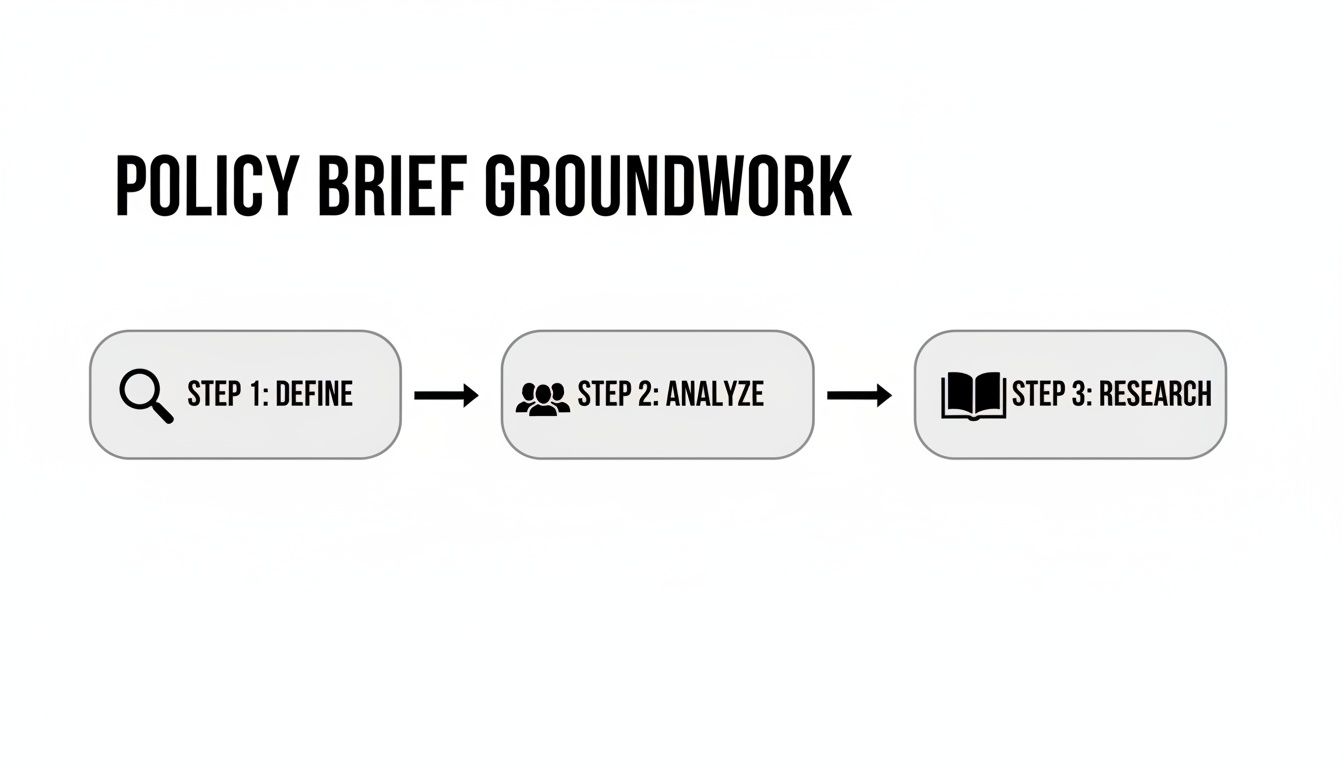
This simple flow shows just how critical those pre-writing steps are. Get these right, and your brief will be targeted, credible, and built on a solid foundation.
Setting the Scene with Context and Urgency
Right after the executive summary, your introduction and background section sets the stage. This is where you expand on the problem, but only with enough context for the reader to grasp why this issue matters right now. Resist the urge to write a lengthy history lesson. Stick to the current situation and what’s at stake.
Going back to our water conservation example, you’d briefly touch on current consumption rates, mention recent drought conditions, and flag the projected costs of doing nothing. A powerful statistic here can create an immediate sense of urgency. This section must answer the reader's unspoken question: "Why should I care?"
A policy brief's power comes from its ability to bridge the "know-do" gap—the space between what research says and what policymakers actually do. Your structure is the bridge.
The most effective briefs are always the most actionable ones. Studies have found that briefs tailored to provide clear, actionable insights achieve 3x greater policy uptake. This is especially true in global health, where successes in low- and middle-income countries rose 22% between 2012-2020 by focusing on this very principle.
Presenting Evidence and Policy Options
Here's the heart of your argument. This is where you lay out the evidence you’ve painstakingly gathered, but don't just dump a list of facts on the page. Weave your data into a clear narrative that naturally leads to your recommendation. Use subheadings to break up the text and guide the reader through your logic.
Visuals are your best friend in this section. A simple bar chart showing rising water costs will always be more impactful than a dense paragraph describing the same trend.
When you get to the policy options, it’s crucial to be balanced. Briefly discuss a few viable alternatives, and always include the "status quo" (i.e., doing nothing) as an option. For each one, lay out the evidence-based pros and cons. A simple comparison table is an incredibly effective tool here, as it allows for a quick, at-a-glance evaluation.
Policy Options Comparison: Renewable Energy Subsidies
To illustrate, here's a sample table you might use to compare different approaches to promoting renewable energy. It provides a clear, digestible overview for a busy policymaker.
| Policy Option | Pros (Evidence-Based) | Cons (Evidence-Based) | Estimated Impact |
|---|---|---|---|
| Option 1: Tax Credits | Proven to incentivize private investment (25% increase in similar jurisdictions). | Higher administrative burden on government agencies. | 15% increase in renewable capacity over 5 years. |
| Option 2: Direct Subsidies | Faster uptake by small-scale producers. | Can be politically contentious; risk of market distortion. | 10% increase in capacity, focused on solar/wind. |
| Option 3: Status Quo | No new budget allocation required. | Misses national emission targets; falls behind peer nations. | Stagnant growth (<2% annually) in renewables. |
By laying out the options this way, you're not just presenting data; you're building credibility and demonstrating that you've considered the issue from all angles before arriving at your final recommendation.
Crafting Actionable Recommendations
Finally, we arrive at the call to action. Your recommendations section must be sharp, clear, and direct. This is no place for ambiguity or hedging. State exactly what you want the reader to do, using strong, action-oriented language.
Don't say: "It might be beneficial to consider a rebate program."
Instead, write: "We recommend the City Council allocate $150,000 to fund a targeted rebate program for high-efficiency toilets and showerheads, modeled on the successful program in City X."
See the difference? You’ve provided a specific, concrete next step. By giving your reader a clear path forward, you make it incredibly easy for them to say "yes" and turn your well-researched brief into tangible policy.
Writing with Clarity and Authority
You can have the most brilliant research and a rock-solid structure, but if the brief is a slog to read, it's dead on arrival. Your ideas will only stick if you communicate them with absolute clarity and a confident, authoritative voice.
This means ditching the dense academic prose you might be used to. Instead, opt for direct, accessible language that a time-crunched policymaker can absorb in minutes. The goal isn’t to "dumb down" your work—it’s to sharpen it. Every single sentence should build your credibility and drive the point home, leaving no room for confusion.
Think of yourself as a translator, converting complex findings into the practical language of action. This is where the craft of writing becomes just as crucial as the research itself.
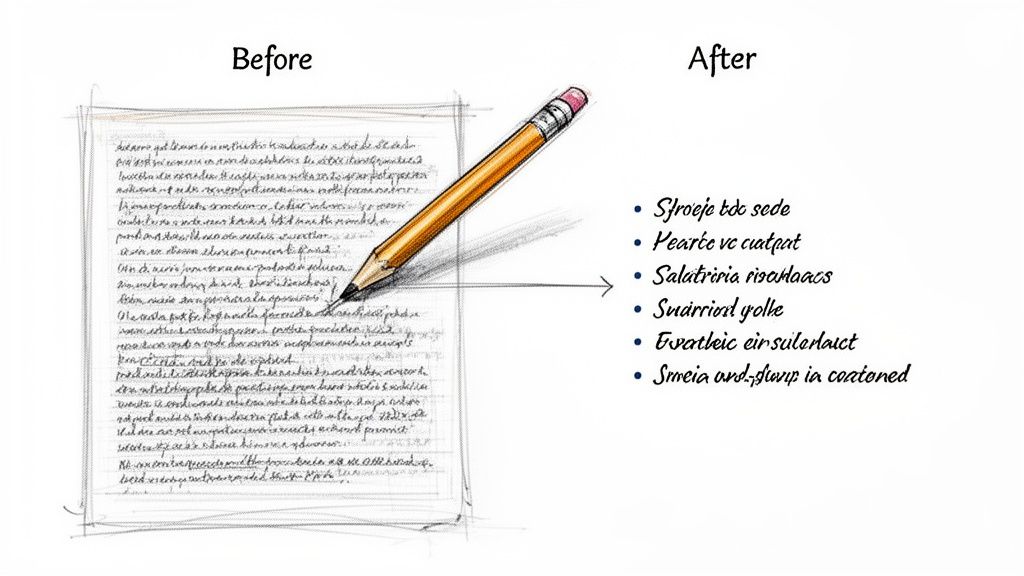
This image nails the concept perfectly. You’re taking a messy pile of notes—your raw data and research—and transforming it into a clean, organized, and powerful message.
Ditch the Jargon and Embrace Simplicity
Academia loves complex sentences and specialized terminology. In a policy brief, that’s a huge liability. Your reader isn't a peer in your specific field; they're a smart generalist who needs to get your point, and get it fast.
Let's see this in action.
Before (Academic and Passive): The amelioration of urban heat island effects has been identified as a significant co-benefit contingent upon the strategic implementation of green infrastructure initiatives by municipal entities.
After (Clear and Direct): Investing in green infrastructure, like parks and green roofs, helps cool cities and reduce the urban heat island effect.
See the difference? The second version is shorter, uses an active voice, and states the benefit plainly. It’s instantly understandable. Getting this right is what separates a policy brief that gets filed away from one that gets results. If you want to hone this skill, our guide on persuasive writing techniques is a great place to start.
Use Formatting as a Communication Tool
Let's be real: your brief will be scanned long before it’s read. Smart formatting turns that scanning behavior into an advantage, guiding your reader’s eye directly to the most important information.
- Headings and Subheadings: These are your signposts. Use clear, descriptive headings to break up the text and create a logical roadmap for your argument.
- Bullet Points: Got a dense paragraph listing benefits, drawbacks, or steps? Turn it into a scannable bulleted list. It's so much easier on the eyes.
- Bold Text: Don't go crazy, but use bolding to make key statistics, crucial terms, or the main takeaway of a paragraph pop.
These aren't just aesthetic choices; they are functional tools that make your document more effective. They create white space, reduce reader fatigue, and ensure your key points don’t get buried in a wall of text.
A well-formatted brief respects the reader's time. It signals that you've done the hard work of organizing your thoughts so they don't have to.
Let Visuals Do the Heavy Lifting
Sometimes a single chart says more than a page of text ever could. Don't just tell your reader about the data; show them. A simple bar chart comparing policy outcomes or a line graph showing a disturbing trend can make your evidence instantly compelling and far more memorable.
This isn’t just a hunch. Think tanks and NGOs that embed visuals into their briefs see 50% higher engagement rates. A 2023 analysis from LegiStorm of over 1,200 U.S. congressional citations found the same thing—data visualization is a massive influence booster.
When you combine clear language, sharp formatting, and powerful visuals, you create a document that doesn’t just inform. It persuades. It establishes your authority and makes your recommendations feel both urgent and undeniable.
Finalizing and Distributing Your Policy Brief
Your work isn't done when you type that last sentence. Far from it. What you do after writing the brief is often what separates a document that sparks change from one that just gets filed away. This is the crucial last mile: polishing your work until it shines and getting it into the right hands.
Think about it: a single typo or a stray statistic that doesn't quite add up can instantly torpedo your credibility. Before you even consider distribution, a thorough, methodical review isn't just a good idea—it's absolutely essential. This is much more than a quick spell-check; it's a full audit of your argument and evidence.
But we've all been there—staring at the same text for hours makes you blind to its flaws. One of the best things you can do is simply step away. Give it a day. When you come back, you’ll see the document with fresh eyes and immediately spot the awkward phrasing and logical gaps you’d become numb to.
The Final Polish and Proofreading
Better than your own fresh eyes? A trusted colleague’s. Hand it over to someone who isn't buried in the project. Their feedback is pure gold for finding spots where your argument gets fuzzy or your evidence doesn’t pack the punch you thought it did. If they can’t figure out your main point in five minutes, you can be sure a time-crunched policymaker won't.
After you've folded in their feedback, it’s time for one last, painstaking proofread. I find it helpful to use a checklist so nothing gets missed.
- Data and Numbers: Go back to your original sources and check every single number. Does the $2.5 million figure on page one match the $2.5M in the chart on page three? Consistency is key.
- Citations: Make sure your citation style is consistent all the way through. A sloppy reference list looks unprofessional and hints that your research might be just as careless.
- Tone and Voice: Read the entire brief out loud. Seriously. You'll catch clunky sentences and jarring transitions when you hear them in a way you never will by just reading. Does it sound confident and clear?
- Formatting: Are all your headings, bullets, and fonts perfectly uniform? Little inconsistencies make a document feel thrown together.
A policy brief is a direct reflection of your professional rigor. A flawless presentation sends a powerful signal that your research and recommendations are just as solid. Don’t let a simple mistake undermine all your hard work.
Strategic Distribution for Maximum Reach
Even the most brilliant policy brief is worthless if no one reads it. Your distribution strategy needs to be as carefully planned as your writing process. The whole point is to make sure your brief lands on the desks—both physical and digital—of the people who can actually do something with it.
First, map out your key stakeholders. This is never just one person; it’s a whole network.
- Primary Audience: This is the decision-maker—the legislator, committee chair, or agency head who can push the button.
- Secondary Audience: These are their senior staff, policy advisors, and legislative aides. They are the gatekeepers and trusted influencers who whisper in the primary audience's ear.
- Tertiary Audience: Think bigger. This includes allied advocacy groups, journalists who cover the beat, and community leaders who can amplify your message and build a groundswell of public support.
Timing is everything. Dropping a brief on education funding the week after the legislative session wraps up is a complete waste of effort. You need to sync your release with key moments in the policy calendar—think budget hearings, committee meetings, or an upcoming floor vote.
Finally, don't just rely on one channel. Direct, personalized email outreach to key staffers is a must, but that's just the start. Pull out key findings and graphics to share on social media, making sure to tag relevant officials and organizations. You might even write a short blog post or an op-ed summarizing your brief's core argument to reach a much wider audience. This multi-pronged approach is how you ensure your work actually enters the conversation instead of just gathering dust.
Answering Your Top Questions About Policy Briefs
Even with the best template in hand, you're bound to hit a few stumbling blocks. It happens to everyone. Questions always come up when you’re trying to turn a mountain of research into a sharp, persuasive document.
Let's walk through some of the most common questions I get asked, from nailing the length to getting the tone just right. Think of this as your go-to reference for those moments when you just need a quick, clear answer.
How Long Should a Policy Brief Be?
This is, without a doubt, the number one question. The answer is almost always: shorter than you think.
A solid policy brief usually falls between two and eight pages, or roughly 1,500 to 3,000 words. The real goal isn't to hit a specific word count, but to make a complete, compelling argument as concisely as humanly possible.
Remember, your reader is buried in paperwork and short on time. They don't want a dissertation; they need a document they can scan quickly to get the main takeaways.
- The Two-Pager (around 1,000 words): This is your rapid-response tool. It’s perfect for a single, urgent issue you need to get in front of someone fast—think leave-behinds for a meeting or a quick explainer on a fast-moving bill.
- The Sweet Spot (4-6 pages, 1,500-2,500 words): Most of your briefs will live here. This length gives you enough room to lay out the context, present your evidence, and make clear recommendations without bogging the reader down.
- The Deep Dive (8+ pages, 3,000+ words): Only go this long for exceptionally complex topics that truly require extensive background information. And even then, every single sentence has to earn its place.
When you're on the fence, always lean toward brevity. A tight, focused four-page brief will beat a rambling eight-page one every time.
Your job isn't to include everything you know. It's to include everything your reader needs to know to make a decision. Cut the rest.
What Is the Right Tone to Use?
Getting the tone right feels like walking a tightrope. You have to sound authoritative but not academic, persuasive but not biased. The sweet spot is a tone that is objective, professional, and confident.
Picture yourself as a trusted advisor stepping into their office. Your role is to present the facts clearly and offer a well-reasoned path forward, not to champion a personal crusade.
Here’s how to strike that balance:
- Write in the active voice. "The data shows..." has much more punch than "It can be shown by the data that..."
- Scrub emotional language. Avoid words like "terrible," "shocking," or "amazing." The facts you present should be powerful enough on their own.
- Keep it solution-oriented. Frame the problem, but quickly pivot to the solution. The focus should always be on what to do next.
This kind of confident, evidence-driven tone is what builds trust and makes your recommendations feel both credible and necessary.
How Do I Cite My Sources?
Citations are the bedrock of your credibility—this part is non-negotiable. But a policy brief isn’t a journal article. You can't have clunky in-text citations or a forest of footnotes tripping up your reader. The goal is a clean, unobtrusive system.
Here are a few of the best ways to handle it:
- Numbered Endnotes: This is my personal favorite for its clean look. Just pop a superscript number after a claim or statistic, then list all your sources in an "Endnotes" or "References" section at the very end.
- Hyperlinks: If you know your brief will be read digitally, embedding links is a fantastic, modern approach. For instance: "A 2023 report from the WHO shows the trend is accelerating."
- Abbreviated In-Text Citations: Some circles still prefer a simple parenthetical citation, like (Author, Year). If that's the standard for your audience, go with it, but know that it can make sentences feel a bit choppy.
Whatever you choose, just be consistent. Pick a style and apply it meticulously throughout the entire document.
Turning complex research into clear, persuasive writing is tough work. Rewritify was built to bridge that exact gap, helping you transform dense drafts into polished, professional text that gets noticed. Whether you're trying to simplify technical jargon or just make your recommendations hit harder, our AI-powered tool refines your writing while keeping your core message intact. Give your next policy brief an edge by visiting https://www.rewritify.com to see how it works.
Recent articles

Is ZeroGPT accurate? We tested its AI detection using 2026 data. See how it performs on false positives and reliability for students, writers, and marketers.

Master the difference between complement and compliment with our guide. Learn the definitions, grammar, and usage with clear examples to perfect your writing.

Discover our top 8 company bio example formats for websites, social media, and sales. Get templates and tips to write a bio that converts.

Discover 10 powerful not understandable synonyms to enhance your writing. Explore examples, tips, and contexts to improve clarity and precision.

Learn how to humanize AI generated text with proven strategies. Move beyond robotic writing to create authentic, engaging content that connects with readers.

Learn how to correct the sentence with practical grammar tips, proofreading tricks, and clear examples that boost clarity and confidence.