A Guide to Using a Plagiarism Checker and Rewriter Ethically
Learn a responsible workflow for using a plagiarism checker and rewriter. Create original, high-quality content that maintains your voice and boosts SEO.
A plagiarism checker and rewriter is really a two-in-one toolkit. First, it scans your document to flag any text that might be copied from somewhere else. Then, it gives you the tools to rephrase those sections, helping you turn them into something original. This combo is a lifesaver for anyone—students, content marketers, writers—who needs to be certain their work is unique and above board.
The Modern Content Creator’s Dilemma
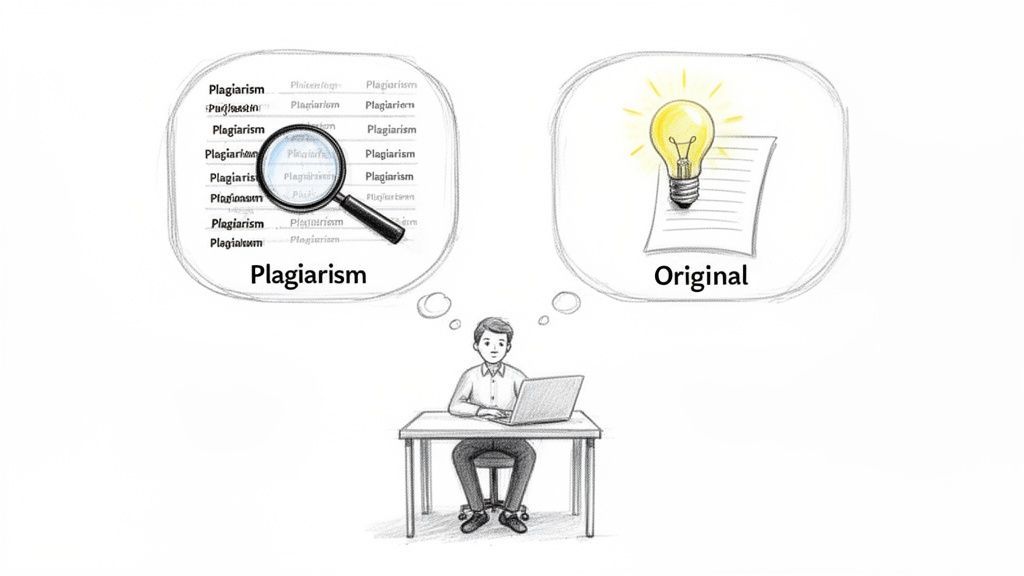
Let's be honest: the pressure to churn out high-quality, original content is intense. If you're a student, you're up against strict academic integrity rules. If you're a marketer, you're fighting for every inch on Google's search results. In both cases, the line between solid research and accidental plagiarism can feel razor-thin.
The old way of doing things—just running a final draft through a plagiarism scanner—doesn't cut it anymore. That's a reactive approach. It tells you that you have a problem, but it leaves you to figure out how to fix it. A truly effective workflow needs to be more proactive, integrating a powerful plagiarism checker and rewriter from the start.
Why a Smarter Workflow Is Necessary
This isn't about finding a sneaky way to disguise copied text. It’s about building a better system for creating genuinely good content, right from the beginning.
Here’s why this integrated approach has become so essential:
- It’s just more efficient. You can spot a problematic sentence and immediately work on rephrasing it, all in one go. This saves countless hours you’d otherwise spend toggling between tabs and manually editing.
- It pushes for true originality. Good rewriters do more than just swap out synonyms. They help you find completely new ways to structure a sentence and express an idea, making it truly yours.
- It improves the writing. The rewriting step is a perfect opportunity to do more than just fix plagiarism flags. You can sharpen clarity, adjust the tone, and boost the overall readability of your work.
The explosion in demand for these tools makes perfect sense when you consider the sheer volume of information out there. The plagiarism detection market was valued at USD 3.9 billion in 2024 and is expected to climb to USD 8.5 billion by 2033, according to research from Verified Market Reports.
This growth is driven by the fact that we create over 2.5 quintillion bytes of data every single day. For professionals, the stakes are high—a staggering 58% of marketers say duplicate content is actively hurting their search rankings.
This changes your whole mindset. You shift from a defensive game of simply avoiding penalties to an offensive one where you're actively creating stronger, more authentic content. A good plagiarism checker and rewriter workflow is your best defense and your most valuable writing partner.
Choosing the Right Tools for Your Workflow
Picking the right plagiarism checker and rewriter is the first, most crucial step in any serious content workflow. If you get this wrong, you're setting yourself up for inaccurate reports, clunky text, and a whole lot of wasted time. The goal is to build a toolkit that feels less like a set of obstacles and more like a reliable co-pilot for your writing.
When you're looking at a plagiarism checker, you need to dig deeper than a simple surface scan. What really matters is the size and scope of its database. A tool that only scours public web pages is a huge blind spot—it's likely to miss matches tucked away in academic journals, paywalled articles, or student paper databases. For any serious academic or professional work, this can create a dangerous false sense of security.
Accuracy is, of course, everything. The best checkers give you detailed, color-coded reports that don't just flag a potential match but show you exactly where it came from. This makes verifying sources and citing them correctly a much smoother process. For a more detailed breakdown, our guide on how to check for plagiarism really gets into the nitty-gritty.
Evaluating AI Rewriters Beyond Simple Word Swaps
The AI rewriter market is flooded, but not all tools are created equal. Far from it. The old-school "article spinners" were notorious for just swapping out words for synonyms, which often resulted in awkward, nonsensical sentences. A truly modern rewriter needs to offer sophisticated rewriting modes that adapt to what you're actually trying to accomplish.
You should be looking for a tool that gives you real options, such as:
- Academic Mode: Keeps the formal tone and complex language needed for research papers and scholarly articles.
- Natural Mode: Focuses on creating conversational, easy-to-read text perfect for blog posts or marketing content.
- Undetectable Mode: Intelligently reworks sentence structures and word choice to sidestep AI detection algorithms.
These settings give you the control to refine your content without stripping away its original meaning or, just as importantly, your own voice.
A key differentiator for a premium rewriter is its ability to maintain your authorial voice. The best tools learn from your style and produce output that feels authentic, not like it was generated by a machine.
Here's a quick look at how these tools differ in their core functions.
Feature Comparison Plagiarism Checkers vs AI Rewriters
This table breaks down what each tool is designed to do, helping you decide where it fits into your process.
| Feature | Plagiarism Checker (e.g., Turnitin, Copyleaks) | AI Rewriter (e.g., Rewritify) |
|---|---|---|
| Primary Function | Scans text and compares it against a vast database to find matches. | Rephrases sentences and paragraphs to improve clarity and originality. |
| Ideal Use Case | Verifying originality, checking for accidental plagiarism, academic integrity. | Rewriting drafts, overcoming writer's block, enhancing content quality. |
| Key Output | A detailed report showing percentage of similarity and matched sources. | A new version of the original text with varied wording and structure. |
| Human Interaction | Requires user to review the report and make manual edits or citations. | Often requires light editing to ensure the output matches the desired tone. |
Ultimately, these tools serve different but complementary purposes. One confirms originality, while the other helps you create it.
Finally, a point that’s too often ignored: always check the privacy policy. You're pasting potentially sensitive or proprietary work into these tools. Make sure the service you choose won't store your data indefinitely or use it to train its own models without your explicit consent. This is about protecting your intellectual property.
While specialized checkers and rewriters are vital, they are just one part of a bigger picture. Understanding the full suite of essential tools for content creators can help you build a more powerful and efficient workflow from start to finish.
The right combination of a top-tier plagiarism checker and an intelligent rewriter does more than just protect you—it gives you the confidence and the capability to turn a good draft into a truly polished piece of work.
Crafting an Ethical Rewriting Workflow
Having the right tools is just the starting point; knowing how to use them responsibly is what really sets your work apart. An ethical rewriting process isn’t a magic trick to disguise copied text. It’s a structured workflow for producing genuinely original, high-quality content where a plagiarism checker and rewriter acts as your co-pilot, not the autopilot.
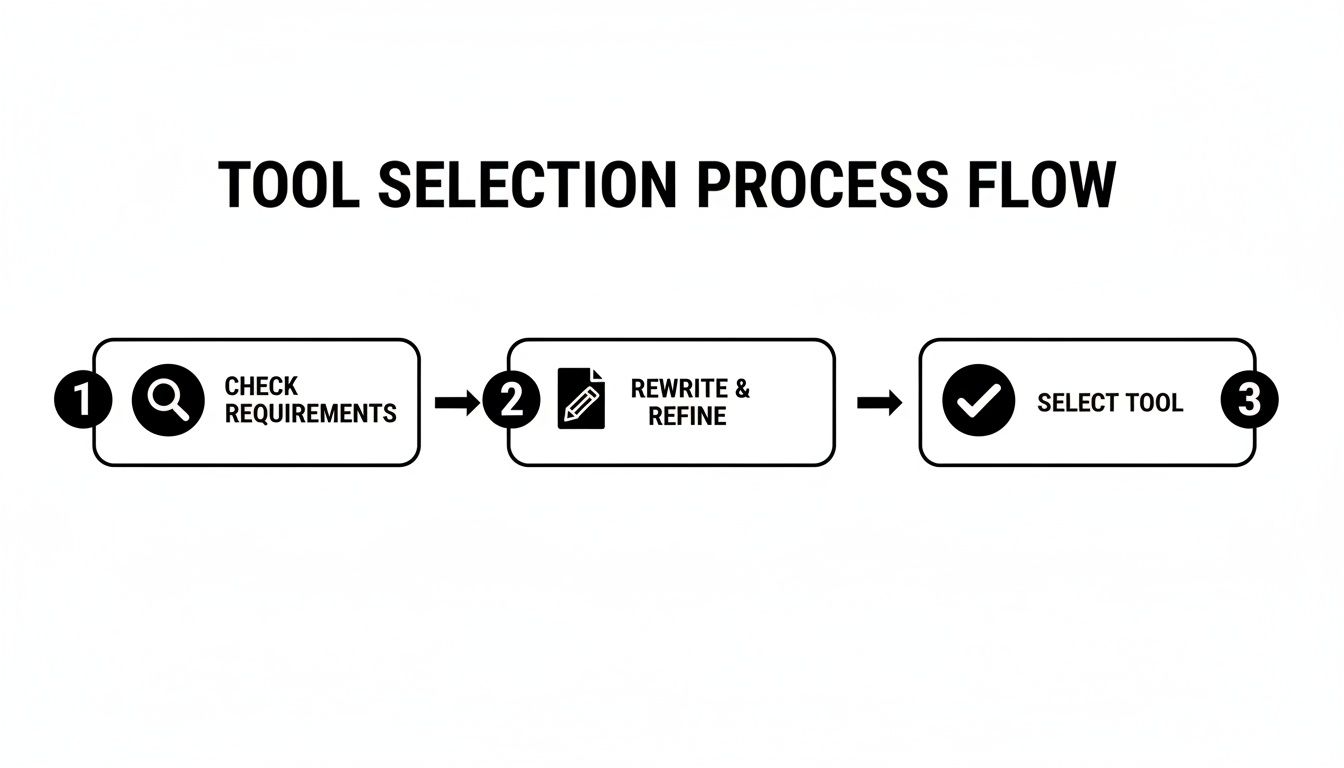
Your first move should always be to run the initial draft through a reliable plagiarism checker. This isn’t just about catching blatant copy-paste jobs. A good scan will flag those tricky spots where your paraphrasing is still a bit too close to the source material—a common mistake that leads to accidental plagiarism.
Think of that initial report as a diagnostic for your content. It shows you exactly which sections need a human touch before you even think about rewriting.
From Flagged Text to Authentic Content
Once you have that report, fight the temptation to just dump every highlighted sentence into an AI rewriter and call it a day. The goal here is to re-craft, not just re-spin. Before you use any tool, take a moment to understand the core idea of the flagged text. What’s the essential point it’s trying to make?
Only then should you bring in the AI rewriter. Use it as a brainstorming partner to explore different ways of saying the same thing. You might be surprised at the new sentence structures and vocabulary it suggests, which can get your own creative gears turning.
This simple process helps you tackle potential issues systematically instead of just papering over the cracks.
Seeing the Transformation in Action
Let’s walk through a real-world example. Say your plagiarism checker flags this sentence from a source you referenced:
- Original Source: "The rapid proliferation of digital media platforms has fundamentally altered traditional marketing paradigms, forcing businesses to adapt their strategies to a more dynamic and interactive consumer environment."
A lazy rewrite might just swap out a few words, leaving the sentence structure nearly identical. But a thoughtful, ethical approach aims for a complete conceptual rephrase.
- Ethical Rewrite (After AI-Assist & Human Polish): "Businesses can no longer rely on old marketing playbooks. Today’s consumers engage with brands across a constantly changing mix of digital channels, demanding more interactive and flexible strategies."
See the difference? The second version captures the original idea but uses an entirely new structure and tone. It's human. It's clear. That's the gold standard. For a deeper dive into these techniques, our guide on how to paraphrase without plagiarizing has more practical tips.
The human review is non-negotiable. AI can give you the raw materials for a new sentence, but you are the one who provides the final polish. It's your job to make sure the text aligns with your voice, intent, and factual accuracy. Never, ever blindly accept what an AI generates.
This hands-on approach is more important than ever. With some analysts predicting AI-generated text could make up 90% of online content by 2026, the line between original and derivative is getting blurry. It’s no surprise the anti-plagiarism software market is projected to hit USD 9 billion by 2030. This boom is driven by the need for smarter, proactive solutions.
By building a solid ethical workflow now, you're not just avoiding plagiarism; you're ensuring your content remains authentic, effective, and truly your own.
Improving Readability and SEO Performance
Once you're sure your content is original, the real fun begins. A top-tier plagiarism checker and rewriter is more than just a safety net; it's a powerful tool for actively polishing your work until it shines for both readers and search engines.
Think of the rewriting feature as a clarity booster. It can take a clunky, jargon-stuffed sentence and transform it into something crisp and direct. This process has a huge impact on your content's readability score, which is absolutely vital for keeping your audience from bouncing.
Enhancing Clarity for Better Engagement
Let's be honest: if your content is a chore to read, people won't stick around. Engaging content is, first and foremost, readable content. An AI rewriter is fantastic for simplifying your language without dumbing down the message.
Here’s how I often use it to refine a piece of writing:
- Simplify Complex Sentences: I'll drop a long, winding sentence into the tool and see what shorter, punchier alternatives it suggests.
- Adjust for Regional Nuances: Writing for a UK audience instead of a US one? A rewriter can quickly swap spellings and local phrases to make the content feel more native.
- Maintain a Consistent Brand Voice: For businesses, this is a game-changer. You can guide the rewriter to match a specific tone, keeping all your content cohesive and on-brand.
Whether you're crafting an academic paper or a marketing campaign, this kind of strategic refinement builds trust and authority with your audience.
Boosting Your SEO with Strategic Rewrites
For anyone doing SEO, a rewriter is an indispensable part of the toolkit. It helps you weave keywords into your text so they sound natural, not shoehorned in. Instead of just stuffing terms where they don't belong, you can rewrite entire paragraphs to incorporate them seamlessly.
For instance, you could rework a section to naturally include the phrase "best plagiarism checker and rewriter for students," making it far more relevant for that search query. If you really want to go deep on this, we've put together a full guide on how to optimize blog posts for SEO.
The risks of unoriginal content are especially high for marketers. Google isn't a fan of duplicate content, penalizing an estimated 68% of sites with these issues, which translates to billions in lost traffic. An AI rewriter like Rewritify helps you sidestep these penalties by transforming rough drafts into undetectable, polished work. As the plagiarism detection software market continues to grow, it's clear these tools are essential for turning potential pitfalls into pristine, original content.
When you stop seeing a rewriter as a simple paraphrasing tool and start using it as a sophisticated writing assistant, you unlock its true potential. It helps you create content that isn't just original, but also clearer, more engaging, and fully optimized to perform.
Keeping Your Voice and Integrity Intact
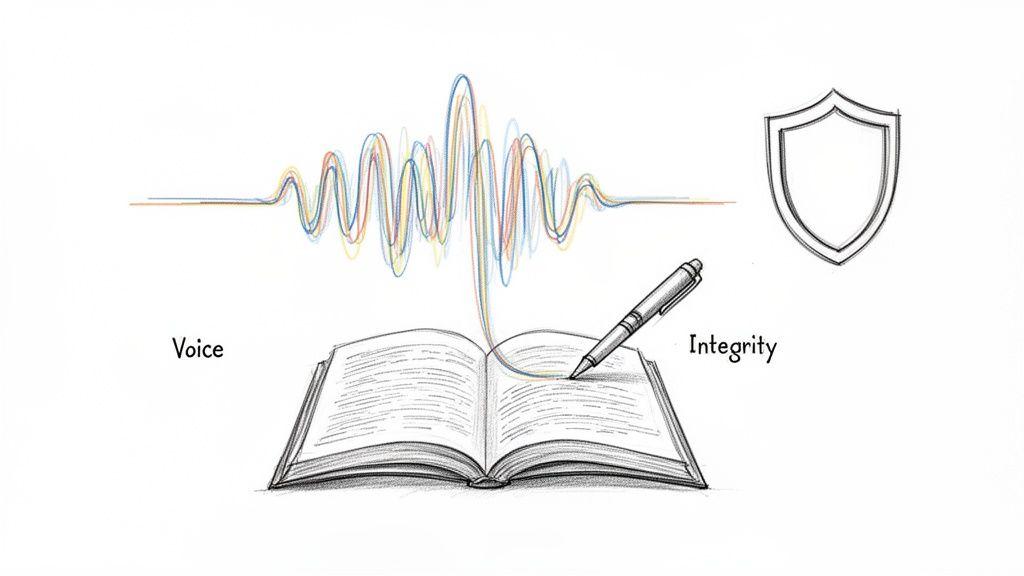
Let's talk about the elephant in the room. When you use a plagiarism checker and rewriter, are you sacrificing what makes your writing yours? Will your work come out sounding like a generic, personality-free robot wrote it? It's a fair question.
The good news is that modern tools are designed to be partners, not replacements. The trick is to see the AI's first draft as just that—a suggestion. It's not the final word. Your unique perspective, analysis, and tone are what give any piece of content its real value. To get a better handle on this, it's worth exploring what makes up your unique authorial voice so you know what you need to protect.
An AI rewriter should amplify your expertise, not mask it. The final word—and the unique style—always belongs to the human writer. Think of it as a tool to overcome a block or find a new angle on a sentence you've stared at for too long.
How to Guide the AI to Match Your Style
The best rewriters give you a surprising amount of control. Don't just paste your text, hit "rewrite," and hope for the best. Take a minute to play with the settings and see what fits the task at hand.
Here's how I typically approach it:
- For Conversational Content: If I'm writing a blog post or email, I'll often use a "Natural" or "Simple" mode. It's great for breaking down complicated jargon into language anyone can understand.
- For Formal Documents: When it's a report or an academic paper, switching to a "Formal" or "Academic" setting is a must. This keeps the sophisticated vocabulary and complex sentence structures appropriate for that audience.
- For Finer Control: Many tools let you dial the intensity up or down. I always recommend starting with a lighter touch. You might be surprised how a few small tweaks can improve flow without stripping the piece of its soul.
By actively directing the tool, you make sure the output actually sounds like something you’d write. It becomes a powerful extension of your own process, not a replacement for it.
Upholding Ethical Standards in Your Work
For students and researchers, the line between helpful tool and academic misconduct can feel razor-thin. And the stakes are incredibly high. Plagiarism checkers are a non-negotiable part of academia; platforms like Turnitin scan over 200 million papers annually, with roughly 15% getting flagged for potential plagiarism.
The goal is to use these tools to enhance your work, not to cheat. Here are the hard-and-fast rules you can't ignore:
- Cite Everything. A rewriter helps you paraphrase, but it doesn't change the origin of an idea. You still have to give credit where credit is due. No exceptions.
- Fact-Check Relentlessly. AI can get things wrong. It might misinterpret context or even invent a "fact" during the rewriting process. You are the final editor, and you're responsible for verifying every claim.
- Use it for Clarity, Not Deception. The only ethical reason to use a rewriter is to improve the flow of your own arguments or to correctly rephrase source material you are properly citing. Using it to pass off someone else's work as your own is, and always will be, plagiarism.
When you use a plagiarism checker and rewriter the right way, it’s a powerful asset for strengthening your academic integrity, not undermining it. It can genuinely help you become a better paraphraser and present your research with more confidence and originality.
Answering Your Top Questions
When you start using tools as powerful as a plagiarism checker and rewriter, questions are bound to come up. It's smart to be curious. Let's get some of the most common uncertainties cleared up so you can work with confidence.
Is Using an AI Rewriter a Form of Cheating?
This is the big one, and the honest answer really comes down to how you use it. If you’re just feeding in someone else’s work and trying to pass it off as your own, that's absolutely plagiarism. No gray area there.
But that's not what these tools are for. Think of them as a smart assistant. Using a rewriter to polish your own sentences, untangle a complex paragraph you’ve already written, or find a better way to phrase an idea you plan to cite is perfectly legitimate. It’s all about your intent.
The real question is: are you trying to improve your own work or steal someone else's? If your goal is to enhance your writing and you're still giving credit where it's due, you're on the right side of the line. Deception is where it becomes academic or professional misconduct.
Will a Rewriter Make My Writing Sound Robotic?
The old-school "article spinners" definitely earned that reputation—they were famous for spitting out awkward, nonsensical sentences. Thankfully, we've come a long way since then.
Modern AI rewriters are much more sophisticated. The good ones give you different modes to choose from, like Natural, Formal, or Academic, so the output actually fits the context. The key is to never just copy and paste the result. Treat the AI’s suggestion as a new first draft. Your job is to then read it over, make those small but essential tweaks, and inject your own voice back into it. That final human touch is non-negotiable.
Should I Bother with a Paid Tool, or is a Free One Good Enough?
I get it, free is tempting for a quick check. But for anything that really matters, free tools come with some serious baggage. Their plagiarism databases are often much smaller, their detection isn't as sharp, and many have questionable data privacy policies—you don't know who's seeing your work.
For any professional content, academic papers, or important SEO articles, investing in a paid tool is the only way to go. You get what you pay for: massive databases for more accurate checks, smarter rewriting features, better security, and actual customer support. It’s about peace of mind and knowing your work is truly up to standard.
The best tools are also constantly getting better. For instance, Rewritify has developed undetectable modes specifically to keep pace with AI detectors. They also address the massive data privacy issue—a concern for 75% of users—with a strict no-storage policy. As innovators like Copyleaks and Quetext push the market forward, having access to these advanced features is what turns a potential headache into polished, original content that sails through every check, a trend noted in market analysis from Valuates Reports.
Ready to create original, high-quality content with confidence? Rewritify offers advanced rewriting modes and a commitment to privacy, helping you enhance your writing while maintaining your unique voice. Discover how Rewritify can transform your writing workflow today!
Relevant articles

Learn how to humanize AI generated text with proven strategies. Move beyond robotic writing to create authentic, engaging content that connects with readers.
Are AI detectors accurate? This guide unpacks the data, revealing why 99% claims are misleading and how to navigate the risks of false positives in your work.
Looking to rewrite my essay for free? Discover 12 top tools and methods for improving clarity, originality, and flow without spending a dime.
Learn how to check for plagiarism with confidence. Our guide covers the best tools, manual techniques, and a clear workflow to ensure your content is original.
Discover how a powerful AI text enhancer can elevate your writing. Learn to improve clarity, refine your tone, and boost productivity with practical tips.
Asking 'does undetectable AI work?' This guide reveals real test data on bypassing AI detectors. See if you can actually fool systems like Turnitin and Google.